









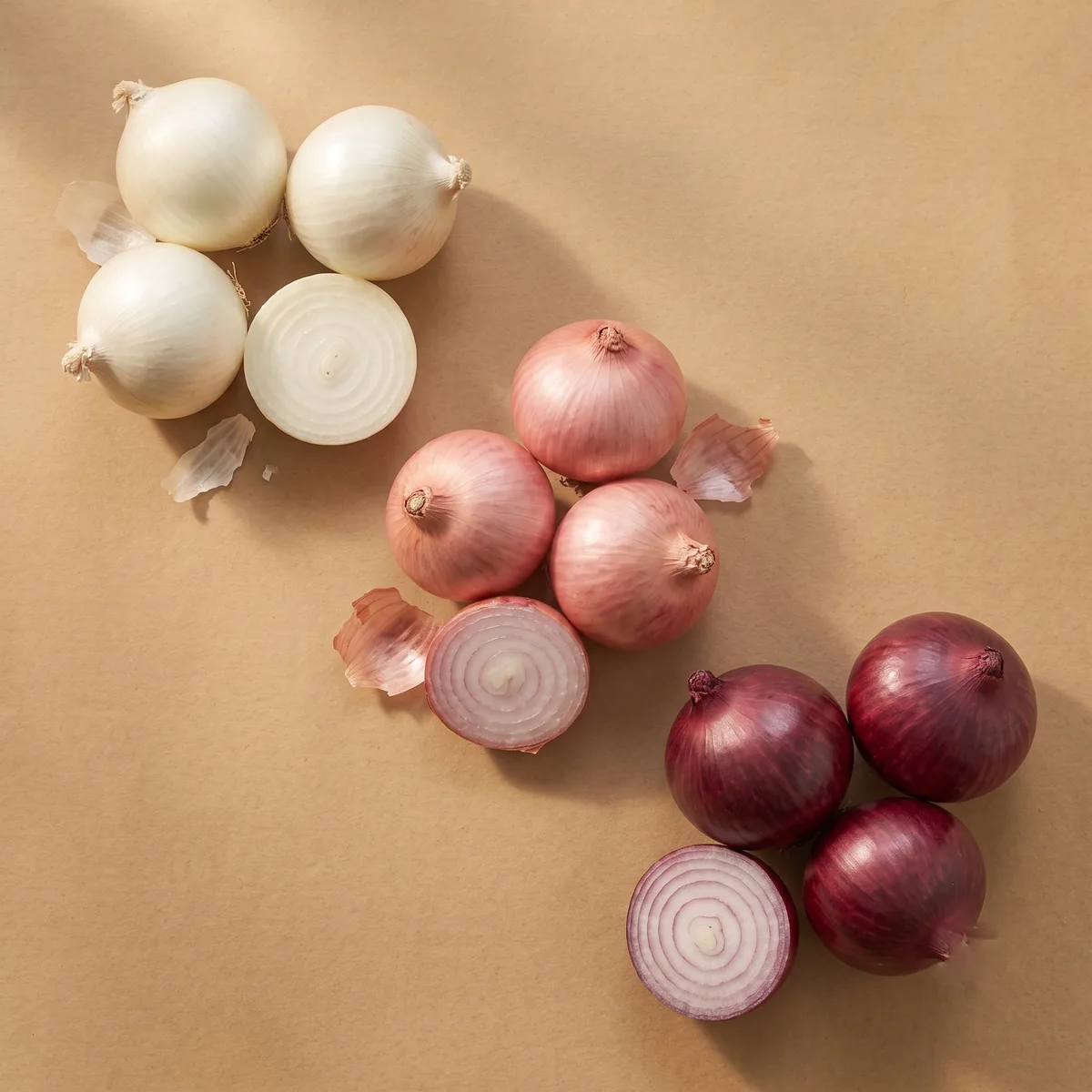

FRESH · SIZE-GRADED · MESH BAGS
Fresh White Onion
Fresh white onions for markets preferring mild flavour and white skin. Size-graded and containerised to order, seasonal availability confirmed at inquiry.
View details for fresh white onionCategory · Fresh onion
Fresh onion is where the dehydrated product starts: the same growing belt, the same farmers, the same curing sheds. We ship white, red and pink onions cured, size-graded to your band, in mesh or jute bags, in ventilated or reefer containers from Pipavav and Mundra.
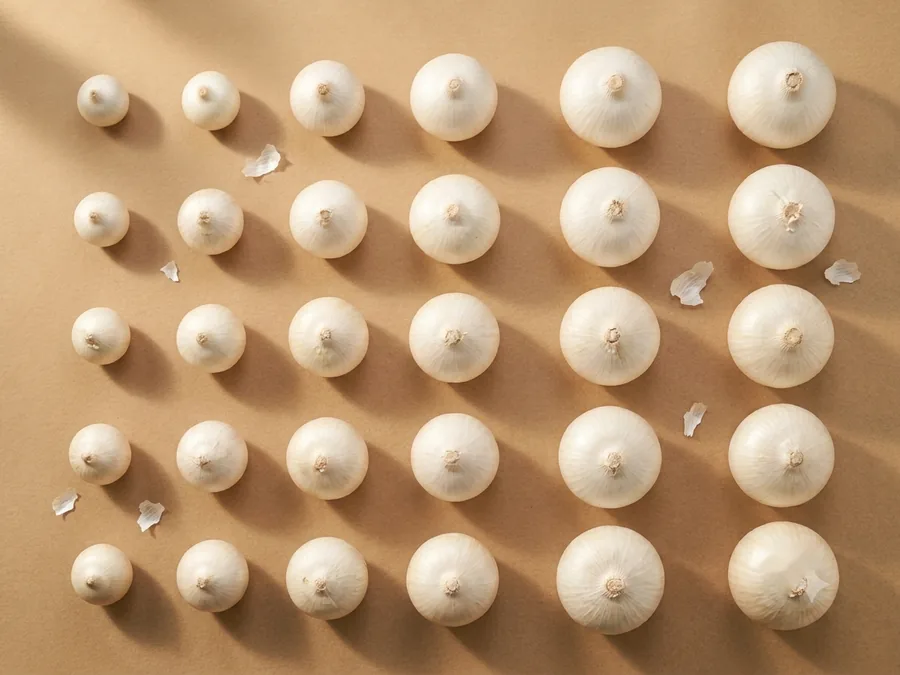
Grades 25-40, 40-60, 50-70, 60-80 and 70 mm+ - one band per lot, with the usual tolerance of about 5 % of bulbs outside it. 5, 10, 20 and 25 kg mesh bags, printable with your label. HS code 0703 10.
Fresh onion ships FCL only: about 12-14 t in a 20-ft container, 26-28 t in a 40-ft. There is no sensible LCL option for a cargo that needs its own ventilation setting.
Grade bands
One band per lot, screened to order, with about 5 % tolerance outside the stated band. Pick by end use - 40-60 mm is the volume grade.
Grade bands are screened to order; about 5 % of bulbs fall outside the stated band.
Products
Cured, size-graded and packed to your grade specification. Fresh onion ships FCL; grades, packing and the seasonal window are confirmed in every quotation.
FRESH · SIZE-GRADED · MESH BAGS
Fresh white onions for markets preferring mild flavour and white skin. Size-graded and containerised to order, seasonal availability confirmed at inquiry.
View details for fresh white onion
FRESH · SIZE-GRADED · MESH BAGS
Export-grade red onions with deep red-purple skins from Gujarat and Maharashtra growing regions. Size-graded, cured, packed in mesh bags and containerised for sea freight.
View details for fresh red onion
FRESH · SIZE-GRADED · MESH BAGS
Light pink-skinned onions with a milder profile - preferred in Gulf and Southeast Asian markets. Size-graded and cured, seasonal windows confirmed at inquiry.
View details for fresh pink onion3
Varieties
White, red, pink
5
Grade bands
25-40 mm to 70 mm+
12-14t
Per 20-ft
26-28 t per 40-ft
FCL
Only
No LCL for a living cargo
Why fresh
India harvests onion three times a year and exports it from the same belt our dehydrated range comes from - four reasons a fresh programme starts here.
Rabi, kharif and late kharif - the country ships for most of the calendar, with the storable rabi crop as the backbone.
Necks dried down and skins set before packing - curing is what lets a living cargo survive weeks in a container.
White, red and pink from the same growing region, one specification format and one loading point.
Fresh and dehydrated from the same exporter - one audit and one contact for a mixed purchasing programme.
Seasons
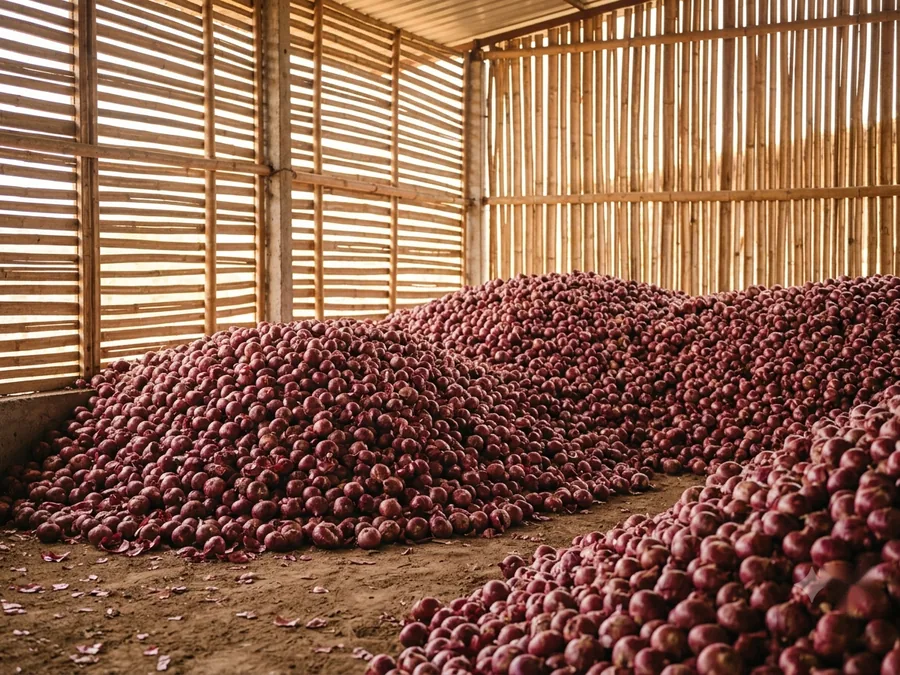
India harvests onion three times a year, which is why it can export for most of the calendar:
| Crop | Harvest | Ships |
|---|---|---|
| Rabi (main) | February - April | March to roughly November, from cured storage |
| Kharif | October - December | October - January, fresh, shorter storage life |
| Late kharif | January - February | January - March |
The storable rabi crop is the backbone of the export programme; kharif onion moves best on short sailings. Pink onion follows the Gujarat rabi window in a narrower band. We confirm the window and the crop condition in every quotation.
The product
What the range is, where it comes from and what it means for your specification.
Fresh onion for export is Allium cepa lifted, field-cured until the necks tighten and the skins set, topped and cleaned, screened into a diameter band and packed in mesh or jute bags for a ventilated container. India grows it three times a year - the storable rabi crop harvested February to April, the kharif crop from October to December and the late kharif in January and February - which is why an Indian fresh onion exporter can ship for most of the calendar.
Three varieties leave our belt: white onion with white skin and flesh and the highest dry matter, the everyday deep-red onion of the Gulf and Southeast Asian trade, and the milder pink onion of Gujarat. All three are sold by bulb diameter, one band per lot, and all three are a living cargo: arrival condition depends on the curing, the transit time and the weather at both ends, which is why we say what the crop can do before it goes into a contract.
Overview
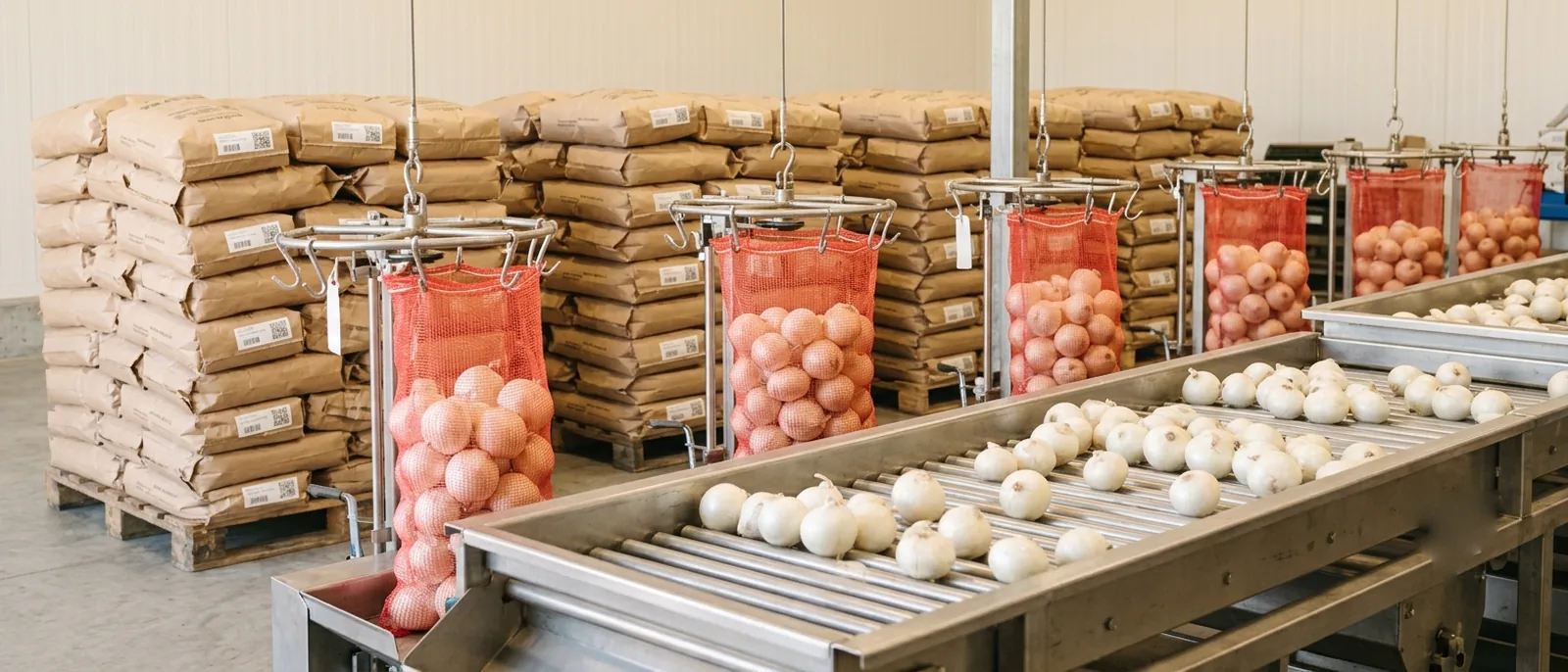
KlarHarvest fresh onion comes from growers in Gujarat's Bhavnagar-Mahuva belt and, in the kharif seasons, from Maharashtra's Nashik belt, field- and shed-cured and held in ventilated stores. Bulbs are topped, cleaned, screened to your grade band and packed in 5-25 kg mesh bags, plain or printed with your label; every bag is counted and weighed, and the loading is photographed and filmed before the container is sealed at our premises.
We are the same fresh onion exporter that supplies the dehydrated range from this belt: one audit, one contact and one loading point for a programme that buys both. Fresh onion from KlarHarvest is quoted FOB, CFR or CIF with the season window, the grade and the packing in one document, inside one business day - and with a straight answer when a sailing is too long for the crop in hand.
Growing and packing
Eight steps from the field to a strapped pallet in a ventilated container. Where a defect can enter the product, the step says so.
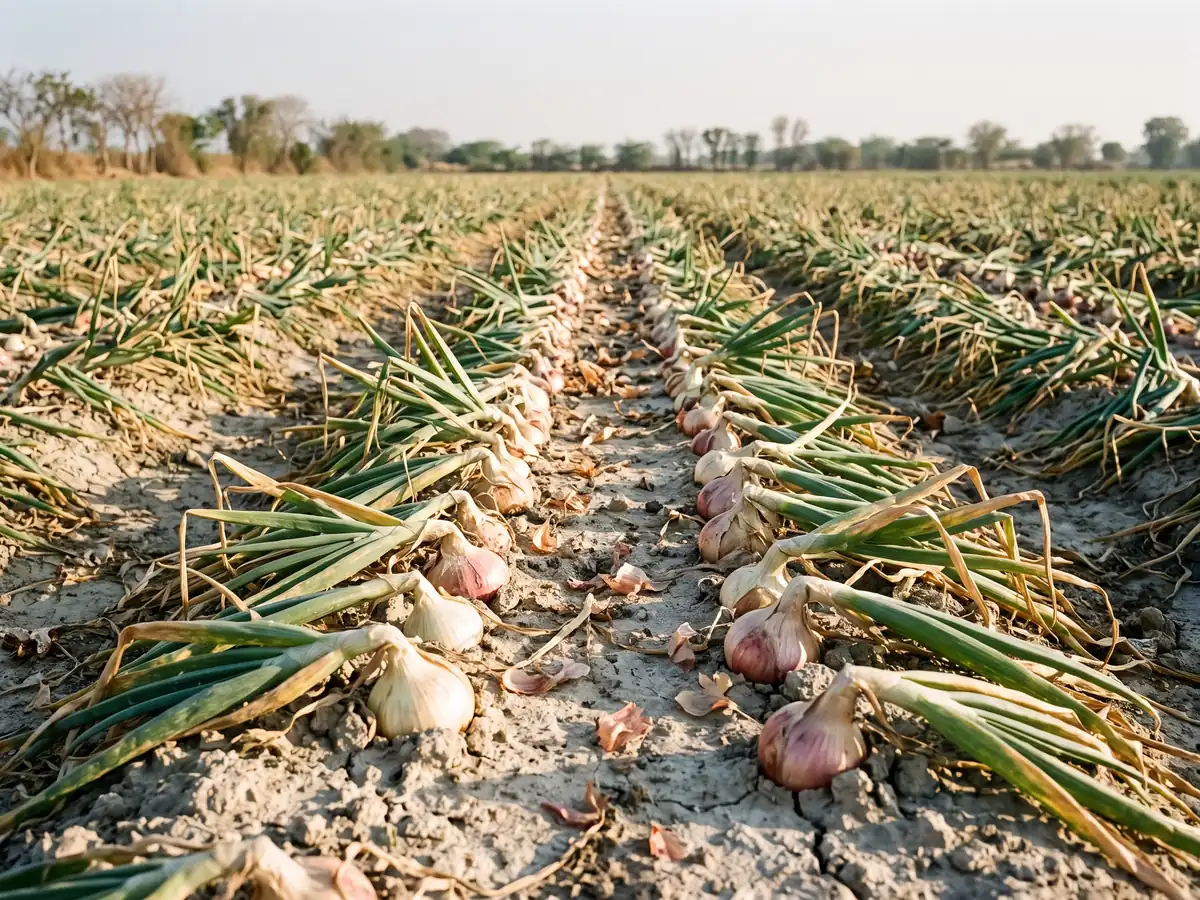
The rabi crop goes in during November and December and is lifted February to April; kharif onion is planted with the monsoon and lifted October to December; the late kharif follows in January and February. The signal to lift is the same every time - the tops fall.
Bulbs lie in windrows under their own tops for several days until the necks close and the skins dry; the rabi crop cures hardest, kharif onion least.
Ventilated sheds stacked for airflow hold the rabi crop for months and the kharif crop for weeks - which crop is in the box decides how long it will keep.
Tops and roots cut, loose skin and soil brushed away, without stripping the outer skin the buyer pays for.
A screening deck drops each bulb into its diameter band; sprouted, split, double and damaged bulbs are picked off the belt by hand.
Mesh bags filled to their net weight, closed, and labelled with grade, lot and your mark.
Palletised and strapped or stowed loose to your instruction, counted and weighed, filmed as they go into a ventilated or reefer container at our premises.
Phytosanitary inspection, export documents, customs seal - and the seal number in your order record before the truck leaves for Pipavav or Mundra.
Data sheet
The three varieties share one packing and shipping standard and differ in colour, flavour and season. Each product page carries the full table.
| Parameter | Fresh white onion | Fresh red onion | Fresh pink onion |
|---|---|---|---|
| Skin / flesh | White to pale straw skin; white flesh | Deep red-purple skin; pale flesh, purple-edged rings | Pale rose skin; near-white flesh, faint pink edge |
| Flavour | Mild to medium | Firmly pungent, sweet finish | About half the pungency of red, sweetest of the three |
| Grades | 25-40 to 70 mm+ | 25-40 to 70 mm+ | 25-40 to 60-80 mm |
| Season | Rabi Feb-Apr; ships into the second half of the year | Rabi, kharif and late kharif - almost all year | Follows the Gujarat rabi window; scheduled runs |
| Growing region | Bhavnagar-Mahuva, Gujarat | Gujarat and Nashik, Maharashtra | Gujarat |
| Packing | 5 / 10 / 20 / 25 kg mesh bags; jute on request | 5 / 10 / 20 / 25 kg mesh bags; jute on request | 5 / 10 / 20 / 25 kg mesh bags; jute on request |
| Container | ~12-14 t / 20 ft · 26-28 t / 40 ft, ventilated | ~12-14 t / 20 ft · 26-28 t / 40 ft, ventilated | ~12-14 t / 20 ft · 26-28 t / 40 ft, ventilated or reefer |
| Terms | FCL only - FOB, CFR, CIF | FCL only - FOB, CFR, CIF | FCL only - FOB, CFR, CIF |
| HS code | 0703 10 | 0703 10 | 0703 10 |
Grade bands
Bulb diameter as a screened band and the tolerances that go with it - what a fresh onion grade actually promises.
Fresh onion is sold by bulb diameter, and the grade band decides price, packing and end use. A band is a screening result, not a promise that every bulb is identical: the normal export tolerance is about 5 % of bulbs outside the stated band, and a tighter band costs more because screening it out of a natural crop leaves more behind.
Small
pickling grade
mm25-40
Firm, single-centre bulbs, dry papery skin
Pickling, whole-onion canning
Medium
export grade
mm40-60
The volume grade: uniform bulbs, dry neck, clean skin
Foodservice, wholesale, retail nets
Medium-large
mm50-70
Fuller bulbs, uniform skin colour
Foodservice, cut-and-pack, retail
Large
mm60-80
Big single bulbs, firm, well cured
Retail loose display, processors buying by the bulb
Extra large
mm70+
Widest bulbs of the crop; screened to order
Ring cutting, slicing lines
Defect limits · per 100 g on the sorted product
Your specification for fresh onion can set a tighter band or tolerance; it is agreed at order stage against the crop in hand and confirmed on the packing list.
Applications
The uses this variety is specified for most often. Tell us yours and we will say whether it is the right one.
Full-container programmes of fresh onion in mesh bags, two weeks from Pipavav, for wholesale markets and catering suppliers.
Cured, sound bulbs in a screened band, sized for the net or the loose display, with the skin colour each market expects.
A uniform band means less trimming waste on the peeling line; white flesh for the pale packs, red for the salad packs.
Dicing, pickling and paste lines buy fresh bulbs by the container when the recipe or the label needs fresh onion, not dried.
The small band goes whole into pickle jars and cans; graded by diameter so every jar fills evenly.
Large bulbs give full rings and long slices with less waste for onion-ring, fried-onion and slicing lines.
Packaging & export
Fresh onion is a living cargo: what arrives depends on the curing, the airflow and the sailing time more than on anything written on the packing list. This is how a container of it leaves.
25kg
Per mesh bag
5, 10 and 20 kg on request
40
Bags per pallet
1,000 kg net; loose stow on request
12-14t
Per 20 ft ventilated
Bags counted and weighed
26-28t
Per 40 ft
Reefer 0-2 C on long sailings
How a lot ships
Bag, pallet, container, protection, route and documents - the things a packing instruction has to say.
Export markets
The same lot, a different document set. Where our containers go and what each destination asks for.
The biggest buyer of Indian fresh onion by far - wholesale, foodservice and retail - two weeks out of Pipavav, Arabic labelling on request, phytosanitary certificate at every port. Jebel Ali, Dammam, Sohar.
Exporting to the GulfMalaysia, Singapore, Vietnam and Sri Lanka take all three varieties from this corridor; ventilated on the short sailings, reefer on the longer ones.
Exporting to Southeast AsiaCustoms code 0703 10; entry through TRACES with a phytosanitary certificate to EU requirements, reefer recommended for the four-to-five-week sailing. Hamburg, Rotterdam, Antwerp.
Exporting to GermanyUK Global Tariff line 0703 10, IPAFFS pre-notification and the phytosanitary certificate; Felixstowe and Southampton.
Exporting to the UKWhatever USDA APHIS and CFIA require for Indian onion in the season in question - confirmed before you commit, not after.
Exporting to the USA and CanadaName the destination; the quotation for fresh onion confirms its plant-health requirements, the document set and the lead time.
Ask about your marketQuality
What is certified, what is tested, and what is still in process - stated as it is today.
Every lot of fresh onion is field- and shed-cured until necks are tight and skins set, and the offer says which crop it is - an uncured bulb does not survive a container.
India's National Plant Protection Organisation inspects and certifies each shipment against the importing country's requirements before it is sealed.
Pesticide residue analysis per EU Regulation 396/2005 by an NABL-accredited laboratory, arranged before loading where the market or the customer asks for it.
A lot code on every bag links to the growing region, the harvest and the packhouse; loading photographs and video sit in the same record.
Counted, weighed, photographed, sample cut, seal number recorded - by us, at our premises, before the truck leaves.
APEDA registration and FSSAI licence in process; numbers published on this page the day they are issued.
Why KlarHarvest
Six things you can check before the first order, not after.
Which crop, what colour, what band it screens to and how much of it exists - before the contract, not after the claim.
Variety, grade, price, freight, transport recommendation and season window in one document.
Indian onion prices move fast and export measures land at short notice; our quotes carry a short validity and the contract states what happens in between.
Bags counted into the container on video, the seal number, the box followed to your port.
Fresh and dehydrated onion from the same exporter in the same belt - one audit, one contact.
Crop photographs, loading video, status and every document behind one link.
FAQ
What buyers ask about this range before the first order. Anything not covered here, send us the question - you have an answer within one business day.
White for a pale, mild onion and the longest storage life; red for the Gulf and Southeast Asian trade and wherever the onion should be tasted and seen; pink for colour without the bite, in raw applications. Photographs of the current crop come with every offer.
One container - about 12-14 t in a 20 ft ventilated box, 26-28 t in a 40 ft. There is no LCL option for a living cargo.
Almost all year for red: rabi February to April from cured storage until about November, kharif October to January, late kharif January to March. White follows the rabi window; pink ships in scheduled runs. Every quotation confirms the window.
Ventilated dry containers on sailings up to about three weeks; reefer at 0-2 °C with fresh-air exchange on longer or warm-season sailings, and on most pink onion sailings. We recommend one for your route.
40-60 mm is the volume export grade; 25-40 for pickling; 50-70 for foodservice and cut-and-pack; 60 mm and above for slicing lines and loose display. We say which band the current crop screens best.
The contract says so in advance: what is refunded, what is shipped at the new duty, and who decides. Our quotes carry a short validity for the same reason.
Yes - that is the point of the range. One audit, one contact and one loading point in the belt where both are produced.
Straight answer
Dehydrated onion is tested in a laboratory before it ships. Fresh onion is a living product whose arrival depends on the crop, the curing, the transit time and the weather at both ends - nobody can promise that the way a certificate of analysis promises a dried lot. What we do promise: the grade you specified, bags counted and weighed, a loading video, and a straight answer when a sailing is too long for the crop in hand.
India also manages onion exports actively - minimum export prices, duties and, in some years, restrictions at short notice. Our quotes carry a short validity and the contract says in advance what happens if a measure lands between confirmation and loading.
At the packhouse
Start here
Product, cut size, quantity, destination port - that's all we need to start. You'll receive a written quotation with full specifications from a dehydrated onion exporter, not a one-line price.
info@klarharvest.com · WhatsApp +91 97371 01599 · Bhavnagar, Gujarat, India
Samples
200-500 g per product from a current lot, dispatched by courier with the specification sheet and the sample lot's lab report.
A complete written quotation - specification sheet, price with freight shown separately, and lead time - within one business day.
The complete specification sheet as a PDF - cut size and sieve range, moisture, microbiology tiers, packing options and container loads - sent to your e-mail within one business day.
Thank you - your sample request is in. You'll have our written reply with dispatch details within one business day, and the parcel ships by courier with the specification sheet and the lot's lab report.
Thank you - your inquiry is in. You'll have a complete written quotation - specification sheet, price with freight shown separately, and lead time - within one business day.
Thank you - the specification sheet is on its way. You'll have the PDF in your inbox within one business day.