


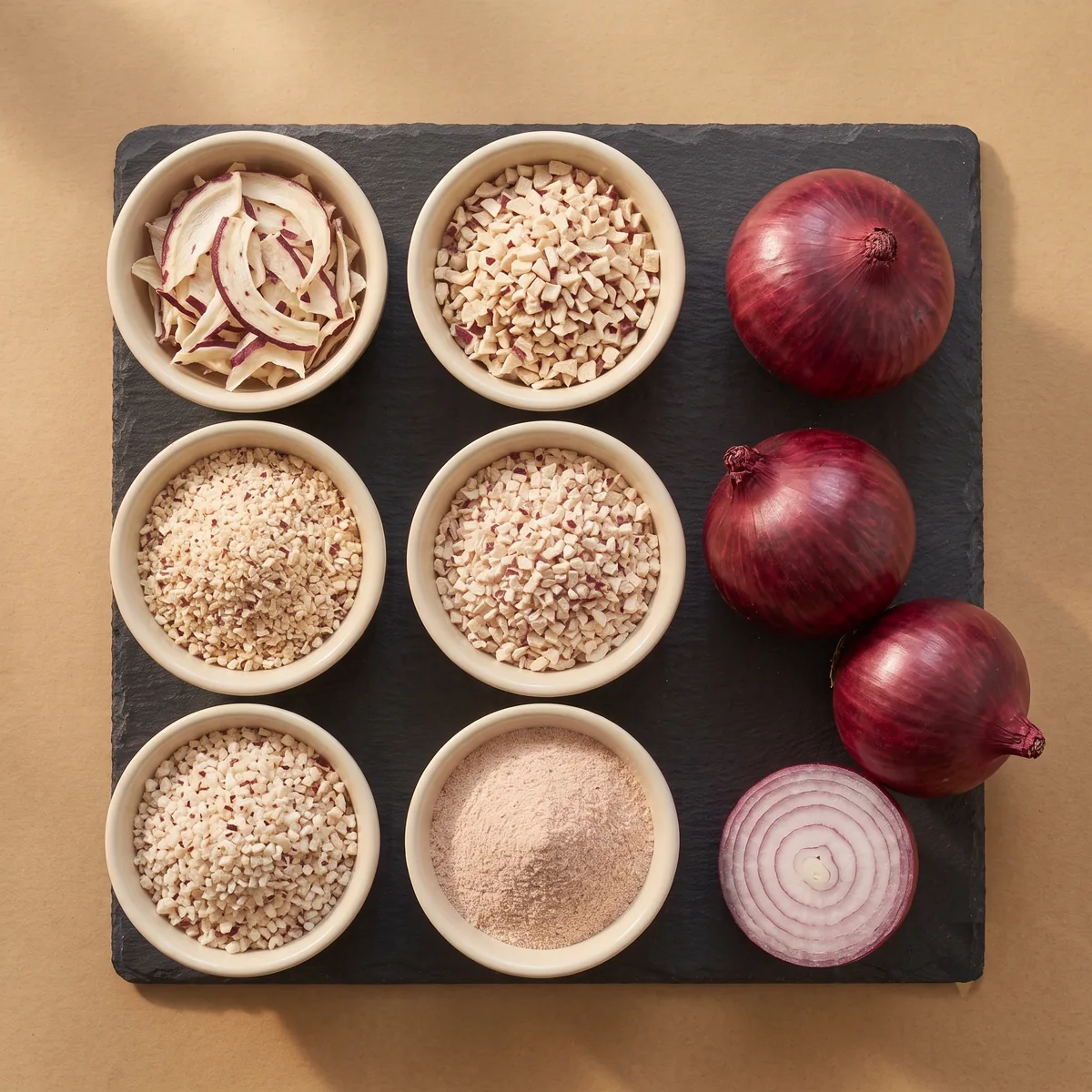

FLAKES · 8-20 MM
Red Onion Flakes (Kibbled)
Pink-red dried pieces with a sharper flavour profile - preferred where colour should be visible in the final dish.
View details for red onion flakes (kibbled)Category · Dehydrated red onion
Red onions bring more pungency and a slightly sweet note - and the reddish skin stays visible after drying. In India they are the everyday onion; in Europe they are chosen where recipes need character: ethnic food, marinades, chutneys, snack toppings, curry blends.
Processed like our white onions: BRC-certified partner plants in Mahuva, moisture ≤ 6 %, no additives, lab report per lot.
Pink onions: milder than red, stronger than white - available on request in all five cut sizes.
Cut sizes
Same onion, same line, same lab report - five particle sizes, and the burgundy skin flecks carry through every one. Pick by visibility and rehydration speed.
Drawn to relative scale. The larger the cut, the more visible the onion in the finished product; the finer the cut, the faster it rehydrates.
Products
Red onion in the same five cuts as white. Colour and pungency carry through every one of them; specify a colour range rather than a fixed shade.
FLAKES · 8-20 MM
Pink-red dried pieces with a sharper flavour profile - preferred where colour should be visible in the final dish.
View details for red onion flakes (kibbled)
CHOPPED · 3-5 MM
Red onion pieces for ethnic cuisine ranges, chutneys, curry bases and dry mixes.
View details for red onion chopped
MINCED · 1-3 MM
Fine cut combining red onion colour with quick rehydration for pastes and sauces.
View details for red onion minced
GRANULES · 0.5-1 MM
Free-flowing granules for blends where red onion character is specified.
View details for red onion granules
POWDER · 100 MESH
Fine red onion powder for seasonings, snack coatings and ready-mix formulations.
View details for red onion powder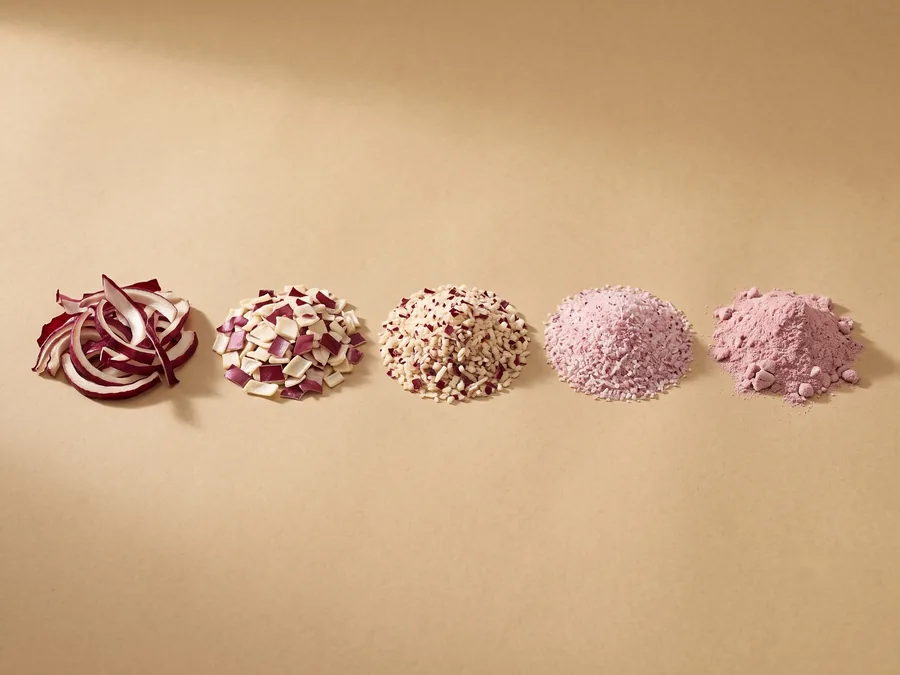
CUSTOM · 8-20 MM TO 100 MESH
We run every cut from 8-20 mm flakes down to 100 mesh powder, and match granulation to your specification at order stage.
Ask us5
Cut sizes
Flakes to powder
6%
Moisture, max
Tested per lot
12
Months shelf life
Unopened, cool and dry
0
Additives
No SO2, no preservatives
Why red
Red onion carries more sulphur compounds and a layer of skin pigment - which is exactly what some recipes are missing.
Burgundy flecks on a bowl, a flatbread or a snack say "onion" before the first bite.
Curry bases, chutneys, sambals and pickles built on red onion taste authentic; white reads flat in these recipes.
A mild sweetness balances the pungency - useful in dressings and relishes.
Pigment depth varies naturally by variety and season - a range holds lot after lot; a fixed shade does not.
Choosing
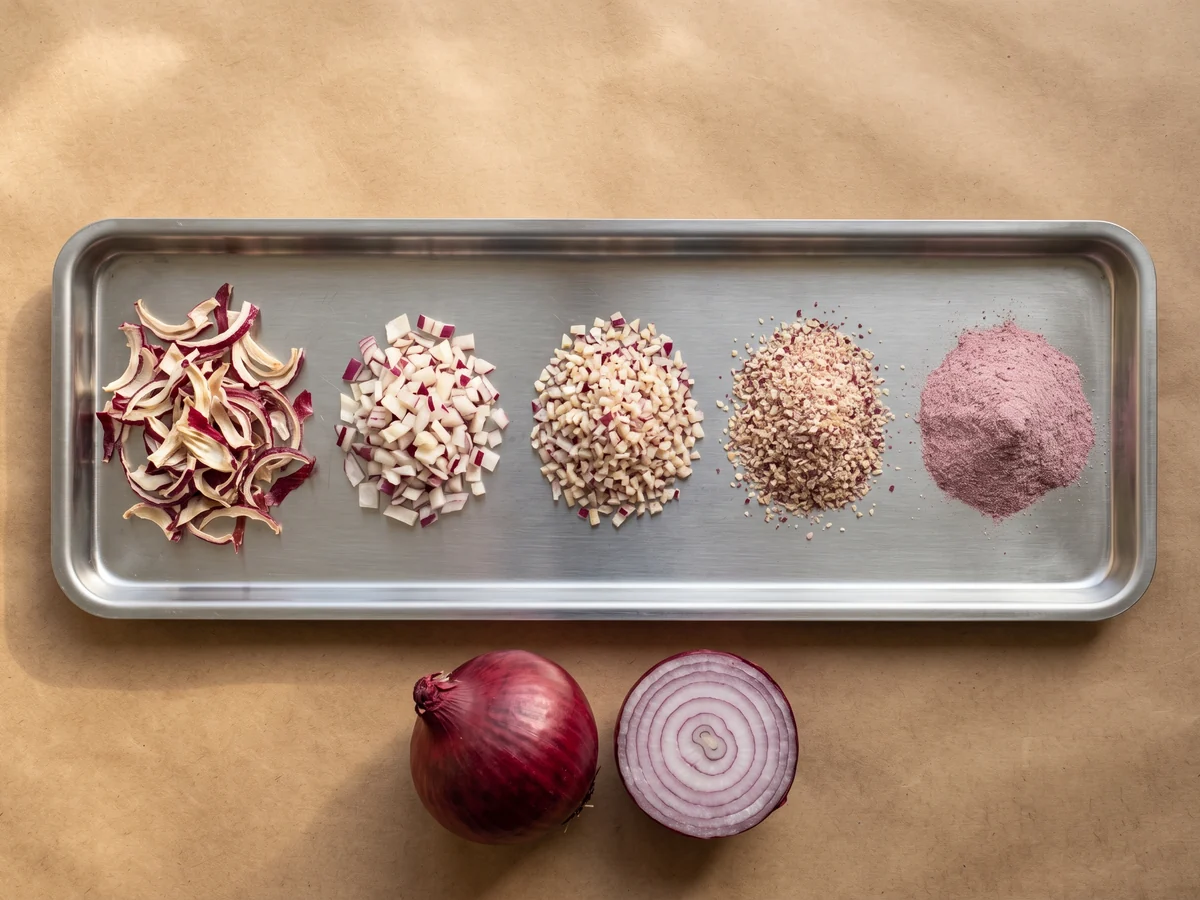
The larger the cut, the more visible the burgundy skin flecks in the end product - the finer, the faster the rehydration (flakes 15-20 min, powder instant). The color carries through all five sizes; so does the stronger flavor. Unsure? We'll send samples of two or three cuts for direct comparison.
The product
What the range is, where it comes from and what it means for your specification.
Dehydrated red onion is red onion sliced, dried on a belt dryer to about 6 % moisture and then sieved, broken or milled into one of five size bands: flakes of 8-20 mm, chopped 3-5 mm, minced 1-3 mm, granules 0.5-1 mm and powder of 80-100 mesh. Nothing is added: the flavour is the onion's own sulphur compounds and sugars, sharper and slightly sweeter than white, and the colour is pale pink flesh flecked with burgundy skin. The pigment sits in the skin, so the coarse cuts show it as flecks and the fine cuts as a lilac-pink tone.
Buyers specify dehydrated red onion where the onion should be tasted and seen: curry bases, chutneys, sambals and pickles, snack and flatbread toppings, marinades and dressings. White onion reads flat in those recipes. Colour depth varies by variety and season, which is why a specification should carry a colour range rather than a fixed shade.
Overview
KlarHarvest dehydrated red onion comes from red onions grown in the Mahuva belt of Gujarat, harvested from March to May and dried within the season at BRCGS-certified plants. Every cut is sieved to its band, dried to 6 % moisture or less, colour-sorted and packed with nothing added: no sulphites, no preservatives, no colour, no anti-caking agent unless you specify one for granules or powder. Each lot is tested by an NABL-accredited laboratory before it is loaded, and the report travels with the goods.
We are a merchant exporter, not a plant: we select the unit, specify the lot, have it filled and sealed inside the certified plant, and ship it under our own label from Pipavav port. That is why dehydrated red onion from KlarHarvest can be ordered from a single pallet, mixed across cuts or with white onion on the same pallet, and quoted with the full document set inside one business day. Pink onion is dried on request in the same five cuts.
Manufacturing process
Eight steps from a cured bulb to a sealed, lot-coded bag. Where a defect can enter the product, the step says so.
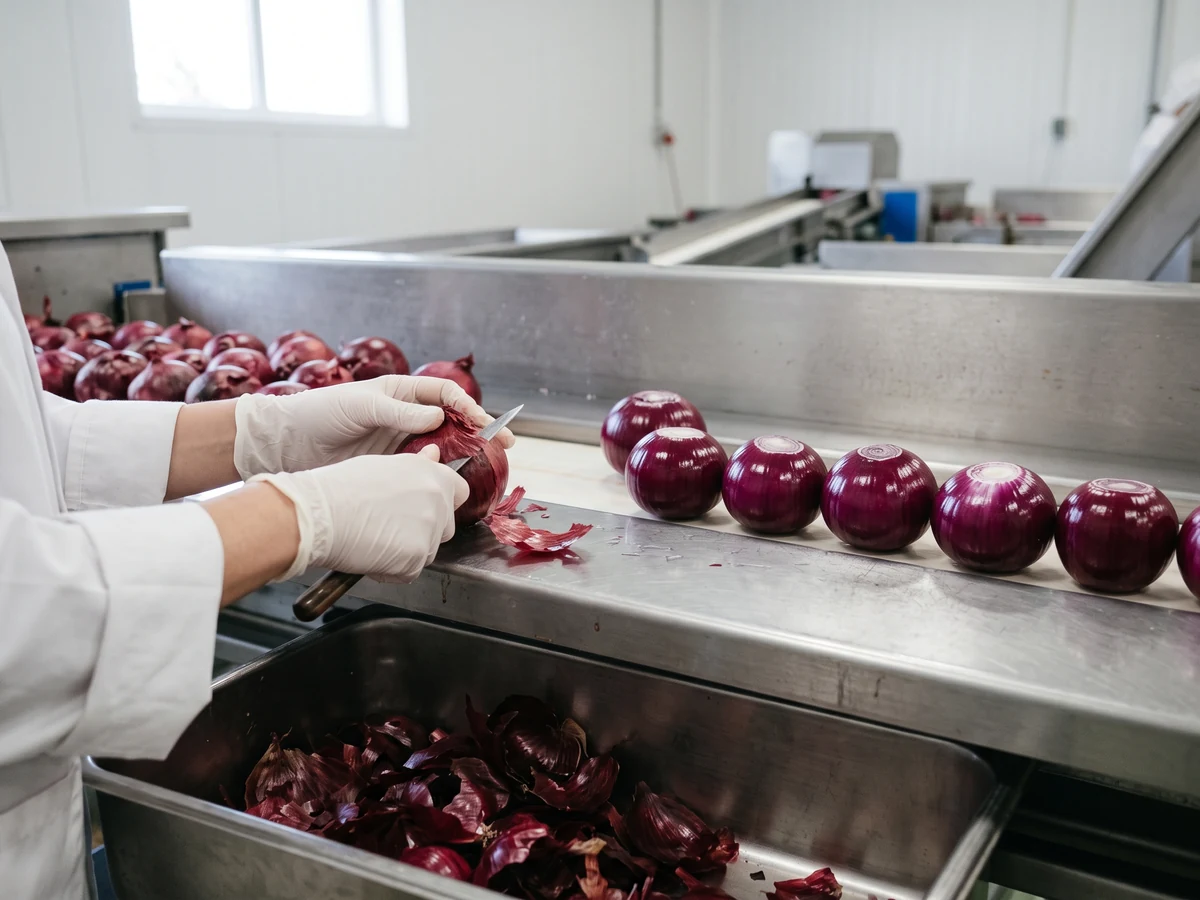
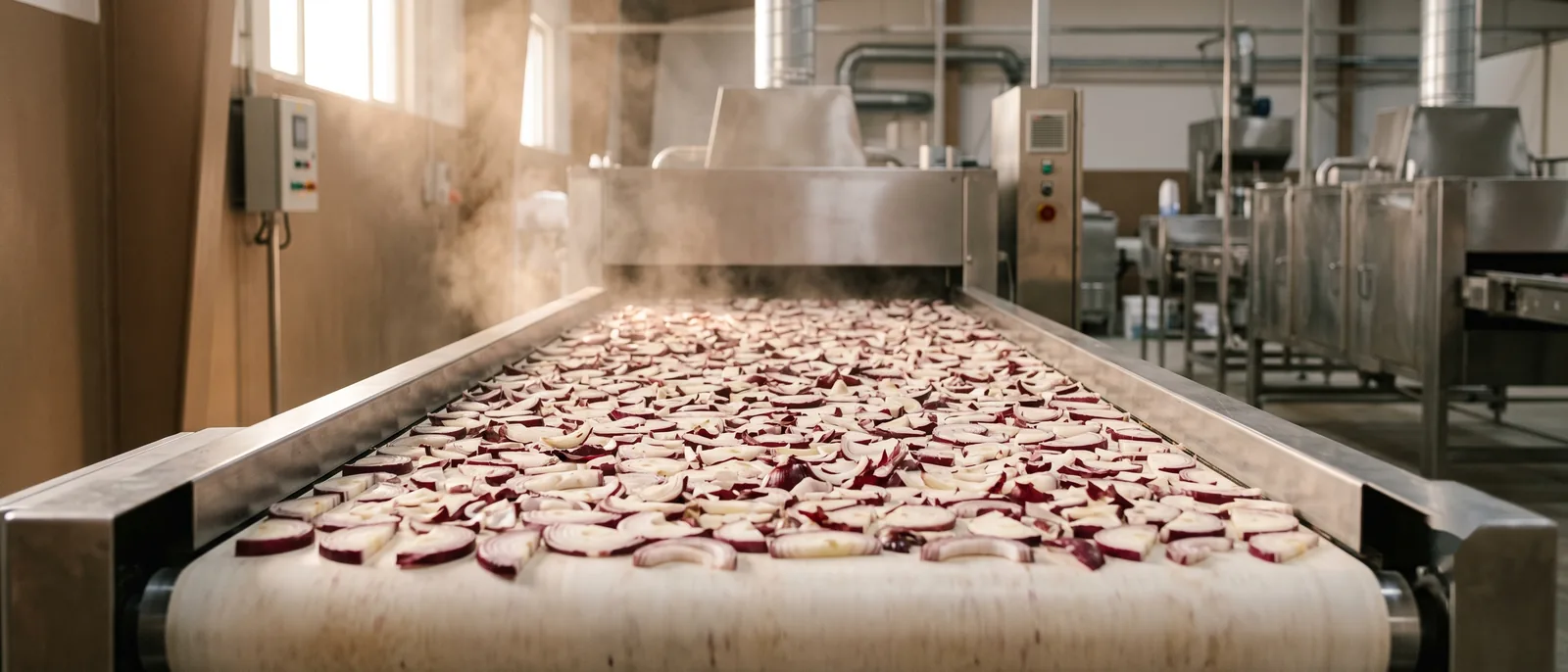
Red onions from the Mahuva belt, lifted between March and May, arrive cured, are graded by size and stored with air moving through the heap. Roughly 8-9 kg of them become 1 kg of dehydrated red onion.
Tops and roots are cut and the loose papery skin removed, but the pigmented inner skin stays on - it is the burgundy in the finished product.
Chlorinated wash water, then a picking belt for bruised and off-colour bulbs.
The slicer sets the thickness for the cut; no sulphite dip, no colour added at any point.
Red onion browns more easily than white, so the multi-stage belt dryer runs a milder temperature profile, still reaching 5-6 % moisture.
Cooled slices are sieved into flakes or milled into chopped, minced, granules and powder; optical sorters take out browned pieces, magnets and sifters run ahead of packing.
A validated steam step and a second drying for the lower-count tiers; Standard tier skips it.
Every bag is metal-detected, sealed with lot code and QR, and held until the laboratory report - with the colour reading - is issued and you have released the lot.
Data sheet
The five cuts of dehydrated red onion share one quality line - moisture ≤ 6 %, foreign matter ≤ 1 %, ash ≤ 4 %, no additives, HS code 0712 20 - and differ in size, rehydration and how they stow. Each product page carries the full table.
| Cut | Size | Rehydration | 20 ft container (est.) | Packing | Typical use |
|---|---|---|---|---|---|
| Flakes (kibbled) | 8-20 mm | 15-20 min | ~9-10 t | 10-14 or 20/25 kg bags | Toppings, ethnic dishes, chutneys |
| Chopped | 3-5 mm | 10-15 min | ~10-12 t | 20/25 kg bags | Curry sauces, sambals, pickles |
| Minced | 1-3 mm | 5-10 min | ~11-13 t | 20/25 kg bags | Spice blends, meat products, dips |
| Granules | 0.5-1 mm | 3-5 min | ~12-13 t | 25 kg bags | Curry and tandoori blends, rubs, bouillons |
| Powder | 80-100 mesh | instant | ~12-13 t | 25 kg bags | Curry bases, marinades, snack seasoning |
Grading
Colour as a measured value and defects as a count per 100 g - the two things a grade actually means.
Colour depth is the reason a buyer specifies dehydrated red onion, and it varies by variety and season, so we quote it as a grade with a measured value, not an adjective. The bands below apply to every cut; the lot you receive carries its L* reading and defect counts on the certificate of analysis.
Deep red
dark red · A grade
L*58-64
Dense burgundy skin flecks on pale flesh, even through the lot
Deep-pigment varieties, fresh-crop lots March to May
Red
standard red
L*64-70
Clear burgundy flecks, pale pink flesh, uniform
Most export lots in season; the usual specification
Light red
pink
L*70-76
Sparse flecks, flesh reads pink rather than red
Light-skinned varieties or late-season lots; specify if wanted
Faded
L*76-82
Brownish flecks, dull flesh
Over-dried or old stock; not offered for export
Not exportedDefect limits · per 100 g on the sorted product
Your specification for dehydrated red onion can set tighter limits; they are agreed at order stage and confirmed on the certificate of analysis.
Applications
The uses this cut is specified for most often. Tell us yours and we will say whether it is the right one.
Red onion cuts bring the sweetness and colour of fried red onion to curry bases, sambals and meal kits without the frying.
Flakes and chopped red onion hold their shape and pink-red hue in vinegar, oil and lime preparations.
Red flakes show on rice bowls, naan and snack mixes; granules and powder season the coating.
Minced red onion and powder disperse in yoghurt, oil and brine and flavour tandoori marinades and dips evenly.
Granules and powder carry a warmer colour than white into curry powders, barbecue rubs and bouillon pastes.
The minced cut spreads through kofta, kebab and sausage mince and leaves visible red flecks in the product.
Packaging & export
Dehydrated red onion packs like white and stows like white: the bag and the pallet are the same across the five cuts, and only the container load moves with the density of the cut.
25kg
Per bag
Laminated kraft, double PE liner
32
Bags per Europallet
800 kg net, 4 x 8 pattern
10
Pallets per 20 ft
9-10 t net, single height
21-23t
Per 40 ft high cube
About 22 pallets
How a lot ships
Bag, pallet, container, protection, route and documents - the things a packing instruction has to say.
Export markets
The same lot, a different document set. Where our containers go and what each destination asks for.
The natural market for dehydrated red onion, where the red bulb is the everyday onion: halal certification on request, Arabic labelling for retail packs, two weeks from Pipavav. Jebel Ali and Dammam.
Exporting to the GulfThe curry-sauce and ethnic-food trade buys red onion in every cut; UK Global Tariff line 0712 20 00, IPAFFS pre-notification where it applies. Felixstowe and Southampton.
Exporting to the UKCustoms code 0712 20 00, residue limits per Regulation 396/2005, IFS and BRCGS supplier-approval questions answered with documents. Hamburg, Rotterdam, Antwerp.
Exporting to GermanyFDA-registered source plant, prior notice filed by us, and the certificate of analysis for the importer's FSVP file. New York, Savannah, Montreal.
Exporting to the USA and CanadaSingapore, Malaysia and Vietnam on the same corridor, for sambals, curry pastes and instant meals.
Exporting to Southeast AsiaTell us the port; the quotation for dehydrated red onion states the document set and the lead time to it.
Ask about your marketQuality
What is certified, what is tested, and what is still in process - stated as it is today.
Every lot of dehydrated red onion is filled and sealed inside a BRCGS-certified plant in Mahuva; nothing is opened or repacked outside it.
Pesticides to EU Regulation 396/2005, microbiology, heavy metals, physical values and the colour reading, tested by an NABL-accredited laboratory before loading; the report is with you before the container.
No sulphites, no preservatives and no added colour - the red is the onion's own skin. An anti-caking agent only on request for granules and powder, and then declared.
Lot code and QR on every bag, linking to the plant, the harvest window and that lot's laboratory report.
FSSAI licence and APEDA registration in process; numbers are published on this page the day they are issued.
Why KlarHarvest
Six things you can check before the first order, not after.
Specification, colour band, price, freight and lead time for dehydrated red onion in one document.
A pallet of red cuts, or red and white together, is an ordinary order here; LCL welcome.
Raw-material price fixed with the plant the day you confirm - the reason a quote is valid 7-10 days and not padded.
The certificate of analysis, colour reading included, exists before the container is stuffed; the box waits for your release.
Your bags on video going into the container, the seal number, the box followed to your port.
Status, photos, videos and every document behind one link.
FAQ
What buyers ask about this range before the first order. Anything not covered here, send us the question - you have an answer within one business day.
The burgundy skin flecks stay visible after rehydration; long wet cooking mutes the colour but does not remove it. Powder tints a pale product with a warm tan-to-rose cast.
Yes - more pungency and aroma, with a slightly sweet note. It is the variety to specify when the onion should be tasted and seen.
Standard red (L* 64-70) unless your specification asks for deep red. Specify a range rather than a shade; the lot reading is on the certificate of analysis.
Flakes for toppings and visible pieces, chopped for curry bases and pickles, minced for blends and meat products, granules for dosing lines, powder for curry bases and seasonings. Samples of two or three cuts on request.
One pallet - 800 to 1,000 kg depending on the cut - as LCL or as part of a mixed pallet with other cuts or with white onion.
Yes, on request, in all five cuts with minimum quantities - milder than red, stronger than white, dried at the same plants.
Yes. Send your target sieve specification and we quote against it; the band is agreed at order stage and confirmed on the COA.
The anthocyanin pigment sits in the skin layers, so flakes and chopped keep visible burgundy flecks after rehydration and cooking; powder and granules give a pink-grey tone to a blend rather than a red one. Colour also shifts with acidity - redder in a vinegar pickle, bluer in an alkaline dough - so we agree a colour range for dehydrated red onion rather than a fixed shade, and the range on the COA is measured, not judged.
Usually, yes: the red varieties grown for drying carry a higher pyruvate level, so dehydrated red onion tastes sharper and more "raw onion" than white at the same dose. For a curry base, chutney or sambal that is the point; for a mild sauce, white is the safer choice. Pyruvate is reported on request for buyers who blend to a flavour target.
The main red dehydration runs follow the kharif and late-kharif harvests from November to February and the rabi harvest from March to May; lots produced in those windows have the freshest colour. Dehydrated red onion bought from stock in the monsoon months is fine if the certificate is recent and the moisture is on it - the sealed bag, not the calendar, decides.
At the plant
Also in white onion
Same plants, same lab report, same packing - the white onion carries its skin colour through every cut.

FLAKES · 8-20 MM
Large dried pieces, neutral cream-white colour. The workhorse form for soups, sauces and visible-piece applications.
View details for white onion flakes (kibbled)
CHOPPED · 3-5 MM
Uniform pieces for even distribution in dry mixes, stuffings and ready-meal bases.
View details for white onion chopped
MINCED · 1-3 MM
Fine cut with fast rehydration - ideal for sauces, dressings and short-cook recipes.
View details for white onion minced
GRANULES · 0.5-1 MM
Free-flowing granulation for seasoning blends and coating systems. Consistent mesh size, lot after lot.
View details for white onion granules
POWDER · 100 MESH
Fine powder with concentrated flavour - the base ingredient for spice blends, marinades and snack seasonings.
View details for white onion powder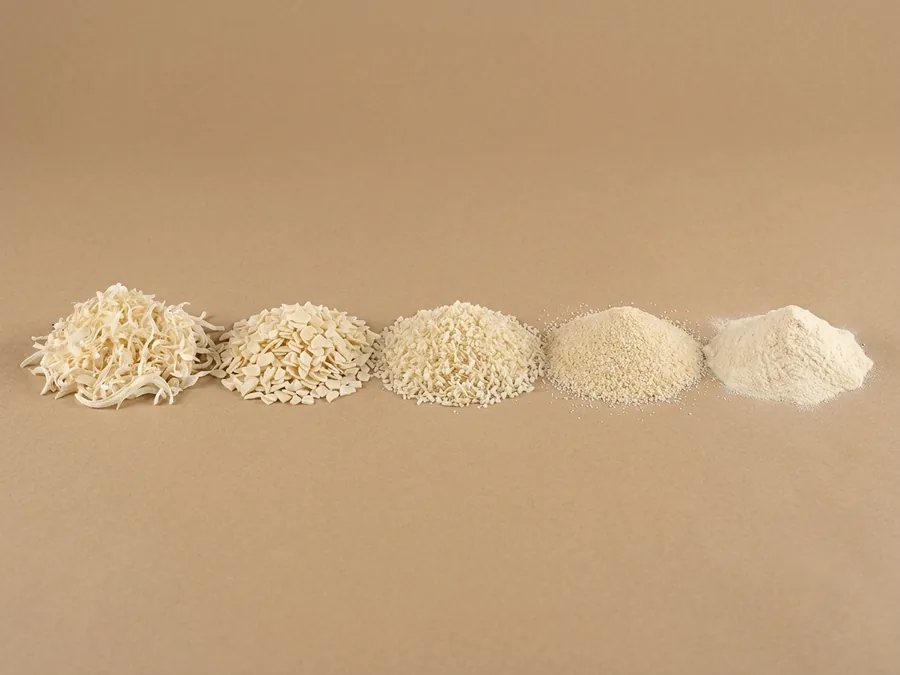
CUSTOM · 8-20 MM TO 100 MESH
We run every cut from 8-20 mm flakes down to 100 mesh powder, and match granulation to your specification at order stage.
Ask usStart here
Product, cut size, quantity, destination port - that's all we need to start. You'll receive a written quotation with full specifications from a dehydrated onion exporter, not a one-line price.
info@klarharvest.com · WhatsApp +91 97371 01599 · Bhavnagar, Gujarat, India
Samples
200-500 g per product from a current lot, dispatched by courier with the specification sheet and the sample lot's lab report.
A complete written quotation - specification sheet, price with freight shown separately, and lead time - within one business day.
The complete specification sheet as a PDF - cut size and sieve range, moisture, microbiology tiers, packing options and container loads - sent to your e-mail within one business day.
Thank you - your sample request is in. You'll have our written reply with dispatch details within one business day, and the parcel ships by courier with the specification sheet and the lot's lab report.
Thank you - your inquiry is in. You'll have a complete written quotation - specification sheet, price with freight shown separately, and lead time - within one business day.
Thank you - the specification sheet is on its way. You'll have the PDF in your inbox within one business day.