- The one number to remember: 8 to 9 kilograms of fresh per kilogram of dry
- The cost stack from field to FOB, January 2026
- What moves the price: crop, policy, energy, currency
- The seasonal pattern inside a year
- Premiums: colour, cut, microbiology tier, organic, packing
- Reading a quote line by line
- FOB, CIF and the freight line
- Why the same kilo costs 3 to 4 euros from a European stockist
- Worked example: landed cost for a container and for a pallet
- Price by origin: India against Egypt, China and the USA
- Buying for a season: fixed, indexed and call-off contracts
- Currency: which one to be quoted in
- What actually moves a price in negotiation
- How KlarHarvest prices
- Frequently asked questions
Judge the product, not the words
200-500 g from a current lot, dispatched by courier with the lot lab report.
Request a sampleThe dehydrated onion price a buyer sees on a quote is the end of a short chain of arithmetic that starts in a field near Mahuva. Eight to nine kilograms of fresh onion make one kilogram of dry product, so the field price multiplied by that ratio is the largest cost in the bag, and every other line, drying energy, labour, packing, freight and margin, sits on top of it. Once you know the chain, a quote stops being a number to accept or reject and becomes a set of lines to check.
This guide gives the full cost stack from field to FOB port with January 2026 figures, explains why the price moves and by how much, shows how much of the year's swing is seasonal and predictable, and reads a quote line by line: FOB against CIF, cut and colour premiums, microbiology tiers, packing, validity and payment terms. It ends with a worked landed cost for one container and one pallet, and with the negotiating levers that actually move the price, as opposed to the ones that only move the supplier's patience.
All prices are ranges with dates. Dehydrated onion has no list price; it has a market, and the market is the raw onion crop.
What this guide covers
- The one number to remember: 8 to 9 kilograms of fresh per kilogram of dry
- The cost stack from field to FOB, January 2026
- What moves the price: crop, policy, energy, currency
- The seasonal pattern inside a year
- Premiums: colour, cut, microbiology tier, organic, packing
- Reading a quote line by line
- FOB, CIF and the freight line
- Why the same kilo costs 3 to 4 euros from a European stockist
- Worked example: landed cost for a container and for a pallet
- Price by origin: India against Egypt, China and the USA
- Buying for a season: fixed, indexed and call-off contracts
- Currency: which one to be quoted in
- What actually moves a price in negotiation
- How KlarHarvest prices
- Frequently asked questions
The one number to remember: 8 to 9 kilograms of fresh per kilogram of dry
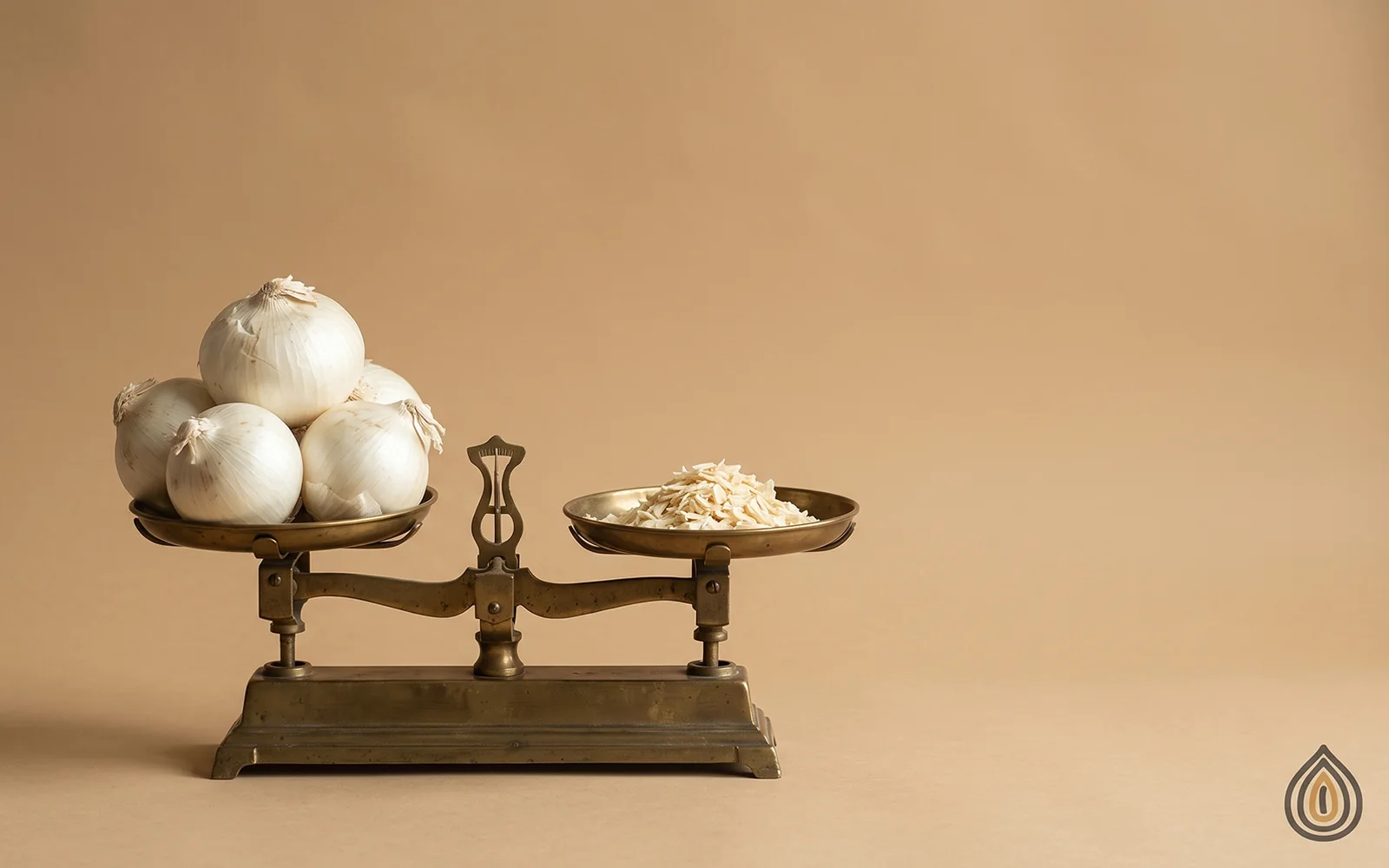
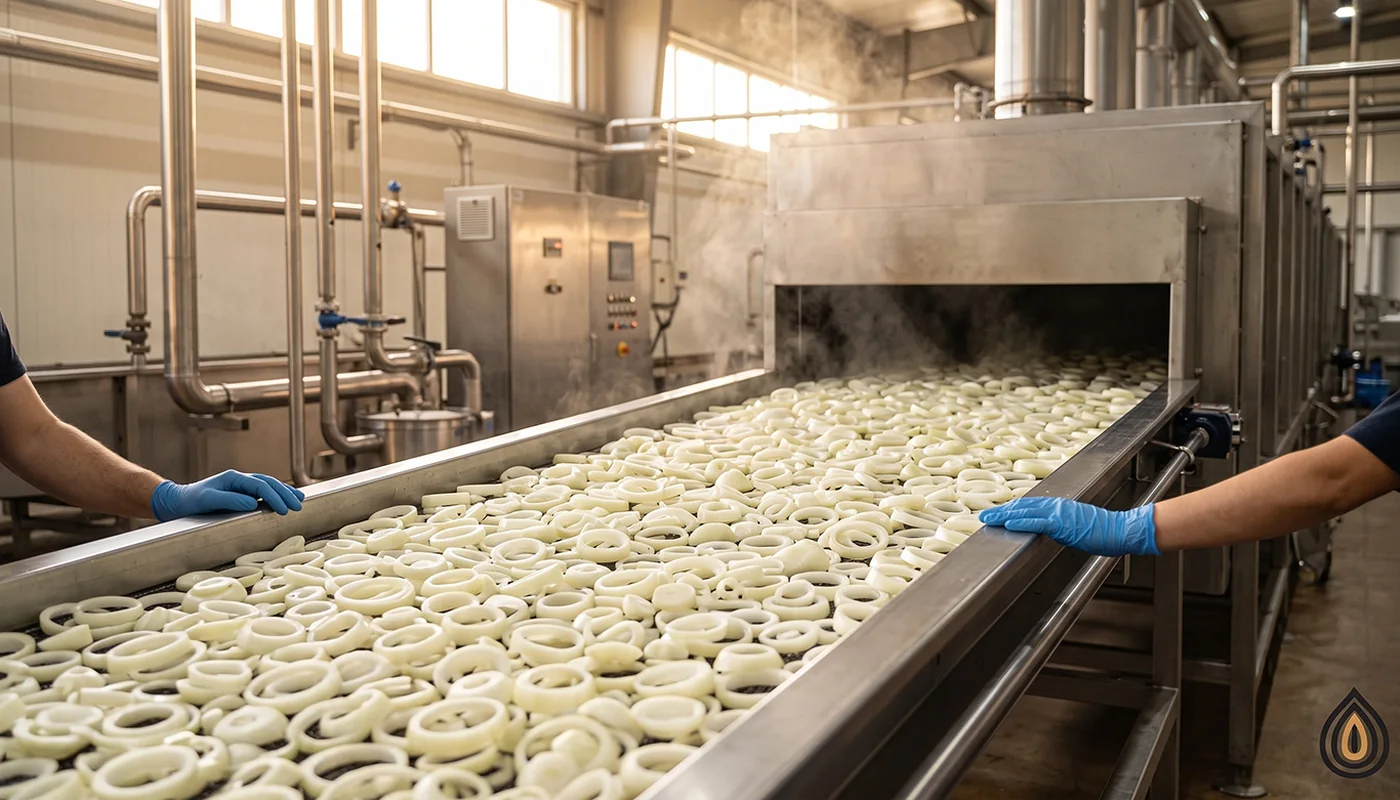
Fresh onion is about 88 percent water. Dehydrated onion is about 5 percent water. Drying a kilogram of fresh onion leaves roughly 120 grams of product, and after peeling losses and the trimmings that go to lower grades, a plant needs 8 to 9 kilograms of fresh onion at the gate for every kilogram of export-grade flakes. The white onion grown around Mahuva was selected for high dry matter, which keeps the ratio at the lower end; a wetter variety or a poor crop pushes it towards 9 or above.
The ratio is a multiplier on price. If raw onion at the plant gate costs 5 rupees per kilogram, the onion in one kilogram of flakes costs 42 to 45 rupees. At 8 rupees per kilogram it costs 64 to 72. A move of 3 rupees in the field, which happens within a season, moves the dry product by 25 to 30 rupees per kilogram, about 15 to 20 percent of the export price. This is why the industry talks about raw onion prices the way a bakery talks about wheat, and why a quote valid for a quarter is a promise nobody can keep.
The cost stack from field to FOB, January 2026
The table builds the FOB price of standard white onion flakes from the plant gate, using ranges observed in the current season. The mid column is what a well-run BRC-certified plant and an exporter with its own handling achieve; the range covers the spread between plants and between weeks.
| Cost line (per kg of dry flakes) | Low (INR) | Mid (INR) | High (INR) | Comment |
|---|---|---|---|---|
| Raw white onion, 8.5 kg at 5-7 INR/kg | 42 | 52 | 60 | The largest line; set by the crop |
| Drying energy (gas, biomass, electricity) | 22 | 28 | 34 | Second largest; depends on fuel and dryer efficiency |
| Peeling, slicing, sorting, milling labour | 8 | 10 | 13 | Seasonal workforce |
| Plant overheads, certification, lab tests | 6 | 8 | 10 | BRC plants carry more, and it shows in consistency |
| Packing: liner, kraft bag, pallet | 4 | 5 | 7 | Printed bags add 2-4 |
| Plant margin | 10 | 15 | 20 | Moves with demand |
| Ex-plant price | 92 | 118 | 144 | What a plant quotes an exporter or a large direct buyer |
| Exporter handling: godown, labelling, stuffing, documents | 3 | 4 | 5 | Per kg on a full container |
| Inland transport plant to port, port charges | 3 | 4 | 5 | Pipavav is 60-70 km from Mahuva |
| Export finance, insurance, bank charges | 2 | 3 | 4 | Higher on letters of credit |
| Exporter margin | 10 | 15 | 25 | 7-20 % on the FOB value |
| FOB Indian port | 110 | 144 | 183 | January 2026 quotes: mostly 150-175 INR, 1.50-1.75 EUR |
Two lines deserve attention. Drying energy is nearly as large as the onion itself, and it is the reason plant efficiency shows up in price: a modern belt dryer with heat recovery burns less gas per kilogram than a twenty-year-old one, and in a season when gas is expensive the gap between efficient and inefficient plants widens. And the two margin lines together are 20 to 45 rupees, which is where negotiation happens; the other lines are costs that a plant cannot cut without cutting quality.
What moves the price: crop, policy, energy, currency
Four drivers explain nearly all of the movement in the dehydrated onion price from one month to the next.
The raw onion crop
India grows three onion crops. The rabi crop, harvested from March to May, is the big one and the one that feeds dehydration, because its white onion has the dry matter and the storage life the plants need. A good rabi crop with high yields in Gujarat and Maharashtra means field prices of 4 to 6 rupees per kilogram at the plant gate in the processing months; a crop hit by unseasonal rain or a poor monsoon the year before means 8 to 12 rupees and a dry product 30 to 60 rupees per kilogram dearer. The crop is known by February, which is why serious buyers watch the acreage and rainfall reports through the winter. The calendar is in The Indian Onion Harvest Calendar.
Government policy on fresh onion
Onion is politically sensitive in India because it is in every household's kitchen. When domestic prices spike, the government has restricted or banned fresh onion exports and imposed export duties, most recently through 2023 and 2024. Those measures do not apply to dehydrated onion, but they change the domestic price that the dehydration plants pay for their raw material: an export ban keeps more fresh onion at home and lowers field prices, a good season for dehydration, while a strong export market for fresh onion competes with the plants for the same bulbs.
Energy
Drying is energy. Plants in Mahuva run on natural gas, biomass briquettes or a mix, and a 20 percent rise in fuel cost adds 5 to 7 rupees per kilogram to the dry product. This driver moves slowly compared with the crop, but it moved sharply in 2022 and buyers who compare a 2026 price with a 2021 memory are partly seeing energy.
Currency
Quotes are made in US dollars or euros but costs are in rupees. A weaker rupee lowers the dollar price a plant needs to cover its costs and tends to soften export quotes; a stronger rupee does the opposite. The rupee has weakened gradually against the dollar for years, which has made Indian dehydrated onion cheaper for importers than the rupee cost stack alone would suggest. The euro-rupee rate moves the price a German buyer sees in the same way.
The seasonal pattern inside a year
Within a normal year, the price follows the crop with a lag. Indian customs data for exports under HS 0712.20 show the pattern clearly: in 2025, average unit values were firmest in February and May, at around 170 rupees per kilogram FOB, and softest from July to November, at roughly 143 to 148 rupees, when the plants had finished the season's production and were selling stock. The February peak reflects the last of the old crop before the new arrivals; the May firmness reflects the plants covering their raw material purchases at the season's prices before they know how much stock the market will absorb.
| Period | What is happening | Typical price position | What a buyer should do |
|---|---|---|---|
| January to February | Old-crop stock running down; new crop being assessed | Firm, near the year's high | Cover only immediate needs; get crop reports |
| March to April | New crop arrives; plants run at full capacity | Falls if the crop is good, holds if it is short | Sample the new crop; negotiate season contracts |
| May to June | Peak production; plants build stock | Firm on raw material cost, then easing | Best time to fix volume for the year |
| July to November | Monsoon; production slows; stock sold | Softest months of the year | Buy for Q4 and Q1; watch storage quality |
| December | Stock thinning; next crop outlook forming | Rising | Cover Q1 before the February peak |
The pattern is reliable in direction and unreliable in size: in a short-crop year the summer softening is small and the winter rise is steep. The month-by-month price history, and what broke the pattern in the years it broke, is in Dehydrated Onion Price History 2020-2026.
Premiums: colour, cut, microbiology tier, organic, packing
The cost stack above is for standard white onion flakes. Everything else is a premium on that base, and the premiums are more stable than the base, because they reflect processing rather than the crop.
| Variant | Premium over standard white flakes | Why |
|---|---|---|
| Chopped, minced | 0 to +3 % | Same kibble, extra sieving |
| Granules, powder | +2 to +6 % | Milling energy, milling losses |
| Red onion, any cut | +10 to +25 % | Dearer raw material in season, smaller runs |
| Pink onion | +15 to +30 % | Made to order |
| Low bacterial (steam treated) | +5 to +10 % | Extra process step, small yield loss |
| Extra low bacterial | +15 to +25 % | Controlled steam treatment, testing |
| Sulphite-free, where a plant normally uses sulphite | 0 to +5 % | Colour risk carried by the plant |
| Organic certified | roughly 2.5 to 3 times the conventional price | Certified farms, segregated processing, small volumes; EU prices around 4.6-5.0 EUR/kg |
| Printed private-label bags | +2 to 4 INR/kg | Printing and minimum bag runs |
| Cartons instead of bags | +3 to 6 INR/kg | Material and handling |
The tier premiums are the ones to check against your real need. Extra low bacterial onion in a product that is boiled for 20 minutes is money spent on a number nobody will ever use. The tiers and the question that decides them are in Microbiology in Dehydrated Onion.
Reading a quote line by line
A usable quote for dehydrated onion has nine elements. If one is missing, the price cannot be compared with another supplier's, and the missing one is usually the one that would have made the cheaper quote dearer.
- The specification it refers to: colour, cut and band, moisture, tier. "White onion flakes" is not a specification.
- Price and unit: per kilogram or per tonne, in a named currency.
- Incoterm and place: FOB Pipavav, CIF Hamburg, DAP your town. Same price, different Incoterm, different cost by 10 to 20 percent.
- Quantity: the price for one pallet is not the price for one container.
- Packing: 20 kg liner-in-kraft on pallets is standard; cartons or printed bags are extra.
- Validity: 7 to 10 days is honest; 90 days with "subject to market" means the price is not fixed.
- Price lock: fixed at order confirmation, in writing.
- Payment terms: advance share, balance trigger, or letter of credit.
- Lead time and shipment window: from confirmation to sailing.
Then compare on the same basis. Convert every quote to FOB in one currency, add your own freight and destination costs, and rank. A quote that is 5 percent cheaper FOB from a plant that has never shipped to your country, on 100 percent advance payment, is not cheaper; it has moved the cost into risk.
FOB, CIF and the freight line
FOB is the price for the goods loaded on the ship at the Indian port. CIF adds sea freight and minimum insurance to your port. The difference should be close to what a forwarder would charge you for the same freight, plus a small handling margin, and in January 2026 that is 10 to 15 rupees per kilogram on a full container of flakes and 25 to 45 rupees on an LCL pallet. If a supplier's CIF price is 40 rupees above their FOB price for a container, the freight line is carrying margin, and the way to see it is to ask for FOB and for the freight separately. Internal pricing at serious exporters is FOB; the freight is a pass-through, quoted at the forwarder's rate of the day. The Incoterm choice and what each one includes is covered in FOB, CIF or DAP?
Why the same kilo costs 3 to 4 euros from a European stockist
Dutch and German traders import Indian dehydrated onion at 1.50 to 2.00 euros per kilogram landed and sell it to food manufacturers at 3 to 4 euros delivered. The gap is not the product; the product is the same bag from the same plants. The gap is service and risk: stock in a European warehouse, delivery in days on a single pallet, one invoice in euros with 30 days credit, the trader's quality department standing between the plant and the buyer, and the trader carrying the raw onion and currency risk between purchase and sale. For a manufacturer buying two pallets a year, that is a fair price for not having to run an import. For one buying four containers a year, it is 40,000 to 80,000 euros of margin paid for convenience that a well-organised direct relationship provides at a fraction of the cost. Where the line falls for your volume is worked through in Buying Dehydrated Onion via Dutch Traders or Direct from India.
Worked example: landed cost for a container and for a pallet
The two calculations below use January 2026 figures and an exchange rate of 90 rupees per euro. They are a template: replace the FOB line with your quote and the freight lines with your forwarder's rate.
| Line | 20 ft container, 10,000 kg flakes | 1 LCL pallet, 600 kg flakes |
|---|---|---|
| FOB Pipavav at 160 INR/kg (1.78 EUR) | 17,800 EUR | 1,068 EUR |
| Ocean freight and origin charges | 1,500 EUR | 300 EUR |
| Marine insurance | 45 EUR | 10 EUR |
| Destination port, handling, delivery order | 350 EUR | 140 EUR |
| Customs broker | 120 EUR | 90 EUR |
| Import duty 6.4 % on customs value (CIF) | 1,238 EUR | 88 EUR |
| Trucking to warehouse | 400 EUR | 120 EUR |
| Landed cost before VAT | 21,453 EUR = 2.15 EUR/kg | 1,816 EUR = 3.03 EUR/kg |
The pallet lands at about 3 euros, close to a stockist's price, because fixed charges are spread over 600 kilograms; the container lands at 2.15 euros, a third below. This is the whole economics of direct import in one table: it pays from a few pallets per shipment upwards and pays handsomely from a container. Note that the duty rate shown is the EU conventional rate for 0712 20 00; whether a preferential rate applies to Indian origin on your entry date is a question for your broker and TARIC. A fuller version with sensitivity to freight and exchange rates is in Landed Cost of Dehydrated Onion in Europe.
Price by origin: India against Egypt, China and the USA
India is the largest supplier of dehydrated onion to Europe and usually the lowest-cost one at export grade. Egypt is the second source for European buyers, with a shorter sea route to the Mediterranean and prices that in most years sit 5 to 15 percent above Indian FOB once freight is included; its season runs a little earlier and its white onion is milder. China supplies a large volume to Asia and some to Europe, at prices close to India's in normal years, and is the usual alternative when the Indian crop is short. The United States produces high-quality dehydrated onion, mostly from California, for its own market and for premium buyers, at two to three times the Indian price. Buyers who specify by origin usually do so for reasons other than price: an established approved supplier, a regional preference, or a customer's origin requirement. Buyers who specify by price and specification end up in India in most years, and the Netherlands trade figures show it: the traders who supply Germany source the bulk of their onion from Gujarat.
The one caveat is the short-crop year. When unseasonal rain hits the Gujarat rabi crop, Indian prices can rise by 40 to 60 percent within weeks and converge with Egypt and China. A buyer with a single approved Indian supplier is exposed in those years; a buyer with a season contract at a fixed price is not, which is the next subject.
Buying for a season: fixed, indexed and call-off contracts
A buyer who takes several containers a year has three ways to price them. A fixed-price season contract, agreed in April or May when the plant knows its raw material cost, sets one price for deliveries over 6 to 12 months; the buyer gives up the summer softening in exchange for protection against a winter rise, and the plant secures volume. An indexed contract sets a formula, typically a base price adjusted by an agreed raw onion index or by the customs unit value, with a cap and a floor; it is fair to both sides and common between large European users and plants that have worked together for years. A call-off arrangement fixes volume and specification but prices each shipment at the quote of the week; it keeps flexibility and takes the market as it comes.
For a first-year direct importer the practical choice is call-offs for the first two or three shipments, then a fixed-price contract for the following season once both sides know each other. Whatever the form, write the specification, the shipment schedule, the price or formula, the payment terms and the claim procedure into one document. The terms that belong in such a contract are in B2B Contract Terms for Dehydrated Onion.
Currency: which one to be quoted in
Indian exporters quote in US dollars by habit and in euros on request. The plant's costs are in rupees, so both are conversions, and the exporter carries the exchange risk between quote and payment on a fixed-price order. For a European buyer a euro quote removes one moving part: the landed cost is known in the currency of the sale price. The cost of that convenience is a slightly wider margin in the exporter's conversion, usually a fraction of a percent. On a season contract, agree the currency once and keep it; a contract that switches between dollar and euro pricing at each call-off is a contract that will be argued about. If your finance team hedges, a fixed-price euro contract with a shipment schedule is the easiest thing to hedge.
What actually moves a price in negotiation
The two margin lines in the cost stack are where a price can move, and four levers move them. Volume: a container is cheaper per kilogram than a pallet at every plant, and a season contract for several containers is cheaper still, because the plant can buy raw material against it in the cheap weeks. Timing: an order placed in the soft months for delivery over the following quarter is cheaper than an order placed in February for immediate shipment. Cut mix: taking the plant's fines and powder along with flakes helps the plant balance its run and is worth a few rupees. Payment terms: a letter of credit costs the exporter bank charges and delay; a clean advance and balance against documents is worth a small discount, and a buyer with a payment history is worth more.
A fifth lever is information. A buyer who knows the raw onion price of the week, the customs unit value of the last month and the freight rate of the day negotiates from the same table as the exporter, and the conversation becomes short: this is the stack, this is your margin, this is mine. The ground reports published on this blog through the season, starting with the March 2026 Mahuva report, exist to give buyers that table. Sharing your own forecast of volume for the year does the same in the other direction; a plant that can see twelve months of demand prices differently from one that sees one order.
What does not move the price is pushing a supplier below its cost stack. A quote of 130 rupees FOB in a season when the stack says 144 is either a plant with a quality problem, an exporter who will renegotiate after the deposit, or a cut in the specification you have not noticed. In this trade the cheapest quote is rarely the cheapest kilo.
How KlarHarvest prices
KlarHarvest quotes FOB Pipavav as the base price and shows freight as a separate line at the forwarder's rate of the day, for LCL and for full containers, so that a buyer can compare with its own forwarder. Quotes carry the specification, the packing, the validity of seven days and the payment terms, and the price is locked at order confirmation because the product is bought at that point. Premiums for cut, colour and microbiology tier are stated as lines, not folded into a single number. We do not quote below the cost of a BRC-certified plant's product plus honest handling, because a price below that is a promise we would have to break. Current indications for each cut are available within one business day through the quote form; the specifications are on the products page.
Frequently asked questions
What is the price of dehydrated onion per kg in 2026?
In January 2026, standard white onion flakes from India are quoted at roughly 150 to 175 rupees per kilogram FOB Indian port, about 1.50 to 1.75 euros or 1.65 to 1.90 US dollars. Powder and granules are slightly higher, red onion 10 to 25 percent higher. Landed in Europe by container, add about 0.35 to 0.50 euros per kilogram.
Why do dehydrated onion prices change so often?
Because 8 to 9 kilograms of fresh onion go into each kilogram of dry product, and fresh onion prices move weekly with the crop, the weather and government export policy. A 3 rupee move in the field is a 25 to 30 rupee move in the bag. Quotes are therefore valid for 7 to 10 days.
When is dehydrated onion cheapest?
Usually from July to November, after the season's production is finished and plants are selling stock. It is usually dearest in February, before the new crop, and firm in May while plants cover their raw material purchases.
Is onion powder more expensive than onion flakes?
At the plant, by 2 to 6 percent, because of milling. Landed in Europe the difference mostly disappears, because powder is denser and costs half as much per kilogram to ship.
How much cheaper is it to import directly than to buy from a European trader?
By container, roughly a third: about 2.15 euros per kilogram landed against 3 to 4 euros from stock, at January 2026 numbers. By single pallet the saving is small, because freight and fixed charges are spread over 600 kilograms.
What does a price lock mean?
That the price on the order does not change after you confirm it, whatever the raw onion market does. Exporters who buy the product at confirmation can promise it; those who wait for your deposit to clear before buying cannot. Ask for it in writing.
Does the price include the certificate of analysis and documents?
With a serious exporter, yes: the lab report per lot, certificate of origin, phytosanitary certificate and the shipping documents are part of the service, not extras. A supplier who charges for the certificate of analysis is telling you it is not routine for them.
Next step
If you have a quote on your desk, send it to us with the specification and we will tell you what we would charge for the same product on the same terms, line by line. If you do not, request a quote for the cut and quantity you need and you will have a priced specification, FOB and with freight shown separately, within one business day.