- What the ratio is, and three ways to state it
- The dry-matter arithmetic
- Losses along the line: where the rest of the onion goes
- A worked ratio for one tonne of fresh onion
- What moves the ratio: variety, season, storage, bulb size
- The ratio by cut: why powder yields less than flakes
- How a plant measures dry matter and yield
- How a plant manages the ratio
- From yard price to FOB price: the multiplier
- Why the ratio explains the trade's volatility
- The ratio through the year
- Garlic, carrot and the other dehydrated vegetables
- Using the ratio to read a quote
- Yield claims to be wary of
- How KlarHarvest uses the ratio
- Frequently asked questions
Judge the product, not the words
200-500 g from a current lot, dispatched by courier with the lot lab report.
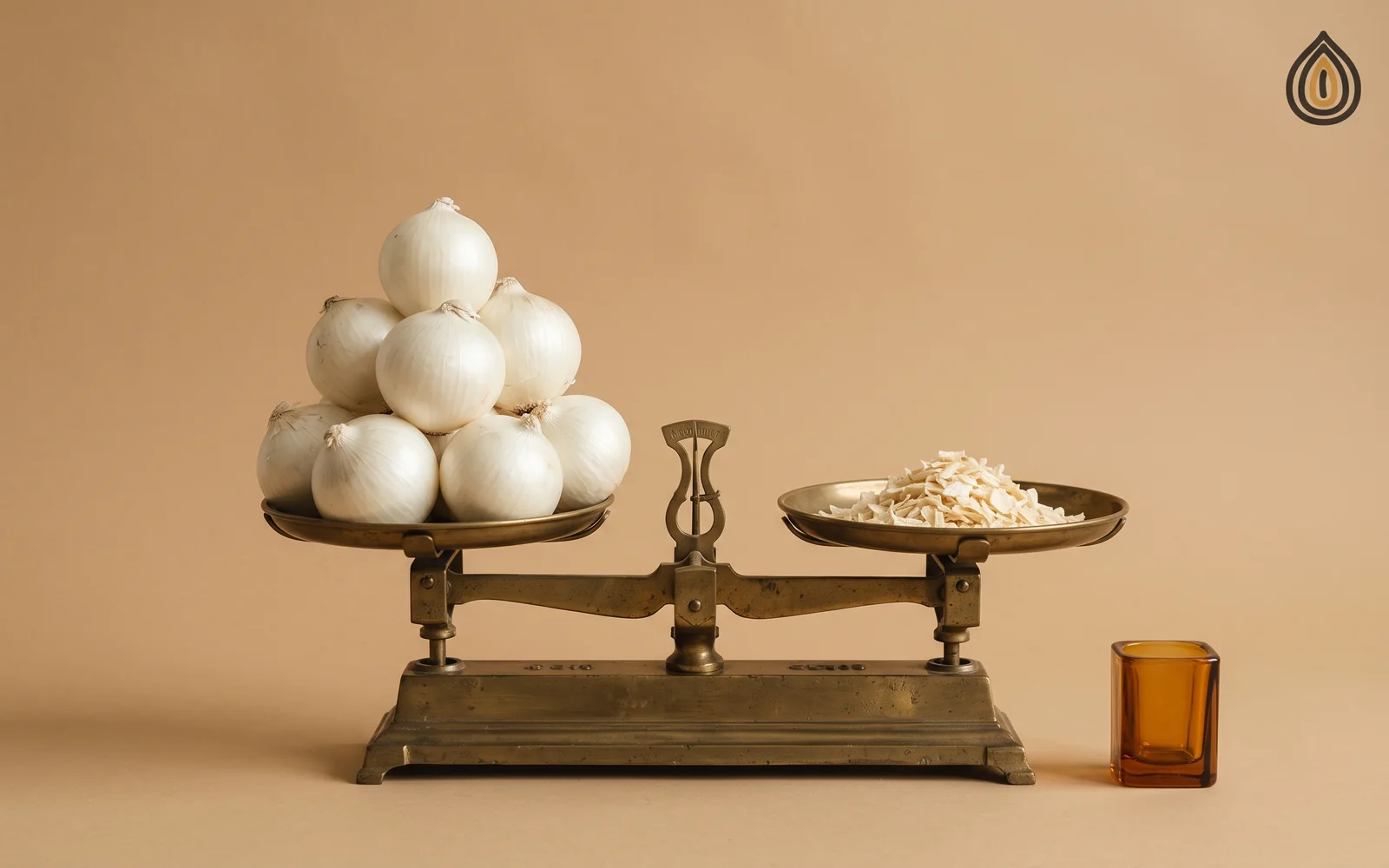
Request a sampleThe dehydrated onion yield ratio is the single number that every price in this trade rests on, and most buyers have never been told what it is or where it comes from. It is the number of kilograms of fresh onion a plant must buy to make one kilogram of dried product, and in Mahuva in a normal season it is 8 to 9 to 1: a plant buys 8.5 tonnes of onion at the market yard, peels it, slices it, dries it, screens it and packs a tonne. Everything follows from that. Raw onion is 55 to 65 percent of the cost of a kilogram of flakes because the ratio multiplies its price by 8.5; a one-rupee move at the yard is a 8 to 9 rupee move in the FOB price; a wet season that lowers the onion's dry matter by two points raises the plant's raw cost by a tenth without the yard price changing; and the plant's whole art, from the variety it contracts to the moisture it dries to, is the management of that ratio. This guide explains it from the biology to the quote.
It covers what the ratio is and how it is defined, the dry-matter arithmetic that produces it, the losses along the line that add to it, what moves it from season to season and plant to plant, how a plant measures and manages it, how it converts a yard price into an FOB price, why it explains the volatility of the trade, the ratios for garlic and the other dehydrated vegetables for comparison, and how a buyer uses it to read a quote and to judge whether a price is real. Figures are for Mahuva plants in the 2026 season.
What this guide covers
- What the ratio is, and three ways to state it
- The dry-matter arithmetic
- Losses along the line: where the rest of the onion goes
- A worked ratio for one tonne of fresh onion
- What moves the ratio: variety, season, storage, bulb size
- The ratio by cut: why powder yields less than flakes
- How a plant measures dry matter and yield
- How a plant manages the ratio
- From yard price to FOB price: the multiplier
- Why the ratio explains the trade's volatility
- The ratio through the year
- Garlic, carrot and the other dehydrated vegetables
- Using the ratio to read a quote
- Yield claims to be wary of
- How KlarHarvest uses the ratio
- Frequently asked questions
What the ratio is, and three ways to state it
The ratio can be stated three ways and the trade uses all of them, which causes confusion. As a fresh-to-dry ratio, "8.5 to 1", it is the kilograms of fresh onion per kilogram of dry product, and it is what plants and traders say. As a yield percentage, "11.8 percent", it is the dry product as a share of the fresh weight, the reciprocal of the ratio, and it is what plant accountants and agronomists say; 8 to 1 is 12.5 percent, 9 to 1 is 11.1 percent, 10 to 1 is 10 percent. And as a recovery, "88 percent", some plants mean the share of the theoretical dry matter that reaches the bag after losses, which is a measure of the plant's efficiency rather than of the onion. The first two describe the same fact; the third is a different fact. A buyer reading a plant's figures should ask which is meant, and this guide uses the fresh-to-dry ratio throughout, measured from onion bought at the yard, unpeeled, to dry product packed.
The dry-matter arithmetic
An onion is water and a small amount of everything else, and the everything else is what ends up in the bag. The dehydrator varieties grown around Mahuva, white bulbs bred for high solids, carry 17 to 20 percent dry matter at harvest, against 10 to 13 percent for the table onions of Europe and the red onions of Maharashtra; that difference is the whole reason the industry sits where it does. The arithmetic is then simple. A kilogram of onion at 18 percent dry matter holds 180 grams of solids and 820 of water. Dried product at 5 percent moisture is 95 percent solids, so those 180 grams of solids become 189 grams of product, and a kilogram of fresh onion would yield 189 grams of dry, a ratio of 5.3 to 1, if nothing were lost. Everything above 5.3 in the real ratio is loss: skin, root and top removed before drying, damaged and rejected bulbs, solids lost in washing and in the dryer as volatiles, fines lost at screening, and product spilled or scrapped. Those losses take the theoretical 5.3 to the real 8 to 9, which is to say that a third of the onion's solids never reach the bag. The table shows how the theoretical ratio moves with dry matter and with the moisture the product is dried to.
| Fresh dry matter | Dried to 4 % moisture | Dried to 5 % | Dried to 6 % | Dried to 7 % |
|---|---|---|---|---|
| 14 % (poor, wet season) | 6.9 to 1 | 6.8 | 6.7 | 6.6 |
| 16 % | 6.0 | 5.9 | 5.9 | 5.8 |
| 18 % (normal Mahuva) | 5.3 | 5.3 | 5.2 | 5.2 |
| 20 % (best fields, dry winter) | 4.8 | 4.8 | 4.7 | 4.7 |
| 12 % (table onion) | 8.0 | 7.9 | 7.8 | 7.8 |
Two things stand out. Dry matter dominates: the difference between a 14 percent and a 20 percent onion is 40 percent in the theoretical ratio, which is why a plant will pay a premium at the yard for high-solids onion. And the final moisture hardly matters to yield: drying to 4 percent instead of 6 costs the plant a fraction of a percent in weight and an hour of dryer time, which is why a buyer who wants 5 percent product pays little more for it. The moisture side is in Dehydrated Onion Moisture Content.
Losses along the line: where the rest of the onion goes
| Step | Loss, share of fresh weight | Loss, share of solids | Notes |
|---|---|---|---|
| Rejects at intake (rot, damage, undersize) | 2-5 % | 2-5 % | Higher in a wet season and from stored onion |
| Topping and root cutting | 3-5 % | 2-3 % | Tops and root plate; more on small bulbs |
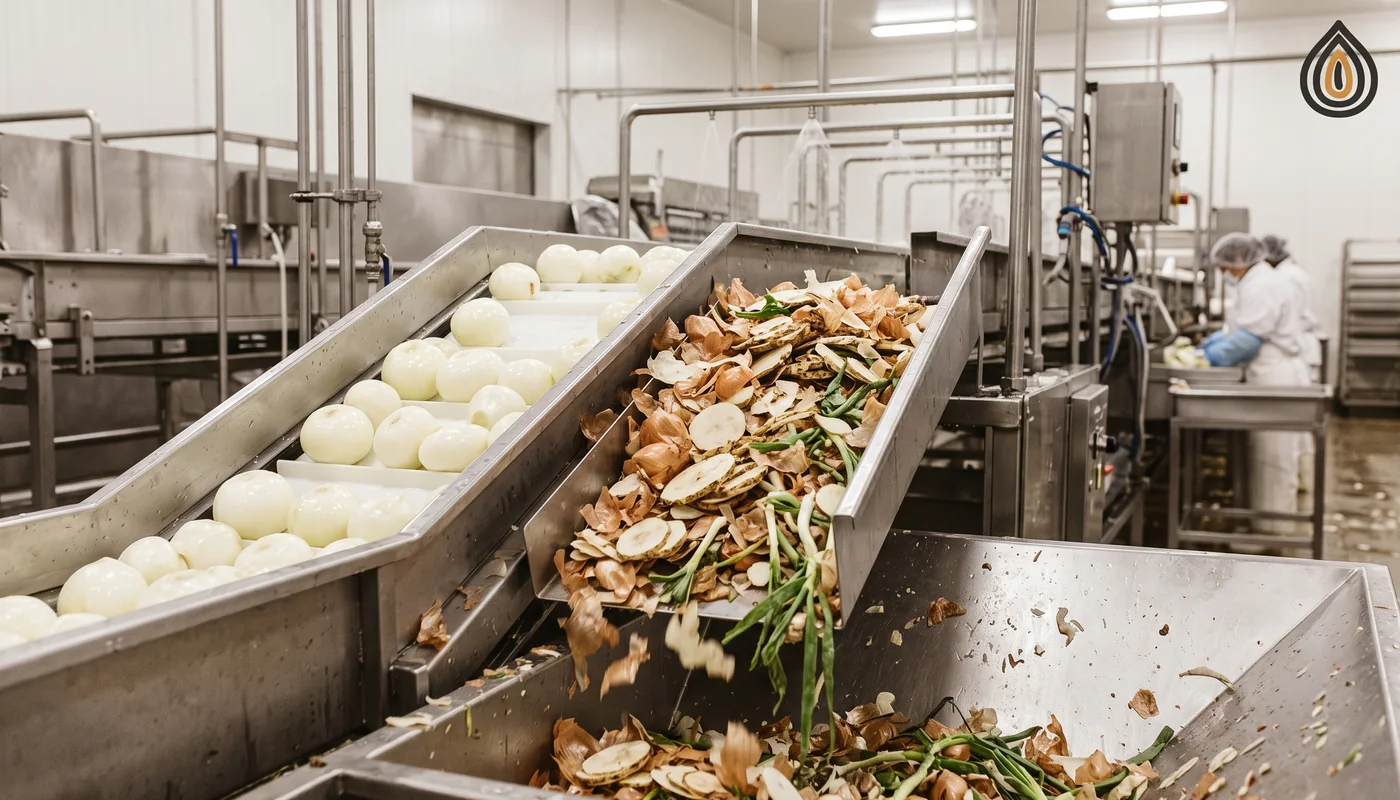
| Peeling | 6-10 % | 5-8 % | Skins plus one or two outer layers; mechanical peeling loses more than hand |
| Washing | 0-1 % | 1-2 % | Soluble solids leach; minimal if washing is brief |
| Slicing and conveying | 0.5-1 % | 0.5-1 % | Juice and fragments |
| Drying | Water | 3-6 % | Volatiles and some sugars lost with the water; higher at high temperature |
| Screening and milling | - | 2-4 % | Dust and fines not recovered; more for powder |
| Sorting (colour, foreign matter) | - | 1-2 % | Scorched and dark pieces removed |
| Packing, spillage, samples | - | 0.5-1 % | |
| Total solids lost | 17-32 % | Best plant, best onion: ~20 %; ordinary: ~28 % |
A plant that starts with 18 percent onion and loses 25 percent of its solids along the line packs 135 grams of solids per kilogram of fresh, which at 5 percent moisture is 142 grams of product, a ratio of 7.0 to 1; the same plant losing 32 percent packs 122 grams of solids, 129 of product, 7.8 to 1. The real Mahuva figures of 8 to 9 to 1 reflect onion that averages nearer 17 percent than 18 across a season, rejects and stored-onion losses that a single-day calculation does not show, and plants that are good rather than perfect. The eight production steps, with these losses in their place, are in How Dehydrated Onion Is Made.
A worked ratio for one tonne of fresh onion
A tonne of dehydrator onion arrives at a Mahuva plant in April at 18 percent dry matter, 180 kilograms of solids.
- Intake rejects, 3 percent: 970 kilograms go on, with 174.6 kilograms of solids.
- Topping and peeling, 12 percent of the fresh weight and 8 percent of the solids: 853 kilograms of peeled onion, 160.6 kilograms of solids.
- Washing and slicing, 1 percent of the fresh weight and 2 percent of the solids: 845 kilograms of slices, 157.4 kilograms of solids.
- Drying, water removed and 4 percent of the solids lost as volatiles: 151.1 kilograms of solids in kibble at 5 percent moisture, which is 159.1 kilograms of kibble.
- Screening, sorting and packing, 4 percent of the solids: 145.1 kilograms of solids, 152.7 kilograms of packed product.
The tonne of fresh onion has become 152.7 kilograms of packed product, a ratio of 6.5 to 1 on a good day with good onion. Across a season, with stored onion in the mix at lower dry matter and higher rejects, the same plant averages 8 to 8.5; a plant with a wetter crop or looser control averages 9 to 9.5. When a plant quotes its ratio, the question to ask is whether it is a good-day figure or a season average, since a quote built on the former will not survive the latter.
What moves the ratio: variety, season, storage, bulb size
Variety is first: the white dehydrator varieties, developed for the Gujarat plants from American high-solids lines, carry 17 to 20 percent dry matter, and a plant that has to use table onion or the wrong red variety in a short season is drying 12 to 14 percent onion at a ratio of 11 to 13 to 1, which is why substitution never pays. Season is second: a dry, cool bulbing period in January and February makes high-solids bulbs, and a warm or wet one makes larger, wetter ones; the 2026 crop's 18 to 20.5 percent at intake, half a point above 2025, is worth about 3 percent on the ratio, which is about 4 rupees on a kilogram of flakes at the raw price of the season. Storage is third: stored rabi onion loses water and gains a little in dry-matter percentage in its first weeks, then sprouts and rots, so the onion the plants dry in July and August carries higher rejects and softer tissue that peels with more loss; the off-season ratio is typically half a point to a point worse than the harvest ratio, which compounds with the higher off-season yard price. Bulb size is fourth: small bulbs have more skin, top and root per kilogram than large ones, and the peeling loss on 40 millimetre onion is double that on 70 millimetre, so the small dehydration-grade bulb that the plants buy cheaply at the yard is cheap partly because of its ratio. Line practice is fifth and is the plant's own: mechanical peelers set too deep, washing that runs too long, dryers run too hot at the finish, mills that make dust. The season's effect on the ratio is one of the threads in The Indian Onion Harvest Calendar.
The ratio by cut: why powder yields less than flakes
The ratio is quoted for flakes, and the finer cuts carry a further loss. Flakes are the dryer's primary product and the screening loss is small; chopped and minced come from breakage and screening with a little more dust; granules and powder pass through mills that turn a few percent of the product into dust too fine to recover and that lose a little moisture and volatiles in the heat of milling. The trade's rule of thumb is that granules need about 3 percent more fresh onion per kilogram of product than flakes and powder about 5 percent more, and that is one of the reasons powder is priced a few rupees above flakes despite being the "waste" fraction in the old view of the trade. Toasted onion, roasted after drying, loses a further 8 to 12 percent of its weight in the roaster and is priced accordingly. The cuts are in Flakes, Chopped, Minced, Granules or Powder.
| Cut | Additional loss over flakes | Effective ratio at a flake ratio of 8.5 |
|---|---|---|
| Flakes 8-20 mm | Baseline | 8.5 to 1 |
| Chopped 3-5 mm | +1 % | 8.6 |
| Minced 1-3 mm | +2 % | 8.7 |
| Granules 16-40 mesh | +3 % | 8.8 |
| Powder 80 mesh | +5 % | 8.9 |
| Powder 100 mesh | +7 % | 9.1 |
| Toasted, any cut | +10-14 % | 9.4-9.7 |
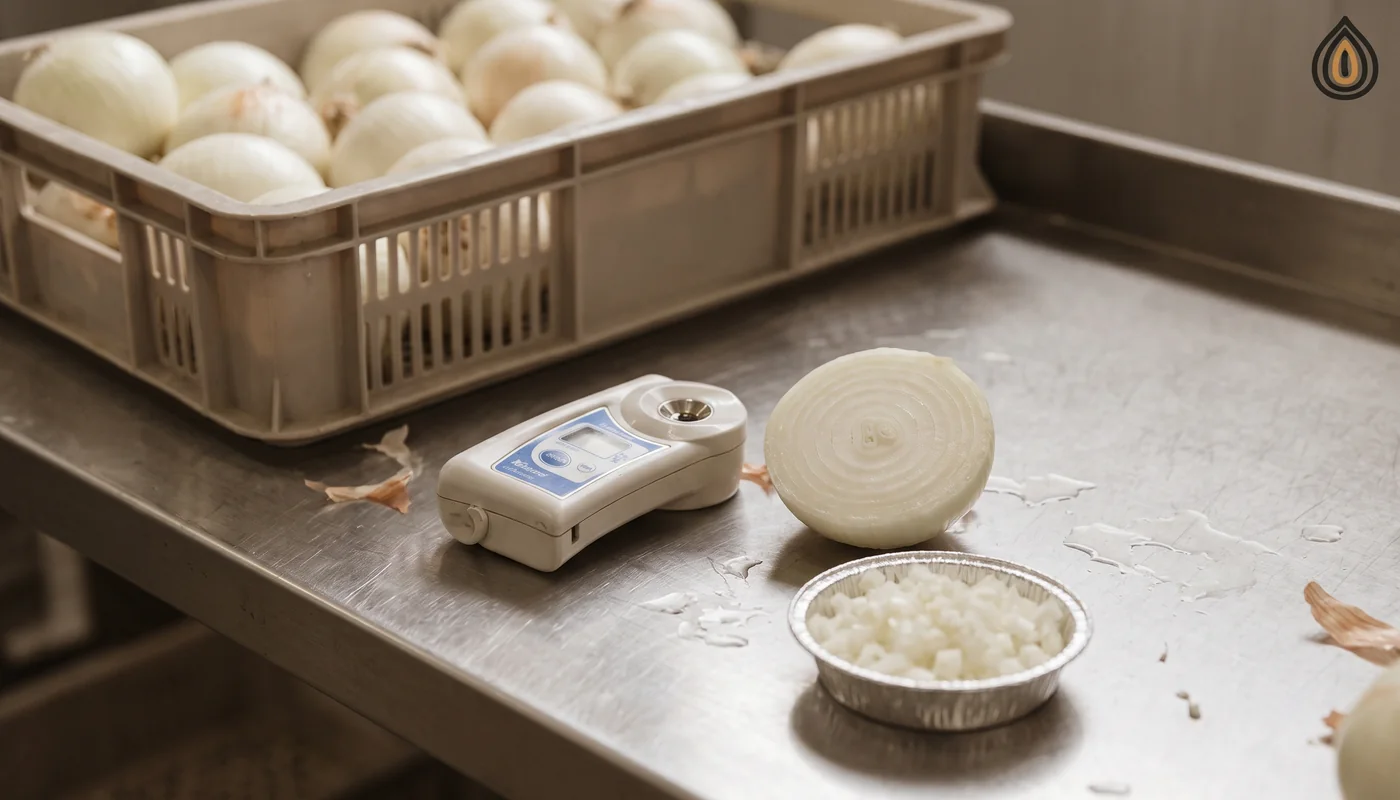
How a plant measures dry matter and yield
A plant measures the ratio at both ends. At intake, the quality staff take a sample of bulbs from each lot, cut and weigh them, and dry them in an oven at 105 degrees to constant weight, which gives the dry matter directly in a few hours; a refractometer reading of the juice's soluble solids, in degrees Brix, gives a faster proxy that correlates well enough within a variety to be used on the weighbridge, and a plant that pays farmers on dry matter, as the better ones do, uses the oven figure. At the packing end, the plant weighs what it packed against what it bought, by day, by farmer group and by season, and the ratio that falls out is the number the owner watches more closely than any other. Between the two, the losses at each step are tracked by weighing the waste, and a plant that knows its peeling loss to a decimal is a plant in control. What a plant cannot measure directly is the solids lost in the dryer, which is inferred from the difference between the intake solids and the packed solids after the weighed losses; it is the number that rises when the dryer's finishing zone runs hot, and it shows first in the colour, as explained in Dehydrated Onion Colour.
How a plant manages the ratio
Everything a good plant does about the ratio happens before the onion is bought or in the first hour after it arrives. It contracts high-solids varieties with farmer groups, sometimes supplying the seed, and pays on dry matter so that the farmer grows for solids rather than for size. It buys sound, dry, cured onion and rejects lots that are wet, sprouted or bruised, because rejects and rot are lost twice, once as waste and once as labour. It sizes its peelers to the bulb and sets them shallow, accepting a few flecks of skin for the sorter rather than a layer of flesh for the waste chute. It washes briefly and slices sharp. It runs the dryer's finishing zone cool, which protects colour and volatiles together. It recovers the fines from screening into the powder line rather than sweeping them out. And it counts: a plant whose season ratio moves from 8.6 to 8.3 has added 3.5 percent to its output from the same onion, which on a 3,000 tonne season is 100 tonnes of product, worth 1.5 crore rupees at FOB. The plants that make the export product well are, almost without exception, the plants that manage the ratio well, because the two are the same discipline.
From yard price to FOB price: the multiplier
The ratio is the multiplier that turns a yard price into the raw-material line of a quote, and the arithmetic is worth doing once by hand. At a yard price of 5 rupees per kilogram for dehydration-grade white onion and a ratio of 8.5, the onion in a kilogram of flakes costs 42.5 rupees; at 6 rupees, 51; at 9, in a tight year, 76.5. Add the conversion cost, fuel, labour, power, packing and overhead, 45 to 55 rupees in 2026, and the plant's margin, and the ex-factory price is 95 to 110 at a 5 rupee yard and 130 to 145 at a 9 rupee yard; add the origin costs and the exporter's margin for FOB. The table gives the raw-material line across the range.
| Yard price, ₹/kg | Ratio 8.0 | Ratio 8.5 | Ratio 9.0 | Ratio 10.0 |
|---|---|---|---|---|
| 4 | 32 | 34 | 36 | 40 |
| 5 | 40 | 42.5 | 45 | 50 |
| 6 | 48 | 51 | 54 | 60 |
| 7 | 56 | 59.5 | 63 | 70 |
| 8 | 64 | 68 | 72 | 80 |
| 9 | 72 | 76.5 | 81 | 90 |
| 10 | 80 | 85 | 90 | 100 |
Read across a row and the ratio's effect appears: at a 7 rupee yard, a plant at 8 to 1 has a raw line of 56 and a plant at 10 to 1 has 70, a 14 rupee difference on a product that sells at 150 to 170, which is the plant's whole margin. Read down a column and the yard's effect appears: at 8.5 to 1, every rupee at the yard is 8.5 rupees on the product. The full cost build from the yard to the landed price is in What Does Dehydrated Onion Cost per Kilogram? and Landed Cost of Dehydrated Onion in Europe.
Why the ratio explains the trade's volatility
Buyers new to the trade are surprised that a product which is 60 percent onion by cost can move 30 percent in a year when the onion moves 60 percent; the ratio is the reason it does not move more, and also the reason it moves as much as it does. Because raw onion is multiplied by 8.5 and the conversion cost is not, the product price is a lever with the yard at the long end: the yard moving from 5 to 9 rupees, which it did between the 2025 and 2024 seasons, adds 34 rupees to the raw line and nothing to conversion, so the product moves from about 150 to about 185 FOB, 23 percent, on an 80 percent raw move. The conversion cost damps the swing; the ratio transmits it. And the ratio itself moves in the same direction as the yard in a bad year, because a short crop is usually a wet or a small-bulbed one with lower dry matter and higher rejects, so the plant is paying more per kilogram for onion of which it needs more kilograms, which is the compounding that took FOB past 200 in 2024. That is why plants lock their price at order confirmation and why quotes carry 7-day validities, as explained in Why Dehydrated Onion Quotes Are Valid for 7 Days, and why the price history in Dehydrated Onion Price History 2020-2026 reads as a series of yard-price cycles amplified by the ratio.

The ratio through the year
| Period | Onion source | Typical dry matter | Typical ratio, flakes | Yard price tendency |
|---|---|---|---|---|
| March | Early harvest, fresh | 17-19 % | 8.5-9.0 | Easing |
| April-May | Peak harvest, fresh | 18-20 % | 8.0-8.5 | Lowest |
| June | Late harvest and field stores | 17-19 % | 8.5-9.0 | Firming |
| July-August | Stored rabi, early storage | 17-18 %, rising rejects | 9.0-9.5 | Rising |
| September-October | Stored rabi, late storage | 16-18 %, high rejects | 9.5-10.0 | High |
| November-February | Late storage, then kharif and early rabi | 15-18 % | 9.5-10.5 | Highest, then easing |
The off-season carries a double penalty, higher yard prices and a worse ratio, and it is why product dried in April and May is the cheapest of the year to make and why the plants' free stock from those months is the buyer's best purchase. The seasonal price pattern that results is in the DGCIS unit-value data cited in Mahuva Ground Report, April 2026.
Garlic, carrot and the other dehydrated vegetables
The same arithmetic runs every dehydrated vegetable, and the ratios show why onion is the cheap one. Garlic, at 35 to 40 percent dry matter, has a ratio of 3 to 3.5 to 1, which is why dried garlic is priced by the raw garlic more directly and swings less on yield; carrot, at 10 to 12 percent, runs 10 to 12 to 1; cabbage and leek, at 8 to 10 percent, 12 to 15 to 1; tomato, at 5 to 6 percent, 18 to 22 to 1, which is why sun-dried tomato costs what it does; potato flakes, from 20 to 22 percent tubers with a cooked process, 5 to 6 to 1. A buyer sourcing several dehydrated vegetables from one plant will find the plant thinks about each in ratio terms and prices each from its raw market times its ratio, and the mixed-load and multi-product sourcing questions are in Dehydrated Garlic and Onion from the Same Supplier and Mixed Containers: Combining Onion Cuts, Garlic and Vegetables.
Using the ratio to read a quote
A buyer with the ratio in hand can check any quote in a minute. Take the current yard price for dehydration-grade white onion, which a supplier will give and which the ground reports carry; multiply by 8.5 for the raw line; add 45 to 55 for conversion, 5 for origin costs and 8 to 15 percent for the plant's and exporter's margins; and the result is the FOB range a real quote must fall in. At a 5.5 rupee yard: 47 raw, plus 50 conversion, plus 5 origin, is 102, plus margins of 10 to 15, is 112 to 118 ex-plant and 145 to 165 FOB with the exporter's costs and margin, which is where the 2026 season's indications sit. A quote well below that range is a lot that is old, off-grade, from a plant with a very good ratio and no margin, or one that will not be honoured when the advance arrives; a quote well above it is a plant with a poor ratio, a high-cost tier or a margin worth negotiating. The same check, run on a competitor's quote or a trader's price, shows what the intermediary is taking. The wider reading of a quote is in Dehydrated Onion Price per kg, and the checks on a supplier in 25-Point Checklist Before You Choose a Dehydrated Onion Supplier.
Yield claims to be wary of
Three yield claims circulate and none should be relied on. "Our ratio is 7 to 1" is a good-day figure from good onion at a good plant, and is true for a day in April; a plant that quotes it as a season average is quoting a number its accounts will not show. "Twelve and a half tonnes of flakes in a 20-foot container" is not a yield claim but is the same kind of arithmetic error, a figure for granules applied to flakes, which fill the box at about ten tonnes; a buyer planning on 12.5 receives a short shipment or a bag count that does not match, as the container guide in How a Dehydrated Onion Container Is Loaded explains. And "the price cannot move because we hold stock" ignores that the stock was bought at a ratio and a yard price, and that a plant which sells below its replacement cost in a rising market does so once. The honest yield statement from a plant is a season average with the range, the dry matter it assumes, and the cut it applies to.
How KlarHarvest uses the ratio
KlarHarvest's quotes are built from the yard price and the plant's season ratio rather than from a list price, and the basis is stated on the quote: the raw onion price and date it assumes, the ratio for the cut, and the conversion and origin lines, so that a buyer can see why the number is what it is and what would move it. The plants KlarHarvest sources from contract high-solids varieties and pay on dry matter, and their season ratios, 8.0 to 8.8 for flakes in 2026, are known and are the basis of the price lock at order confirmation. The ground reports carry the yard price each month so that a buyer can run the check independently; the reports and the cost model are on the products page, and a quote with the basis shown comes from the contact page.
Frequently asked questions
How many kilograms of fresh onion make one kilogram of dried onion?
8 to 9 kilograms at a Mahuva plant in a normal season for flakes, from dehydrator onion at 17 to 20 percent dry matter. The theoretical minimum at 18 percent dry matter is about 5.3 to 1; the rest is skin, root, rejects, drying losses and screening losses.
Why does the yield ratio matter to a buyer?
Because it multiplies the raw onion price into the product price: at 8.5 to 1, every rupee at the yard is 8.5 rupees on a kilogram of flakes. It explains why the product price follows the onion crop and lets a buyer check whether a quote is real.
What is the yield percentage of onion dehydration?
The reciprocal of the ratio: 8 to 1 is 12.5 percent, 8.5 to 1 is 11.8 percent, 9 to 1 is 11.1 percent. Plant accountants use the percentage; traders use the ratio.
What moves the ratio from season to season?
Dry matter above all, which depends on variety and on a cool, dry bulbing period; then rejects and storage losses, which rise in the off-season; then bulb size, since small bulbs lose more to peeling; then the plant's own line practice.
Does the final moisture change the yield?
Hardly: drying to 4 percent instead of 6 costs a fraction of a percent of weight. Dry matter, at the other end, changes it by 40 percent between a poor and a good onion.
Why does onion powder yield less than flakes?
Milling turns a few percent of the product into unrecoverable dust and loses a little in the mill's heat; powder needs about 5 percent more fresh onion per kilogram than flakes and is priced a few rupees higher for it.
How do I use the ratio to check a quote?
Multiply the current yard price by 8.5, add 45 to 55 rupees of conversion, 5 of origin costs and 10 to 15 percent of margins; the result is the FOB range a genuine quote falls in. A quote far below it will not be honoured; one far above has room to negotiate.
Next step
Request a quote and it comes with the basis shown, the yard price, the ratio and the conversion line, so that the number can be checked against this guide; or request a sample and the drying date and dry-matter record of its lot come with the certificate.