- India's three onion crops and where they grow
- The crop that feeds dehydration: rabi white onion in Saurashtra
- The dehydration calendar, month by month
- Weather risks: unseasonal rain, heat and the monsoon
- Policy risks: export bans, duties and stock limits on fresh onion
- Storage between harvests and why losses move late-season prices
- How plants buy raw material through the season
- Quality through the year: new crop, stored crop, monsoon
- Regional calendars and the red onion buyer
- Reading the crop estimate: acreage, yield and the February view
- Matching the Indian calendar to a European planning year
- Fresh onion exports: a different calendar
- The buyer's calendar: sample, contract, cover, avoid
- What to watch, and where
- How KlarHarvest follows the season
- Frequently asked questions
Judge the product, not the words
200-500 g from a current lot, dispatched by courier with the lot lab report.
Request a sampleThe Indian onion harvest season is the clock that every dehydrated onion price, lead time and quality question runs on. India grows onion in three overlapping crops across the year, but only one of them, the rabi crop lifted from late February to May, supplies the white onion that the dehydration plants of Gujarat dry, and the whole trade breathes with it: prices set in April, plants at full capacity through June, stock sold down through the winter, and the tightest weeks in February before the new arrivals. A buyer who knows the calendar samples the new crop at the right time, fixes volume in the right month and avoids the weeks when everyone else is short.
This guide sets out the three Indian onion crops and their regions, the calendar of the dehydration crop month by month with what each month means for price, quality and availability, the weather and policy risks that break the pattern, how onion is stored between harvests and why storage losses move late-season prices, how plants buy raw material through the season, and the buyer's own calendar: when to sample, when to contract, when to buy for the fourth quarter and what to watch in the news. It ends with the sources a buyer can follow for free.
Figures are as of March 2026; dates are typical and shift by two or three weeks with the monsoon and the winter.
What this guide covers
- India's three onion crops and where they grow
- The crop that feeds dehydration: rabi white onion in Saurashtra
- The dehydration calendar, month by month
- Weather risks: unseasonal rain, heat and the monsoon
- Policy risks: export bans, duties and stock limits on fresh onion
- Storage between harvests and why losses move late-season prices
- How plants buy raw material through the season
- Quality through the year: new crop, stored crop, monsoon
- Regional calendars and the red onion buyer
- Reading the crop estimate: acreage, yield and the February view
- Matching the Indian calendar to a European planning year
- Fresh onion exports: a different calendar
- The buyer's calendar: sample, contract, cover, avoid
- What to watch, and where
- How KlarHarvest follows the season
- Frequently asked questions
India's three onion crops and where they grow
India is the world's second-largest onion producer, at roughly 24 to 27 million tonnes a year on about 1.7 to 1.9 million hectares, and it harvests onion in three seasons named after the agricultural year's two halves.
| Crop | Sown / transplanted | Harvested | Share of production | Main regions | Character |
|---|---|---|---|---|---|
| Kharif | June-July (monsoon) | October-December | About 20 % | Maharashtra, Karnataka, Andhra Pradesh, Gujarat | Red, high moisture, poor storage; goes straight to the fresh market |
| Late kharif | August-October | January-March | About 15-20 % | Maharashtra, Madhya Pradesh | Bridges the gap before rabi; moderate storage |
| Rabi | November-January | March-May | About 60-65 % | Maharashtra, Madhya Pradesh, Gujarat, Karnataka, Rajasthan | The storable crop; feeds the fresh market for months and the dehydration plants entirely |
The rabi crop is the one that matters for everything in this trade. It is grown through the cool dry winter, lifted in the dry heat of spring, cures well and stores for four to six months in ventilated sheds, and it is the only crop from which the dehydration plants buy, because the white varieties bred for drying are rabi varieties and because the plants need dry bulbs in dry air. The kharif and late kharif crops are red table onions for the fresh market; they matter to a dehydration buyer only indirectly, because a poor kharif pushes fresh-market prices up in autumn and the government's response to that shapes the following rabi.
The crop that feeds dehydration: rabi white onion in Saurashtra
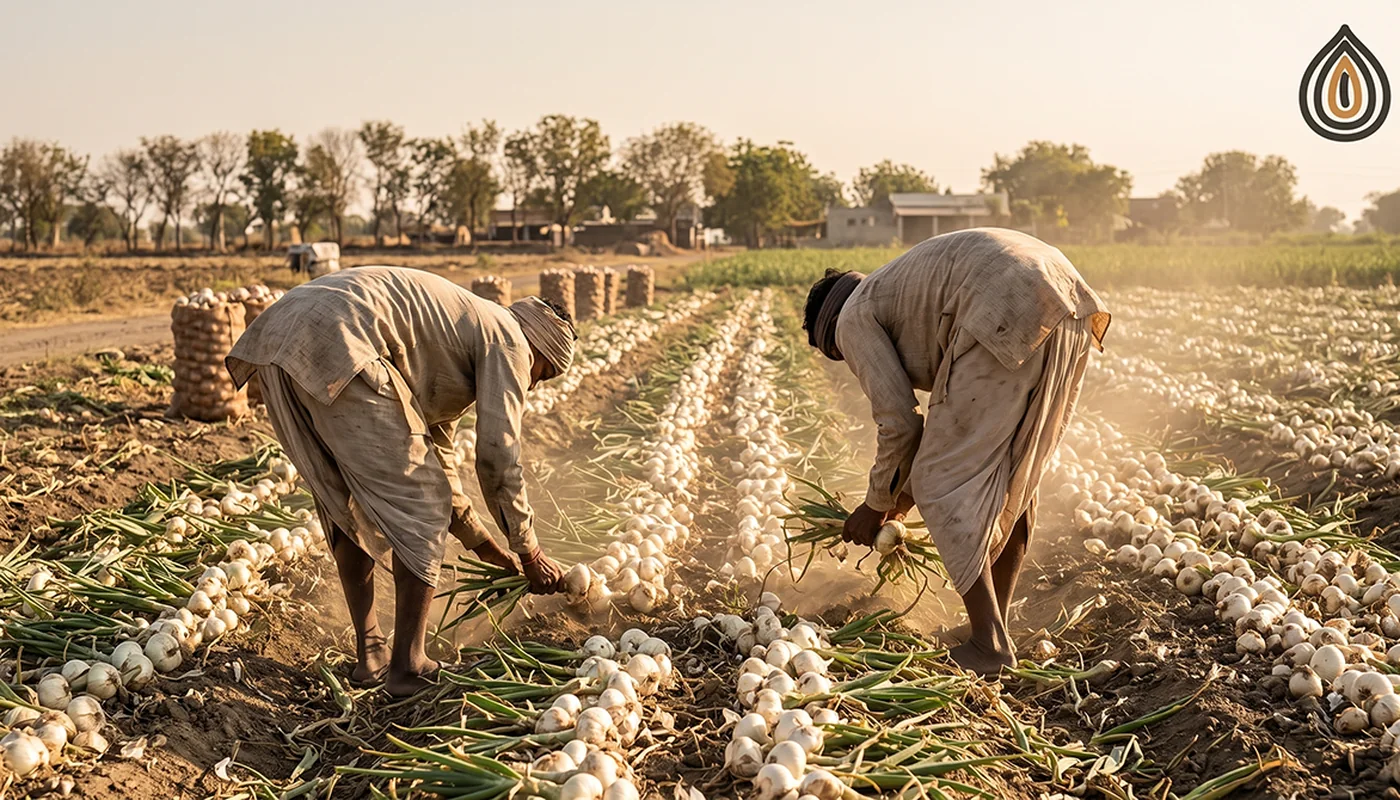
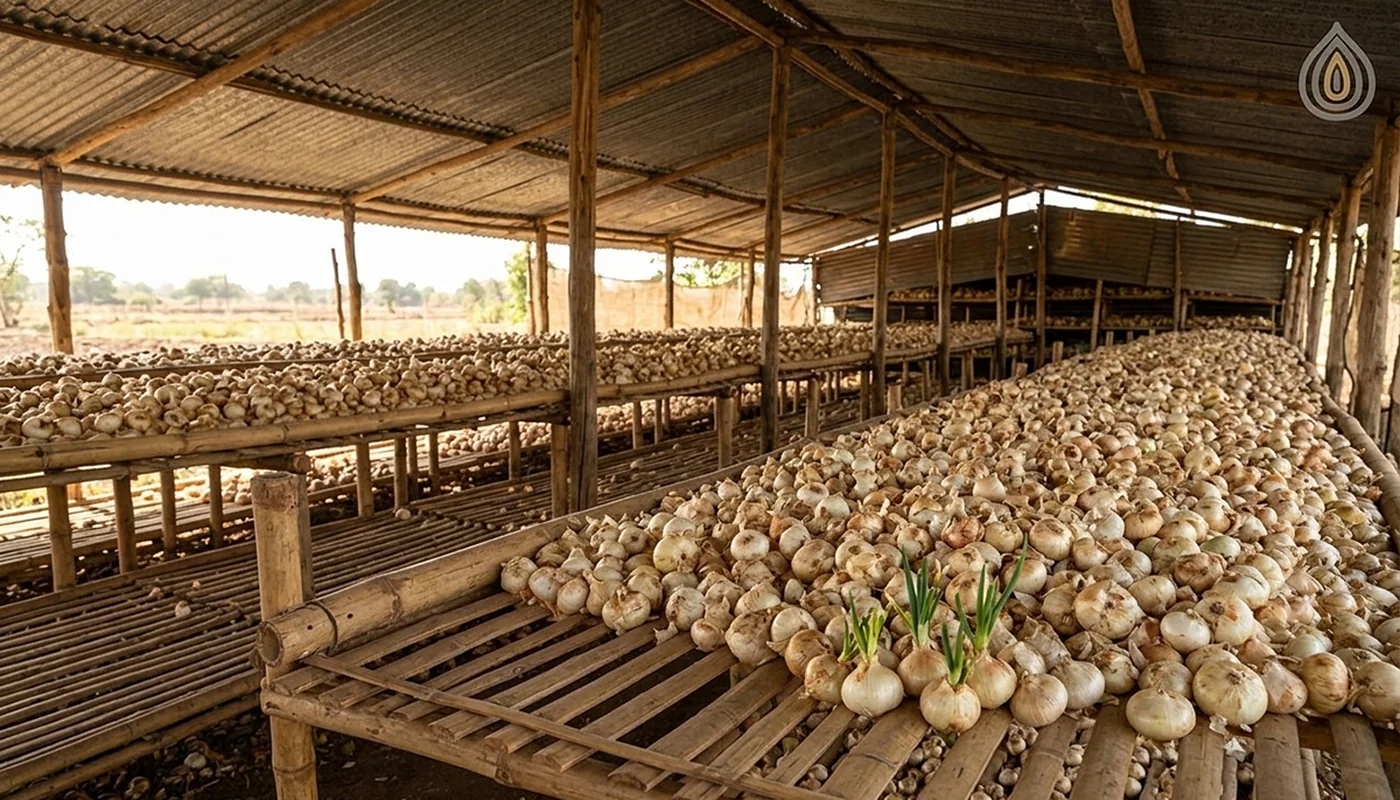
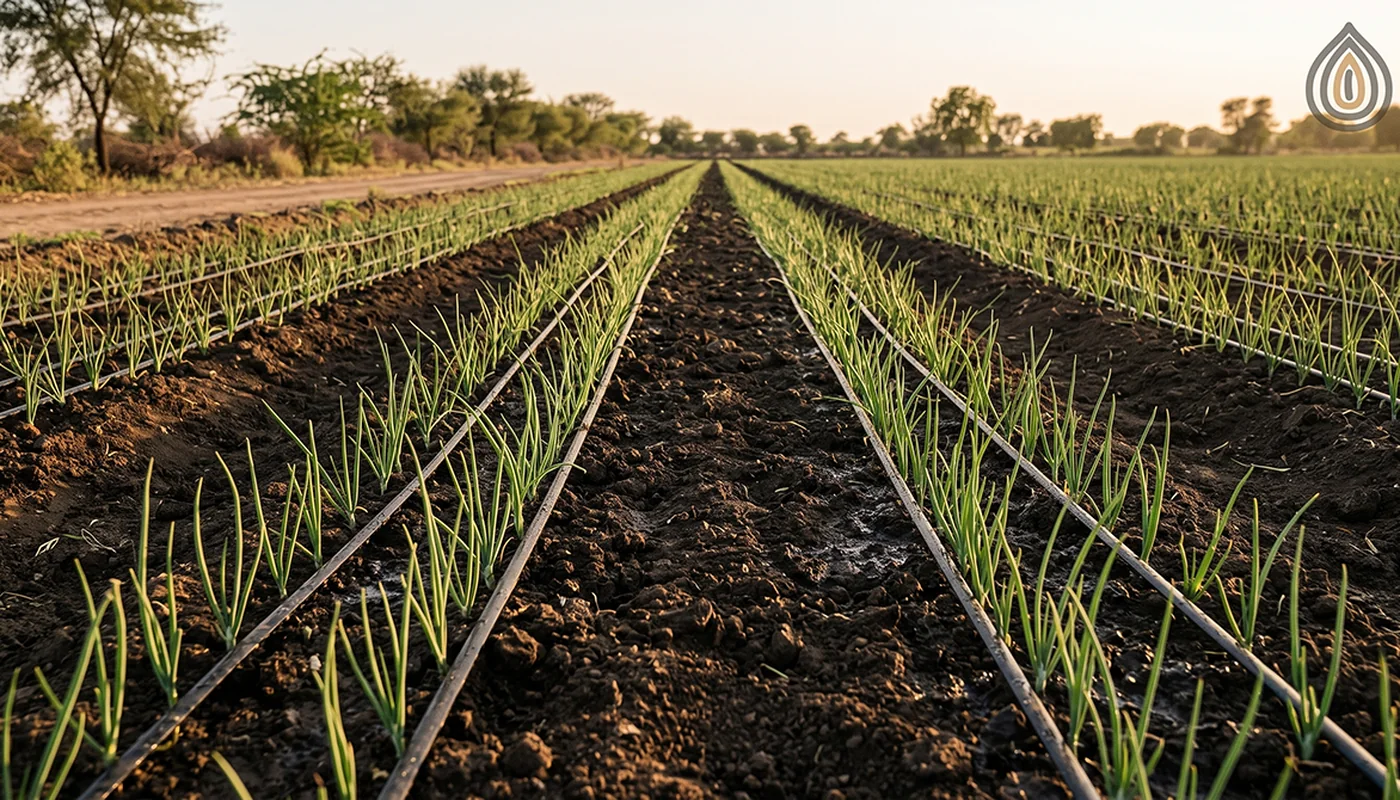
The white onion for dehydration is grown in the coastal talukas of Bhavnagar and Amreli districts in Gujarat's Saurashtra region, around Mahuva, Talaja and Rajula, on tens of thousands of hectares of light, well-drained loam. Nurseries are sown in October and November after the monsoon withdraws, seedlings are transplanted from November to early January, bulbs form through the cool nights of December to February, and lifting begins in the last week of February in the earliest fields and runs through May, with the peak in the second half of March and April. Yields are 25 to 35 tonnes per hectare in a normal year. The crop is grown for the plants: the varieties are local selections with 14 to 16 percent dry matter, a flat bulb and a mild flavour, and very little of it is eaten fresh. Smaller white onion areas in Maharashtra and Madhya Pradesh supply plants there and supplement Gujarat in a short year. The cluster that receives the crop is described in Mahuva, Gujarat: Inside India's Onion Dehydration Hub.
The dehydration calendar, month by month
| Month | In the field | In the plants | Raw onion price at the gate | Dry product price | What the buyer sees |
|---|---|---|---|---|---|
| October | Nurseries sown; kharif red onion harvested elsewhere | Off-season; stock sales; maintenance | No white onion trade | Firming from the summer low | Stock from the last crop; lead times short for stock cuts |
| November | Transplanting | Off-season; some plants close for weeks | - | Firming | Acreage estimates published; first read on next crop |
| December | Bulbs forming; cool nights | Stock thinning | - | Rising | Cover Q1 needs now; custom cuts need longer lead times |
| January | Bulbing; crop condition visible | Lowest stock of the year | - | High | Old-crop premium; plants prioritise regular buyers |
| February | Earliest fields lifted in the last week | First new-crop runs at month end | High for the first lots | Year's peak | Avoid buying if you can; new-crop samples from the earliest plants |
| March | Main harvest begins; peak from mid-month | Full capacity, 24 hours | Falls as arrivals build | New-crop price set; falls in a good crop | Sample the new crop; negotiate season contracts |
| April | Peak harvest | Peak production; most of the year's output | Season low in a good year | Firm on raw-material cost, then eases | Best time to fix season volume; plants at their busiest |
| May | Late harvest; farmers' storage filling | High production; red onion runs; stock building | Rising from the low as field supply ends | Firm | Last month to contract at new-crop prices |
| June | Monsoon arrives; fields to other crops | Production from stored onion; humidity control begins | Stored onion, rising | Easing as stock is sold | Good time to buy for Q3 delivery |
| July-September | Monsoon; storage losses mount | Reduced runs; stock sales; conditioned packing | Storage onion, rising | Softest months of the year | Buy for Q4 and Q1; check moisture on monsoon lots |
The pattern is a saw-tooth: prices fall into the harvest, firm while the plants pay for raw material, ease through the summer as stock is sold, and climb through the winter to a February peak. Customs data confirm it: in recent years India's average export unit value for dried onion has been firmest in February and around May, at roughly 170 rupees per kilogram FOB, and softest from July to November, at 143 to 148. The price mechanics behind the pattern are in Dehydrated Onion Price per kg.
Weather risks: unseasonal rain, heat and the monsoon
Three weather events break the pattern, and each has done so in recent years. Unseasonal rain in February or March, from western disturbances that reach Gujarat late, damages bulbs in the field and ruins the curing; a wet March in the harvest belt cuts yields, raises the reject rate at the plants and lifts the plant-gate price within a week. Heat waves in late March and April, when temperatures pass 42 °C, hasten maturity, reduce bulb size and stress the drying yards. And the monsoon itself, arriving in mid-June, sets the humidity in which the plants pack for the next three months and, through the previous year's rainfall, sets how much groundwater the winter crop had. A weak or late monsoon the year before means a smaller rabi crop; an excessive one delays transplanting. The 2023 and 2024 seasons showed the effect of unseasonal rain: reduced rabi yields, fresh-onion prices high enough to prompt government intervention, and dehydrated onion 30 to 60 percent dearer than the previous season. The buyer's defence is the calendar itself: the crop's condition is visible by February, and a season contract signed in April in a good year locks a price that a bad following year cannot touch.
Policy risks: export bans, duties and stock limits on fresh onion
Onion is India's most politically sensitive vegetable, and when fresh-market prices spike, usually in the autumn after a poor kharif, the central government acts: export bans on fresh onion, as in December 2023, minimum export prices, export duties of 20 to 40 percent, and stock-holding limits on traders. None of these measures has applied to dehydrated onion, which has stayed freely exportable through every episode, but all of them move the raw material price the plants pay. An export ban keeps fresh onion inside India and lowers domestic prices, which is good for the plants' raw-material costs in the following rabi; a free export market for fresh onion, or a government buying programme for buffer stocks, competes with the plants for the same bulbs and raises them. Policy moves are announced with little notice and lifted the same way, and their effect reaches the dehydration price through the 8-to-1 yield ratio within weeks. A buyer does not need to predict them, only to notice them: a fresh-onion export ban in the news is a signal that the next dehydration season's raw material may be cheaper, and its lifting is the opposite signal. The history of these episodes and their price effects is in Dehydrated Onion Price History 2020-2026.
Storage between harvests and why losses move late-season prices
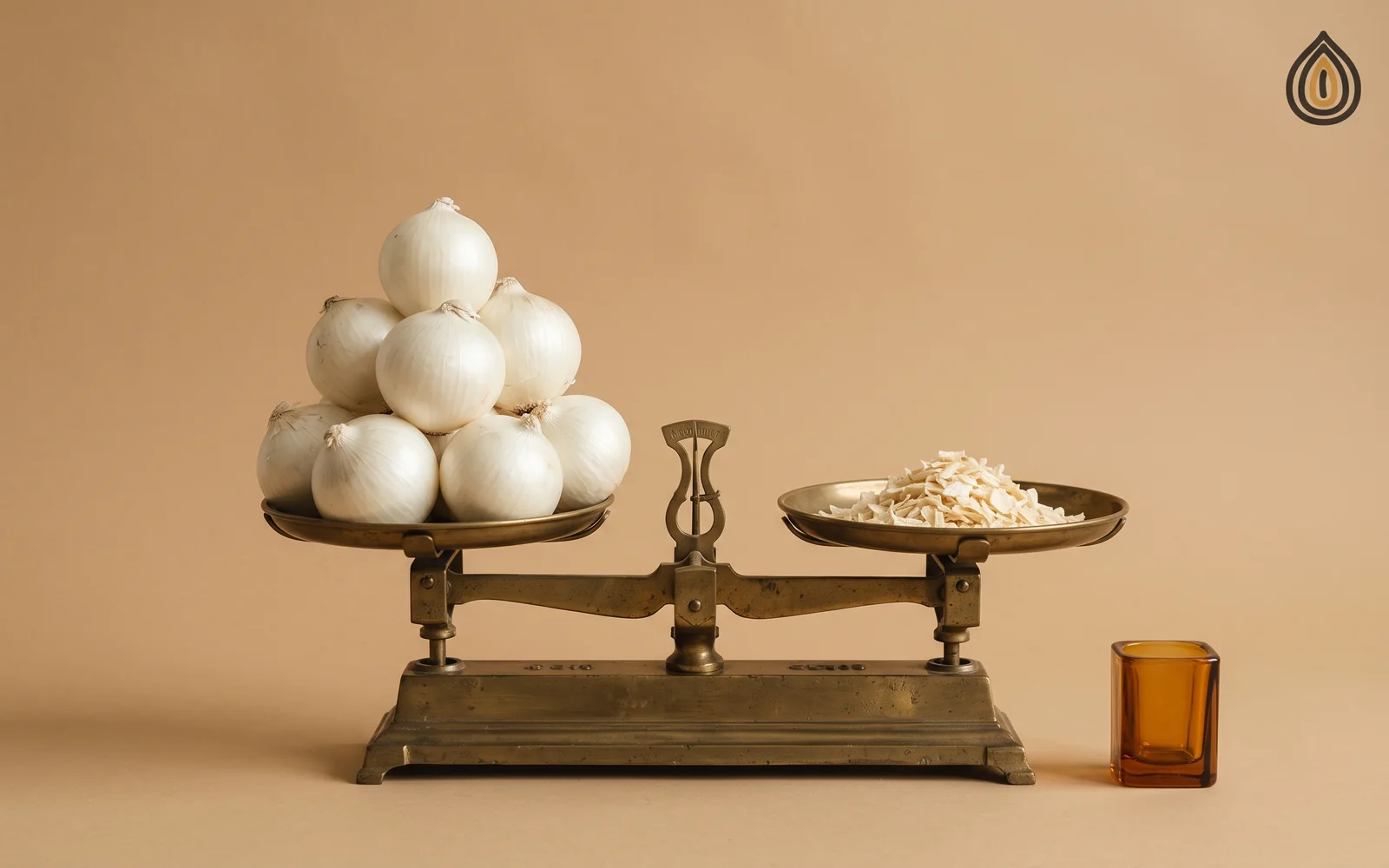
Rabi onion is stored from May to the next harvest in ventilated sheds, the "kanda chawls" of Maharashtra and their Gujarat equivalents, on farms and in traders' yards, where it loses weight and quality through sprouting, rotting and drying at a rate that climbs through the monsoon: 10 to 15 percent by August, 25 to 40 percent by December in a normal year, more in a humid one. The plants buy stored white onion from June onward to keep running after the field supply ends, and its price rises through the summer both because supply is shrinking and because the losses are priced in. This is the mechanism behind the winter climb in dehydrated onion prices, and it is why a plant's cost of producing a kilogram of flakes in September from stored onion is higher than in April from field onion, even though the September selling price is lower: the September product is mostly stock made in April being sold down, and the plants' new production in the off-season is small and dear. For a buyer, the practical consequence is that the "same" lot bought in October may have been dried in April, which is fine, or dried in September from six-month-old stored bulbs, which is a lower grade, and the lot record tells which. Storage effects on quality are in Monsoon and Dehydrated Onion.
How plants buy raw material through the season
Plants buy white onion in three ways, and the mix decides how quickly a crop shock reaches their prices. Contract farming, where the plant advances seed and inputs to growers and buys the crop at a pre-agreed price or a formula, gives the plant a known cost for part of its needs and the grower a guaranteed buyer; the certified plants cover a third to a half of their season this way. Spot purchase through brokers at the field or at the Mahuva market yard, priced by the day, covers the rest in season and is where the daily price signal comes from. And stored onion bought from farmers and traders from June onward, at rising prices, keeps the lines running through the off-season. A plant that has contracted well in a year when spot prices spike has a cost advantage it will share with regular buyers; one that buys spot is at the market's mercy and passes it on. Buyers can ask a supplier how its plants cover their raw material, and the answer explains a good deal about the supplier's price stability. The cost lines are in Dehydrated Onion Price per kg.
Quality through the year: new crop, stored crop, monsoon
The calendar shapes quality as much as price. New-crop product from March and April, dried from field-fresh bulbs in dry air, is the year's best: lowest counts, palest colour, fullest aroma, moisture with margin. Product dried in May and June from onion stored for a few weeks is nearly as good. Product dried from July to September, from stored bulbs in monsoon humidity, is a step down on every parameter: higher counts unless the plant conditions its rooms, slightly darker colour from bulbs that have begun to sprout or soften, and moisture at packing that needs watching. Product dried after October, from long-stored bulbs, is the year's weakest and the smallest in volume. The lot's drying month therefore matters, and it is in the lot record even when the bag shows only the packing date. A buyer with a sensitive application, a pale product, a treated tier, a retail pack, should specify new-crop product or ask for the drying month; one buying for cooked applications can take stock from any month at the corresponding price. The month-by-month quality picture from the ground is the subject of the season's reports, starting with the March 2026 Mahuva ground report.
Regional calendars and the red onion buyer
A buyer of red onion products follows a slightly different map, because red onion for dehydration is bought from the fresh-market crop rather than from a dedicated belt. Maharashtra's Nashik district is the centre of India's red onion trade, with a late kharif harvest from January to March and a rabi harvest from March to May that goes into storage; Madhya Pradesh follows a similar rabi calendar; Karnataka and Andhra Pradesh supply the kharif crop from October. The Mahuva plants buy red onion mostly in April and May, when the Maharashtra and Gujarat rabi red is abundant and cheapest, and dry it in runs between the white production; some plants buy stored red through the summer for repeat orders. The consequence for a buyer is that red onion products are best contracted in April and May, are made in the largest volumes then, and become slower and dearer to obtain from July onward, when the plants are drawing on stored red bulbs that have already begun to lose colour. Pink onion, grown in small pockets, follows the same rabi timing and is dried strictly to order. The colour question is set out in White vs Red Dehydrated Onion.
Reading the crop estimate: acreage, yield and the February view
The size of the crop that will set the year's price is knowable, in outline, months before harvest, and the trade reads three numbers. Acreage: the area transplanted by January, reported by the state agriculture departments and visible to anyone who drives the Bhavnagar to Mahuva road in December, where every field is either onion or not. A year with high onion prices the previous autumn brings more acreage, because farmers plant what paid last time; a year with low prices brings less. Yield: set by the winter's weather and water, and estimated by the plants' field staff from bulb size in February; 25 to 35 tonnes per hectare is the normal range, and unseasonal rain or a heat wave takes it to the bottom. Dry matter: sampled from the first lots, since a wet crop with 13 percent dry matter costs the plant a kilogram more onion per kilogram of product than a 15 percent crop. Acreage times yield gives the field supply; dry matter gives the yield ratio; the two together give a plant its raw-material cost per kilogram of product before the season starts, which is why the certified plants can quote season contracts in April with some confidence. A buyer who asks a supplier in February for its view of acreage, yield and dry matter learns whether the supplier is close to the fields or reading the same newspaper.
Matching the Indian calendar to a European planning year
European food manufacturers plan on a calendar year or a fiscal year, budget in the autumn, and negotiate ingredient contracts in the fourth quarter, which is the worst moment in the Indian onion year to fix a dehydrated onion price: stock is thinning, the next crop is unknown and the February peak is ahead. The mismatch explains why so many European buyers pay the winter price. Two adjustments resolve it. Fix the onion contract in April or May, outside the main budgeting round, on a season basis from June to the following May, and budget the following year on that known price. Or, if procurement rules force a calendar-year contract, sign it in the fourth quarter with an indexed price tied to the following April's new-crop level, with a cap and a floor, so that a good crop is passed on and a bad one is bounded. Either way, the buyer's stock plan should carry six to nine months of consumption through the winter and be replenished in the summer, which is the mirror image of the plants' own cycle. The contract mechanics are in B2B Contract Terms for Dehydrated Onion, and the Q4 planning problem in its own guide, Q4 Demand Planning.
Fresh onion exports: a different calendar
Buyers who take fresh onion as well as dried should know that the fresh trade runs on the whole three-crop calendar and on a different logic. Fresh red onion is exported from October to May from whichever crop is being harvested, mostly to the Gulf, Bangladesh, Sri Lanka and Malaysia, and it is the trade the export bans and duties hit, because it competes directly with Indian consumers for the same bulbs. Fresh white onion from Gujarat is exported in smaller volumes in the rabi months. A fresh consignment is a living cargo with a three-to-five-week shelf life at sea, a phytosanitary certificate without exception, and arrival-condition risks that the dried product does not have; the seasons, grades and shipping windows are on the fresh onion pages. A buyer combining the two should not assume that a good dehydration year is a good fresh year or the reverse: a fresh export ban is bad for the fresh business and good for the dehydration plants' raw-material cost in the same season.
The buyer's calendar: sample, contract, cover, avoid
| When | What to do | Why |
|---|---|---|
| November-January | Read the acreage estimates and crop reports; cover Q1 needs from stock in December | The next crop's size is forming; January and February are the dearest months |
| Late February-March | Request new-crop samples from two or three plants; test them in your process | The year's best product; the new price level is being set |
| April-May | Fix season volume: a fixed-price or indexed contract with a shipment schedule | Plants know their raw-material cost; volume commitments earn the best terms |
| June-September | Buy spot or call off for Q3 and Q4 delivery; specify moisture and ask for drying month | Softest prices; monsoon lots need a moisture check |
| October-December | Take contracted call-offs; place Q1 orders early; avoid new spot buying late | Stock thins and prices climb toward February |
| Any month | Keep 6 to 9 months of consumption in the pipeline; never let stock run to zero in January | The February gap is the one every unprepared buyer pays for |
The pattern is worth stating plainly: buy in the season, ship through the summer, do not go to market in the winter. A manufacturer who takes two containers a year gets the best result by fixing both in April, one for June shipment and one for September. A distributor turning stock quarterly buys a container every quarter but contracts the price in April. The contract forms are in B2B Contract Terms for Dehydrated Onion.
What to watch, and where
A buyer can follow the crop for free with five sources. The Indian Ministry of Agriculture's horticulture estimates give acreage and production by crop and state, published in stages through the season. The India Meteorological Department's monsoon forecast in April and its updates through the summer give the water outlook for the next winter crop. The Lasalgaon market in Maharashtra, India's largest onion market, publishes daily prices that the whole trade quotes, and the Mahuva market yard price for white onion, available through Gujarat's agricultural marketing portal, is the direct signal for dehydration raw material. Customs data from the Directorate General of Commercial Intelligence and Statistics give the monthly export unit value for dried onion under HS 0712.20 with a two-month lag. And the trade press, Indian business newspapers and agricultural news services, reports the policy moves within hours. A buyer who checks the Mahuva yard price weekly from February to May and the customs unit value monthly knows as much about the price level as the exporter does. The customs data reading is explained in HS Code 071220 for Dried Onion.
How KlarHarvest follows the season
KlarHarvest is in Bhavnagar, an hour from the fields, and the season runs through the office: new-crop samples go out to buyers from the first March runs, season contracts are quoted in April and May with the plant's raw-material cover behind them, and monsoon lots are specified at 5 percent moisture and shipped with the drying month on the lot record. Through the year we publish ground reports on this blog, March, April, May and August, with arrivals, yields, yard prices and plant capacity from the district, so that buyers see what we see. Buyers who tell us their annual volume in March get a season plan with shipment months and a price for each; the request goes through the quote form, and the process is on our process.
Frequently asked questions
When is the onion harvest season in India?
India harvests three onion crops: kharif from October to December, late kharif from January to March, and rabi from March to May. The rabi crop is about 60 to 65 percent of production and is the only one that supplies the dehydration plants.
When is dehydrated onion made in India?
Mostly from March to June, when the rabi white onion is harvested in Gujarat and the plants run at full capacity in dry air. Smaller volumes are dried from stored onion through the monsoon and autumn, and stock made in season is sold through the winter.
When is dehydrated onion cheapest?
From July to November, when the season's production is finished and plants sell stock. It is dearest in January and February, before the new crop, and firm in April and May while plants pay for raw material.
When should I sample the new crop?
From the last week of February through March, when the first new-crop lots are dried. Test them in your process and use the results to fix season volume in April or May.
How do fresh onion export bans affect dehydrated onion?
They do not apply to dehydrated onion, which stays exportable, but they lower the domestic price of the fresh onion the plants buy, which makes the following season's raw material cheaper. Lifting a ban does the opposite.
Does the drying month matter?
Yes. Product dried in March and April from field-fresh bulbs is the year's best; product dried from stored bulbs in the monsoon is a step down on counts, colour and moisture margin. The lot record carries the drying month even when the bag shows the packing date.
How big is the Indian onion crop?
Roughly 24 to 27 million tonnes a year on 1.7 to 1.9 million hectares, second in the world after China. The white onion for dehydration is a small specialised part of it, grown mainly in Bhavnagar and Amreli districts of Gujarat.
Next step
If you buy through the year, tell us your annual volume and the months you need it, and request a quote for a season plan: shipment months, cuts and a price for each, built on the crop as it stands. For the new crop as it arrives, request a sample in March and it comes from the first runs with the lot's drying date.