- What landed cost is and where quotes stop
- Line 1: the plant price, and how it is built
- Line 2: origin costs to FOB
- Line 3: sea freight and its surcharges
- Line 4: insurance
- Line 5: duty on the customs value
- Line 6: destination port and clearance
- Line 7: trucking to the warehouse
- Line 8: the importer's own costs
- The worked container: white flakes to Hamburg
- Granules and powder: why the container load changes everything
- LCL and pallet orders
- Tiers, colours and organic: the premiums on top
- Currency and timing
- Comparing a trader's delivered price
- The calculator
- The same container to Rotterdam, Felixstowe and Koper
- A 40-foot container: when the bigger box pays
- What moves the landed cost most: a sensitivity table
- Landed cost into a recipe: cost per portion
- How KlarHarvest quotes landed cost
- Frequently asked questions
Judge the product, not the words
200-500 g from a current lot, dispatched by courier with the lot lab report.
Request a sampleThe dehydrated onion landed cost is the only price that matters to a buyer, and it is the one that no supplier's quote states, because a quote ends at a port and a landed cost ends at a warehouse shelf. Between the two sit a dozen lines, some fixed percentages and some variable sums, and a buyer who cannot build them from a quote cannot compare two suppliers, cannot compare a Dutch trader's delivered price with an Indian exporter's FOB, and cannot cost a recipe. This guide builds every line on a real container, ten tonnes of white onion flakes from Mahuva to a warehouse near Hamburg in the 2026 season, then repeats it for granules and powder, where the freight per kilo is different because the container carries more, and gives a calculator a buyer can fill in with its own numbers.
It is written for buyers, purchasing managers and product developers, with March to June 2026 figures; freight in particular moves, and the forwarder's quote replaces the figure here. The Incoterm mechanics that decide which lines a seller's price already contains are in FOB, CIF or DAP?; this guide is the arithmetic.

What this guide covers
- What landed cost is and where quotes stop
- Line 1: the plant price, and how it is built
- Line 2: origin costs to FOB
- Line 3: sea freight and its surcharges
- Line 4: insurance
- Line 5: duty on the customs value
- Line 6: destination port and clearance
- Line 7: trucking to the warehouse
- Line 8: the importer's own costs
- The worked container: white flakes to Hamburg
- Granules and powder: why the container load changes everything
- LCL and pallet orders
- Tiers, colours and organic: the premiums on top
- Currency and timing
- Comparing a trader's delivered price
- The calculator
- The same container to Rotterdam, Felixstowe and Koper
- A 40-foot container: when the bigger box pays
- What moves the landed cost most: a sensitivity table
- Landed cost into a recipe: cost per portion
- How KlarHarvest quotes landed cost
- Frequently asked questions
What landed cost is and where quotes stop
Landed cost is the total spent to put a kilogram of usable product on the buyer's shelf: the goods, every transport and handling charge, insurance, duty and clearance, divided by the kilograms that arrived. Import VAT is excluded, since a registered importer recovers it, and so are the buyer's internal handling and working capital, which belong to the buyer's own costing rather than the purchase. A supplier's quote stops at an Incoterm: FOB Pipavav ends with the goods on the ship, CIF Hamburg ends with the ship at the port and the insurance paid, DAP ends at the door with duty and VAT still to pay. Every quote therefore needs the remaining lines added before it is a landed cost, and the lines are the same for every supplier, which is what makes the comparison fair once they are added.
Line 1: the plant price, and how it is built
The plant's ex-factory price is raw onion times the yield ratio plus conversion plus the plant's margin, and in the 2026 season for white flakes it runs 110 to 125 rupees per kilogram: a yard price of 5.0 to 5.5 rupees at the April low times a ratio of 8.5 gives a raw line of 42 to 47, conversion of 45 to 55 covers fuel, labour, power, packing and overhead, and the plant takes 8 to 15 percent on top. An exporter sourcing from the plant adds its own costs and margin, and the product leaves the plant gate at 118 to 135. The multiplier that makes the yard price dominant, and the way the plant price moves through the year, are in 8 to 1: The Fresh-to-Dry Yield Ratio and What Does Dehydrated Onion Cost per Kilogram?
Line 2: origin costs to FOB
Between the plant gate and the ship come the trucking to Pipavav, 18,000 to 25,000 rupees for a container from Mahuva; the customs house agent and the shipping bill, 8,000 to 15,000; origin terminal handling, 10,000 to 14,000; the e-seal, documentation and the forwarder's origin fees, 4,000 to 8,000; and the exporter's margin on the movement. On a ten-tonne container of flakes the origin costs are 45,000 to 60,000 rupees, 4.5 to 6 rupees per kilogram; on a seventeen-tonne container of granules the same rupees are 2.6 to 3.5 per kilogram. The exporter's FOB price includes all of it, and in the 2026 season white flakes quote at 145 to 165 rupees FOB, which at 100 rupees to the euro is 1.45 to 1.65 euros per kilogram. The origin document set that the costs pay for is in Export Documents for Dehydrated Onion from India.
Line 3: sea freight and its surcharges
Freight is the most variable line and the one most often misquoted. The all-in rate for a 20-foot container from Pipavav to Hamburg or Rotterdam in the first half of 2026 ran 1,000 to 2,000 euros, port to port, built from a base ocean rate, a fuel surcharge, a Cape or Red Sea contingency surcharge when the service is routed south, a peak season surcharge in the busy months, and the small fixed items; origin terminal handling is usually inside the exporter's FOB and destination terminal handling is charged at the other end. A 40-foot container costs 1.5 to 1.8 times the 20-foot rate and carries twice the cargo. Per kilo, the freight depends on the load: at 1,400 euros a container, flakes at ten tonnes carry 14 cents per kilogram, granules at seventeen tonnes 8 cents, and powder at nineteen tonnes 7 cents. The lane, its routing question and the surcharge list are in Pipavav to Hamburg, and the rate history in Freight Rates India to Europe 2026-2027.
Line 4: insurance
Cargo insurance under Institute Cargo Clauses (A) for 110 percent of the CIF value costs 0.15 to 0.3 percent of the insured value, 25 to 55 euros on a container of flakes, under an exporter's open cover on CIF terms or the buyer's own on FOB; per kilo it is a fraction of a cent and it is the line a buyer should never economise on, since a wetted container is a total loss of the cargo. The cover and the claims process are in Marine Insurance and Claims for Dehydrated Onion Shipments.
Line 5: duty on the customs value
EU import duty on CN 0712 20 00 is 6.4 percent of the customs value, and the customs value is the CIF value at the EU border, goods plus freight plus insurance, whatever term the goods were bought on; a FOB buyer adds its freight and insurance to the invoice before the duty is calculated. On a container of flakes at 1.54 euros FOB with 1,400 euros of freight and 40 of insurance, the CIF value is 16,840 euros and the duty 1,078, 10.8 cents per kilogram. There is no preferential rate for India, no quota and no anti-dumping measure. The UK charges a comparable duty on its own tariff; the US charges 21.3 percent on most cuts and 29.8 on powder, which is why American landed costs run higher. The classification and the other markets' rates are in HS Code 071220 for Dried Onion.
Line 6: destination port and clearance
At Hamburg or Rotterdam the container incurs destination terminal handling of 200 to 320 euros, the carrier's documentation and release fees of 50 to 120, the customs broker's fee of 80 to 150 for the import declaration, and, if the box is selected for examination, an examination fee and a day or two of storage; a clean clearance costs 350 to 600 euros a container, 3.5 to 6 cents per kilogram on flakes. Demurrage and detention, if the container overstays the carrier's free days, are the avoidable extra, at 50 to 150 euros a day. The clearance steps, and how to keep them to a day, are in Customs Clearance for Dehydrated Onion in the EU.
Line 7: trucking to the warehouse
A container truck from Hamburg to a warehouse within 100 kilometres costs 300 to 450 euros including the empty return; to 300 kilometres, 500 to 750; to southern Germany from Rotterdam, 800 to 1,100 by road or less by barge to a Rhine port. Per kilo on flakes, 3 to 11 cents. A buyer without a container-height dock pays for a tail-lift or a transload at a depot, which adds 150 to 300 euros. The German entry points and the regional logistics are in Importing Dehydrated Onion into Germany.
Line 8: the importer's own costs
Four costs sit inside the importer's business rather than the shipment and are counted by some buyers and not others: verification testing, 300 to 700 euros on a first lot and 100 to 200 on a routine one, 1 to 7 cents per kilogram; unloading and warehouse receipt, 80 to 150 euros a container; working capital, the cost of 20,000 euros tied up for the six to eight weeks between the advance and the goods' arrival, which at a business's own cost of money is 100 to 300 euros; and the buyer's staff time on documents and supplier management, which a large importer counts in cents per kilo and a small one does not count at all. Included in a landed cost, they add 3 to 10 cents per kilogram; a buyer comparing against a trader's delivered price should include them, since the trader's price absorbs the equivalent.
The worked container: white flakes to Hamburg
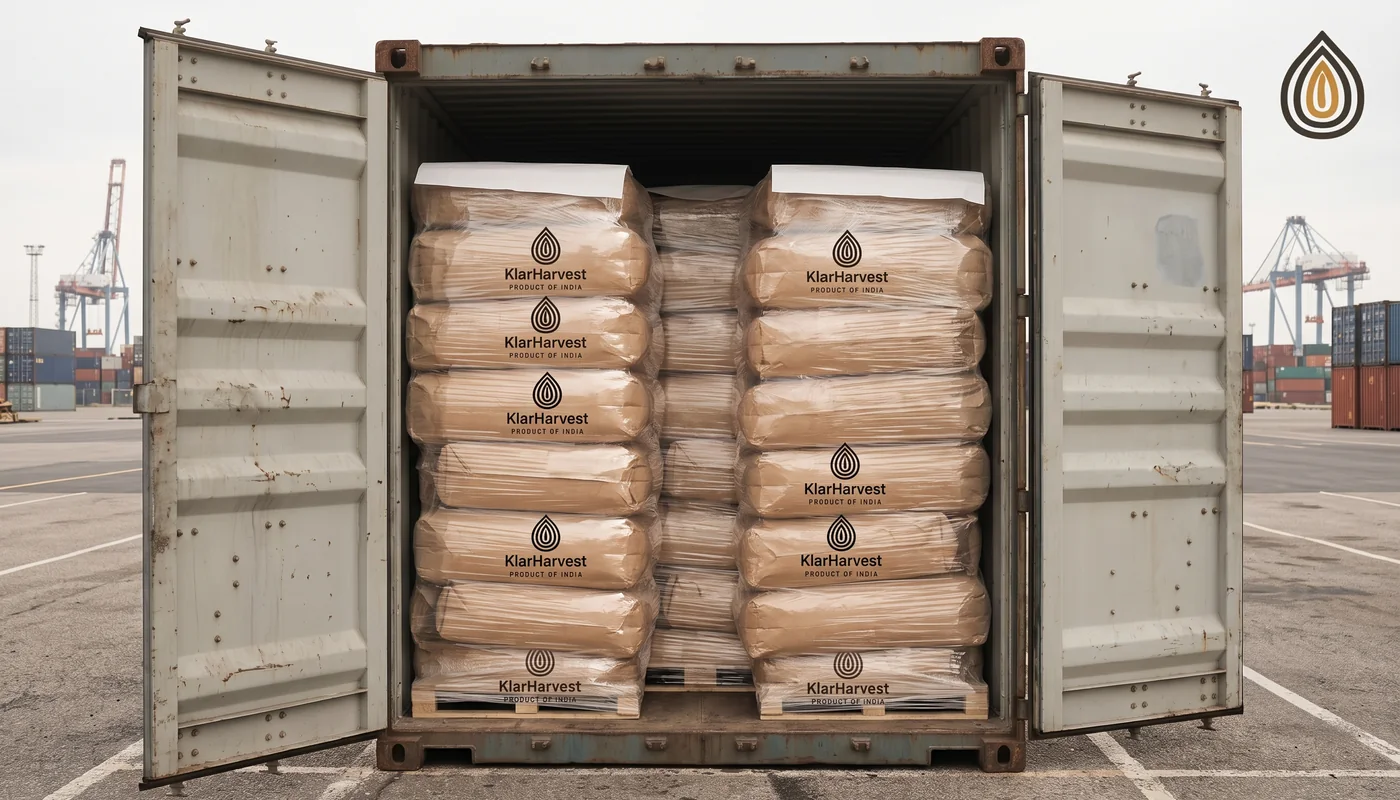
Ten tonnes of white onion flakes, standard tier, 20 kilogram bags, 20-foot container, Pipavav to a warehouse 100 kilometres from Hamburg, June 2026.
| Line | € total | € per kg | Share of landed |
|---|---|---|---|
| FOB Pipavav (plant price + origin costs + exporter) | 15,400 | 1.540 | 81 % |
| Sea freight, 20 ft, Cape routing with surcharges | 1,400 | 0.140 | 7 % |
| Insurance, ICC(A), 110 % of CIF | 40 | 0.004 | 0.2 % |
| CIF Hamburg | 16,840 | 1.684 | |
| Duty 6.4 % on CIF | 1,078 | 0.108 | 6 % |
| Destination THC, release, documentation | 320 | 0.032 | 2 % |
| Customs broker | 120 | 0.012 | 0.6 % |
| Trucking, 100 km, with empty return | 400 | 0.040 | 2 % |
| Landed at the warehouse, before importer's costs | 18,758 | 1.876 | |
| Verification test, receipt, working capital | 350 | 0.035 | 2 % |
| Full landed cost | 19,108 | 1.911 | 100 % |
| Import VAT 7 %, recovered, not a cost | (1,254) | (0.125) |
The landed cost is 24 percent above FOB, and the split is the one to remember: the goods are four fifths of it, freight and duty are most of the rest, and clearance and trucking together are under five percent. A change of 300 euros in the freight rate moves the landed cost by 3 cents; a change of 10 rupees in the plant price moves it by 10 cents. The plant price is where a buyer's attention belongs.
Granules and powder: why the container load changes everything
The lines that are per container rather than per kilo, freight, THC, broker, trucking, are divided by more kilos for the denser cuts, and the landed premium over FOB shrinks.
| Flakes | Chopped | Minced | Granules | Powder | |
|---|---|---|---|---|---|
| Kg in a 20 ft container | 10,000 | 12,500 | 14,500 | 17,000 | 19,000 |
| FOB, €/kg (June 2026) | 1.54 | 1.54 | 1.56 | 1.58 | 1.60 |
| Freight + insurance per kg | 0.144 | 0.115 | 0.099 | 0.085 | 0.076 |
| Duty 6.4 % on CIF per kg | 0.108 | 0.106 | 0.106 | 0.107 | 0.107 |
| Destination, broker, trucking per kg | 0.084 | 0.067 | 0.058 | 0.049 | 0.044 |
| Importer's costs per kg | 0.035 | 0.028 | 0.024 | 0.021 | 0.018 |
| Landed, €/kg | 1.91 | 1.86 | 1.85 | 1.84 | 1.85 |
| Landed premium over FOB | 24 % | 21 % | 19 % | 16 % | 15 % |
Powder that costs 6 cents more than flakes at the plant lands 6 cents cheaper, because a container carries nearly twice as much of it; a buyer who can use granules or powder in place of flakes saves on freight what it never sees on a quote. The loads per cut and the reasons are in How a Dehydrated Onion Container Is Loaded.
LCL and pallet orders
A pallet or a few pallets by LCL replace the container's freight with a consolidator's charge per cubic metre or per tonne, plus origin and destination consolidation fees that are fixed per shipment and therefore heavy on a small one. A single Europallet of flakes, 600 kilograms, lands at 2.60 to 3.20 euros per kilogram against the container's 1.91; three pallets at 2.20 to 2.60; a full container is where the per-kilo cost settles. Air freight for a first pallet adds 2 to 4 euros per kilogram and is a trial cost rather than a supply cost. The LCL structure and its destination charges are in LCL or Full Container?, and the small-buyer options in Buying Dehydrated Onion as a Small Food Business.
Tiers, colours and organic: the premiums on top
The premiums are rupees at the plant and become euros per kilo at the warehouse with duty on top, since duty is a percentage of the CIF value and rises with the price.
| Product | Premium at FOB, ₹/kg | Landed, €/kg (flakes basis) |
|---|---|---|
| White, standard | baseline 154 | 1.91 |
| White, low bacterial | +8 to +15 | 2.00 to 2.08 |
| White, extra low bacterial | +20 to +35 | 2.13 to 2.29 |
| Pink | +8 to +15 | 2.00 to 2.08 |
| Red | +15 to +30 | 2.08 to 2.24 |
| Toasted | +30 to +50 | 2.24 to 2.46 |
| Organic white | +250 to +370 | 4.60 to 5.90 |
| Custom mesh band | +3 to +8 | 1.94 to 2.00 |
| Private-label printed sack | +2 to +4 | 1.93 to 1.96 |
The tiers are in Low Bacterial and Extra Low Bacterial Dehydrated Onion, the colours in White vs Red Dehydrated Onion, and organic's price gap in Organic Dehydrated Onion from India.
Currency and timing
The plant's costs are in rupees, the freight is in dollars, the duty and the destination costs are in euros, and a buyer's landed cost moves with two exchange rates between quotation and delivery: a 2 percent move in the rupee against the euro over the six to eight weeks of an order moves the goods line by 3 cents, and a 2 percent move in the dollar moves the freight by a fraction of a cent. A euro invoice from the exporter fixes the goods line and puts the rupee risk on the seller; a dollar freight quote fixed at booking puts the freight risk on the forwarder. Timing moves more than currency: the same container costs 8 to 15 percent more landed in September than in May because the plant price follows the stored-onion yard, as Monsoon and Dehydrated Onion explains, and a buyer contracting at the April low with scheduled shipments fixes the goods line for most of the year. The instruments that fix the price and the terms are in Payment Terms for Dehydrated Onion Imports.
Comparing a trader's delivered price
A Dutch or Belgian trader's delivered price for white flakes in Germany runs 2.30 to 3.50 euros per kilogram in 2026, against the 1.91 landed above, and the honest comparison adds to the direct figure what the trader's price includes and the direct route does not: stock on the ground and a two-day lead time, an EU invoice with no import paperwork, 30 to 60 days' credit, quality risk carried by the trader, and the aggregation of small orders. For a buyer at container volume those are worth 10 to 20 cents per kilogram at most, and the trader's margin above that is the price of not importing; for a buyer at two pallets a month they may be worth the whole gap. The comparison, with the volumes at which each side wins, is in Buying Dehydrated Onion via Dutch Traders or Direct from India.
The calculator
Fill the lines with your own quote and your forwarder's figures.
- FOB price per kg from the quote, in euros. If the quote is CIF, take the CIF line and skip steps 2 and 3.
- Freight per container from the forwarder, all-in port to port, divided by the kilos in the container for your cut (10,000 flakes, 12,500 chopped, 14,500 minced, 17,000 granules, 19,000 powder).
- Insurance: 0.2 percent of (FOB + freight) times 1.1, per kg.
- CIF per kg = 1 + 2 + 3.
- Duty = CIF per kg times 0.064 (EU), or your market's rate.
- Destination charges and broker per container, divided by the kilos: typically 400 to 600 euros.
- Trucking per container to your door, divided by the kilos.
- Landed per kg = 4 + 5 + 6 + 7.
- Importer's costs if you count them: testing, receipt and working capital per container, divided by the kilos.
- Full landed per kg = 8 + 9. Compare across suppliers, cuts and the trader's delivered price on this line only.
A buyer who runs the calculator on two quotes finds that a 5 cent difference at FOB survives as a 5 cent difference landed, and that a cut change or a container size change moves the result more than most supplier negotiations do.
The same container to Rotterdam, Felixstowe and Koper
The sea leg to the four northern gateways costs within a few percent of the same, and the differences in landed cost come from the destination side: the port's handling charges, the customs regime and the trucking to the buyer. Rotterdam's terminal handling is a little lower than Hamburg's and its clearance faster, and a German buyer in the west or south clearing there through a fiscal representative removes the import VAT cash flow entirely; Felixstowe adds the UK's own duty and its post-Brexit clearance through IPAFFS-adjacent systems, with a comparable rate on dried onion, and a buyer there budgets 0.5 to 1 cent per kilogram more for the customs process; Koper and Trieste on the Adriatic reach southern Germany and Austria a week earlier than Hamburg, with trucking to Munich at 500 to 700 euros against 900 to 1,100 from Rotterdam, and a landed cost 2 to 4 cents per kilogram lower for a Bavarian buyer. For the flakes container, the spread across the four is about 5 cents per kilogram at the extremes, which is less than a routing change on the sea leg. The lane and the gateways are in Pipavav to Hamburg, and the UK's separate regime in Importing Dehydrated Onion into the UK.
A 40-foot container: when the bigger box pays
A 40-foot container carries twice the cargo of a 20-foot at 1.5 to 1.8 times the freight, and the per-container destination charges rise by less than that, so a buyer who can fill one lands the product 4 to 6 cents per kilogram cheaper.
| 20 ft, flakes | 40 ft, flakes | 20 ft, granules | 40 ft, granules | |
|---|---|---|---|---|
| Kg loaded | 10,000 | 20,000 | 17,000 | 34,000 |
| Freight + insurance | €1,440 | €2,400 | €1,440 | €2,400 |
| Duty at 6.4 % of CIF | €1,078 | €2,125 | €1,812 | €3,592 |
| Destination, broker, trucking | €840 | €1,050 | €840 | €1,050 |
| Landed, €/kg (before importer's costs) | 1.876 | 1.819 | 1.822 | 1.788 |
| Saving per kg for the 40 ft | 5.7 cents | 3.4 cents |
The saving is real and the condition is the buyer's ability to use twenty tonnes of flakes, a year's supply for many manufacturers, within the shelf life and the warehouse space; a 40-foot of a single cut suits the large soup and meat processors, and a 40-foot mixed across cuts suits a blender, as Mixed Containers: Combining Onion Cuts, Garlic and Vegetables sets out. The high-cube 40-foot adds volume, not weight, and helps flakes most.
What moves the landed cost most: a sensitivity table
| Change | Effect on landed cost of flakes, €/kg | Note |
|---|---|---|
| Yard price of raw onion +1 rupee | +0.085 to +0.09 | Through the 8.5 ratio; the largest single lever |
| Plant price +10 rupees | +0.10 (+0.106 with duty on it) | Season, tier, colour |
| Freight +300 euros a container | +0.030 (flakes), +0.018 (granules) | Routing, peak season |
| Rupee weakens 2 % against the euro | -0.031 | On a rupee-based price; nil on a euro invoice |
| Switch flakes to granules, same recipe by flavour | -0.05 to -0.07 | Container load; see the cut table |
| 20 ft to 40 ft | -0.034 to -0.057 | If the volume can be used |
| Low bacterial tier | +0.09 to +0.16 | Including duty on the premium |
| Trucking 100 km to 400 km | +0.035 | |
| LCL, one pallet, instead of a container | +0.70 to +1.30 | Fixed consolidation fees |
| Contract at April low instead of buying in September | -0.15 to -0.28 | The season's swing on the plant price |
Read down the table and the priorities appear: the raw onion and the season decide the landed cost, the cut and the container size are the buyer's own levers, freight and currency are noise by comparison, and the small-order penalty dwarfs everything else. A buyer who negotiates 2 cents off the freight and buys in September has lost 20 cents to the calendar; the season's mechanics are in Monsoon and Dehydrated Onion and the contracting timing in Payment Terms for Dehydrated Onion Imports.
Landed cost into a recipe: cost per portion
The landed figure is the one a product developer costs with, and at 1.91 euros per kilogram for flakes and 1.85 for granules the onion in the finished product is small: a 250 millilitre portion of soup at 1 percent dry onion carries 2.5 grams, under half a cent; a 400 gram jar of cooking sauce at 2 percent, 8 grams, 1.5 cents; a 100 gram bag of snack seasoning at 12 percent onion applied at 2 percent to the snack, 0.24 grams per bag, a twentieth of a cent; a 60 gram onion roll with 1.5 grams of topping, 0.3 cents. The comparison with fresh onion on the same landed basis, once the 8.5-to-1 equivalence and the peeling waste and labour are counted, is in Dehydrated vs Fresh Onion: The Real Cost per Kilo, and the dosing rates by product in the application guides for soups and sauces, meat and bakery.
How KlarHarvest quotes landed cost
Every KlarHarvest quote carries FOB and CIF side by side and a landed-cost estimate for the buyer's country and port, built on the forwarder's current rate, the container load for the cut, the duty and the typical destination and trucking figures, so that the number a buyer plans with is the number it will pay; the basis is shown line by line and the premiums for tiers, colours and packaging are separate lines. A buyer comparing cuts or container sizes can ask for the table above rebuilt on its own figures; the quote comes from the contact page and the cost model behind it is on the products page.
Frequently asked questions
What is the landed cost of dehydrated onion in Europe?
About 1.85 to 1.95 euros per kilogram for white standard-tier product by full container in mid-2026, roughly 15 to 25 percent above the FOB price depending on the cut, before the buyer's own handling costs. Low bacterial, red and organic carry their premiums on top.
What is the biggest cost after the product itself?
Freight, at 7 to 14 cents per kilogram depending on the cut and the routing, then duty at 6.4 percent of the CIF value, about 11 cents. Clearance and trucking together are under 10 cents.
Why does powder land cheaper than flakes?
A 20-foot container carries about 19 tonnes of powder and 10 of flakes, so the per-container costs are divided by nearly twice the kilos; powder's 6-cent premium at the plant becomes a 6-cent saving at the warehouse.
Is duty charged on the FOB or the CIF value?
The CIF value: goods plus freight plus insurance to the EU border, whatever term you bought on. A FOB buyer adds its own freight and insurance before calculating the 6.4 percent.
How much more does a pallet cost than a container per kilo?
A single pallet by LCL lands at 2.60 to 3.20 euros per kilogram against about 1.91 by container, because the consolidation fees are fixed per shipment; three pallets narrow the gap to 2.20 to 2.60.
Should I include my own costs in the landed cost?
For comparing suppliers, no, since they are the same for all; for comparing the direct route with a trader's delivered price, yes, since the trader's price absorbs them. They add 3 to 10 cents per kilogram.
When is landed cost lowest?
For product shipped from the April and May harvest, contracted at the season's low; the same container lands 8 to 15 percent higher from September as the plant price follows the stored-onion yard.
Next step
Request a quote with your port, cut and volume and it comes with the landed-cost estimate for your country built line by line; or request a sample first and run the calculator on the quote that follows.