- The equivalence: how much dried replaces how much fresh
- The invoice comparison, and why it misleads
- Waste: what a fresh onion loses before the pot
- Labour: peeling, chopping, cleaning
- Storage, spoilage and shrinkage
- Price volatility: the fresh onion's year
- Microbiology and food safety costs
- Consistency: the cost of variation
- Where fresh wins
- The calculator: a method for your own numbers
- Four worked cases
- Mixed use: fresh for the top note, dried for the base
- Frozen and pre-prepared fresh onion: the third option
- Converting a recipe: a step-by-step method
- Sensory differences and how developers handle them
- The environmental side: water, transport and waste
- Objections from the kitchen, and the answers
- How KlarHarvest helps with the comparison
- Frequently asked questions
Judge the product, not the words
200-500 g from a current lot, dispatched by courier with the lot lab report.
Request a sampleThe dehydrated vs fresh onion cost question has an easy answer and a right one. The easy answer compares the price per kilogram, 2.30 euros for dried against 0.50 for fresh, and stops there. The right one starts from what a recipe actually needs, a certain weight of onion flavour and body in the finished product, works out how much of each ingredient delivers it, and then adds everything the fresh onion costs that is not on its invoice: the skin, root and outer layers that go in the bin, the labour that removes them, the chilled space the sacks occupy, the price that doubles between May and November, the spoilage, the microbiology a plant has to manage, and the variation in water and sugar that changes the product from one week to the next. On that comparison dried onion is cheaper in almost every industrial use and in most catering, and more expensive only where the raw sharpness of fresh onion is the point. This guide gives the method, the numbers and four worked cases.
Prices are European wholesale and landed values for March 2026 and vary by country and season; the method is the point, and a reader should put their own numbers into it.
What this guide covers
- The equivalence: how much dried replaces how much fresh
- The invoice comparison, and why it misleads
- Waste: what a fresh onion loses before the pot
- Labour: peeling, chopping, cleaning
- Storage, spoilage and shrinkage
- Price volatility: the fresh onion's year
- Microbiology and food safety costs
- Consistency: the cost of variation
- Where fresh wins
- The calculator: a method for your own numbers
- Four worked cases
- Mixed use: fresh for the top note, dried for the base
- Frozen and pre-prepared fresh onion: the third option
- Converting a recipe: a step-by-step method
- Sensory differences and how developers handle them
- The environmental side: water, transport and waste
- Objections from the kitchen, and the answers
- How KlarHarvest helps with the comparison
- Frequently asked questions
The equivalence: how much dried replaces how much fresh
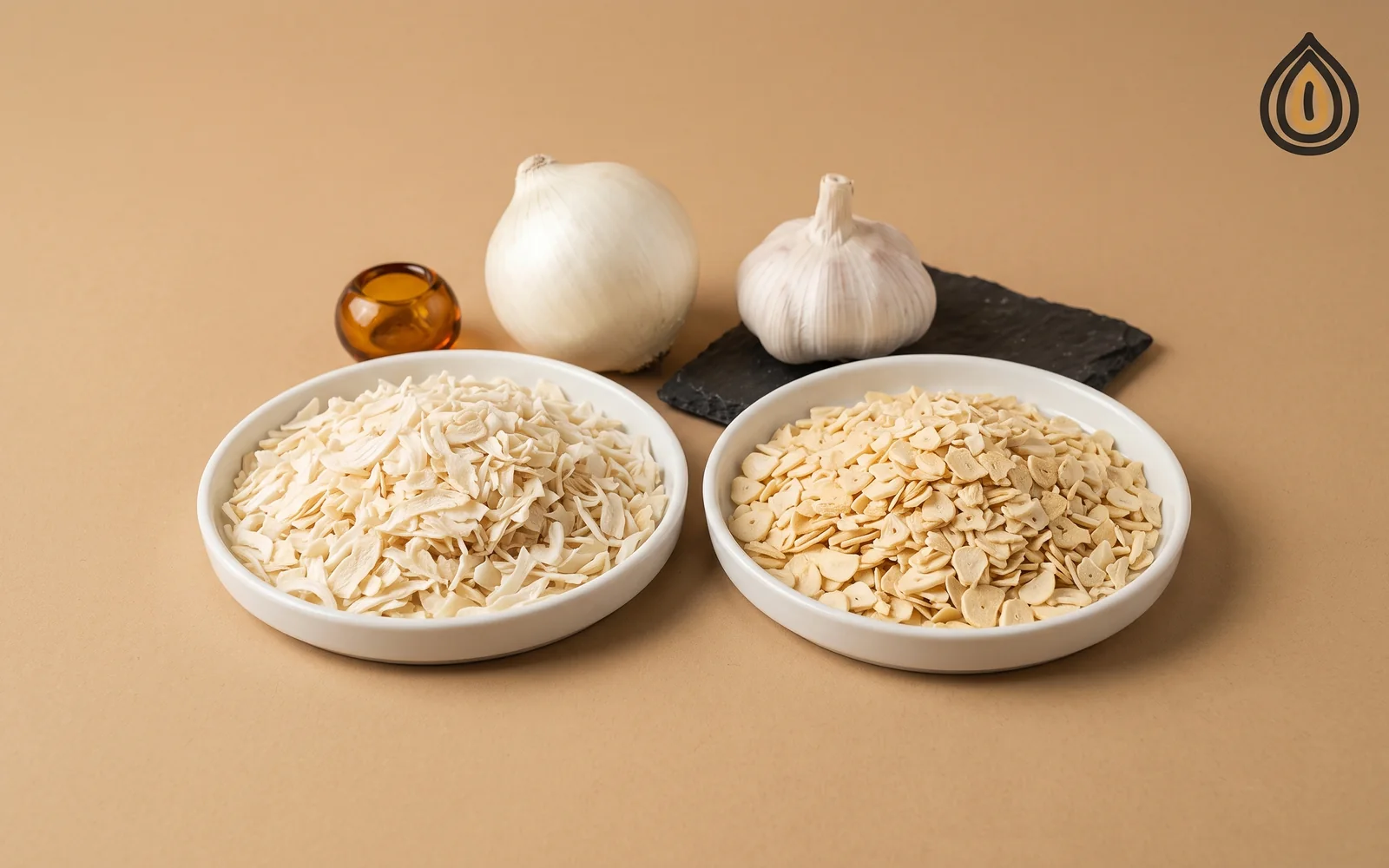
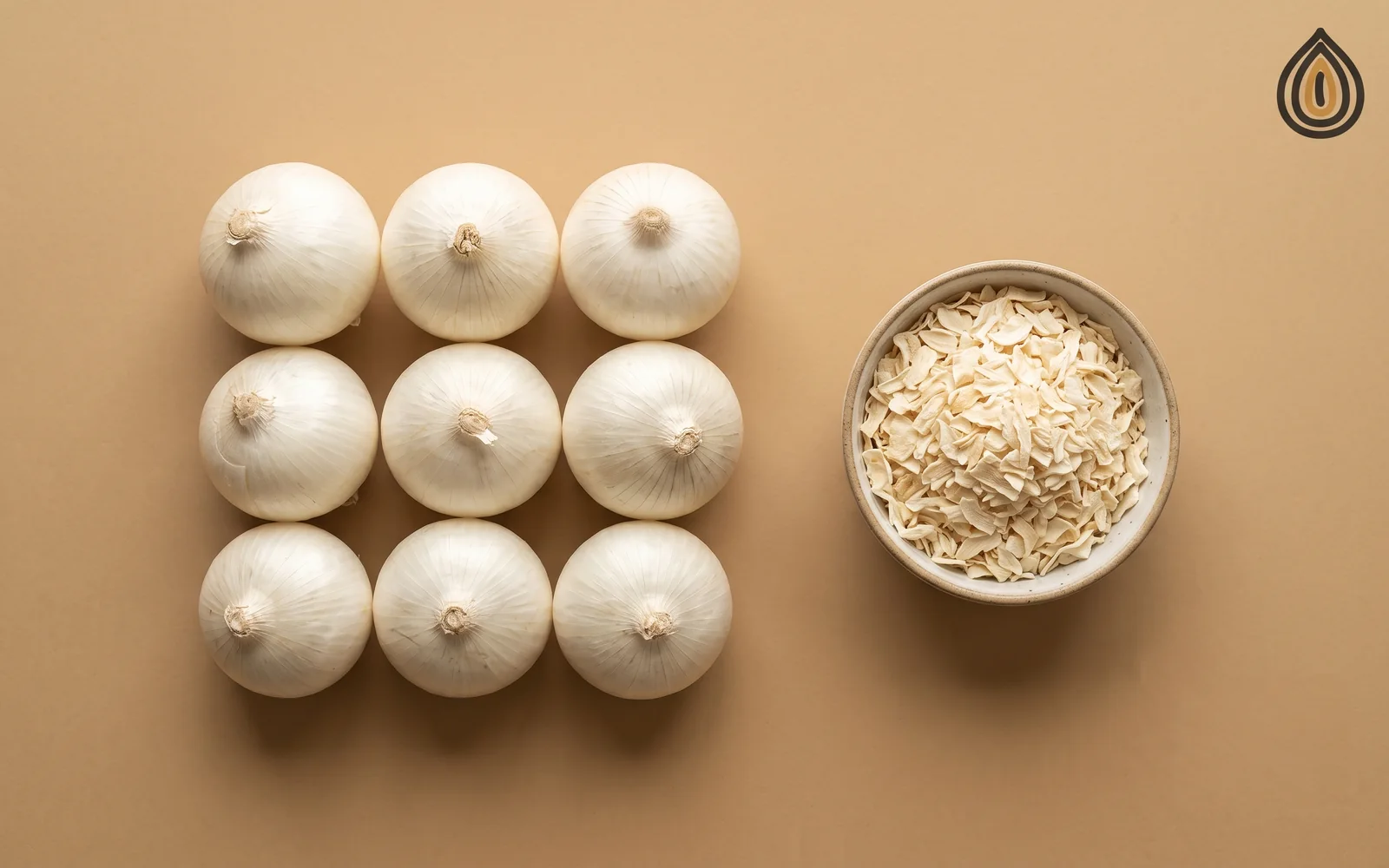
Fresh onion is 88 to 90 percent water; dried onion is 4 to 6 percent. Drying removes the water and the flavour stays, so one kilogram of dried onion carries the solids of 8 to 9 kilograms of fresh, and in flavour terms replaces that much; the trade's rule is 8 to 1, and the plants' own yield, one kilogram of dry from 8 to 9.5 kilograms of peeled onion, confirms it. In weight terms after rehydration the dried product does not take back all its water, and one kilogram of dried onion becomes 4 to 5 kilograms of rehydrated onion, so a recipe that needs the bulk of fresh onion as well as its flavour makes up the difference with water. The two numbers, 8 to 1 for flavour and 4 to 5 to 1 for bulk, are the basis of every comparison; the drying arithmetic behind them is in 8 to 1: The Fresh-to-Dry Yield Ratio, and the rehydration side in Rehydrating Dehydrated Onion.
The invoice comparison, and why it misleads
| Fresh onion, European wholesale | Dehydrated onion, landed Europe | |
|---|---|---|
| Price per kg, March 2026 | €0.40-0.80 (25 kg sacks, class 1, delivered) | €2.10-2.60 (white flakes or minced, standard tier) |
| Kg needed per kg of dried-onion equivalent | 8.5 | 1 |
| Cost per kg of dried equivalent, invoice only | €3.40-6.80 | €2.10-2.60 |
Even on the invoice alone, once the equivalence is applied, dried onion is cheaper than fresh at any fresh price above about 0.28 euros per kilogram, which the European wholesale market has not seen for a sustained period in years. The invoice comparison misleads when it is done per kilogram without the equivalence, which is the mistake most often made in a kitchen, and it flatters fresh onion because everything below is still to come.
Waste: what a fresh onion loses before the pot
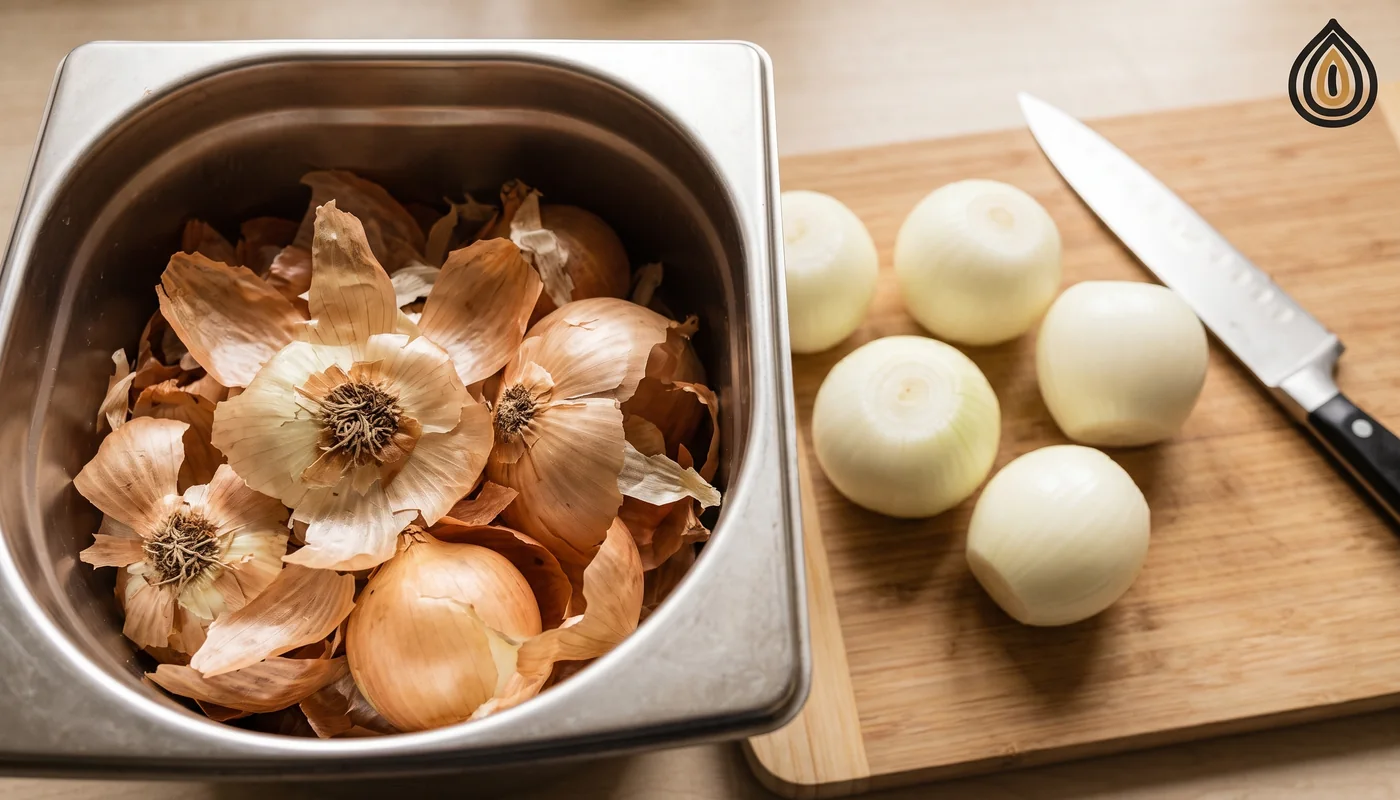
A class 1 fresh onion loses its outer papery skins, one or two outer fleshy layers that are damaged or discoloured, the root plate and the neck: 8 to 12 percent by weight for a good large onion peeled by machine, 12 to 18 percent for small or poor onions peeled by hand, and more in spring when the stored crop has sprouted and softened. Add the onions rejected on receipt or found rotten in the sack, 2 to 5 percent, and the shrinkage of a sack that has sat for a week, 1 to 2 percent in water loss. A realistic waste figure for an industrial user is 12 to 18 percent, which raises the fresh price per usable kilogram by that share; at a purchase price of 0.55 euros, the usable onion costs 0.63 to 0.67. The dried product's waste is nil beyond a scoop dropped on the floor, and the fines in the bag are usable.
Labour: peeling, chopping, cleaning
Peeling and chopping are the largest cost of fresh onion in any operation that pays European wages. By hand, a trained kitchen worker peels and dices 40 to 80 kilograms of onion an hour; a small peeling machine and a dicer at a manufacturer raise it to 200 to 400 kilograms an hour with one operator loading and one clearing. At a fully loaded labour cost of 25 to 40 euros an hour, hand preparation adds 0.30 to 1.00 euros per kilogram of fresh onion, and machine preparation 0.10 to 0.25 including the machines' cost and cleaning. Cleaning is not trivial: onion preparation leaves skins, juice and odour, the equipment and the area must be cleaned daily, and the room is often a wet, chilled space that a plant would rather not run. Dried onion is weighed from a bag in a dry room in seconds, and the labour cost per kilogram of equivalent is a few cents. On the equivalence, hand-prepared fresh onion costs 2.50 to 8.50 euros per kilogram of dried equivalent in labour alone before the onion is paid for.

Storage, spoilage and shrinkage
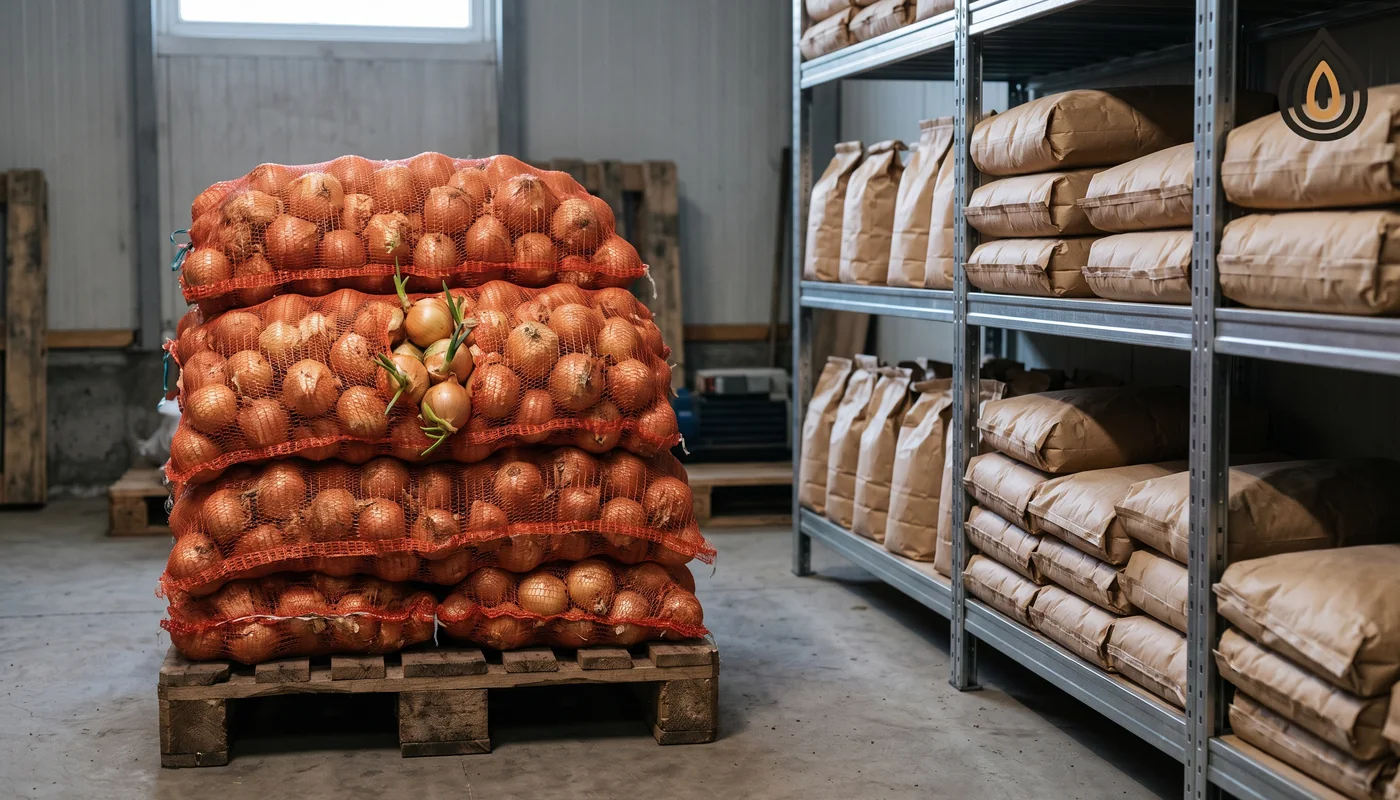
Fresh onion is stored cool, at 0 to 5 degrees for long keeping or at ambient for a week or two, in a ventilated area, and a manufacturer using a tonne a week holds a few tonnes of sacks on the floor of a chilled store that could hold higher-value product. Chilled storage costs 0.02 to 0.05 euros per kilogram per week in energy, space and handling; a two-week stock adds 0.04 to 0.10 per kilogram. Spoilage in storage, beyond the receipt rejections above, is 1 to 3 percent in autumn and winter and up to 10 percent in late spring, when the stored European crop sprouts and the new crop is not yet in; the loss is written off or shows as extra peeling waste. Dried onion sits in sealed bags on an ambient shelf, a tonne on a single pallet, for 18 to 24 months, and its storage cost per kilogram of equivalent is a fraction of a cent. The storage rules for it are in Dehydrated Onion Shelf Life.
Price volatility: the fresh onion's year
The European fresh onion price has a season: lowest at harvest in September and October, rising through the winter as the stored crop shrinks, highest in April to June when stores run out and imports fill the gap, and occasionally spiking when a European crop fails, as in 2022 and 2023, when wholesale prices doubled and tripled for months. A manufacturer who costs a product on the October price and buys through the year pays the average, which is 20 to 40 percent above the October price, and carries the risk of a spike it cannot pass on. Dried onion has a season too, cheapest at the Indian harvest in April and May and firmer in the second half, but the swing is 5 to 15 percent in a normal year and can be fixed for six to nine months by contract at harvest, which no fresh-onion buyer can do. A product costed on dried onion carries one contracted price; one costed on fresh carries a curve. The dried product's own price drivers are in What Does Dehydrated Onion Cost per Kilogram?
Microbiology and food safety costs
Fresh onion arrives with soil, its own microbial load and whatever the field and the sack brought; it enters a food plant as a raw agricultural product that must be received, stored and prepared away from the ready-to-eat area, with its own hazard analysis, cleaning schedule and, at most plants, a wash step. The costs are the segregated area, the cleaning, the testing and the management attention. Dried onion arrives as a certified ingredient with a certificate of analysis per lot, a known microbiological tier, no soil and no juice, and goes into the dry store with the spices. For a product that is not cooked in the plant, a dip, a dressing, a dry mix, the difference is decisive, since fresh onion cannot deliver a controlled low count and the dried product can, at the extra low bacterial tier; the tiers are in Microbiology in Dehydrated Onion.
Consistency: the cost of variation
Fresh onion varies in water, sugar, pungency and size through the year and between suppliers: a spring onion from store is sweeter and softer than an autumn one, a Spanish onion differs from a Dutch, and a recipe set in October drifts by spring. The variation costs a manufacturer in adjustment, in complaints and in the product developer's time, and it is why the larger manufacturers moved to dried onion for the base note decades ago. Dried onion from a single plant and variety is consistent within a season and close between seasons, and its flavour profile, sweet and cooked rather than sharp and raw, is the one most cooked products want anyway. Consistency is hard to price and easy to feel; a developer who has retuned a recipe three times in a year knows what it costs.
Where fresh wins
Fresh onion wins where its raw sharpness and its texture are the point: a salad, a salsa, a raw garnish, a pickle where crunch matters, a caramelised onion where the cook wants the sugars and the water of the fresh vegetable to work together over an hour, a restaurant kitchen where the chef's hands are the process. It also wins in cost where labour is very cheap, which is not Europe, and where the onion is grown on site. It ties where a product uses a small amount of onion and the labour is absorbed by staff who are there anyway, a small café making twenty portions of soup, though even there the dried product's convenience usually wins. Everywhere else, the industrial soup, sauce, sausage, ready meal, snack seasoning, dry mix and the large kitchen, the comparison favours dried on cost and on consistency, and the applications where each cut fits are in Flakes, Chopped, Minced, Granules or Powder.
The calculator: a method for your own numbers
- Fresh onion price per kg delivered, averaged over your buying year, or the contract price if you have one. Call it F.
- Usable share after peeling, trimming and rejects: typically 0.82 to 0.88. Usable fresh cost = F ÷ usable share.
- Preparation labour per kg of fresh, from your throughput and loaded wage: L.
- Storage and spoilage per kg of fresh: S, typically €0.03 to €0.10.
- Fresh cost per kg of dried equivalent = (F ÷ usable share + L + S) × 8.5.
- Dried onion landed cost per kg, from your supplier's CIF or DAP price plus duty, clearance and delivery: D, typically €2.10 to €2.60 for standard white, more for lower tiers and red.
- Dried handling per kg: weighing and re-sealing, a few cents; plus water for rehydration where bulk matters, negligible.
- Compare the figure from step 5 with D plus step 7. The difference times your annual dried-equivalent tonnage is the saving or the cost.
- Add the unpriced items as a note: price risk, consistency, microbiology, chilled space freed.
Four worked cases
| Soup manufacturer, 30 t fresh/yr | Sausage maker, 12 t fresh/yr | Contract caterer, 3 t fresh/yr | Ready-meal line, 60 t fresh/yr | |
|---|---|---|---|---|
| Fresh price F, year average | €0.55 | €0.60 | €0.70 (smaller lots) | €0.50 (contract) |
| Usable share | 0.86 (machine peel) | 0.84 | 0.82 (hand) | 0.87 (machine) |
| Labour L per kg fresh | €0.15 (machine) | €0.20 | €0.60 (hand) | €0.12 (machine) |
| Storage and spoilage S | €0.06 | €0.06 | €0.08 | €0.05 |
| Fresh cost per kg dried equivalent (×8.5) | €7.22 | €8.28 | €13.03 | €6.33 |
| Dried landed cost D | €2.30 (minced, standard) | €2.60 (minced, low bacterial) | €2.50 (flakes, small lots) | €2.25 (chopped, standard) |
| Dried handling | €0.05 | €0.05 | €0.05 | €0.05 |
| Saving per kg of dried equivalent | €4.87 | €5.63 | €10.48 | €4.03 |
| Dried equivalent tonnage (fresh ÷ 8.5) | 3.5 t | 1.4 t | 0.35 t | 7.1 t |
| Annual saving | ~€17,000 | ~€7,900 | ~€3,700 | ~€28,600 |
| Unpriced | Consistency of the base note; price risk removed | Low bacterial tier for a raw product; no wet room | Labour freed for cooking; no chilled sacks | Contracted price; controlled rehydration in process |
The caterer's case shows the largest saving per kilogram because hand labour dominates, and the ready-meal line the largest in total because of volume; the sausage maker's includes the low bacterial premium and still saves. In every case the fresh onion's invoice was the smallest part of its cost.
Mixed use: fresh for the top note, dried for the base
Many manufacturers do not choose but split: dried onion for the base, the 80 percent of the onion flavour that is cooked, sweet and consistent, and a small share of fresh for the raw top note where the product wants it, a chilled soup or a fresh salsa. The split captures most of the saving, since the fresh share is small and its labour is proportionate, and keeps the sensory character that a developer might otherwise miss. Onion powder added late in a process restores some sharpness without any fresh onion at all, and toasted onion adds a roasted note that fresh cannot; the application guides for soups and sauces and meat products work through the substitution in detail.
Frozen and pre-prepared fresh onion: the third option
Between fresh and dried sits a third product that many manufacturers use: diced onion, peeled and cut by a vegetable processor and sold chilled with a shelf life of a week or frozen with a year's. It removes the waste and the labour of fresh onion, keeps the raw sharpness, and costs for it: chilled diced onion runs 1.20 to 2.00 euros per kilogram delivered in Europe and frozen 0.90 to 1.60, for a product that is still 88 percent water. On the equivalence, 8.5 kilograms of diced onion at 1.50 euros is 12.75 euros per kilogram of dried equivalent, five to six times the dried product's landed cost, and the frozen version needs freezer space at 0.10 to 0.20 euros per kilogram per month and a defrost step that leaks water into the recipe. Where it wins is texture and sharpness in a short-process product, a fresh salsa or a chilled soup, and in kitchens with no preparation area; where it loses is everywhere the onion is cooked long enough for the sharpness to go anyway, which is most industrial products. A comparison that includes all three usually ends with dried for the base, and diced fresh or frozen for the visible or sharp component where the product needs one.
| Fresh whole | Diced, chilled or frozen | Dehydrated | |
|---|---|---|---|
| Price per kg delivered, March 2026 | €0.40-0.80 | €0.90-2.00 | €2.10-2.60 |
| Kg per kg of dried equivalent | 8.5 | 8.5 | 1 |
| Cost per kg of dried equivalent, invoice only | €3.40-6.80 | €7.65-17.00 | €2.10-2.60 |
| Waste at the plant | 12-18 % | 0-2 % | 0 |
| Labour | High | Low | Minimal |
| Storage | Chilled, weeks | Chilled, days; or frozen, a year | Ambient, two years |
| Sharpness of raw onion | Full | Full | Absent; cooked note |
| Microbiology | Raw agricultural | Processed, controlled | Certified tier |
Converting a recipe: a step-by-step method
- Find the fresh onion weight in the recipe as prepared, that is, after peeling; if the recipe gives whole onions, take 85 percent of the purchased weight.
- Divide by 8.5 for the dried onion weight at the same flavour. A recipe with 10 kilograms of prepared fresh onion takes about 1.2 kilograms of dried.
- Choose the cut by the product's texture and process: minced or granules where fresh was finely diced, chopped or flakes where it was sliced or coarsely diced, powder where it was puréed or where no pieces are wanted.
- Add back the water: the fresh onion brought about 8.8 kilograms of water in that 10; the dried onion will take up about 4 to 5 in rehydrating, so add 4 to 5 kilograms of water to the recipe, or accept a slightly more concentrated product and adjust the batch water.
- Decide the hydration step: in a wet, long-cooked product the dried onion goes in dry with the water; in a short process or a meat mix it is pre-hydrated for 15 to 30 minutes in cold water.
- Adjust sugar and acid: the dried product is slightly sweeter at the same flavour; reduce added sugar a little and, where the raw sharpness mattered, add a small dose of onion powder late in the process or a trace of acid.
- Run the trial side by side with the fresh version, blind, and score; then run it through the shelf life, since the differences between fresh and dried show most after storage.
- Recost with the calculator above, and record the conversion in the recipe file so that the next developer does not repeat it.
Onion is the easiest vegetable to convert this way because its flavour survives drying so well; the rehydration data by cut, which the method depends on, are in Rehydrating Dehydrated Onion, and the cuts are in Flakes, Chopped, Minced, Granules or Powder.
Sensory differences and how developers handle them
The honest account of the flavour difference is this. Raw onion's bite comes from sulphur compounds formed when the cell is cut and an enzyme meets its substrate; those compounds are volatile and most are lost or transformed in drying, so dried onion tastes of onion that has been cooked, sweet, savoury and rounded, with a faint toasted note in some lots, and it does not sting the eyes or the palate. In a cooked product the fresh onion would have lost the same compounds in the pot, and the two converge; in a raw or briefly cooked product they do not. Texture differs too: rehydrated onion is soft and slightly translucent without the crunch of raw and without the silkiness of onion slowly sweated in fat, since the cell structure was set by drying. Developers handle the gap in four ways, singly or together: a small fresh share for the top note; onion powder added at the end of the process, which brings back some sharpness because the fine particles release flavour fast; a trace of acid, which sharpens the perception; and, for products that need the sweated-onion character, toasted onion, which carries the caramelised note that a long sweat produces. The sensory comparison itself, how to run it and score it, is in Sensory Evaluation of Dehydrated Onion.
The environmental side: water, transport and waste
The cost comparison has an environmental twin, and it points the same way for most of the chain. Dried onion is one ninth of the weight and about one fifth of the volume of the fresh onion it replaces, so a container of dried onion carries the flavour of nine containers of fresh; the sea transport from India, which sounds like the environmental cost, is small per kilogram of onion flavour delivered against trucking fresh onion across Europe in refrigerated vehicles. The drying itself uses energy, 3 to 3.5 kilograms of biomass briquette or the gas equivalent per kilogram of dry product at a Mahuva plant, which is the largest single environmental cost of the dried product and is partly offset by the biomass being crop residue. Fresh onion's costs sit elsewhere: the 12 to 18 percent waste at the user, the chilled storage energy, the spoilage in spring, and the peelings sent to disposal rather than to the plant's own biomass or feed streams. Water use is roughly equal, since the onion is grown either way, and India's dehydrator crop is irrigated from wells and canals in a dry season. A buyer with a sustainability reporting obligation can put its own factors into the calculator's structure; the storage side, which is where the fresh product's losses accumulate, is in Dehydrated Onion Shelf Life.
Objections from the kitchen, and the answers
"Dried onion tastes artificial." It tastes of cooked onion, which in a cooked product is the target; a lot that tastes stale or scorched is a bad lot, not a bad product, and a sensory check on each lot against a reference catches it. "Our customers expect fresh." In a cooked product they cannot tell, and blind tests routinely show it; where the raw note matters, a small fresh share keeps it. "It is more expensive." Only per kilogram of bag; per kilogram of onion used, after waste and labour, it is cheaper in almost every case, as the four cases show. "We already have the labour." The labour has an opportunity cost, and the wet, chilled preparation room has a hygiene cost; both go when the onion arrives dry. "Fresh is local." European fresh onion is local for half the year and imported from Egypt, New Zealand or the southern hemisphere for the other half, and dried onion's transport per unit of flavour is smaller than a refrigerated truck's. "We tried it once and it was hard in the product." It was not hydrated before a short process; the conversion method above fixes that. The practical answer to all of them is a side-by-side trial, blind, with the cost sheet beside it.
How KlarHarvest helps with the comparison
A buyer running the comparison needs a landed cost, not an FOB price, and KlarHarvest quotes carry the landed-cost estimate for the buyer's country beside the CIF price, with duty, clearance and delivery, so that D in the calculator is a real number. Samples of two cuts from one lot let a developer set the substitution rate on the line rather than on paper, and the spec sheet for each cut gives the rehydration ratio for the bulk calculation. The cuts and their uses are on the products page, and the comparison can be run with a KlarHarvest contact on request through the contact page.
Frequently asked questions
How much dehydrated onion equals fresh onion?
One kilogram of dried onion replaces 8 to 9 kilograms of fresh in flavour and becomes 4 to 5 kilograms when rehydrated. Use 8.5 to 1 for the cost comparison and add water for bulk.
Is dehydrated onion cheaper than fresh?
On the invoice alone, once the equivalence is applied, dried is cheaper at any fresh price above about 0.28 euros per kilogram. With waste, labour, storage and price risk added, it is cheaper in almost every industrial and catering use.
What does fresh onion really cost per kilogram used?
Purchase price divided by the usable share after peeling, 0.82 to 0.88, plus preparation labour of 0.10 to 1.00 euros depending on method, plus storage and spoilage; typically 0.75 to 1.50 euros per usable kilogram, or 6 to 13 euros per kilogram of dried equivalent.
Where does fresh onion still make sense?
Where raw sharpness and crunch are the product: salads, salsas, garnishes, some pickles and caramelised onion made from scratch. Also where labour is very cheap or the onion is grown on site.
Does dried onion taste the same as fresh?
No. It tastes of cooked onion, sweet and round, without the raw sharpness; in cooked products that is the flavour wanted anyway. A little onion powder added late or a small fresh share restores the top note where needed.
How does price volatility compare?
European fresh onion moves 20 to 40 percent through a normal year and can double in a crop failure. Dried onion moves 5 to 15 percent and can be contracted at harvest for six to nine months.
What about microbiology?
Fresh onion is a raw agricultural product with soil and its own load, needing segregated handling. Dried onion is a certified ingredient with a known tier, and for uncooked products the extra low bacterial tier delivers a control that fresh cannot.
Next step
Request a sample of the cut that matches your fresh use, run the substitution on your line, and put your own numbers into the calculator; then request a quote with the annual tonnage and the landed cost comes back for your country within one business day.