- Why meat processors use dried rather than fresh onion
- Which cut for which meat product
- Dosing rates and fresh-onion equivalents
- Hydration in the mix: where the water comes from
- Water binding, yield and the onion's share of it
- Through the process: chopper, mixer, filler, cooker, smokehouse, freezer
- Flavour and colour in the finished product
- Microbiology: why raw products need the lower tiers
- Salt, phosphate, curing and the onion
- Marinades, injection brines and coatings
- Common faults and fixes
- Cost per kilogram of product
- Specification lines for meat use
- A worked formulation: beef burger patty
- Doner, kebab and the ethnic meat products
- Running a mixer trial
- What KlarHarvest supplies to meat processors
- Frequently asked questions
Judge the product, not the words
200-500 g from a current lot, dispatched by courier with the lot lab report.
Request a sampleDehydrated onion for meat processing is a different ingredient from the one that goes into a soup, even when the bag is the same. It enters a cold mixer with raw meat rather than a hot pot; it takes its water from the meat block or from a measured addition rather than from a litre of stock; it must survive a bowl chopper, a filler, a smokehouse and a grill without browning or showing as hard pieces; and it goes into a product whose microbiology is managed from the raw state, which changes what the onion's own counts mean. Sausage, burger, kebab, meatball, ham and marinade manufacturers are the second largest users of dehydrated onion in Europe after the soup and sauce sector, and this guide is written for their product developers, buyers and quality managers.
It covers which cut suits which meat product, dosing rates and the fresh-onion equivalents, how the onion hydrates in a meat mix and what that does to water binding and yield, behaviour through chopping, filling, cooking, smoking and freezing, flavour and colour in the finished product, the microbiology tiers and why raw products need the lower ones, the interaction with salt, phosphate and other seasonings, common faults and fixes, cost per kilogram of product, the specification lines for this use, and a worked burger patty formulation. Figures are trade-typical values for Mahuva product in March 2026.
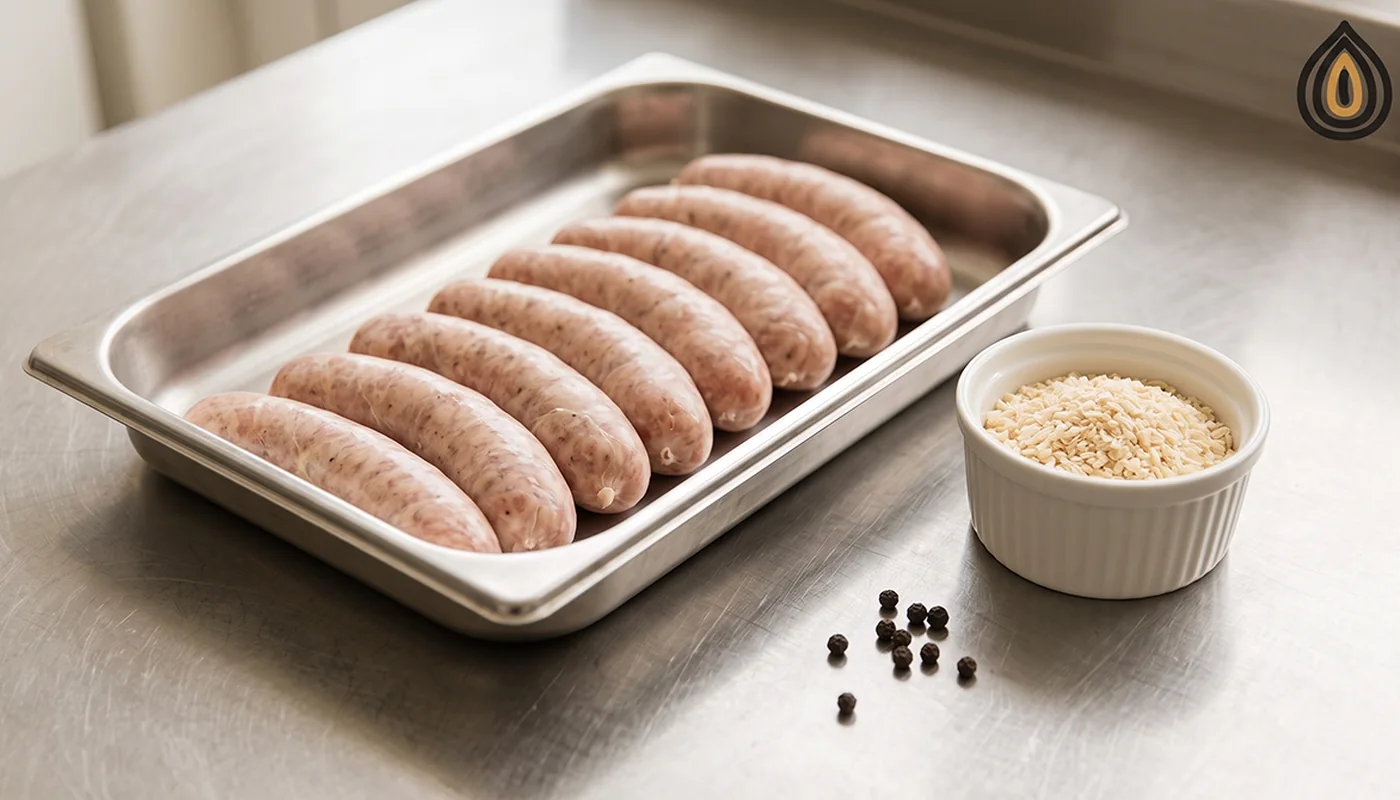
What this guide covers
- Why meat processors use dried rather than fresh onion
- Which cut for which meat product
- Dosing rates and fresh-onion equivalents
- Hydration in the mix: where the water comes from
- Water binding, yield and the onion's share of it
- Through the process: chopper, mixer, filler, cooker, smokehouse, freezer
- Flavour and colour in the finished product
- Microbiology: why raw products need the lower tiers
- Salt, phosphate, curing and the onion
- Marinades, injection brines and coatings
- Common faults and fixes
- Cost per kilogram of product
- Specification lines for meat use
- A worked formulation: beef burger patty
- Doner, kebab and the ethnic meat products
- Running a mixer trial
- What KlarHarvest supplies to meat processors
- Frequently asked questions
Why meat processors use dried rather than fresh onion
Fresh onion in a meat plant means peeling, chopping, a wet ingredient that varies in water and sugar through the year, a microbiological load of its own that the plant must manage, waste of 10 to 15 percent, and cold storage of a bulky vegetable in a chilled area meant for meat. Dried onion means a dry ingredient weighed from a bag, consistent in flavour across the year, with a known and certified microbiology, a two-year shelf life at ambient, and one ninth of the weight to store. The flavour is different, sweeter and rounder, without the raw sharpness, which most cooked meat products want anyway. And the dried product's absorption of water is a feature in a meat mix rather than a nuisance, since it binds water that would otherwise purge. The cost comparison, once labour and waste are counted, favours dried in nearly every industrial product; it is worked through in Dehydrated vs Fresh Onion: The Real Cost per Kilo.
Which cut for which meat product
| Product | Preferred cut | Why | Also used |
|---|---|---|---|
| Fresh sausage, coarse (bratwurst, breakfast, Cumberland) | Minced 1-3 mm | Visible flecks, hydrates in the mix, no hard bite | Chopped 3-5 mm in rustic styles, pre-hydrated |
| Emulsified sausage (frankfurter, mortadella, bologna) | Powder 80 mesh | Disperses in the emulsion; pieces would show as defects | Granules 40-60 mesh for a little texture |
| Dry-cured and fermented sausage (salami, chorizo) | Powder or granules 40-60 | Low water; onion must not add moisture | Onion is a minor note here |
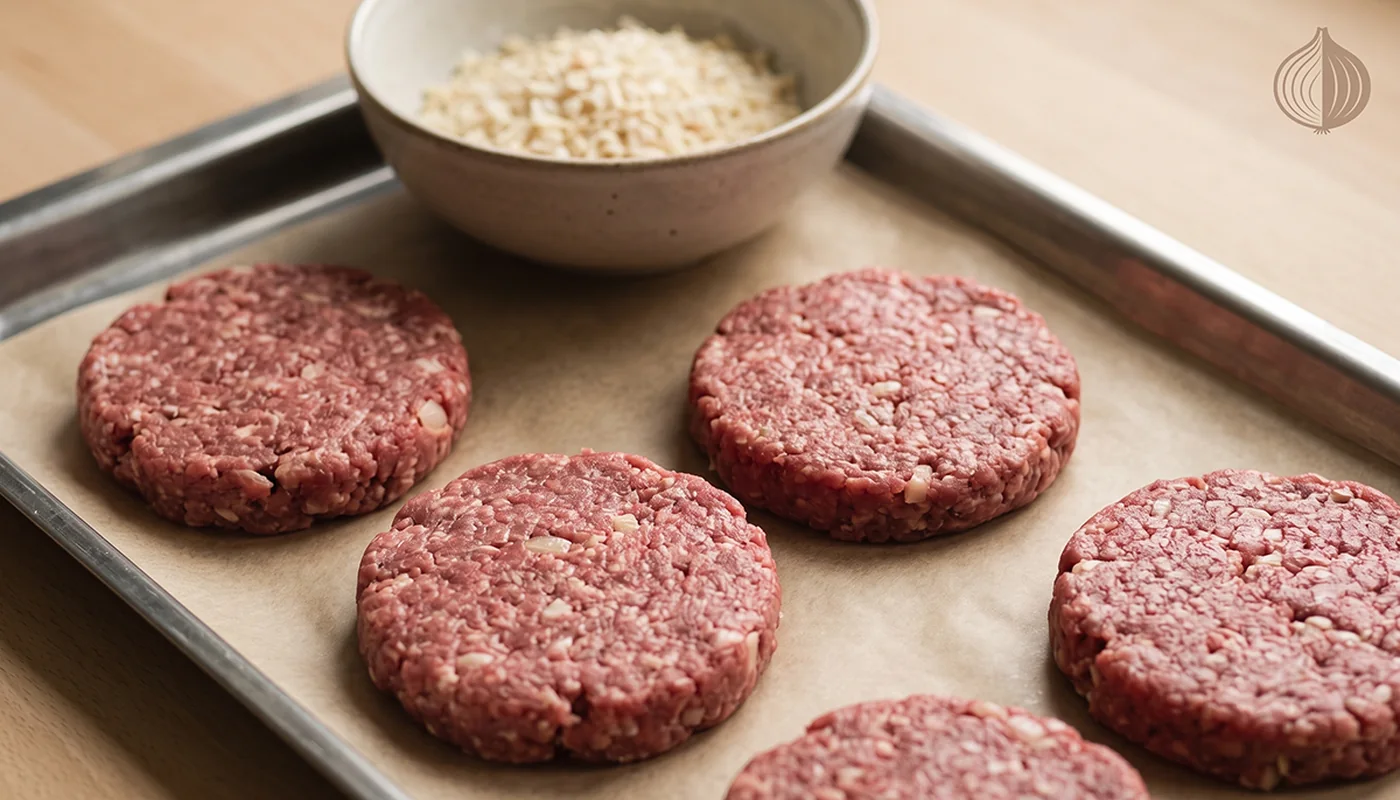
| Burger patties, beef and pork | Minced 1-3 mm or granules 16-40 | Visible onion, hydrates from meat water | Chopped for "homestyle" patties, pre-hydrated |
| Meatballs, kofta, kebab, doner | Minced or granules | Flavour body, some texture | Powder for smooth doner pastes |
| Poultry products (nuggets, sausages) | Powder or granules 40-60 | Mild flavour, no colour | |
| Ham, bacon and brine-injected products | Powder | Only powder passes an injector | Onion extract for very fine needles |
| Marinades, rubs, coatings | Powder; granules 26-40 in rubs | Dispersion in liquid; visible particles in rubs | Toasted onion in dark rubs |
| Pâté, spreads, terrines | Powder or pre-hydrated minced | Smooth texture | |
| Ready meals with meat components | By component | See the ready-meal guide |
The rule of thumb: the coarser the meat texture, the coarser the onion; and any product that passes a fine plate, an emulsifier or a needle takes powder only. The cuts as products are described in Flakes, Chopped, Minced, Granules or Powder.
Dosing rates and fresh-onion equivalents
| Product | Dry onion, % of total mix | Fresh-onion equivalent, % | Notes |
|---|---|---|---|
| Coarse fresh sausage | 1.0-2.5 | 8-20 | 1.5 is a typical British sausage; German styles at the lower end |
| Emulsified sausage | 0.3-1.0 (powder) | 2.5-8 | Above 1 percent the onion dominates |
| Burger patty | 1.0-2.0 | 8-16 | "Onion burgers" to 3 percent |
| Meatball, kofta | 1.5-3.0 | 12-25 | Kofta and kebab at the top |
| Doner and gyros paste | 1.0-2.0 (powder or minced) | 8-16 | |
| Injection brine (in the brine) | 0.5-1.5 (powder) | At 10-20 percent injection, 0.05-0.3 in the product | |
| Marinade (in the marinade) | 1-3 (powder) | ||
| Dry rub | 5-15 (powder and granules) | Diluted by the coating rate |
The conversion from a fresh recipe is one part dried for eight to nine parts fresh by weight for flavour; the dried product then takes up water, and the rehydrated weight is four to five parts, so a recipe converted by flavour loses three to four parts of bulk that were water and vegetable fibre, and a developer usually adds back water to hold the meat-to-total ratio. A fresh recipe's raw-onion sharpness is absent from the dried product; where it mattered, a small dose of onion powder added late or a trace of acid restores some of it.
Hydration in the mix: where the water comes from
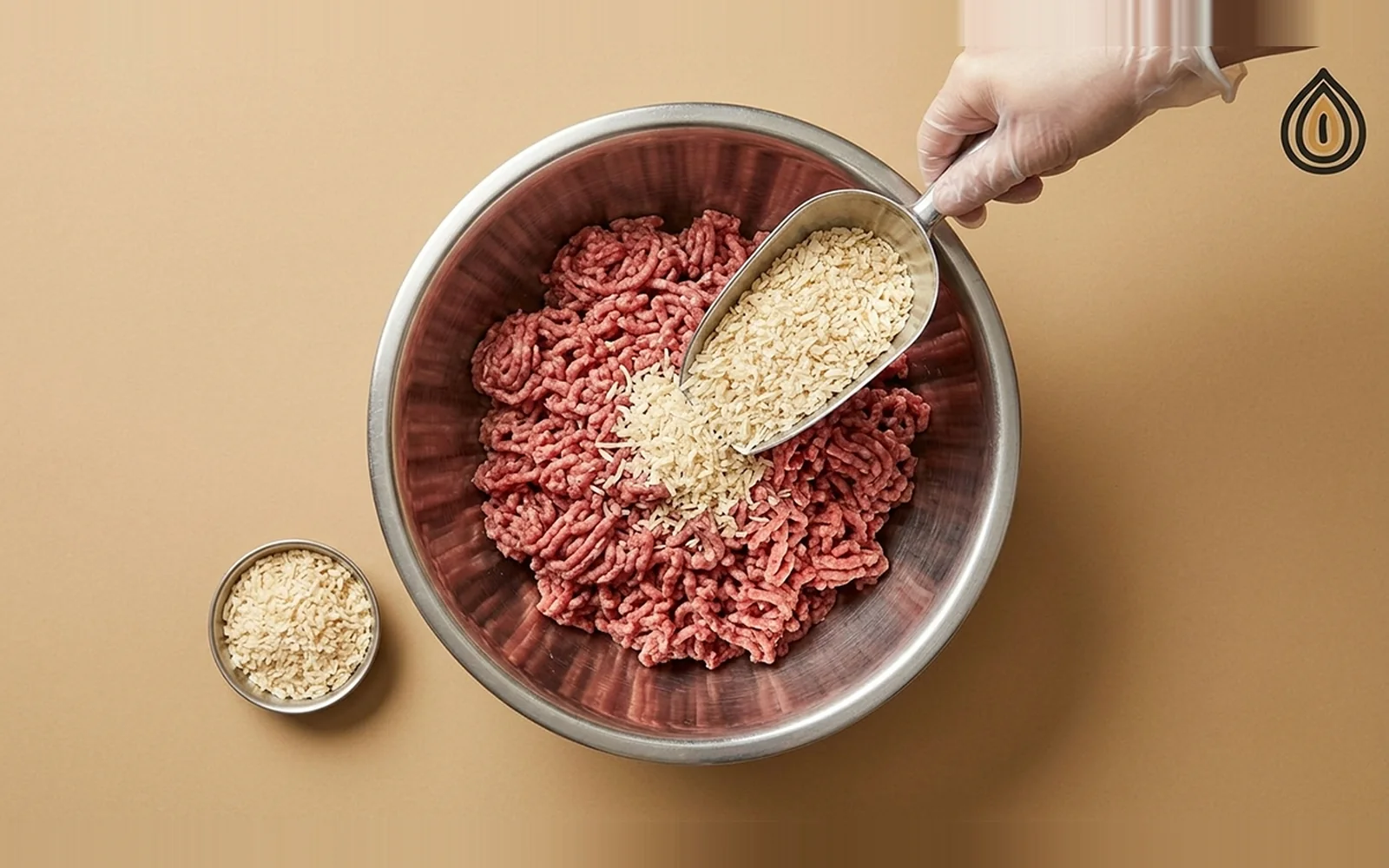
In a soup, onion hydrates in a surplus of water; in a meat mix there is no surplus, and the onion competes with the meat proteins, the salt and any starch or fibre for the water in the block. Dried onion added dry to a burger mix at 1.5 percent takes up 4 to 5 percent of the mix's weight in water over the 20 to 40 minutes between mixing and forming, drawing it from the meat; the patty is drier and firmer as a result, which some products want and others do not, and pieces that have not finished hydrating when the patty is cooked show as hard, chewy flecks. Three approaches are used. Add the onion dry and add its water, 3 to 4 parts water per part of onion, to the mix at the same time, letting the onion hydrate in the mixer; this is the common industrial method and works for minced and granules. Pre-hydrate the onion in cold water, 1 part onion to 3 parts water for 15 to 30 minutes in a lidded tub in the chill, and add the drained or undrained slurry; this gives the most even hydration and is used for chopped and for products with a short mixing time. Or use powder, which hydrates in seconds and needs no allowance beyond the water it binds. Hydration water should be cold, since warm water in a meat mix is a hygiene and texture problem, and cold hydration takes the times in the rehydration table in Rehydrating Dehydrated Onion, which are longer than the hot-water times: 15 to 25 minutes for minced, 25 to 40 for chopped.
Water binding, yield and the onion's share of it
Onion fibre holds water in a cooked meat product, and dried onion at 1.5 to 2 percent binds 4 to 6 percent of the product's weight in water through cooking, which shows as a lower cook loss and a juicier bite; sausage makers have used onion, breadcrumb and rusk for water binding for a century for this reason. The effect is real but modest beside the meat protein, the salt and any phosphate, and it depends on the onion being fully hydrated before cooking; dry onion that hydrates during cooking takes water from the product rather than holding it. For cook-yield calculations, treat fully hydrated onion as holding about 3 parts of water per part of dry onion through a standard cook and 2 to 2.5 through a long grill or fry. In a dry-cured sausage the opposite applies: the onion should add no water, and powder or granules are used at a low dose with no hydration allowance.
Through the process: chopper, mixer, filler, cooker, smokehouse, freezer
Bowl chopper. In an emulsified sausage the onion goes in as powder with the dry seasonings early in the chop, so that it disperses through the emulsion; minced or granules added to a chopper are cut to powder anyway and gain nothing. Mixer. In coarse products the onion goes in with its water or pre-hydrated, early enough to finish hydrating before forming, usually with the salt and seasonings and before the fat. Filler and former. Hydrated onion pieces pass a sausage filler and a patty former without trouble at the standard cuts; chopped onion at 3 to 5 millimetres can bridge in a narrow filler nozzle and is pre-hydrated to soften it. Cooker. In a hot-water or steam cook to 72 degrees the onion cooks with the meat and its flavour rounds; browning of the onion does not occur below 100 degrees in a wet product. On a grill, a flat-top or in a fryer, surface onion pieces brown and can scorch, which is wanted in a "flame-grilled" patty and not in a pale poultry product; finer cuts and powder reduce it. Smokehouse. Smoke and the drying phase of a smokehouse cycle concentrate flavour and darken surface pieces slightly; no special allowance. Freezer. Frozen raw patties and sausages hold hydrated onion without ice damage; dry onion that was not hydrated before freezing stays dry through the freezer and hydrates unevenly in the cook, which is the most common cause of hard onion pieces in frozen burgers. The ready-meal case, with its own processes, is in Dehydrated Onion in Ready Meals and Frozen Foods.
Flavour and colour in the finished product
Cooked dried onion in meat gives the sweet, savoury, slightly caramel note of sautéed onion rather than the sharpness of raw; it supports meatiness and rounds the salt, which is why it appears in nearly every seasoning blend for meat. White onion is standard for all meat products because red pigment turns a grey-brown in a cooked meat matrix and can show as pink flecks in a pale sausage that a consumer mistakes for under-cooking; red is used only in some ethnic products where the colour is expected. Toasted onion, roasted to golden-brown before milling, gives a deeper roasted note used in grilled and smoked products and in dark rubs. Colour of the onion itself hardly matters in meat, since the pieces are pale flecks in a coloured matrix, except that scorched pieces show as black specks in a pale product, so the defect count matters and the L* value does not; the grades and counts are in Dehydrated Onion Colour.
Microbiology: why raw products need the lower tiers
A meat product's microbiology is managed from raw materials that are themselves not sterile, and a dried ingredient's counts are judged against the raw meat's, which typically carries a total count of 100,000 to 1,000,000 per gram. Standard-tier onion at up to 500,000 per gram adds nothing meaningful to a mix at 1.5 percent inclusion, and for products that are fully cooked in the plant, hot-fill sausages, cooked ham and cooked meatballs, the standard tier is usually acceptable under the plant's hazard analysis. The lower tiers are specified for three reasons. Raw products sold to be cooked by the consumer, fresh sausages and raw burgers, where the plant's kill step does not exist and every raw material's spore and pathogen load is scrutinised; here most European processors specify low bacterial, and the spore-formers matter, since Bacillus and Clostridium spores in a dried vegetable survive the consumer's cook if it is inadequate. Fermented and dry-cured products, where the onion's yeasts and moulds could compete with the starter culture. And products for retailers whose codes of practice set ingredient limits regardless of process. Salmonella absent in 25 grams and E. coli absent in 1 gram apply at every tier. The steam treatment that delivers the lower tiers is explained in Low Bacterial and Extra Low Bacterial Dehydrated Onion; the counts and their methods in Microbiology in Dehydrated Onion. The onion must also be handled in the plant as a dry ingredient stored away from the raw meat area and weighed in a dry room, since a bag opened in a wet, chilled area takes up moisture and mould follows.
Salt, phosphate, curing and the onion
Salt at 1.5 to 2.5 percent slows the onion's hydration and firms its texture, which is one reason to hydrate before the salt goes in or to allow longer mixing; phosphates raise the meat's water binding and leave less free water for the onion, so a phosphated recipe needs the onion's water added explicitly. Nitrite curing does not react with onion, but the sulphur compounds in onion can contribute a faint greenish note in some cured products at high doses, which is why cured products stay at the low end of the dosing table. Onion contains fructans that support the growth of some bacteria, which is neutral in a cooked product and a consideration in fermented ones. Sugar in the onion, 30 to 40 percent of the dry weight, contributes to browning on a grill and to the flavour balance, and a recipe converted from fresh to dried onion is slightly sweeter at the same flavour intensity; developers reduce added sugar a little. The allergen side is simple, since onion carries no declarable allergen, but the plant's other ingredients and the onion supplier's cross-contact control both matter for the label; see Allergens, Gluten and Dehydrated Onion.
Marinades, injection brines and coatings
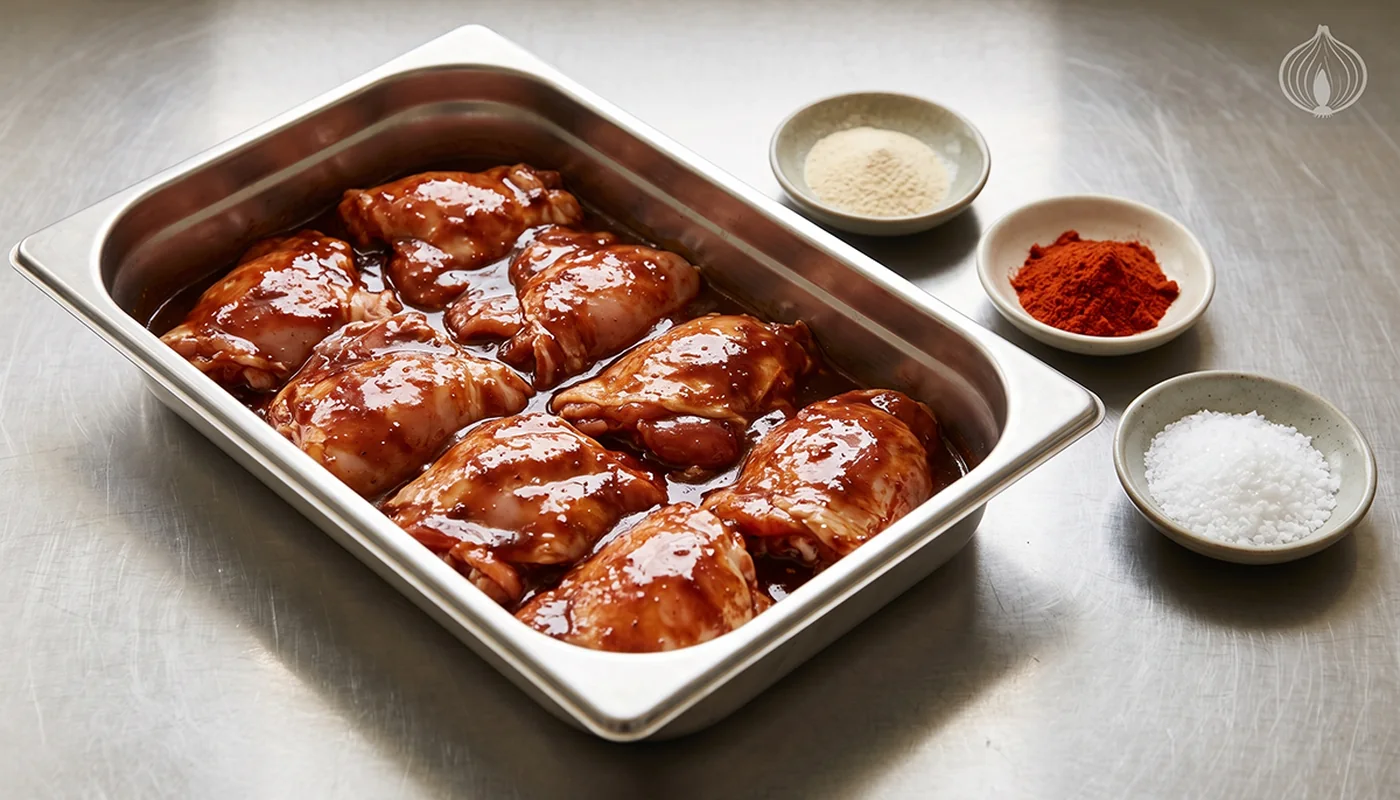
Marinades for poultry, pork and kebab meat use onion powder at 1 to 3 percent of the marinade, dispersed with the salt and spices in the liquid before the meat goes in; tumbling under vacuum drives the marinade into the meat and the onion flavour with it. Injection brines take powder only, dispersed and then filtered or fine-sieved before injection, since any particle above 100 microns blocks needles; where a very fine brine is needed, onion extract or oleoresin replaces powder, and the choice between them is in Dehydrated Onion vs Onion Oil and Oleoresin. Dry rubs and coating seasonings for grilled products use granules at 26-40 or 40-60 mesh for visible particles that adhere to the surface, with powder for the base flavour, and the particle size rules for coatings are those of the snack trade in Dehydrated Onion in Snack Seasoning. Breadcrumb and batter systems carry onion powder at 0.5 to 2 percent of the crumb.
Common faults and fixes
| Fault | Cause | Fix |
|---|---|---|
| Hard, chewy onion pieces in the bite | Onion not hydrated before forming or freezing | Pre-hydrate, or add water with the onion and mix long enough; finer cut |
| Patty too dry or firm | Onion took water from the meat | Add 3-4 parts water per part onion |
| Purge or soft texture | Too much water added with the onion, or onion added after the salt had set the protein | Reduce added water; add onion before salt and phosphate |
| Black specks in a pale product | Scorched onion pieces in the lot, or surface pieces scorched on the grill | Tighter defect count; finer cut or powder |
| Pink flecks in a pale sausage | Red or pink onion admixture | Specify white with an admixture limit |
| Onion flavour fades in the smokehouse | Long cycle, low dose | Raise dose 20 percent; part as powder |
| Inconsistent onion note between batches | Different plants or lots, different hydration | Single-source lots; fixed hydration procedure; sensory check per lot |
| Mould in the onion store | Bag opened in the chilled wet area | Store and weigh dry onion in a dry room; re-seal liners |
| High spore counts in a raw product | Standard-tier onion in a raw product | Low bacterial tier; steam-treated |
| Onion bridging in the filler nozzle | Chopped cut too coarse | Pre-hydrate to soften; use minced |
Cost per kilogram of product
At a landed cost of 2.10 to 2.60 euros per kilogram for white minced or granules in March 2026, and 2.40 to 3.00 for low bacterial, the onion in a kilogram of sausage at 1.5 percent inclusion costs 3 to 4.5 cents; in a burger at 1.5 percent the same; in a marinated product at 2 percent onion in a marinade applied at 15 percent, well under a cent. Against fresh onion at 0.40 to 0.80 euros per kilogram plus 10 to 15 percent waste, peeling and chopping labour, chilled storage and the equivalent of 8 to 9 kilograms per kilogram of dried, the dried product is cheaper in every industrial meat product and the labour saving alone usually exceeds the ingredient cost. The landed-cost build, with freight and duty, is in Landed Cost of Dehydrated Onion in Europe.
Specification lines for meat use
- Cut and band matched to the product, with the fines maximum, since fines dust in a dry weighing room.
- Colour: white; pink or red admixture maximum 0.5 percent by weight; scorched or dark pieces maximum 10 per 100 grams. L* value optional.
- Moisture: maximum 6 percent.
- Microbiology tier: low bacterial for raw products sold uncooked; standard acceptable for fully cooked products under the plant's hazard analysis; Salmonella absent in 25 grams and E. coli absent in 1 gram always. Bacillus cereus and Clostridium perfringens limits where the retailer's code requires.
- Rehydration ratio: minimum 3:1 in cold water in 30 minutes for minced and granules, by the buyer's method.
- Flavour: sensory clause against a retained reference, since a scorched lot passes every count.
- Sulphite-free, declared; allergen statement covering the plant's cross-contact.
- Packaging: 20 or 25 kilogram lined bags, or cartons for powder, so that a bag is used within a shift.
The whole specification sheet is in How to Read a Dehydrated Onion Specification Sheet.
A worked formulation: beef burger patty
A retail frozen beef burger, 113 gram patty, 80 percent visual lean, with a visible onion note.
| Ingredient | Share of mix | Per 100 kg batch | Role |
|---|---|---|---|
| Beef trim, 80/20 | 89.0 % | 89.0 kg | |
| Water, cold | 5.5 % | 5.5 kg | Hydrates the onion; 3.7 parts per part onion |
| Dehydrated white onion, minced 1-3 mm, low bacterial | 1.5 % | 1.5 kg | Visible flecks, flavour, water binding |
| Salt | 1.4 % | 1.4 kg | |
| Rusk or breadcrumb | 2.0 % | 2.0 kg | Binder |
| Seasoning (pepper, onion powder 0.2 %, garlic, herbs) | 0.6 % | 0.6 kg | Onion powder rounds the note |
Method: chill all materials to 0 to 2 degrees; mix the onion with the water and hold 15 minutes in the chill, or add both to the mixer first and mix 2 minutes before the salt and seasoning; add the beef and mix to the target protein extraction; form and freeze. The onion at 1.5 percent replaces about 12 percent fresh onion by flavour and, hydrated, contributes about 7 percent of the patty's mass as rehydrated onion, which is the visible flecking; the added water is what the fresh onion would have brought. The low bacterial tier is specified because the patty is sold raw. Cost of the onion per patty: about half a cent.
Doner, kebab and the ethnic meat products
Germany's doner kebab industry, which processes several hundred thousand tonnes of meat a year for the country's kebab shops, is one of the largest single users of onion in European meat processing, and it uses onion in two forms: minced or fine-chopped fresh onion in the traditional recipes, and dehydrated minced or powder in the industrial ones, at 1 to 2 percent of the meat block, hydrated in the mixer with the marinade. The dried product's advantages in a doner plant are the ones that apply everywhere, consistency, hygiene and labour, plus one specific to the product: the doner cone is frozen and then sliced hot from the rotisserie, and hydrated dried onion holds up through the freeze and the slice better than fresh, which weeps. Kofta, kebab skewers, seekh kebab and the Middle Eastern and South Asian ready-to-cook meat products use onion at higher rates, 2 to 4 percent dried, often with a share as powder for the base and minced for the pieces, and frequently want a sharper note than the plain dried product gives, which a small dose of onion powder added at the end or a trace of acid supplies. Halal certification of the onion, a plant matter rather than a product one, is asked for by most of these processors and is covered in Halal and Kosher Dehydrated Onion.
Running a mixer trial
A mixer trial on dried onion in a meat product answers the two questions the kitchen cannot: whether the onion hydrates fully in the plant's own process, and how the finished product compares through its shelf life. Take 25 to 50 kilograms of the trial lot with its certificate, and run the standard recipe twice on the same day with the same operator, the control with the current onion and the trial with the new, at the same temperatures and mixing times; record the mix temperature, the mixing time to protein extraction, the appearance of the onion pieces at forming, and any handling difference at the filler or the former. Cook or freeze as the product requires, then hold samples of both through the shelf life and evaluate at the start, the middle and the end, cooked as the consumer would cook them, for onion piece texture, flavour intensity, any off-note and overall preference, blind. A trial that passes at day one and fails at week six on hard pieces or a flat flavour is telling you about hydration or about the lot's age, and the supplier should be told the drying date of the lot that failed. Trials are also the moment to test a finer cut or a lower tier against the current one, since a burger that carries chopped onion may be as good with minced, which hydrates faster; the sample and trial sequence is in From Sample to First Container, and the structured comparison method in Sensory Evaluation of Dehydrated Onion.
What KlarHarvest supplies to meat processors
White minced, granules and powder at the standard, low bacterial and extra low bacterial tiers, from BRCGS-certified plants in Mahuva, with the sieve band, defect count, moisture and tier on every certificate and Bacillus cereus and Clostridium perfringens on request; toasted onion for grilled and smoked products on request. Samples are sent as two cuts from one lot with the certificate, so that a mixer trial compares cut and nothing else, and the lot record for every shipment carries the plant, the drying date and the steam-treatment record. The products are on the minced, granules and powder pages.
Frequently asked questions
Which dehydrated onion cut is best for sausages?
Minced 1-3 mm for coarse fresh sausages, hydrated in the mix; powder for emulsified sausages, where pieces would show as defects; powder or fine granules for dry-cured products, which must not take on water.
How much dehydrated onion replaces fresh onion in a burger?
One part dried for eight to nine parts fresh by flavour, so 1.5 percent dried replaces about 12 percent fresh. Add 3 to 4 parts cold water per part of dried onion to replace the water the fresh onion brought.
Why are there hard onion pieces in my frozen burgers?
The onion was not hydrated before forming and freezing, and it hydrates unevenly in the cook. Pre-hydrate in cold water for 15 to 30 minutes, or mix the onion with its water before the salt, and check hydration before forming.
Does dehydrated onion need to be low bacterial for meat products?
For raw products sold to be cooked by the consumer, most European processors specify low bacterial; for fully cooked products the standard tier is usually acceptable under the plant's hazard analysis. Salmonella and E. coli absence apply at every tier.
Can onion powder go into an injection brine?
Yes, dispersed in the brine and fine-sieved before injection; anything coarser blocks needles. For very fine needles use onion extract instead.
White or red onion for meat products?
White, in nearly all cases. Red pigment turns grey-brown in cooked meat and can show as pink flecks in pale products. Toasted onion adds a roasted note for grilled and smoked styles.
How does onion affect water binding and yield?
Fully hydrated onion holds about 3 parts of water per part of dry onion through a standard cook, lowering cook loss slightly. Onion that hydrates during cooking takes water from the product instead, so hydrate it first.
Next step
Request a sample of minced and granules from one lot at the low bacterial tier and run them in your mixer against your current onion; then request a quote with the annual volume and the tier, and it is priced within one business day.