- Specification versus certificate of analysis
- The identity block: product, cut, colour, origin, lot
- Moisture and water activity
- Ash and acid-insoluble ash
- Particle size, sieve analysis and bulk density
- Colour and appearance
- Foreign matter, defects and metal
- Sulphites, pesticide residues, heavy metals and ethylene oxide
- Microbiology: the tier table and the pathogen lines
- Allergen, GMO, irradiation and diet statements
- Packaging, shelf life and storage lines
- Reading a certificate of analysis: what makes it credible
- Seven traps on specification sheets
- A template specification for white onion flakes
- How KlarHarvest documents a lot
- Frequently asked questions
Judge the product, not the words
200-500 g from a current lot, dispatched by courier with the lot lab report.
Request a sampleA dehydrated onion specification is a one-page contract about numbers. It says what moisture, what particle size, what colour, what microbial load and what foreign matter a lot may contain, and the certificate of analysis that travels with the lot says what it actually contained. Buyers who can read both documents line by line, with the units and the test methods, reject fewer lots, argue fewer claims and compare suppliers on the same basis. Buyers who cannot end up comparing a sheet that says "moisture: conforms" with one that says "moisture: 4.8 percent, oven method, 105 °C", and choosing the wrong one.
This guide goes through a dehydrated onion specification sheet parameter by parameter: what each number means, what the typical values are for white and red onion from Mahuva, how it is measured, what a bad value tells you about the lot, and how to write the line so that a supplier cannot read it two ways. It then explains how a certificate of analysis differs from a specification, what makes one credible, and the traps that catch buyers most often. A template specification for standard white onion flakes is at the end.
The values are those in use for export-grade Indian dehydrated onion in January 2026. Your own product may need tighter limits on one or two lines, and the guide says which lines are worth tightening.
What this guide covers
- Specification versus certificate of analysis
- The identity block: product, cut, colour, origin, lot
- Moisture and water activity
- Ash and acid-insoluble ash
- Particle size, sieve analysis and bulk density
- Colour and appearance
- Foreign matter, defects and metal
- Sulphites, pesticide residues, heavy metals and ethylene oxide
- Microbiology: the tier table and the pathogen lines
- Allergen, GMO, irradiation and diet statements
- Packaging, shelf life and storage lines
- Reading a certificate of analysis: what makes it credible
- Seven traps on specification sheets
- A template specification for white onion flakes
- How KlarHarvest documents a lot
- Frequently asked questions
Specification versus certificate of analysis
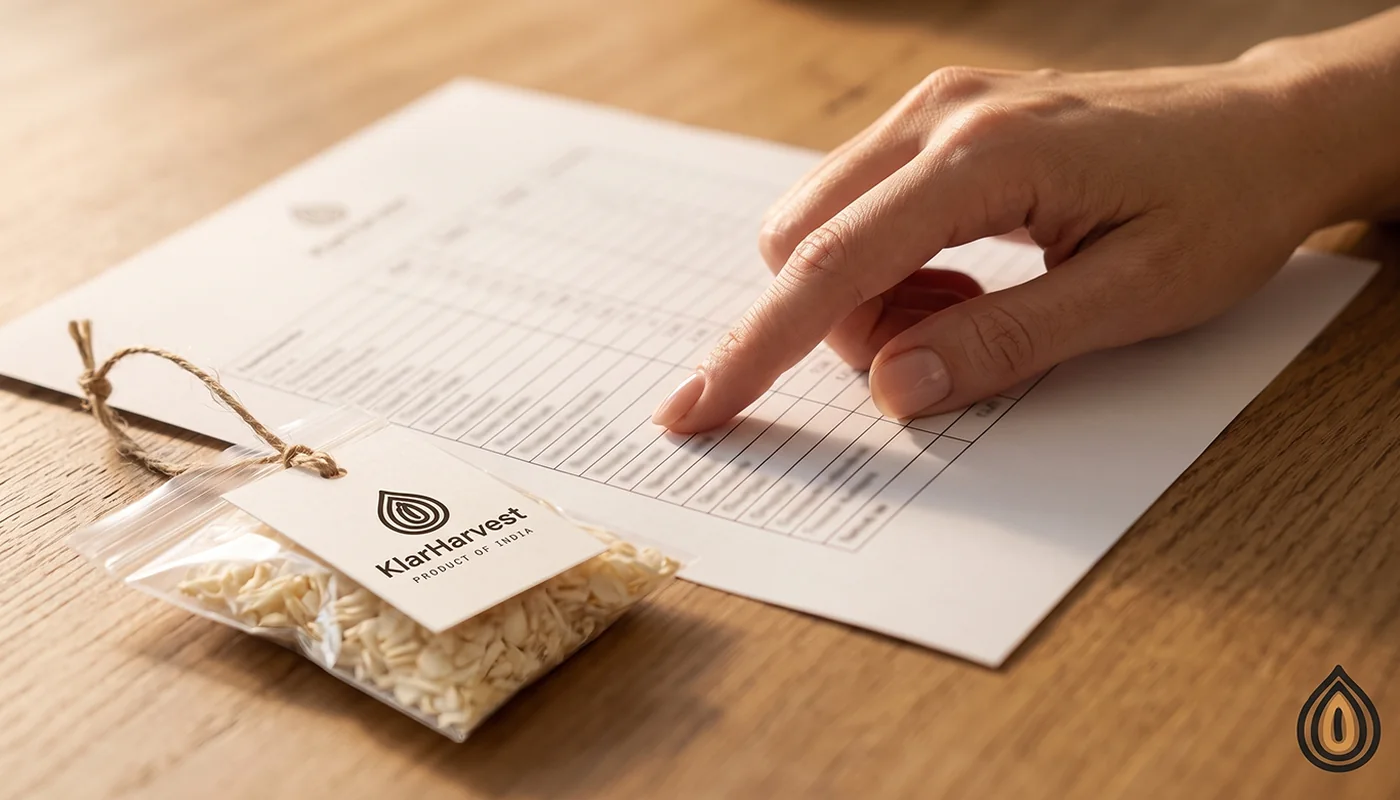
The specification is the promise: a list of parameters with limits, agreed between buyer and supplier, that every lot must meet. It is written once and referenced on every order. The certificate of analysis, usually shortened to CoA, is the evidence for one lot: the same parameters, with the measured values, the method, the laboratory, the lot number and the date. A supplier's brochure sheet that lists parameters with the word "conforms" or "as per standard" in the value column is neither; it is a specification pretending to be a certificate, and the first thing to ask for is a real CoA for a recent lot of the cut you want.
Three parties can issue a CoA. The plant's own laboratory, which tests every lot for moisture, sieve analysis and often total plate count; an external accredited laboratory, in India usually one accredited by NABL under ISO/IEC 17025, which tests the full list including pathogens, residues and metals; and your own laboratory on arrival. A credible supplier provides the plant's results for every lot and an accredited laboratory's report for the parameters that matter for safety, and expects you to spot-check. What to look for on the document is in the section on reading a CoA below.
The identity block: product, cut, colour, origin, lot
The top of the sheet identifies what is being described, and vagueness here undoes everything below. The lines that belong in it:
- Product name: dehydrated white onion, or dehydrated red onion; "onion" alone will be read as white.
- Cut and band: flakes 8-20 mm, chopped 3-5 mm, minced 1-3 mm, granules 0.5-1 mm (16-40 mesh), powder 80-100 mesh. The band belongs here and again in the particle-size line.
- Grade or tier: standard, low bacterial or extra low bacterial; Grade A or export grade for the physical quality.
- Botanical name and origin: Allium cepa L., India, with the state or district if your customer's traceability needs it.
- Process: washed, peeled, sliced, hot-air dried, sieved or milled, metal detected; steam treated where the tier requires it; sulphite treated or sulphite-free.
- Lot identification: the format of the lot code and what it encodes (plant, crop, date), so that a bag can be traced back to the certificate.
Anything else in this block is decoration. The identity block on a CoA adds the actual lot number, the production date and the quantity the certificate covers.
Moisture and water activity
Moisture is the percentage of the product's weight that is water, and for dehydrated onion the export limit is 6 percent, with well-dried lots at 4.5 to 5.5 percent. It is the most important number on the sheet for three reasons. Safety: below about 6 percent the water activity of onion is low enough that bacteria and moulds cannot grow. Shelf life: every percent of moisture above 5 shortens the time before caking and browning become visible. And money: a lot at 7 percent moisture instead of 5 contains 2 percent water that you paid for at the price of onion, and on a 10 tonne container that is 200 kilograms of water at 1.60 euros a kilogram.
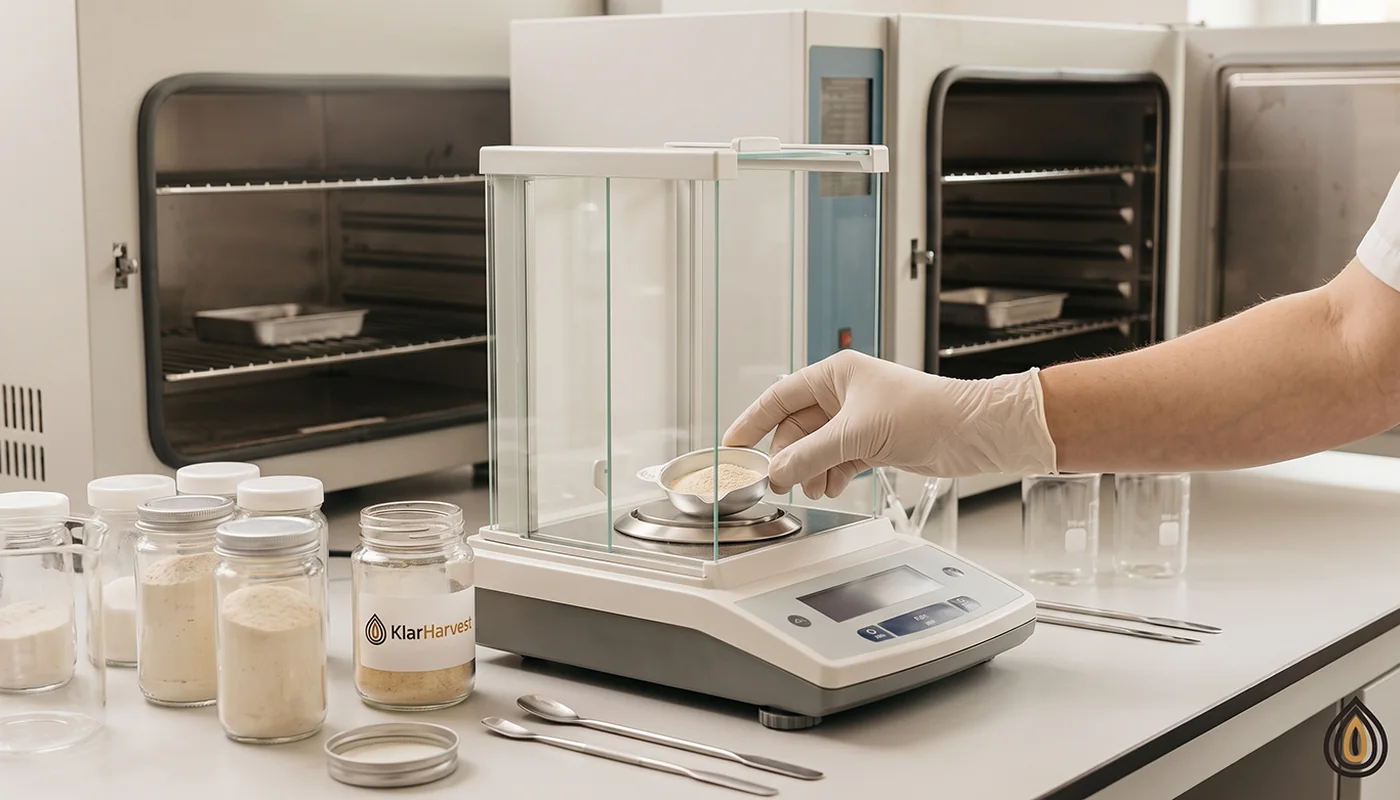
The reference method is oven drying: a weighed sample is dried at 105 °C to constant weight and the loss is the moisture. It takes hours. Plants and buyers use halogen or infrared moisture analysers for routine control, which give a result in ten minutes and read slightly differently from the oven; a CoA should state which method was used, and a specification should name the reference method for disputes. Water activity, written aw, is a related but different number: it measures the water available for microbial growth, on a scale from 0 to 1, and dehydrated onion below 6 percent moisture has an aw of about 0.3 to 0.4, far below the 0.6 at which moulds start to grow. Some buyers specify aw at maximum 0.5 as a safety line; most rely on moisture. Both are explained further in Dehydrated Onion Moisture Content and Water Activity in Dehydrated Onion.
How to write the line: "Moisture: maximum 6.0 percent, reference method oven drying 105 °C; routine method halogen analyser, calibrated against the reference." Tighten to 5.5 percent if you buy powder for a humid production environment.
Ash and acid-insoluble ash
Total ash is the mineral residue left when a sample is burned at 550 °C, expressed as a percentage of dry weight. Onion itself contains about 3 to 4 percent minerals, so a total ash limit of 5 percent leaves room for natural variation while catching contamination with soil or with added salt. A value above 5 percent points to poor washing or a plant that has cut corners. Acid-insoluble ash is the part of that residue that does not dissolve in dilute hydrochloric acid, which in practice is sand and grit; the limit is 0.5 percent and a good lot is below 0.2. This is the number that tells you whether the onions were washed properly before slicing, and it matters most for powder and granules, where grit cannot be seen and reaches the consumer's teeth.
How to write the lines: "Total ash: maximum 5.0 percent on dry basis. Acid-insoluble ash: maximum 0.5 percent on dry basis." Both are on every full CoA and rarely fail at a BRC-certified plant; they are worth specifying precisely because a trader who sources from an uncertified unit cannot always meet them.
Particle size, sieve analysis and bulk density
Particle size is where specifications are vaguest and disputes most frequent. A cut name is not a specification; a band with a minimum share inside it is. The sheet should say the sieve sizes, the minimum percentage retained between them and the maximum share of fines below the band, and the CoA should carry a sieve analysis showing the actual distribution across at least three fractions.
| Cut | Specification wording | What the sieve analysis should show |
|---|---|---|
| Flakes | Minimum 90 % retained between 8 mm and 20 mm; fines below 3 mm maximum 5 % | Above 20 mm, 8-20 mm, 3-8 mm, below 3 mm |
| Chopped | Minimum 90 % between 3 mm and 5 mm | Above 5, 3-5, 1-3, below 1 mm |
| Minced | Minimum 90 % between 1 mm and 3 mm | Above 3, 1-3, below 1 mm |
| Granules | Minimum 90 % between 16 and 40 mesh; maximum 5 % passing 40 mesh | On 16, 16-40, through 40 mesh |
| Powder | Minimum 95 % passing 80 mesh | On 80, through 80 mesh; optionally through 100 |
Bulk density, in grams per litre, is specified by buyers who dose by volume or who need to know how many kilograms fit a hopper or a container. Typical values are 180 to 230 for flakes, 280 to 350 for chopped, 350 to 450 for minced, 450 to 550 for granules and 500 to 650 for powder, measured loose or tapped; say which. A bulk density far below the range for a cut means the lot is coarser than specified or unusually fluffy; far above means fines. The flow behaviour of the fine cuts is discussed in Bulk Density and Flowability of Onion Powder and Granules, and the size bands in detail in Mesh Size in Dehydrated Onion.
Colour and appearance
Colour is the parameter a line operator sees first and the one hardest to put into numbers. The standard wording for white onion is "ivory to pale cream, uniform, free of brown or dark pieces", judged against a retained reference sample under daylight. For red onion it is "cream flesh with reddish-purple skin fragments, uniform", with, for flakes and chopped, a minimum share of pieces showing red skin. Buyers of white powder for pale products sometimes add an instrumental value, a Hunter Lab or CIE L* lightness above a stated figure, measured on the powder; it removes the argument about what "pale cream" means but requires both sides to have the instrument.
What a bad colour tells you: uniform beige across a white lot means over-drying or old stock; scattered brown pieces mean burnt edges from an uneven dryer belt; a grey cast in powder means fines from the darker outer layers; faded red in red onion means age or heat. Colour is also where a sulphite question hides, because sulphite treatment keeps white onion whiter, and an unusually bright white lot from a plant that claims sulphite-free is worth a sulphite test. The causes and the grading are in Dehydrated Onion Colour.
Foreign matter, defects and metal
Three lines cover what should not be in the bag. Extraneous matter is anything that is not onion: stones, string, insects, plant stalks; the limit is effectively zero, written as "absent" or "maximum 0.1 percent by weight". Defects are onion that should not have passed grading: black or dark brown specks from burnt pieces, root plate fragments, discoloured pieces; the usual limit is 0.5 percent by weight for black specks and 1 to 2 percent for discoloured pieces, counted on a spread sample. Metal is covered by a statement that the lot passed metal detection at stated sensitivities, typically 1.5 millimetres ferrous, 2.0 non-ferrous and 2.5 stainless steel, and by the acid-insoluble ash line for grit.
These lines separate plants more than any others, because they depend on sorting: optical sorters and hand-picking lines at the certified units, or neither at the cheapest ones. A CoA that reports "black specks: 0.1 percent" from an actual count is worth more than one that reports "nil". Defects, their causes and the reject decision are the subject of Common Quality Defects in Dehydrated Onion.
Sulphites, pesticide residues, heavy metals and ethylene oxide
Four chemical lines matter for a European buyer, and none of them is tested on every lot at the plant; they are tested at an accredited laboratory on a schedule, and the sheet should say how often.
| Parameter | Typical specification line | Where the limit comes from | Testing frequency |
|---|---|---|---|
| Sulphur dioxide (sulphites) | Not treated, maximum 10 mg/kg (undeclared), or treated, within the EU limit for dried vegetables | EU additives regulation; allergen labelling above 10 mg/kg | Each lot at the plant if treated; periodic external test if sulphite-free |
| Pesticide residues | Within EU maximum residue levels for onion with the processing factor applied; multi-residue screen | EU MRL regulation 396/2005 | Per crop and plant, at least twice a season; per lot for sensitive buyers |
| Heavy metals | Lead maximum 0.1 mg/kg, cadmium maximum 0.05 mg/kg on fresh-weight basis with the drying factor applied | EU contaminants regulation | Per crop and plant |
| Ethylene oxide (and 2-chloroethanol) | Not detected, below 0.02 mg/kg | EU MRL; treatment not permitted in the EU | Per lot or per shipment for EU buyers since 2020 |
Two of these need a word. The EU residue and contaminant limits are set for fresh onion; for the dried product the laboratory applies a processing factor, and a specification should say "on a fresh-weight basis with the drying factor" so that a value on the dried product is not compared with a fresh limit. And ethylene oxide, a fumigant used against microbes in some countries and not permitted in the EU, caused hundreds of recalls of Indian spices and seeds from 2020 onward; a buyer of any Indian dried ingredient should have a per-shipment test in the specification, and a serious supplier already does it. The regulations are gathered in EU Import Requirements for Dehydrated Onion, the residue testing in Pesticide Residues in Dehydrated Onion and the ethylene oxide story in Ethylene Oxide and Dehydrated Onion.
Microbiology: the tier table and the pathogen lines
Microbiology on a dehydrated onion sheet has two parts: indicator counts that describe the general load, which vary by tier, and pathogen lines that are absolute. The indicator counts are total plate count (aerobic mesophilic bacteria), yeast and mould, and sometimes coliforms or Enterobacteriaceae. The pathogen lines are Salmonella, absent in 25 grams, and E. coli, absent in 1 gram or below 10 cfu/g, in every tier.
| Tier | Total plate count (cfu/g) | Yeast and mould (cfu/g) | Enterobacteriaceae (cfu/g) | Salmonella | E. coli |
|---|---|---|---|---|---|
| Standard | max 500,000 | max 5,000 | max 10,000 | absent / 25 g | absent / 1 g |
| Low bacterial | max 50,000 | max 1,000 | max 1,000 | absent / 25 g | absent / 1 g |
| Extra low bacterial | max 10,000 | max 500 | max 100 | absent / 25 g | absent / 1 g |
The methods belong on the sheet, because counts depend on them: ISO 4833 for total plate count, ISO 21527 for yeast and mould, ISO 21528 for Enterobacteriaceae, ISO 6579 for Salmonella, ISO 16649 for E. coli. A plant's own laboratory usually runs total plate count and yeast and mould on every lot and sends pathogens to an accredited laboratory; the CoA should show which is which. Choosing the tier is a question about your own process: if there is a validated kill step after the onion is added, standard grade is normal; if not, the treated grades are the specification. The full reasoning is in Microbiology in Dehydrated Onion and the treatment in Low Bacterial and Extra Low Bacterial Dehydrated Onion.
Allergen, GMO, irradiation and diet statements
The bottom of the sheet carries statements rather than numbers, and a buyer's quality system will ask for each of them. Allergens: onion is not one of the fourteen EU-listed allergens, and a sulphite-free product carries no allergen; a sulphite-treated product must declare sulphites above 10 milligrams per kilogram. Cross-contact with allergens in the plant, typically nil for a dedicated onion and garlic line, should be stated. GMO: no genetically modified onion is in commercial cultivation, so the statement is "not derived from genetically modified organisms". Irradiation: not irradiated, since irradiation is not used on Indian dehydrated onion and would have to be labelled in the EU. Diet and religious statements: suitable for vegetarians and vegans; halal and kosher certificates are available from some plants and should be named if you need them. Gluten: naturally gluten-free, with a cross-contact statement if the plant handles cereals, which onion plants do not. The statements are covered in Allergens, Gluten and Dehydrated Onion and GMO and Irradiation Status of Indian Dehydrated Onion.
Packaging, shelf life and storage lines
The last block says how the product arrives and how long it lasts. Packaging: 20 kilogram net in a food-grade polyethylene liner inside a multi-wall kraft paper bag or a woven polypropylene bag, heat-sealed, on fumigated or heat-treated wooden pallets to ISPM 15 or on plastic pallets, with the number of bags per pallet and pallets per container. Shelf life: 18 months from the production date in the original sealed packaging, or 24 months where the buyer's storage is controlled, with the storage conditions: below 25 °C, below 60 percent relative humidity, away from light and odours. Labelling on the bag: product name, cut, net weight, lot code, production date, best-before date, origin, and the supplier's name and address or code. These lines are where private-label and logistics questions are answered; the options are in Dehydrated Onion Packaging and the shelf-life reasoning in Dehydrated Onion Shelf Life.
Reading a certificate of analysis: what makes it credible
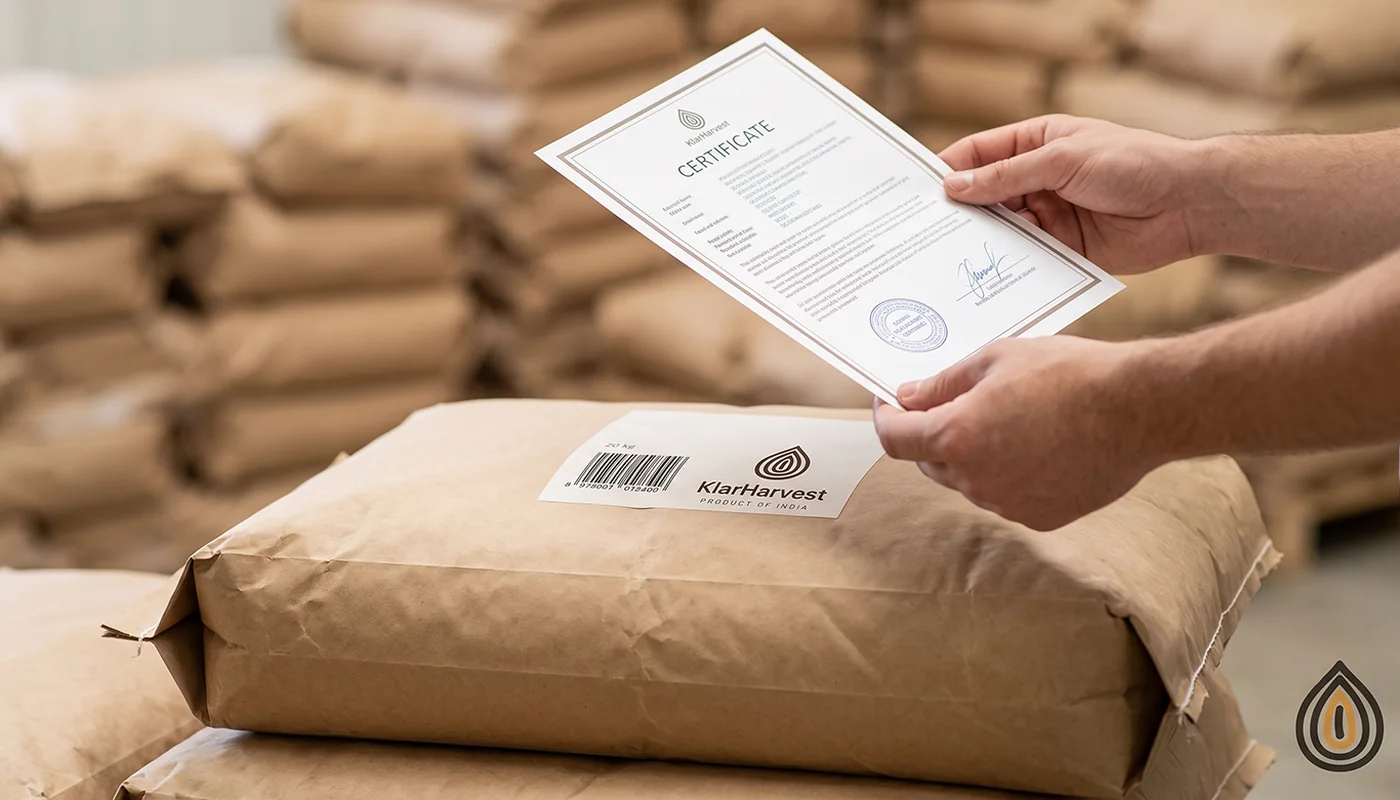
A certificate of analysis is credible when it can be traced and reproduced. Check these before checking the values.
- Laboratory identity and accreditation. The laboratory's name, address and accreditation number (NABL in India, ISO/IEC 17025 elsewhere) with the scope covering the tests reported. A plant's internal laboratory is fine for moisture and sieve analysis and should be identified as internal.
- Lot number, sample description and dates. The lot code on the CoA must match the bags; the sample date and the report date should be days apart, not months; the quantity the lot represents should be stated.
- Measured values, not "conforms". Every line should show a number with a unit, and the specification limit beside it. "Complies" in the value column means nobody measured.
- Methods. Each line names the method, ISO or AOAC or the laboratory's own validated method.
- Units that match the specification. cfu/g for counts, mg/kg for chemicals, percent for moisture and ash; and the basis, fresh weight or dry weight, for residues and metals.
- A signature or an electronic authorisation and a report number that the laboratory can confirm if you call.
A certificate that fails one of these is not necessarily false, but it cannot settle a dispute, which is what it is for. The reading of a full NABL report, page by page, is in How to Read a Dehydrated Onion Lab Report.
Seven traps on specification sheets
- "Typical" values presented as limits. A sheet that says "moisture: 5 percent" without "maximum" is describing an average, not a promise. Every limit needs "maximum" or "minimum".
- Cut names without bands. "Flakes" allows 25 percent fines. Write the sieve sizes.
- Counts without methods. A total plate count by one method can read three times another. Name the ISO method.
- Residue limits on the wrong basis. A dried-product value compared with a fresh-onion limit will fail; state the basis and the factor.
- Tier by name only. "Low bacterial" means different counts at different plants. Write the number.
- Colour by adjective only. Add a reference sample, and for powder an instrumental value if you can.
- A sheet that never changes. A specification dated three years ago, with no version number, is one nobody has read since. Version it, date it, and attach it to every order.
A template specification for white onion flakes
The template below is the full sheet for standard-grade white onion flakes as most European buyers specify it. Change the tier line for treated grades, the band for other cuts, and the colour and sulphite lines for red onion.
| Line | Specification |
|---|---|
| Product | Dehydrated white onion flakes, Allium cepa L., origin India (Gujarat) |
| Process | Washed, peeled, sliced, hot-air dried, sieved, metal detected; sulphite-free |
| Particle size | Minimum 90 % retained between 8 mm and 20 mm; fines below 3 mm maximum 5 %; sieve analysis on each CoA |
| Moisture | Maximum 6.0 %, oven 105 °C reference |
| Water activity | Maximum 0.5 |
| Total ash / acid-insoluble ash | Maximum 5.0 % / maximum 0.5 %, dry basis |
| Colour | Ivory to pale cream, uniform, free of brown; against retained reference |
| Defects | Black specks maximum 0.5 %; discoloured pieces maximum 2 %; extraneous matter absent |
| Metal detection | Passed at Fe 1.5 mm, non-Fe 2.0 mm, SS 2.5 mm |
| Sulphur dioxide | Maximum 10 mg/kg (not treated) |
| Pesticide residues | Within EU MRLs, fresh-weight basis with drying factor; multi-residue screen per crop |
| Heavy metals | Lead maximum 0.1 mg/kg, cadmium maximum 0.05 mg/kg, fresh-weight basis |
| Ethylene oxide | Not detected, below 0.02 mg/kg, per shipment |
| Microbiology (standard tier) | TPC maximum 500,000 cfu/g (ISO 4833); yeast and mould maximum 5,000 (ISO 21527); Enterobacteriaceae maximum 10,000 (ISO 21528); Salmonella absent in 25 g (ISO 6579); E. coli absent in 1 g (ISO 16649) |
| Statements | No allergens; not derived from GMO; not irradiated; suitable for vegetarians and vegans |
| Packaging | 20 kg net, PE liner in kraft paper bag, heat-sealed; 40 bags per pallet, ISPM 15 pallets |
| Shelf life and storage | 18 months from production in sealed packaging; below 25 °C, below 60 % RH, away from light |
| Documents per lot | CoA (plant + accredited laboratory), lot code, retained sample held 24 months |
How KlarHarvest documents a lot
Every KlarHarvest lot carries a certificate of analysis from an NABL-accredited laboratory for the safety parameters and the plant's results for moisture, sieve analysis and counts, both referenced to the lot code printed on each bag. The specification sheet for each cut is on its product page, versioned and dated, and is attached to every quote so that the price refers to a document rather than a product name. A retained sample of each lot is held for the shelf life. Buyers who need tighter limits on a line, a lower moisture, an instrumental colour value, a per-lot residue screen, get them written into their own version of the sheet and priced accordingly. The product pages start at products, and the testing routine is described on the quality page.
Frequently asked questions
What should a dehydrated onion specification include?
Identity (colour, cut and band, grade, origin, process), moisture, ash, particle size with sieve analysis, colour reference, defects and metal detection, sulphite status, residue and contaminant limits, the microbiology tier with methods, allergen and GMO statements, packaging, shelf life and the documents required per lot. It fits on one page.
What is the difference between a specification and a certificate of analysis?
The specification is the agreed limits for every lot. The certificate of analysis is the measured values for one lot, with the laboratory, method, lot number and date. A sheet with "conforms" in the value column is neither.
What moisture should dehydrated onion have?
Maximum 6 percent, with good lots at 4.5 to 5.5 percent, by the oven method at 105 °C. Buyers of powder for humid environments often specify 5.5 percent.
Which microbiology tier do I need?
Standard if your process has a validated kill step after the onion is added; low bacterial or extra low bacterial if the product is eaten without one. Pathogen limits, Salmonella absent in 25 grams and E. coli absent in 1 gram, apply to every tier.
How often are pesticide residues and heavy metals tested?
Not on every lot at the plant; at an accredited laboratory per crop and per plant, at least twice a season, and per lot for buyers who specify it. Ethylene oxide is tested per shipment for EU buyers.
Is a plant's own certificate of analysis acceptable?
For moisture, sieve analysis and routine counts, yes, if it is identified as the plant laboratory. For pathogens, residues and metals, an accredited external laboratory's report is the credible document.
Can I use my own specification instead of the supplier's?
Yes, and you should. Send your sheet with the enquiry, ask the supplier to confirm each line or propose a change, and reference the agreed version on every order.
Next step
If you have a specification, send it and we will confirm it line by line or say where a line needs changing. If you do not, ask for the spec sheet of the cut you need and start from ours; or request a sample and receive the lot's certificate of analysis with it, so that you can read the two documents side by side.