- What organic means for a dehydrated vegetable
- Growing organic onion in Saurashtra
- India's NPOP system and its standing with the EU
- The plant's certification: segregation and mass balance
- The certificate of inspection and TRACES
- Who makes organic dehydrated onion, and how much
- Availability by season and cut
- The price gap and where it comes from
- Testing: residues, contaminants and the organic paradox
- Integrity risks and how to manage them
- UK, US and other markets
- Quality: does organic onion taste or perform differently?
- Who buys it and why
- Alternatives: clean-label without the premium
- Specification and contract lines for organic
- Buying organic onion: the sequence and the calendar
- How KlarHarvest handles organic
- Frequently asked questions
Judge the product, not the words
200-500 g from a current lot, dispatched by courier with the lot lab report.
Request a sampleOrganic dehydrated onion from India is a real product with a real market and a set of traps for a buyer who assumes it is simply the conventional product with a certificate attached. It is grown on certified plots that yield a third less, dried at plants that must segregate it from the conventional runs and document every kilogram, certified under India's own organic standard whose standing with the EU has changed and is changing again, shipped with an electronic certificate of inspection that the EU border must endorse, and priced at roughly three times the conventional product for all of those reasons. The volumes are small, the seasonal window is narrow, and the residue and integrity questions that hang over organic imports from India in general apply to onion in particular. This guide covers the whole chain so that a buyer can decide whether organic onion is worth its price for a given product, and buy it properly if it is.
It explains how organic onion is grown and what that does to yield and quality, the Indian certification system and its relationship with EU and other rules, the plant's side of organic certification, the certificate of inspection and the TRACES process, who makes organic dried onion and how much, availability by season, the price gap and its components, the testing and residue position, the integrity risks and how to manage them, the specification lines, and the alternatives for a buyer who wants a clean-label story without the organic premium. Figures are for 2026; the regulatory position should be checked in its current text.
What this guide covers
- What organic means for a dehydrated vegetable
- Growing organic onion in Saurashtra
- India's NPOP system and its standing with the EU
- The plant's certification: segregation and mass balance
- The certificate of inspection and TRACES
- Who makes organic dehydrated onion, and how much
- Availability by season and cut
- The price gap and where it comes from
- Testing: residues, contaminants and the organic paradox
- Integrity risks and how to manage them
- UK, US and other markets
- Quality: does organic onion taste or perform differently?
- Who buys it and why
- Alternatives: clean-label without the premium
- Specification and contract lines for organic
- Buying organic onion: the sequence and the calendar
- How KlarHarvest handles organic
- Frequently asked questions
What organic means for a dehydrated vegetable
Organic status is a claim about process, not about the product's analysis: the onion was grown without synthetic fertilisers and pesticides on land that has been managed organically for a conversion period, processed without prohibited additives or treatments at a facility that keeps organic and conventional apart, and traced with documents at every step. A laboratory cannot prove a lot organic, only disprove it by finding a prohibited residue, and the whole system therefore rests on certification and inspection of the operators rather than on testing of the goods. For a dried vegetable the chain has four certified links: the grower, the plant, the exporter and the importer, and a break in any of them, an uncertified trader who bought and resold the lot, a plant that ran it on a line without segregation, an exporter without organic registration, removes the claim. The EU regulation that governs all of it is 2018/848, in force since 2022, with its import rules for third countries; the frame around it is in EU Import Requirements for Dehydrated Onion.
Growing organic onion in Saurashtra
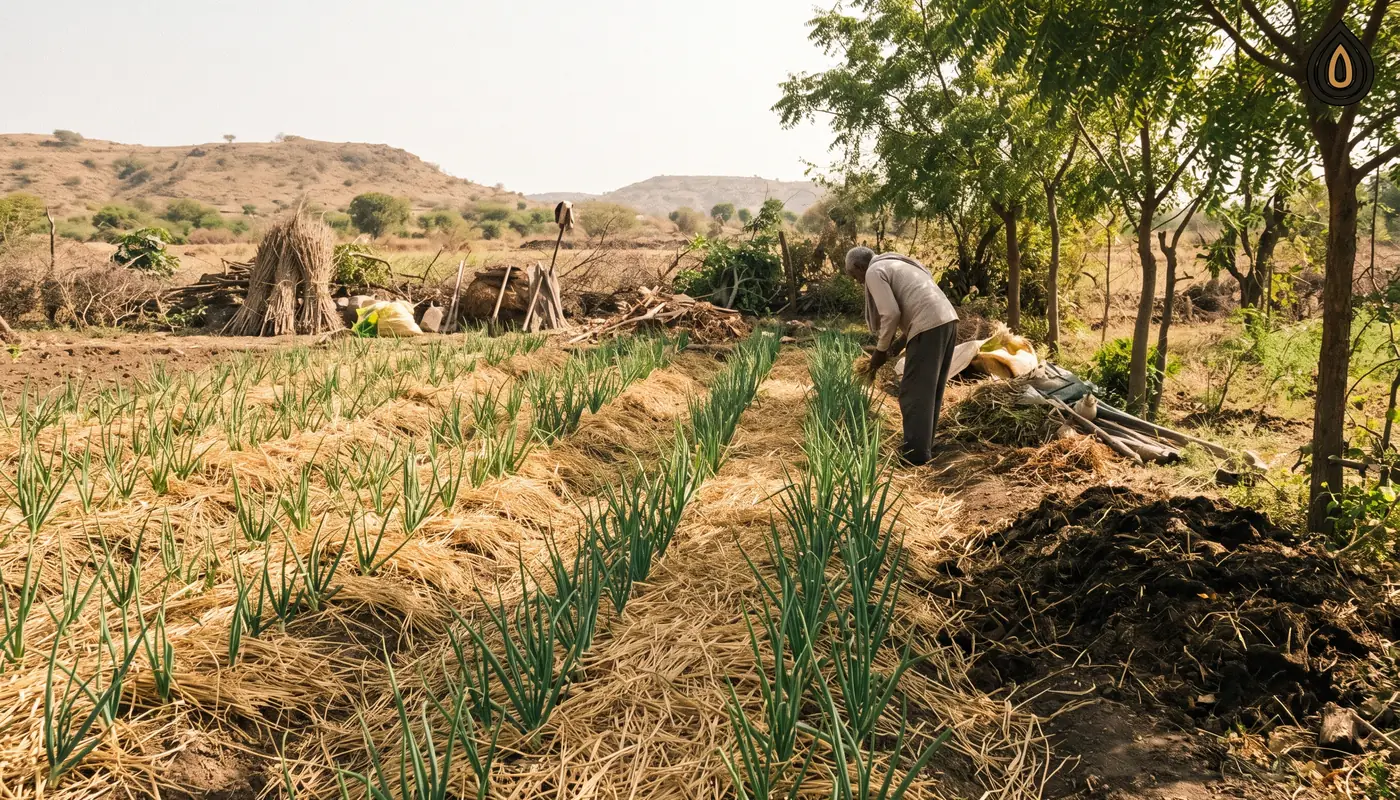
Organic onion around Mahuva and in the wider Saurashtra belt is grown on small certified plots, a hectare or a few, by farmers in certified groups under an internal control system that a certification body inspects, and the agronomy differs from the conventional crop in ways a buyer should understand. Fertility comes from farmyard manure, compost and green manures rather than urea and phosphate, which limits the nitrogen the crop gets and the bulb size it reaches; thrips and blight are managed with neem, biological controls, crop rotation and tolerant varieties rather than with the insecticides and fungicides the conventional crop receives, which costs yield in a bad thrips year; weeds are hand-pulled and mulched. Yields are 20 to 40 percent below conventional, bulbs are smaller and more variable, and dry matter is often a point higher, since a slower-grown, lower-nitrogen bulb tends to be denser, which is a small advantage at the dryer. The conversion period, three years for a plot to move from conventional to organic status, means the supply cannot expand quickly, and the plots in conversion sell as conventional until they qualify. The organic crop is a fraction of a percent of the district's onion, grown mostly under contract to the few plants that dry it, and the seasonal pattern follows the conventional rabi crop described in The Indian Onion Harvest Calendar.
India's NPOP system and its standing with the EU
India certifies organic production under the National Programme for Organic Production, NPOP, run by APEDA, through accredited certification bodies, Indian and international, that inspect growers, processors and exporters and issue the transaction certificates that follow each lot. NPOP was recognised by the EU as equivalent to its own organic rules for unprocessed and processed plant products for many years, under the old regulation's third-country list, which let Indian organic product enter the EU on an NPOP certificate. Under Regulation 2018/848 the recognition of third-country systems was placed on a transition: the equivalence arrangements continued for a period, with the Commission narrowing India's recognition to unprocessed plant products in 2023 and 2024 after integrity problems in some Indian supply chains, and the system as a whole moving toward direct compliance, under which the certification body itself, rather than the national programme, must be recognised by the EU for the product category and the country. The practical position in 2026 is that an Indian organic dried onion consignment must be certified by a control body that the EU recognises for processed products from India under the compliance regime, and a buyer must confirm that specific recognition for the specific body before contracting, since a certificate from a body recognised only for unprocessed products does not carry a dried product. The list of recognised bodies and their scopes is public and changes; the exporter's certification body should be checked against it at approval and again each year.
The plant's certification: segregation and mass balance
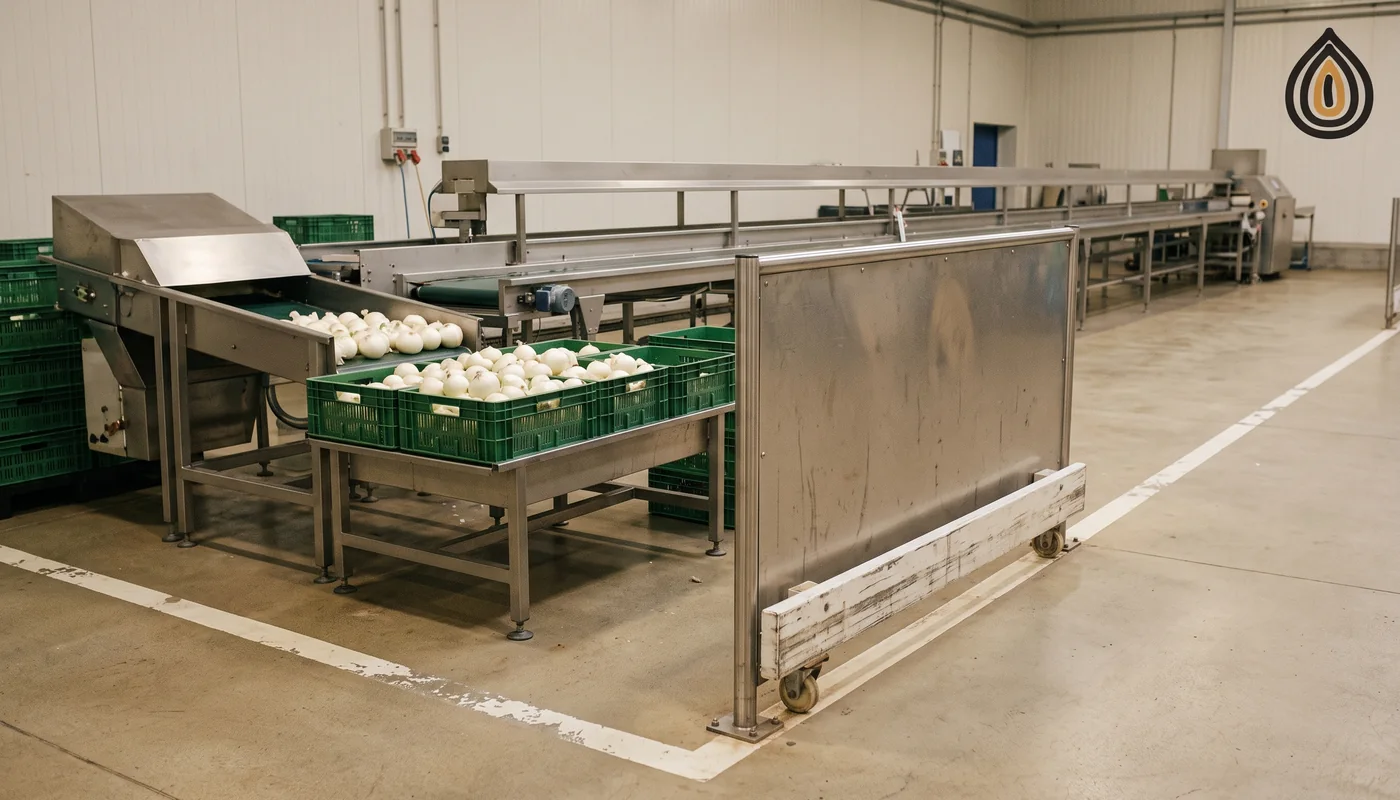
A plant that dries organic onion is certified as an organic processor, and the inspector looks for three things. Segregation: organic onion is received, stored, processed and packed apart from conventional, in space, on a dedicated line, or in time, as a run that follows a documented clean-down and precedes any conventional run; most Mahuva plants that do organic run it in time, in blocks at the start of a shift after a clean, since a dedicated line for a small volume does not pay. Inputs: no prohibited processing aids, no sulphite, no synthetic anti-caking agent, and the plant's cleaning chemicals and pest control within the organic rules. Mass balance: the organic onion received, by transaction certificate from the grower group, must reconcile with the organic product packed and sold, by transaction certificate to the buyer, with the yield ratio in between and no more organic product leaving than the onion could have made; the mass-balance reconciliation is the inspector's main tool against the substitution of conventional product, and a plant's records must survive it. The plant's BRCGS certification is separate and still applies; the organic certificate adds to it rather than replacing it. The production process, common to both products, is in How Dehydrated Onion Is Made.
The certificate of inspection and TRACES
Every organic consignment entering the EU needs a certificate of inspection, COI, issued electronically in the EU's TRACES system by the exporter's control body before the goods leave India, naming the exporter, the importer, the product, the quantity, the lot and the control bodies at each end, and endorsed at the EU border by the competent authority after a document check and, on a risk basis, sampling. The importer must be registered as an organic operator with its own control body and must be named on the COI as the first consignee; a consignment arriving without a valid COI, or with one that does not match the goods, loses its organic status and clears as conventional, which at three times the price is a disaster rather than a delay. The COI is applied for by the exporter through its control body once the transaction certificate for the lot exists, takes a few days, and must be complete before the vessel sails; the border endorsement at Hamburg or Rotterdam takes a day or two on top of the ordinary customs clearance, and the importer's broker must know to present it. The EU's border sampling of organic products from India has been intensive since the integrity problems of the early 2020s, and a buyer should expect a residue sample on a share of consignments. The ordinary clearance the COI sits within is in Customs Clearance for Dehydrated Onion in the EU.
Who makes organic dehydrated onion, and how much
A handful of the larger Mahuva plants and a few plants elsewhere in Gujarat and Maharashtra hold organic processing certification and dry organic onion in blocks each season, mostly white, mostly flakes, granules and powder, for European and American buyers under contract; the total is a few hundred to perhaps a thousand tonnes a year against the district's tens of thousands of conventional, and it is contracted before it is dried. Some exporters market organic onion that they buy from those plants; a few trade organic product of uncertain chain. The buyers are European organic brands, retail private label for the organic ranges of the supermarkets, baby-food and organic-soup manufacturers, and the American natural-foods trade, and the volumes per buyer are pallets to a container or two a year. A buyer looking for organic onion should expect to deal with a short list of plants, to contract early, and to find that the plant's organic block for the season is sold out by May. The Mahuva industry as a whole is described in Mahuva, Gujarat: Inside India's Onion Dehydration Hub.
Availability by season and cut
| Period | Organic availability | Notes |
|---|---|---|
| March-May | Fresh-crop organic runs at the certified plants | The only time new organic product is made in volume; contract by February |
| June | Last organic blocks from field stores | Small |
| July-February | Stock only | What was dried in spring; powder and granules hold, flakes are scarcer |
| Any time | Red organic | Very small; a plant or two in some years |
| Any time | Custom bands, toasted, low bacterial tiers | Possible on the organic block by arrangement; steam treatment is permitted under organic rules |
A buyer with a year-round need holds stock from the spring run or contracts a plant to hold it; the plants' dehumidified storage and the product's two-year life make that practical, as explained in Dehydrated Onion Shelf Life.
The price gap and where it comes from
| Cost component | Conventional white flakes | Organic white flakes | Why |
|---|---|---|---|
| Raw onion at the plant gate | ₹5-6/kg | ₹12-18/kg | Lower yields, hand weeding, certification cost, small plots, premium to the grower |
| Yield ratio | 8.5 | 8.0-8.5 | Slightly higher dry matter offsets smaller bulbs |
| Raw material per kg of product | ₹45-50 | ₹100-150 | |
| Conversion | ₹45-55 | ₹60-75 | Short runs, clean-downs, segregated storage, documentation |
| Certification, COI, transaction certificates | - | ₹5-10 per kg on small volumes | Fixed costs over small tonnage |
| Margin | 8-15 % | 10-20 % | Risk of losing status; small volumes |
| FOB, ₹/kg | ₹150-170 | ₹400-520 | |
| FOB, €/kg | €1.50-1.70 | €4.00-5.20 | About 3× |
| Landed Europe, €/kg | €1.80-2.10 | €4.60-5.80 | Duty and freight the same per kg |
The gap is mostly the raw onion: an organic grower's yield is a third lower, the labour higher, and the price the plant must pay to keep the grower organic is two to three times the conventional yard price. Short processing runs and the certification overhead add the rest. The conventional cost build, for comparison, is in What Does Dehydrated Onion Cost per Kilogram?
Testing: residues, contaminants and the organic paradox
Organic onion is tested more than conventional, not less, because a residue finding removes the organic status as well as failing the lot, and because EU border controls sample organic imports from India on a risk basis. The multi-residue screen is run on every organic lot at an LOQ of 0.01 milligrams per kilogram, and the expectation is nothing detected; a detection of a synthetic pesticide at any level above the LOQ is investigated as a possible contamination or fraud, and under the EU rules the operator must withhold the organic claim until the investigation clears it. The paradox is that the conventional product from a plant with field-block sourcing also tests clean at that LOQ nearly all of the time, so the organic certificate is buying a process guarantee rather than a measurably cleaner product; buyers who want a residue-free product for its own sake can have it from good conventional sourcing at a third of the price, and buyers who want the organic claim for their label pay for the claim. Contaminants, heavy metals, are no different for organic; microbiology is the same, and steam treatment for the lower tiers is permitted. The residue picture as a whole is in Pesticide Residues in Dehydrated Onion.
Integrity risks and how to manage them
Organic imports from India have had integrity problems, and the European authorities' response, the narrowing of NPOP recognition and the intensified border sampling, followed cases of conventional product sold as organic and of certification bodies whose inspections were inadequate. For dried onion the risks are specific: a plant substituting conventional onion into an organic block when the organic raw material runs short; an exporter buying organic product from the market without a transaction certificate that reaches back to the grower; a certification body recognised for the wrong scope. The buyer's defences are to deal with the plant directly or with an exporter that names it, to obtain the transaction certificates for the lot back to the grower group, to check the control body's EU recognition for processed products, to check the mass balance for the season if the volumes warrant it, to run the residue screen on every lot at the buyer's own laboratory, and to visit or video-audit the segregation. An organic claim that cannot be traced to a certified grower group with a transaction certificate is not an organic claim. The supplier vetting that applies with extra weight to organic is in 25-Point Checklist Before You Choose a Dehydrated Onion Supplier, and the warning signs in 12 Red Flags When Dealing with a Dehydrated Onion Exporter.
UK, US and other markets
The UK retained the EU organic rules at Brexit and runs its own recognition of third-country control bodies and its own certificate of inspection through its import system; the position for India mirrors the EU's with its own list, and a UK buyer checks the UK recognition. The United States runs the National Organic Program, under which India's NPOP has no equivalence and Indian operators are certified directly by USDA-accredited certifiers, many of the same bodies, to the NOP standard; an organic dried onion for the US needs NOP certification of the grower, the plant and the exporter and an NOP import certificate under the strengthened rules in force since 2024. Japan's JAS, Canada's COR and Switzerland's Bio Suisse each have their own recognition of Indian certification, with Canada and Switzerland close to the EU's. A plant that serves several organic markets holds NPOP, EU-compliance and NOP certification together, which most of the organic-capable Mahuva plants do; a buyer should ask for the certificate for its own market rather than assuming one covers all. The UK and US import routes in general are in Importing Dehydrated Onion into the UK and Importing Dehydrated Onion into the USA.
Quality: does organic onion taste or perform differently?
In the bag, organic dried onion from a good plant is indistinguishable from the conventional product of the same plant: the same colour grades, the same sieve bands, the same rehydration, the same microbiology after the same treatment. Two small differences appear in the raw material. Organic bulbs are smaller and more variable, which costs the plant a little in peeling loss and shows, if at all, as a fraction more skin fragments in flakes; and organic onion often carries a point more dry matter and a slightly higher pungency, which some flavour houses notice as a marginally stronger note at the same dose. The absence of sulphite and synthetic anti-caking agents is shared with the conventional export product, which does not use them either. Colour can be a shade less uniform across an organic lot because the raw material is more variable. A buyer running a sensory comparison between organic and conventional from the same plant will usually find them within the lot-to-lot variation of either; the comparison method is in Sensory Evaluation of Dehydrated Onion.

Who buys it and why
The buyers of organic dried onion are buying a label claim that their customers pay for: organic soups, sauces and ready meals at a retail premium of 30 to 100 percent over conventional; organic baby food, where the residue expectation is absolute and the organic certificate is the process guarantee that the brand's own testing complements; organic spice and seasoning ranges; and the organic private-label ranges of the European discounters and supermarkets, which have grown steadily and which source their onion powder and granules through organic-certified packers. In each case the onion is a small share of the product's cost, so three times the price on a few percent of the recipe is bearable, and the certificate is worth more than the ingredient's cost difference. A conventional manufacturer considering an organic line should cost the whole recipe, since every ingredient must be organic for the claim, and the onion is the easy part.
Alternatives: clean-label without the premium
A buyer who wants a residue-free, additive-free, transparently sourced onion without the organic premium has it in the conventional export product from a plant with field-block sourcing and a spray programme: sulphite-free, no additives, non-GMO by nature, not irradiated, residues below 0.01 on the screen, from a named plant with a lot record. What it cannot carry is the word "organic" or the EU leaf, and for many product ranges that is the whole point; for others, "no additives", "sourced from a named farm group", "residue-tested every lot" and a traceable lot code are the claims the customer values, and they cost a third of the organic price. The traceability that supports those claims is in Lot Codes and Traceability in Dehydrated Onion, and the GMO and irradiation statements in GMO and Irradiation Status of Indian Dehydrated Onion.
Specification and contract lines for organic
- Status: "Certified organic under [EU Regulation 2018/848 / NOP / UK organic regulations] by [control body], recognised for processed plant products from India; certificate numbers of grower group, processor and exporter attached and renewed annually."
- Traceability: "Transaction certificates for each lot from grower group to exporter to be provided with the certificate of analysis."
- COI: "Certificate of inspection to be issued in TRACES naming [importer] as first consignee before the vessel departs; the seller bears the cost of any loss of organic status caused by a defective or missing COI."
- Segregation: "Product processed in a dedicated organic run following a documented clean-down; the seller to provide the run record on request."
- Residues: "Multi-residue screen of not fewer than 400 actives at LOQ 0.01 mg/kg on each lot; any detection of a synthetic active to be notified before shipment and the lot withheld pending investigation."
- Inputs: "No sulphite, no synthetic anti-caking agent, no prohibited processing aid; steam treatment permitted for the microbiological tier ordered."
- Price basis: "Price fixed for the season's organic block; quantity contracted by [date]."
- Mass balance: "The seller to make its organic mass-balance records for the season available to the buyer's control body on request."
The general specification these lines join is in How to Read a Dehydrated Onion Specification Sheet, and the contract in B2B Contract Terms for Dehydrated Onion.
Buying organic onion: the sequence and the calendar
An organic purchase runs on the conventional sequence with three extra steps and an earlier start. In November or December, when the organic plots are transplanted, the buyer identifies the plants with organic blocks for the coming season and asks each for its control body's name, certificate and EU recognition scope, its grower groups, and the tonnage it expects to dry organic in the spring; the buyer's own control body is told of the intended supplier so that the importer's certification covers it. In January and February, samples from the previous season's organic stock arrive with their transaction certificates and residue screens, the buyer's quality team approves the plant as an organic supplier, and the block is contracted with a fixed price and a shipment schedule, since an organic block is sold out before it is dried. In March to May the block is dried in its segregated runs, each lot tested and issued with a transaction certificate, and the buyer receives the certificates before shipment. At shipment, the exporter's control body issues the certificate of inspection in TRACES with the importer named as first consignee, the buyer's broker is told to present it at the border, and the goods clear with the organic endorsement. The whole sequence is twelve to twenty weeks from first contact to the first organic container, a month or two longer than the conventional path in From Sample to First Container, and the difference is the certification links, each of which must exist before the next can be issued.
| Month | Organic step |
|---|---|
| November-December | Identify plants and control bodies; notify the buyer's own control body |
| January-February | Samples, approval, contract for the spring block |
| March-May | Segregated drying; per-lot transaction certificates and residue screens |
| At shipment | Certificate of inspection issued in TRACES; broker instructed |
| Arrival | Border endorsement; organic status confirmed; verification residue screen |
| Yearly | Certificates renewed; control body's recognition re-checked |
How KlarHarvest handles organic
KlarHarvest supplies organic dried onion from organic-certified plants in Mahuva on contract for the spring run, with the grower group's, the plant's and the exporter's certificates and the transaction certificates for each lot in the lot record, the control body's EU recognition confirmed and documented at approval, a residue screen on every lot at the buyer's chosen laboratory, and the certificate of inspection raised in TRACES before departure with the importer named; the conventional product from the same plants is offered beside it with its own residue results, so that a buyer can compare the two and decide which claim its product needs. Organic inquiries go through the contact page, and the registrations behind both products are on the quality page.
Frequently asked questions
Is organic dehydrated onion available from India?
Yes, in small volumes from a handful of certified plants in Gujarat, dried in blocks during the spring harvest and sold from stock for the rest of the year. Contract by February for the season.
How much more does organic dried onion cost?
About three times the conventional price: roughly 4.00 to 5.20 euros per kilogram FOB for white flakes in 2026 against 1.50 to 1.70. The raw onion, at two to three times the conventional yard price, is most of the gap.
Is Indian organic certification accepted in the EU?
Only through a control body that the EU recognises for processed products from India under the current compliance regime; NPOP's general recognition was narrowed after 2023. Check the specific body's recognition and scope before contracting.
What is a certificate of inspection?
The electronic certificate in the EU's TRACES system that every organic consignment needs, issued by the exporter's control body before departure and endorsed at the border. Without a valid one the goods clear as conventional.
Does organic onion test cleaner than conventional?
Not measurably from a well-sourced conventional plant, where residues are below 0.01 mg/kg on nearly every lot. Organic is a process guarantee and a label claim rather than a different analysis, and it is tested more, not less.
Does organic onion taste different?
From the same plant, no more than lot-to-lot variation. Organic bulbs are smaller and a little denser; the dried product's colour, sieve, rehydration and microbiology are the same.
Can organic onion be steam-treated for a low bacterial tier?
Yes; steam treatment is a physical process permitted under organic rules. Sulphite and synthetic anti-caking agents are not.
Next step
Request a sample of organic and conventional product from the same plant, each with its certificate and residue screen, and decide which claim your product needs; to contract an organic block for the season, request a quote by February with the cut and the volume.