- The legal framework: which regulation governs what
- Tariff classification and duty
- Pesticide residues: MRLs and the processing factor
- Contaminants: lead, cadmium and the rest
- Ethylene oxide
- Additives and sulphites
- Microbiology: what the law says and what buyers require
- Increased official controls: is Indian dried onion listed?
- The documents that arrive with the goods
- Labelling: bag marking for B2B and retail packs
- The importer as food business operator
- Organic and other claims
- Differences between member states
- Pre-shipment compliance checklist
- How KlarHarvest prepares a shipment for the EU
- Frequently asked questions
Judge the product, not the words
200-500 g from a current lot, dispatched by courier with the lot lab report.
Request a sampleThe EU import requirements for dehydrated onion are spread across a dozen regulations that nobody reads end to end, and the practical consequence for an importer is a short list: the right tariff line and duty, pesticide residues within the maximum residue levels once the drying concentration is accounted for, contaminants within the limits, sulphites declared if present, a label that meets the food information rules, a document set that clears customs without a query, and an importer who understands that from the moment the goods enter the Union they are that importer's legal responsibility. None of it is difficult once the pieces are in one place. This guide puts them there, as the one-page answer to the search that brings most buyers here, EU import requirements dehydrated onion.
It covers the legal framework and which regulation governs what, the tariff classification and the duty, pesticide residues and the processing factor that makes dried products tricky, contaminant limits, additives and the sulphite question, microbiological expectations, the increased-official-controls list and whether Indian dried onion is on it, the documents that arrive with the container, labelling for B2B and retail, the importer's own obligations under the general food law, organic and other claims, the differences between member states, and a pre-shipment checklist.
Written for the rules in force in March 2026. Regulations change; the amending acts are listed in EUR-Lex under each regulation number given here, and a buyer's own regulatory adviser or importer should confirm the current text before relying on a figure. Nothing here is legal advice.
What this guide covers
- The legal framework: which regulation governs what
- Tariff classification and duty
- Pesticide residues: MRLs and the processing factor
- Contaminants: lead, cadmium and the rest
- Ethylene oxide
- Additives and sulphites
- Microbiology: what the law says and what buyers require
- Increased official controls: is Indian dried onion listed?
- The documents that arrive with the goods
- Labelling: bag marking for B2B and retail packs
- The importer as food business operator
- Organic and other claims
- Differences between member states
- Pre-shipment compliance checklist
- How KlarHarvest prepares a shipment for the EU
- Frequently asked questions
The legal framework: which regulation governs what
EU food law is layered: a general law that sets principles and responsibilities, hygiene rules that apply to every operator, and specific regulations that set numbers. For dehydrated onion the ones that matter are these.
| Regulation | What it governs for dried onion | Practical effect |
|---|---|---|
| Regulation (EC) 178/2002, general food law | Definitions, safety requirement, traceability, importer responsibility, RASFF | The importer is the responsible operator; one-step-back, one-step-forward records |
| Regulation (EC) 852/2004, hygiene of foodstuffs | Hygiene obligations for all operators, HACCP | Applies to the importer's own handling and storage |
| Regulation (EU) 2017/625, official controls | How member states check imports, including the increased-controls mechanism | Border checks; frequency depends on listing |
| Regulation (EC) 396/2005, pesticide MRLs | Maximum residue levels, processing factors | The residue test and the concentration calculation |
| Regulation (EU) 2023/915, contaminants | Lead, cadmium, other contaminants | Limits set on the fresh product; concentration applied |
| Regulation (EC) 1333/2008, food additives | Which additives are permitted in dried vegetables and at what level | Sulphites, anti-caking agents |
| Regulation (EU) 1169/2011, food information to consumers | Labelling, allergens, origin, date marking | Retail pack label; B2B minimum |
| Directive 2011/91/EU, lot marking | Lot identification on every pack | Lot code on every bag |
| Regulation (EU) 2019/1793, increased controls at import | Lists of products from third countries subject to extra checks | Whether a health certificate and CHED are needed |
| Regulation (EU) 2018/848, organic | Organic production, import of organic products | Certificate of inspection for organic lots |
Two things are absent that buyers sometimes expect. There is no EU product standard for dehydrated onion, no regulation that defines "flakes" or sets a moisture limit; quality is contractual, set by the specification. And there are no legal microbiological criteria for dried vegetables in the regulation that sets them for other foods, so the counts a buyer expects are, again, contractual. The specification therefore carries more weight in this trade than in many others; the sheet is explained in How to Read a Dehydrated Onion Specification Sheet.
Tariff classification and duty
Dried onion is classified under Combined Nomenclature code 0712 20 00, "onions, dried, whole, cut, sliced, broken or in powder, but not further prepared", within heading 0712 for dried vegetables. The code covers every cut from flakes to powder, white and red alike, provided the product is simply dried and not mixed with other ingredients; an onion-salt blend or a seasoning is classified elsewhere at a different rate. The third-country duty on 0712 20 00 is 6.4 percent of the customs value, which under most terms is the CIF value at the EU port, and there is no tariff quota, no anti-dumping measure and no entry-price mechanism. India was removed from tariff preferences for this product section under the Generalised Scheme of Preferences, so no preferential rate applies in practice; the EU-India free trade agreement was still under negotiation in March 2026 and nothing from it applied. Import VAT is charged in the member state of clearance at that state's rate for food, 7 percent in Germany, 9 percent in the Netherlands, and is recoverable by a VAT-registered importer. The classification, the reasoning behind it and the duty in other markets are worked through in HS Code 071220 for Dried Onion.
Pesticide residues: MRLs and the processing factor
Regulation 396/2005 sets a maximum residue level, MRL, for every combination of active substance and crop, and where none is set a default of 0.01 milligrams per kilogram applies. The levels are set on the fresh commodity, in this case fresh onion, and Article 20 provides that for processed products the MRL is adjusted by a processing factor reflecting concentration or dilution. Dehydration concentrates: 8 to 9 kilograms of fresh onion become one kilogram of dry product, and a residue that does not degrade in drying is concentrated by roughly that factor. Where the Commission has published a processing factor for a substance on dried onion, that factor applies; where none is published, the practice of member-state laboratories is to divide the measured dry-product result by the concentration factor, typically 8, and compare the result with the fresh-onion MRL, or, more conservatively for the importer, to compare the dry result with the fresh MRL directly. Which convention a laboratory applies changes a pass into a fail, so the importer's own laboratory should state its convention on the report and the supplier's certificate should state the factor used.
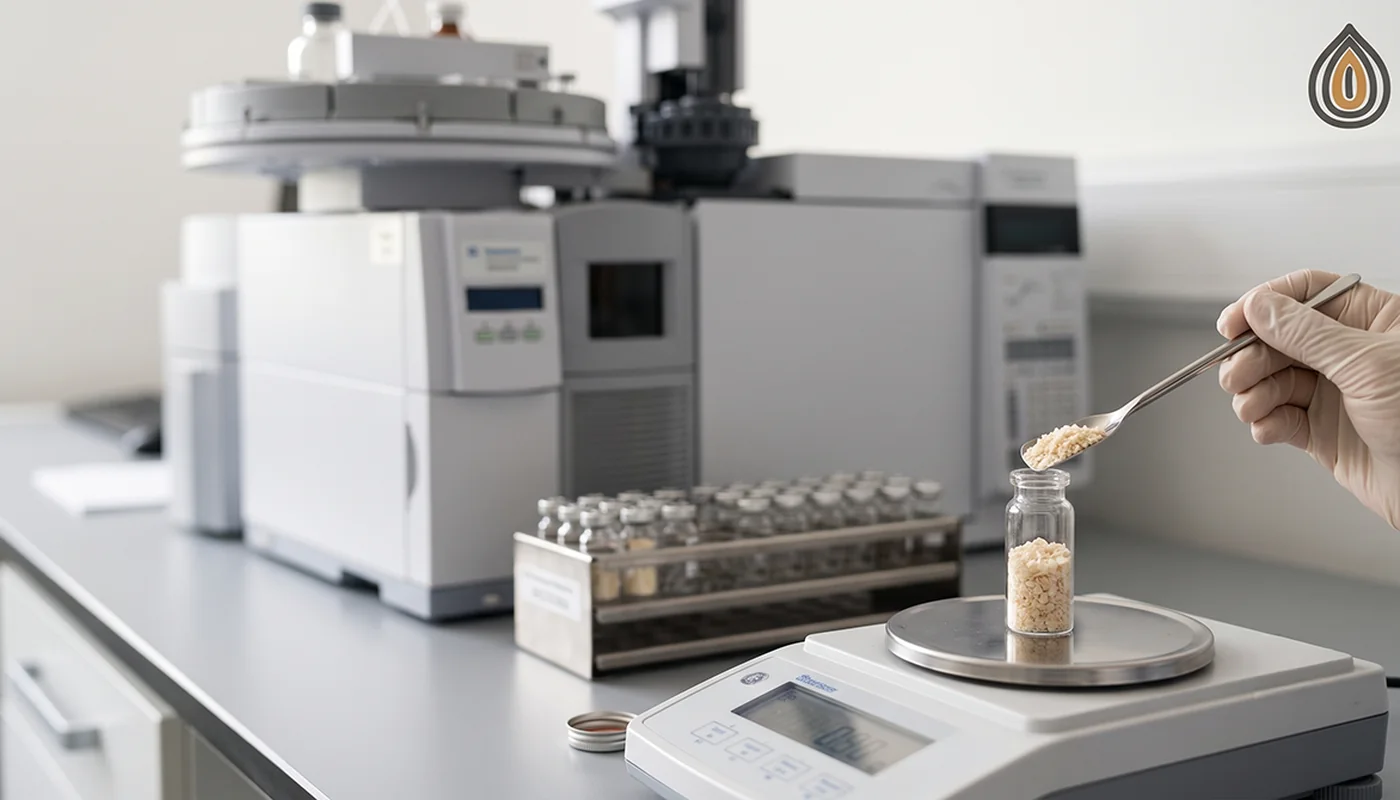
The substances that matter on Indian onion are a short list. Chlorpyrifos and chlorpyrifos-methyl lost their EU approval in 2020 and their MRLs fell to the default 0.01; they were once widely used on onion in India and remain the most common reason for a failed screen. Mancozeb lost approval in 2021 and its MRLs were lowered; it is still used against blight on Indian onion. Carbendazim, lambda-cyhalothrin, imidacloprid, profenofos and tricyclazole appear less often. A proper test is a multi-residue screen of 500 or more actives by gas and liquid chromatography with mass spectrometry, with a limit of quantification of 0.01 milligrams per kilogram on the dry product, run by an accredited laboratory on every lot or on a sampling plan the importer has agreed. Certified plants in Mahuva control residues at the source, through field-block sourcing from farmers under a spray programme and pre-harvest interval, and test raw onion before it enters the plant. The residue question is treated at length in Pesticide Residues in Dehydrated Onion.
Contaminants: lead, cadmium and the rest
Regulation 2023/915 replaced the older contaminants regulation in 2023 and sets maximum levels for lead, cadmium and other contaminants in foods, again on the fresh commodity with a concentration factor applied to dried products. For bulb vegetables the levels are 0.10 milligrams per kilogram for lead and 0.05 for cadmium on the fresh weight, so a dried onion result must be divided by the concentration factor, or equivalently the limit multiplied by it, before comparison; the regulation itself directs this in its general provisions for dried and processed products. In practice Indian onion runs well inside both, with lead typically below 0.05 and cadmium below 0.02 on the dry product, because the Saurashtra soils are not contaminated and the crop is irrigated from bores and canals rather than from industrial effluent. Mycotoxins are not regulated for dried onion, and aflatoxin is not a realistic risk in a product dried to 5 percent moisture, but many buyers ask for an aflatoxin result on the first lot because their generic raw-material specification requires it. Nitrate and nitrite are not regulated for onion. The heavy-metal picture, with the numbers per market, is in Heavy Metals in Dehydrated Onion.
Ethylene oxide
Ethylene oxide, a fumigant and sterilant, is not approved in the EU and has an MRL for onion at the limit of quantification, 0.02 milligrams per kilogram, expressed as the sum of ethylene oxide and its reaction product 2-chloroethanol. It became the most prominent import issue of 2020 to 2022 after it was found in sesame from India and then in a long list of other products, and it remains the substance importers ask about first. It is relevant to dried onion because some processors in some countries have used it to reduce microbial counts; the recognised methods in Mahuva are steam treatment and, for the highest tiers, validated thermal processes, neither of which leaves a residue. A buyer should ask the supplier to state in writing that no ethylene oxide or other chemical sterilant is used, and should test for it on the first lots and then on a sampling plan; a positive at any level above the reporting limit is a rejection and a RASFF notification. The whole story is in Ethylene Oxide and Dehydrated Onion.
Additives and sulphites
Regulation 1333/2008 lists the additives permitted in each food category and their maximum levels. Dried vegetables fall in category 04.2.1, and the additive that matters is sulphur dioxide and the sulphites, E220 to E228, which are permitted in certain dried vegetables as a preservative and colour retainer at levels set in Annex II; the entry for dried white vegetables carries a limit expressed as sulphur dioxide and a buyer should check the current Annex II text for the figure that applies. Whether they are used at all is the question. Sulphiting dried onion keeps it pale, and it was once common; the standard product from Mahuva is now sulphite-free, and most European buyers specify sulphite-free because any sulphite above 10 milligrams per kilogram in the finished food triggers an allergen declaration and because their customers ask. A sulphite-free lot should still be tested, as sulphite residues can arrive from the water or from cross-contact at a plant that runs both products; a Monier-Williams or an enzymatic method with a limit around 10 milligrams per kilogram is the test. Anti-caking agents, silicon dioxide E551 or calcium silicate E552, are permitted in powder at levels in the same Annex and must be declared as ingredients; plain granules and flakes carry none. The sulphite question, including why some markets still want it, is in Sulphites in Dehydrated Onion.
Microbiology: what the law says and what buyers require
Regulation 2073/2005 sets microbiological criteria for a list of foods, and dried vegetables are not on it, so there is no legal count for dehydrated onion as such; the general food-safety requirement of Regulation 178/2002 still applies, which means Salmonella in a food that may be eaten without further cooking is unsafe regardless of any number. Everything else is contractual. The trade's three tiers, standard at a total plate count of 500,000 per gram, low bacterial at 50,000 and extra low bacterial at 10,000, with Salmonella absent in 25 grams and E. coli absent in one gram at every tier, are buyer specifications, and a European buyer's own hazard analysis decides which tier a use needs: standard for ingredients cooked in process, the lower tiers for dry blends, snack seasonings and anything not cooked again. Steam treatment at the plant is what delivers the lower tiers. The importer's obligation is to hold the supplier's certificate and to run its own verification tests on a plan; both are explained in Microbiology in Dehydrated Onion.
Increased official controls: is Indian dried onion listed?
Regulation 2019/1793 maintains two lists of products from named third countries that receive extra checks at the EU border: Annex I products get a set frequency of identity and physical checks, and Annex II products additionally need an official certificate from the exporting country's authority and a laboratory result before each consignment. Both lists are reviewed roughly every six months. Indian entries have included curry leaves, okra, peppers, sesame seed, guar gum, groundnuts, rice and some spices; dried onion from India was not on either list in March 2026, and consignments therefore enter under the ordinary regime, a customs declaration without a Common Health Entry Document, subject to random checks at the member state's discretion. A buyer should check the current annexes before each shipment, because a product is added when a pattern of RASFF notifications appears, and once listed the certificate and testing requirement adds weeks to every consignment. The nearest lesson is sesame, which went from unlisted to Annex II within a year after the ethylene oxide findings.
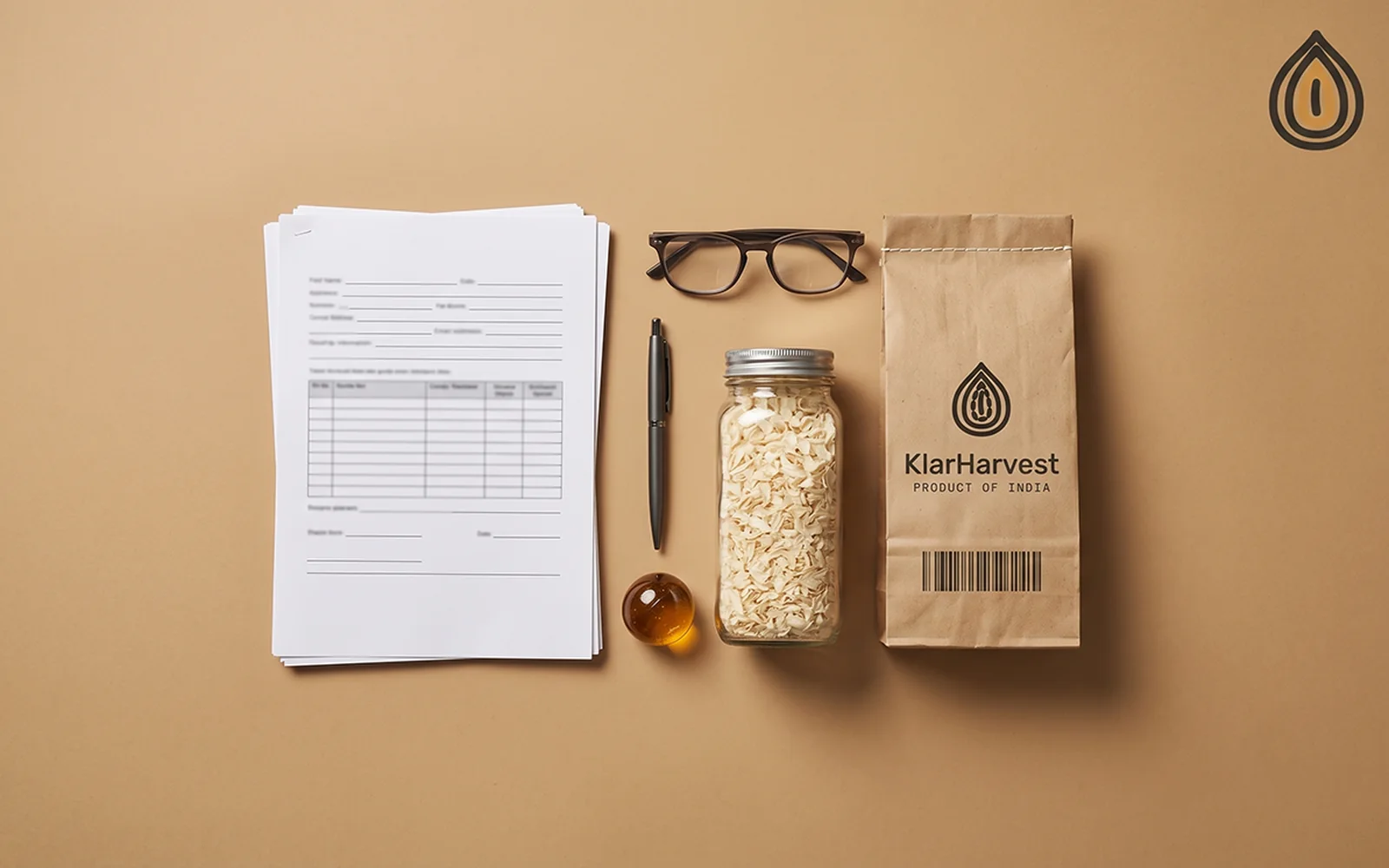
The documents that arrive with the goods
| Document | Issued by | Required for | Notes |
|---|---|---|---|
| Commercial invoice | Exporter | Customs value, duty, VAT | Incoterm, HS code, origin, lot numbers |
| Packing list | Exporter | Customs and warehouse check | Bags, pallets, gross and net weights per lot |
| Bill of lading | Carrier or forwarder | Release of the goods | Original or telex release; seaway bill for trusted trade |
| Certificate of origin | Indian chamber of commerce | Origin declaration; some importers' banks | Non-preferential; no duty benefit but often required |
| Certificate of analysis | Accredited laboratory | Importer's due diligence | Per lot; parameters per the specification |
| Phytosanitary certificate | Indian plant quarantine | Not legally required for dried onion | Many importers still ask; cheap to obtain |
| Health certificate | Indian authority | Only if listed under 2019/1793 | Not required in March 2026 |
| Fumigation certificate | Licensed fumigator | Wooden pallets; some importers | ISPM 15 stamp on pallets suffices for wood |
| Insurance certificate | Insurer | CIF and CIP terms | Institute Cargo Clauses A |
| Supplier declarations | Exporter | Importer's QA file | Non-GMO, no irradiation, no ethylene oxide, allergen statement, sulphite-free |
Dried onion is not a product of animal origin and not a live plant, so it needs neither a veterinary certificate nor, under the plant health regime of Regulation 2016/2031, a phytosanitary certificate; it enters on a customs declaration lodged by the importer or its broker with an EORI number, after the carrier's entry summary declaration under ICS2. Customs may ask for a sample and may hold the container for a laboratory check, which under the ordinary regime happens to a small share of consignments. The full Indian export document set, and who issues what, is in Export Documents for Dehydrated Onion from India; the clearance steps on the EU side are in Customs Clearance for Dehydrated Onion in the EU.
Labelling: bag marking for B2B and retail packs
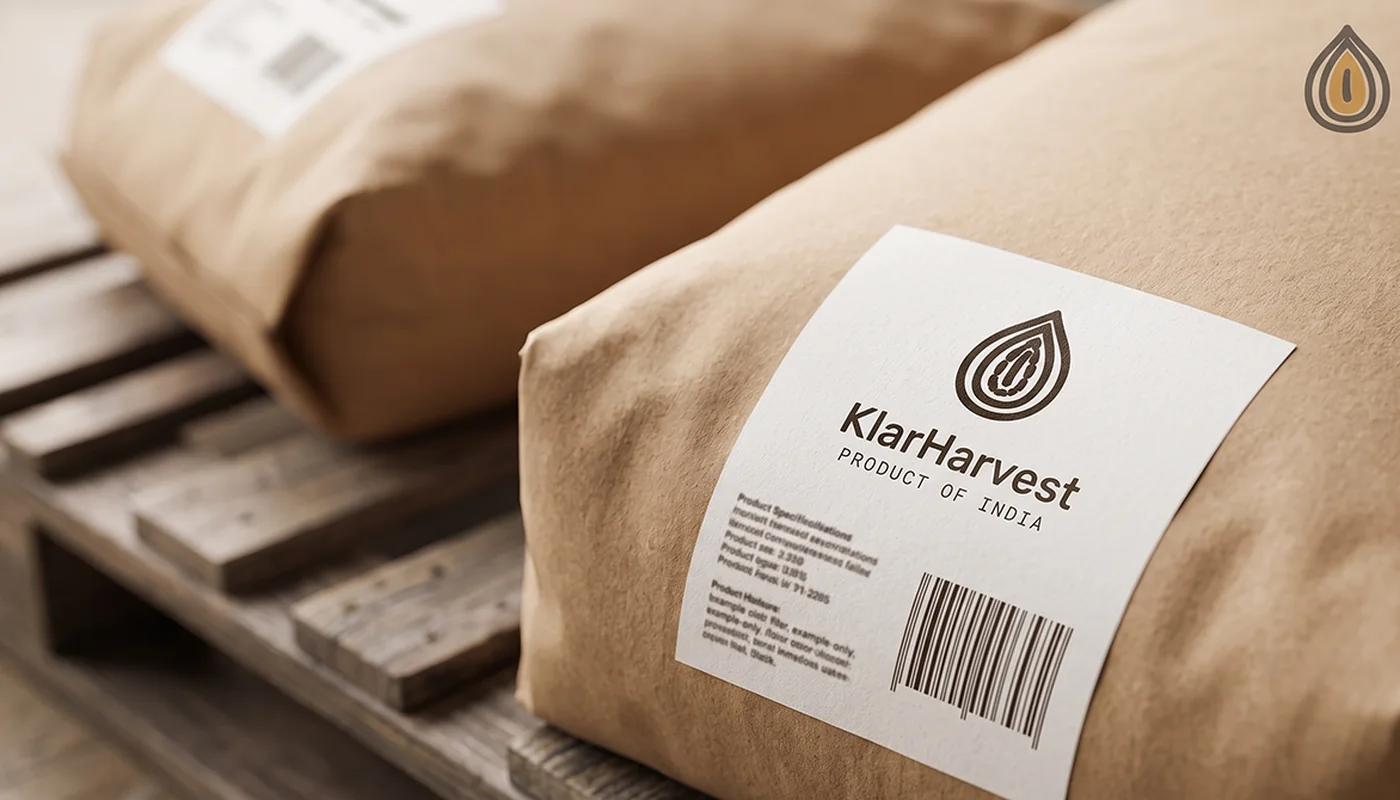
For goods sold business to business, the food information regulation requires that the mandatory particulars appear either on the pack or in the commercial documents, with the name, date of minimum durability, operator name and address and lot marking on the outer packaging itself. In practice every 20 kilogram bag from a certified plant carries a printed or labelled panel with the product name and cut, net weight, lot number, production date and best-before date, storage instructions, country of origin, the packer's or exporter's name and address, and, where the buyer requests, the buyer's item code and a barcode. Lot marking under Directive 2011/91 is mandatory on every unit; a bag without a lot code cannot be placed on the market. Language for B2B goods is by agreement, and English is accepted throughout the Union for trade packaging.
Retail packs are a different matter and are usually labelled by the European packer, not in India. The retail label must carry the name of the food, the ingredient list where there is more than one ingredient, allergens emphasised, net quantity, date of minimum durability in the "best before end" format with at least month and year for products keeping more than three months, storage conditions, the name and address of the EU-established operator responsible for the food, the country of origin where its omission would mislead, which for a product labelled with a European packer's address and a distinctly Indian origin means "Origin: India" is expected, and a nutrition declaration per 100 grams. All in a language easily understood in the member state of sale, which means German in Germany, Dutch and French in Belgium, and so on. The full retail rules are in Labelling Dehydrated Onion for the EU, and the nutrition figures in Dehydrated Onion Nutrition Facts per 100 g.
The importer as food business operator
The point that first-time importers most often miss is that under the general food law the importer is the food business operator who places the product on the EU market, and with that come four obligations that do not transfer to the Indian supplier however good its certificates are. The importer must be able to show that the food is safe, which in practice means a supplier approval file, a specification, the supplier's certificates and the importer's own verification results. It must keep traceability records one step back, the supplier and lot, and one step forward, every customer that received any part of the lot, so that a withdrawal can be executed; the records must be produced to the authorities on request, usually within hours. It must withdraw or recall product it has reason to believe is unsafe and inform the competent authority, which feeds the Rapid Alert System for Food and Feed, RASFF, where a notification about an Indian dried onion consignment would be visible to every member state and would raise the likelihood of listing under the increased-controls regulation. And it must operate under the hygiene regulation itself, with a HACCP-based system covering its own storage and handling. Retailers and manufacturers audit their importers on exactly these points, and an importer whose supplier holds a BRCGS certificate has an easier audit, because the certificate covers the supplier's side of the chain; what the certificate does and does not cover is in What BRC Certification Means for a Dehydrated Onion Supplier.
Organic and other claims
An organic claim on imported dried onion requires certification of the Indian producer and processor under a control body recognised by the EU for India under Regulation 2018/848, an electronic certificate of inspection issued in TRACES before the consignment leaves, endorsed at the EU border, and an organic-certified importer. India's own NPOP standard was recognised by the EU for years, and the scope of that recognition has been narrowed and is in transition to the newer compliance regime, so a buyer should confirm the current status of the specific control body before contracting; organic dried onion from Mahuva is available in small volumes at roughly three times the conventional price, as explained in Organic Dehydrated Onion from India. "Non-GMO" is a statement of fact for onion, since no genetically modified onion exists commercially anywhere, and it is made in a supplier declaration rather than certified. "Not irradiated" likewise: irradiated food must be labelled in the EU, so the supplier's declaration that no irradiation was applied is what the importer files, and a laboratory can verify it. Halal and kosher are private certifications with their own bodies, covered in Halal and Kosher Dehydrated Onion. "Gluten-free" is true of pure onion and may be stated under the rules for that claim, provided cross-contact is controlled.
Differences between member states
The regulations are EU-wide, but their enforcement is national, and a few differences are worth knowing. Germany's food surveillance is run by the states and is thorough; importers commonly commission their own residue and contaminant analyses at a German accredited laboratory on every lot, and German buyers tend to ask for the full analytical file at supplier approval rather than at first delivery. The German LFGB, the national food and feed code, adds no product-specific rules for dried onion but is the frame under which the EU rules are enforced. The Netherlands and Belgium are the traders' entry points, with Rotterdam and Antwerp handling most of the Union's dried-vegetable imports, and their customs are practised in this product and clear it quickly. Southern member states check origin marking more closely on retail packs. VAT rates on food differ by state, which matters only for cash flow. And the language of the retail label follows the member state of sale, not of entry. Germany specifically, with the buyers, duty and documents, is in Importing Dehydrated Onion into Germany.
Pre-shipment compliance checklist
| Item | Who | When |
|---|---|---|
| Confirm CN code 0712 20 00 and the duty on TARIC | Importer or broker | At quotation |
| Check Regulation 2019/1793 annexes for dried onion from India | Importer | Before every shipment |
| Specification signed by both parties, incl. residue and micro limits and the processing-factor convention | Both | Before order |
| Supplier declarations: no ethylene oxide, no irradiation, non-GMO, sulphite-free, allergen statement | Exporter | At supplier approval, renewed yearly |
| Certificate of analysis per lot: moisture, micro, residues, heavy metals, sulphite where relevant | Accredited laboratory | Before shipment |
| Bag marking: name, cut, net weight, lot, dates, origin, operator, storage | Exporter | At packing |
| Pallets ISPM 15 stamped; fumigation certificate if the importer requires | Exporter | At loading |
| Invoice, packing list, certificate of origin, bill of lading drafts checked | Both | Before vessel departure |
| EORI number, broker instructed, import VAT arrangement | Importer | Before arrival |
| Importer's own verification test on arrival per sampling plan | Importer | On arrival |
| Traceability records: lot received, lots dispatched to each customer | Importer | Ongoing |
How KlarHarvest prepares a shipment for the EU
Every KlarHarvest lot for the EU ships with a certificate of analysis from an NABL-accredited laboratory covering moisture, the microbiology tier ordered, a multi-residue pesticide screen with the processing-factor convention stated, lead and cadmium, and sulphite where the buyer requires it; ethylene oxide and 2-chloroethanol are tested on request and never used. Supplier declarations for no irradiation, non-GMO, allergen status and the absence of chemical sterilants are issued at supplier approval and renewed each year. Bags are marked to the EU B2B requirements and carry the lot QR code that opens the lot record with the plant, the drying date and the laboratory report, described on our process page. Document drafts go to the importer for checking before the vessel sails. The registrations behind the export, IEC, APEDA and FSSAI, are listed on the quality page with their status.
Frequently asked questions
Does dried onion from India need a health certificate to enter the EU?
Not in March 2026. Dried onion from India is not listed under Regulation 2019/1793, so it enters on an ordinary customs declaration without a health certificate or a Common Health Entry Document. Check the annexes before each shipment, as they change twice a year.
What is the EU duty on dehydrated onion?
6.4 percent of the customs value under CN code 0712 20 00, with no quota. Import VAT at the member state's food rate is charged on top and is recoverable by a VAT-registered importer.
How do pesticide MRLs apply to a dried product?
MRLs are set on fresh onion. For dried onion the measured residue is adjusted for the concentration of drying, roughly a factor of 8, using a published processing factor where one exists. The laboratory should state the convention it applied.
Is a phytosanitary certificate required?
Not by EU law for dried onion, which is a processed product outside the plant health regime. Many importers still request one, and it is inexpensive to obtain, so most exporters supply it.
Are sulphites allowed in dehydrated onion in the EU?
Sulphites are permitted in certain dried vegetables under Regulation 1333/2008 at the levels in its Annex II, and any sulphite above 10 milligrams per kilogram in the finished food must be declared as an allergen. Standard Mahuva product is sulphite-free, and most EU buyers specify it that way.
Are there legal microbiological limits for dried onion?
No specific criteria in Regulation 2073/2005. The general safety requirement applies, and the counts are set by the buyer's specification, usually at one of the three trade tiers.
Who is legally responsible once the goods are in the EU?
The importer, as the food business operator placing the product on the market: safety, traceability one step back and forward, withdrawal and recall, and hygiene of its own operations.
Can I import organic dehydrated onion from India?
Yes, with an EU-recognised control body certifying the Indian operator, a certificate of inspection in TRACES per consignment and an organic-certified importer. Confirm the control body's current recognition status before contracting.
Next step
Request a sample and the supplier declarations and a specimen certificate of analysis come with it, so your regulatory file can be built before the first order. To price a shipment for a specific member state, request a quote with the port and the microbiology tier.