- What BRCGS certification is and who owns it
- What the audit covers in a dehydration plant
- Grades, audit types and how long a certificate lasts
- How to verify a certificate in five minutes
- Scope: the line that decides whether your product is covered
- Certified plants in Mahuva: how many and which
- BRCGS, FSSC 22000, ISO 22000 and IFS compared for a European buyer
- What certification means when you buy through an exporter
- What changes in the product and the documents
- What certification does not guarantee
- What certification costs a plant, and why it shows in the price
- When a certificate lapses mid-contract
- Handing the chain to your own customer's auditor
- Questions to ask and documents to file
- How KlarHarvest works with certified plants
- Frequently asked questions
Judge the product, not the words
200-500 g from a current lot, dispatched by courier with the lot lab report.
Request a sampleEvery second supplier listing for dehydrated onion from India says "BRC certified", and a BRC certified dehydrated onion supplier can mean one of three very different things: a plant whose site holds a current BRCGS Food Safety certificate with dehydrated onion in its scope; an exporter who buys from such a plant, sometimes; or a company that once saw a certificate. A buyer whose own customers require GFSI-recognised certification up the chain, which in Germany, the Netherlands and the United Kingdom is most food manufacturers and every retailer, needs to know which of the three is on the other end of the email, and how to check in five minutes.
This guide explains what the BRCGS Global Standard for Food Safety certifies and what it does not, how the grades and audit types work, how to read and verify a certificate against the public directory, where the certified plants sit in the Mahuva cluster and roughly how many there are, how BRCGS compares with FSSC 22000, ISO 22000 and IFS for a European buyer, what "certified" means for a merchant exporter that does not run the plant, and what changes in the product and the documents when the plant is certified. It ends with the questions to ask and the documents to file.
As of February 2026 the current version of the standard is Issue 9; the details below refer to it, and to how Indian dehydration plants are audited against it in practice.
What this guide covers
- What BRCGS certification is and who owns it
- What the audit covers in a dehydration plant
- Grades, audit types and how long a certificate lasts
- How to verify a certificate in five minutes
- Scope: the line that decides whether your product is covered
- Certified plants in Mahuva: how many and which
- BRCGS, FSSC 22000, ISO 22000 and IFS compared for a European buyer
- What certification means when you buy through an exporter
- What changes in the product and the documents
- What certification does not guarantee
- What certification costs a plant, and why it shows in the price
- When a certificate lapses mid-contract
- Handing the chain to your own customer's auditor
- Questions to ask and documents to file
- How KlarHarvest works with certified plants
- Frequently asked questions
What BRCGS certification is and who owns it
BRCGS, formerly the British Retail Consortium Global Standards, is a private standards owner whose Global Standard for Food Safety was written in 1998 for British retailers auditing their own-label suppliers and has since become one of the most widely used food safety certification schemes in the world, with over 20,000 certified sites. It is benchmarked by the Global Food Safety Initiative, which means that a retailer or manufacturer that requires "a GFSI-recognised certificate" from its suppliers accepts BRCGS alongside FSSC 22000, IFS, SQF and a few others. The standard certifies a site, not a company: the certificate names one address, one set of processes and a product scope, and it is issued by a third-party certification body that BRCGS has approved and that is itself accredited, in India usually by UKAS, ANAB or NABCB.
The certificate says that on the audit day the site's food safety management system, buildings, equipment, processes and staff met the requirements of the standard, and that the non-conformities found were corrected within the deadline. It is renewed by a full audit every year, or every six months for a site that scored poorly. It does not certify the product; it certifies the system that makes it, which is why a certificate and a certificate of analysis are different documents that a buyer needs both of.
What the audit covers in a dehydration plant
Issue 9 of the standard has nine sections, and in a Mahuva dehydration plant they translate into concrete things an auditor looks at over two or three days on site.
| Section | What it requires | What it looks like in an onion plant |
|---|---|---|
| 1. Senior management commitment | Policy, resources, food safety culture plan, review | Owner and plant manager in the audit; a culture plan with training records |
| 2. Food safety plan (HACCP) | Hazard analysis, critical control points, validation | CCPs at washing (chlorine), drying (exit moisture and temperature), metal detection, steam treatment for treated grades |
| 3. Food safety and quality management system | Documentation, supplier approval, traceability, complaints, recall | Farmer and broker approval records, lot codes from field batch to bag, a mock recall done within four hours |
| 4. Site standards | Buildings, layout, utilities, pest control, hygiene, storage, waste | Sealed floors, screened windows, separate raw and finished areas, pest contractor records, potable water tests |
| 5. Product control | Design, allergens, foreign body controls, product testing, release | Sieves, magnets, metal detector checks every hour, sulphite control, laboratory schedule, positive release of lots |
| 6. Process control | Operation of critical processes, calibration | Dryer logs, moisture analyser calibration against the oven, weigh scale calibration |
| 7. Personnel | Training, protective clothing, medical screening, hygiene | Seasonal workers trained before the season, hairnets and coats, hand-wash stations, illness reporting |
| 8. High-risk, high-care and ambient high-care zones | Segregation where products are ready to eat | Applies to steam-treated grades packed for no-kill-step use: separate post-treatment area |
| 9. Requirements for traded products | For sites that also trade goods they do not make | Applies where a plant sells other plants' product under its certificate |
The parts that matter most to an onion buyer are traceability, because it links the bag to the field and the certificate of analysis to the lot; foreign body control, because sieves, magnets and metal detection are where grit and metal are stopped; and process control at the dryer, because moisture and colour are set there. A plant that passes section 3 can tell you, within hours, which farmer's field and which drying run are in the bag on your floor.
Grades, audit types and how long a certificate lasts
A BRCGS audit produces a grade based on the number and severity of non-conformities. AA is the top grade, with five or fewer minor non-conformities; A allows up to ten; B up to 16 or one major; C up to 24 or two majors; D is more than that; and a critical non-conformity or a failed corrective action means no certificate. The grade carries a plus sign, AA+, A+, when the audit was unannounced, which is the type buyers prefer because the site did not prepare for it; about half of certified sites are on the unannounced programme by choice or by their customers' requirement.
| Grade | Minor non-conformities | Major | Certificate valid | What it tells a buyer |
|---|---|---|---|---|
| AA / AA+ | 1-5 | 0 | 12 months | A well-run site; the norm for the large Mahuva exporters |
| A / A+ | 6-10 | 0 | 12 months | Sound; the common grade |
| B / B+ | 11-16, or 1 major | 0-1 | 12 months | Acceptable to most manufacturers; ask what the major was |
| C / C+ | 17-24, or 2 majors | up to 2 | 6 months | Re-audited in six months; many retailers do not accept |
| D | 25-30, or 3 majors | up to 3 | 6 months | Rarely accepted |
The certificate shows the grade, the audit date, the issue date and the expiry date. A certificate that expired two months ago is not a certificate; sites are re-audited within a window around the anniversary, and a gap means the audit was missed or failed. Grade and audit type are the first two things to read.

How to verify a certificate in five minutes
A PDF certificate proves nothing by itself; certificates are photographed, altered and borrowed. The BRCGS Directory, the public database on the BRCGS website, lists every certified site with its name, address, certification body, standard, scope, grade and expiry, and it is the only source that counts. The check:
- Ask the supplier for the plant's name and site code (the BRCGS site code is a number on the certificate) and for the certificate PDF.
- Search the directory by site name or site code. If the plant is not in it, the certificate is not current, whatever the PDF says.
- Match the address. The directory address must be the plant that will process your product, not a head office in Ahmedabad or Mumbai.
- Read the scope for your product and process, covered in the next section.
- Read the grade and expiry, and note whether the audit was announced or unannounced.
- Ask for the audit report if your quality system needs it. Sites can share it under a confidentiality agreement, and a site with an AA grade usually will.
A supplier who cannot give you the site code or the plant name is not selling you a certified product; they are selling you a product that may or may not come from a certified site. That distinction is the whole subject of the exporter section below.
Scope: the line that decides whether your product is covered
The scope on the certificate describes what the site is certified to make, in the words of the standard's product categories and in the site's own product list, for example "Processing of dehydrated onion and garlic (flakes, chopped, minced, granules, powder) by washing, peeling, slicing, hot-air drying, sieving, milling and packing in bags; steam treatment for low-bacterial grades." A certificate whose scope says "spices and seasonings" from a site that also happens to dry onion does not cover the onion unless it is named; a scope that names onion flakes and powder but not steam treatment does not cover the treated grades, which is a common gap because the steam line was added after the audit. Read the scope against the product you are buying, and if the treated grades or a particular cut are not in it, ask the site when the scope was last extended and whether the extension audit has happened.
Scope also tells you whether the site trades. Section 9 of the standard covers traded products, and a site that sells other plants' onion under its own certificate must have section 9 in scope; a certificate without it means everything sold under that certificate was made on that site. For a buyer this is the difference between a plant and a plant that is also a trader.
Certified plants in Mahuva: how many and which
Of the roughly 120 dehydration plants in the Mahuva area, somewhere between 15 and 25 hold a current BRCGS certificate, most at grade A or AA, and a similar number hold FSSC 22000 or ISO 22000 instead or as well; the count moves as sites certify, let certificates lapse or change hands, and the directory is the only current list. These plants are the larger ones, with continuous belt dryers, their own laboratories, optical sorting and conditioned packing rooms, and they produce most of what the cluster sends to Europe and North America. Below them sit plants with ISO 22000 and FSSAI licences that supply the Middle East, Asia and domestic buyers and, in a short year, supply kibble to the certified plants themselves.
For a European buyer the practical consequence is that a specification that requires a BRCGS-certified site narrows the supplier field to those plants and to the exporters who source from them, and that is a feature: it is the fastest way to exclude the bottom half of the cluster. The cluster's structure, and where the certified plants sit in it, is described in Mahuva, Gujarat: Inside India's Onion Dehydration Hub.
BRCGS, FSSC 22000, ISO 22000 and IFS compared for a European buyer
Four schemes appear on Indian plants' certificates, and a buyer's own customer usually accepts some and not others.
| Scheme | GFSI recognised | Certifies | Where it is preferred | Common in Mahuva |
|---|---|---|---|---|
| BRCGS Food Safety | Yes | Site, graded, announced or unannounced | UK, Netherlands, most of Europe, North America | The larger export plants |
| FSSC 22000 | Yes | Site, ISO 22000 plus prerequisite programmes and scheme requirements; pass/fail | Multinational manufacturers, continental Europe | Several large plants, often alongside BRCGS |
| ISO 22000 | No (not benchmarked on its own) | Management system; pass/fail | Accepted by some manufacturers as a minimum | Many mid-size plants |
| IFS Food | Yes | Site, scored (Foundation or Higher level) | Germany, France, Italy; German retail own-label | Rare in India |
The German question deserves a note. German retailers and many German manufacturers ask for IFS Food, which almost no Indian dehydration plant holds, because IFS grew out of German and French retail and Indian plants certified to the scheme their British and Dutch customers asked for first. In practice, German manufacturers whose supplier-approval procedure says "GFSI-recognised certification" accept BRCGS, since both are benchmarked, and those whose procedure says "IFS" usually have a route for equivalent GFSI schemes with an additional questionnaire or audit. A buyer who needs IFS specifically should raise it at the first enquiry; a plant will not certify to IFS for one customer, but a merchant exporter with its own handling site can, in principle, and the question is discussed in IFS and BRC Supplier Approval.
What certification means when you buy through an exporter
Most European buyers of Indian dehydrated onion buy from a merchant exporter, not from a plant, and here the phrase "BRC certified" needs care. The exporter's certificate, if it has one, is usually the BRCGS Agents and Brokers standard, which certifies that the exporter's supplier approval, traceability and product-handling procedures meet a standard; it does not certify a plant. The plant's certificate covers the product up to the point where it leaves the plant's site in sealed bags. What happens between the plant gate and the ship, storage, labelling, stuffing, is either inside the plant's certified site, if the plant does it, or inside the exporter's own premises, which are certified only if the exporter has certified them.
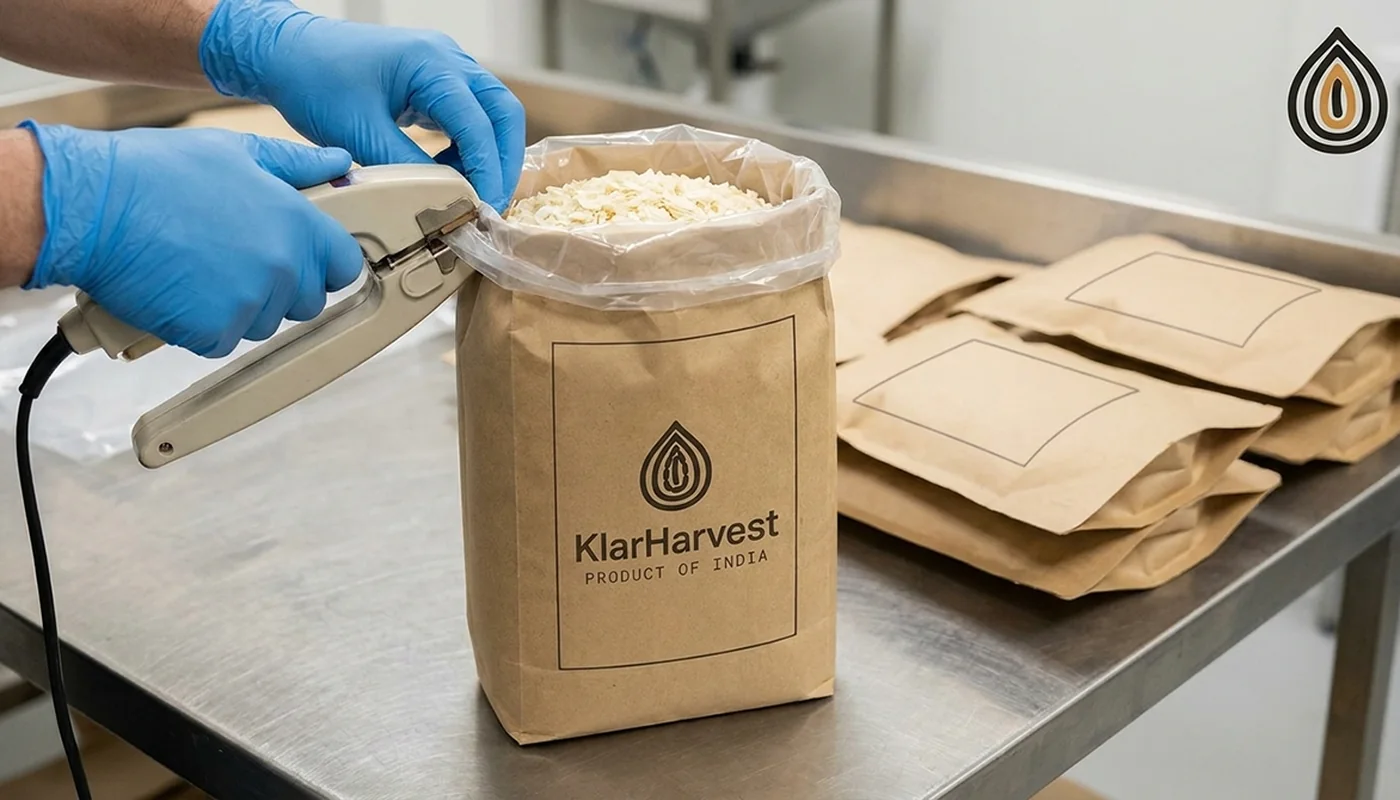
Two arrangements keep the chain intact. The plant fills, seals, labels and stuffs on its own site, and the exporter only sells and documents; or the plant fills and seals, and the exporter's premises receive sealed bags, label and stuff them without opening a bag, under the exporter's own hygiene and traceability procedures, ideally certified to the Agents and Brokers standard or to a storage and distribution standard. The arrangement that breaks the chain is repacking: an exporter who opens plant bags to blend, re-bag or relabel has created an uncertified processing step, and the plant's certificate no longer describes the product in the bag. Ask any exporter one question: are the bags opened anywhere after the plant seals them? The answer should be no. What each kind of seller can and cannot promise is in Exporter, Trader or Manufacturer.
What changes in the product and the documents
Certification changes the product in ways a buyer can see. The lot code on the bag traces to a field batch and a drying run, and the plant can produce that trace on request. The certificate of analysis for the lot comes from a laboratory schedule that the audit checked, with pathogens, residues and metals tested at an accredited laboratory on a defined frequency rather than when a customer asks. Foreign matter is lower, because optical sorting, magnets and metal detection are audited controls. Moisture and colour are more consistent between lots, because dryer logs and calibrated analysers are audited. And the documents arrive: a certified plant has a specification sheet, an allergen statement, a GMO statement, a pest control record and a mock recall on file because the audit required them, and a buyer's supplier-approval questionnaire is a form the plant has filled in before. None of this makes the onion taste different; it makes the second container the same as the first.
What certification does not guarantee
A certificate is a snapshot of a system, and four things fall outside it. It does not guarantee the lot: a certified plant can still ship a lot at 7 percent moisture, which is what the certificate of analysis and your arrival test are for. It does not cover the exporter's handling unless the exporter is certified for it. It does not cover the raw material beyond the plant's supplier approval: pesticide residues come from the field, and the plant's testing schedule, not its certificate, is what controls them. And it does not cover the season between audits: a plant audited in November, in the quiet season, is being certified for how it runs when 40 people are on site, and it will be running with 200 in April. The unannounced programme exists for this reason, and the certified plants that stay on it are the ones to prefer. The controls that live outside the certificate, residues, metals, ethylene oxide and the lot-level testing, are covered in EU Import Requirements for Dehydrated Onion.
What certification costs a plant, and why it shows in the price
Certification is not a fee; it is a way of running a plant. The audit itself costs a Mahuva plant a few thousand euros a year in certification-body fees, travel and the auditor's days, which is small against a turnover of millions. The real cost is the system: a quality manager and a laboratory technician on the payroll all year rather than a seasonal supervisor, a laboratory with a moisture oven, sieves and an incubator, optical sorters and metal detectors and their hourly checks, a pest control contract, sealed floors and screened windows, conditioned packing rooms, training every season for a workforce that changes every season, and the external testing schedule at accredited laboratories. Taken together it adds a few rupees per kilogram to the plant's costs, and the certified plants' prices reflect it: a certified site's flakes are typically 3 to 8 percent dearer FOB than an uncertified neighbour's in the same week. That premium buys the consistency and the documents described above, and for a European buyer whose own customers audit the chain, it is not optional. The cost stack, with the certification and testing line in it, is in Dehydrated Onion Price per kg.
When a certificate lapses mid-contract
Certificates lapse. A plant misses its audit window because of a change of ownership, fails an audit on a major non-conformity it needs months to fix, or lets a certificate go because its customers stopped asking. A buyer with a season contract discovers this at the anniversary check, or worse, from its own customer's auditor. The contract should say what happens: the supplier must notify the buyer within days of any suspension, withdrawal or failed audit; the buyer may suspend call-offs until a certificate is restored; and product already shipped from lots made while the certificate was valid remains conforming, because the certificate describes the system at the time of production. For an exporter sourcing from several certified plants, a lapse at one is an inconvenience rather than a crisis: production moves to another certified site and the buyer is told which. That flexibility is one of the arguments for buying through an exporter with more than one plant relationship rather than from a single plant, and it is worth asking a supplier how many certified sites it works with. The contract clauses are in B2B Contract Terms for Dehydrated Onion.
Handing the chain to your own customer's auditor
Sooner or later a buyer's own customer, a retailer or a large manufacturer, asks for the supply chain behind the onion, and a buyer who has filed the right documents answers in an afternoon. The pack that satisfies most retail audits: the plant's BRCGS certificate and a directory printout dated within the last three months; the certificate's scope showing the product; the exporter's statement of its handling arrangement and, if it has one, its own Agents and Brokers or storage certificate; the current specification sheet; the last three certificates of analysis for lots received; the residue, heavy-metal and ethylene oxide reports for the crop; the allergen, GMO and irradiation statements; and a traceability example, one lot code traced from the buyer's stock to the plant's drying run and field batch, which a certified plant can produce on request and which auditors like more than any certificate. Buyers who assemble this pack once at supplier approval and refresh the dated items at each anniversary never scramble. The whole approval procedure, from the questionnaire to the visit, is described in IFS and BRC Supplier Approval.
Questions to ask and documents to file
For supplier approval, five questions and four documents cover the certification side.
- Which site processes my product, and what is its BRCGS site code?
- Does the scope name my cut and, if I buy treated grades, the steam treatment?
- What grade, announced or unannounced, and when does the certificate expire?
- Are the bags opened anywhere after the plant seals them, and who is responsible for storage and stuffing?
- Can I see the last audit report under a confidentiality agreement?
File the certificate PDF with the directory printout or screenshot showing it current, the scope, the plant's specification sheet for your cut, and the exporter's statement of its own handling arrangement. Re-check the directory at each anniversary; a supplier-approval system that files a certificate once and never looks again is the one that discovers a lapse from its own customer's auditor. The full supplier checklist is in 25-Point Checklist Before You Choose a Dehydrated Onion Supplier.
How KlarHarvest works with certified plants
KlarHarvest sources only from plants holding a current BRCGS Food Safety certificate with dehydrated onion in scope, and names the plant and its site code to any buyer under supplier approval, with the certificate and, where the plant agrees, the audit report. Bags are filled and heat-sealed at the plant and are never opened afterwards: our own godown in Bhavnagar receives sealed bags, applies the lot label and stuffs the container under customs seal, and the plant's certificate therefore describes the product in the bag on your floor. For the treated grades we use plants whose scope includes steam treatment. Each lot ships with a certificate of analysis from an NABL-accredited laboratory and the lot record that links it to the plant and the drying run. The chain from field to container is on the our process page, and the testing on the quality page.
Frequently asked questions
What does BRC certified mean for dehydrated onion?
That the plant which processed the onion holds a current BRCGS Global Standard for Food Safety certificate, issued by an accredited certification body after an audit of its food safety system, buildings, processes and staff, with dehydrated onion in the certificate's scope. It certifies the site and its system, not the individual lot.
How do I check whether a supplier is really BRC certified?
Search the public BRCGS Directory for the plant's name or site code and match the address, scope, grade and expiry to what you were told. A PDF alone is not proof. An exporter must be able to name the plant.
What is a good BRCGS grade?
AA and A are the norm for well-run plants; B is acceptable to most manufacturers; C and D are re-audited within six months and are rarely accepted. A plus sign means the audit was unannounced, which buyers prefer.
Is BRCGS accepted in Germany instead of IFS?
Both are GFSI-benchmarked, and German manufacturers whose procedures ask for GFSI-recognised certification accept BRCGS. Those whose procedures name IFS usually have an equivalence route with an additional questionnaire. Almost no Indian dehydration plant holds IFS.
Does an exporter's BRC certificate cover the plant?
No. An exporter's certificate, if any, is usually the BRCGS Agents and Brokers standard, which covers its procedures, not the processing. The plant needs its own site certificate, and the bags must stay sealed between plant and buyer for that certificate to describe the product.
Are the steam-treated grades covered by the plant's certificate?
Only if steam treatment is named in the scope. Many plants added steam lines after their first audit; ask when the scope was extended.
Does certification make the onion better?
It makes it more consistent and better documented: traceable lot codes, scheduled laboratory testing, audited foreign-body controls and calibrated dryers. The individual lot is still checked by its certificate of analysis and your arrival test.
Next step
If your supplier approval needs the plant's certificate and scope, ask for the spec sheet of the cut you buy and say so; the certificate, site code and specification come back together within one business day. For a first look at the product from a certified site, request a sample and the lot's certificate of analysis travels with it.