- The three tiers and their counts
- Where the bacteria in dried onion come from
- How steam treatment works
- The equipment: batch and continuous
- What the treatment does to the product
- Validation: proving the treatment works
- Verification: what the certificate and the buyer's test show
- Cost: the premium and where it comes from
- The alternatives, and why the trade does not use them
- Who needs which tier
- Spores: what steam does and does not do
- Treated product in storage and use
- Specifying and buying treated onion
- Common misunderstandings
- Auditing a plant's treatment: questions and records
- A treated lot through a chilled dip, worked
- How KlarHarvest supplies the tiers
- Frequently asked questions
Judge the product, not the words
200-500 g from a current lot, dispatched by courier with the lot lab report.
Request a sampleLow bacterial dehydrated onion is the product a European buyer specifies when the onion will not be cooked again, and the term hides a set of facts that most specifications get half right. Standard dehydrated onion, dried and packed with no further step, carries a total plate count of up to 500,000 per gram, which is normal for a dried vegetable and harmless in a soup or a sausage that will be cooked; a dip, a table shaker, a snack seasoning applied after frying or a raw product sold to be cooked by the consumer needs a lower load, and the plants deliver it with a steam treatment that takes the count down by one or two orders of magnitude without chemicals. This guide explains the three tiers and what the counts mean, how the treatment works and what it does to the product, how a plant validates it and a buyer verifies it, what it costs, the alternatives and why the trade does not use them, which products need which tier, and the specification lines that make the tier a contractual fact rather than a label.
It is written for quality managers, product developers and buyers, with figures for Mahuva plants in the 2026 season. The counts themselves, their methods and their meaning, are in Microbiology in Dehydrated Onion; this guide is about the treatment that changes them.
What this guide covers
- The three tiers and their counts
- Where the bacteria in dried onion come from
- How steam treatment works
- The equipment: batch and continuous
- What the treatment does to the product
- Validation: proving the treatment works
- Verification: what the certificate and the buyer's test show
- Cost: the premium and where it comes from
- The alternatives, and why the trade does not use them
- Who needs which tier
- Spores: what steam does and does not do
- Treated product in storage and use
- Specifying and buying treated onion
- Common misunderstandings
- Auditing a plant's treatment: questions and records
- A treated lot through a chilled dip, worked
- How KlarHarvest supplies the tiers
- Frequently asked questions
The three tiers and their counts
| Tier | Total plate count | Yeast and mould | Enterobacteriaceae | E. coli | Salmonella | How it is made |
|---|---|---|---|---|---|---|
| Standard | ≤500,000/g | ≤10,000/g | ≤1,000/g | Absent in 1 g | Absent in 25 g | Drying and packing only |
| Low bacterial (LB) | ≤50,000/g | ≤1,000/g | ≤100/g | Absent in 1 g | Absent in 25 g | Steam treatment, re-drying |
| Extra low bacterial (ELB) | ≤10,000/g | ≤500/g | ≤10/g | Absent in 1 g | Absent in 25 g | Steam treatment at a higher dose, re-drying |
The tiers are trade conventions rather than legal categories, and individual buyers' specifications vary by a factor of two or so around them; some American buyers use "sterilised" for the ELB tier, which is a misnomer since the product is not sterile, and some European buyers add spore-former limits, Bacillus cereus and Clostridium perfringens, to the LB and ELB tiers for chilled and rice products. A plant's real results sit inside the limits with room: a good LB lot reads 10,000 to 30,000, a good ELB lot 1,000 to 5,000. The pathogen lines, Salmonella and E. coli, are the same at every tier and are not what the treatment is for; they should be absent in standard product from a clean plant, and a treatment that is relied on to remove Salmonella is a plant with a hygiene problem.
Where the bacteria in dried onion come from
The load on a standard lot is the load that survived drying, and it comes from three places: the soil and the field, which put spore-forming bacteria and soil organisms on the bulb's skin and in the cracks of the root plate; the plant's water and surfaces, which add whatever the washing flume and the belts carry; and the drying itself, which kills most vegetative cells at the wet end but leaves the spores and the heat-tolerant organisms, and can add mould spores from the air if the dryer's intake is dusty. A dried product at 5 percent moisture and a water activity of 0.3 supports no growth, so the count at packing is the count a year later, give or take; the organisms are dormant, and they wake when the product is rehydrated in a warm, wet food. That is why the tier matters where the onion is not cooked: in a dip or a dressing the dormant load becomes a growing one at refrigerator temperature over the product's life, and in a raw sausage it joins the meat's own load. The plant's control of the standard load, intake washing, clean water and a dust-free dryer, is part of its certification and is described in How Dehydrated Onion Is Made.
How steam treatment works
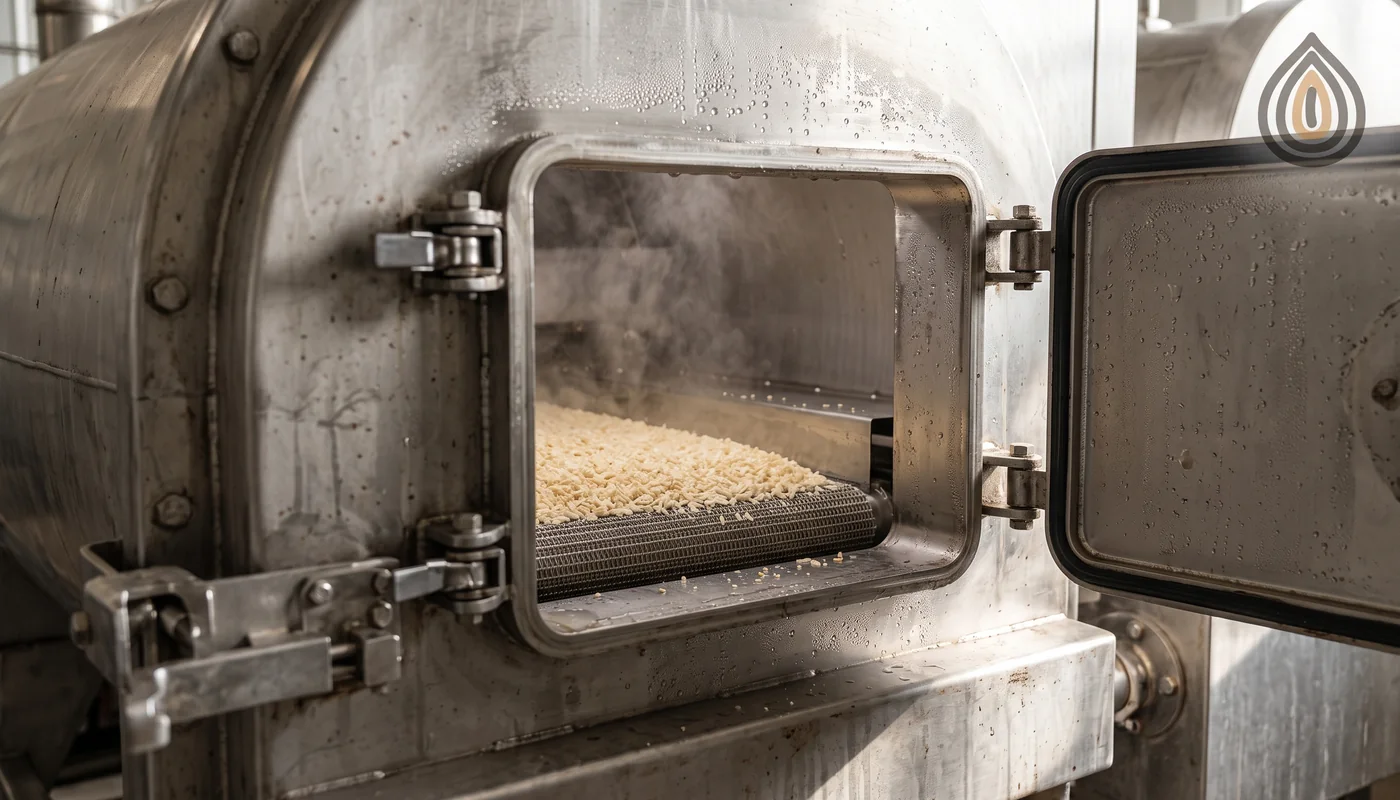
Steam treatment exposes the dried product to saturated steam at atmospheric or slightly raised pressure for a short time, seconds to a minute or two, so that the surface of every particle reaches 100 degrees or more while the core barely warms, then dries the product again to remove the moisture the steam deposited. The kill comes from wet heat: saturated steam condenses on the cool particle surface, releasing its latent heat and raising the surface temperature almost instantly, and wet heat at 100 degrees kills vegetative bacteria, yeasts and moulds in seconds and reduces spores by a smaller factor that depends on time and temperature. The product's moisture rises from 5 percent to 8 or 10 during the exposure, which is why re-drying follows immediately, in a belt dryer or a fluid bed at 60 to 70 degrees for ten to twenty minutes, back to 5 percent. The whole cycle is a few minutes per particle, and the plant controls the kill with the steam temperature, the exposure time and the bed depth, and the product quality with the re-drying temperature and the speed of the return to 5 percent. A treatment that gives the product a longer or hotter exposure kills more and browns more; the ELB tier is the LB tier with a higher dose, and the colour cost rises with it.
The equipment: batch and continuous
Two kinds of plant exist in Mahuva. Batch treaters are jacketed vessels or chambers into which a few hundred kilograms of product are loaded, steam is admitted for a timed period, and the product is discharged to a dryer; they are simple, cheap and used by the mid-sized plants for occasional LB runs, and their weakness is uneven exposure, since the product at the vessel's wall and its centre see different steam. Continuous treaters pass the product on a belt or through a screw under a steam curtain and into an in-line re-dryer, with the exposure set by the belt speed; they are the equipment of the larger plants and of any plant that runs ELB routinely, since the exposure is uniform and the re-drying is immediate. A few plants use pressurised continuous systems that run above 100 degrees for a shorter exposure, which gives a larger spore reduction at a smaller colour cost; they are the state of the art and are what a buyer specifying ELB with spore limits should ask about. A buyer auditing a plant should ask which type it has, how the exposure is controlled and recorded, and how fast the re-drying returns the product to 5 percent, since a slow re-dry is where the product browns and where counts can rebound.
What the treatment does to the product
| Property | Standard | After LB treatment | After ELB treatment | Notes |
|---|---|---|---|---|
| Colour, L* on ground product | Baseline | -0.5 to -1.5 | -1 to -3 | The re-dry is where most of the loss happens |
| Flavour | Full raw-onion top note | Slightly reduced top note | Noticeably rounder, sweeter | Volatile sulphur compounds lost with the steam |
| Rehydration ratio | 3.5-4.5 (flakes) | Same or slightly lower | Slightly lower | Some cell-wall damage |
| Bulk density | Baseline | Same | Same | |
| Fines | Baseline | +1-2 points | +2-3 points | Handling through the treater breaks flakes |
| Moisture at packing | 4.5-6 % | 4.5-6 % | 4.5-6 % | Must be re-dried fully |
| Water activity | 0.30-0.35 | Same | Same | |
| Shelf life | 18-24 months | Same | Same | |
| Caking tendency | Baseline | Slightly higher for powder | Slightly higher | Surface sugars mobilised by the steam |
A well-run LB treatment is nearly invisible in the product; a well-run ELB treatment is visible to a trained eye as a warmer tone and a rounder flavour; a badly run treatment of either tier, with a hot or slow re-dry, is a tan product with a cooked flavour that no buyer wants. Powder is treated as kibble before milling at most plants, since treating powder cakes it, and milled after the re-dry. The colour grades and how to measure the loss are in Dehydrated Onion Colour.
Validation: proving the treatment works
A treatment is validated once and verified per lot. Validation means the plant has shown, with data, that its equipment at its settings achieves the log reduction it claims on its product: samples of untreated product with a known count, or inoculated with a surrogate organism, are run through the treater at the production settings, sampled at the exit and after the re-dry, and counted; the reduction, expressed in log units, is recorded with the settings, and the settings become the critical limits in the plant's HACCP plan. A plant that says "we steam treat" without a validation study has a process, not a validated one, and a buyer's auditor will ask for the study; the certification schemes require it. The study should cover the worst case, the deepest bed, the fastest belt and the coarsest cut, and should be repeated when the equipment or the product changes. A buyer can ask for the validation summary at supplier approval, and the better plants provide it under confidentiality; what the certificate covers and what an audit checks is in What BRC Certification Means for a Dehydrated Onion Supplier.
Verification: what the certificate and the buyer's test show
Each treated lot is tested after the re-dry and packing, and the certificate carries the counts against the tier's limits, with the method for each and the sample size for Salmonella; a lot certificate for an LB or ELB lot should also state that the lot was steam-treated and give the treatment date, since a buyer can otherwise not tell a treated lot from a lucky standard one. The buyer's own verification, on the first lots and on a plan, is the same microbiological set at its own laboratory, and the two results should agree within the method's variation; counts are log-normal and a two-fold difference between two laboratories on the same sample is ordinary, a ten-fold difference is not. Sampling matters: counts vary between bags, and a composite of several bags is the fair sample. The reading of the certificate, and the sampling line on it, is in How to Read a Dehydrated Onion Lab Report.
Cost: the premium and where it comes from
| Tier | Premium over standard, FOB | What the premium pays for |
|---|---|---|
| Low bacterial | ₹8-15/kg, about 5-10 % | Treatment energy and time, re-drying fuel, yield loss of 1-3 % as fines and moisture, extra testing, scheduling |
| Extra low bacterial | ₹20-35/kg, about 12-22 % | Higher dose and longer re-dry, yield loss of 3-5 %, spore testing, the pressurised equipment at the plants that have it, smaller runs |
The premium is the same in rupees whatever the cut, so it is a larger share on flakes than on powder; and it is a small number against the cost of a microbiological failure in a chilled product, which is the comparison a quality manager makes. The seasonal pattern matters too: plants run treatment blocks in April and May when they have the capacity, and a treated lot ordered in August from stored-onion production carries a longer lead time. The price build is in What Does Dehydrated Onion Cost per Kilogram?
The alternatives, and why the trade does not use them
Four other ways to reduce the count on a dried vegetable exist, and each is excluded for the European trade for a reason. Ethylene oxide fumigation is effective, cheap and leaves a residue that the EU limits at the detection limit; it is not approved, it is the substance behind the 2020 to 2022 recall wave, and its presence at any level is a rejection; see Ethylene Oxide and Dehydrated Onion. Irradiation with gamma rays or electron beams is effective, permitted in the EU for dried herbs and spices at a set dose, and must be declared on the label as "irradiated", which European buyers will not carry; it is not used on Indian export onion and a supplier's declaration says so, as explained in GMO and Irradiation Status of Indian Dehydrated Onion. Dry heat, holding the product at 100 to 120 degrees in air, needs a long exposure to kill what wet steam kills in seconds, and browns the product badly; it is not practical for onion. Propylene oxide is used in the United States on some nuts and spices, is not approved in the EU, and is not used on onion. Steam is the treatment that removes counts without a residue, without a label declaration and without destroying the product, which is why it is the trade's method; its limits are the spore question below and the colour cost above.
Who needs which tier
| Use | Kill step after the onion goes in? | Tier usually specified | Why |
|---|---|---|---|
| Retorted soups, sauces, meals | Sterilisation | Standard | Everything is killed in the retort |
| Cooked sausages, cooked ham, meatballs cooked in plant | Cook to 72 °C+ | Standard, or LB under a retailer's code | Plant cook is the kill step |
| Dry soup and sauce mixes, consumer-cooked | Consumer's cooking only | LB | Cooking may be short or inadequate |
| Chilled ready meals | Plant cook, then chilled hold | LB by most retailers' codes | Low initial load widens the safety margin |
| Raw sausages, raw burgers, kebab meat | Consumer's cooking only | LB | Raw product; spores matter |
| Fermented and dry-cured meats | None | LB or ELB | Onion's yeasts must not compete with the starter |
| Snack seasonings applied after frying | None | ELB | The seasoning is eaten as applied |
| Dips, dressings, cold sauces, mayonnaise-based | None; refrigerated life | ELB | Growth at 4 °C over weeks |
| Table shakers, onion salt, finishing seasonings | None | ELB | Consumer sprinkles on finished food |
| Bakery toppings applied after baking | None | LB or ELB | |
| Bakery inclusions and toppings baked on | Oven | Standard | |
| Infant and clinical foods | Varies | ELB with spore limits | Vulnerable consumers |
The tier follows the hazard analysis rather than the sector, and a buyer's own HACCP team decides; the table gives the trade's usual choices. The application guides, Dehydrated Onion in Snack Seasoning, Dehydrated Onion in Meat Products and Dehydrated Onion in Ready Meals and Frozen Foods, work the tier question through for each.
Spores: what steam does and does not do
Steam at atmospheric pressure kills vegetative cells completely and spores partially: a typical atmospheric treatment reduces Bacillus and Clostridium spores by half a log to one log, which is why an ELB lot at 5,000 per gram is mostly spore-formers that survived and why an ELB specification for a chilled or rice product adds specific limits, Bacillus cereus below 100 or 1,000 per gram and Clostridium perfringens below 100. Pressurised steam above 100 degrees kills spores faster, and the pressurised continuous systems at a few plants achieve two to three log reductions on spores, which is the difference between an ELB lot that meets a B. cereus limit of 100 and one that does not. A buyer whose product is a chilled rice dish, a sous-vide meal or an infant food should specify the spore limits and ask which equipment the plant uses; the spore-formers are discussed with the counts in the microbiology guide linked above. No treatment short of full sterilisation makes onion sterile, and a specification asking for "sterile onion powder" is asking for something that does not exist as a dried product.
Treated product in storage and use
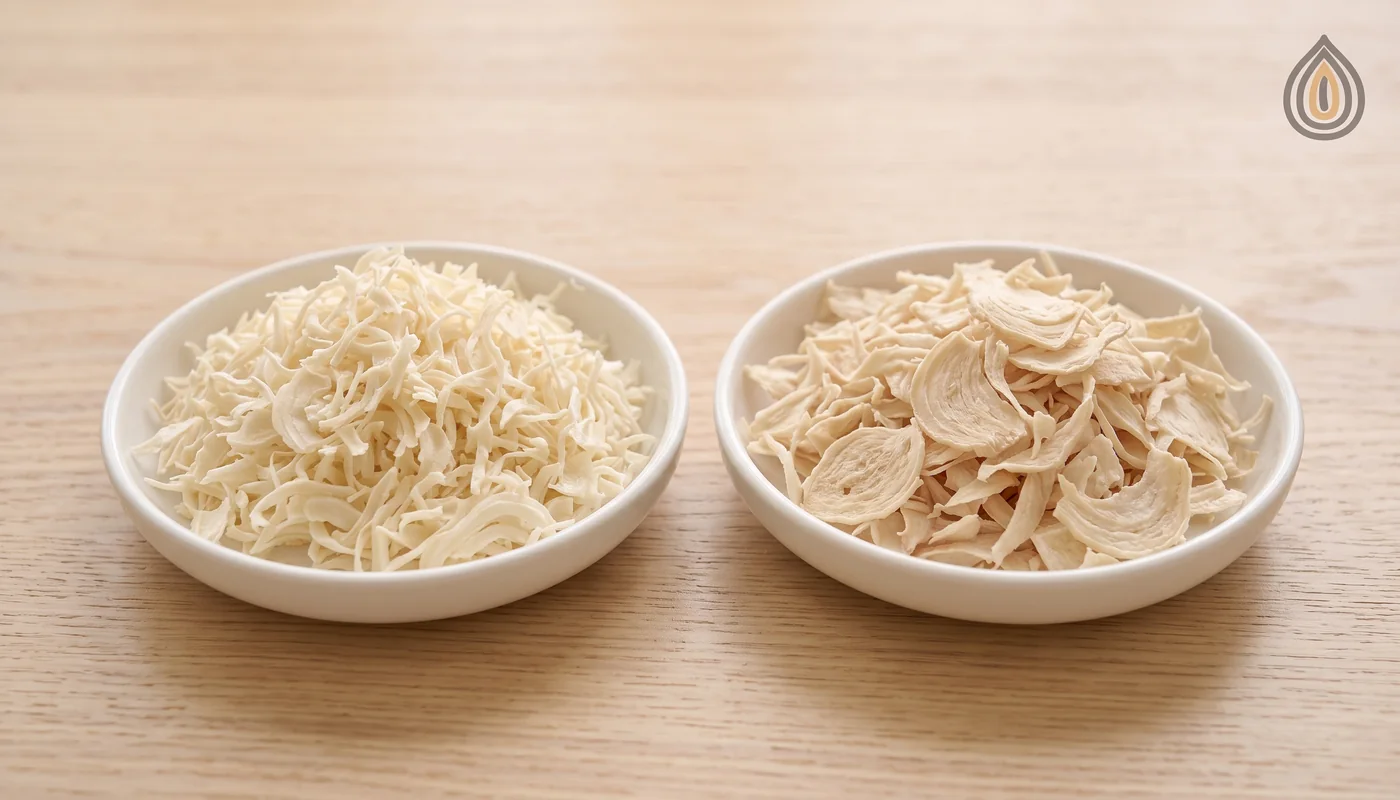
A treated lot stores as a standard lot does, at 5 percent moisture in a sealed liner, and its count does not rise in storage; what can happen is that a treated lot re-dried to 6 or 7 percent rather than 5, or a treated powder with its surface sugars mobilised by the steam, cakes sooner in a humid warehouse, so treated product should be bought at 5 percent maximum and stored as carefully as any. In use, a treated lot rehydrated in a warm product grows as any lot does, from a lower start; the treatment buys a margin, not immunity, and a dip made with ELB onion still needs its own hurdles, acid, salt, refrigeration and a shelf life. The storage rules are in Dehydrated Onion Shelf Life, and the water-activity thresholds that keep the dormant load dormant in Water Activity in Dehydrated Onion.
Specifying and buying treated onion
- Tier and counts: "Low bacterial: total plate count maximum 50,000 cfu/g, yeast and mould maximum 1,000, Enterobacteriaceae maximum 100, E. coli absent in 1 g, Salmonella absent in 25 g, by [ISO methods]", or the ELB set; add "Bacillus cereus maximum [100/1,000] cfu/g and Clostridium perfringens maximum 100" where the product needs them.
- Treatment: "Product steam-treated after drying at a validated process; no chemical or irradiation treatment; treatment date stated on the certificate and the bag."
- Validation: "Validation summary of the treatment process available at supplier approval."
- Colour and flavour after treatment: the colour grade or L* value for the treated product, which is lower than standard's, and a sensory clause against a treated reference sample.
- Moisture: maximum 5.0 percent after re-drying.
- Certificate per lot with the counts, the methods, the sample size and the sampling line.
- Buyer's verification on the first lots and on a plan, with a referee laboratory named.
- Lead time: treated lots from the spring blocks where possible, or the plant's lead time for an off-season treatment run.
The specification sheet as a whole is in How to Read a Dehydrated Onion Specification Sheet.
Common misunderstandings
"Low bacterial means the onion is cleaner." It means the count is lower after a treatment; the raw material and the plant hygiene are the same, and a dirty plant with a treater makes treated dirty product. "ELB is sterile." It is not; it carries up to 10,000 organisms per gram, mostly spores. "The treatment removes Salmonella." It would, but Salmonella should be absent before it; a plant relying on the treatment for pathogen control has a problem upstream. "Standard product is unsafe." It is safe in anything cooked, which is most of what onion goes into, and specifying LB for a retorted soup pays a premium for nothing. "Treated product tastes the same." An LB lot nearly does; an ELB lot is rounder and a shade darker, and a buyer should taste the treated product, not the standard, at approval. "Any plant can do ELB." Most can do LB in a batch vessel; consistent ELB with spore limits needs continuous equipment and a validation, which fewer plants have.
Auditing a plant's treatment: questions and records
A buyer approving a plant for treated product, on a visit or a video call, has seven things to ask for, and the good plants have all seven to hand. The equipment: batch or continuous, atmospheric or pressurised, and a look at it running. The validation study: the log reductions achieved at the production settings on the plant's own product, with the date and the organisms used. The critical limits: the steam temperature, the exposure or belt speed and the bed depth written into the HACCP plan, and the record of them for a recent lot. The re-drying record: the temperature, the time and the moisture at the exit for the same lot, since the re-dry is where the product browns and where a count can rebound. The post-treatment hygiene: how treated product is kept from re-contamination between the re-dryer and the bag, which means a closed conveyor, a clean packing room and no shared bins with untreated kibble. The testing: which laboratory, which methods, and the last twelve lot results against the tier limits. And the segregation: how treated and untreated lots are labelled and stored apart, since a mixed pallet is the commonest way a standard lot ships as LB. A plant that answers from documents is one whose LB certificate means what it says; the remote audit method these questions belong to is in How to Audit a Dehydrated Onion Supplier Remotely, and the wider supplier vetting in 25-Point Checklist Before You Choose a Dehydrated Onion Supplier.
A treated lot through a chilled dip, worked
A Dutch manufacturer makes a sour-cream-and-onion dip with a 28-day chilled life, 3 percent dehydrated white minced onion hydrated in the dairy base, no cook step after the onion goes in. With standard-tier onion at a typical 200,000 per gram, the onion contributes 6,000 organisms per gram of dip on day one, mostly dormant spore-formers and soil organisms, and in a product at pH 4.6 and 4 degrees the dip's own hurdles hold most of them; the manufacturer's shelf-life study, though, showed yeast and mould from the onion growing to a visible count by day 20 in the warmest retail case, and a retailer's code that limited the ingredient to 10,000 per gram. With ELB onion at 3,000 per gram, the onion contributes 90 organisms per gram of dip, the yeast and mould line is met through day 28 with margin, and the retailer's code is satisfied. The onion cost rose from 2.10 to 2.40 euros per kilogram landed, which at 3 percent of a 200 gram tub is 0.2 cents per tub; the alternative, a shorter shelf life or a preservative, cost more in lost sales or in label. The dip's B. cereus limit was met because the plant's pressurised treater gave a two-log spore reduction, which the manufacturer confirmed from the validation study at approval. The application side of dips and cold sauces is in Dehydrated Onion in Soups, Sauces and Gravies, and the water-activity hurdles that the dip relies on in Water Activity in Dehydrated Onion.
How KlarHarvest supplies the tiers
KlarHarvest offers every cut at standard, low bacterial and extra low bacterial from BRCGS-certified plants that steam-treat on continuous equipment with a validation study available at approval; treated lots carry the treatment date on the bag and the certificate, the full microbiological set with methods and sample sizes, and Bacillus cereus and Clostridium perfringens on request, with the colour reading of the treated product rather than a standard reference. Samples of the standard and the treated product from the same kibble are sent together so that a buyer tastes the difference before choosing the tier, and the tier's premium is shown as a separate line on the quote. Spring treatment blocks are reserved for buyers who contract in April. The tiers are on every product page, starting with powder, and a tier question goes to the contact page.
Frequently asked questions
What is low bacterial dehydrated onion?
Dehydrated onion steam-treated after drying so that its total plate count is at or below 50,000 per gram, a tenth of the standard tier's 500,000. Extra low bacterial is the same treatment at a higher dose, to 10,000 or below.
How is the count reduced?
By saturated steam for seconds to a minute or two, which kills the vegetative bacteria, yeasts and moulds on the particle surface, followed by immediate re-drying back to 5 percent moisture. No chemicals, no irradiation.
Does steam treatment change the product?
A little: about one L* unit of colour and a slightly rounder flavour for the LB tier, more for ELB; a badly run treatment browns the product. Rehydration, density and shelf life are essentially unchanged.
Which products need low bacterial onion?
Anything not cooked after the onion goes in, or where the consumer's cooking is the only kill step: dry mixes, raw sausages and burgers, chilled meals under retailer codes, and for ELB, dips, dressings, snack seasonings and table shakers.
How much does it cost?
About 8 to 15 rupees per kilogram over standard for LB and 20 to 35 for ELB in the 2026 season, covering the treatment, the re-drying, the yield loss and the extra testing.
Is extra low bacterial onion sterile?
No. It carries up to 10,000 organisms per gram, mostly spore-formers that survive atmospheric steam. Specify Bacillus cereus and Clostridium perfringens limits where they matter, and ask whether the plant uses pressurised equipment.
How do I verify the tier?
The lot certificate with the counts, methods and sample sizes, plus your own test on the first lots and on a plan at an accredited laboratory. Ask for the plant's validation summary at supplier approval.
Next step
Request a sample of the standard and the treated product from the same kibble, with both certificates, and taste and test the difference; to price a tier for your volume, request a quote with the counts your hazard analysis needs and the premium comes back as a separate line.