- Why a product at 5 percent moisture still has microbes
- The parameters: indicators and pathogens
- Typical results for untreated dried onion
- The three tiers and their limits
- Pathogen lines that apply to every tier
- The legal position in the EU and what buyers specify instead
- Steam treatment: how the counts are lowered
- The one question that decides the tier
- Methods and why counts differ between laboratories
- Sampling plans and reading a result
- What to do when a result fails
- Microbiology after the plant: storage and use
- Seasonal variation: why monsoon lots read higher
- The specification lines
- How KlarHarvest tests and reports
- Frequently asked questions
Judge the product, not the words
200-500 g from a current lot, dispatched by courier with the lot lab report.
Request a sampleDehydrated onion microbiology surprises people who assume that a product at 5 percent moisture must be nearly sterile. It is not. Drying stops microbes growing; it does not kill them all, and a standard-grade onion powder carries a total plate count of a few hundred thousand colony-forming units per gram, mostly harmless spore-forming bacteria from the soil that survived the dryer. That number is normal, acceptable in a product that will be cooked, and unacceptable in a dip that will not. Knowing which of those two you are making is the whole of the microbiology question, and the rest is limits, methods and the treatment that lowers the count when it must be lowered.
This guide explains where the microbes in dried onion come from and why drying leaves them, what each parameter on a certificate of analysis measures and what typical values are, the three commercial tiers, standard, low bacterial and extra low bacterial, with their limits, the pathogen lines that apply to every tier, the legal position in the EU and the practical position in buyers' specifications, the ISO methods and why counts by different methods differ, sampling plans, how to read a result, what to do when one fails, and how steam treatment works. It ends with the one question that decides the tier and the specification wording that follows from it.
The values are for white and red onion processed in certified Mahuva plants, as of February 2026, and they are typical ranges rather than guarantees; the certificate of analysis for the lot is the number that counts.
What this guide covers
- Why a product at 5 percent moisture still has microbes
- The parameters: indicators and pathogens
- Typical results for untreated dried onion
- The three tiers and their limits
- Pathogen lines that apply to every tier
- The legal position in the EU and what buyers specify instead
- Steam treatment: how the counts are lowered
- The one question that decides the tier
- Methods and why counts differ between laboratories
- Sampling plans and reading a result
- What to do when a result fails
- Microbiology after the plant: storage and use
- Seasonal variation: why monsoon lots read higher
- The specification lines
- How KlarHarvest tests and reports
- Frequently asked questions
Why a product at 5 percent moisture still has microbes
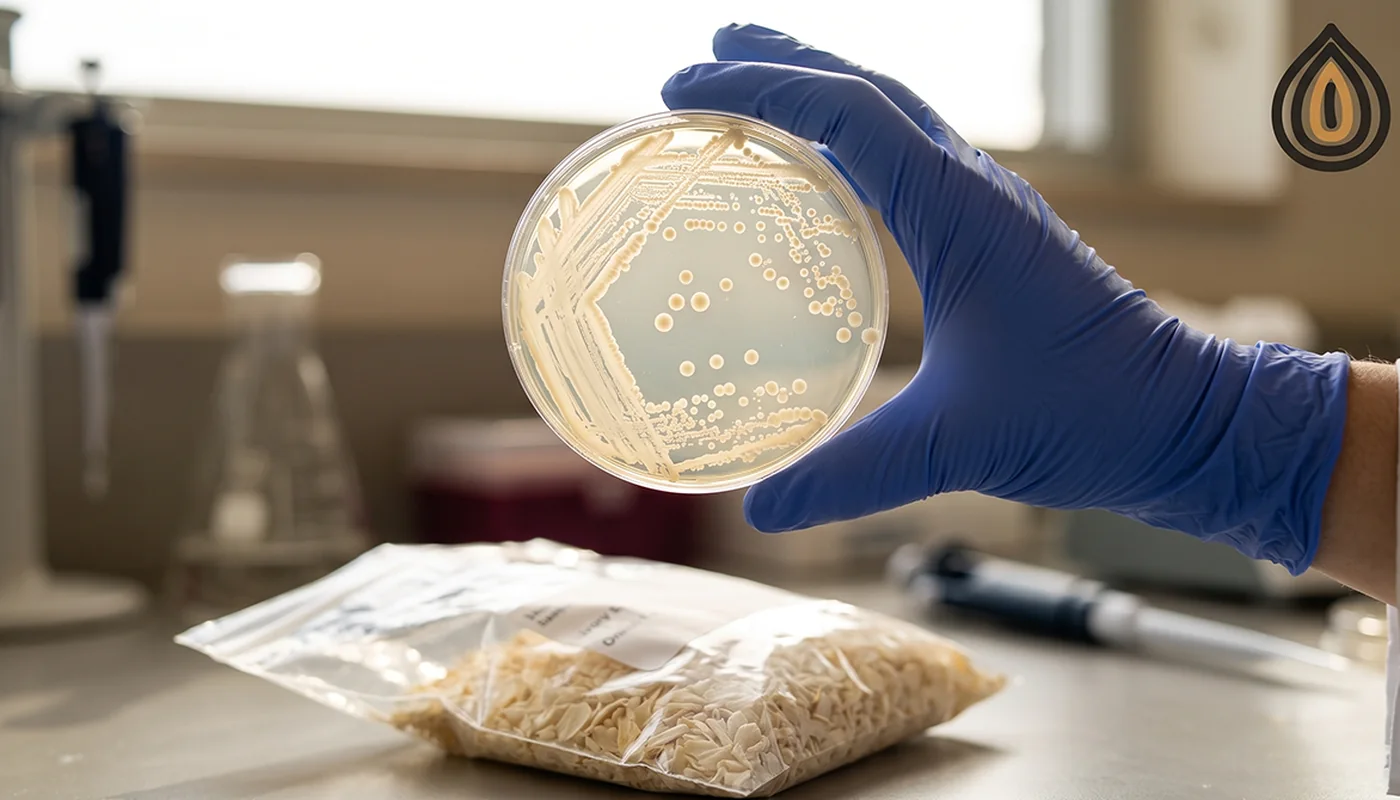
Onions grow in soil, and soil is full of bacteria and mould spores. Washing removes most of the soil but not the organisms in the outer layers and root plate, and the sliced onion that enters the dryer carries a population in the millions per gram. Hot air at 60 to 80 °C for several hours kills the vegetative cells of most bacteria and yeasts, which is why the count falls by two or three orders of magnitude through the dryer, but it does not kill bacterial spores, the dormant forms made by Bacillus and Clostridium species that survive heat, drying and time. Those spores, plus a residue of heat-tolerant bacteria and mould spores, are what remains in the finished product: a total count typically between 50,000 and 500,000 per gram, dominated by Bacillus.
The low moisture then holds everything still. At a water activity of 0.3 to 0.4 nothing can grow, so the count in a sealed bag stays roughly where the dryer left it for the whole shelf life; it drifts down slowly as some cells die and does not rise unless the product takes up water. When the onion is rehydrated in a soup or a sauce, the spores can germinate, and in a product that is then held warm for hours without cooking, they can grow; that is the food-safety logic behind the tiers, and it is why the buyer's own process, not the count, decides which tier is needed.
The parameters: indicators and pathogens
A microbiology panel for dried onion has two kinds of lines. Indicator organisms describe the general load and the hygiene of the process; they are counted and compared with a limit. Pathogens are the organisms that cause illness; they are tested for presence and must be absent.
| Parameter | Type | What it indicates | Reported as |
|---|---|---|---|
| Total plate count (aerobic mesophilic count, TPC, APC, TVC) | Indicator | General load; mostly Bacillus spores in dried onion | cfu/g |
| Yeast and mould | Indicator | Fungal load; storage and humidity history | cfu/g |
| Enterobacteriaceae | Indicator | Process hygiene; gut-related bacteria | cfu/g |
| Coliforms / E. coli | Indicator (coliforms) / hygiene pathogen marker (E. coli) | Faecal or water contamination | cfu/g or absent in 1 g |
| Salmonella | Pathogen | Must be absent; the critical line | Absent in 25 g |
| Bacillus cereus | Pathogen (toxin-forming spore-former) | Relevant where rehydrated product is held warm | cfu/g |
| Clostridium perfringens | Pathogen (spore-former) | As above; low in dried onion | cfu/g |
| Staphylococcus aureus | Pathogen (handling) | Human handling after drying | cfu/g |
| Listeria monocytogenes | Pathogen | Rare in dried onion; specified by some ready-to-eat buyers | Absent in 25 g |
Typical results for untreated dried onion
The table gives the ranges a buyer sees on certificates for standard-grade product from a certified Mahuva plant. The spread reflects the crop, the season and the plant; the monsoon months and the small units sit at the top of each range.
| Parameter | Typical, certified plant, standard grade | Common specification limit |
|---|---|---|
| Total plate count | 50,000-300,000 cfu/g | Max 500,000 (some buyers 1,000,000) |
| Yeast and mould | 100-2,000 cfu/g | Max 5,000 (some 10,000) |
| Enterobacteriaceae | 100-5,000 cfu/g | Max 10,000 |
| Coliforms | 10-1,000 cfu/g | Max 1,000 |
| E. coli | Absent | Absent in 1 g (below 10 cfu/g) |
| Salmonella | Absent | Absent in 25 g |
| Bacillus cereus | 100-5,000 cfu/g | Max 10,000 (ready-to-eat buyers 1,000) |
| Staphylococcus aureus | Below 100 | Max 100 |
A total plate count of 200,000 on a certificate is not a warning; it is the product. A count of 2,000,000 is a process or storage problem. A yeast and mould count of 20,000 means the product was damp at some point. A positive Salmonella or E. coli result in 25 grams or 1 gram is a rejection of the lot in every tier and a question about the plant.
The three tiers and their limits
The industry sells dried onion in three microbiological grades, and the names are standard across Mahuva even though the exact limits vary a little between plants and buyers.
| Tier | TPC (cfu/g) | Yeast and mould | Enterobacteriaceae | Treatment | Premium over standard | Made for |
|---|---|---|---|---|---|---|
| Standard | Max 500,000 | Max 5,000 | Max 10,000 | None; drying only | - | Products with a cooking step after the onion is added |
| Low bacterial (LB) | Max 50,000 | Max 1,000 | Max 1,000 | Steam treatment of the dried product, re-drying | +5 to +10 % | Dry blends with mild processes; products with a marginal kill step |
| Extra low bacterial (ELB) | Max 10,000 | Max 500 | Max 100 | Controlled steam treatment, validated, re-drying, post-treatment segregation | +15 to +25 % | Ready-to-eat products: dips, dressings, dairy, cold sauces, toppings with no kill step |
Some plants and buyers use a two-tier system, standard and "steam treated" at 10,000 or 20,000 cfu/g; some European buyers specify a total plate count of 100,000 for the standard grade, which a good plant meets most of the year and not always in the monsoon. Whatever the names, the mechanism is the same: standard is what drying gives, and the treated tiers are what a steam step gives. Each tier's pathogen requirements are identical and are the next section.
Pathogen lines that apply to every tier
Salmonella absent in 25 grams and E. coli absent in 1 gram are the two lines that do not change between tiers, and they are the two that a buyer should never relax. Salmonella has been found in dried vegetables and spices from several origins over the years, usually from contaminated water or from handling after drying, and the certified plants test for it at an accredited laboratory on every lot or on a tight sampling schedule because a positive result triggers a recall in Europe. E. coli in a dried product points at water or hygiene failure and is treated the same way. Bacillus cereus deserves a word because it is the one pathogen that survives drying as a matter of course: it is a spore-former present in most dried vegetables at low levels, harmless in a cooked product and in a dry blend, and a hazard only if the rehydrated product is held between 10 and 50 °C for hours; buyers making chilled ready-to-eat products specify it at 1,000 cfu/g and use the treated tiers, everyone else at 10,000. Listeria is rarely specified for dried onion and rarely found, but ready-to-eat manufacturers include it because their own products are tested for it. The full set, and how a certificate reports them, is in How to Read a Dehydrated Onion Lab Report.
The legal position in the EU and what buyers specify instead
EU law sets few numeric microbiological criteria for dried vegetables. Regulation 2073/2005 on microbiological criteria for foodstuffs lists food safety criteria for specific categories, sprouted seeds, ready-to-eat products for Listeria, and others, and dried onion as an ingredient is not one of them; the general requirement of Regulation 178/2002 that food must not be unsafe applies, and a food business operator must show, through its hazard analysis, that its ingredients are fit for the use it makes of them. In practice this means that the numeric limits on dried onion come from the buyer's specification, from the retailer codes of practice that buyers pass down, and from industry guidance such as the European Spice Association's quality minima for herbs and spices, which most dried-vegetable buyers borrow: total plate count and yeast and mould limits similar to the standard tier above, Salmonella absent in 25 grams, E. coli below 100 cfu/g. India's FSSAI standards for dehydrated onion set similar lines. The result is that the tiers table is not a legal document but a commercial one, and the buyer's own hazard analysis is the document that decides which tier it needs. The wider regulatory picture is in EU Import Requirements for Dehydrated Onion.
Steam treatment: how the counts are lowered
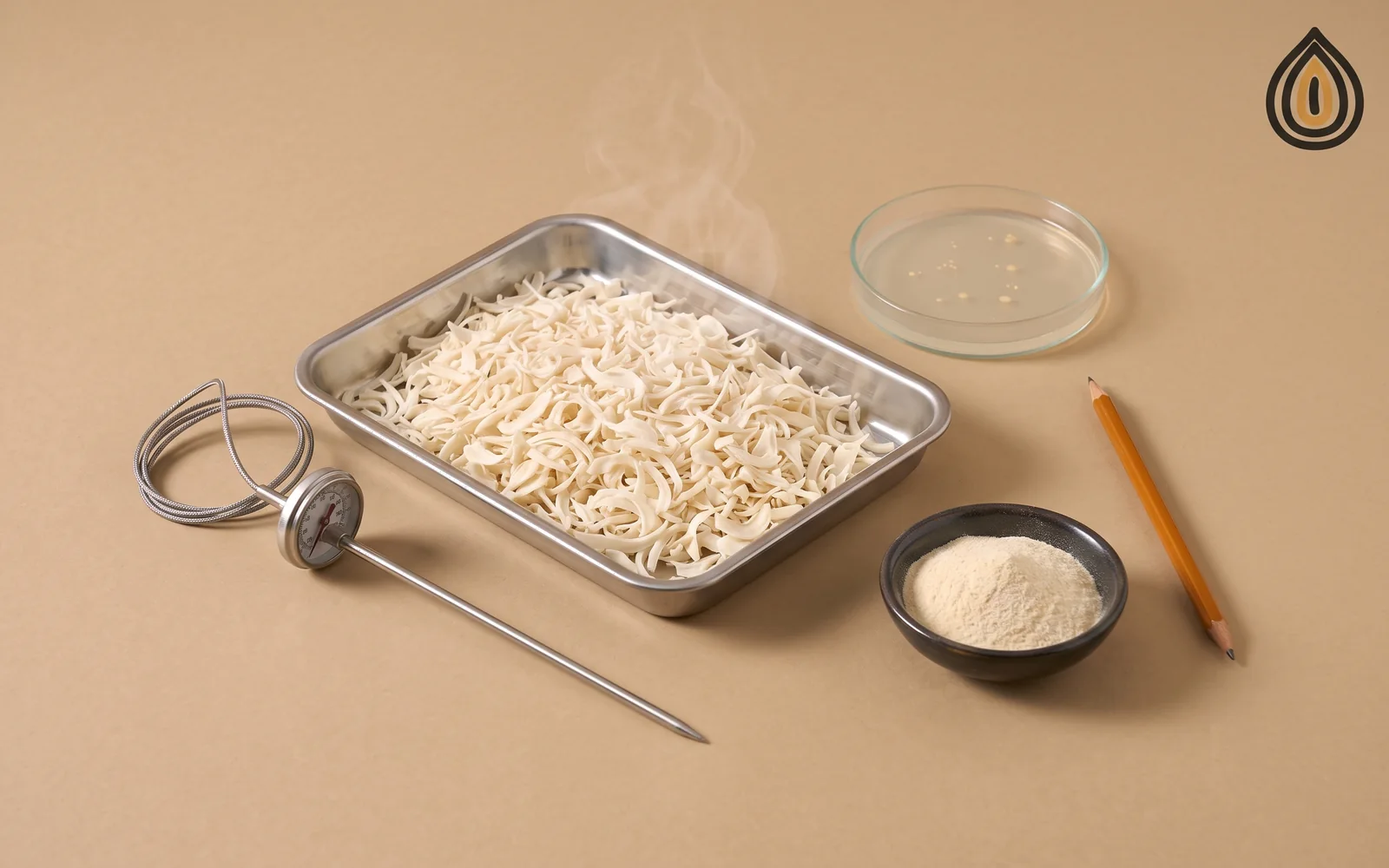
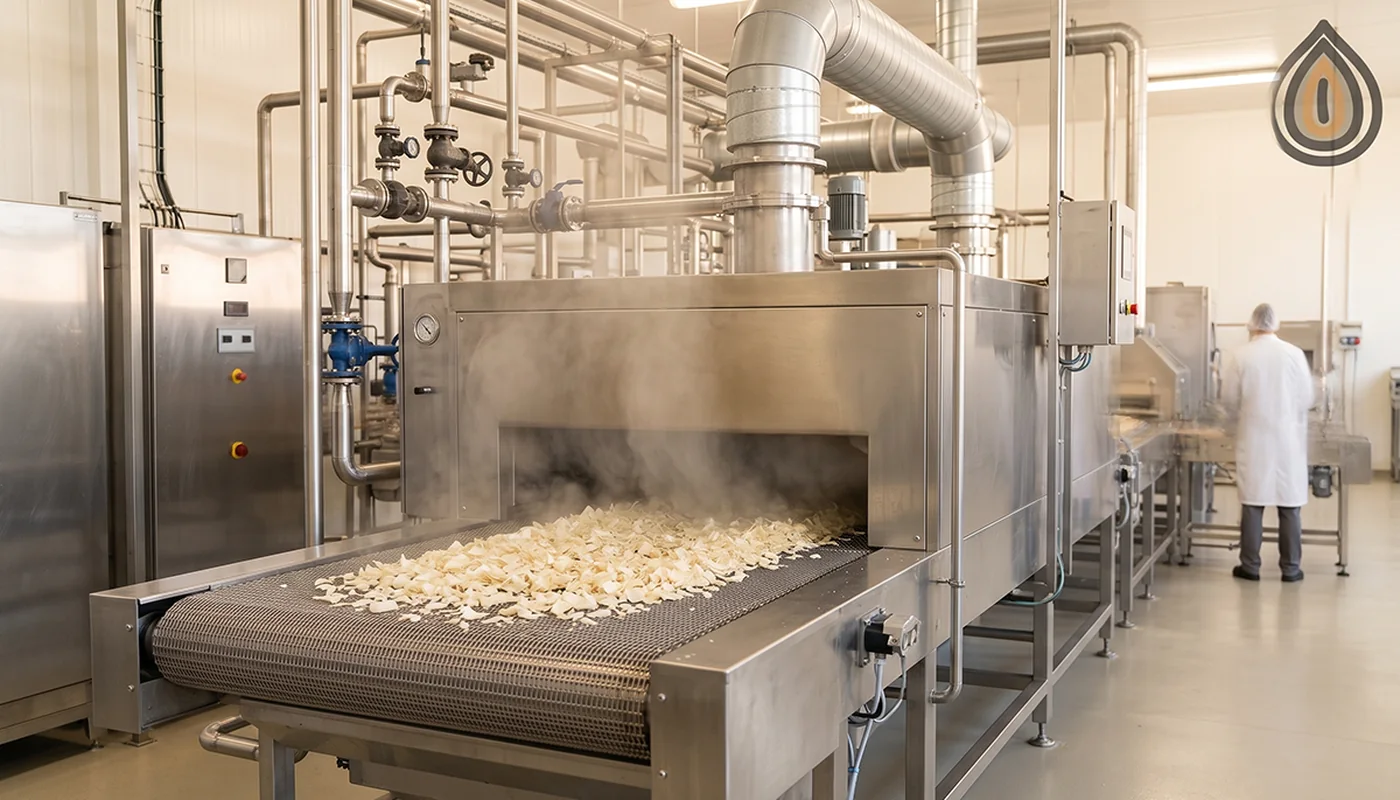
The treated tiers are made by passing the dried product through saturated steam for a short, controlled time, typically at 100 to 110 °C for one to a few minutes, in a continuous steam tunnel or a batch vessel, then re-drying it to below 6 percent moisture. Steam kills vegetative cells at once and, given enough time and temperature, a large share of the spores, and a validated process achieves a reduction of two to three orders of magnitude, from 200,000 to 2,000 or below. The costs of the treatment are a slight darkening and a slight loss of the sharpest volatile notes, a small yield loss, energy for the second drying, and the equipment; they are the tier premium. The treated product is also more porous and takes up moisture faster afterwards, so it needs heat-sealed liners and careful handling. Plants offering the ELB tier segregate the treated product from untreated material after the step, run the treatment as a validated critical control point under their BRCGS system, and test every lot. Alternatives exist: ethylene oxide fumigation, which is not permitted for food in the EU and is discussed in Ethylene Oxide and Dehydrated Onion; irradiation, which is permitted for dried herbs and spices in the EU with labelling but is not used on Indian onion for export; and dry-heat or infrared treatments used by some plants. The steam process in detail is in Low Bacterial and Extra Low Bacterial Dehydrated Onion.
The one question that decides the tier
Is there a validated kill step after the onion is added? A kill step is a stage in your process that reliably destroys vegetative bacteria, in practice a cook, bake, fry, retort or pasteurisation that brings the product to 70 °C or more for long enough; a validated one is a step your hazard analysis has measured and documented. If yes, standard grade is the right specification, because your process will remove the vegetative cells and the spores are held still by low water activity or the product's own preservation; paying for a treated tier adds nothing. If no, because the onion goes into a dip, a cold dressing, a cheese product, a topping added after baking, a raw pet treat or a dry blend sold for cold use, then the onion's own count becomes the product's count, and the treated tiers are the specification. The marginal cases are products with a mild heat step, warm-filled sauces at 60 °C, cook-chill products held for days, where the low bacterial tier is the usual compromise. Ask the question of your own quality team before you ask a supplier for a price, and write the answer into the specification; the supplier's job is to meet the tier, not to choose it. The tiers appear in the wider specification in How to Read a Dehydrated Onion Specification Sheet.
Methods and why counts differ between laboratories
A count is a method as much as a number. Two laboratories testing the same bag can differ by a factor of two or three with both being right, because plate counts depend on the medium, the incubation temperature and time, the dilution and the way the sample was mixed. The specification therefore names the methods, and a certificate names the methods it used.
| Parameter | Reference method | Incubation | Note |
|---|---|---|---|
| Total plate count | ISO 4833-1 | 30 °C, 72 h | Some labs use 35-37 °C, 48 h (AOAC), which reads lower on spore-formers |
| Yeast and mould | ISO 21527-2 (low water activity foods) | 25 °C, 5 days | Part 2 is the right one for dried products |
| Enterobacteriaceae | ISO 21528-2 | 37 °C, 24 h | - |
| E. coli | ISO 16649-2 (count) or ISO 7251 (MPN) | 44 °C, 18-24 h | Report as absent in 1 g or below 10 cfu/g |
| Salmonella | ISO 6579-1 | Enrichment, 3-5 days | Absent in 25 g; rapid PCR screens are common with ISO confirmation |
| Bacillus cereus | ISO 7932 | 30 °C, 24-48 h | Presumptive count |
| Staphylococcus aureus | ISO 6888-1 | 37 °C, 24-48 h | Coagulase-positive |
The practical rules: name ISO methods in the specification; expect a plant laboratory to use them for routine counts and an accredited external laboratory for pathogens; and when two results disagree, compare the methods before comparing the numbers. Laboratory accreditation, NABL in India under ISO/IEC 17025, is the assurance that the method was run as written.
Sampling plans and reading a result
A single 25 gram sample from one bag is a weak basis for a decision about ten tonnes, and both plants and buyers use sampling plans for the parameters that matter. The common form is the two-class or three-class plan borrowed from the Codex and ICMSF schemes: for Salmonella, five 25 gram samples from five bags across the lot, all absent; for total plate count, five samples with a target limit m and a maximum M, where the lot passes if no sample exceeds M and no more than c samples fall between m and M. A specification that says "TPC maximum 500,000" is read by most laboratories as M with n=1; a specification that says "n=5, c=2, m=100,000, M=500,000" is stricter and clearer. For routine lots, plant laboratories test a composite of several bags; for treated tiers and for buyers' first orders, the five-sample plan is worth writing in.
Reading a result means reading it against the tier and the method. A total plate count of 350,000 by ISO 4833 at 30 °C on a standard-grade lot is within specification; the same count on a low-bacterial lot is a failure of the treatment. A yeast and mould count of 8,000 on a lot certified at 800 at the plant means the product took up moisture after packing. A Bacillus cereus of 3,000 is normal for standard grade and a concern for a chilled ready-to-eat buyer who specified 1,000. Results should be read with the certificate's date: counts on dried onion drift slowly downward in storage, so a buyer's arrival result lower than the plant's is expected, and one higher means moisture.
What to do when a result fails
A failed indicator count, a total plate count or yeast and mould over the limit, calls for three steps: re-test the retained sample at an accredited laboratory by the specified method, because single counts vary; check moisture, because a count that rose after packing means water; and, if the re-test confirms, decide with the supplier between use in a cooked application at an adjusted price, replacement or credit. A failed pathogen test is different: a confirmed Salmonella or E. coli positive means the lot is rejected and not used in any tier, the supplier is informed the same day with the laboratory report, the plant investigates its water, hygiene and post-drying handling, and the buyer's own quality system records it as a supplier non-conformance. A serious supplier will send the retained-sample result and the plant's investigation without being asked; one that argues about the laboratory is telling you something. The claim procedure, with the arbitrating laboratory named in the contract, is in B2B Contract Terms for Dehydrated Onion.
Microbiology after the plant: storage and use
A note on units before the storage question: certificates report counts in colony-forming units per gram, cfu/g, and some laboratories report them as logarithms, log cfu/g, so that 100,000 appears as 5.0 and 10,000 as 4.0; a specification should use one convention, and a buyer comparing certificates should convert before comparing, since a difference of one log is a factor of ten.
The certificate describes the lot as packed, and two things can change it. Moisture uptake in storage lets yeasts and moulds grow first, since they tolerate lower water activity than bacteria; a bag that has been open in a humid room will show a yeast and mould count rising within weeks while the bacterial count stays flat, which is why yeast and mould is the storage indicator. And handling after opening adds organisms: scoops, hands, dust in the production room. Neither matters in a product that will be cooked; both matter in a ready-to-eat one, which is why ELB grades are packed in smaller units, opened as needed and not decanted into open bins. The rehydration step is where the microbiology becomes dynamic again: rehydrated onion held warm is a growth medium, and a process that soaks flakes for an hour at 40 °C before cooking has created a hazard the dried product did not have. Rehydrate cold or hot, not warm, and use within the time your hazard analysis allows. Storage conditions in general are in Dehydrated Onion Shelf Life.
Seasonal variation: why monsoon lots read higher
Counts on untreated dried onion are not constant through the year, and a buyer who compares a June certificate with an April one should know why. Product made in March and April, from fresh bulbs in dry air, has the lowest counts of the year: fast drying, low humidity in the sieving and packing rooms, and a short time between field and dryer. Product made or packed from July to September, in the monsoon, reads higher on every indicator, sometimes by a factor of three to five, because the humid air slows drying at the end of the belt, raises the moisture at packing and lets yeasts and moulds get a start on any surface. The certified plants counter this with conditioned packing rooms and by drying a little harder, and their monsoon lots stay within the standard tier; smaller units without conditioning produce monsoon lots that fail a 500,000 limit. Two practical rules follow. Ask for the production month with the certificate, and if a lot for a sensitive application will be bought in the second half of the year, specify the low bacterial tier or ask for product from the spring production; and treat a yeast and mould count well above the plant's own spring figures as a moisture signal before treating it as a microbiology one. The seasonal pattern in quality, and how to buy around it, is in Monsoon and Dehydrated Onion.
The specification lines
The microbiology block of a specification names the tier, the limits with their methods, the pathogen lines and the sampling plan. For standard grade: "Total plate count maximum 500,000 cfu/g (ISO 4833-1, 30 °C); yeast and mould maximum 5,000 cfu/g (ISO 21527-2); Enterobacteriaceae maximum 10,000 cfu/g (ISO 21528-2); E. coli absent in 1 g (ISO 16649-2); Salmonella absent in 25 g (ISO 6579-1), n=5; Bacillus cereus maximum 10,000 cfu/g (ISO 7932). Certificate of analysis per lot from an accredited laboratory for Salmonella and E. coli; plant laboratory acceptable for counts." For the treated tiers, change the three count limits and add "steam treated; treatment validated as a CCP under the plant's food safety system; post-treatment product segregated." For chilled ready-to-eat buyers, add Listeria monocytogenes absent in 25 g and reduce Bacillus cereus to 1,000.
How KlarHarvest tests and reports
Every KlarHarvest lot ships with a certificate of analysis from an NABL-accredited laboratory reporting total plate count, yeast and mould, Enterobacteriaceae, E. coli and Salmonella by the ISO methods named above, alongside the plant's own routine counts, and the tier is stated on the certificate and on the bag label. The three tiers are available in every cut of white and red onion from plants whose BRCGS scope includes steam treatment for the treated grades. Buyers who have not decided the tier are asked the kill-step question first and sent samples of standard and low bacterial grade of the same cut, so that the difference in colour and flavour can be judged alongside the counts. Retained samples of every lot are held for re-testing. The testing routine is described on the quality page, and each product page under products carries an example certificate.
Frequently asked questions
What is a normal total plate count for dehydrated onion?
Between 50,000 and 300,000 cfu/g for untreated standard grade from a certified plant, mostly harmless Bacillus spores that survive drying. Most specifications set a maximum of 500,000. Steam-treated grades are below 50,000 or below 10,000.
Is dehydrated onion sterile?
No. Drying stops microbes growing but does not kill bacterial spores. The low water activity keeps the population still until the product is rehydrated, which is why the buyer's process after rehydration decides which grade is needed.
Which microbiology grade do I need?
Standard if there is a validated cooking step after the onion is added. Low bacterial or extra low bacterial if the product is eaten without one: dips, dressings, dairy, cold sauces, toppings added after baking, cold-use dry blends.
Are Salmonella and E. coli tested on every lot?
At certified plants, yes, or on a tight sampling schedule, at an accredited laboratory, because a positive result would trigger a recall in Europe. Both must be absent in every tier: Salmonella in 25 grams, E. coli in 1 gram.
Why do two laboratories give different counts on the same sample?
Plate counts depend on the medium, temperature, time and mixing. A total plate count at 30 °C by ISO 4833 reads higher on spore-formers than one at 37 °C by AOAC. Specify the ISO methods and compare methods before numbers.
What is the difference between low bacterial and extra low bacterial onion?
The limits: low bacterial is typically total plate count below 50,000 cfu/g, extra low bacterial below 10,000, with lower yeast and mould and Enterobacteriaceae to match. Both are made by steam treatment; the ELB tier uses a validated, segregated process and costs 15 to 25 percent more than standard.
Does dehydrated onion contain Bacillus cereus?
Usually at low levels, as it does in most dried vegetables, because it is a spore-former that survives drying. It is harmless in cooked products and dry blends and a hazard only if rehydrated product is held warm for hours. Chilled ready-to-eat buyers specify it at 1,000 cfu/g and use treated grades.
Next step
If you are not sure which tier your product needs, describe the process in a sentence and request a sample of standard and low bacterial grade in the same cut; both come with their certificates of analysis so that your quality team can judge counts, colour and flavour together. If the tier is decided, request a quote with the tier and the limits and the priced specification is back within one business day.