- What the 18 or 24 months means
- Three ways dried onion ages
- Ageing by cut and by colour
- Storage conditions: the four numbers that matter
- Packaging from plant to production floor
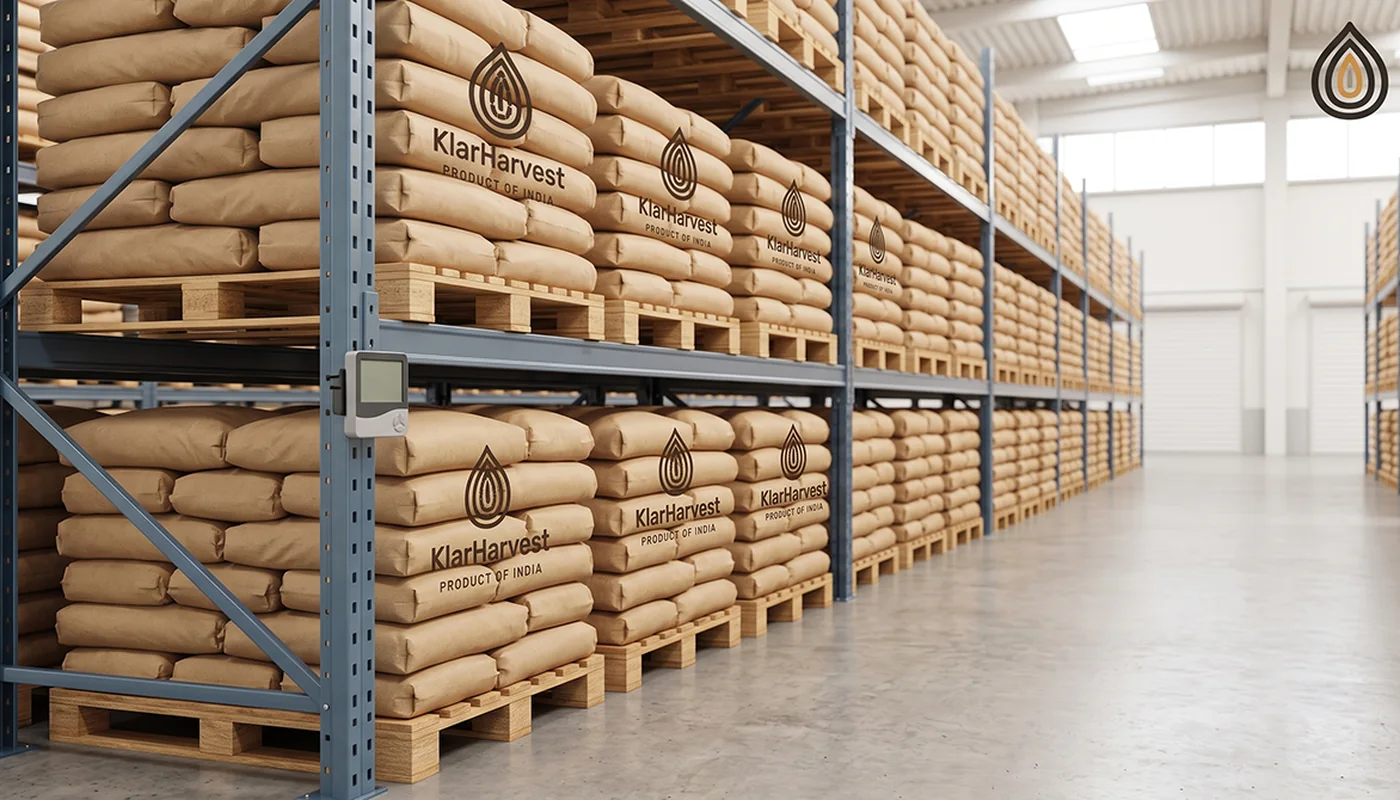
- Warehouse practice: pallets, rotation, distance from walls
- Pests: the one risk that sealed bags do not remove
- Opened bags and caking on the production floor
- What to do with stock past its best
- The first six weeks: transit and the receiving dock
- What the onion contributes to your own product's shelf life
- Contract stock and consignment: who owns the ageing
- Tests that tell you where a lot stands
- Practical shelf life by conditions
- The specification lines
- How KlarHarvest stores and ships
- Frequently asked questions
Judge the product, not the words
200-500 g from a current lot, dispatched by courier with the lot lab report.
Request a sampleDehydrated onion shelf life is declared at 18 months by most plants and 24 by some, and both numbers are honest only under conditions that the bag never states in full: a sealed liner, a warehouse below 25 °C and below 60 percent relative humidity, no light, no strong smells nearby, and a stock rotation that uses the oldest lot first. Under those conditions a bag of flakes from the April crop is still a good product two years later. Under a warm roof with the liner open, the same bag is caked, brown and flat within months. Dehydrated onion does not go off the way fresh food does; it goes downhill, and the slope is set by how it is kept.
This guide explains what the shelf-life declaration means and how plants arrive at it, the three ways dried onion ages and what each one looks like, how the five cuts and the two colours age differently, the storage conditions that matter and the numbers behind them, the packaging that protects the product from plant to production floor, warehouse practice including rotation and pest control, how to handle opened bags without caking, what to do with stock that has passed its best, and the tests that tell you where a lot stands. It ends with the specification lines for shelf life and storage and a table of practical life by conditions.
The figures are for white and red onion from Mahuva at below 6 percent moisture, as of February 2026, and they are plant experience rather than a formal stability study; where a buyer's quality system needs a study, the section on tests says how to run one.
What this guide covers
- What the 18 or 24 months means
- Three ways dried onion ages
- Ageing by cut and by colour
- Storage conditions: the four numbers that matter
- Packaging from plant to production floor
- Warehouse practice: pallets, rotation, distance from walls
- Pests: the one risk that sealed bags do not remove
- Opened bags and caking on the production floor
- What to do with stock past its best
- The first six weeks: transit and the receiving dock
- What the onion contributes to your own product's shelf life
- Contract stock and consignment: who owns the ageing
- Tests that tell you where a lot stands
- Practical shelf life by conditions
- The specification lines
- How KlarHarvest stores and ships
- Frequently asked questions
What the 18 or 24 months means
The shelf life on a dehydrated onion bag is a best-before declaration, not a safety limit. Below 6 percent moisture, sealed, the product cannot support microbial growth, so the date does not mark the point at which it becomes unsafe; it marks the point up to which the plant guarantees that the product, kept as instructed, will still meet its specification for colour, aroma, flow and moisture. Plants set 18 months as the standard declaration because it covers a full season cycle plus a margin: product made in April is sold through the year and the following winter, and the next crop's product replaces it before the date. Some plants declare 24 months for flakes and chopped, which age slowest, and some buyers' specifications ask for a minimum remaining shelf life on arrival, typically 12 months, which in practice means product from the current or previous crop.
The declaration is conditional, and the conditions are printed on the bag in a short form: store in a cool, dry place, away from light, in sealed packaging. Each of those phrases has a number behind it, and the section on conditions gives them. A buyer who meets the numbers gets the declared life; one who does not gets less, and the difference is not the plant's responsibility. This is the reason certified plants photograph and record the packing conditions and why a claim about aged stock is decided on storage records as much as on the product.
Three ways dried onion ages
Dried onion changes in three ways over time, at rates that depend on moisture, temperature and exposure.
Browning
The slow darkening from ivory to beige to brown is non-enzymatic browning, the reaction between the onion's sugars and its amino acids that also gives toasted onion its colour, running at room temperature over months instead of in a dryer over minutes. It is faster at higher moisture and at higher temperature, roughly doubling for every 10 °C, and it is the change that most often ends a lot's useful life in a pale product: a soup or a white sauce made with 20-month-old flakes is a shade darker than one made with fresh stock. It does not affect safety and only slightly affects flavour, which becomes a little sweeter and more cooked.
Aroma loss
The compounds that make onion smell of onion are volatile sulphur compounds, and they leave slowly through any opening and are slowly oxidised by air in the bag. A sealed liner with little headspace holds them well; an opened bag loses them in weeks. The change is easy to test by smell against a retained sample and shows as a product that needs a higher dose for the same onion impact, which for a seasoning manufacturer is a cost.
Moisture uptake
The fast route to a spoiled lot. Dried onion in contact with humid air moves towards the moisture in equilibrium with that air, which above 60 percent relative humidity is well above the 6 percent limit. The results, in order, are softening of flakes, caking of powder and granules, accelerated browning, and, above about 8 percent, the possibility of mould. Everything in the storage rules below is aimed at this mechanism, because the other two are slow and this one is not. The moisture science is in Dehydrated Onion Moisture Content.
Ageing by cut and by colour
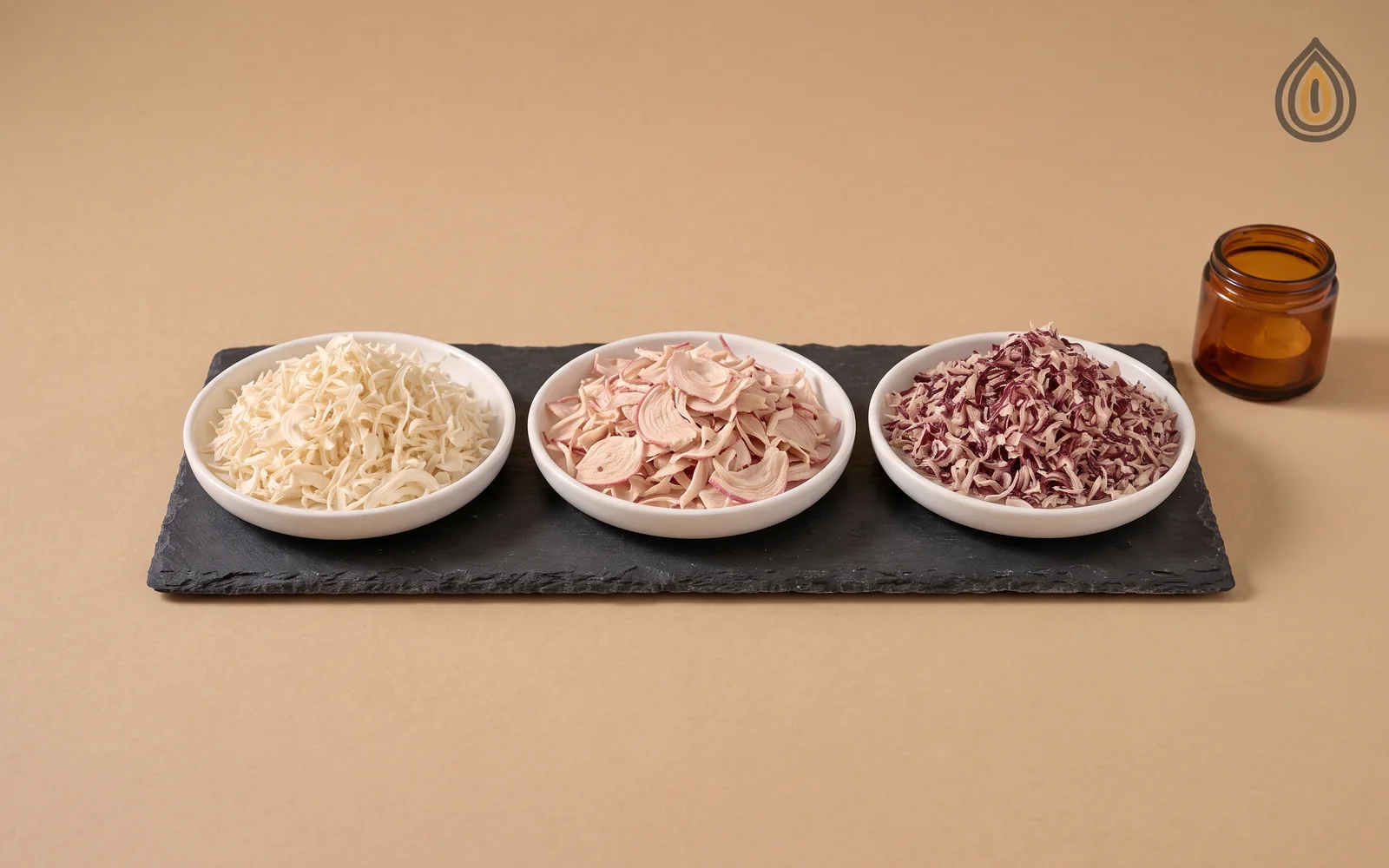
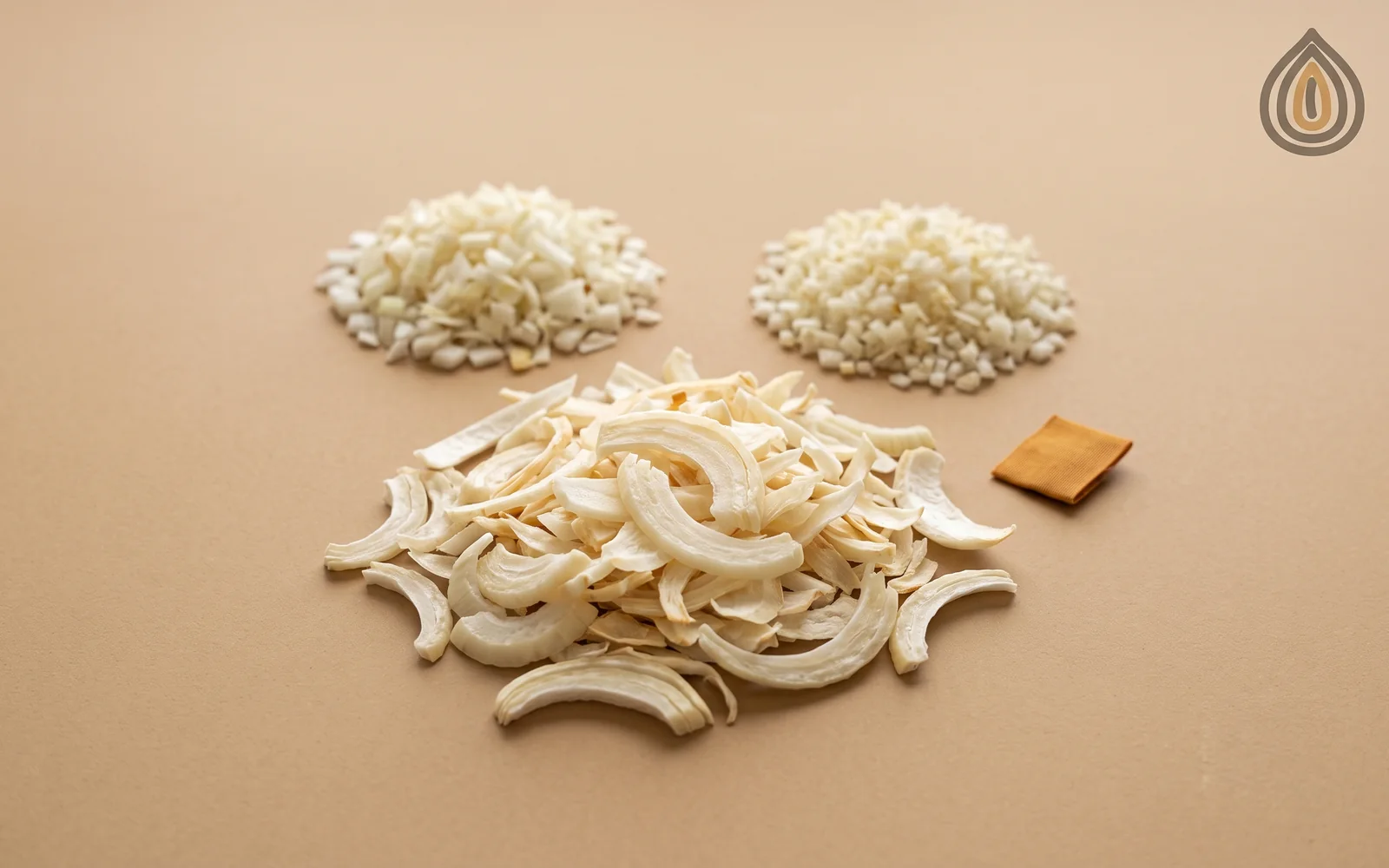
The five cuts share a moisture specification but not a rate of ageing. Surface area decides it: powder has hundreds of times the surface of flakes per kilogram, so it takes up moisture faster, loses aroma faster and shows browning sooner because the darker material is evenly distributed rather than confined to a few edges. Flakes age slowest, chopped and minced in between, granules close to powder.
| Cut | Moisture uptake when open | Aroma loss | Browning visibility | Practical life in sealed bag at 20 °C |
|---|---|---|---|---|
| Flakes | Slow, days | Slow | Late, edges first | 24 months |
| Chopped | Slow to moderate | Slow | 18-24 months | 24 months |
| Minced | Moderate, hours to a day | Moderate | Even, from 15 months | 18-24 months |
| Granules | Fast, hours | Moderate to fast | Even, from 12-15 months | 18 months |
| Powder | Fast, hours | Fast | Even, from 12 months | 18 months |
Colour adds a fourth mechanism for red onion: the anthocyanin pigment in the skin fragments fades towards brown with time, heat and light, faster than the white base browns. A red flake keeps full colour for about 9 to 12 months at 20 °C and is visibly duller by 18, while its flavour holds. Buyers who use red onion for appearance should rotate it faster than the declared life suggests, and buy it in season. The two colours are compared in White vs Red Dehydrated Onion.
Storage conditions: the four numbers that matter
| Condition | Target | Tolerable | Damaging | Why |
|---|---|---|---|---|
| Temperature | Below 20 °C | Up to 25 °C | Above 30 °C for weeks | Browning and aroma loss double with every 10 °C; heat drives moisture migration inside the bag |
| Relative humidity | Below 50 % | Up to 60 % | Above 65 % | Sealed liners slow but do not stop uptake through seams and pinholes; open bags equilibrate fast |
| Light | Dark | Indirect light on outer bags | Direct sun on bags or windows | Bleaches red pigment, warms bags unevenly, drives condensation inside the liner |
| Odours and chemicals | None nearby | Neutral dry goods | Detergents, fuels, spices, fish meal, fresh produce | Dried onion absorbs and gives off odours through kraft and even through polyethylene over months |
The temperature figure is the one European buyers most often miss, because a warehouse that is fine in winter reaches 30 °C under a metal roof in July. The humidity figure is the one Indian exporters most often miss in the monsoon. Both are cheap to measure: a logging thermo-hygrometer on the shelf next to the onion costs less than one bag of product and tells a buyer, at claim time, what the stock actually experienced. A refrigerated store at 5 to 10 °C roughly doubles the practical life of powder and red onion and is used by some large users, but it introduces a condensation risk when pallets are moved out into warm air, so bags must stay sealed until they have warmed up.
Packaging from plant to production floor
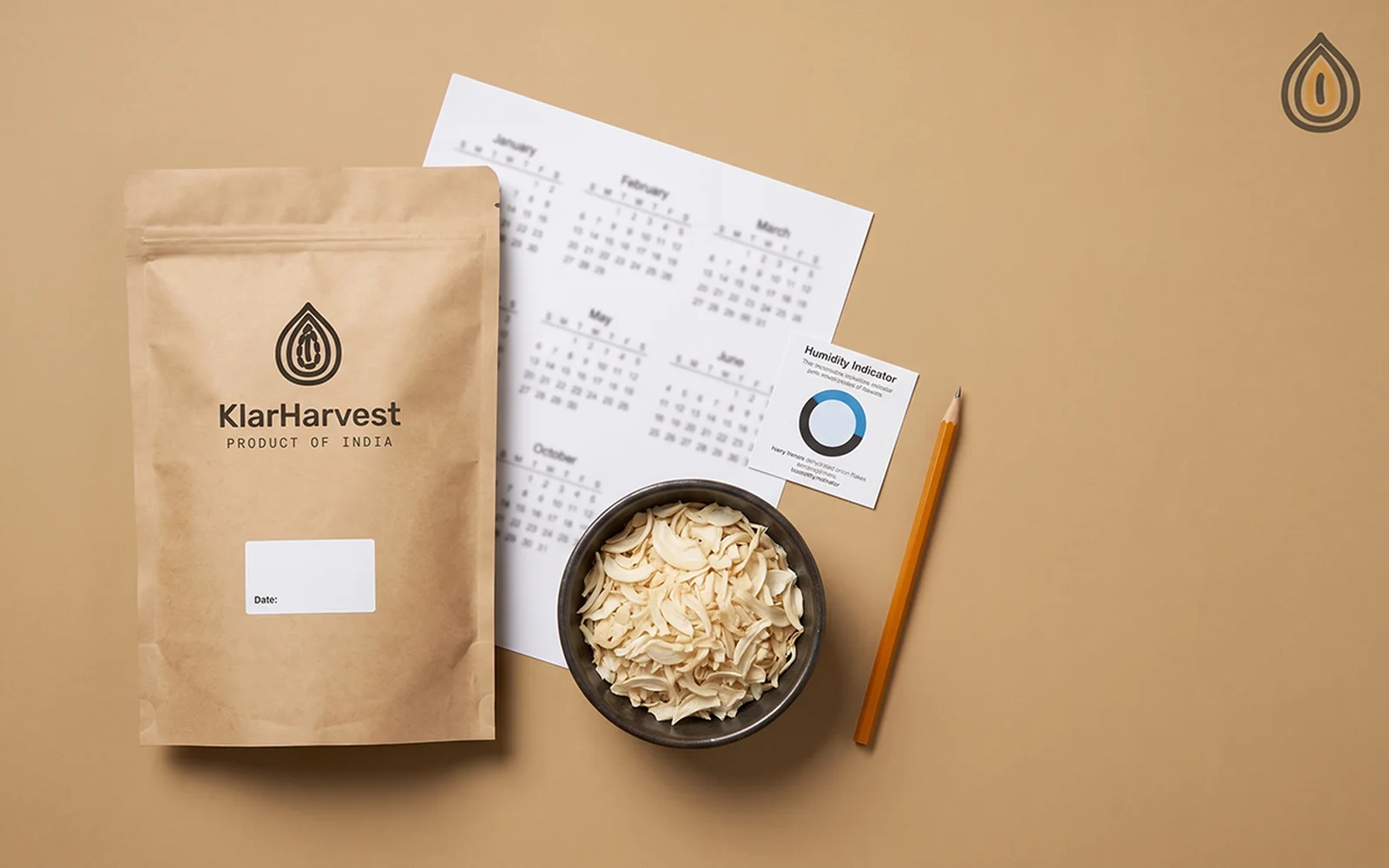
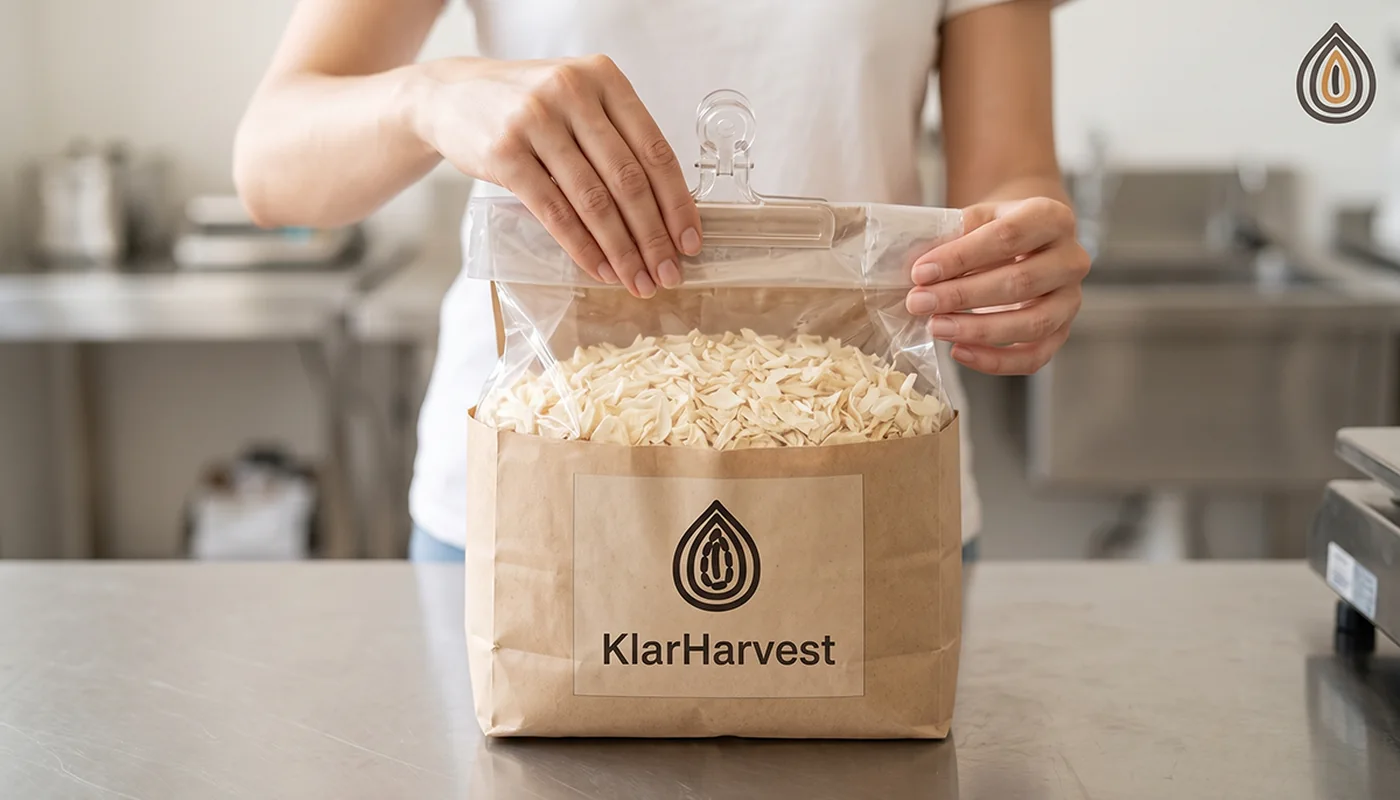
The standard export pack is a food-grade polyethylene liner of 80 to 100 microns, heat-sealed at the plant with the air pressed out, inside a multi-wall kraft paper bag or a woven polypropylene bag, 20 kilograms net, stitched or heat-sealed at the top. The liner is the moisture and odour barrier; the outer bag is for handling and for the label. Two upgrades exist for demanding buyers: a metallised or aluminium-laminated liner, which cuts moisture and oxygen transfer to a fraction of polyethylene's and extends the life of powder and red onion at a cost of a few rupees per kilogram, and nitrogen flushing of the liner before sealing, which removes the oxygen that drives aroma loss and is used for premium powder. Cartons of 10 or 12.5 kilograms with an inner liner suit retail-oriented buyers and air freight; bulk bags of 500 to 1,000 kilograms with a liner suit large powder users with silo handling, at the cost of exposing the whole bag once opened.
What the packaging cannot do is survive being opened. A liner that is cut and rolled down is not sealed, and the product inside it ages at the rate of the room it is in. The plant's job is to deliver a sealed liner; the buyer's job, discussed under opened bags below, is to keep it sealed until the product is used or to decant into something that seals. The packaging options and their costs are in Dehydrated Onion Packaging.
Warehouse practice: pallets, rotation, distance from walls
Good practice in a European dry-goods warehouse is the same for onion as for any dried food, and the points that matter most for onion are these. Keep pallets off the floor and 30 to 50 centimetres from exterior walls, where condensation forms in cold weather and heat builds in summer. Do not stack pallets more than two high, or bags in the lower layers are crushed and liners split. Keep onion away from products with strong odours and from anything wet or chilled. Use the lot code on every bag for rotation: first in, first out by lot, with the lot's production date, which the certificate of analysis carries, as the reference rather than the arrival date. Record temperature and humidity with a logger in the onion area. And keep the retained sample of each lot, sealed and in the dark, so that a colour or aroma complaint can be checked against the product as it arrived.
Rotation deserves emphasis because it is where good stock is wasted. A buyer who takes two containers a year and always picks from the front of the rack uses the newest lot first and discovers, a year later, a pallet of 20-month-old powder at the back. A simple rule, one lot in use at a time and the lot number written on the production record, avoids it and also gives the traceability a customer audit asks for. The warehouse side is expanded in Storing Dehydrated Onion in a European Warehouse.
Pests: the one risk that sealed bags do not remove
Dried onion is not a favourite of stored-product insects, its sulphur compounds see to that, but it is not immune, and the Indian meal moth and some beetles will infest an opened or torn bag in a warm warehouse that already has them. The risk comes with the warehouse, not with the product: a certified plant fumigates its raw-material stores, keeps its finished-goods store screened and monitored, and ships in sealed liners that insects cannot enter. A European warehouse with a pest control contract, sticky traps checked monthly and no torn bags will not have a problem. Where a buyer finds insects in onion, the first question is whether the liner was intact on arrival, and the loading video and the arrival inspection photographs answer it. Fumigation of finished dried onion is not practised and would raise its own residue questions; infested stock is destroyed, and the claim, if the liner was breached in transit, is on the marine insurance. The arrival inspection routine is in How to Import Dehydrated Onion from India.
Opened bags and caking on the production floor
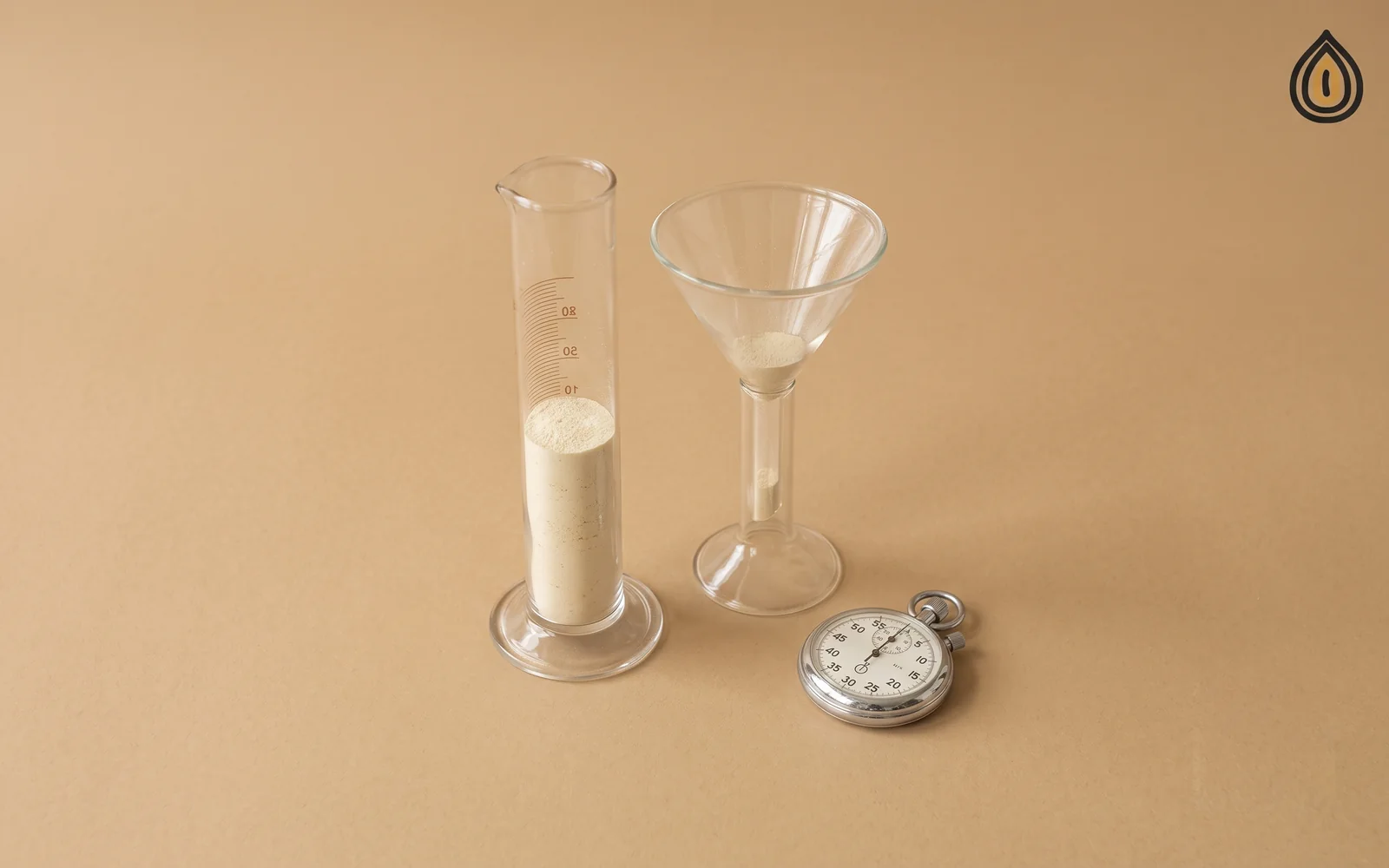
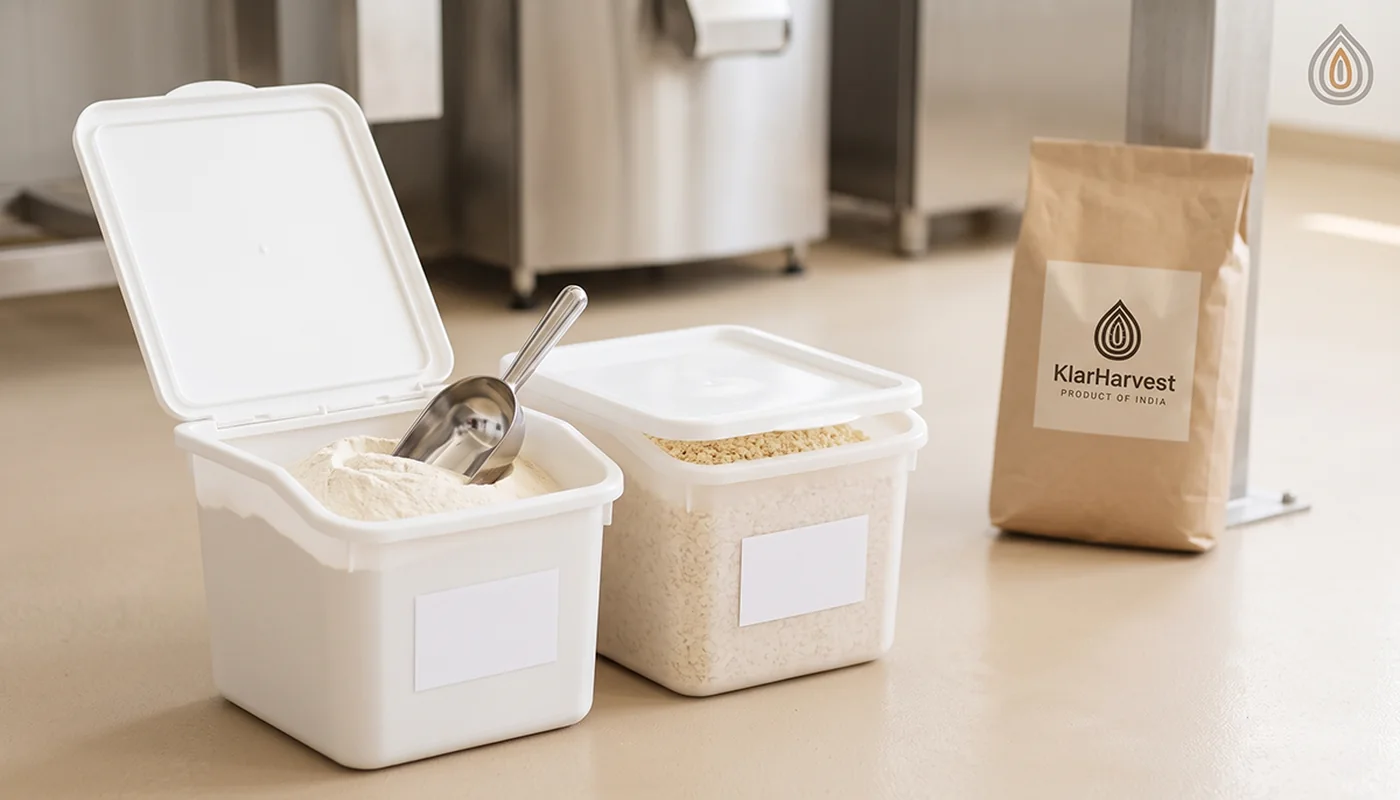
Most shelf-life problems begin on the production floor, not in the warehouse. A 20 kilogram bag opened for a batch that needs 3 kilograms sits open for the shift, and in a humid production room powder can go from 5 to 7 percent in a day and cake within a week. The rules that prevent it cost almost nothing. Open bags only when needed and close them the same shift: fold the liner over twice and clip it, or better, decant the remainder into a lidded food-grade bin with a scoop. Keep opened stock in the driest part of the plant, not next to the cooking kettles or the wash-down area. Use opened powder and minced within a week and opened flakes within a month. For lines that run powder continuously in humid conditions, two options exist: order powder with an anti-caking agent, silicon dioxide at up to 1 percent, which keeps it flowing for weeks in an open hopper, or dehumidify the dosing area. Caked powder that has not moulded can be broken and sieved and used in cooked products; it should not be sold or used in dry blends. The flow behaviour of the fine cuts is in Bulk Density and Flowability of Onion Powder and Granules.
What to do with stock past its best
Stock that has passed its best-before date, or that has aged early because of storage, is not necessarily waste. Test it first: moisture, and if the lot is powder or granules, a look at flow and caking; smell against the retained sample; colour against the retained sample under daylight. A lot that is under 6 percent moisture, free of mould and only darker and quieter than the reference can be used in cooked products where colour and aroma are not critical, in dark sauces, marinades, stuffings and meat products, at a slightly higher dose. Flakes and chopped can be re-sieved to remove fines and used as normal in long-cooked products. Aged red onion whose colour has faded is useful where its flavour was the point. What should not happen is using aged stock in the products where onion is visible or where the finished product is pale, or blending it into a new lot to hide it, which makes the new lot's certificate of analysis untrue. A lot above 8 percent moisture, with any smell of mustiness or any visible mould, is disposed of. Buyers who find themselves with aged stock more than once a year have a rotation problem, not a supplier problem.
The first six weeks: transit and the receiving dock
A lot's storage life begins at the plant, not at your warehouse, and the six weeks in between are the hardest it will ever have. A container stuffed at 35 °C in Mahuva, sailing through the tropics and cooling to 15 °C at Hamburg, takes the product through the widest temperature swing of its life and through the condensation risk described in Dehydrated Onion Moisture Content. Desiccant bags in the container, kraft top sheets on the pallets and heat-sealed liners are what keep the swing harmless; a buyer should ask for the first two and check the third on arrival. The receiving dock is the second risk: pallets left on a loading bay in the rain, or in a summer yard for a weekend, or next to a chiller door where they sweat, lose more life in three days than in three months of proper storage. Receive dried onion into the dry store the day it arrives, inspect it there, and start the rotation clock from the production date on the certificate rather than from the arrival date. Shipping choices and their effect on the product are in LCL or Full Container?
What the onion contributes to your own product's shelf life
Product developers ask how dried onion affects the best-before date of the food it goes into, and the answer is usually: not at all, provided the onion is within its own life when used. In a dry blend such as a seasoning or a soup mix, the onion is the same kind of ingredient as the rest, low moisture and low water activity, and the blend's life is set by its most vulnerable component, often a dairy powder or a fat, not by the onion. In a wet product, sauces, ready meals, meat products, the onion rehydrates and its own shelf life becomes irrelevant; the product's life is set by the process. The two cases where onion does matter are colour, where aged onion darkens a pale product from day one, and aroma, where a blend made with quiet onion needs a higher dose to reach the same impact and may fade sooner on the shelf. Both are reasons to use onion within 12 months of production even where the declaration allows 18, and to note the onion lot code on the batch record so that a customer complaint about colour can be traced. The labelling side, what the ingredient list must say, is in Labelling Dehydrated Onion for the EU.
Contract stock and consignment: who owns the ageing
Buyers who take a season's volume in one or two containers and use it over the year are, in effect, holding the supplier's stock for it, and some negotiate arrangements that move the ageing risk back. Call-off contracts keep the stock in India and ship it in pallets or containers as needed, at a fixed price, so the buyer holds three months of stock rather than twelve; the supplier carries the storage, and the buyer pays a little more in freight for the smaller shipments. Consignment stock in a European warehouse, owned by the supplier until called off, is offered by some traders and a few exporters to large customers, and shifts both the ageing and the working capital. Vendor-managed inventory, where the supplier watches the buyer's usage and ships to a minimum level, is the same idea with data. The arrangement that makes sense depends on volume and on how sensitive the product is to age: a manufacturer of pale soups using powder should hold less stock and pay for more shipments; a distributor turning flakes in a quarter can take containers. The contract forms are in B2B Contract Terms for Dehydrated Onion.
Tests that tell you where a lot stands
Four tests, none needing a laboratory beyond a moisture analyser, track a lot through its life. Moisture, on arrival and every three months in stock, against the certificate of analysis. Colour, against the retained sample under daylight or an instrumental L-value for powder, at the same intervals. Aroma, a simple triangle test with three cups, two of the retained sample and one of the stock or the reverse, judged by two people; when they can reliably tell the difference, the lot has aged noticeably. And a flow check for powder and granules, a handful squeezed and released, which should fall apart. A buyer whose quality system requires a formal shelf-life study can run an accelerated one: samples held at 35 °C and 65 percent relative humidity age roughly three to four times faster than at 20 °C and 50 percent, and 12 weeks at the accelerated condition gives a fair picture of a year in a normal warehouse. Plants that supply retailers have such studies on file and will share them. Sensory scoring in more detail is in Sensory Evaluation of Dehydrated Onion.
Practical shelf life by conditions
| Condition | Flakes / chopped | Minced / granules | Powder | Red onion (colour) |
|---|---|---|---|---|
| Sealed, 15 °C, 45 % RH | 30+ months | 24-30 months | 24 months | 15-18 months |
| Sealed, 20-25 °C, 50-60 % RH (declared conditions) | 24 months | 18-24 months | 18 months | 9-12 months |
| Sealed, 30 °C, 60 % RH (hot summer store) | 12-15 months | 9-12 months | 6-9 months | 6 months |
| Opened bag, 20 °C, 50 % RH | 4-8 weeks | 2-3 weeks | 1-2 weeks | 4 weeks |
| Opened bag, 25 °C, 70 % RH (humid production room) | 2 weeks | Days | 1-3 days before caking | 2 weeks |
The specification lines
Three lines cover shelf life on a specification. "Shelf life: 18 months from production date in the original sealed packaging, stored below 25 °C and 60 percent relative humidity, away from light and odours." "Minimum remaining shelf life on arrival: 12 months." And "Packaging: 20 kg net in heat-sealed polyethylene liner of minimum 80 microns inside a multi-wall kraft bag; production date and lot code printed on each bag." Buyers of powder or red onion for demanding applications add "metallised liner" or "nitrogen-flushed liner" and accept the small premium. The lines sit in the packaging block of the sheet described in How to Read a Dehydrated Onion Specification Sheet.
How KlarHarvest stores and ships
KlarHarvest holds stock in sealed plant liners in a godown in Bhavnagar with pest control, screened storage and logged temperature and humidity, rotates by lot code, and ships product from the current or previous crop with at least 12 months of declared life remaining, stated on the certificate of analysis. Containers stuffed in the hot months carry desiccant bags and pallet top sheets against condensation, and the stuffing is recorded on video. Metallised liners and nitrogen flushing are quoted for powder and red onion on request. A retained sample of every lot is held sealed and dark for the full shelf life, so that an ageing question a year later can be answered against the product as it left. The storage routine is part of our process, and the specifications are on the products pages.
Frequently asked questions
How long does dehydrated onion last?
18 months as the standard declaration and 24 for flakes and chopped, in a sealed liner below 25 °C and 60 percent relative humidity. It stays safe well beyond that if it stays dry; it slowly browns, loses aroma and, for powder, cakes. Opened bags last weeks, not months.
Does dehydrated onion go bad?
Not in the way fresh food does. Below 6 percent moisture nothing can grow in it. It goes bad only if it takes up water: above about 8 percent moisture mould becomes possible, and a musty smell or visible mould means disposal.
Why has my onion powder caked?
It took up moisture from the air, usually because the liner was opened and left, or the store was humid, or a container sweated in transit. Powder equilibrates with humid air within hours. Keep liners sealed, decant into lidded bins, and consider an anti-caking agent for lines that run powder in humid rooms.
Should dehydrated onion be refrigerated?
Not normally. Cool dry ambient storage is the standard. A chilled store at 5 to 10 °C roughly doubles the practical life of powder and red onion but creates a condensation risk when pallets come out into warm air; bags must stay sealed until they have warmed.
Can I use dehydrated onion after the best-before date?
If it is under 6 percent moisture, free of mould and only darker or quieter than fresh stock, yes, in cooked products where colour is not critical, at a slightly higher dose. Not in pale products, not in visible applications, and never blended into a fresh lot.
Does red onion have a shorter shelf life than white?
For flavour and safety, the same. For colour, shorter: the red pigment fades noticeably after 9 to 12 months at room temperature. Buy red onion in season and rotate it faster.
What is the best packaging for long storage?
A heat-sealed polyethylene liner of at least 80 microns inside a kraft or woven bag is standard and adequate. A metallised liner, and nitrogen flushing for powder, extend the life of powder and red onion for a small premium.
Next step
If you want to see how a lot ages in your own conditions, request a sample and keep half of it sealed as a reference; the certificate of analysis gives the starting moisture. For product with a metallised or nitrogen-flushed liner, or a minimum remaining shelf life written into the order, request a quote and state the requirement.