- What moisture content is: from 88 percent to 6
- Where the 6 percent limit comes from
- Moisture and water activity: why safety depends on the second number
- What happens above the limit: 7, 8 and 10 percent
- The commercial side: paying for water
- Moisture by cut, and why powder is the sensitive one
- Equilibrium: how onion takes water back from the air
- How moisture is measured: oven, halogen, Karl Fischer, NIR
- How a plant controls moisture
- Testing on arrival and making a moisture claim
- Container sweat: how a dry lot gets wet on the water
- Steam treatment and moisture: the treated grades
- Moisture, temperature and shelf life
- The specification line
- How KlarHarvest reports moisture
- Frequently asked questions
Judge the product, not the words
200-500 g from a current lot, dispatched by courier with the lot lab report.
Request a sampleDehydrated onion moisture content is the number that decides whether a bag of onion is safe, whether it will still look right in a year, and how much of the price you paid went on water. The trade limit is 6 percent, well-dried lots sit between 4.5 and 5.5, and everything about storage, caking, browning and microbial safety follows from that line. It is also the parameter most often over specification on arrival and the one most often measured wrongly, by a meter that was never calibrated against an oven.
This guide explains what the number means and where the 6 percent limit comes from, how moisture relates to water activity and to microbial growth, what happens to onion at 7, 8 and 10 percent, how a plant controls the number and how a laboratory measures it with the oven, halogen, Karl Fischer and near-infrared methods, how much those methods disagree, and how to test on arrival and write a moisture claim that holds. It ends with the specification wording and a shelf-life table by moisture and temperature.
The figures are for white and red onion dried in Mahuva, Gujarat, as of February 2026. Moisture is a percentage of total weight throughout, which is how the trade quotes it.
What this guide covers
- What moisture content is: from 88 percent to 6
- Where the 6 percent limit comes from
- Moisture and water activity: why safety depends on the second number
- What happens above the limit: 7, 8 and 10 percent
- The commercial side: paying for water
- Moisture by cut, and why powder is the sensitive one
- Equilibrium: how onion takes water back from the air
- How moisture is measured: oven, halogen, Karl Fischer, NIR
- How a plant controls moisture
- Testing on arrival and making a moisture claim
- Container sweat: how a dry lot gets wet on the water
- Steam treatment and moisture: the treated grades
- Moisture, temperature and shelf life
- The specification line
- How KlarHarvest reports moisture
- Frequently asked questions
What moisture content is: from 88 percent to 6
A fresh onion is about 88 percent water by weight; the remaining 12 percent is the dry matter, the sugars, fibre, minerals and flavour compounds that make it an onion. Dehydration removes water with hot air until the product is about 5 percent water and 95 percent dry matter. Moisture content, as the trade uses the term, is the weight of water in the product as a percentage of the product's total weight: a 20 kilogram bag of flakes at 5 percent moisture contains 1 kilogram of water and 19 kilograms of onion solids.
Two conventions matter when comparing figures. Moisture on a wet basis, water divided by total weight, is what specifications and certificates of analysis report and what this guide uses. Moisture on a dry basis, water divided by dry solids, appears in some drying literature and reads higher: 5 percent wet basis is 5.3 percent dry basis. A certificate should state the basis; if it does not, wet basis is the safe assumption in this trade. The other convention is that moisture includes all water, bound and free, that the test method removes; the fraction of that water that is available to microbes is a separate number, water activity, covered below.
Where the 6 percent limit comes from
The 6 percent maximum is written into the international specification for dehydrated onion, ISO 5559, into the standards of the main importing markets, and into nearly every buyer's specification. It is not an arbitrary round number. Below about 6 percent, onion's water activity falls under 0.5, where no bacterium, yeast or mould can grow; the product is microbiologically stable without preservatives or cold. Below about 6 percent, the non-enzymatic browning that darkens dried vegetables slows enough that a lot keeps its colour for the 18 to 24 month shelf life. And below about 6 percent, powder and granules flow and resist caking under normal warehouse humidity. The limit is where three curves, safety, colour and handling, all turn favourable, and it costs a plant only a little more energy to reach it than to stop at 7.
Plants that dry to 4.5 or 5 percent do it for margin against uptake: onion is hygroscopic and picks up moisture from the air during cooling, sieving, milling and packing, and a product that leaves the dryer at 5 percent may be at 5.5 by the time the bag is sealed in a humid packing room. Drying much below 4 percent gains nothing and costs energy and colour, because the last water is the hardest to remove and the product spends longer in hot air.
Moisture and water activity: why safety depends on the second number
Moisture content tells you how much water is in the product; water activity, written aw, tells you how much of it is available. It is the ratio of the water vapour pressure over the product to that over pure water, on a scale from 0 to 1, and it is the number microbiology actually depends on. Bacteria need an aw above about 0.85 to grow, most yeasts above 0.8, and most moulds above 0.6 to 0.7; the hardiest xerophilic moulds stop at about 0.6. Dehydrated onion at 5 percent moisture has an aw of roughly 0.3 to 0.4; at 6 percent about 0.45; at 8 percent it approaches 0.6, the edge of mould growth; at 10 percent it is above it.
| Moisture (wet basis) | Approximate water activity | Microbial status | Physical status |
|---|---|---|---|
| 4 % | 0.25-0.30 | Stable | Free-flowing; brittle flakes |
| 5 % | 0.30-0.40 | Stable | Free-flowing; normal |
| 6 % | 0.40-0.50 | Stable | Slight softening of flakes; powder still flows |
| 7 % | 0.50-0.55 | Stable, no margin | Powder begins to cake in weeks; browning faster |
| 8 % | 0.55-0.62 | Xerophilic moulds possible | Caking; flakes pliable; aroma loss |
| 10 % | 0.65-0.70 | Mould growth likely in weeks | Lumps; off-odour possible |
The relationship between moisture and aw is the product's sorption isotherm, and it is not linear: aw rises slowly with moisture at the dry end and fast above 7 percent, which is why the difference between 6 and 8 percent matters far more than the difference between 4 and 6. Some buyers specify water activity directly, at a maximum of 0.5, as a safety line that is independent of the test method for moisture; the argument for and against is in Water Activity in Dehydrated Onion.
What happens above the limit: 7, 8 and 10 percent
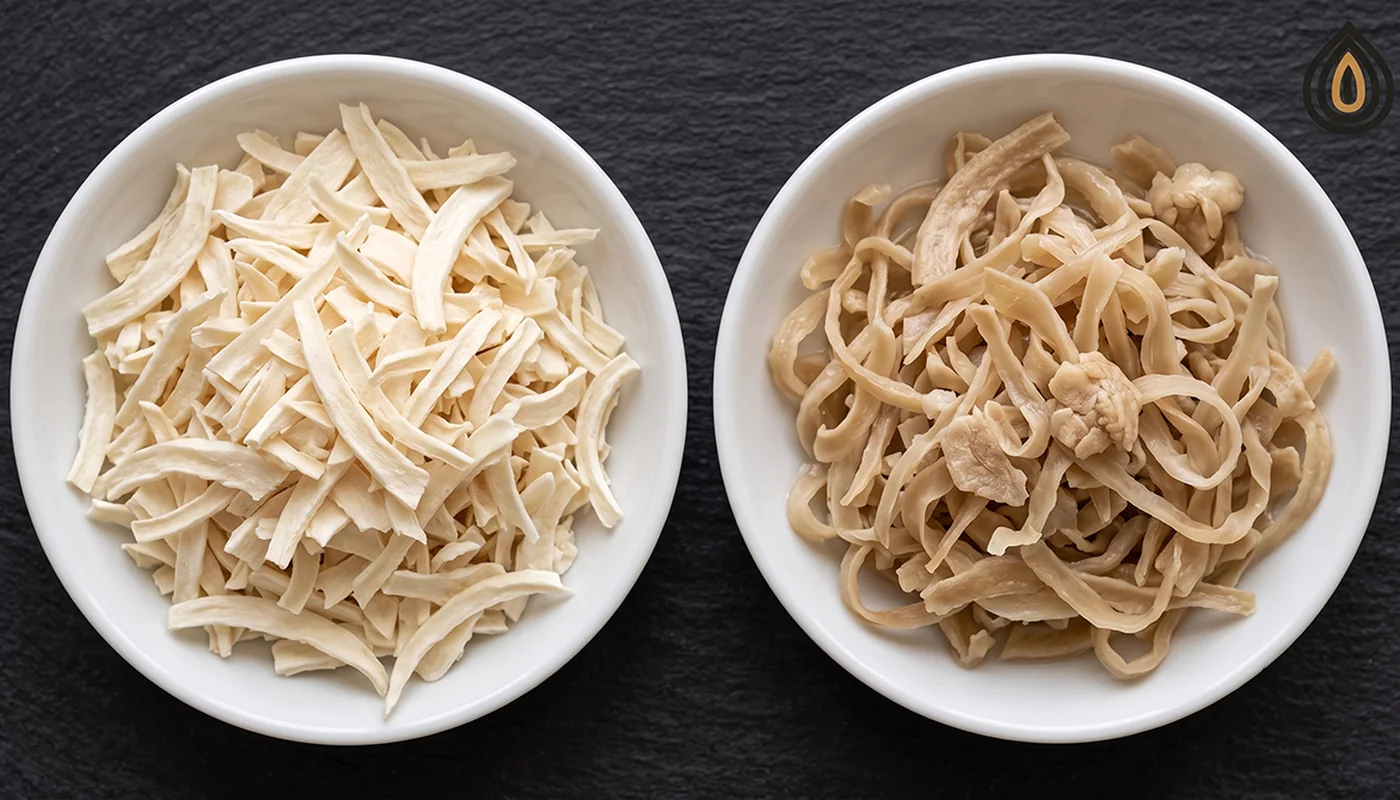
A lot at 7 percent is not dangerous; it is a lot with no margin. Powder from it will cake within weeks in a warehouse at 20 °C and 60 percent relative humidity, the browning reactions run perhaps twice as fast as at 5 percent, and the aroma fades sooner. A lot at 8 percent is a lot with a problem: the aw is at the edge of mould growth, powder cakes within days, flakes lose their brittleness and bend rather than snap, and the certificate of analysis that was issued at 5.5 percent at the plant is no longer true, which means the product took water on somewhere between the dryer and your door. A lot at 10 percent will grow mould in the bag within weeks in a warm store, smells musty when opened, and is a rejection.
The cause of high moisture on arrival is almost never the dryer. Plants measure moisture at the dryer exit on every run, and a lot that left at 7 percent would be re-dried. The causes are downstream: cooling and sieving in a humid room during the monsoon, a liner that was not heat-sealed, a bag torn in stuffing, a container that sweated on the water because it was stuffed hot and shipped into a cold port, or a warehouse in Europe where the bags stood open. Each of those shows up differently on arrival, and the arrival test described below is designed to tell them apart.
The commercial side: paying for water
Every percent of moisture is a percent of the invoice spent on water. A 20 foot container holds 10,000 kilograms of flakes; at 5 percent moisture that is 9,500 kilograms of onion solids, at 7 percent it is 9,300, and the 200 kilogram difference at 1.60 euros per kilogram is 320 euros of water on one container. Over a year of ten containers it is 3,200 euros, which is why large buyers write 5.5 percent rather than 6 into their specifications and why some contracts price on dry-matter content. The same arithmetic runs the other way for the plant: drying from 6 to 5 percent removes a kilogram of water from every hundred and costs energy to do it, so a plant that consistently ships at 5 percent is giving the buyer a little more onion than the specification requires and expects to be paid for a product that keeps.
The commercial rule that follows is simple. Specify a maximum, measure on arrival, and if the arrival figure is above the specification, claim on the difference: a lot at 7.5 percent against a specification of 6 percent contains 1.5 percent less onion than was invoiced, and the adjustment is 1.5 percent of the value, before any argument about quality. How that claim is made and settled is below.
Moisture by cut, and why powder is the sensitive one
All five cuts leave the same dryer and share the same target, but they differ in how fast they move away from it. Flakes have a small surface area for their weight and take up moisture slowly; a bag of flakes open for a shift in a normal production room gains a fraction of a percent. Powder has a surface area hundreds of times larger and equilibrates with the air within hours; a bag of powder open for a shift in a humid room can go from 5 to 7 percent, and it is the cut that most often arrives above specification when a liner was not sealed. Granules and minced sit between the two. Milling also warms the product and drives off a little more water, so powder often leaves the plant slightly drier than the flakes it was milled from, at 4 to 4.5 percent, and then gains it back at the first opportunity.
For buyers this means the moisture specification can be the same for all cuts, but the handling rules differ: powder and minced should be specified at 5.5 percent where a humid production environment is involved, packed in a heat-sealed liner with the air pressed out, and opened only as needed. The cut differences in handling are in Flakes, Chopped, Minced, Granules or Powder.
Equilibrium: how onion takes water back from the air
Dried onion left in open air moves towards the moisture content that is in equilibrium with the air's relative humidity, and the equilibrium is well above the specification at ordinary humidities. The figures below are indicative for onion powder at 20 °C; flakes reach the same values more slowly.
| Relative humidity of the air | Equilibrium moisture of onion, approx. | Time for open powder to get close |
|---|---|---|
| 30 % | 4-5 % | - |
| 45 % | 6-7 % | 1-2 days |
| 60 % | 8-10 % | Hours to a day |
| 75 % | 13-16 % | Hours |
| 90 % (monsoon air) | above 20 % | Hours |
The table explains most moisture incidents. A European warehouse in winter at 40 to 50 percent relative humidity is safe for sealed bags and tolerable for open ones; a summer warehouse at 70 percent will push an open bag of powder past 10 percent overnight. A Mahuva packing room in August, in monsoon air at 85 to 95 percent humidity, will do the same in an hour, which is why certified plants condition their packing rooms and why the monsoon is the season of moisture claims. The seasonal risk and how to time purchases around it are in Monsoon and Dehydrated Onion.
How moisture is measured: oven, halogen, Karl Fischer, NIR
Four methods are in use, and they do not give the same number on the same sample. A specification should name the reference method, and a certificate should name the method used.
| Method | How it works | Time | Typical bias against oven | Used for |
|---|---|---|---|---|
| Oven (105 °C to constant weight, or 70 °C under vacuum) | Weigh, dry, weigh; loss is moisture | 3-16 hours | Reference (0) | Certificates of analysis, disputes |
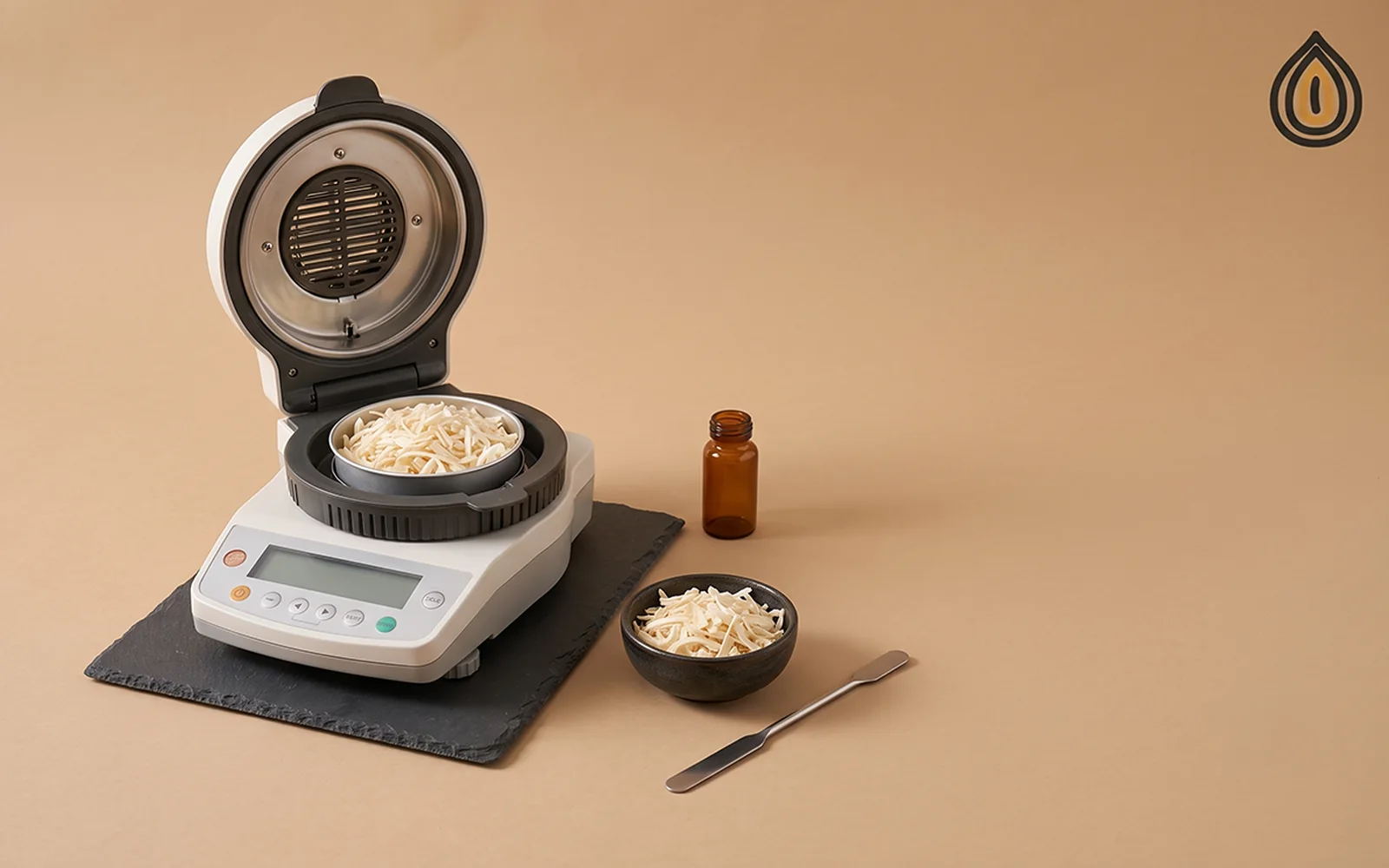
| Halogen or infrared moisture analyser | Heats a 3-5 g sample on a balance, reads loss | 5-15 minutes | ±0.3-0.5 % unless calibrated on onion | Plant control, incoming checks |
| Karl Fischer titration | Chemical titration of water only | 15-30 minutes | Reads slightly lower than oven (volatiles excluded) | Precision work, low-moisture powders |
| Near-infrared (NIR) | Optical reading calibrated to reference samples | Seconds | Depends entirely on calibration | Online control on the dryer, large plants |
The oven method loses everything that evaporates, including a small amount of onion's volatile flavour compounds, so it reads a little high; Karl Fischer measures water alone and reads a little low; the halogen analyser heats faster and can char the surface of a powder, reading high, or stop early on flakes, reading low, unless its programme has been set up on onion and checked against the oven. The differences are a few tenths of a percent, which is nothing in a lot at 5 percent and everything in a dispute about a lot at 6.2. Both sides therefore agree the reference method in the specification, and a claim is decided by that method at an accredited laboratory on a retained sample. Sampling matters as much as the method: take from several bags across the lot, from the middle of the bag rather than the top, and seal the sample immediately, because a sample of powder left on a bench for an hour has already changed.
How a plant controls moisture
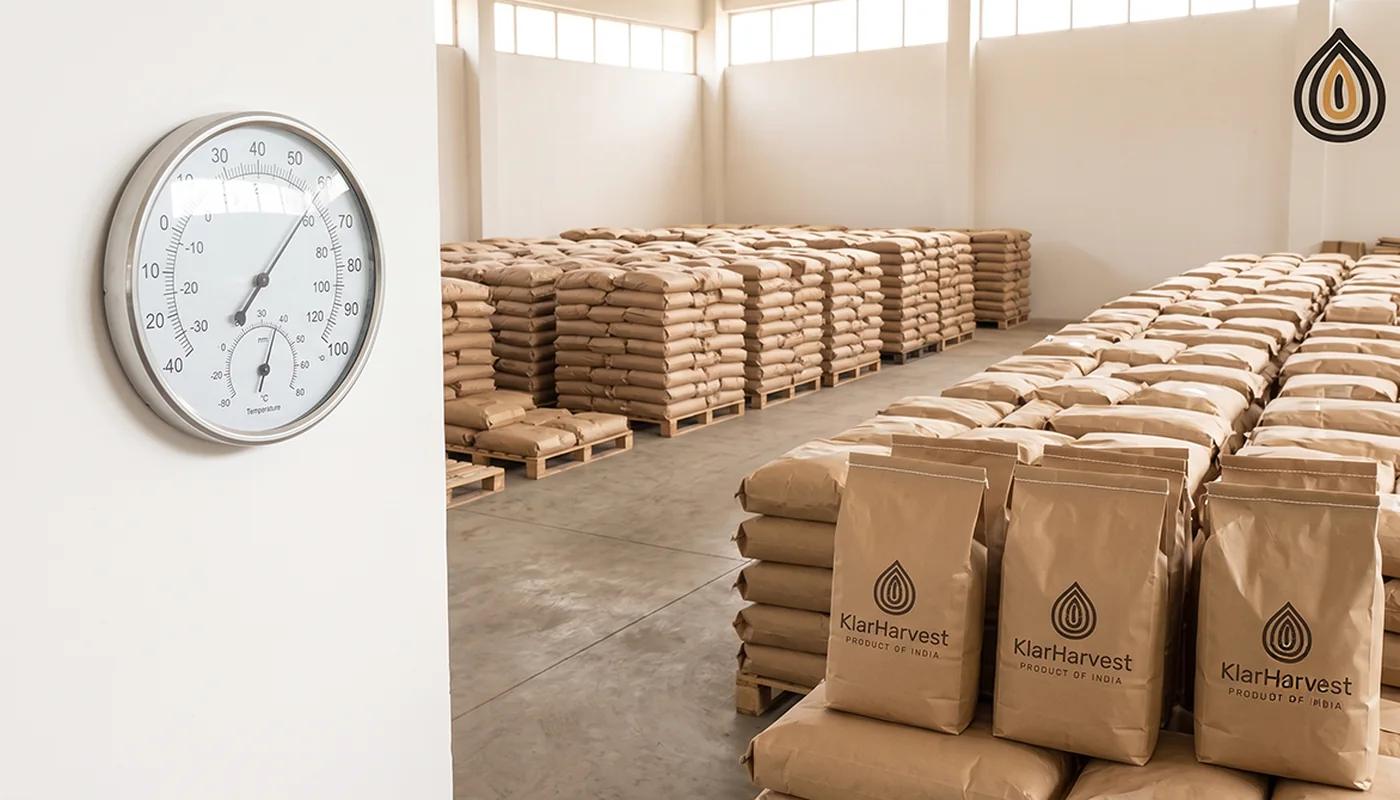
A belt dryer dries in stages: high air temperature at the entry, where the slices are wet and can take heat, falling towards the exit, where over-heating browns the product. Moisture at the exit is controlled by belt speed, air temperature and air flow, and a good plant checks it every hour with a halogen analyser and every lot with the oven. After the dryer the product is cooled, because warm onion packed into a liner sweats, then sieved and milled, then packed. The certified plants condition the air in the sieving and packing rooms during the monsoon, some to below 50 percent relative humidity, and heat-seal the liners with the air pressed out. Where a plant cannot condition the packing room, it dries a little lower, to 4 percent, so that the uptake during packing still lands the product under specification.
The plant's own moisture record for the lot, dryer exit and packed, is worth asking for alongside the certificate of analysis: it shows whether the lot left with margin. The eight-step process, with the points where moisture is checked, is described in How Dehydrated Onion Is Made.
Testing on arrival and making a moisture claim
Test moisture on every lot on arrival, before the pallets go into stock. The routine that stands up in a claim takes half an hour.
- Inspect the bags for tears, damp patches, and liners that are not sealed, and photograph anything found with the lot code visible.
- Sample from at least three bags per lot, from the middle of the bag, into a sealed jar, and record the bag numbers.
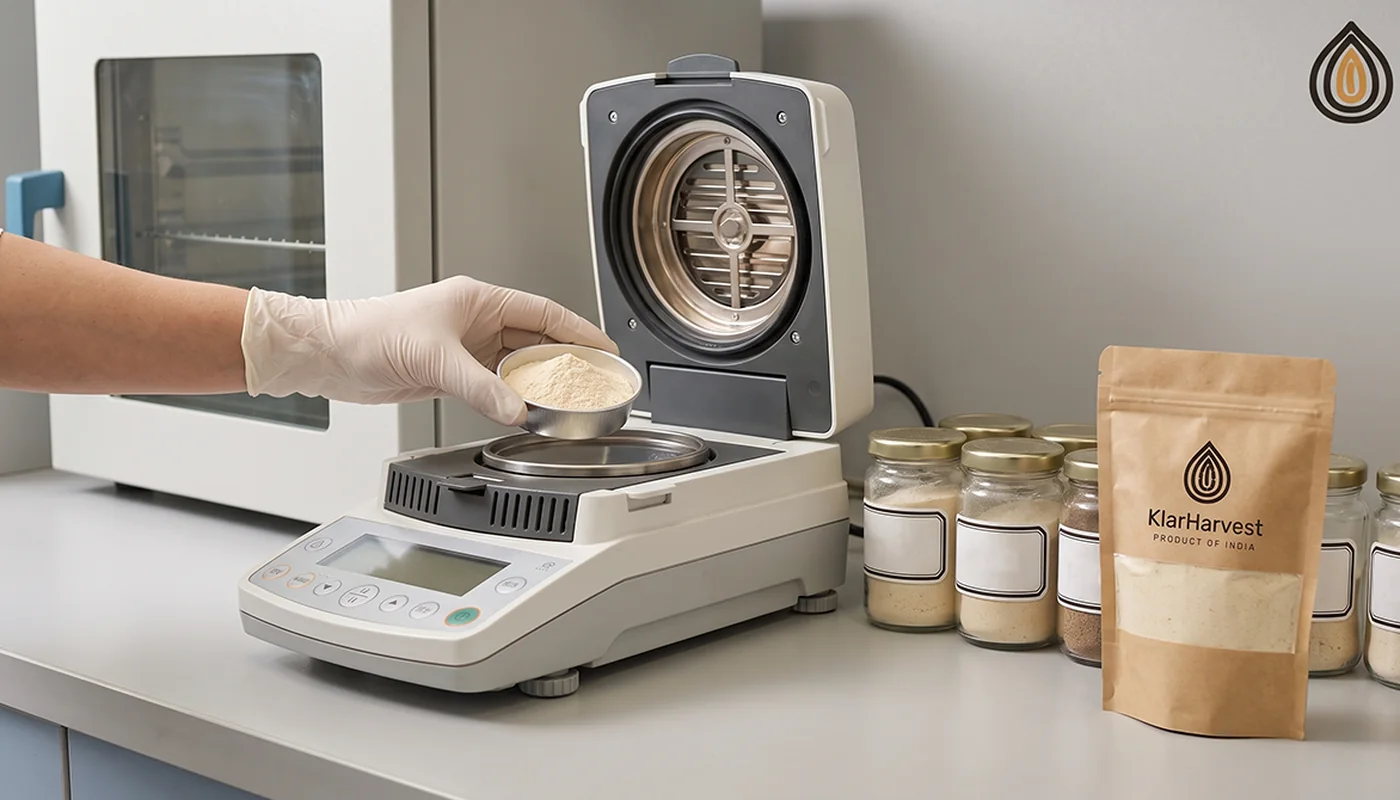
- Test with a halogen analyser that has been calibrated against the oven on onion, and if the result is within 0.5 percent of the specification limit, run the oven method too.
- Compare with the certificate of analysis. A lot certified at 5.2 percent and arriving at 5.6 has taken up a little water in transit, which is normal and within specification; one arriving at 7.5 has had a packaging or transit failure.
- Notify the supplier the same day with the lot code, the bag numbers, the method and the result, and hold the retained samples sealed.
A serious supplier will re-test its own retained sample, and if that reads within specification while yours does not, the water came in after the plant sealed the bag, which points at the packaging or the container. Either way the remedy is the same: an adjustment for the water paid for as onion, and, if the moisture is above about 7 percent, a decision about whether the lot can be used quickly or should be replaced. Writing the claim window and the arbitrating laboratory into the order makes this a procedure rather than an argument; the wording is in B2B Contract Terms for Dehydrated Onion.
Container sweat: how a dry lot gets wet on the water
The one moisture failure that has nothing to do with the plant or the warehouse happens inside the container. A steel box stuffed in Mahuva in May at 38 °C carries air that holds a lot of water; when the ship reaches the North Sea in June and the box cools to 15 °C overnight, that water condenses on the roof and walls and drips onto the top layer of pallets. The bags at the top get wet on the outside, and if a liner is not sealed or a bag is torn, the product inside takes up the water. Flakes in a torn bag under a drip can go from 5 to 12 percent in a fortnight. The signs on arrival are unmistakable: water marks on the top bags, rust streaks on the container roof, and a moisture problem confined to the top layer of one or two pallets while the rest of the lot reads normal.
Prevention is cheap. Desiccant bags hung in the container, a few kilograms of calcium chloride per box, absorb the condensation before it drips; a kraft paper or corrugated top sheet on each pallet catches what does; stuffing in the cooler morning hours reduces the air's water load; and heat-sealed liners keep the product dry even when the bag is wet. A serious exporter does all four in the monsoon months and photographs the desiccants in the loading video. A buyer who finds sweat damage on arrival photographs it before unloading further, notes which bags and which layer, and claims on the marine insurance for the damaged bags rather than on the supplier for the lot. How a container is stuffed to avoid it is in How a Dehydrated Onion Container Is Loaded.
Steam treatment and moisture: the treated grades
Low bacterial and extra low bacterial onion are made by exposing the dried product to steam for a short time and then re-drying it, and the treatment temporarily raises moisture by several percent before the second drying brings it back under the limit. Two things follow for the buyer. The treated grades are re-dried products, and their moisture on the certificate is the moisture after the second drying, which is usually 4 to 5 percent, since plants dry them a little harder to compensate for the slight darkening the steam causes. And the treated grades are more sensitive to uptake afterwards, because the steam opens the structure of the flake and the second drying leaves it more porous; a treated powder in an unsealed bag gains moisture faster than an untreated one. Specify the same 6 percent limit, or 5.5 for powder, and insist on heat-sealed liners; the treatment itself does not change the moisture specification, only the care needed after it. What the treatment does to the counts, and when a product needs it, is in Low Bacterial and Extra Low Bacterial Dehydrated Onion.
Moisture, temperature and shelf life
Shelf life declarations of 18 to 24 months assume moisture under 6 percent, a sealed liner and storage below 25 °C. The table shows how the practical life, the time before colour and aroma changes become noticeable, moves with moisture and temperature; it is indicative, from plant experience rather than a formal study, and it is the reason to buy the moisture you specify.
| Moisture at packing | Stored at 15 °C | Stored at 25 °C | Stored at 35 °C (summer container, hot warehouse) |
|---|---|---|---|
| 4.5 % | 24+ months | 18-24 months | 9-12 months |
| 5.5 % | 24 months | 15-18 months | 6-9 months |
| 6.5 % | 12-18 months | 9-12 months | 3-6 months, caking risk |
| 8 % | 6-9 months, caking | 3-6 months, mould risk | Weeks |
Powder ages faster than flakes at every point in the table. The storage side, warehouse conditions and rotation, is covered in Dehydrated Onion Shelf Life.
The specification line
The moisture line that avoids disputes has four parts: the limit, the basis, the reference method and the routine method. "Moisture: maximum 6.0 percent, wet basis; reference method oven drying at 105 °C to constant weight (ISO 1026 or equivalent); routine control by halogen moisture analyser calibrated against the reference on dehydrated onion. Certificate of analysis to state the method used." Add "maximum 5.5 percent" for powder and minced where your production environment is humid, and add a water activity line, "maximum 0.5", if your quality system prefers a method-independent safety number. The whole sheet is described in How to Read a Dehydrated Onion Specification Sheet.
How KlarHarvest reports moisture
Every KlarHarvest lot carries two moisture figures: the plant's dryer-exit and packed values from its own analyser, and the accredited laboratory's oven result on the certificate of analysis. Product is packed in heat-sealed liners at the plant and the bags are not opened again before stuffing, which is done at our own godown, so that the moisture on the certificate is the moisture in the bag. During the monsoon we ship from plants that condition their packing rooms and we specify 5 percent rather than 6 as our own internal limit for powder and minced. A retained sample of every lot is held sealed for the shelf life, so that a moisture claim can be checked against it. The lab report for each product is on its page under products, and the testing routine is on the quality page.
Frequently asked questions
What is the moisture content of dehydrated onion?
The trade maximum is 6 percent by weight, and well-dried lots leave the plant at 4.5 to 5.5 percent. Fresh onion is about 88 percent water; dehydration removes nearly all of it.
Why is 6 percent the limit?
Below about 6 percent the water activity of onion is under 0.5, where no microbes can grow, browning is slow enough for an 18 to 24 month shelf life, and powder still flows. Above it, powder cakes, colour darkens faster and, from about 8 percent, mould becomes possible.
What is the difference between moisture content and water activity?
Moisture content is how much water the product contains, as a percentage of weight. Water activity is how much of that water is available to microbes, on a scale of 0 to 1. Dehydrated onion at 5 percent moisture has a water activity of about 0.3 to 0.4; moulds need above 0.6.
How is moisture in dehydrated onion measured?
The reference method is oven drying at 105 °C to constant weight. Plants and buyers use halogen moisture analysers for routine checks in minutes; Karl Fischer titration and near-infrared instruments are used in some laboratories and plants. The methods differ by a few tenths of a percent, so the specification should name the reference.
Why did my onion powder arrive above the moisture specification?
Almost always because of water taken up after drying: a liner that was not heat-sealed, a torn bag, a container that sweated, or a humid packing room in the monsoon. Plants re-dry lots that leave the dryer wet. Test on arrival, compare with the certificate, and notify the supplier with the lot code the same day.
Does moisture affect the price?
Directly: every percent of moisture is a percent of the invoice paid for water. On a 10 tonne container, 2 percent extra moisture is 200 kilograms of water at the price of onion. Claims are settled on that arithmetic.
Can I dry onion that arrived too wet?
Flakes and chopped can be re-dried at low temperature in a food dryer if the moisture is below about 8 percent and there is no mould; powder generally cannot be recovered once it has caked. A lot above 8 percent is a rejection or a fast-use decision, not a repair.
Next step
Request a sample of any cut and it comes with the lot's certificate of analysis showing the oven moisture, and with the plant's packed moisture on request, so that you can run your own analyser against a known value before the first order. For a specification with a tighter moisture line, request a quote and state the limit; powder and minced at 5.5 percent are quoted as standard.