- How the cuts are made and why size is the only difference
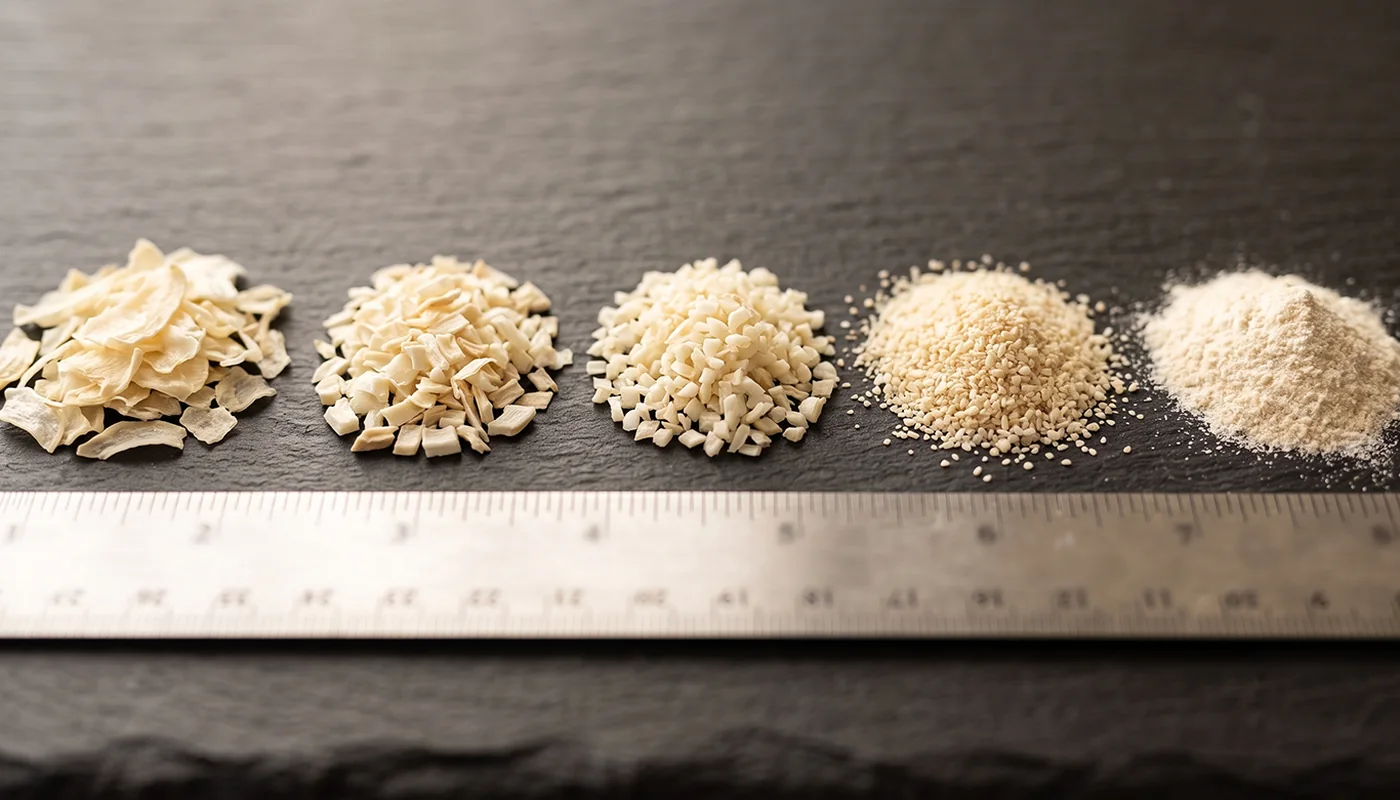
- The five size bands: millimetres, mesh and what is in the bag
- Flakes (kibbled): 8-20 mm
- Chopped: 3-5 mm
- Minced: 1-3 mm
- Granules: 0.5-1 mm
- Powder: 80-100 mesh
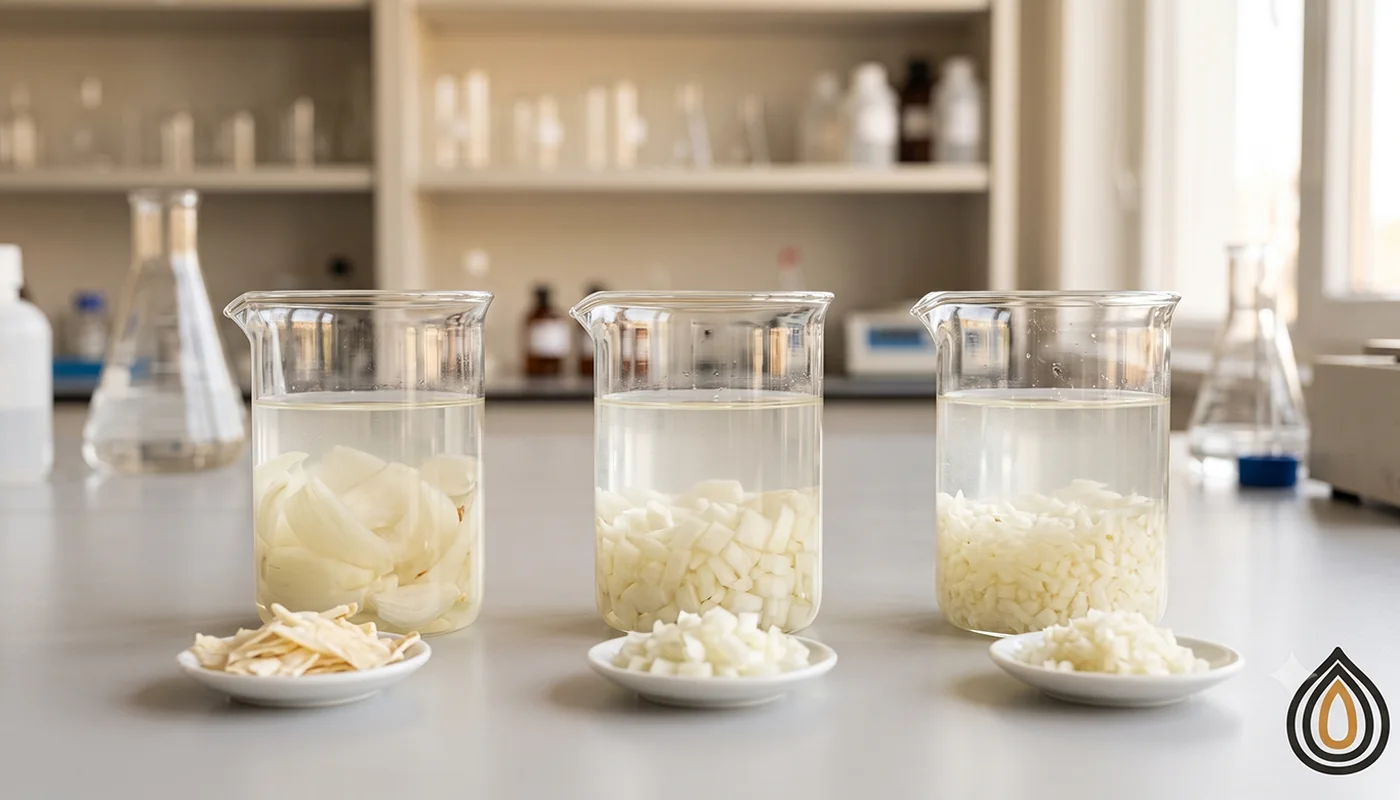
- Rehydration: ratios, times and temperatures by cut
- Choosing a cut by application: a decision table
- Price, yield and container load by cut
- Red onion in each cut: what changes
- Custom bands and two-cut products
- Incoming checks by cut
- Storage and handling by cut
- Specifying a cut so the supplier cannot misread it
- How KlarHarvest supplies the five cuts
- Frequently asked questions
Judge the product, not the words
200-500 g from a current lot, dispatched by courier with the lot lab report.
Request a sampleThe five dehydrated onion cuts sold by every Indian plant are flakes, chopped, minced, granules and powder, and the difference between them is particle size and nothing else. Same onion, same drying, same moisture; the cut is decided after drying by breaking, sieving and milling. That sounds like a small choice. On a production line it is the choice that decides whether onion is visible in the finished product, how long it takes to rehydrate, whether a dry blend flows or cakes, and how much water a sauce recipe has to allow for.
This guide is for product developers and buyers who have to specify one cut, or two, for a specific application. It gives the size bands in millimetres and mesh, the rehydration behaviour of each cut with times and ratios, the applications where each one is the usual choice, the price differences, and the specification wording that stops a supplier shipping the wrong thing. Where a cut has a trade name that confuses people, such as kibbled or roasted, it says what the name means.
The numbers are for white onion from Mahuva, Gujarat, dried to below 6 percent moisture. Red onion is cut the same way and behaves the same way, with a colour and flavour difference covered separately.
What this guide covers
- How the cuts are made and why size is the only difference
- The five size bands: millimetres, mesh and what is in the bag
- Flakes (kibbled): 8-20 mm
- Chopped: 3-5 mm
- Minced: 1-3 mm
- Granules: 0.5-1 mm
- Powder: 80-100 mesh
- Rehydration: ratios, times and temperatures by cut
- Choosing a cut by application: a decision table
- Price, yield and container load by cut
- Red onion in each cut: what changes
- Custom bands and two-cut products
- Incoming checks by cut
- Storage and handling by cut
- Specifying a cut so the supplier cannot misread it
- How KlarHarvest supplies the five cuts
- Frequently asked questions
How the cuts are made and why size is the only difference
At the plant, peeled onions are sliced into rings of 3 to 5 millimetres and dried on belts with hot air until the slices are brittle at about 5 percent moisture. The dried slices, called kibble in the trade, are the raw material for every cut. Flakes are the largest fragments of those slices after gentle breaking and sieving. Everything smaller is sieved into chopped and minced fractions, and the finest material plus a share of deliberately milled kibble becomes granules and powder. A plant therefore produces all five cuts from one drying run, and the proportions are set by demand: when Europe wants flakes, more kibble is kept whole; when the snack industry wants granules, more is milled.
Two consequences follow. The flavour, colour and microbiology of the five cuts from one lot are the same, because they came from the same slices; a certificate of analysis for the kibble applies to all of them, except for particle size. And the cuts differ in bulk density, which is why a 20 foot container holds about 10 tonnes of flakes but 18 to 20 tonnes of powder, and why freight per kilogram of flakes is nearly double.
The only cut made differently is toasted or roasted onion, which is standard cut onion heated further until it browns. It is a separate product with its own flavour, described in Toasted Onion vs Natural Dehydrated Onion.
The five size bands: millimetres, mesh and what is in the bag
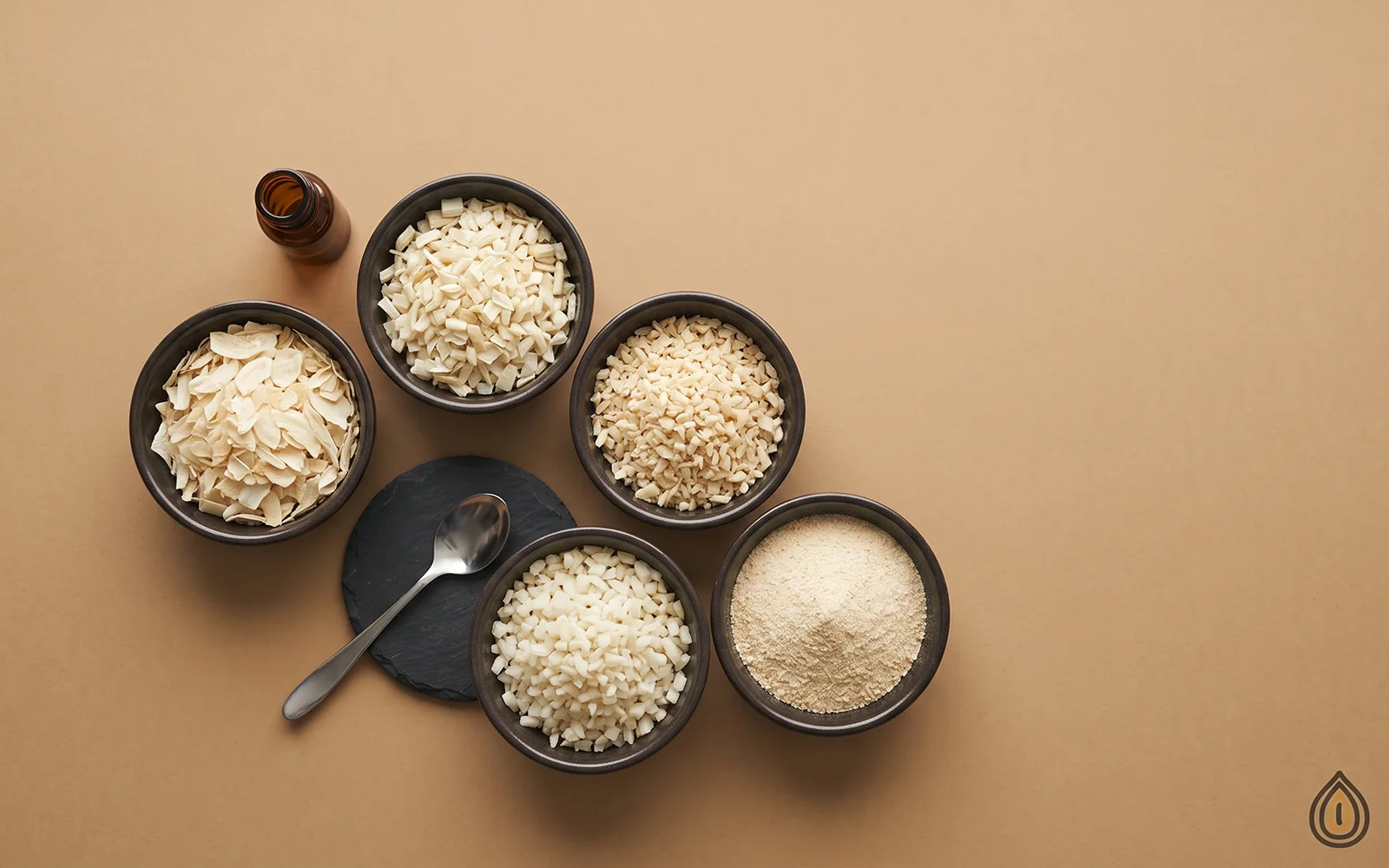
Size bands are expressed in millimetres for the coarse cuts and in mesh for the fine ones. Mesh is the number of openings per inch in the sieve: 16 mesh is about 1.2 millimetres, 40 mesh about 0.42 millimetres, 100 mesh about 0.15 millimetres. The bands used by most Indian plants and European buyers are:
| Cut | Band (mm) | Band (mesh) | Typical share inside the band | Bulk density (g/l) |
|---|---|---|---|---|
| Flakes / kibbled | 8-20 | - | 90 % min, fines below 3 mm max 5 % | 180-230 |
| Chopped | 3-5 | 4-6 | 90 % min | 280-350 |
| Minced | 1-3 | 8-16 | 90 % min | 350-450 |
| Granules | 0.5-1 | 16-40 (also 26-40, 40-60 on request) | 90 % min | 450-550 |
| Powder | below 0.18 | 80-100 | 95 % passing 80 mesh | 500-650 |
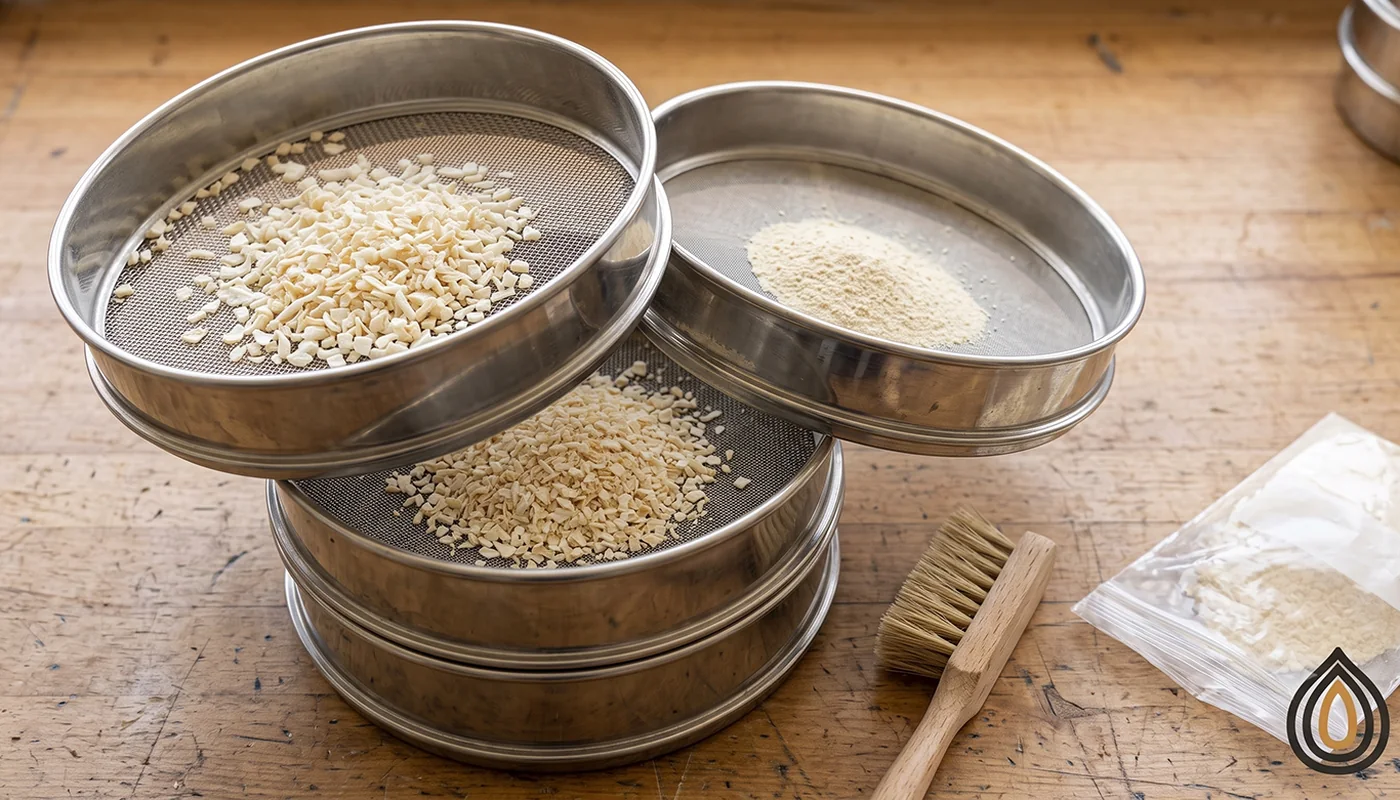
No bag is 100 percent inside its band. Breakage in transit creates fines in flakes; sieving is never perfect in granules. The specification therefore states a minimum share inside the band and a maximum share of fines, and a sieve analysis on the certificate of analysis shows the actual distribution. The bands can be customised: some buyers want 5-8 millimetre flakes for a specific topping, some want 40-60 mesh granules for a coating. Plants can make them, at a small premium and a slightly longer lead time, because the sieve stack has to be changed.
Flakes (kibbled): 8-20 mm
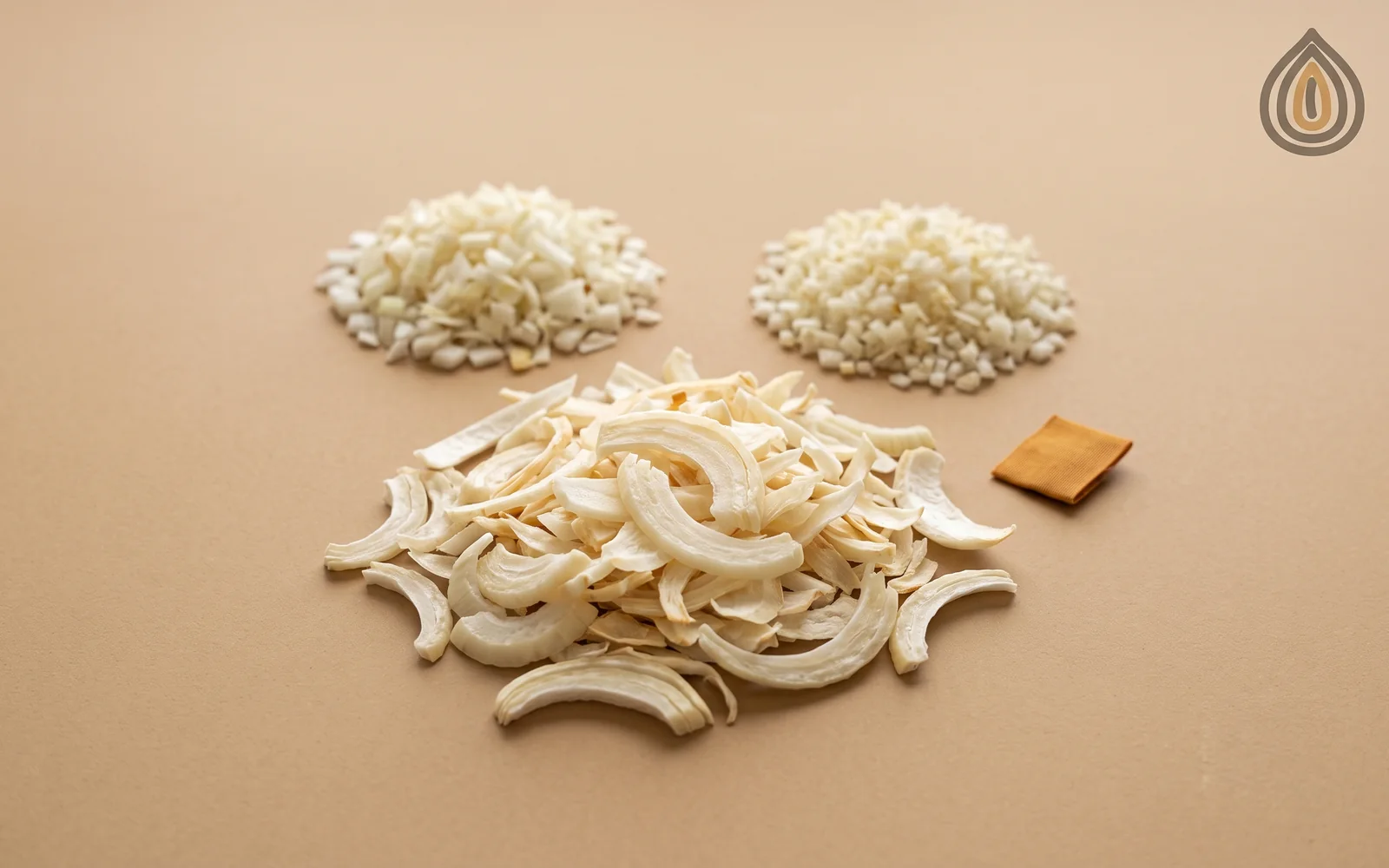
Flakes are the largest cut and the one that looks most like onion after rehydration: a flake of 12 millimetres plumps back into a recognisable piece of onion. They are the standard for products where onion should be seen: cream of onion soup, pizza and bread toppings, pickled vegetables, stuffing mixes, retail jars. Kibbled onion is the British name for the same product, sometimes for a slightly smaller 5-10 millimetre band, so the safe practice is to write the band in millimetres and not the name.
Rehydration takes 15 to 20 minutes in water at room temperature and 8 to 10 minutes in hot water, and one part of flakes takes up about three parts of water, giving roughly 4 kilograms of rehydrated onion per kilogram of dry flakes. In a soup that simmers for 20 minutes, flakes can be added dry. In a cold application they must be soaked first. The main quality issues are fines from breakage and colour differences between lots, both visible on the line, which is why flake buyers care about a colour reference sample more than powder buyers do. The specification and lab values are on the white onion flakes page; red onion flakes are on the red flakes page.
Chopped: 3-5 mm
Chopped onion is the cut for products where onion should be visible but small: sauces, gravies, ready meals, rice and pasta mixes, stuffings, meat marinades. It rehydrates in 10 to 15 minutes cold and 5 to 8 minutes hot and takes up about the same three parts of water. In a sauce cooked for 15 minutes it can be added dry and will finish rehydrating in the sauce; recipe developers usually add 2.5 to 3 parts of extra water per part of dry onion so that the sauce does not thicken unexpectedly.
Chopped is the most forgiving cut to specify because the 3-5 millimetre band is narrow and easy to sieve; the usual quality question is the share of pieces above 5 millimetres, which come from under-broken kibble, and below 3, which are minced. The chopped onion page carries the specification.
Minced: 1-3 mm
Minced onion sits between visible and invisible. Pieces of 2 millimetres rehydrate in 5 to 10 minutes and disappear into a meat emulsion, a dip or a dressing while still giving small points of texture, which is why minced is the standard cut for sausages, burgers, meatballs and kebabs, for dips and dressings, and for seasonings that should have some body. It is also the cut most often used dry as a topping on crackers and bread, where it browns attractively in the oven.
Because the particles are small, minced carries more dust than the coarser cuts and is more sensitive to humidity; a bag left open in a warm production room will cake within days. Minced onion in meat products is the subject of Dehydrated Onion in Meat Products; the product specification is on the minced onion page.
Granules: 0.5-1 mm
Granules are the cut of the dry-blend industry. At 16 to 40 mesh they flow like coarse sand, do not cake as readily as powder, disperse evenly in a seasoning drum, and rehydrate in 3 to 5 minutes or simply dissolve into a sauce. Snack seasonings, spice blends, rubs, instant noodle sachets, soup powders and coating mixes use granules where a powder would cake or dust, and where a minced cut would be visible as specks. A 26-40 or 40-60 mesh granule is specified where the blend is finer.
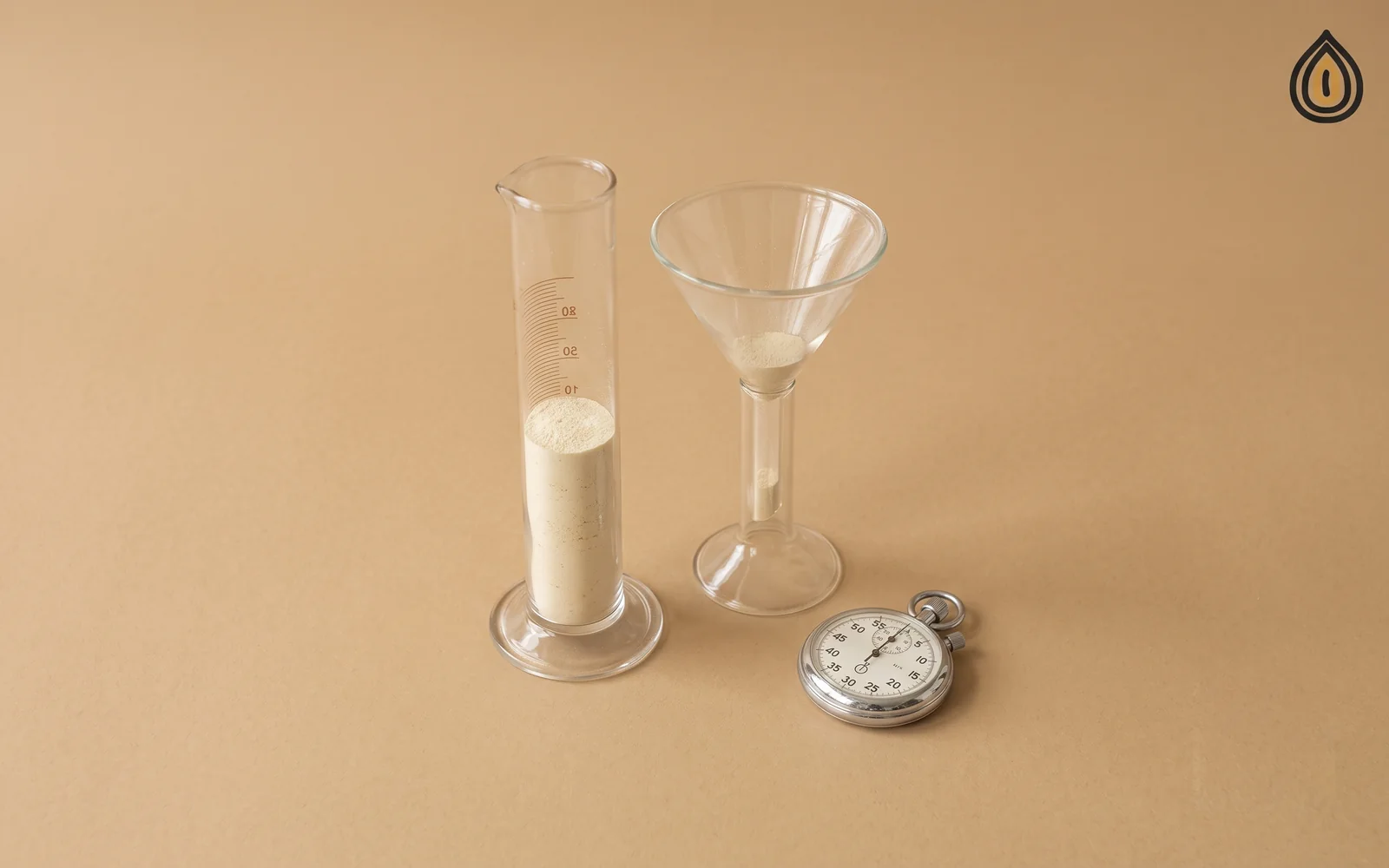
The quality parameters that matter for granules are flowability and bulk density, because they are dosed by volume on many lines, and fines below 40 mesh, which behave like powder. Ask for a sieve analysis with at least three fractions on the certificate of analysis. Application rates and blending behaviour are in Dehydrated Onion in Snack Seasoning; the specification is on the granules page.
Powder: 80-100 mesh
Onion powder is milled kibble at 80 to 100 mesh, about 0.15 millimetres, and it is the cut with the most flavour per gram at the point of use because the flavour compounds are fully exposed. It disperses instantly in liquids, needs no rehydration step, and is dosed at 0.5 to 2 percent in sauces, soups, dressings, coatings and extruded snacks. It is also the cut with the highest handling risk: powder absorbs moisture fastest, cakes hardest, and dusts on the line. Plants offer powder with an anti-caking agent such as silicon dioxide at up to 1 percent for buyers whose lines need free flow; the standard export product is without.
Colour is the other powder-specific concern. Because powder is milled from the whole kibble, including any browned edges, it is slightly darker than flakes from the same lot, and lots that were over-dried show it as a beige rather than cream powder. Specify the colour against a reference and check it on every delivery. Bulk density and caking behaviour are covered in Bulk Density and Flowability of Onion Powder and Granules; the product is on the onion powder page.
Rehydration: ratios, times and temperatures by cut
Every cut returns to about the same weight of rehydrated onion, roughly four times its dry weight, because the water lost in drying was the same. What differs is how fast the water goes back in. The figures below are for still water; agitation and salt-free water speed it up, and sugar or salt in the liquid slow it down.
| Cut | Water : onion by weight | Cold water (20 °C) | Hot water (80 °C) | Can be added dry to a cooked product? |
|---|---|---|---|---|
| Flakes | 3 : 1 | 15-20 min | 8-10 min | Yes, if it cooks 20 min or more |
| Chopped | 3 : 1 | 10-15 min | 5-8 min | Yes, if it cooks 15 min or more |
| Minced | 2.5-3 : 1 | 5-10 min | 3-5 min | Yes, in most processes |
| Granules | 2.5 : 1 | 3-5 min | 2-3 min | Yes; usually used dry in blends |
| Powder | disperses | instant | instant | Yes; used dry |
A worked example for a sauce recipe. A tomato sauce calls for 100 grams of fresh onion per kilogram. Fresh onion is about 88 percent water, so 100 grams of fresh onion is 12 grams of onion dry matter, which is close to 13 grams of dehydrated onion at 5 percent moisture. Replace the 100 grams of fresh onion with 13 grams of chopped dehydrated onion and add 87 grams of water to keep the recipe's water balance. If the sauce cooks for 15 minutes, the chopped onion can go in dry with the water. The full method with more examples is in Rehydrating Dehydrated Onion.
Choosing a cut by application: a decision table
Start with two questions. Should onion be visible in the finished product? And is there a wet step of at least five minutes before the product is finished? The table gives the usual answer for common applications; it is a starting point, and a sample trial in your own process settles the choice.
| Application | Usual cut | Alternative | Why |
|---|---|---|---|
| Cream and clear soups (cooked 20 min or more) | Flakes | Chopped | Visible pieces, long cook rehydrates them fully |
| Instant soups and noodle sachets | Minced or granules | Chopped (small) | Must rehydrate in 3-5 min in hot water |
| Sauces, gravies, ketchup, dressings | Chopped or minced | Powder | Powder where the sauce must be smooth |
| Sausages, burgers, meatballs | Minced | Chopped | Rehydrates in the emulsion, stays as small pieces |
| Snack seasonings, coatings | Granules or powder | - | Flow and even coverage; powder for smooth coatings |
| Spice blends, rubs | Granules | Powder | Granules resist caking with salt |
| Bread, cracker and pizza toppings | Minced or flakes | Chopped | Browns in the oven, stays visible |
| Pickles, relishes, chutneys | Flakes or chopped | - | Visible onion, rehydrates in the brine |
| Ready meals, frozen foods | Chopped | Minced | Rehydrates in the sauce during cooking or reheating |
| Plant-based meat alternatives | Minced or granules | Powder | Texture without visible large pieces |
| Dips, cheese and dairy products (no kill step) | Minced or powder, low bacterial grade | - | Microbiology tier matters more than the cut |
Price, yield and container load by cut
Because all five cuts come from the same kibble, their ex-plant prices are close. Powder and granules cost a little more than flakes per kilogram: milling adds energy and labour, and milling losses are higher. Flakes cost more to ship per kilogram because they are light for their volume. The net effect is that the landed cost per kilogram in Europe is similar across cuts, with flakes and powder usually within 10 percent of each other.
| Cut | Indicative FOB premium over flakes | 20 ft container load | Sea freight per kg at 1,500 EUR per box |
|---|---|---|---|
| Flakes | base | ~10 t | 0.15 EUR |
| Chopped | 0 to +2 % | ~13 t | 0.12 EUR |
| Minced | +1 to +3 % | ~15 t | 0.10 EUR |
| Granules | +2 to +5 % | ~17 t | 0.09 EUR |
| Powder | +3 to +6 % | ~18-20 t | 0.08 EUR |
The premiums are indicative for January 2026 and move with demand: in a year when the snack industry buys heavily, granules and powder carry a larger premium; in a year when Europe wants flakes for retail, flakes do. What does not change is that the raw onion price sets the level for all five together, described in Dehydrated Onion Price per kg. A buyer who needs two cuts should ask for both in one quote and one shipment; mixing cuts on a pallet or in a container is routine and does not cost extra.
Red onion in each cut: what changes
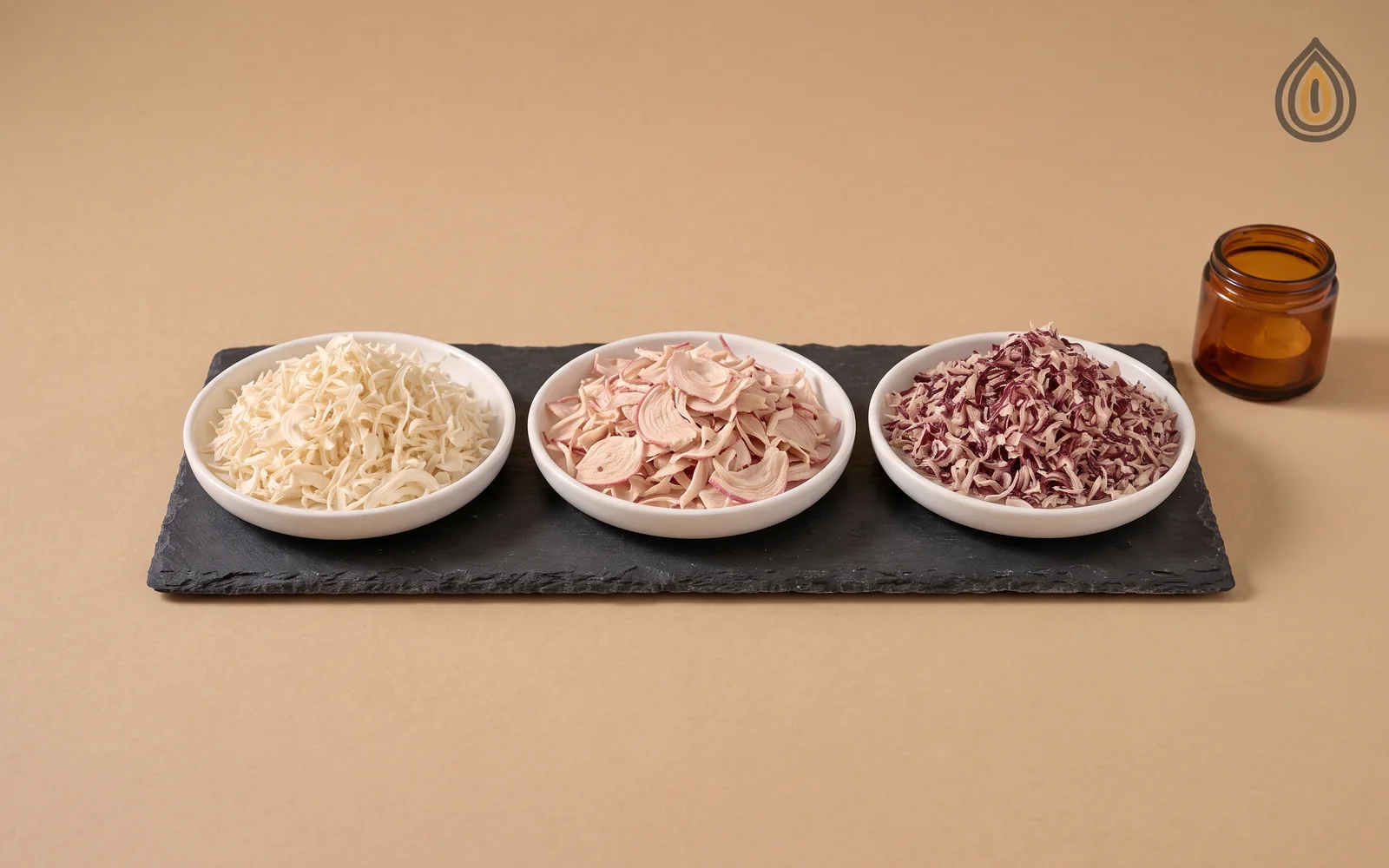
Red onion is cut into the same five bands and behaves the same way in water, but two things change. The colour is carried mostly by the outer layers of the bulb, so in flakes and chopped the reddish-purple skin fragments are clearly visible against cream flesh, while in granules and powder the colour blends into a pinkish beige. A developer who wants red onion for its appearance should choose flakes, chopped or minced; one who wants its stronger, slightly sweet flavour in a smooth product can use powder and accept that the colour is muted. The flavour difference is real: red onion has more pungency, and in a seasoning blend a dose of red granules can be 10 to 20 percent lower than white for the same onion impact.
The second change is price and availability. Red onion is processed in smaller runs, its raw material costs more in the dehydration months, and plants keep less of it in stock in the off-season, so lead times for a specific red cut can be a week or two longer between July and February. Pink onion, a regional variety between the two, is cut to order in the same bands. The comparison of the three colours across flavour, colour stability and price is in White vs Red Dehydrated Onion.
Custom bands and two-cut products
The five standard bands cover most uses, and staying inside them keeps price and lead time standard. Where a product needs something else, plants can sieve to order: 5-8 millimetre flakes for a topping that must not look coarse, 2-4 millimetres for a mince that reads as chopped, 26-40 or 40-60 mesh granules for a finer blend, or 60-80 mesh for a powder that must not dust. A custom band costs a small premium, because the sieve stack is changed for the run and the fractions outside the band have to be sold as something else, and it adds a few days of lead time. It is worth specifying when a line has been tuned to a particle size; it is not worth specifying because a datasheet from another supplier happened to say 5-10 millimetres.
Some products use two cuts in one recipe on purpose: flakes for visible pieces and powder for background flavour in a soup, or granules for the seasoning drum and minced for the visible topping on a snack. Buying the two cuts from the same lot keeps the flavour identical between them, which matters when a product is tasted side by side across batches. Ask the supplier whether the two cuts can be drawn from one lot; in season it is easy, in the off-season it depends on stock.
Incoming checks by cut
An incoming inspection takes ten minutes per lot if it is organised by cut, because each cut fails in its own way. For flakes and chopped, spread 100 grams on a white tray and look for three things: fines, which show as dust at the bottom of the bag and should be within the specified share; colour, compared with the retained sample under daylight, since browning is the first sign of over-drying or old stock; and foreign matter, dark specks or skin fragments beyond the specified maximum. For minced and granules, pour a sample through a household sieve of the band's lower limit and weigh what passes; more than 5 to 10 percent passing means the lot is finer than specified and will behave differently in the blend. For powder, check colour against the reference, press a handful and see whether it holds a shape (a sign of moisture above specification), and run a sample through the line's dosing unit if flow matters.
A moisture test is worth doing on every lot, whatever the cut, because moisture is the parameter most often over specification and the one with the largest commercial effect. A laboratory oven at 105 °C for a few hours is the reference method; a halogen moisture analyser gives a result in ten minutes and is close enough for incoming control if it has been calibrated against the oven on your own product. Keep the retained sample and the certificate of analysis together; they are the basis of any claim. The full list of quality defects and their causes is in Common Quality Defects in Dehydrated Onion.
Storage and handling by cut
All cuts are stored the same way: sealed bags, below 25 °C, below 60 percent relative humidity, away from light and strong odours, on pallets off the floor. What differs is how quickly each cut is damaged when those conditions are not met. Flakes tolerate a warm week in a loading bay; powder does not. In a production room, an opened bag of flakes can stand for a shift; an opened bag of powder or minced should be closed after each use or decanted into a lidded bin with a scoop. Where a line runs powder continuously in a humid environment, the choice is between an anti-caking agent in the product and a dehumidified store for the open bags; most plants offer the former, and many European buyers prefer the latter because it keeps the ingredient declaration clean.
Rotation matters more than most buyers expect. A lot from the April crop, bought in June and used by December, is at its best. The same lot used the following summer is still within shelf life but has lost aroma, and a powder will have darkened a shade. First in, first out by lot code is the simplest rule, and the lot code on every bag makes it easy. The conditions and a warehouse checklist are in Dehydrated Onion Shelf Life.
Specifying a cut so the supplier cannot misread it
Most disputes about cut come from a specification that named the cut but not the band. The wording that avoids them is short:
- Cut and band: "White onion flakes, 8-20 mm, minimum 90 percent retained between 8 mm and 20 mm sieves, fines below 3 mm maximum 5 percent."
- For granules: "White onion granules 16-40 mesh, minimum 90 percent between 16 and 40 mesh, maximum 5 percent passing 40 mesh."
- For powder: "White onion powder, minimum 95 percent passing 80 mesh, no anti-caking agent" or "with silicon dioxide maximum 1 percent" if you want it.
- Sieve analysis on every certificate of analysis, with the sieve sizes you named.
- A retained reference sample from the approved lot, held by both sides, as the colour and size reference.
Add the moisture limit, the microbiology tier and the colour, and the cut specification is complete. The full one-page specification is described in How to Read a Dehydrated Onion Specification Sheet.
How KlarHarvest supplies the five cuts
KlarHarvest supplies all five cuts in white and red onion from BRC-certified plants in Mahuva, and pink onion on request. Every product page carries the size band, the specification and an example lab report, and the same lot is available in several cuts when a buyer needs, for example, flakes for one product and powder for another from matching raw material. Sample sets of two adjacent cuts are the usual first step, so that a developer can run the trial in the process instead of choosing from a table. Mixed pallets and mixed containers are packed at our godown from sealed plant bags, each cut with its own lot code and certificate of analysis. The range is on the products page.
Frequently asked questions
What is the difference between onion flakes and kibbled onion?
In most markets they are the same product, dehydrated onion in the 8 to 20 millimetre range. Some suppliers use kibbled for a smaller 5 to 10 millimetre cut. Always specify the band in millimetres rather than relying on the name.
Which dehydrated onion cut is closest to fresh chopped onion?
Chopped, 3 to 5 millimetres, after rehydration in three parts water for 10 to 15 minutes. Flakes rehydrate into larger pieces closer to sliced onion; minced gives a finer result closer to grated onion.
Can onion powder replace fresh onion in a recipe?
Yes for flavour, not for texture. About 13 grams of powder at 5 percent moisture carries the dry matter of 100 grams of fresh onion; add about 87 grams of water to keep the recipe balance. Powder gives no visible pieces and a slightly more cooked flavour.
Why does onion powder cake, and how do I prevent it?
Powder has a large surface area and absorbs moisture from the air. Keep bags sealed until use, store below 25 °C and below 60 percent relative humidity, and use opened bags within days. An anti-caking agent such as silicon dioxide at up to 1 percent is available where a line needs free flow over long periods.
Do the cuts have different shelf lives?
All cuts are declared at 18 to 24 months in sealed bags. In practice flakes keep colour and aroma longest and powder shortest, because of surface area. Storage conditions matter more than the cut.
Can I order several cuts in one shipment?
Yes. Mixed pallets and mixed containers with several cuts and colours are routine, each cut with its own lot code and certificate of analysis, and there is no surcharge for mixing.
Are granules and powder more expensive than flakes?
Slightly, at the plant, because of milling; but they ship at a lower freight cost per kilogram because they are denser. Landed in Europe the five cuts are usually within 10 percent of each other.
Next step
If you are between two cuts, do not decide from a table. Request a sample of both, with the application described in a sentence, and we send them from a current lot with the sieve analysis and lab report. If the cut is already decided, request a quote with your band and tier and the priced specification is back within one business day.