- What bulk density is, and why loose and tapped differ
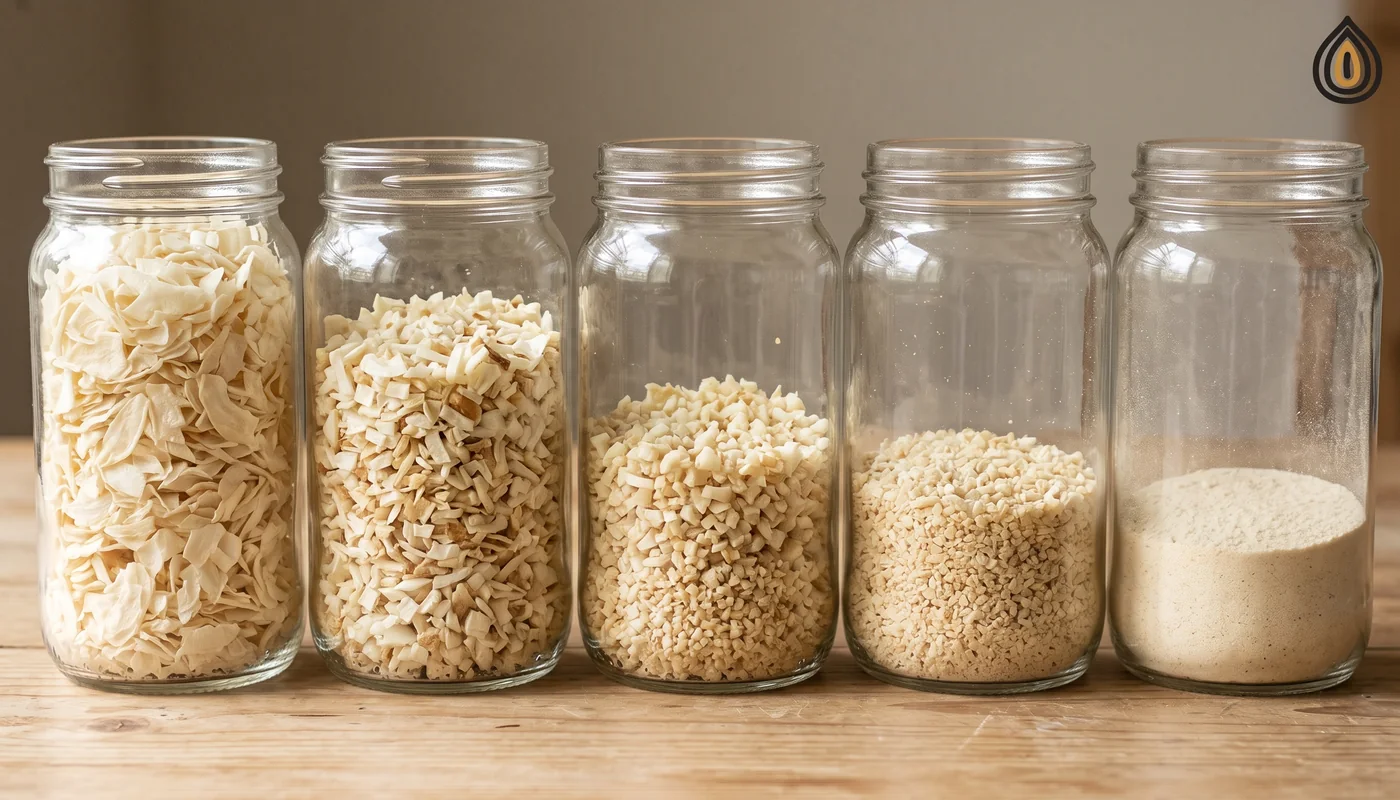
- Bulk density by cut
- What sets the density of a lot
- Measuring bulk density on a bench
- Flowability: what it is and how to measure it
- Why onion powder cakes and bridges
- Moisture, temperature and time
- Anti-caking agents and clean-label alternatives
- Hopper, feeder and conveyor design for onion
- Dosing on volumetric lines
- Particle size and shape effects
- Granules as the alternative to powder
- Handling rules in the blending plant
- Specification lines for flow and density
- A worked example: a filler out of tolerance
- How KlarHarvest reports density and flow
- Frequently asked questions
Judge the product, not the words
200-500 g from a current lot, dispatched by courier with the lot lab report.
Request a sampleOnion powder bulk density and flowability are the two properties a production line cares about more than flavour, because a powder that arrives at the wrong density throws a volumetric filler out of tolerance and a powder that will not flow stops the line altogether. Onion is among the worst-flowing materials in a spice store: it is hygroscopic, so it takes up moisture from the air and from its neighbours; it is 30 to 40 percent sugar, so the moisture it takes up dissolves the surface into a syrup that glues particles together; it is milled fine, so it has a large surface for both; and it carries a static charge that makes it cling to steel and to itself. A blender that understands why it behaves that way can specify it, store it and handle it so that it runs, and this guide is the explanation.
It covers what bulk density is and why loose and tapped values differ, the values for each cut and what sets them, how to measure density and flow with simple equipment, the physics of caking and bridging in onion, how moisture, temperature and time change flow, the anti-caking agents and the clean-label alternatives, hopper and feeder design for onion powder, the dosing consequences on volumetric lines, the particle-size and shape effects, and the specification lines that a blender should write. Values are for Mahuva product in 2026.
What this guide covers
- What bulk density is, and why loose and tapped differ
- Bulk density by cut
- What sets the density of a lot
- Measuring bulk density on a bench
- Flowability: what it is and how to measure it
- Why onion powder cakes and bridges
- Moisture, temperature and time
- Anti-caking agents and clean-label alternatives
- Hopper, feeder and conveyor design for onion
- Dosing on volumetric lines
- Particle size and shape effects
- Granules as the alternative to powder
- Handling rules in the blending plant
- Specification lines for flow and density
- A worked example: a filler out of tolerance
- How KlarHarvest reports density and flow
- Frequently asked questions
What bulk density is, and why loose and tapped differ
Bulk density is the mass of a powder divided by the volume it occupies including the air between its particles, in grams per litre or kilograms per cubic metre, and it is not a property of the material alone but of the material and its packing. Poured gently into a container, a powder settles with a lot of air and reads its loose or aerated density; tapped or vibrated, the particles rearrange, the air leaves and the same mass occupies less volume, reading its tapped density; compressed under load in a silo or at the bottom of a pallet it packs tighter still. For onion powder the loose density is 500 to 650 grams per litre and the tapped 600 to 750, a difference of 15 to 20 percent, and the ratio of the two, the Hausner ratio, is itself a measure of flow: a free-flowing powder packs little more when tapped, a cohesive one packs much more, and onion powder's Hausner ratio of 1.2 to 1.35 puts it in the "fair to poor flow" range on the scale the pharmaceutical industry uses. Any density figure on a specification must say which it is; a specification that says "bulk density 600" without the word loose or tapped is a number that both sides can read as they wish.
Bulk density by cut
| Cut | Loose bulk density (g/l) | Tapped (g/l) | Hausner ratio | Flow character |
|---|---|---|---|---|
| Flakes 8-20 mm | 180-230 | 210-270 | 1.15-1.2 | Free-flowing but interlocking; bridges in narrow outlets |
| Chopped 3-5 mm | 280-350 | 320-400 | 1.15 | Free-flowing |
| Minced 1-3 mm | 350-450 | 400-500 | 1.15 | Free-flowing |
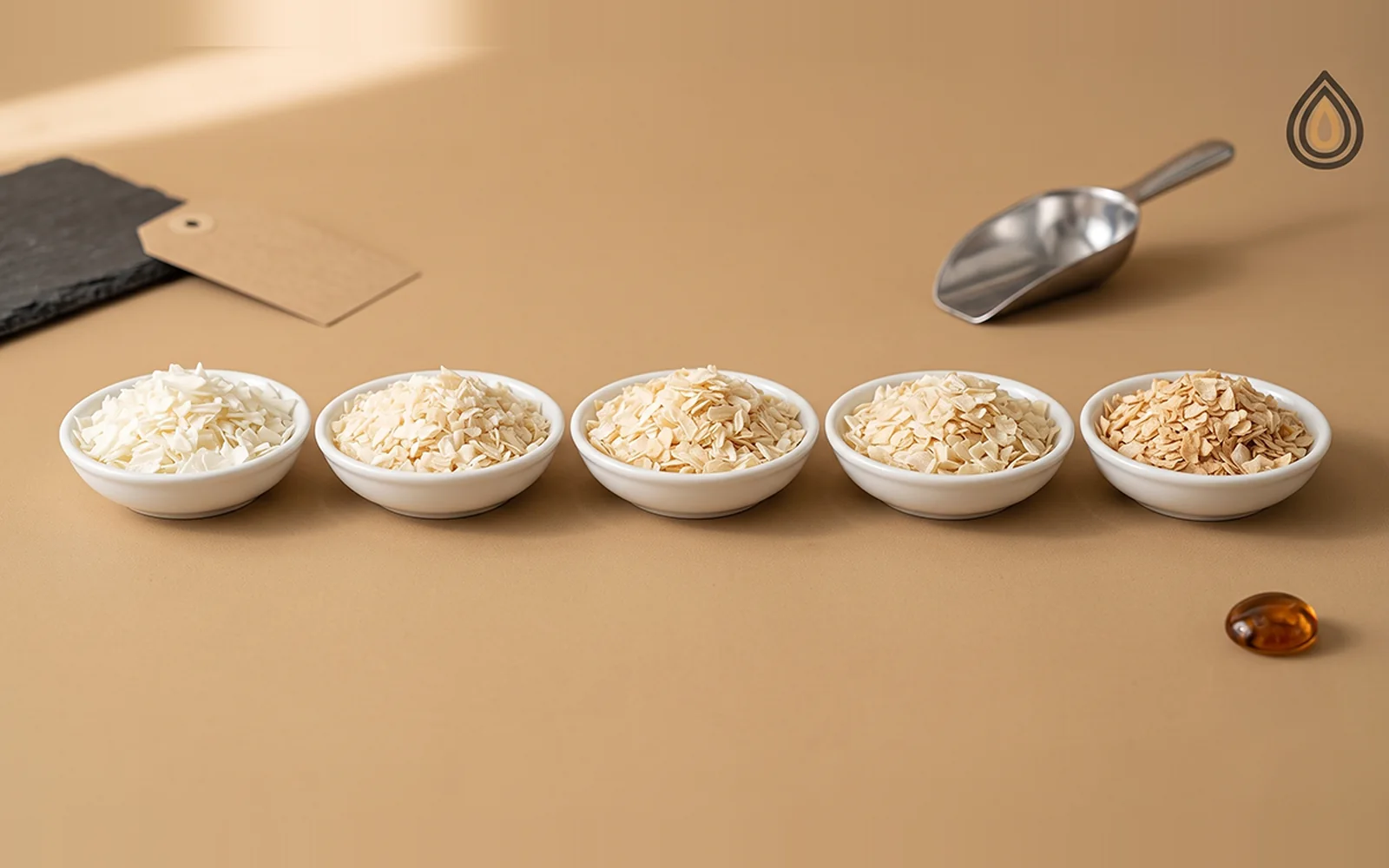
| Granules 16-40 mesh | 450-550 | 500-620 | 1.1-1.2 | Good flow; the best-handling cut |
| Granules 40-60 mesh | 500-580 | 580-660 | 1.15-1.25 | Good to fair |
| Powder 80 mesh | 500-650 | 600-750 | 1.2-1.35 | Fair to poor; cakes |
| Powder 100 mesh | 520-660 | 620-780 | 1.25-1.4 | Poor; cakes and bridges |
| Toasted onion powder | 480-600 | 560-700 | 1.2-1.3 | Fair; slightly better than natural |
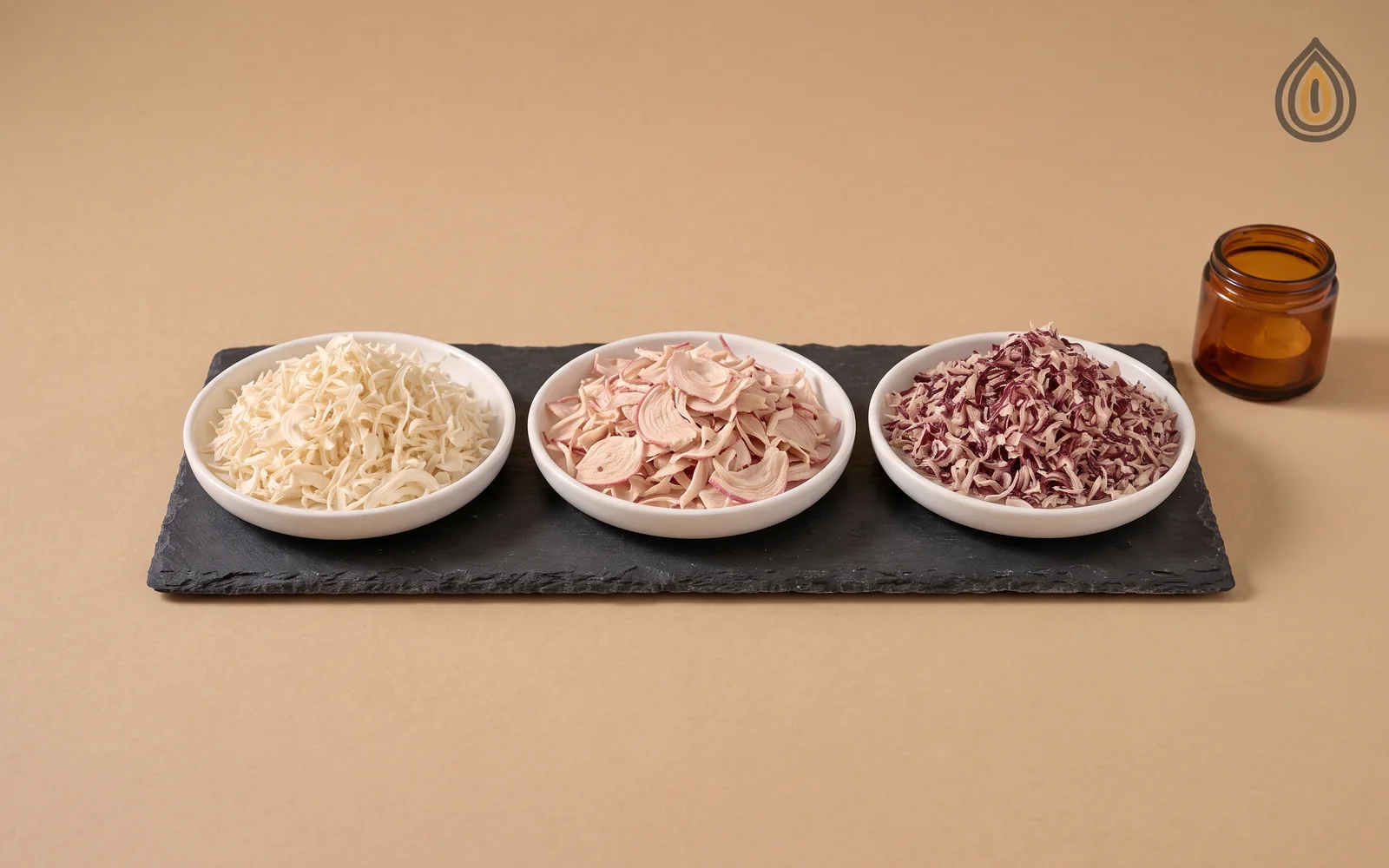
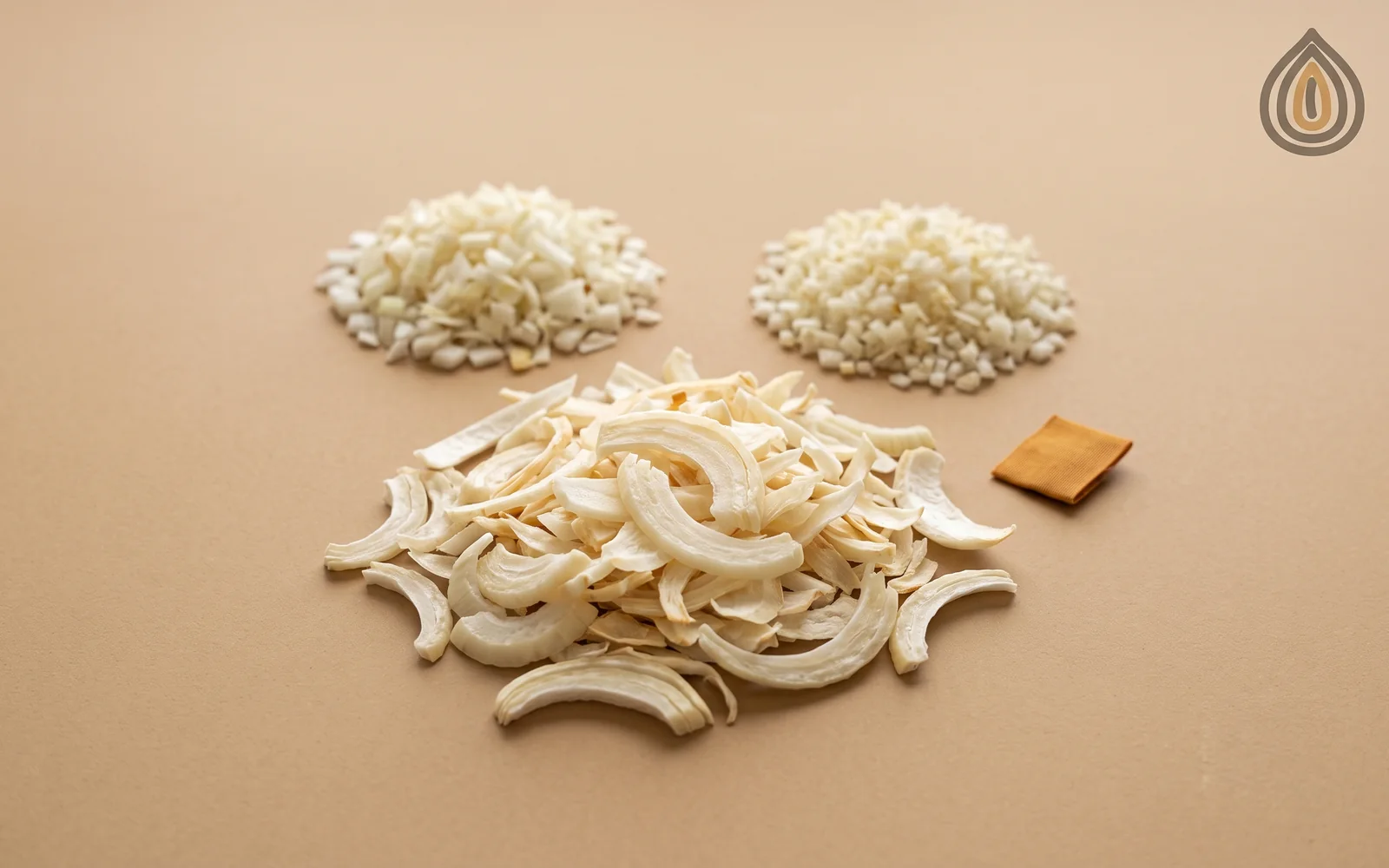
The pattern is that density rises and flow worsens as the cut gets finer, until the granule bands, which are the sweet spot: dense enough to dose well and coarse enough to flow. Flakes are the odd case, light and free-flowing but prone to interlock in a narrow outlet, like leaves in a gutter. The cuts as products are in Flakes, Chopped, Minced, Granules or Powder, and the bands in Mesh Size in Dehydrated Onion.
What sets the density of a lot
Within a cut, four things move the density from one lot to another. Particle size distribution: a lot at the fine end of its band, or with more fines, packs denser because small particles fill the gaps between large ones; a 16-40 mesh granule with 8 percent fines reads 30 grams per litre denser than one with 3. Particle shape: hammer-milled granules are chips, longer than thick, and pack looser than the near-equant particles from a pin mill; two lots at the same sieve analysis from different mills can differ by 10 percent in density. Moisture: a lot at 6 percent moisture is a little denser than one at 4 because the particles are heavier and slightly plastic, and it packs more under tapping. Tissue density: high-solids onion dried gently makes a dense, glassy particle; low-solids onion or product puffed by fast drying makes a lighter one, so a lot's origin and season show in its density. A plant that controls all four makes lots of consistent density, and a buyer that specifies a density range with the sieve band is asking the plant to do so. The mill and shape question is discussed in the mesh-size guide linked above.
Measuring bulk density on a bench
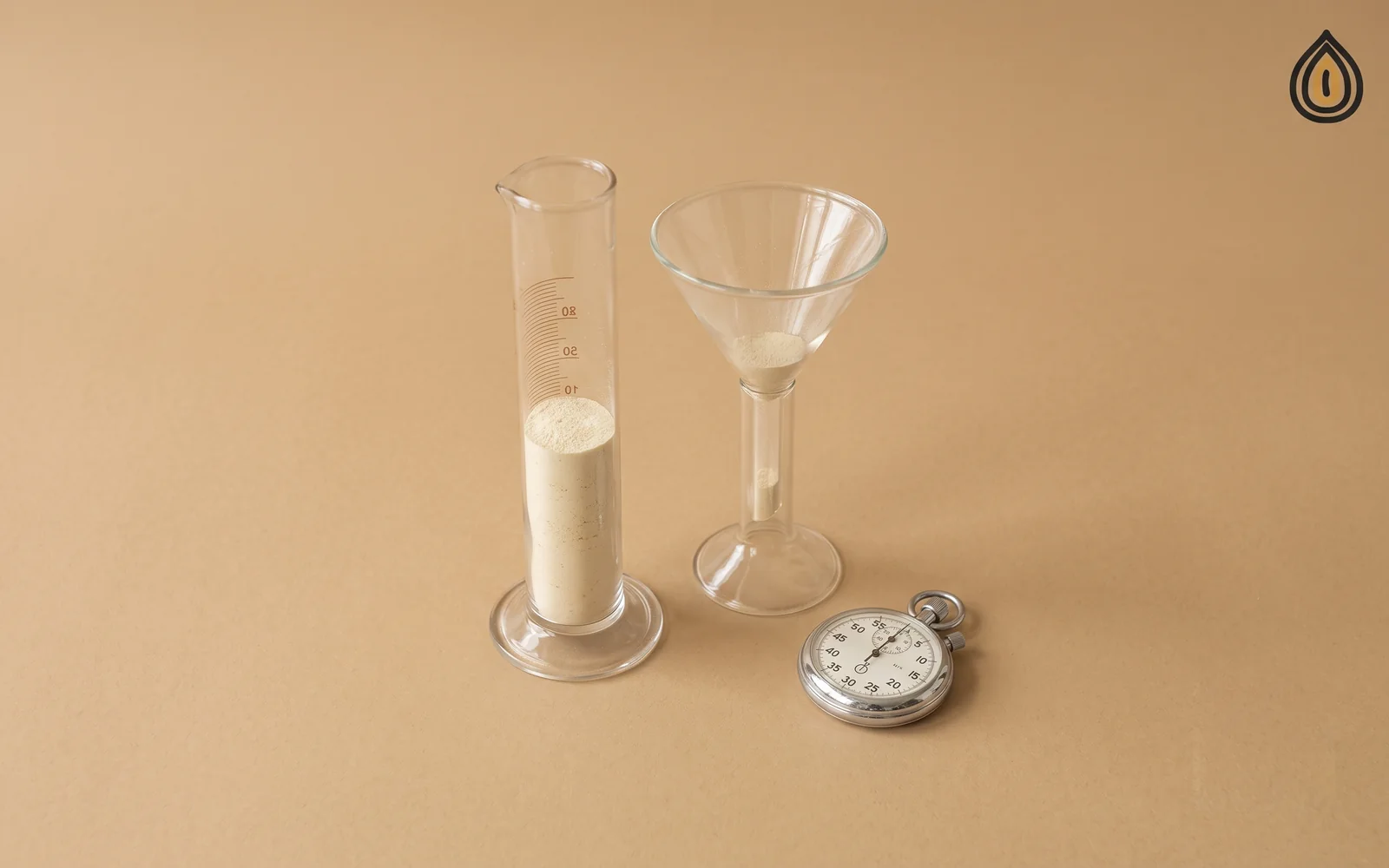
Loose density: pour the powder through a funnel into a tared 250 or 500 millilitre graduated cylinder from a fixed height without tapping, level the top with a straight edge without pressing, weigh, and divide the mass by the volume. Tapped density: tap the filled cylinder on a bench a fixed number of times, 100 taps by hand or a set count on a tapping machine, read the settled volume, and divide. Both are described in the standard methods for powders, and a plant's laboratory and a buyer's should agree the cylinder size, the funnel height and the tap count once so that the numbers compare; a 100 millilitre cylinder reads differently from a 500 because of wall effects. Three readings averaged, on a sample taken from the middle of a bag after gentle mixing, since the top of a bag is coarser and the bottom finer after transit. The whole measurement takes five minutes and belongs in the arrival inspection for any buyer dosing by volume; the inspection routine is in Common Quality Defects in Dehydrated Onion.
Flowability: what it is and how to measure it
Flowability is the powder's willingness to move under its own weight, and there is no single number for it; the practical measures are these. Angle of repose: pour the powder through a funnel onto a flat surface until a cone forms, and measure the cone's angle; below 30 degrees is free-flowing, 30 to 40 fair, 40 to 50 poor, above 50 very poor; fresh onion granules read 30 to 35, fresh powder 38 to 45, and powder that has taken up moisture above 50. Flow through an orifice: time for 100 grams to pass through a funnel of a stated outlet, or the smallest orifice through which the powder flows at all; onion powder flows through a 15 to 20 millimetre orifice when fresh and blocks a 25 millimetre one when damp. Hausner ratio and Carr index, from the loose and tapped densities as above. Shear cell testing, which measures the powder's cohesion and internal friction under load and gives the data a hopper designer needs; it is a laboratory service rather than a bench test. A blender needs the first three on arrival and the fourth once, when a hopper is designed for onion. The angle of repose on a lot the day it is opened and again after a week in the blending room is the most telling pair of numbers a blender can keep.
Why onion powder cakes and bridges
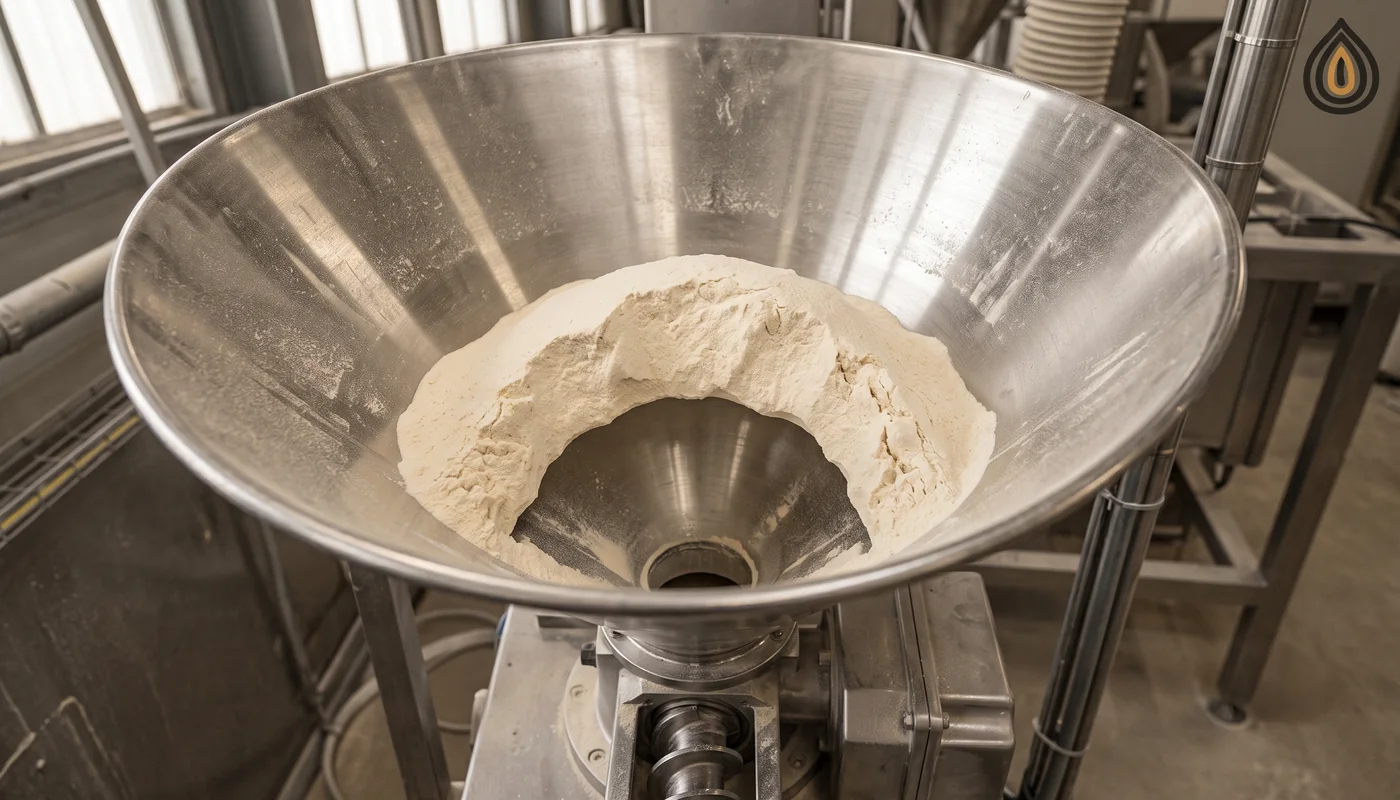
Caking, the fusion of a powder into lumps or a block, and bridging, the formation of a stable arch of powder over a hopper outlet, are the same physics. Particles of onion powder are held together by three forces: van der Waals attraction, which is small and matters only for very fine particles; electrostatic charge, which the powder picks up from friction against steel and plastic and which makes it cling; and liquid bridges, which are the main one. Onion powder's surface is sugar and fructan, both hygroscopic; at a water activity above about 0.4, which the powder reaches at 6 to 7 percent moisture or in a room at 60 percent humidity, the surface takes up enough water to dissolve into a thin syrup, and where two particles touch the syrup forms a bridge; if the powder then dries a little, the bridge crystallises into a solid neck and the particles are cemented. Under the weight of a pallet stack or a full hopper the contacts are pressed together and the bridges are stronger, which is why the bottom bag of a pallet cakes first and why a hopper that ran yesterday bridges today. Temperature adds to it: at 30 degrees the sugar surface is softer and the bridges form faster, and a warehouse that swings between night and day temperatures cycles the powder through uptake and release that builds bridges each time. Granules cake less because they have less surface per gram and fewer contacts; flakes hardly at all. The water-activity side is in Water Activity in Dehydrated Onion.
Moisture, temperature and time
| Condition | Effect on flow of 80 mesh onion powder |
|---|---|
| 4 % moisture, 20 °C, sealed | Free-flowing for months; angle of repose ~38° |
| 5 % moisture, 20 °C, sealed | Free-flowing for months; ~40° |
| 6 % moisture, 20 °C, sealed | Flow fair; soft lumps after 4-8 weeks under load |
| 7 % moisture | Cakes within 2-4 weeks; bridges in hoppers |
| 5 % moisture, opened bag, 60 % RH room | Reaches 7 % in 3-5 days; cakes within 2 weeks |
| 5 % moisture, opened bag, 80 % RH room | Reaches 9 % in 2-3 days; cakes within a week |
| 5 % moisture, sealed, 35 °C | Flow fair; bridges in hoppers sooner; colour darkens |
| Temperature cycling 15-30 °C daily, sealed | Soft caking at the bag surface within weeks |
The rule the table gives is that onion powder for blending should be bought at 5 percent maximum, opened only for the shift, and stored sealed below 25 degrees; product at 6 percent, which conforms to the standard specification, is fine for a soup maker who tips a bag into a kettle and a problem for a blender who keeps it in a hopper. The moisture measurement and its limits are in Dehydrated Onion Moisture Content.
Anti-caking agents and clean-label alternatives
An anti-caking agent works by coating the particles with a fine, inert, non-hygroscopic powder that sits between them, takes up surface moisture itself, and breaks the liquid bridges before they form. Silicon dioxide (E551), amorphous silica, at 0.5 to 1 percent, is the standard for onion powder and is permitted in the EU for dried powdered foods at up to 1 percent and in seasonings at higher levels; it is tasteless, and it keeps onion powder flowing for months at 6 percent moisture and for weeks in an opened bag. Calcium silicate (E552) and magnesium carbonate (E504) do the same at similar doses and are chosen where a blender's other components already carry them. Tricalcium phosphate (E341) is common in the American trade. All must be declared in the ingredient list, which is why plain onion powder from a plant carries none and a buyer who wants it specifies it. The clean-label alternatives avoid the E number at a cost: rice concentrate or rice flour at 2 to 4 percent, which absorbs moisture and separates particles but adds a carbohydrate and dilutes the flavour; maltodextrin at 5 to 10 percent, which is more a carrier than an anti-caking agent; and, for retail, nitrogen flushing and a foil pack, which keep the moisture out rather than managing it. Rice concentrate is the usual clean-label choice for onion powder in Europe and works well at 2 percent for a product at 5 percent moisture. None of them fixes a powder that was already caked, and none replaces the liner and the store. The additive rules, and the allergen and gluten questions a carrier raises, are in EU Import Requirements for Dehydrated Onion and Allergens, Gluten and Dehydrated Onion.
Hopper, feeder and conveyor design for onion
A hopper that handles onion powder without bridging is designed for a cohesive powder, and the rules from powder mechanics apply. The outlet should be as large as the feeder allows, since the critical arching dimension for onion powder at 5 percent moisture is 60 to 100 millimetres and rises fast with moisture; a hopper with a 50 millimetre outlet will bridge. The walls should be steep, 70 degrees or more from the horizontal for a conical hopper, so that the powder flows along the walls rather than in a central core that leaves stagnant powder to cake on the sides, and the inside surface should be polished stainless steel or lined, since onion sticks to rough steel. Vibration helps a bridged hopper for a moment and then compacts the powder and makes the next bridge stronger; an air pad or a mechanical agitator at the outlet is better, and a bin activator best. Feeders: screw feeders work well for granules and adequately for powder if the screw is a proper progressive-pitch design and the hopper feeds it evenly; vibratory feeders handle granules and struggle with powder; loss-in-weight feeders with an agitated hopper are the right choice for accurate dosing of powder. Conveyors: pneumatic conveying works for powder and generates static and fines; screw and flexible-screw conveyors are gentler; belt and bucket conveyors suit granules and flakes. A day bin of a size that is emptied each shift, rather than a silo that holds a week, is the single most effective design choice for onion, since the powder never sits under load long enough to bridge.
Dosing on volumetric lines
A volumetric filler, an auger, a cup or a pocket, dispenses a fixed volume, and the weight it delivers is that volume times the bulk density of the powder in the filler's hopper, which is neither the loose nor the tapped density but something between, depending on how the powder was fed. A blend that is 20 percent onion powder changes its density by 4 percent when the onion's density changes by 20, which is within the range between two lots of onion from different mills; the fill weight moves by the same 4 percent, and a sachet nominally 40 grams delivers 38.4 or 41.6. On a line with a checkweigher and feedback the auger corrects itself and the drift is a few minutes of out-of-tolerance packs; on one without, the drift is a whole run. The fixes are to specify the onion's loose bulk density with a range, to check it on arrival and to adjust the filler at each lot change; or to fill by weight, which removes the problem at the cost of speed; or to condition the blend to a stable density by a fixed handling routine before the filler. The interaction with the rest of the blend, and the segregation that follows a density mismatch, is in Dehydrated Onion in Spice Blends and Seasonings.
Particle size and shape effects
Finer is worse for flow and better for dispersion, and the trade's 80 mesh standard is the balance. Below 80 mesh, the fraction under 200 mesh, 75 microns, is the dust that floats, coats equipment, takes up moisture fastest and cements the rest; a specification with a dust maximum, 10 percent passing 200 mesh, makes a powder that flows measurably better than one without. Shape matters as much: pin-milled powder, near-equant, flows better and packs denser than hammer-milled, which is flaky; and a powder milled cold has fewer surface-melted particles that stick. Agglomerated onion powder, made by wetting and re-drying fine powder into porous granules of 300 to 600 microns, is sold by some processors for instant dispersion and much better flow, at a premium; it dissolves faster than plain powder and cakes less, and it is the form to consider for a line that cannot handle powder and cannot accept the visible particles of a granule. The particle-shape discussion is in the mesh-size guide linked above.
Granules as the alternative to powder
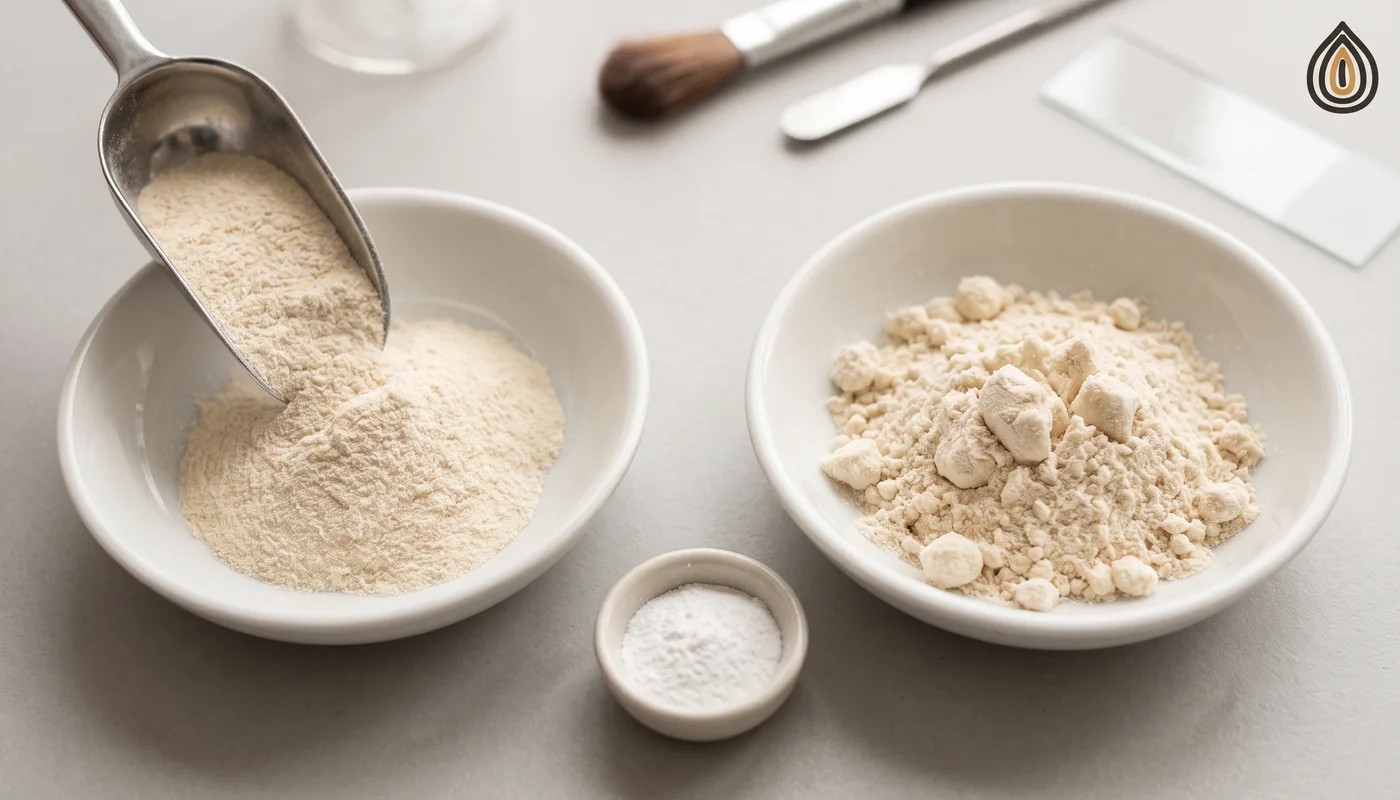
Most flow problems with onion powder are solved by not using powder: granules at 40-60 mesh disperse in a few minutes in a wet product, flow freely, dose accurately by volume, cake slowly and dust little, and carry the same flavour per gram. A soup mix, a dry sauce base, a rub or a shaker that does not need instant dispersion in cold water is better with granules than with powder, and many European blenders have moved to 40-60 or 26-40 granules for exactly that reason. The cases that need powder are instant dispersion in a liquid, coating and dusting applications, brines and injection, and blends where every other component is a fine powder and a granule would segregate. The granule product is on the granules page and the powder on the powder page.
Handling rules in the blending plant
- Buy powder at 5 percent moisture maximum for blending; 4.5 for a hopper-fed line.
- Store sealed, on pallets no more than two high, below 25 degrees and 65 percent humidity, out of the sun and away from the blending room's steam.
- Open a bag only for the shift's use; re-seal the liner with a clip or tape; do not decant into open bins.
- Feed the hopper from a day bin sized for a shift, not from a week's silo.
- Break up any soft lumps by sieving before the hopper, never by crushing in the hopper.
- Empty and clean hoppers and feeders at the end of each shift; residue in a corner cakes and seeds the next bridge.
- Earth the conveying and the hopper to bleed static; use polished surfaces.
- Check angle of repose and loose density on each new lot and after a week in the room; log them.
- Rotate stock by drying date; use the oldest powder first and the freshest for the finest applications.
- Keep an anti-caking agent or rice concentrate in the recipe if the line has ever bridged; it is cheaper than a stopped line.
The storage rules for the whole product range are in Dehydrated Onion Shelf Life and, for the warehouse, Storing Dehydrated Onion in a European Warehouse.
Specification lines for flow and density
- Bulk density, loose: "500-600 g/l, measured by [method: cylinder size, funnel height], on the product as delivered; tapped density reported."
- Particle size: "Minimum 95 percent passing 80 mesh; maximum 10 percent passing 200 mesh."
- Moisture: "Maximum 5.0 percent by halogen analyser at 105 °C" and, for a hopper-fed line, "4.5 percent".
- Water activity: "Maximum 0.35 at 25 °C."
- Flow: "Angle of repose maximum 42° by the fixed-funnel method on the product as delivered."
- Anti-caking: "None" or "Silicon dioxide E551 at 0.8 percent, declared" or "Rice concentrate at 2 percent, declared".
- Mill type: "Pin-milled" where a line has been tuned to it.
- Packaging: "Lined cartons or drums of 20 kg" for powder used gradually, since bags under a pallet stack compress the powder.
- Age: "Not more than 90 days from milling at shipment" for a line that needs the freshest flow.
The whole specification sheet is in How to Read a Dehydrated Onion Specification Sheet.
A worked example: a filler out of tolerance
A Dutch seasoning packer fills 50 gram sachets of a barbecue rub on an auger filler with a checkweigher set to plus or minus 1.5 grams. The rub is 25 percent onion granules at 26-40 mesh. A new lot of granules arrives from the same supplier, passes the sieve check at 92 percent inside the band, and the line starts rejecting sachets at 48 grams after twenty minutes. The arrival log shows the loose density of the new lot at 505 grams per litre against 560 for the previous lot; the supplier's certificate shows the new lot was milled on a hammer mill after the plant's pin mill was down for maintenance, and the sieve analysis shows 3 percent fines against 7 in the old lot. The blend's density has fallen by about 2.5 percent, the auger delivers 2.5 percent less, and the checkweigher's feedback is too slow for the drift. The fix on the day is to re-set the auger; the fix in the specification is a loose-density range of 540 to 600 and a mill-type line, and a note to the supplier that a mill change is a change to notify. The episode cost an hour of line time and forty kilograms of rejected sachets, which is the usual scale of a density surprise, and the cost of the specification line that prevents it is nil.
How KlarHarvest reports density and flow
Every KlarHarvest certificate for powder and granules carries the loose and tapped bulk density by a stated method, the sieve analysis including the fraction passing 200 mesh for powder, the moisture and, on request, the water activity and the angle of repose; the mill type is stated on the specification and a change is notified before shipment. Powder is offered plain, with silicon dioxide or with rice concentrate at the buyer's choice, declared on the bag, and in cartons or drums for buyers who use it gradually. A buyer can request two lots milled on different equipment as samples to tune a line, and the flow figures for each are on the certificates; the request goes through the contact page.
Frequently asked questions
What is the bulk density of onion powder?
Loose, 500 to 650 grams per litre; tapped, 600 to 750. Granules at 16-40 mesh are 450 to 550 loose, flakes 180 to 230. A specification must say loose or tapped and the method.
Why does onion powder cake?
Its surface is sugar and fructan, which take up moisture from the air and dissolve into a syrup at the points where particles touch; the syrup bridges cement the particles, faster under the weight of a stack or a full hopper and at higher temperature. Moisture above 5 to 6 percent, or an opened bag in a humid room, is the usual start.
What anti-caking agent is used in onion powder?
Silicon dioxide (E551) at 0.5 to 1 percent is the standard; calcium silicate and tricalcium phosphate are alternatives; rice concentrate at 2 to 4 percent is the clean-label choice. All must be declared, and plain onion powder from a plant carries none unless specified.
How do I measure bulk density?
Pour the powder through a funnel into a graduated cylinder without tapping, level and weigh for loose density; tap a fixed number of times and re-read the volume for tapped density. Agree the cylinder size and tap count with the supplier so the numbers compare.
Why did my filler go out of tolerance on a new lot?
The lot's bulk density changed, usually from a different mill or a different fines share, and a volumetric filler delivers weight in proportion to density. Specify a density range and a mill type, check on arrival and re-set the filler at each lot change.
Should I use granules instead of powder?
Where the product does not need instant dispersion in cold liquid, yes: granules at 40-60 mesh flow freely, dose accurately, cake slowly and carry the same flavour. Powder is needed for instant dispersion, coatings, brines and all-powder blends.
How should onion powder be stored in a blending plant?
Sealed, below 25 degrees and 65 percent humidity, pallets no more than two high, opened only for the shift's use and re-sealed, and fed to the line from a day bin rather than a silo.
Next step
Request a sample of 80 mesh powder and 40-60 granules from one lot, with the density and flow figures on the certificates, and run them through your own hopper; then request a quote with the density range, the anti-caking choice and the pack format, and the plant confirms the mill and the figures before the first lot.