- The regulatory lists: EU, UK, US, Canada, Australia
- What dehydrated onion contains and does not
- The sulphite exception
- Cross-contact: the plant, not the onion
- Cross-contact control at a certified plant
- Gluten-free: what the claim needs
- Onion intolerance, fructans and low-FODMAP
- Additives and carriers in onion products
- The allergen declaration: format and content
- The label downstream: what the onion contributes
- Verification: what a buyer can test
- The pet-food note
- Allergen risk by plant type: a matrix
- The supplier questionnaire: answering the allergen section
- Precautionary labelling: when "may contain" is right and when it is lazy
- Allergen incidents in the dried-vegetable trade, and what they teach
- How KlarHarvest declares
- Frequently asked questions
Judge the product, not the words
200-500 g from a current lot, dispatched by courier with the lot lab report.
Request a sampleDehydrated onion allergens are a short subject with a long declaration. Onion is not among the fourteen substances the EU requires to be emphasised on a label, nor among the nine the United States lists, nor on any major market's mandatory list; a pure dried onion contains no milk, egg, fish, shellfish, nut, peanut, soy, wheat, celery, mustard, sesame, lupin or mollusc, and no gluten. A buyer's quality system still requires an allergen statement from the supplier, and the statement is not a formality, because three things can put an allergen into a bag of onion that has none of its own: sulphite, which is on the list above 10 milligrams per kilogram and was once routinely added to dried onion; cross-contact at a plant that processes other ingredients on the same lines; and the ingredients added to onion in blends and powders, anti-caking agents and carriers, which are not allergens but must be known. This guide sets out what onion carries and does not, the sulphite exception, cross-contact and its control, what a gluten-free claim needs, the fructan question that is often confused with allergy, the declaration format that satisfies a retailer's auditor, and the pet-food note that belongs in every onion supplier's file.
Regulations are cited as of March 2026 and should be checked in their current text; nothing here is legal advice.
What this guide covers
- The regulatory lists: EU, UK, US, Canada, Australia
- What dehydrated onion contains and does not
- The sulphite exception
- Cross-contact: the plant, not the onion
- Cross-contact control at a certified plant
- Gluten-free: what the claim needs
- Onion intolerance, fructans and low-FODMAP
- Additives and carriers in onion products
- The allergen declaration: format and content
- The label downstream: what the onion contributes
- Verification: what a buyer can test
- The pet-food note
- Allergen risk by plant type: a matrix
- The supplier questionnaire: answering the allergen section
- Precautionary labelling: when "may contain" is right and when it is lazy
- Allergen incidents in the dried-vegetable trade, and what they teach
- How KlarHarvest declares
- Frequently asked questions
The regulatory lists: EU, UK, US, Canada, Australia
| Market | Rule | Mandatory allergens | Onion listed? | Sulphite listed? |
|---|---|---|---|---|
| EU | Regulation (EU) 1169/2011, Annex II | 14: cereals containing gluten, crustaceans, eggs, fish, peanuts, soybeans, milk, nuts, celery, mustard, sesame, sulphur dioxide and sulphites >10 mg/kg, lupin, molluscs | No | Yes |
| UK | Retained FIC; Natasha's Law for prepacked-for-direct-sale | Same 14 | No | Yes |
| USA | FALCPA and the FASTER Act | 9: milk, eggs, fish, crustacean shellfish, tree nuts, peanuts, wheat, soybeans, sesame | No | Not an allergen, but sulphites ≥10 ppm must be declared |
| Canada | Food and Drug Regulations, priority allergens | 11 including mustard, sesame, sulphites, plus gluten sources | No | Yes |
| Australia and New Zealand | Food Standards Code 1.2.3 | 10 groups plus sulphites ≥10 mg/kg and lupin | No | Yes |
| Japan | Food Labelling Act | 8 mandatory, 20 recommended | No | Not as an allergen |
| Codex | General Standard for Labelling | 8 groups plus sulphites ≥10 mg/kg | No | Yes |
Onion appears on no mandatory list anywhere. Sulphite appears on nearly all of them, either as an allergen or as a substance with its own declaration threshold, at 10 milligrams per kilogram, and that is the line that matters for dried onion.
What dehydrated onion contains and does not
Dried onion is onion: water removed, nothing added. It contains onion's own proteins, sugars, fibre, sulphur compounds and minerals, and none of the proteins from the allergenic foods, because none of those foods is part of it. Allergy to onion itself exists but is rare, documented in case reports rather than population studies, and it is not the basis of any mandatory declaration; a manufacturer that wants to accommodate it lists onion in the ingredient list, which is required anyway. Onion contains no gluten, since gluten is a protein of wheat, barley and rye. It contains no lactose, no soy, no nut proteins. It is, on its own composition, one of the cleanest ingredients in the spice trade for allergen purposes, and that is why a plant that dries only alliums and dehydrated vegetables can declare its product free of all fourteen with confidence. The composition is given in Dehydrated Onion Nutrition Facts per 100 g.
The sulphite exception
Sulphites were added to dried onion for decades to keep it white and to reduce counts, and sulphited product is still made in India for the domestic and some export markets. A sulphited onion carries 200 to 2,000 milligrams per kilogram of sulphur dioxide equivalent, which makes it a declarable allergen in itself in the EU and triggers the declaration in any finished food at an inclusion above a fraction of a percent. The standard export product from certified Mahuva plants is sulphite-free, below 10 milligrams per kilogram, and the allergen declaration should say so explicitly, name the test method, and state whether sulphite is used anywhere on the plant's premises, because cross-contact from a sulphited line can carry 20 to 100 milligrams per kilogram into a nominally sulphite-free lot. A buyer specifying sulphite-free should test it, by ion chromatography or the enzymatic method rather than the Monier-Williams distillation that gives false positives on onion. The whole subject, including the false-positive problem, is in Sulphites in Dehydrated Onion.
Cross-contact: the plant, not the onion
The realistic allergen risk in dried onion comes from what else the plant handles. A plant that dries onion and garlic only, which describes most of the Mahuva export plants, has no allergen on site except sulphite where it is used. A plant that also dries or packs other vegetables, carrot, cabbage, potato, beetroot, has no allergen among them either. The risk arises at plants that blend and pack seasonings on the same site as they dry onion, since a seasoning line may run celery, mustard, sesame, wheat-based carriers, milk powder or soy, and a shared mill, sieve, conveyor or packing line can carry a trace into the onion; at plants that pack third-party products; and at plants that dry other crops in the off-season on the same dryers, of which the allergenic possibilities are few but real, mustard and celery leaf among them. A buyer's allergen question to a supplier is therefore about the site: what is processed there, on which lines, and how the lines are separated. The site question belongs in the supplier vetting in 25-Point Checklist Before You Choose a Dehydrated Onion Supplier.
Cross-contact control at a certified plant
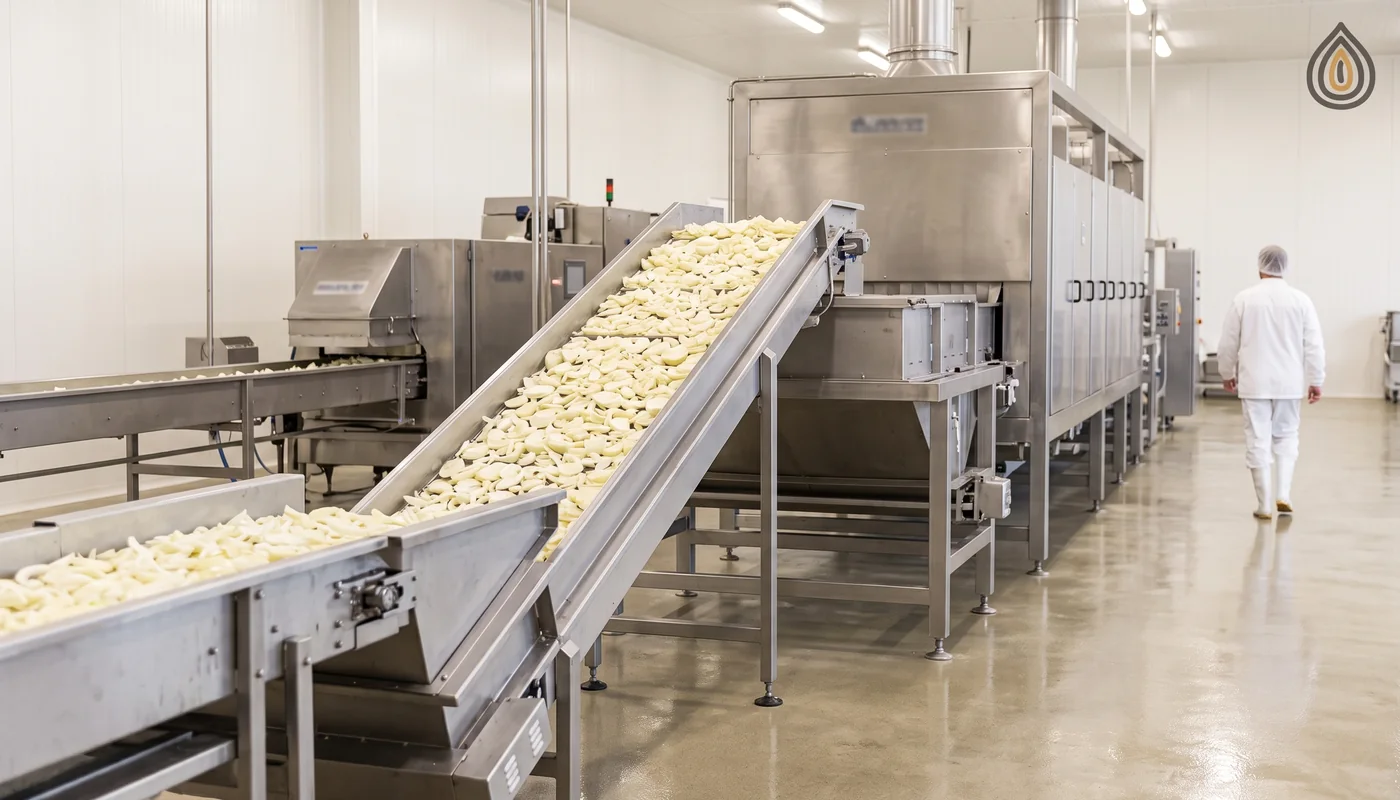
BRCGS, IFS and FSSC 22000 all require an allergen management programme, and a plant's audit report shows how it works. The elements a buyer should expect: an allergen risk assessment of every raw material and every line, including sulphite as an allergen; physical segregation of allergen-containing materials in storage and, where possible, dedicated lines; where lines are shared, a validated cleaning procedure between an allergen-containing run and the next, with verification by swab or product testing; production scheduling that runs allergen-free product first after a clean; labelling and traceability that identify allergen-containing lots; and staff training. For a plant that runs only alliums the programme is short and the declaration is simple; for a plant with a seasoning line it is the difference between "free from" and "may contain". A supplier's declaration should state which it is and on what basis, and the buyer's file should hold the audit report's allergen section. The certificate's scope and what it covers are in What BRC Certification Means for a Dehydrated Onion Supplier, and the remote audit questions in How to Audit a Dehydrated Onion Supplier Remotely.

Gluten-free: what the claim needs
Onion contains no gluten, and a "gluten-free" claim on onion or on a product made with it is permitted in the EU under Regulation (EU) 828/2014 where the food contains no more than 20 milligrams per kilogram of gluten, and in the US under the FDA's rule at the same threshold. The claim needs three things from the onion supplier: a statement that no gluten-containing ingredient is used in the product, which is trivially true for pure onion; a statement on cross-contact, since a plant that mills wheat-based carriers or packs seasonings with wheat flour on shared equipment cannot support the claim without validated cleaning; and, for a buyer that makes the claim on its own product, a test result on the onion by an ELISA method at a limit below 20 milligrams per kilogram, on the first lots and on a plan. Onion powder with an anti-caking agent or a carrier must be checked for the carrier: silicon dioxide and calcium silicate are gluten-free; a maltodextrin carrier may be wheat-derived, and though wheat maltodextrin is exempt from gluten labelling in the EU because of its processing, a buyer making a gluten-free claim under a certification scheme may need it excluded. "Gluten-free onion powder" is a real search and a real request, and the answer is that plain onion powder from an allium-only plant is gluten-free by composition and needs the plant statement and a test to be claimed as such.
Onion intolerance, fructans and low-FODMAP
Onion is often described as something people "react to", and the reaction is nearly always intolerance rather than allergy: onion is rich in fructans, chains of fructose that the small intestine does not absorb and the colon ferments, and people with irritable bowel syndrome and others following a low-FODMAP diet avoid onion for that reason. Fructans are not an allergen, do not appear on any declaration list, and are concentrated in dried onion in proportion to the drying, so a dried onion carries 20 to 30 percent fructans by weight. The relevance to a supplier is twofold: a buyer making a low-FODMAP product will exclude onion altogether or use an onion-flavoured oil, since the fructans are water-soluble and do not pass into oil, which is one of the uses of onion oil discussed in Dehydrated Onion vs Onion Oil and Oleoresin; and a supplier asked about "onion allergy" should answer that onion carries no declarable allergen and that the common sensitivity is fructan intolerance, which the ingredient list addresses by naming onion.
Additives and carriers in onion products
Plain flakes, chopped, minced and granules contain nothing but onion. Powder is sometimes supplied with an anti-caking agent, silicon dioxide or calcium silicate at 0.5 to 2 percent, which is declared as an additive and is not an allergen. Some onion powders on the market, especially retail and some blended products, contain a carrier, maltodextrin, dextrose or salt, which changes the composition and the label; a buyer should specify "onion powder, 100 percent onion, no carrier, no anti-caking" or the additive it accepts, and the certificate of analysis or the specification should state the composition. Toasted onion is onion roasted, with no additive. Onion oil and oleoresin are extracts and are declared differently. None of the permitted additives introduces an allergen, but a carrier from a wheat source affects a gluten-free claim as above, and a salt carrier changes the sodium declaration. The additive rules are in EU Import Requirements for Dehydrated Onion.
The allergen declaration: format and content
The document a retailer's or manufacturer's auditor wants to see is an allergen statement or matrix, on the supplier's letterhead, signed and dated, renewed annually or on any change, covering the specific product and the site. Its content:
- Product identification: name, cut, specification reference, and the site of manufacture.
- The fourteen EU allergens, each on a line, with three columns: present as an ingredient (yes/no), present through cross-contact (yes/no/controlled), and the basis for the answer. For pure onion from an allium-only plant every line reads "no / no / not handled on site", except sulphite, which reads "no / no / not used on site" or "no / controlled / used on a separated line under a validated allergen programme, tested per lot".
- The additional allergens of other markets, where the buyer supplies them: for the US, the same set less celery, mustard and lupin plus nothing extra; for Canada, the priority list; for Australia, the code's list.
- Gluten: a specific line, "no gluten-containing ingredient; site does not handle gluten-containing materials" or the control statement, and the test method and result where a claim is supported.
- Sulphite test: method and the latest result, with the frequency.
- Additives and carriers: none, or named.
- Change notification: an undertaking to notify the buyer before any change to ingredients, site or lines.
- Signature: the plant's or exporter's quality manager, with the date and the review date.
A declaration in that form answers every question a supplier questionnaire asks and survives an audit; a one-line "our product is allergen-free" does not. The declaration sits with the specification and the certificates in the supplier approval file described in How to Read a Dehydrated Onion Specification Sheet.
The label downstream: what the onion contributes
On the finished product's label, the onion contributes its name in the ingredient list, "onion" or "dried onion" or "onion powder", with the percentage where the quantitative ingredient declaration applies, and nothing to the emphasised allergens unless it carries sulphite above the threshold in the finished food. The "may contain" statement on a finished product reflects the packer's own cross-contact assessment and, where the onion's declaration reports controlled cross-contact at the plant, the packer decides whether to carry it through; most do not for an ingredient at a few percent with a validated control upstream, and some retailers' codes require it. Retail label rules as a whole, including the emphasis format and the language, are in Labelling Dehydrated Onion for the EU.
Verification: what a buyer can test
Allergen testing on dried onion is done for verification rather than routine, since the composition is known. The useful tests: sulphite by a specific method, on every lot for high-inclusion uses; gluten by ELISA at a limit of 5 to 10 milligrams per kilogram, on the first lots and periodically where a gluten-free claim is made; and, where a plant's site handles a specific allergen, an ELISA for that allergen, milk, soy, mustard, celery or sesame, on a plan agreed with the supplier. Swab results from the plant's own verification are useful evidence and can be requested. Onion's sulphur compounds and sugars can interfere with some ELISA kits, and a laboratory should confirm the kit is validated on dried alliums. Testing costs 40 to 120 euros per allergen per sample at a European laboratory and takes a week. The certificate of analysis and its reading are in How to Read a Dehydrated Onion Lab Report.
The pet-food note
Onion is not an allergen for people and it is toxic to dogs and cats, whose red blood cells are damaged by its sulphur compounds; onion and garlic in any form are excluded from pet food and from treats, and a seasoning or a soup base that finds its way into a pet product is a recall. An onion supplier's file and declaration should note that the product is for human consumption and is not suitable for pet food, and a blender that serves both markets should keep onion out of the pet lines and off the shared equipment. The subject, which surprises many people in the trade, has its own guide, Onion and Pet Food: Why Dehydrated Onion Is Excluded.
Allergen risk by plant type: a matrix
The allergen exposure of a bag of dried onion is decided by the site it came from, and the sites fall into recognisable types. The matrix below is the one a buyer's quality team can use to set the depth of its questions and the testing it runs.
| Plant type | What else is on site | Allergens realistically present | Sulphite | Declaration a buyer should expect | Testing a buyer should run |
|---|---|---|---|---|---|
| Allium-only dehydrator (most Mahuva export plants) | Onion, garlic; sometimes dehydrated ginger | None of the fourteen | Usually not used; if used, on a separated line | "Not handled on site" for all fourteen; sulphite statement per line | Sulphite by specific method on a plan; nothing else routine |
| Mixed dehydrated-vegetable plant | Onion, garlic, carrot, cabbage, beetroot, potato, leek, spinach | None of the fourteen; celery only if celeriac or celery leaf is dried | As above | As above, with the crop list | Sulphite; celery ELISA if celery products are dried |
| Dehydrator with a seasoning or blending line | Above plus spices, salt, carriers, sometimes mustard, celery, sesame, milk powder, wheat-based carriers | Mustard, celery, sesame, gluten, milk, soy through shared equipment | Possible | Matrix with "controlled" entries and the control described; audit report's allergen section | ELISA for each allergen handled, on first lots and on a plan; gluten if claimed |
| Trader or repacker opening bags | Whatever the repacking site handles | Depends on the site; often spices and nuts | Unknown | Should be refused; repacking breaks the chain | Full panel until the site is known |
| Plant with a retail packing line | Above plus retail packaging of other products | Depends on what is packed | Possible | As for the seasoning line | As for the seasoning line |
The first two rows describe the supply a European buyer should be looking for, and the third is common enough that the question "do you blend or pack anything else on site?" belongs in every supplier questionnaire. The trader row is the reason the no-repack rule exists, as explained in Private Label Dehydrated Onion.
The supplier questionnaire: answering the allergen section
Every European buyer's supplier questionnaire has an allergen section, and an exporter's answers to it are read by a quality manager who has read a hundred others; the ones that pass are specific. "Do you handle any of the following allergens on site?" is answered per allergen, not with a single "no", and with "not handled" rather than "not present in product", because the question is about the site. "Is the product free from gluten?" is answered "no gluten-containing ingredient; no gluten-containing material handled on site; ELISA result on request" rather than "yes". "Do you use sulphites?" is answered for the product and for the site, with the test method and the latest result. "Describe your allergen management programme" is answered with a paragraph that names the risk assessment, the segregation or the cleaning validation, the scheduling rule, the verification and the training, and offers the audit report's section. "Do you have a precautionary allergen labelling policy?" is answered with the policy, which for an allium-only plant is that no precautionary statement is needed and none is applied. "Has the site had an allergen-related recall or withdrawal?" is answered honestly, with the year and the cause if there was one. And every answer is consistent with the declaration document and the specification, because the three are read side by side and a difference between them is treated as an error in all three. The rest of the questionnaire, and what German buyers in particular expect, is in Importing Dehydrated Onion into Germany.
Precautionary labelling: when "may contain" is right and when it is lazy
A "may contain" statement on a finished product is meant to warn of an unavoidable cross-contact risk that a risk assessment has found real; it is not a substitute for control, and regulators and retailers in the EU and the UK have been tightening its use, with the newer guidance asking for quantitative risk assessment against reference doses before a precautionary statement is applied. For dried onion the honest positions are two. From an allium-only plant, no precautionary statement is justified and a buyer should not apply one on the onion's account; a "may contain celery, mustard" on a soup because the onion supplier's questionnaire was answered vaguely is the lazy case, and it costs the buyer the customers who avoid those allergens for no reason. From a plant with a seasoning line and a validated cleaning programme, the supplier's declaration says "controlled", the buyer's own risk assessment decides whether the residual risk after control warrants a statement, and the answer at an inclusion of a few percent with a validated control upstream is usually no. The exception is sulphite from a plant that runs a sulphited line, where the residual risk is quantifiable and, at high onion inclusions, can exceed the 10 milligram threshold, in which case the buyer specifies sulphite-free with per-lot testing or buys from a plant that does not sulphite at all. The retail label rules that frame precautionary statements are in Labelling Dehydrated Onion for the EU.
Allergen incidents in the dried-vegetable trade, and what they teach
The public recall databases in the EU, the UK and the US carry a small number of allergen incidents involving dried onion and its neighbours over the last decade, and they follow patterns worth knowing. Undeclared sulphite is the most common, in onion and in other dried vegetables, nearly always from product that was sulphited at origin and sold on as untreated, or from cross-contact at a plant running both; the lesson is the site question and the specific test. Undeclared mustard and celery in seasoning blends containing onion, from shared blending equipment, is the next, and the onion is rarely the source but often the suspect; the lesson is the matrix declaration that names where the onion came from. Wheat in an "onion powder" that carried a wheat maltodextrin carrier undeclared by a repacker is a recurring case in retail spice recalls; the lesson is the composition line in the specification. And peanut or tree-nut traces in spice blends from repacking sites that also handle nuts, which touches onion only when it has passed through such a site; the lesson is the no-repack rule. None of the incidents involved onion's own composition, which is the reassurance, and all of them involved a gap between what a document said and what a site did, which is the warning. RASFF and the national recall lists are searchable, and a buyer's supplier file benefits from a note that the supplier's name and site were checked in them at approval and at each review.
How KlarHarvest declares
KlarHarvest sources from BRCGS-certified plants in Mahuva that process alliums and dehydrated vegetables only, and issues for every product an allergen declaration in the matrix form above, in English and German, naming the site, covering the fourteen EU allergens and the US and Canadian lists, stating sulphite as not used on site or controlled on a separated line per plant, with the sulphite result by ion chromatography on the certificate, and a gluten statement supported by ELISA on request. Declarations are dated, renewed annually and reissued on any change, and the plant's allergen programme summary from its audit report is available under confidentiality. The declarations sit with the specifications on the quality page, and the product composition, 100 percent onion with no carrier or additive unless specified, on each product page.
Frequently asked questions
Is onion an allergen?
Not on any mandatory list: it is not among the EU's fourteen, the US nine or any other major market's declared allergens. True onion allergy is rare; the common reaction is fructan intolerance, which is not an allergy.
Is dehydrated onion gluten-free?
By composition, yes; onion contains no gluten. A gluten-free claim needs the plant's statement that no gluten-containing material is handled or that cross-contact is controlled, and a test below 20 mg/kg where the claim is made.
Why do I need an allergen declaration for an ingredient with no allergens?
Because the declaration is about the site as much as the product: what else is processed there, how sulphite is handled, and on what basis the "free from" answer rests. Auditors require it for every ingredient.
Can dehydrated onion contain sulphite?
Yes, if it was sulphited during processing, which the standard export product is not, or through cross-contact at a plant that runs a sulphited line. Specify sulphite-free, ask about the site, and test by a specific method.
What should the allergen statement contain?
Each of the fourteen EU allergens on its own line with present, cross-contact and basis columns; a gluten line; the sulphite method and result; additives and carriers; a change-notification undertaking; a signature and a review date.
Does onion powder contain anything other than onion?
Plain powder does not. Some powders carry an anti-caking agent or a carrier such as maltodextrin, which must be declared and which affect gluten-free and sodium claims; specify what you want.
Is dehydrated onion safe for pet food?
No. Onion is toxic to dogs and cats and is excluded from pet food and treats; a supplier's declaration should note the product is for human consumption only.
Next step
Request a sample and the allergen declaration for its plant comes with it, in the matrix form your supplier questionnaire expects; for a gluten-free or sulphite-free claim with per-lot testing, request a quote and say so, and the testing is priced in.