- Who issues the certificate: plant, exporter, laboratory
- NABL accreditation and how to verify a laboratory
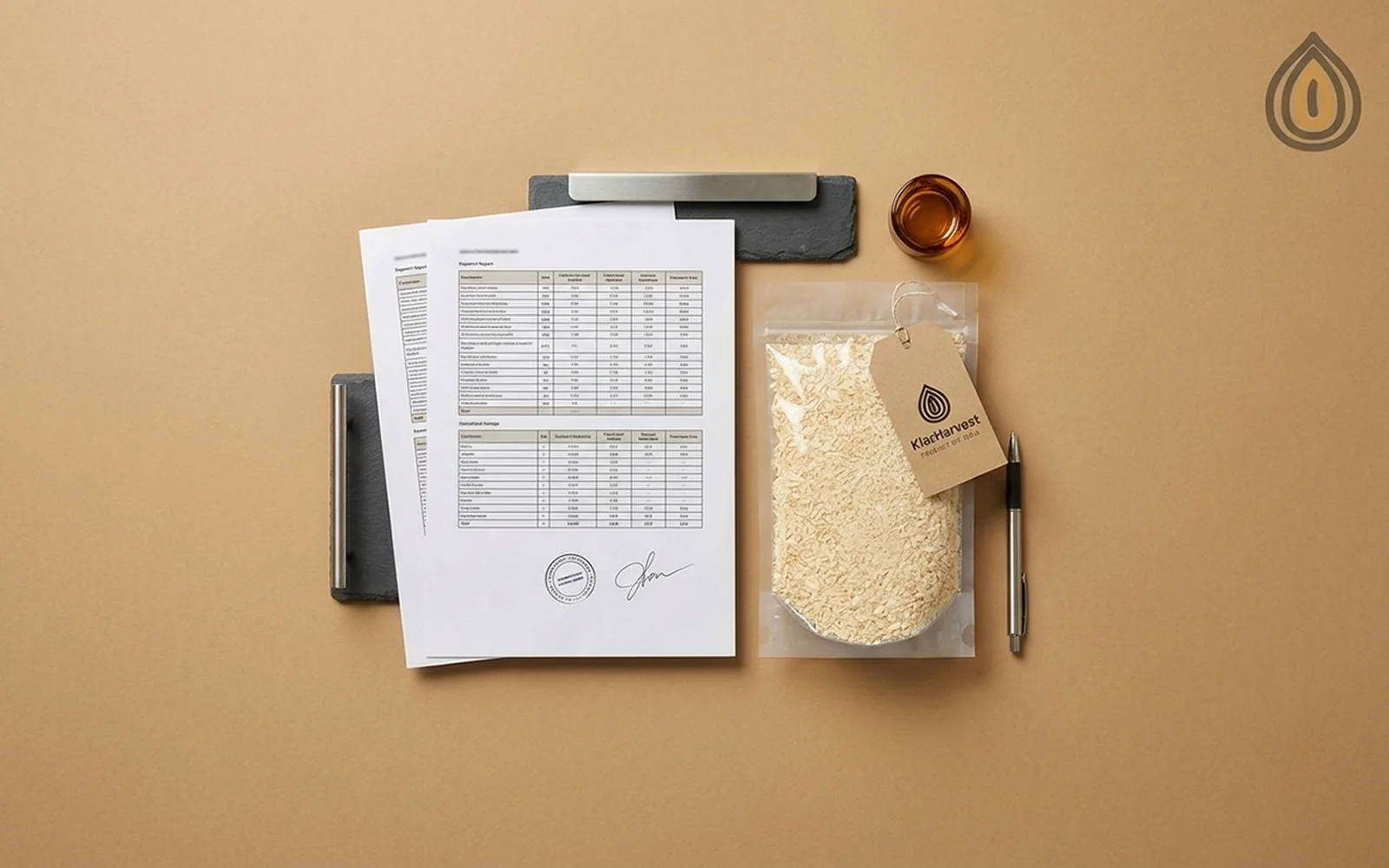
- The anatomy of a certificate of analysis
- Physical parameters: moisture, particle size, density, colour, defects
- Chemical parameters: ash, sulphite, residues, metals, ethylene oxide
- Microbiological parameters and the sample size that matters
- Detection limits, "absent", "not detected" and units
- Who took the sample, and why it matters most
- Lot certificate versus typical analysis
- Warning signs on a report
- Verifying a report with the laboratory
- The importer's own verification plan
- A specimen certificate, with commentary
- What a certificate does not tell you
- What testing costs, and who pays
- KlarHarvest's certificates
- Frequently asked questions
Judge the product, not the words
200-500 g from a current lot, dispatched by courier with the lot lab report.
Request a sampleA dehydrated onion lab report, the certificate of analysis that travels with every lot, is the document a buyer relies on most and reads least. It is usually two pages of numbers under a laboratory's letterhead, and it answers the questions that decide whether a lot can be used: how wet it is, how clean it is, what it carries from the field, and whether it is the product the specification describes. It can also be misread in a dozen ways, from a moisture figure quoted on the wrong basis to a Salmonella "absent" from a 1 gram sample that should have been 25, and it can be faked, borrowed or dated before the lot it describes existed. This guide teaches the document, line by line.
It covers who issues a certificate and what NABL accreditation means, how to verify a laboratory and a report, the anatomy of the report from header to signature, every parameter group with its method, unit and the limit it is compared with, how to read detection and quantification limits, "absent" and "not detected", who took the sample and why that matters more than any result, the difference between a lot certificate and a typical analysis, the warning signs of an unreliable report, how an importer's own verification testing should be planned, and a specimen certificate with commentary.
Methods, limits and practices are those current in March 2026 in the Indian export trade and in European receiving laboratories.

What this guide covers
- Who issues the certificate: plant, exporter, laboratory
- NABL accreditation and how to verify a laboratory
- The anatomy of a certificate of analysis
- Physical parameters: moisture, particle size, density, colour, defects
- Chemical parameters: ash, sulphite, residues, metals, ethylene oxide
- Microbiological parameters and the sample size that matters
- Detection limits, "absent", "not detected" and units
- Who took the sample, and why it matters most
- Lot certificate versus typical analysis
- Warning signs on a report
- Verifying a report with the laboratory
- The importer's own verification plan
- A specimen certificate, with commentary
- What a certificate does not tell you
- What testing costs, and who pays
- KlarHarvest's certificates
- Frequently asked questions
Who issues the certificate: plant, exporter, laboratory
Three documents get called a certificate of analysis, and they are not equal. A plant's in-house report, from its own quality laboratory, records the checks the plant runs on every lot, moisture, sieve analysis, colour, sometimes a plate count, and is a production record rather than independent evidence. An exporter's certificate is often a transcription of the plant's figures onto the exporter's letterhead and adds nothing. A third-party laboratory report, from an accredited laboratory that received a sample and tested it, is the document a buyer's own quality system means when it asks for a certificate of analysis, and it is the one that carries weight with an auditor. Certified plants send every export lot to an accredited laboratory for the parameters their customers specify, and the report comes back in three to seven days for most tests and up to ten for a full residue screen. A buyer's specification should say which of the three it expects, and for EU supply it should be the third.
NABL accreditation and how to verify a laboratory
The National Accreditation Board for Testing and Calibration Laboratories, NABL, accredits Indian laboratories to ISO/IEC 17025, the same standard as accreditation bodies in Europe use, and NABL is a signatory to the ILAC mutual recognition arrangement, which means a NABL-accredited result is formally recognised by DAkkS in Germany, UKAS in Britain and the other members. Accreditation is per test, not per laboratory: a laboratory is accredited for a scope that lists the products and the parameters and the methods it may report under the NABL logo, and a report for a parameter outside the scope should not carry the logo for that line. To verify a laboratory, find its NABL certificate number on the report, look it up on the NABL website, and check that the scope covers dried vegetables or spices and the parameters reported. Since 2019 every NABL-endorsed report carries a Unique Lab Report number, ULR, in a defined format that encodes the laboratory and the year, and the number can be checked with the laboratory; a report without a ULR that claims to be NABL-endorsed is either old or not what it claims. The laboratories the Mahuva plants use are in Bhavnagar, Rajkot, Ahmedabad and Mumbai, and the larger names, including the Indian branches of the international testing groups, are all on the NABL register.
The anatomy of a certificate of analysis
| Section | What it should contain | What to check |
|---|---|---|
| Header | Laboratory name, address, NABL certificate number, ULR number, report number, page x of y | NABL number resolves; ULR present; all pages present |
| Customer | Who submitted the sample: plant or exporter | Matches the supplier |
| Sample description | Product, cut, colour, lot number, batch size, packing, drying date, quantity of sample | Lot number matches the shipment; drying date before sampling date |
| Sampling | Who sampled (laboratory, plant, third party), date, method, condition on receipt | The single most important line: see the sampling section |
| Dates | Received, testing started, testing completed, report issued | Sequence is logical; microbiology takes 3-5 days minimum |
| Results table | Parameter, method, unit, result, specification limit, remark | Method named for each line; units consistent; limits match your specification |
| Remarks | Whether the sample conforms; any deviations; uncertainty statement | "Conforms" is only as good as the limits column |
| Authorisation | Signature of the authorised signatory, name, designation | Signatory is named on the NABL scope |
| Footer | Statements: results relate only to the sample tested; report not to be reproduced in part | Standard; their absence is odd |
Physical parameters: moisture, particle size, density, colour, defects
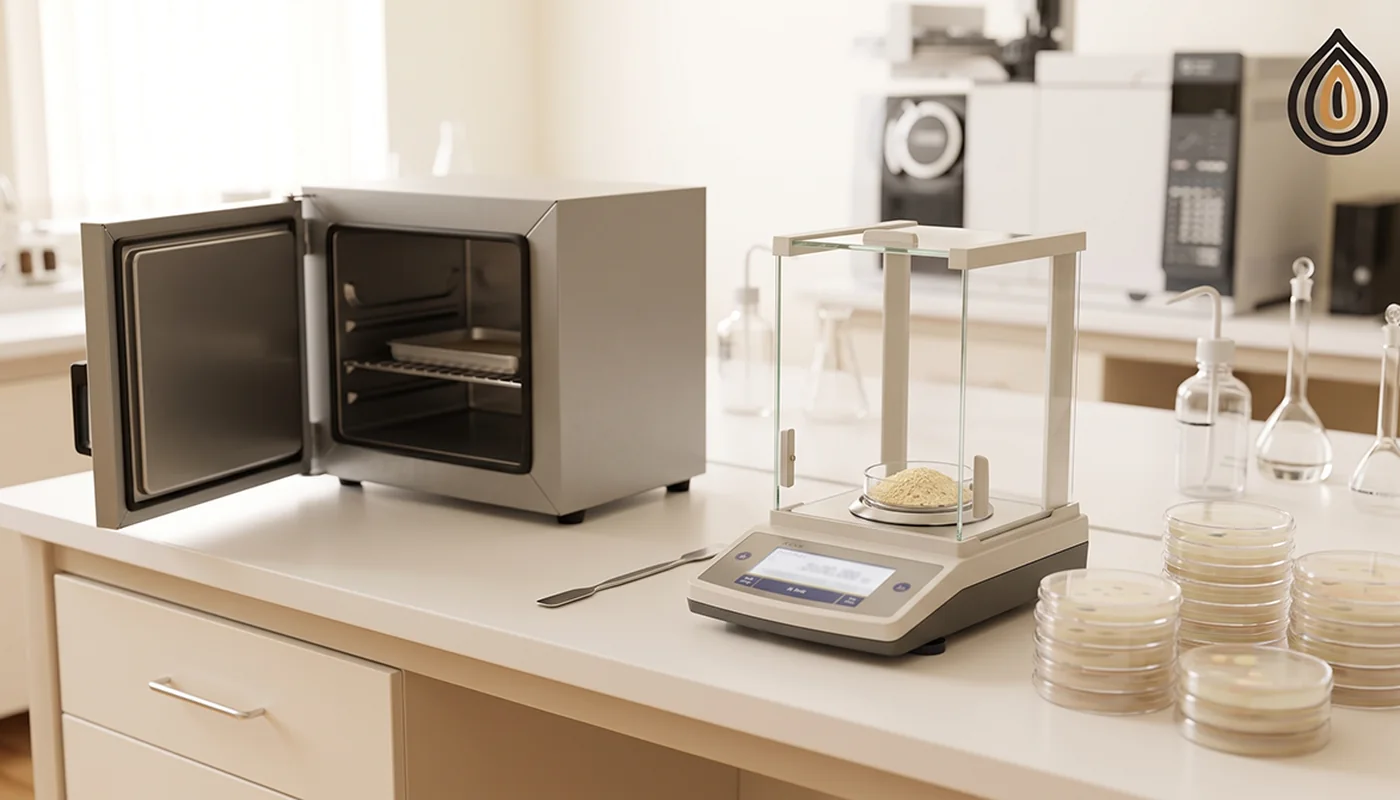
Moisture is reported as a percentage by weight, and the method decides the number: oven drying at 103 degrees to constant weight (IS 4707 or AOAC 925.10) is the reference; a halogen moisture analyser gives a comparable figure faster; Karl Fischer titration measures water only and reads 0.3 to 0.5 points lower than the oven, which loses some volatiles too. A specification at 6 percent maximum and a result of 5.2 by oven is a pass; the same lot by Karl Fischer reads 4.8. The report should name the method; the reasons the number matters are in Dehydrated Onion Moisture Content. Particle size is a sieve analysis, the share retained on each named sieve, and should be read against the band and the fines maximum in the specification; a single "conforms" without the fractions is not an analysis, as explained in Mesh Size in Dehydrated Onion. Bulk density, loose or tapped, in grams per litre, should say which. Colour may be a visual grade against a reference or an instrumental value, L*a*b* or a whiteness index, and the two are not interchangeable; the instrument and its settings should be named. Foreign matter, in percent or as counts per 100 grams, and defects, browned, scorched, skin, root and stem pieces, are reported by hand sorting of a weighed sample, and the sample size, 100 or 200 grams, should be stated since a defect rate on 50 grams means little. Water activity, reported as a decimal, is a different measurement from moisture and is the better predictor of stability, as Water Activity in Dehydrated Onion explains.
Chemical parameters: ash, sulphite, residues, metals, ethylene oxide
Total ash, 3 to 5 percent in onion, and acid-insoluble ash, a measure of sand and soil, below 0.5 percent and usually below 0.2 in a well-washed lot, are cheap tests that catch a plant with poor washing. Sulphite, as sulphur dioxide in milligrams per kilogram, must name the method, because the standard distillation method gives false positives on onion; the detail is in Sulphites in Dehydrated Onion. Pesticide residues are reported as a list, each active substance with its result, its limit of quantification and the MRL, or as "none detected above LOQ" with the number of actives screened and the LOQ; a screen of 500 or more actives at 0.01 milligrams per kilogram by GC-MS/MS and LC-MS/MS is the trade standard, and the report should say whether the results are on the dry product as tested and which processing-factor convention, if any, was applied in the conformity column. Heavy metals, lead, cadmium, arsenic and mercury, by ICP-MS in milligrams per kilogram, with the LOQ, are compared with the EU limits after the concentration factor, as set out in Heavy Metals in Dehydrated Onion. Ethylene oxide is reported as the sum of ethylene oxide and 2-chloroethanol, in milligrams per kilogram, against an MRL at the LOQ; a result "not detected, LOQ 0.01" is the answer a buyer wants. Aflatoxins, where requested, are reported as B1 and total in micrograms per kilogram by HPLC or LC-MS/MS. Occasionally a report carries pungency, as pyruvic acid in micromoles per gram, or total sulphur, which some flavour houses specify; these are quality rather than safety parameters.
Microbiological parameters and the sample size that matters
| Parameter | Usual method | Unit | Typical limit, standard tier | Note |
|---|---|---|---|---|
| Total plate count (aerobic mesophilic count) | ISO 4833-1 or FDA BAM ch. 3 | cfu/g | ≤500,000 | Low bacterial ≤50,000; extra low ≤10,000 |
| Yeast and mould | ISO 21527-2 or BAM ch. 18 | cfu/g | ≤10,000 | Often ≤1,000 for treated product |
| Coliforms | ISO 4832 or BAM ch. 4 | cfu/g | ≤1,000 | Some specifications use Enterobacteriaceae instead |
| Enterobacteriaceae | ISO 21528-2 | cfu/g | ≤1,000 | Preferred hygiene indicator in EU specifications |
| Escherichia coli | ISO 16649-2 or BAM ch. 4 | cfu/g or absent/1 g | Absent in 1 g (<10 cfu/g) | Every tier |
| Salmonella | ISO 6579-1 or BAM ch. 5 | per 25 g | Absent in 25 g | Every tier; 25 g is the sample size that counts |
| Bacillus cereus | ISO 7932 | cfu/g | ≤1,000 | Requested for soups and rice products |
| Staphylococcus aureus | ISO 6888-1 | cfu/g | ≤100 | Requested by some buyers |
| Listeria monocytogenes | ISO 11290-1 | per 25 g | Absent in 25 g | Rarely requested for a dry product; some ready-meal makers ask |
Two reading rules. The Salmonella line must say 25 grams; a report that says "absent" in 1 or 10 grams has tested a smaller sample and gives less assurance, and a specification that says 25 should not accept it. And a count reported as "<10 cfu/g" is the method's lower limit, not zero; it is the correct way to report a result below the countable range. The tiers, what delivers them and what a buyer should specify for each use are in Microbiology in Dehydrated Onion.
Detection limits, "absent", "not detected" and units
A laboratory can only report what its method can see, and three terms describe the edge of sight. The limit of detection, LOD, is the lowest concentration the method can distinguish from nothing; the limit of quantification, LOQ, the lowest it can put a number on; results between the two are reported as "detected, below LOQ" or with a "less than" sign. "Not detected" or "ND" means below the LOD, and it means nothing without the LOD stated: a pesticide screen that reports "not detected" at an LOQ of 0.05 is four times less sensitive than one at 0.01, and a substance at 0.03 would be invisible to it while breaching a 0.01 MRL. "Absent" is the microbiological equivalent, tied to the sample size. Units trip readers too: milligrams per kilogram and parts per million are the same thing; micrograms per kilogram, used for aflatoxins, are a thousand times smaller; cfu per gram are colony-forming units; and a result on a dry-weight basis is a different number from one as-is, by the moisture content, which for a product at 5 percent moisture is a 5 percent difference that matters at a limit. A buyer's specification should state the basis and the LOQ it expects for each parameter, so that the report can be read against it without interpretation.
Who took the sample, and why it matters most
A result describes the sample, and the sample describes the lot only if it was taken to represent the lot. The sampling line on the report tells a buyer which of three things happened. "Sample drawn by laboratory" means the laboratory's sampler visited the plant or godown and took increments from a stated number of bags across the lot according to a plan, usually the square root of the number of bags, combined them and sealed the composite: the strongest case. "Sample submitted by customer" means the plant or exporter took the sample and sent it in, and the laboratory tested what it received; the result is honest but the sample's representativeness rests on the supplier, and a supplier under pressure can send a good bag. "Sample drawn by [third-party inspection company]" means the buyer's appointed inspector sampled at the buyer's cost, which is the option for a first container or a dispute. The report should also state the condition of the sample on receipt, sealed and intact or not, and the quantity, which for a full parameter set should be at least 500 grams and for microbiology in separate sterile bags. A certificate with a perfect result on a customer-submitted 100 gram sample from a 10 tonne lot is a document to weigh accordingly, and a buyer who wants the result to mean the lot should specify laboratory sampling or third-party sampling for the first lots and for any lot that matters.
Lot certificate versus typical analysis
Suppliers issue two kinds of document that look alike. A lot certificate reports the tests on one identified lot and is what ships with the goods; a typical analysis, sometimes called a product data sheet, reports the values a product usually shows, averaged across many lots, and is what a supplier sends at the inquiry stage. The typical analysis is useful for setting a specification and useless as evidence for a lot; a supplier who sends a typical analysis when a lot certificate was asked for has answered a different question, and a buyer who files typical values as if they were lot results has a gap in the approval file. The tell is the absence of a lot number and a sampling date. Some suppliers also send a "certificate of conformity", a one-line statement that the lot meets the specification, which is a declaration and not a report; it has its place in the document set but does not replace the certificate.
Warning signs on a report
- No NABL number, no ULR, no scope match. The report may be genuine and unaccredited, or may be neither; verify before relying on it.
- Dates out of sequence. A report issued before the lot's drying date, a microbiology result completed the day after receipt, a sampling date after the report date.
- A lot number that does not match the shipment, or a "lot" that is a month rather than a batch.
- Identical results across lots. Real lots vary; three consecutive certificates with the same moisture to a decimal and the same plate count are copies.
- Results suspiciously at the limit: every parameter just inside its specification, or counts reported as "<10" for everything including yeast and mould on an untreated product.
- Methods missing or generic: "standard method", or a moisture method that does not say oven, halogen or Karl Fischer.
- Salmonella on less than 25 grams, or "absent" without a sample size.
- A residue screen with no LOQ and no list of actives, or a heavy-metal line without units.
- Photocopy artefacts, altered fields, a laboratory logo at the wrong resolution; and a PDF whose metadata shows it was last edited by the supplier.
- A laboratory that cannot be reached, or that says it has no record of the report number.
Any one of these is a reason to ask; two are a reason to have the lot sampled and tested independently before it is used. The wider supplier warning signs are in 12 Red Flags When Dealing with a Dehydrated Onion Exporter.
Verifying a report with the laboratory
Accredited laboratories will confirm that a report number and ULR exist and that the results shown match their records, to a party who can show a legitimate interest, which the buyer of the lot has; a short e-mail with the report number, the ULR, the lot number and a copy of the report, asking for confirmation that the document is as issued, gets an answer in a day or two. Some laboratories print a QR code that resolves to the report on their own server, which is faster. Verification should be done on the first certificates from a new supplier and then on a sample of later ones, and the fact that it is done, mentioned to the supplier, is itself a control. A laboratory that says the report differs from its record has told the buyer everything it needs to know about the supplier.
The importer's own verification plan
The supplier's certificate is the supplier's evidence; the importer's own testing is the importer's, and an auditor expects both. A proportionate plan for an importer receiving dehydrated onion from a certified supplier with a clean history: on the first three lots, a full set at a European accredited laboratory, moisture, sieve, microbiology, a residue screen, heavy metals, sulphite by a specific method and ethylene oxide, compared line by line with the supplier's certificate; thereafter, moisture and microbiology on every lot at the importer's own bench or a local laboratory, since they are cheap and are where lots go wrong, and the residue screen, metals and ethylene oxide on one lot in four or one per season, rising to every lot if a result is ever near a limit. A retained sample from every lot, 500 grams sealed and dated, kept for the shelf life, makes a later dispute resolvable. The plan should be written, the results filed against the supplier, and the frequency reviewed yearly; the supplier approval file it belongs in is described in 25-Point Checklist Before You Choose a Dehydrated Onion Supplier. Where the importer's result and the supplier's certificate disagree beyond the methods' uncertainty, the retained sample goes to an agreed referee laboratory, and the contract should name one in advance.
A specimen certificate, with commentary
| Parameter | Method | Unit | Result | Limit | Commentary |
|---|---|---|---|---|---|
| Moisture | Oven, 103 °C, IS 4707 | % | 5.1 | ≤6.0 | Well dried; method named |
| Water activity | Dew-point, 25 °C | aw | 0.31 | ≤0.45 | Stable |
| Sieve analysis, 16-40 mesh | ISO 2591-1 | % retained | 93.2 | ≥90 | Fractions listed below in full report |
| Fines passing 40 mesh | ISO 2591-1 | % | 4.1 | ≤5 | Inside, near the limit; watch after transit |
| Bulk density, loose | Graduated cylinder | g/l | 512 | 450-550 | Says loose; good |
| Acid-insoluble ash | AOAC 941.12 | % | 0.12 | ≤0.5 | Clean washing |
| Total plate count | ISO 4833-1 | cfu/g | 38,000 | ≤50,000 | Low bacterial tier met; not far inside |
| Yeast and mould | ISO 21527-2 | cfu/g | 400 | ≤1,000 | Good |
| Enterobacteriaceae | ISO 21528-2 | cfu/g | <10 | ≤100 | Below countable range |
| E. coli | ISO 16649-2 | cfu/g | <10 | Absent in 1 g | Conforms |
| Salmonella | ISO 6579-1 | /25 g | Absent | Absent in 25 g | Sample size stated; correct |
| Pesticide residues, 520 actives | GC-MS/MS, LC-MS/MS | mg/kg | None above LOQ 0.01 | EU MRLs | Basis: as tested, dry product; no factor applied |
| Lead | ICP-MS | mg/kg | 0.04 | 0.10 × factor | Well inside even without the factor |
| Cadmium | ICP-MS | mg/kg | 0.02 | 0.05 × factor | Well inside |
| Sulphite as SO2 | Ion chromatography | mg/kg | <10 | <10 | Specific method; conforms as sulphite-free |
| Ethylene oxide + 2-chloroethanol | GC-MS/MS | mg/kg | Not detected, LOQ 0.01 | 0.02 | LOQ stated; conforms |
Header lines on the same specimen: sample drawn by the laboratory at the plant on 9 March 2026 from 11 of 125 bags, sealed; lot KH-W3-0309-A, white granules 16-40 mesh, dried 6-7 March; received 10 March, microbiology completed 15 March, report issued 17 March; ULR and NABL number present; authorised signatory named. That header is what turns the table into evidence.
What a certificate does not tell you
A certificate that passes every line can still describe a lot that fails in use, because four things are not on it. Flavour and aroma, which only a sensory check catches, and which are where a stale, scorched or off-variety lot shows. Particle shape and mill type, which change bulk density and rehydration without changing the sieve analysis. Batch-to-batch consistency, which one certificate cannot show and a run of certificates can. And the plant's process, which the certificate describes only through its results; the BRCGS certificate and the lot record describe the rest. A buyer reads the certificate for what it can say and uses the retained sample, the kitchen and the supplier file for what it cannot; the sensory method is in Sensory Evaluation of Dehydrated Onion.
What testing costs, and who pays
A full certificate on an export lot, moisture, water activity, sieve analysis, bulk density, ash, the microbiological set with Salmonella on 25 grams, a 500-active residue screen, four heavy metals, sulphite by a specific method and ethylene oxide, costs 15,000 to 25,000 rupees at an Indian accredited laboratory, 150 to 250 euros, and takes seven to ten days; the same set at a German or Dutch laboratory costs 400 to 700 euros. The plant or the exporter pays for the lot certificate as part of the price, and it amounts to 1.5 to 2.5 rupees per kilogram on a ten-tonne container, which is why a supplier asked for a full set on every pallet of an LCL order will quote a testing charge. The buyer pays for its own verification testing, for third-party sampling at 8,000 to 15,000 rupees per visit, and for any referee analysis in a dispute, which the contract usually splits according to the result. A residue screen alone is 8,000 to 15,000 rupees in India and 150 to 300 euros in Europe; a microbiological set 2,500 to 5,000 rupees; a single ELISA for an allergen 3,000 to 6,000. Against a container worth 15 to 17 lakh rupees the whole certificate is under 2 percent of the value, and the argument for cutting it is never a good one.
KlarHarvest's certificates
Every KlarHarvest lot ships with a certificate of analysis from a NABL-accredited laboratory, sampled by the laboratory at the plant for container lots and for the first lots of any new buyer, with the sampling line, the ULR, the method for every parameter, the LOQ for every residue and contaminant line, Salmonella on 25 grams, sulphite by a specific method and the moisture method named. The certificate is attached to the lot record that the QR code on every bag opens, alongside the plant's own process record, so that the two can be read together; the record is described on our process page. Third-party sampling and testing at the buyer's cost is arranged on request, and a referee laboratory is named in the contract. Verification with the laboratory is welcome, and the laboratory's contact details are on the certificate.
Frequently asked questions
What is a certificate of analysis for dehydrated onion?
A laboratory report on one identified lot, listing each parameter tested with its method, unit, result and the limit it is compared with. For EU supply it should come from an accredited third-party laboratory, not from the plant's own bench.
How do I check that a lab report is genuine?
Look up the laboratory's NABL number and scope on the NABL website, check the report carries a ULR number, and e-mail the laboratory with the report and ULR numbers asking for confirmation. Check the dates are in sequence and the lot number matches the shipment.
What does "not detected" mean on a pesticide screen?
Below the method's detection limit, which must be stated. A screen at an LOQ of 0.01 mg/kg is the trade standard; "not detected" at 0.05 is much weaker.
Why does the sampling line matter?
Because a result describes the sample. A sample drawn by the laboratory or a third party from many bags represents the lot; a sample submitted by the supplier represents what the supplier chose to send.
What sample size should the Salmonella test use?
25 grams. A result on 1 or 10 grams gives less assurance and should not be accepted against a 25 gram specification.
Is a typical analysis the same as a lot certificate?
No. A typical analysis gives the product's usual values and has no lot number; it is for setting a specification. A lot certificate reports tests on one lot and is what ships with the goods.
How much of my own testing should I do?
A full set on the first three lots from a new supplier, then moisture and microbiology on every lot and the expensive tests on a sampling plan, with a retained sample from every lot and a referee laboratory named in the contract.
Next step
Request a sample and it comes with the certificate for its lot, sampling line and ULR included, so the document can be read and verified before any order; or request a quote and specify laboratory sampling and the parameter set you need, and the testing is priced in.