- What sulphites are and what they do in dried onion
- How sulphite is applied at a plant, and the residue it leaves
- The EU legal position: additive rules and allergen labelling
- UK, US and other markets
- The health basis for the 10 mg/kg rule
- Testing for sulphite, and why onion fools the standard method
- Keeping onion white without sulphite
- The colour difference a buyer will see
- Cross-contact at plants that run both
- Who still wants sulphited product
- A short history: from burning sulphur to sulphite-free
- The arithmetic: when sulphited onion tips a product over 10 mg/kg
- Questions for the plant audit
- Specification wording for sulphite-free product
- KlarHarvest's position
- Frequently asked questions
Judge the product, not the words
200-500 g from a current lot, dispatched by courier with the lot lab report.
Request a sampleSulphites in dehydrated onion are a question every European buyer asks and few suppliers answer fully. Sulphur dioxide and its salts were, for decades, the standard way to keep dried onion white: a dip in sodium metabisulphite before drying stops the browning that heat and storage would otherwise cause, and it knocks back microbial counts on the way. The trade in Europe and North America has moved almost entirely to sulphite-free product, because sulphites above 10 milligrams per kilogram are an allergen that must be declared on every label the onion ends up on, and because buyers no longer want the additive. But sulphited product is still made, some markets still prefer it, cross-contact at plants that run both is a real risk, and the standard test for sulphite gives false positives on onion. This guide covers all of it.
It explains what sulphites are and what they do in dried onion, how they are applied at a plant and what residue they leave, the EU legal position under the additives and food information regulations, the rules in the UK, the US and other markets, the health basis for the allergen rule, how sulphite is tested and why onion is a special case for the analyst, how a plant keeps onion white without sulphite, the colour difference a buyer will see, cross-contact and how to control it, the markets that still want sulphited product, and the specification wording for sulphite-free onion powder, flakes and granules.
Current as of March 2026; regulation numbers are given so that the current text can be checked. Not legal advice.
What this guide covers
- What sulphites are and what they do in dried onion
- How sulphite is applied at a plant, and the residue it leaves
- The EU legal position: additive rules and allergen labelling
- UK, US and other markets
- The health basis for the 10 mg/kg rule
- Testing for sulphite, and why onion fools the standard method
- Keeping onion white without sulphite
- The colour difference a buyer will see
- Cross-contact at plants that run both
- Who still wants sulphited product
- A short history: from burning sulphur to sulphite-free
- The arithmetic: when sulphited onion tips a product over 10 mg/kg
- Questions for the plant audit
- Specification wording for sulphite-free product
- KlarHarvest's position
- Frequently asked questions
What sulphites are and what they do in dried onion
"Sulphites" is the collective name for sulphur dioxide and the salts that release it in food: sodium sulphite, sodium bisulphite, sodium metabisulphite, potassium metabisulphite and their calcium equivalents, E220 to E228 in the EU numbering. In water they all form the same active species, and in food they do three things. They inhibit the enzyme, polyphenol oxidase, that browns cut onion tissue when it meets air; they block the non-enzymatic browning, the Maillard reaction between sugars and amino acids, that darkens onion during drying and, more slowly, during storage; and they are antimicrobial, particularly against yeasts, moulds and some bacteria, at the concentrations used. For a product whose whole value in the market lies in staying white and in low counts, that combination made sulphite the obvious tool for the first sixty years of the industry. What changed was not the chemistry but the labelling: once sulphite had to be declared as an allergen on the finished food, a soup manufacturer's label would say "contains sulphites" because of the onion, and manufacturers asked for onion that carried none.
How sulphite is applied at a plant, and the residue it leaves
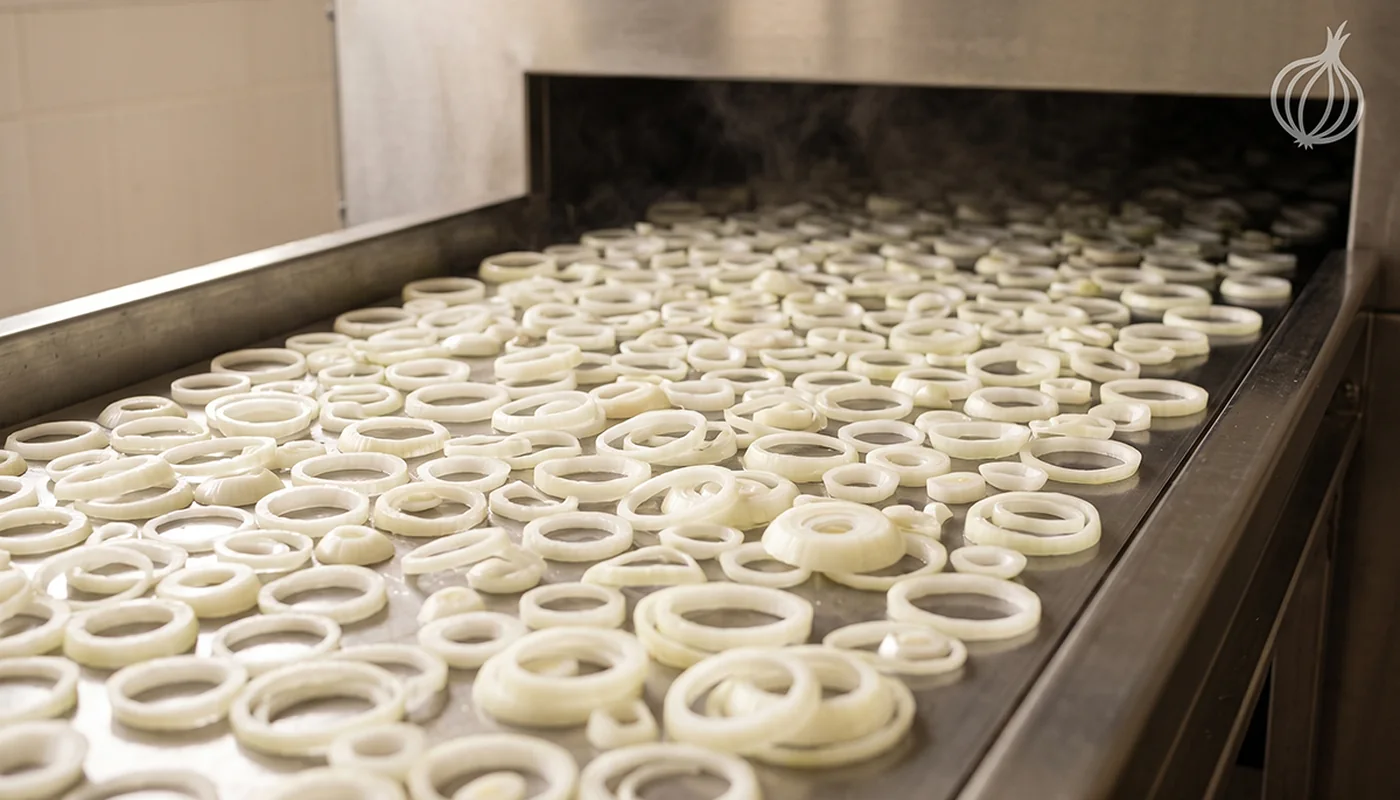
At a plant that sulphites, the sliced onion passes through a dip or spray of sodium metabisulphite solution, typically 0.1 to 0.5 percent, for a minute or two before it goes onto the dryer belt, or in older plants the drying air itself is dosed with burning sulphur. The tissue takes up sulphite, much of which is driven off as sulphur dioxide in the dryer, and the finished product carries a residue of 200 to 2,000 milligrams per kilogram as sulphur dioxide, depending on the dose, the drying and the cut; fine cuts and powder lose more in drying and retain less. The residue falls slowly in storage as sulphite oxidises to sulphate, so a sulphited lot tested at packing and again a year later shows a lower figure. None of this is hidden at a plant that does it: the metabisulphite is on the ingredient store shelf, the dip tank is on the line, and the product is declared "sulphited" on the specification and the bag, since the plant's own certification requires the declaration. The problem cases are the plant that runs both sulphited and sulphite-free lines and the exporter who buys from the market without knowing which process a lot came from. The eight steps of production, and where the dip sits in them, are in How Dehydrated Onion Is Made.
The EU legal position: additive rules and allergen labelling
Two regulations govern sulphite in dried onion in the EU, and they answer different questions. Regulation (EC) 1333/2008 on food additives says whether sulphite may be used and at what level. Its Annex II lists permitted additives by food category, and dried vegetables sit in category 04.2.1, dried fruit and vegetables, where sulphur dioxide and sulphites, E220 to E228, are permitted in named dried vegetables at maximum levels expressed as sulphur dioxide; the entries for dried white vegetables and for other dried vegetables carry different figures, and a buyer or supplier should read the current Annex II text for the level that applies to onion, as the annex has been amended several times and the figures are not reproduced here in case they move. Where sulphite is used, it must be declared in the ingredient list of the food it ends up in, by its name or E number, and the onion supplier's specification and bag label must state it so that the manufacturer can do so.
Regulation (EU) 1169/2011 on food information to consumers says how it must be declared. Its Annex II lists the fourteen substances that must be emphasised as allergens on the label, and sulphur dioxide and sulphites at concentrations above 10 milligrams per kilogram or per litre, expressed as total sulphur dioxide, are on that list. The rule applies to the finished food as sold, so what matters to a manufacturer is the sulphite the onion contributes to the finished product: a soup mix at 20 percent onion using a sulphited onion at 1,000 milligrams per kilogram carries 200 milligrams per kilogram from the onion alone and must declare it; the same mix using a sulphite-free onion at below 10 does not, provided no other ingredient contributes. For B2B supply, the food information regulation requires that the allergen information be passed along the chain so that the final labeller has it, which is why the allergen statement in a supplier's declaration should say in terms whether sulphite is present, absent or not detected, and at what limit. The whole set of EU rules that touches dried onion is in EU Import Requirements for Dehydrated Onion.
UK, US and other markets
| Market | Use permitted in dried onion? | Allergen declaration threshold | Notes |
|---|---|---|---|
| EU | Yes, per Annex II of Reg. 1333/2008, category 04.2.1 | >10 mg/kg as SO2, emphasised on label | Must be in ingredient list if used |
| UK | Yes, retained EU additive law | >10 mg/kg, emphasised | Same 14-allergen list as EU |
| USA | Yes, GRAS as a preservative in dried vegetables; prohibited on fresh produce served raw | ≥10 ppm must be declared on the label | Not one of the nine FALCPA allergens, but the 10 ppm declaration rule applies |
| Canada | Yes, listed preservative with limits | ≥10 ppm, listed among priority allergens | Sulphites are a named priority allergen in Canada |
| Australia and New Zealand | Yes, with limits under the Food Standards Code | ≥10 mg/kg, declared | Sulphite is on the mandatory declaration list |
| Gulf states, GSO | Yes, Codex-based limits | Declaration per GSO labelling standard | Sulphited onion still common in the market |
| Japan | Yes, with limits | Declared as an additive | Buyers usually specify sulphite-free |
| India, domestic | Yes, under FSSAI additive rules | Declared as an additive | Sulphited product common in domestic trade |
The pattern is the same everywhere that matters to an exporter: sulphite is permitted in dried onion within limits, and it must be declared at or above 10 milligrams per kilogram. The difference between markets is demand, not law. European, British, North American and Japanese manufacturers overwhelmingly specify sulphite-free, and the export plants in Mahuva have aligned their standard product to that; sulphited product persists in domestic and some Middle Eastern and African trade, where the paler colour and the lower price of the cheaper raw material it allows are still valued. The US rules for onion imports as a whole are in Importing Dehydrated Onion into the USA.
The health basis for the 10 mg/kg rule
Sulphites are not an allergen in the immunological sense for most people, and the label rule exists because a minority react to them: sulphite sensitivity affects perhaps 1 percent of the general population and 5 to 10 percent of people with asthma, in whom sulphite can trigger bronchospasm, and less commonly urticaria or anaphylactoid reactions. The 10 milligrams per kilogram threshold was set as the level at which reactions in sensitive people become a realistic risk and at which analytical methods could reliably measure. Separately, the acceptable daily intake set by the Joint FAO/WHO Expert Committee is 0.7 milligrams per kilogram of body weight as sulphur dioxide, and the European Food Safety Authority, in its 2016 and 2022 reviews, found data gaps and noted that intake by high consumers could exceed the ADI, which is one reason the Commission has been tightening the Annex II levels for some categories. For a manufacturer none of this changes the practical position: sulphite present above 10 must be declared, and a declared allergen is a cost, in labelling, in customer questions and in lost sales to the people who avoid it, that sulphite-free onion removes at the source. The wider allergen picture for dried onion, which is otherwise a clean ingredient, is in Allergens, Gluten and Dehydrated Onion.
Testing for sulphite, and why onion fools the standard method
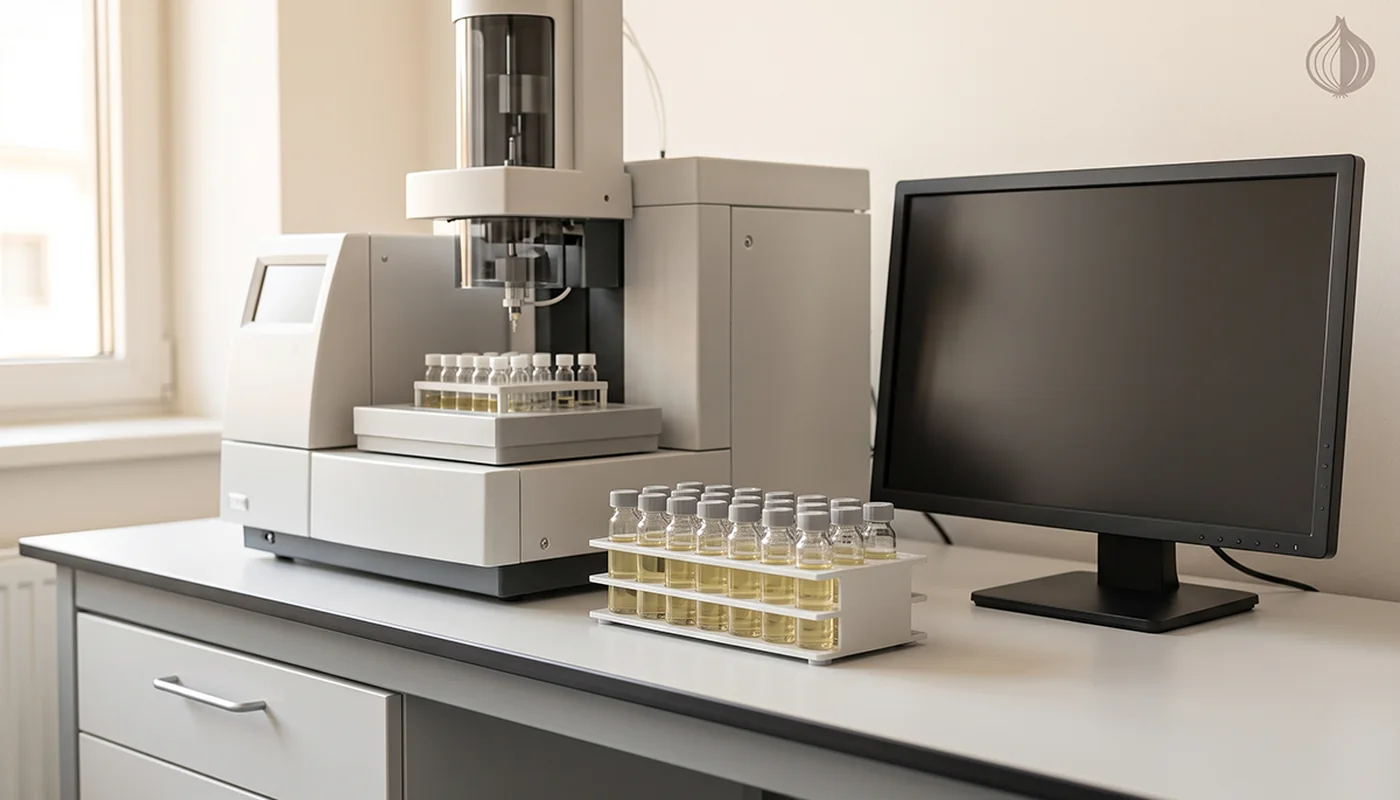
The reference method for sulphite in food is the optimised Monier-Williams procedure, AOAC 990.28: the sample is refluxed in acid, the sulphur dioxide driven off is carried by a nitrogen stream into hydrogen peroxide, where it becomes sulphuric acid, and the acid is titrated. It is robust and cheap, and it has a known weakness with onion and garlic. Those crops contain natural volatile sulphur compounds, the ones that make onion smell of onion, and under the acid reflux some of them decompose to sulphur dioxide or to other acids that the titration counts, so a sulphite-free onion can return an apparent sulphite result of 20 to 80 milligrams per kilogram by Monier-Williams, above the 10 threshold, with no sulphite in it. Every plant in Mahuva has a story of a sulphite-free lot rejected on a Monier-Williams result from an importer's laboratory. The methods that distinguish added sulphite from the crop's own sulphur are ion chromatography with conductivity detection after a controlled extraction, the enzymatic sulphite oxidase method, and liquid chromatography methods developed for allium crops; a laboratory that tests dried onion for sulphite should be asked which method it uses and whether it has validated it on onion, and a buyer's specification should name the method. The Monier-Williams result on a sulphite-free onion is not a fail; it is the wrong test. Reading the laboratory report in general is covered in How to Read a Dehydrated Onion Lab Report.
| Method | Principle | Limit of quantification | Suitability for onion |
|---|---|---|---|
| Optimised Monier-Williams, AOAC 990.28 | Acid reflux, distillation, titration | ~10 mg/kg | False positives from natural sulphur compounds; unsuitable as sole method |
| Ion chromatography, conductivity detection | Extraction, chromatographic separation of sulphite as sulphate after oxidation | ~5-10 mg/kg | Good, with an onion-validated extraction |
| Enzymatic, sulphite oxidase | Enzyme-specific oxidation, spectrophotometric | ~5-10 mg/kg | Good; specific to sulphite |
| LC-MS/MS after derivatisation | Mass spectrometric confirmation | ~1-5 mg/kg | Best for disputes; costly |
| Test strips, Ripper titration | Rapid screening | ~20-50 mg/kg | Screening only; not for certificates |
Keeping onion white without sulphite
A plant that makes sulphite-free onion white and keeps it white uses process control in place of chemistry, and the methods are worth knowing because they are what a buyer is paying for. The variety comes first: the white dehydrator varieties grown in Saurashtra for the plants have high dry matter, around 18 to 20 percent, and low reducing sugars, which slows Maillard browning in the dryer. Speed comes second: onion is peeled, sliced and on the dryer within an hour of the slice, so the cut surfaces have no time to brown enzymatically; a plant with a bottleneck between the slicer and the dryer makes cream product, not white. The drying profile is third: high air temperature at the wet end, where evaporation keeps the tissue cool, and low temperature, 55 to 60 degrees, at the dry end, where the tissue has no water to protect it and browns fastest; the moisture and colour relationship is in Dehydrated Onion Moisture Content. Quick cooling and immediate packing in a lined bag come fourth, since warm product in an open bin continues to brown. Storage below 25 degrees and away from light is fifth, because the non-enzymatic browning that sulphite would have blocked continues slowly in storage and is the reason sulphite-free onion shifts from white to cream over 18 to 24 months. Some plants also blanch before drying to inactivate the browning enzyme, at a cost in flavour and yield; most Mahuva plants do not. The colour grades, causes of browning and how to specify colour are in Dehydrated Onion Colour.
The colour difference a buyer will see
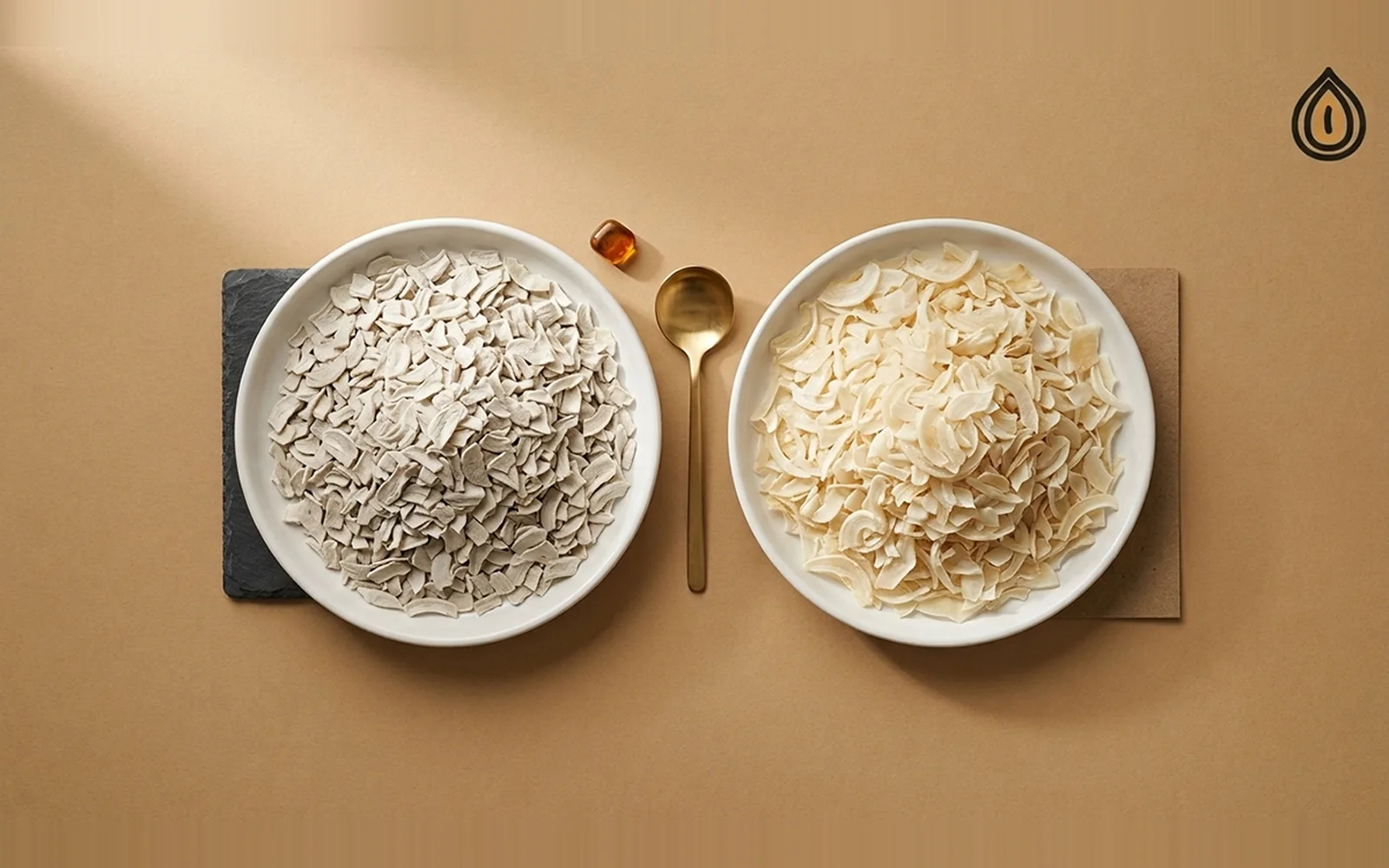
A buyer comparing a sulphited and a sulphite-free sample side by side sees a difference, and should know what it means. Sulphited flakes are a flat, uniform white with a faint grey cast and stay that way for two years; sulphite-free flakes from a good plant are ivory white with a warmer tone, and over a year in storage move toward pale cream. On a colour meter the difference is one or two units of whiteness at packing and three or four after a year. In the pot the difference disappears, since both cook to the same translucent pale gold, and in a pale product such as a cream soup the sulphite-free onion at the top colour grade is indistinguishable after processing. Where the difference matters is in products where the dry onion is seen: a topping, a visible inclusion in a bread, a clear jar. For those, a buyer choosing sulphite-free specifies the top colour grade and a fresh lot, and accepts the ivory tone, or uses the sulphited product and declares it. What a buyer should not do is specify sulphite-free and the flat white of a sulphited product together; the combination cannot be met, and a supplier who claims to meet it is either using sulphite or bleaching.
Cross-contact at plants that run both
The realistic sulphite risk for an EU buyer of sulphite-free onion is not a plant that secretly dips the onion; it is a plant that runs sulphited product for the domestic or Gulf market on the same line, or in the same dryer, with inadequate cleaning between. Sulphite residues in the dip tank, on the belt, in the dryer's dust and in the milling equipment transfer to the next run, and a sulphite-free lot that follows a sulphited one can pick up 20 to 100 milligrams per kilogram, enough to breach the declaration threshold in a product that uses onion at a high rate. A BRCGS-certified plant treats sulphite as an allergen under its allergen management programme, which means either a physical separation of lines, which the larger plants have, or a validated cleaning and a sequencing rule, sulphite-free first after a full clean, with verification testing; a buyer should ask which. The safest supply is a plant that does not use sulphite at all, and an increasing number in Mahuva have stopped, since their export customers do not want it and the domestic price for sulphited product no longer justifies the line. The supplier declaration should therefore say not just "sulphite not added" but "sulphite not used on these premises" or, failing that, describe the control. The allergen control questions belong in the supplier vetting in 25-Point Checklist Before You Choose a Dehydrated Onion Supplier.
Who still wants sulphited product
Sulphited dried onion is still made in India in volume, and the buyers are identifiable. The domestic market for onion powder and flakes in seasonings and snacks accepts it because the price is lower, since sulphiting lets a plant use cheaper, lower-dry-matter raw onion and older stock without visible browning, and because the label rules are less prominent. Some Gulf and African buyers specify it for the flat white colour that their markets expect, and for its antimicrobial effect in supply chains without controlled storage. Some pickle and chutney manufacturers use it as part of a formulation that is sulphited anyway. Export plants that serve those customers keep a sulphited line, and the exporter's job is to know which line a lot came from. The price gap between sulphited and sulphite-free product is small at the plant gate, 5 to 10 rupees per kilogram, and reflects the raw material and the colour grading more than the chemical; a European buyer offered "sulphite-free at the sulphited price" should ask how, and check the colour grade and the drying date of the lot on offer.
A short history: from burning sulphur to sulphite-free
Sulphur has been burned under drying fruit since antiquity, and the first Indian dehydration plants of the 1960s and 1970s, built to serve the domestic and Gulf trade, sulphured their onion in the same way, in closed chambers with sulphur pots before the drying tunnels. Metabisulphite dips replaced the pots in the 1980s because they were easier to control, and by the 1990s a typical Mahuva plant ran everything through the dip. The turn came with the export market: the EU allergen labelling directive of 2003, which put sulphites on the list of substances to be declared, took effect in 2005, the US had required declaration at 10 parts per million since 1986, and by the late 2000s the European and American buyers who were becoming the industry's best customers wanted sulphite-free product and were prepared to pay for the raw-material discipline it needed. The plants that invested in high-dry-matter varieties, fast lines and controlled dryers made the switch and won the export business; the ones that did not stayed in the domestic market. By the mid-2010s sulphite-free was the export standard, and the certified plants that supply Europe today mostly never installed a dip tank or have removed it. The trade's shift is one reason the Mahuva product improved as much as it did in twenty years: without sulphite, the only way to make white onion is to make it well.
The arithmetic: when sulphited onion tips a product over 10 mg/kg
A manufacturer deciding whether a sulphited onion would force a declaration can do the sum from the onion's inclusion rate and its sulphite level. The threshold is 10 milligrams per kilogram of total sulphur dioxide in the finished food as sold, or as consumed for a product that is diluted.
| Onion sulphite level (mg/kg as SO2) | Onion inclusion 0.5 % | Inclusion 2 % | Inclusion 10 % | Inclusion 25 % |
|---|---|---|---|---|
| <10 (sulphite-free) | <0.05 | <0.2 | <1 | <2.5 |
| 50 (cross-contact) | 0.25 | 1 | 5 | 12.5, declaration required |
| 300 (lightly sulphited) | 1.5 | 6 | 30, declaration required | 75, declaration required |
| 1,000 (typical sulphited) | 5 | 20, declaration required | 100, declaration required | 250, declaration required |
| 2,000 (heavily sulphited) | 10, at the threshold | 40, declaration required | 200, declaration required | 500, declaration required |
The sum shows why the standard has moved: a typical sulphited onion forces the declaration at an inclusion of 1 percent, which is the level of almost every soup, sauce and seasoning, and even cross-contact at 50 milligrams per kilogram forces it in a dry onion soup mix at 25 percent onion. It also shows the one case where sulphited onion is harmless to the label, a powder used at a fraction of a percent, which is why a few flavour houses still accept it; and it shows that a sulphite-free claim on an onion at "below 10" gives the manufacturer a margin of more than ten times at any realistic inclusion, which is the point of specifying it.
Questions for the plant audit
For a buyer auditing a plant, remotely or in person, the sulphite questions take ten minutes and settle the matter. Is sodium metabisulphite, or any sulphite, on the premises, and can we see the chemical store and the purchase register? If yes, which products is it used for, on which line, and where is the dip? How are sulphited and sulphite-free runs separated: physically, or by sequence and cleaning, and what does the cleaning validation show? Is sulphite in the allergen management programme under the plant's BRCGS certification, and what does the last audit report say about it? Which laboratory tests sulphite for the plant, by which method, and can we see the last twelve results on sulphite-free lots? What is the plant's statement on the bag and the specification: "not added", "not used on the premises", or something else? A plant with no sulphite on site answers the first question and the rest fall away; a plant that runs both should answer all of them from documents rather than from memory. The remote audit method as a whole is in How to Audit a Dehydrated Onion Supplier Remotely.
Specification wording for sulphite-free product
- Product line: "Dehydrated white onion powder 80 mesh, sulphite-free."
- Additive clause: "No sulphur dioxide or sulphite (E220-E228) or any other additive is used in the production of this product. The product is manufactured on premises where sulphite is not used" or, where that is not true, "…on a line physically separated from sulphited production, with allergen cleaning validated and verified by testing."
- Limit: "Total sulphur dioxide below 10 mg/kg, determined by ion chromatography or enzymatic method validated for allium products. Results by Monier-Williams distillation are not accepted as evidence of sulphite in onion products without confirmation by a specific method."
- Testing: "Tested per lot on the certificate of analysis" for high-inclusion uses, or "tested on a sampling plan of [n] lots per season" for low-inclusion uses.
- Declaration: "The supplier's allergen declaration states sulphite as absent, renewed annually, and the supplier undertakes to notify any change in process or premises before shipment."
- Colour: a colour grade or meter value appropriate to a sulphite-free product, with the shelf life at which it applies.
The specification as a whole, line by line, is in How to Read a Dehydrated Onion Specification Sheet.
KlarHarvest's position
KlarHarvest supplies sulphite-free product only, from BRCGS-certified plants in Mahuva that either do not use sulphite on the premises or run it on a physically separated line under a validated allergen programme; which of the two applies to a given plant is stated in the lot record. Every product page carries the sulphite-free declaration; the certificate of analysis carries a sulphite result by ion chromatography or the enzymatic method, with the method named, on request per lot or on a seasonal sampling plan, and a Monier-Williams result is never used as the sole evidence. Sulphited product is not offered. The declarations sit with the allergen statement on the quality page, and the onion powder specification on the powder page.
Frequently asked questions
Does dehydrated onion from India contain sulphites?
Export-grade product from the certified Mahuva plants is sulphite-free as standard. Sulphited product is still made for the domestic market and some others, so the specification and the supplier declaration should state which a lot is, and the certificate should carry a result.
Are sulphites allowed in dried onion in the EU?
Yes, within the levels in Annex II of the additives regulation for dried vegetables, and they must be declared in the ingredient list and, above 10 mg/kg in the finished food, emphasised as an allergen. Most EU buyers specify sulphite-free instead.
Why did my sulphite-free onion test positive for sulphite?
Most likely the Monier-Williams method, which reads onion's natural sulphur compounds as sulphite and returns 20 to 80 mg/kg on a sulphite-free sample. Ask for a specific method, ion chromatography or enzymatic, validated on onion.
Is sulphite-free onion less white?
Slightly: ivory rather than flat white, and it moves toward cream over a year or two of storage. After cooking there is no difference. Specify the top colour grade and a recent drying date where dry appearance matters.
What is the threshold for the allergen declaration?
10 mg/kg or 10 mg/l as total sulphur dioxide in the finished food, in the EU, UK, USA, Canada and Australia alike.
Can a sulphite-free lot pick up sulphite at the plant?
Yes, from a sulphited run on the same line without validated cleaning; 20 to 100 mg/kg is possible. Ask whether the plant uses sulphite at all and, if it does, how the lines are separated.
Does sulphite-free onion have a shorter shelf life?
Not for safety. Sulphite-free product keeps 18 to 24 months; the colour shifts toward cream in that time, which sulphite would have slowed, but moisture, counts and flavour hold if the product is stored dry and cool.
Next step
Request a sample and it comes with the sulphite result by a specific method and the plant's sulphite-use statement; to specify sulphite-free product for a high-inclusion use with per-lot testing, request a quote and say so, and the testing is priced in.