- Group 1: identity and legitimacy (points 1-5)
- Group 2: certification and food safety (points 6-10)
- Group 3: product and specification (points 11-14)
- Group 4: sampling and testing (points 15-18)
- Group 5: commercial terms (points 19-22)
- Group 6: logistics and communication (points 23-25)
- The order to run the checks in
- A scoring sheet
- Manufacturer, exporter or trader: what changes on the checklist
- Ten questions for the first video call
- The supplier approval file: what to keep
- Re-checking an approved supplier each season
- If you are a small buyer
- How KlarHarvest answers the 25 points
- Frequently asked questions
Judge the product, not the words
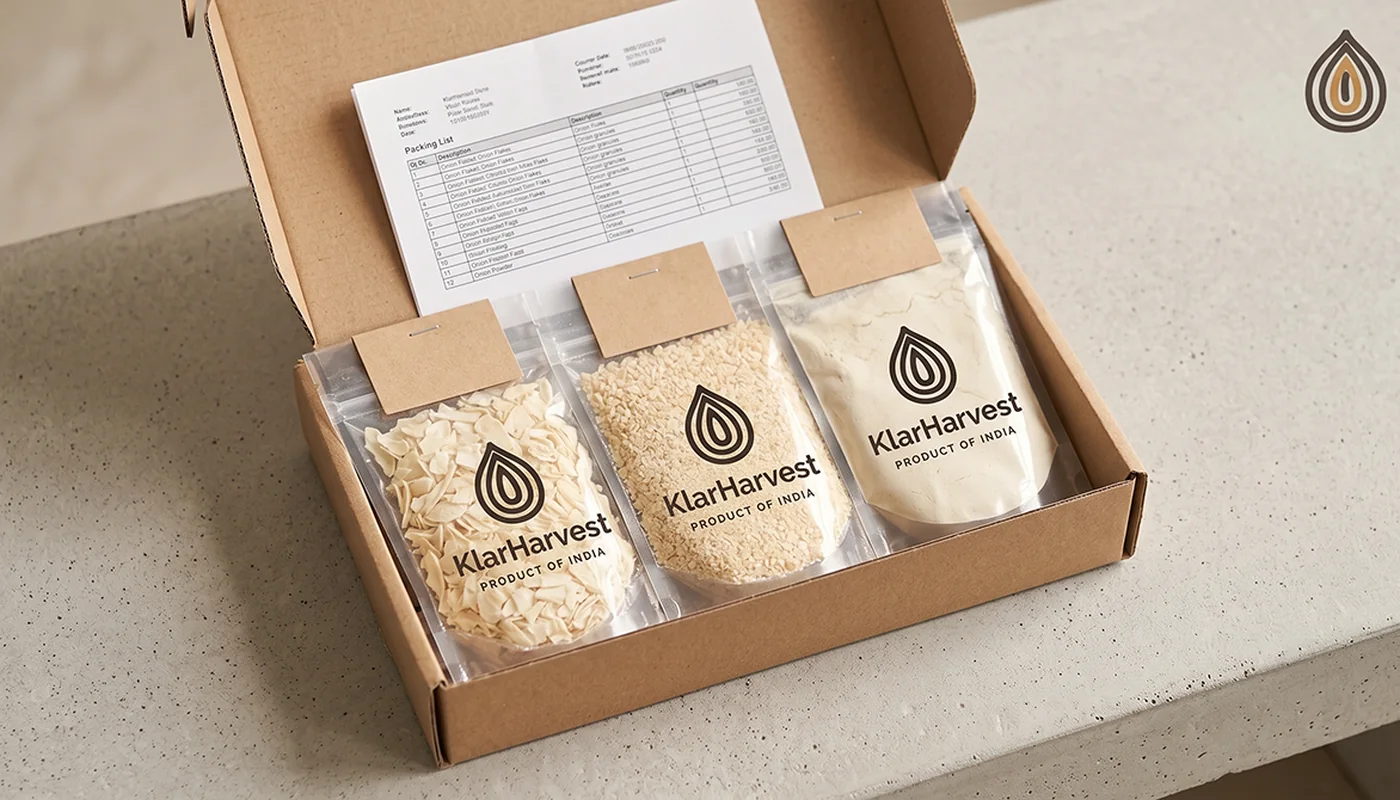
200-500 g from a current lot, dispatched by courier with the lot lab report.
Request a sampleA dehydrated onion supplier checklist exists because the failures in this trade are predictable. The same dozen things go wrong for first-time importers year after year: a plant that turned out to be a trader, a BRC certificate that belonged to somebody else, a specification with no numbers, a lab report on a different lot, a quote that was never valid at the price quoted, a container that weighed less than the invoice said. Every one of them is visible before the order if you know where to look. This checklist is the where.
It is 25 points in six groups: identity and legitimacy, certification and food safety, product and specification, sampling and testing, commercial terms, and logistics and communication. Each point says what to ask for, what a good answer looks like, and what a bad answer looks like. A scoring sheet at the end turns the answers into a decision, and a section on the order in which to run the checks keeps the work to a few hours rather than a few weeks. It is written for a European or other overseas buyer sourcing from India, where most of the world's dehydrated onion comes from, and specifically from Mahuva in Gujarat, where most of India's comes from; the geography is in Mahuva, Gujarat: Inside India's Onion Dehydration Hub.
Current for March 2026.

What this guide covers
- Group 1: identity and legitimacy (points 1-5)
- Group 2: certification and food safety (points 6-10)
- Group 3: product and specification (points 11-14)
- Group 4: sampling and testing (points 15-18)
- Group 5: commercial terms (points 19-22)
- Group 6: logistics and communication (points 23-25)
- The order to run the checks in
- A scoring sheet
- Manufacturer, exporter or trader: what changes on the checklist
- Ten questions for the first video call
- The supplier approval file: what to keep
- Re-checking an approved supplier each season
- If you are a small buyer
- How KlarHarvest answers the 25 points
- Frequently asked questions
Group 1: identity and legitimacy (points 1-5)
1. Legal entity and registrations. Ask for the company's legal name, its Indian registration (a company or LLP number from the Ministry of Corporate Affairs, or a proprietorship's GST registration), its Importer-Exporter Code from the Directorate General of Foreign Trade, and its APEDA registration. Good: all four provided on request, names consistent across them, and each verifiable on the public register. Bad: a WhatsApp number and a Gmail address, a name that changes between the letterhead and the invoice, or an IEC that belongs to a different company "that we export through". The registrations and how to verify them are in FSSAI, APEDA and IEC.
2. Who actually makes the product. Ask, in plain words, whether the supplier owns the plant that dries the onion, sources from plants it names, or buys finished product from the market. All three can be legitimate; only the answer that hides the truth is a problem. Good: a straight answer, and for an exporter or trader, the names of the plants and permission to verify with them. Bad: "our own factory" with photographs that turn out to be another company's, which a reverse image search catches in a minute.
3. Physical address and the option to visit. A plant has a plot number in a GIDC estate or a village address on the Mahuva road, and a godown has one too. Good: an address that resolves on a map to an industrial building, and a standing invitation to visit or to take a live video walk-through. Bad: an office address in a city with no facility, or a visit that is always "next month".
4. Track record with your kind of buyer. Ask for two references from importers in your region, or, if the supplier is new, for the plants' references. Good: references that answer an e-mail and describe orders like yours. Bad: references who cannot be contacted or who turn out to be the same person. A new exporter with transparent sourcing and a strong plant behind it can be a fine choice; one that invents a track record cannot.
5. Bank details on letterhead, verified by call. Payment fraud in this trade is nearly always a changed bank account in an e-mail chain. Good: bank details on a signed letterhead, confirmed by a phone call to a number you found independently, and a standing rule that any change is confirmed the same way. Bad: bank details that arrive by e-mail only, or that change after the proforma. The payment side is in Payment Terms for Dehydrated Onion Imports.
Group 2: certification and food safety (points 6-10)
6. BRCGS or equivalent GFSI certificate in the name of the plant. Ask for the certificate PDF and the audit report summary, then verify the certificate number in the BRCGS Directory. Good: a valid certificate in the name of the plant that will produce your goods, with the product scope covering dehydrated onion, grade AA or A, and the audit report available under a confidentiality agreement. Bad: a certificate in another company's name, an expired one, or one for a different site. The meaning and limits of the certificate are in What BRC Certification Means for a Dehydrated Onion Supplier.
7. FSSAI licence covering the activity. A plant holds a manufacturing licence; an exporter with a godown holds a storage or trading licence. Good: a licence number that checks on the FSSAI portal, for the right premises and category. Bad: no licence, or a licence "applied for" with no number after a year in business.
8. HACCP plan and the critical control points named. Ask which steps are critical control points and what the limits are. Good: a plant that names dryer outlet moisture, metal detection and, for treated product, the steam-treatment temperature and time, with the monitoring records available. Bad: "we have HACCP" and nothing more.
9. Statement on chemical treatments. Ask for a written declaration that no ethylene oxide, no irradiation and, unless you want it, no sulphite is used, and how counts are reduced instead. Good: a declaration on letterhead plus an explanation of steam treatment. Bad: silence, or a vague "we treat as required". See Ethylene Oxide and Dehydrated Onion.
10. Allergen and foreign-body controls. Ask what else runs through the plant and how the line is cleaned, and what metal detection and sieving is in place. Good: a plant that runs only onion and garlic and other dehydrated vegetables, names its cleaning validation, and has an in-line metal detector with a test record. Bad: a plant that packs spice blends with mustard, celery or gluten-containing ingredients on the same line without a changeover procedure. The allergen question is in Allergens, Gluten and Dehydrated Onion.

Group 3: product and specification (points 11-14)
11. A written specification with numbers. Ask for the specification sheet for the cut you want. Good: moisture maximum, particle-size band with the share inside it, colour grade, microbiology tier with the counts, defect limits, bulk density, packaging and shelf life, all with numbers. Bad: a sheet of adjectives, or one that copies a competitor's numbers the plant cannot meet. What every line means is in How to Read a Dehydrated Onion Specification Sheet.
12. The full range of cuts and colours. Ask which cuts and colours the supplier can ship from the same source. Good: white and red in all five cuts, with the custom bands and the microbiology tiers available and priced, and a straight answer about which come from which plant. Bad: only flakes and powder, with the rest "arranged" from unnamed sources.
13. Lot and traceability system. Ask what a lot number tells you. Good: lot codes that resolve to plant, drying date, line and, at the better plants, the field block, with the lab report attached to the lot; ideally a portal or a QR code that shows it. Bad: a lot number that is the invoice number. Traceability is in Lot Codes and Traceability in Dehydrated Onion.
14. Honest stated shelf life and storage advice. Ask for the shelf life and the storage conditions. Good: 18 to 24 months in the original sealed liner below 25 degrees and 65 percent relative humidity, with advice on caking and re-sealing. Bad: "three years, no special storage". The evidence is in Dehydrated Onion Shelf Life.
Group 4: sampling and testing (points 15-18)
15. Samples from a named lot, with its report. Ask for 250 to 500 grams of each cut from a current lot, with the lot number and the lab report for that lot. Good: samples arrive within a week, courier tracked, with the report and a retained sample kept at the supplier. Bad: samples with no lot number, or a report dated before the lot existed. The sample process is in From Sample to First Container.
16. Laboratory accreditation. Ask which laboratory issues the certificates of analysis and for its accreditation. Good: an NABL-accredited laboratory, ISO 17025, with the certificate number printed on the report and the scope covering the tests. Bad: an in-house report on plain paper. Reading the report is in How to Read a Dehydrated Onion Lab Report.
17. Pesticide residue and heavy-metal results on the dry product. Ask for the most recent multi-residue screen and lead and cadmium results. Good: a 500-plus-active screen at 0.01 milligrams per kilogram on the dry product with the processing-factor convention stated, and metals well inside the EU limits. Bad: no residue testing "because our farmers do not spray", which is not a test result.
18. Pre-shipment sampling and a sealed retained sample. Ask whether you can have the lot sampled by a third party before shipment and whether a sealed sample is retained. Good: yes to both, with SGS, Bureau Veritas or a local NABL laboratory sampling at the plant at your cost, and a retained sample held for the shelf life. Bad: no third-party access to the goods before they sail.
Group 5: commercial terms (points 19-22)
19. A quote that names its basis and its validity. Ask for FOB and CIF prices with the port, the cut, the microbiology tier, the packing and the validity period. Good: a written quote with a 7 to 10 day validity, the raw-onion basis it rests on, and a clear statement of what is included. Bad: a price with no validity and no Incoterm, or one so far below the market that the arithmetic does not work; the arithmetic is in What Does Dehydrated Onion Cost per Kilogram? and the validity logic in Why Dehydrated Onion Quotes Are Valid for 7 Days.
20. Reasonable payment terms for a first order. Good: 30 percent advance and 70 percent against copy documents for a first container, moving to documents against payment or open account with credit insurance as trust builds, or an irrevocable letter of credit if you prefer. Bad: 100 percent advance for a first order from a supplier you have not met, or a supplier that refuses a letter of credit outright.
21. Minimum order quantity that fits you. Ask what the smallest order is and how it is shipped. Good: a pallet or a few pallets by LCL for a first order, priced honestly with the LCL surcharge shown, and a full container price beside it. Bad: "one container minimum" to a buyer who needs two pallets, or a pallet price that hides a fifty percent LCL penalty. The options are in Minimum Order Quantity for Dehydrated Onion.
22. Claims procedure in writing. Ask what happens if a lot fails on arrival. Good: a procedure in the contract, with a notice period, a joint sampling method, an agreed referee laboratory and the remedies, replacement or credit. Bad: "no problem, we will see", which means an argument later. Contract terms are in B2B Contract Terms for Dehydrated Onion.
Group 6: logistics and communication (points 23-25)
23. Realistic container weights and lead times. Ask how many tonnes of your cut fit a 20-foot container and how long from order to vessel. Good: about 10 tonnes for flakes, more for finer cuts, and 3 to 5 weeks from order to sailing in season, longer off-season. Bad: 12.5 tonnes of flakes promised in a 20-foot box, which does not fit and ends as a short shipment or a bag count that does not match. Loading facts are in How a Dehydrated Onion Container Is Loaded.
24. Documents drafted for checking before sailing. Ask whether invoice, packing list, certificate of origin and bill of lading drafts come to you before the vessel leaves. Good: yes, as routine, with your item codes and lot numbers on them. Bad: documents that arrive after the container does, with errors that cost a week at customs.
25. Response time and a named person. Send a specific technical question and time the reply. Good: a complete answer inside a business day from a named person who understands the product, and a stated commitment on response time. Bad: three days of silence, then a reply that answers a different question. In this trade the quality of the first three e-mails predicts the quality of the next three years.
The order to run the checks in
The list is long and most of it can be done at a desk in an afternoon if it is run in the right order. Day one, points 1, 2, 3, 6 and 7: the registrations and certificates, all verifiable online, which eliminate half of the candidates without a single e-mail. Day two, points 11, 12 and 19: the specification and the quote, one e-mail each, which show whether the supplier can write numbers down and whether the price is real. Days three to ten, points 15, 16 and 17: samples requested and received, with their reports. Meanwhile, points 4, 5, 8, 9, 10, 13 and 14 by e-mail and a video call. Points 18, 20, 21 and 22 belong to the contract negotiation. Points 23, 24 and 25 are observed, not asked, over the whole process. Two candidates that pass everything are the right number to hold; one supplier is a risk and three is an administrative burden. The whole sequence from first contact to first container is laid out in How to Import Dehydrated Onion from India.
A scoring sheet
| Group | Points | Weight | Fail means |
|---|---|---|---|
| Identity and legitimacy | 1-5 | Gate | Any fail on 1, 2 or 5 ends the evaluation |
| Certification and food safety | 6-10 | Gate for EU buyers | No valid GFSI certificate at the producing plant ends it for retail and manufacturing supply |
| Product and specification | 11-14 | 25 % | Score each 0-2; below 5 of 8 is a weak supplier |
| Sampling and testing | 15-18 | 25 % | No accredited lab or no residue data ends it |
| Commercial terms | 19-22 | 25 % | Score 0-2; note refusals, they predict disputes |
| Logistics and communication | 23-25 | 25 % | Score 0-2; response time is the strongest single predictor |
Score the non-gate points 0, 1 or 2, sum them, and compare candidates on the total out of 30; a supplier scoring under 20 is one to keep on file rather than to order from. The gates are absolute: a supplier that fails identity or certification does not get a score, however good the price.
Manufacturer, exporter or trader: what changes on the checklist
| Point | Manufacturer (plant) | Exporter sourcing from named plants | Trader buying finished stock |
|---|---|---|---|
| 2 Who makes it | Itself | Named plants, verifiable | Often unknown per lot |
| 6 BRC certificate | Its own | The plants'; exporter's own storage certification a plus | Rarely traceable to the lot |
| 13 Traceability | To the field block | To the plant and lot, via the plant | To the invoice |
| 12 Range | Its own cuts and colours | Widest, across plants | What is in stock |
| 21 MOQ | Often a container | Pallets and LCL | Variable |
| 25 Communication | Variable; production-focused | Usually the strongest | Variable |
Each model has its place, and the choice between them is the subject of Exporter, Trader or Manufacturer: Who Should You Buy Dehydrated Onion From?; the twelve warning signs that apply to all three are in 12 Red Flags When Dealing with a Dehydrated Onion Exporter.
Ten questions for the first video call
A thirty-minute video call, with the camera at the supplier's end walking through the premises, settles more than a month of e-mail. The questions that get the most out of it, in the order to ask them: Which plant will dry my product, and can we walk to the dryer now? What is the onion in the receiving area today, where did it come from and what did it cost at the yard this week? Show me the metal detector and its last test record. Which lot is being packed at the moment, and what does its lot number encode? Where is the laboratory sample for that lot, and which laboratory tests it? How many tonnes of my cut did you ship last season, and to which countries? What was your last customer complaint about, and what did you change? Who will answer my e-mails, and what is their working day in my time zone? What happens if raw onion rises by two rupees after I confirm an order at your price? And, at the end, is there anything about your operation you would rather I heard from you than found out later? The answers matter less than the manner: a plant manager who walks to the dryer without hesitation, reads the lot number off a bag and names the laboratory is a supplier; one who keeps the camera in the office is not yet. Record the call, with permission, for the approval file.
The supplier approval file: what to keep
A European retailer's or manufacturer's auditor will ask an importer for its supplier approval file, and the 25 points produce one if the answers are kept. The file should hold, per supplier: the registration documents and the date each was verified online; the BRCGS or other certificate with the directory check date and the audit summary; the FSSAI licence; the signed specification per cut; the supplier declarations for allergens, ethylene oxide, irradiation, GMO and sulphite, dated and renewed yearly; the sample reports and the importer's own verification results; the plant walk-through recording or visit report; the contract with the claims clause; the references contacted and their replies; and the scoring sheet with the date and the reviewer's name. Keep it as a folder per supplier with a one-page index, and put a review date on the index twelve months out. The file is also what protects the importer under the general food law if a problem arises: an importer who can show due diligence on paper is in a different position from one who cannot, and the obligations that make the file necessary are in EU Import Requirements for Dehydrated Onion.
| File section | Contents | Renewal |
|---|---|---|
| Identity | Registrations, IEC, APEDA, bank letterhead, verification dates | Yearly, and on any change |
| Certification | GFSI certificate, audit summary, FSSAI licence, HACCP summary | At each certificate expiry |
| Specification | Signed specification per cut, colour and tier | On any change; review yearly |
| Declarations | Allergen, EtO, irradiation, GMO, sulphite, origin | Yearly |
| Testing | Sample reports, lot certificates, own verification results, sampling plan | Per lot; plan reviewed yearly |
| Commercial | Contract, claims clause, terms, price history | Per contract |
| Performance | Delivery dates vs promised, claims, response times, scoring sheet | Updated per order |
Re-checking an approved supplier each season
Approval is not permanent. The onion trade runs on a yearly crop, plants change hands, certificates lapse, and the person who answered e-mails last year may have left. A light re-check each season, before the first new-crop order, keeps the file honest: verify the certificate again in the directory, since a plant that failed its audit in the off-season will not always say so; ask for the new season's specification and price basis, since the raw-onion market resets in March and April; request a new-crop sample with its report, since the first lots of a season are where drying problems appear; confirm the contact person and the bank details by phone; and score the previous season's performance, delivery dates against promised, claims raised and how they were settled, response times. A supplier whose score falls two seasons running is one to replace before it fails, not after. The season's rhythm, and why the re-check belongs in March, is in The Indian Onion Harvest Calendar.
If you are a small buyer
A buyer of a pallet or two cannot fly to Mahuva, commission a third-party inspection on every lot or run a full residue screen on 500 kilograms of product, and does not need to. The gates still apply in full, because they cost nothing: registrations, a certificate verified in the directory, a clear answer on who makes the product, bank details confirmed by phone, and a refusal to pay more than half in advance. The rest scales down: the supplier's own lot certificate stands in for the buyer's testing, a video walk-through stands in for the visit, a retained sample and a kitchen trial stand in for the laboratory, and a documented claims procedure stands in for the inspection. What a small buyer should insist on is transparency about the plant, since a small order is more likely to be met from whatever stock the exporter holds, and a lot number that resolves to a certificate. The practical options for small orders, pallets and LCL and consolidators, are in Buying Dehydrated Onion as a Small Food Business.
How KlarHarvest answers the 25 points
KlarHarvest is an exporter sourcing from named BRCGS-certified plants in Mahuva, and the answers to the 25 points are on the site rather than in a reply: the registrations and their status on the quality page, the specification per cut on each product page, the lot system and the client portal on our process page, the people on the about page. Samples come from a named lot with the NABL report; supplier declarations are issued at approval; documents go to the buyer as drafts before sailing; and the response commitment is one business day for any inquiry. The point on which an exporter cannot match a plant, the field-block traceability, is answered by the plant's own lot record, which the portal shows unchanged.
Frequently asked questions
What is the single most important check on a dehydrated onion supplier?
The BRCGS certificate in the name of the plant that will produce your goods, verified in the BRCGS Directory, together with a clear answer to who makes the product. Those two together eliminate most of the risk.
Can I trust a supplier I have never visited?
Yes, if the desk checks pass, the samples match their reports, a live video walk-through is offered and a third party can sample before shipment. A visit is better than any of these but is not the only route.
How many suppliers should I evaluate?
Screen five to eight at the desk, sample from three, contract with one and keep a second qualified. One supplier is a risk; more than two is an administrative burden.
Is a low price a red flag?
A price well below the cost arithmetic of raw onion, yield and drying is. Either the lot is old or off-grade, or the quote will not be honoured when the raw price moves.
Should I insist on a manufacturer rather than an exporter?
Not necessarily. Plants sell containers and focus on production; exporters serve smaller orders, wider ranges and communication. What matters is that the plant is named and certified and the exporter is transparent.
How long does a proper supplier evaluation take?
About two weeks, most of it waiting for samples. The desk checks take an afternoon; the samples and reports a week to ten days; the contract points a few e-mails.
What if a supplier refuses third-party pre-shipment inspection?
Treat it as a fail on point 18. Inspection at the buyer's cost is routine in this trade, and a refusal has no innocent explanation.
Next step
Run the list against KlarHarvest: request a sample from a named lot and the report comes with it, or request a quote and the basis, validity and terms are stated on the quote itself.