- The units of the trade: bags, pallets, LCL, 20 ft and 40 ft
- How much fits: container loads by cut
- Why suppliers name the minimums they name
- What a small order really costs: freight and fixed charges per kilogram
- The price breaks: where buying more gets cheaper
- Mixed pallets and mixed containers
- Samples: quantities, cost and what to test
- Planning a first order that is small and still sensible
- From pallets to containers: when to make the step
- Lead times by order size
- Air freight for small urgent quantities
- What a pallet and a container mean for your warehouse
- Below the line: when a European stockist is the right answer
- How KlarHarvest handles small and mixed orders
- Frequently asked questions
Judge the product, not the words
200-500 g from a current lot, dispatched by courier with the lot lab report.
Request a sampleThe dehydrated onion minimum order quantity that a supplier names tells you more about the supplier than about the product. Plants prefer full containers because a container is one production run, one set of documents and one truck. Exporters who serve smaller buyers accept a single pallet because they consolidate. Traders on marketplaces write "MOQ 1 tonne" or "MOQ 50 kilograms" depending on the day. None of these numbers is a property of onion, and a buyer who understands where they come from can usually get the quantity that suits the business, at a price that reflects the real cost of a small order rather than a made-up one.
This guide explains how order size works in the dehydrated onion trade: what a pallet, an LCL shipment, a 20 foot container and a 40 foot container hold for each cut, what each size costs per kilogram to move, where the price breaks are, what suppliers actually mean by their minimums, how mixed pallets and mixed containers let a buyer reach a sensible quantity with several products, how samples fit in, and how to plan a first order and a second one. It is written for the food business that needs less than a container and wants to know whether direct import still makes sense, and for the one that has outgrown pallets and wants to know when to fill a box.
Weights, freight and prices are as of January 2026 for standard white onion from Mahuva; they are ranges and they move.
What this guide covers
- The units of the trade: bags, pallets, LCL, 20 ft and 40 ft
- How much fits: container loads by cut
- Why suppliers name the minimums they name
- What a small order really costs: freight and fixed charges per kilogram
- The price breaks: where buying more gets cheaper
- Mixed pallets and mixed containers
- Samples: quantities, cost and what to test
- Planning a first order that is small and still sensible
- From pallets to containers: when to make the step
- Lead times by order size
- Air freight for small urgent quantities
- What a pallet and a container mean for your warehouse
- Below the line: when a European stockist is the right answer
- How KlarHarvest handles small and mixed orders
- Frequently asked questions
The units of the trade: bags, pallets, LCL, 20 ft and 40 ft
Dehydrated onion moves in five units, and each one is a step in cost per kilogram.
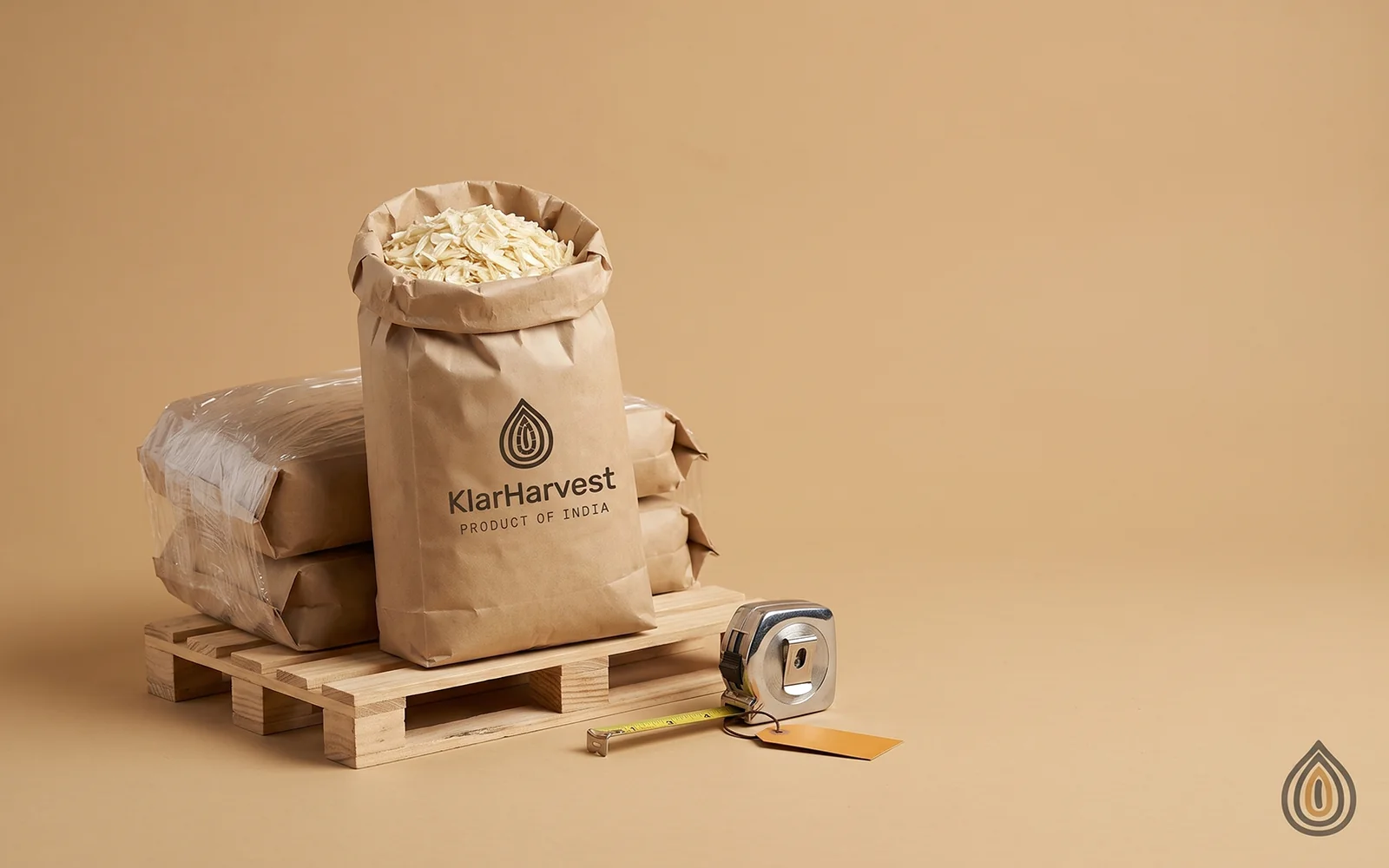
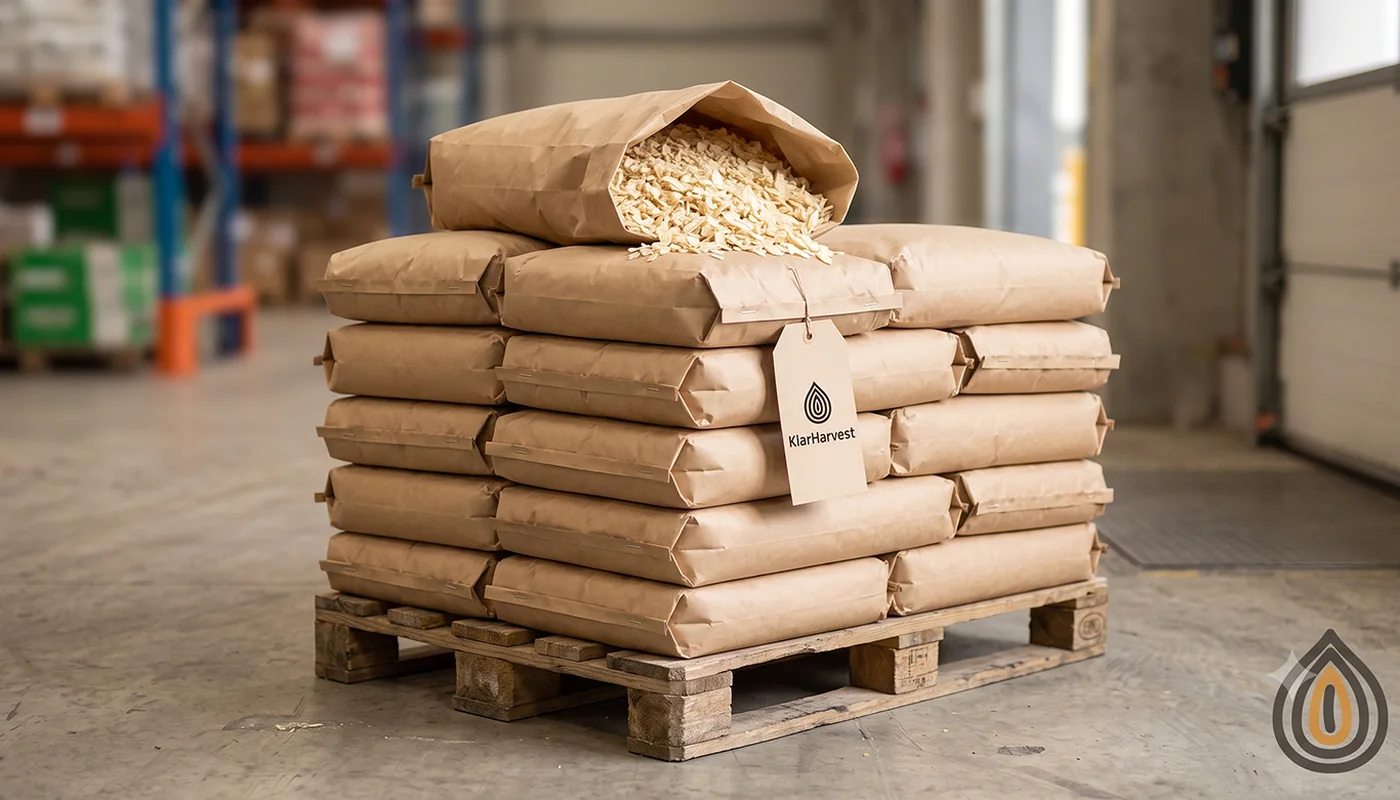
- The bag: 20 kilograms net in a polyethylene liner inside a kraft paper or woven polypropylene bag, the standard export unit. Cartons of 10 or 12.5 kilograms exist for retail-oriented buyers and for air freight. Nobody ships a single bag by sea; a bag is the unit inside a pallet.
- The pallet: a standard 1,200 by 1,000 millimetre pallet stacked to about 1.6 metres takes 30 to 40 bags, which is 600 to 800 kilograms of flakes or up to 1,000 kilograms of the denser cuts. A Europallet, 1,200 by 800, takes about 25 percent less. The pallet is the smallest unit a forwarder will consolidate.
- LCL (less than container load): one to about ten pallets consolidated with other shippers' cargo in a shared container. Freight is charged per cubic metre or per tonne, whichever is greater, plus fixed charges at each end. This is the unit for first orders and for small businesses.
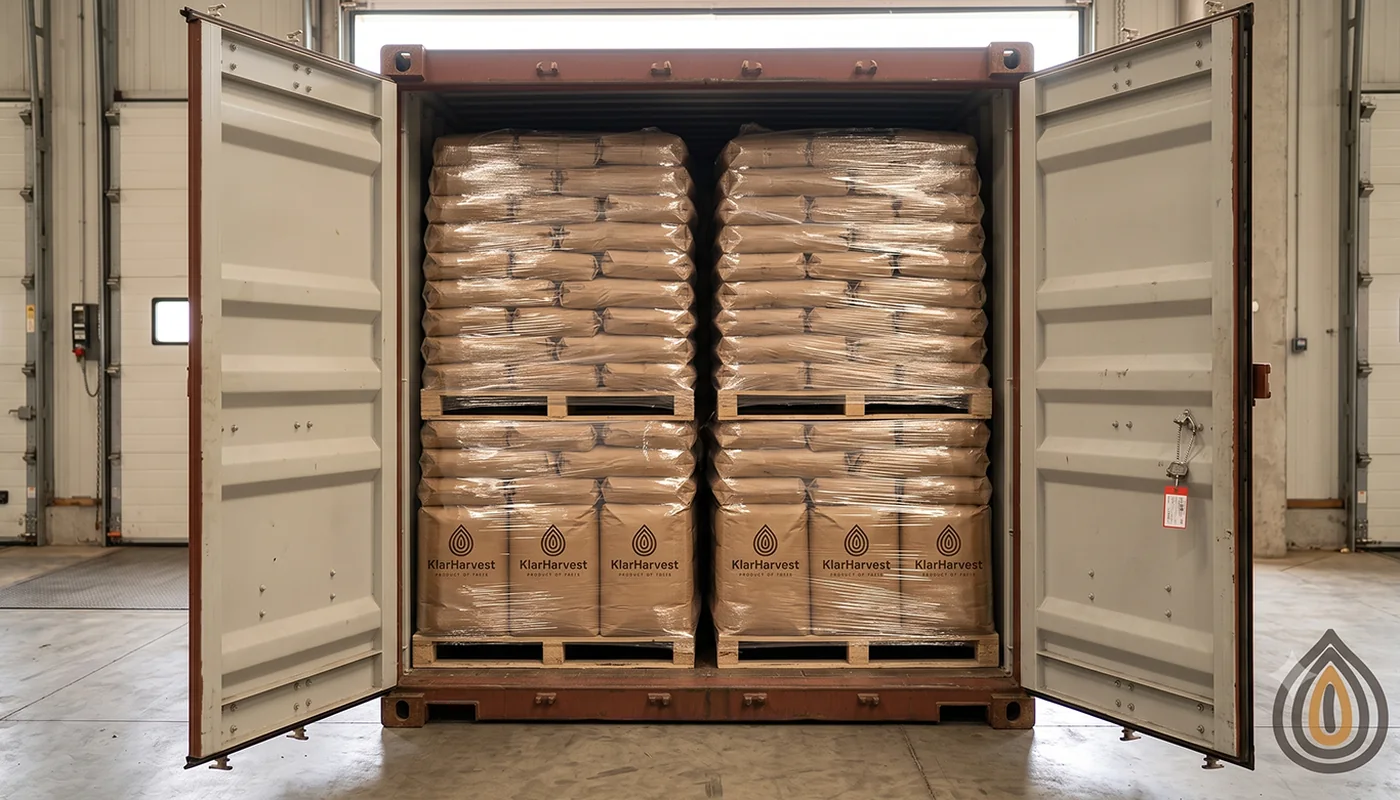
- The 20 foot container (FCL): 33 cubic metres, which onion fills long before it reaches the weight limit. The unit at which freight per kilogram falls sharply and the exporter can stuff at its own premises under customs seal.
- The 40 foot high-cube container: 76 cubic metres, roughly double the 20 foot load for a freight rate that is far less than double. The unit for distributors and large users.
How much fits: container loads by cut
Onion cubes out. A 20 foot container has a payload limit of about 21 tonnes but a volume of 33 cubic metres, and flakes at 180 to 230 grams per litre fill the volume at about 10 tonnes on pallets. The denser cuts fit more, and powder comes close to the weight limit. These loads decide freight per kilogram, which is why the same ocean rate gives flakes nearly twice the freight cost per kilogram of powder.
| Cut | Bulk density (g/l) | Per pallet (kg) | 20 ft container (kg) | 40 ft HC container (kg) |
|---|---|---|---|---|
| Flakes | 180-230 | 600-700 | 9,000-10,500 | 19,000-21,000 |
| Chopped | 280-350 | 800-900 | 12,000-13,500 | 21,000 (weight limit) |
| Minced | 350-450 | 900-1,000 | 14,000-16,000 | 21,000 (weight limit) |
| Granules | 450-550 | 1,000 | 16,000-18,000 | 21,000 (weight limit) |
| Powder | 500-650 | 1,000 | 18,000-20,000 | 21,000 (weight limit) |
The figures assume palletised cargo, which European buyers want for handling and which costs about 10 percent of the volume. Floor-loaded bags, stacked without pallets, fit 10 to 15 percent more and are common for bulk markets but slow to unload in a European warehouse. The full comparison of LCL and containers, with the arithmetic of when to fill a box, is in LCL or Full Container?
Why suppliers name the minimums they name
Four things sit behind a stated minimum order quantity, and each can be negotiated once it is understood.
Production runs. A plant changes its sieve stack for a cut and its dryer settings for a colour; a run of a few hundred kilograms costs almost as much to set up as one of ten tonnes. Plants therefore quote minimums per cut, typically 1 to 5 tonnes, and prefer to fill a container from stock cuts. An exporter who holds stock of the standard cuts can sell one pallet from it without asking the plant for a run.
Documents and handling. Every shipment, whatever its size, needs an invoice, a packing list, a certificate of origin, a phytosanitary certificate, a certificate of analysis and a customs filing, and someone has to arrange the truck and the booking. That is a fixed cost of a few hundred euros per shipment, and on one pallet it is 0.30 to 0.50 euros per kilogram, on a container it is 0.03. Suppliers who state high minimums are often saying they do not want to do that work for a small invoice.
Payment risk and administration. A 1,000 euro order from a new foreign buyer carries the same bank charges, the same advance-payment paperwork and the same risk of a dispute as a 20,000 euro order. Some suppliers price that in; some decline it.
Market positioning. Plants that sell containers to multinationals do not want pallets; exporters who built their business on smaller European buyers do. Neither is wrong, and a buyer should look for the supplier whose minimum matches its size rather than negotiating a large plant down to a pallet it will resent.
The realistic minimums, as of January 2026: from a plant directly, 1 to 5 tonnes per cut and a preference for containers; from an exporter serving smaller buyers, one pallet of any stock cut, and a few hundred kilograms per cut inside a mixed pallet; from a European stockist, one bag. Marketplace listings that say 50 kilograms are usually traders quoting for samples or for domestic delivery, and the price on the listing will not survive a request for a real quote.
What a small order really costs: freight and fixed charges per kilogram
The FOB price of onion is nearly the same for a pallet and for a container; the difference in landed cost is entirely in freight and fixed charges spread over fewer kilograms. The table shows the arithmetic for white onion flakes to a warehouse near Hamburg at January 2026 rates.
| Order | Weight | FOB (1.70 EUR/kg) | Freight and charges | Duty 6.4 % | Landed total | Landed per kg |
|---|---|---|---|---|---|---|
| 1 pallet LCL | 650 kg | 1,105 EUR | 560 EUR | 95 EUR | 1,760 EUR | 2.71 EUR |
| 3 pallets LCL | 1,950 kg | 3,315 EUR | 950 EUR | 260 EUR | 4,525 EUR | 2.32 EUR |
| 6 pallets LCL | 3,900 kg | 6,630 EUR | 1,500 EUR | 500 EUR | 8,630 EUR | 2.21 EUR |
| 20 ft FCL | 10,000 kg | 17,000 EUR | 2,400 EUR | 1,220 EUR | 20,620 EUR | 2.06 EUR |
| 40 ft HC FCL | 20,000 kg | 34,000 EUR | 3,300 EUR | 2,380 EUR | 39,680 EUR | 1.98 EUR |
Freight and charges include ocean freight, origin and destination handling, customs brokerage, insurance and delivery to the warehouse; duty is the EU conventional rate on the customs value, and VAT, which is reclaimable, is left out. The pattern is the whole story of order size: one pallet lands 30 percent above a container per kilogram, three pallets 13 percent above, six pallets 7 percent above. The first pallet is expensive because of the fixed charges; from three pallets upward, LCL is close to container economics, and the container's advantage is mainly that the exporter stuffs it under seal at its own premises. The cost mechanics are in Dehydrated Onion Price per kg.
The price breaks: where buying more gets cheaper
Suppliers have three price breaks, and they are less dramatic than buyers expect. The first is between a sample quantity and a pallet: samples are free or at cost, but a 100 kilogram order is priced like a pallet with a surcharge for the handling, because the fixed work is the same. The second is between LCL and a full container, worth 2 to 4 percent on the FOB price at most exporters, because the container saves them consolidation and lets them stuff under seal. The third is between a single container and a season contract for several, worth another 2 to 5 percent, because the plant can buy raw material against the contract in the cheap weeks. Beyond that, price follows the market, not the volume; a buyer of ten containers a year pays a small premium less than a buyer of two, not a large one.
What this means in practice is that a buyer should not chase volume for the FOB price. The saving in FOB from a pallet to a container is a few cents per kilogram; the saving in freight and fixed charges is 50 to 60 cents. The order size that makes sense is the one that keeps the freight line small relative to the product, and that is reached at three to six pallets per shipment, well below a container.
Mixed pallets and mixed containers
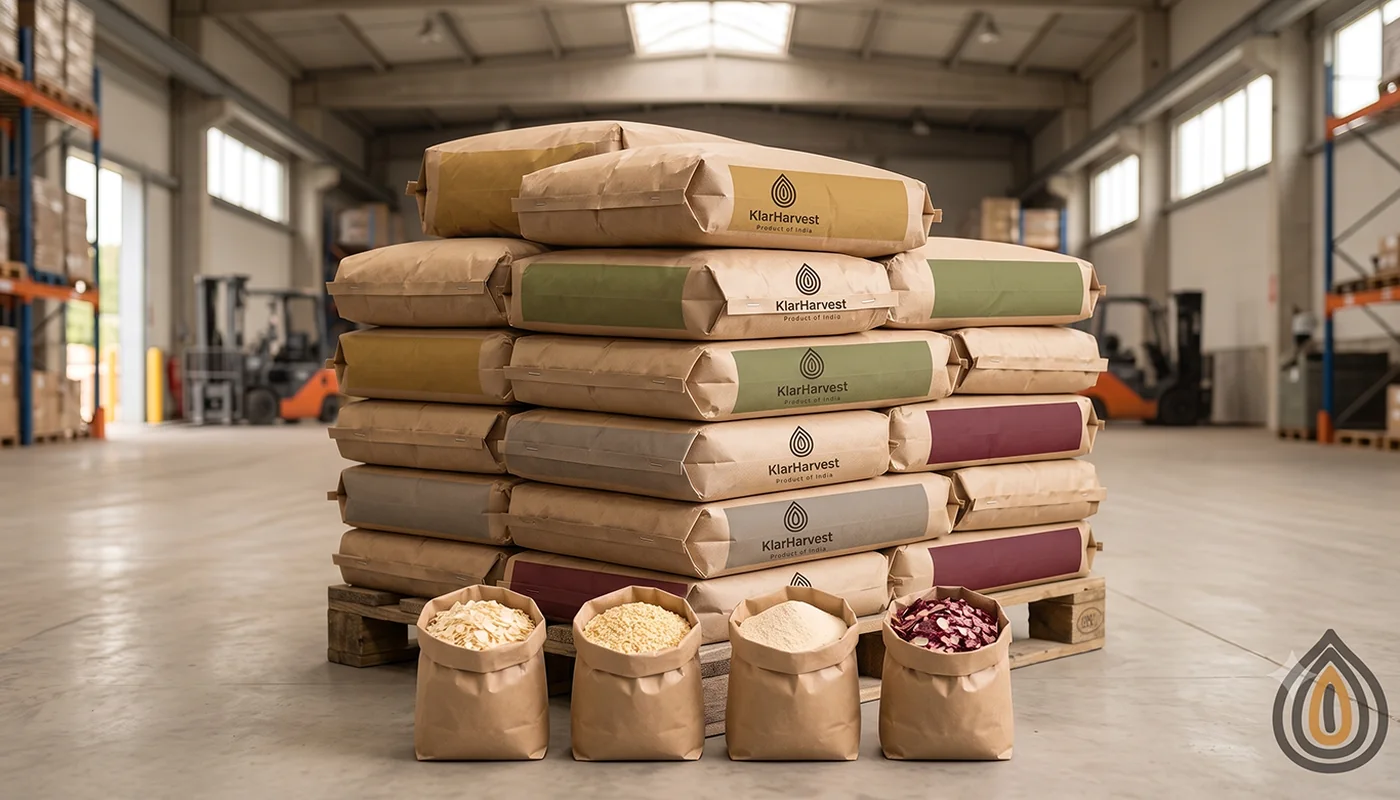
The way to reach a sensible order size with several products is to mix them. A pallet can carry two or three cuts in separate bags with separate lot codes, a white flake and a red flake, a granule and a powder; a container can carry every cut and colour a distributor sells, plus dehydrated garlic and other vegetables from the same plants, each product on its own pallets with its own line on the invoice and its own certificate of analysis. Exporters who serve smaller buyers do this as a matter of routine, and there is no surcharge for mixing; the only constraint is that each cut is subject to the plant's own run minimums, so a few hundred kilograms of a stock cut is easy and a few hundred kilograms of a custom band is not.
A typical first mixed pallet for a food manufacturer: 300 kilograms of white flakes, 200 of white granules and 100 of white powder, with a 100 kilogram trial of red chopped, totalling 700 kilograms on one pallet. A typical mixed container for a distributor: four pallets of white flakes, two of chopped, two of minced, three of granules, two of powder, two of red flakes and one of dehydrated garlic flakes, sixteen pallets in a 20 foot box. The document side is the same as for a single product, with one more line per product. Mixed loads across product families are described in Mixed Containers: Combining Onion Cuts, Garlic and Vegetables.
Samples: quantities, cost and what to test
Samples sit outside the minimum order question and should be treated as a separate step. Laboratory and kitchen samples of 250 grams to 1 kilogram per cut are free from most exporters and sent by courier within a week; the courier cost of 40 to 80 euros is sometimes charged and credited against the first order. Pilot quantities of 5 to 25 kilograms, for a line trial rather than a bench test, are charged at the pallet price plus courier or air freight, which makes them expensive per kilogram but cheap compared with a wrong pallet. Ask for samples from a current lot, with the certificate of analysis for that lot, and test them in the process, not only on the bench: rehydrate flakes in your soup base, blend granules with your salt and store the blend for two weeks, run powder through your dosing unit. Keep a retained sample of the lot you approve as the reference for the first delivery. The full sampling routine is part of How to Import Dehydrated Onion from India.
Planning a first order that is small and still sensible
A first order has two jobs: to prove the supplier and to prove the product in production. It does not need to be efficient. The sensible size is the smallest quantity that lets you run the product on the line for a few weeks, which for most manufacturers is one to three pallets, and the sensible composition is the cut you intend to use plus a small quantity of the adjacent cut, so that a wrong guess about particle size can be corrected without a second shipment. Ship it LCL, buy it CIF or DAP so that the exporter's forwarder handles the origin side, insure it to your door, and treat the landed cost as the cost of learning: at 2.30 to 2.70 euros per kilogram for a pallet or two, it is still at or below the stockist's price, and the second order will land at 2.10.
What to write into the first order: the specification, the quantity per cut, the packaging, CIF or DAP with the port or address, a shipment window, the documents you require, and the payment terms, typically a 30 percent advance and 70 percent against the bill of lading copy for a new supplier. Ask for the loading photographs and the certificate of analysis before the balance is due. The order confirmation is one page; a checklist for it is in From Sample to First Container.
From pallets to containers: when to make the step
The step from LCL pallets to a container is worth taking when three conditions hold: you use the product steadily enough to consume 10 tonnes of flakes, or the equivalent volume of a mixed load, within six to nine months; you have the warehouse space, which for a 20 foot container is 16 pallet positions; and you can fund the stock, since a container ties up 17,000 to 20,000 euros for the months it takes to use. A buyer with two product lines using different cuts often reaches the container earlier with a mixed load than with one product. The container brings a 2 to 4 percent FOB break, a freight line under 0.25 euros per kilogram, stuffing under customs seal at the exporter's premises with a loading video, and a simpler document set, one bill of lading for one box. It also brings a longer commitment to a lot: a container of flakes is 500 bags of the same lot, and the specification, the retained sample and the supplier relationship matter more when the stock is that deep.
A distributor or importer who resells reaches the container sooner, because it sells a range and the mixed container is the natural unit; the arithmetic for a distributor filling a box with a whole product family is in Buying Dehydrated Onion as a Small Food Business and, for the large end, in Landed Cost of Dehydrated Onion in Europe.
Lead times by order size
Order size changes lead time less than buyers expect, because most of the time is sea transit, which is the same for a pallet and a container. What differs is the origin side. A pallet of a stock cut from an exporter's godown can be ready for the consolidator within a week of the advance payment; an LCL consolidation then waits for the weekly cut-off and adds three to seven days before sailing, and destination deconsolidation adds two to four days after arrival. A container of a stock cut takes one to two weeks to assemble, stuff and clear, and sails direct. A container that needs a production run, in the off-season or for a custom band, adds one to three weeks at the plant. In practice, from advance payment to a German warehouse: six to eight weeks for a pallet, six to eight for a container of stock cuts, eight to ten for a container that needs a run, and a week or two longer for red onion between July and February.
| Order | Origin preparation | Sailing and transit | Destination | Total from payment |
|---|---|---|---|---|
| 1-3 pallets LCL, stock cut | 5-10 days | 4-6 weeks incl. consolidation | 3-5 days | 6-8 weeks |
| 20 ft FCL, stock cuts | 7-14 days | 4-5 weeks | 2-4 days | 6-8 weeks |
| 20 ft FCL, production run needed | 2-4 weeks | 4-5 weeks | 2-4 days | 8-10 weeks |
| Air freight, 50-500 kg | 3-5 days | 3-6 days | 1-2 days | 1-2 weeks |
The practical consequence is that a buyer should not choose LCL for speed; it is chosen for size. Where speed matters and the quantity is small, air freight is the answer, and it is the next section.
Air freight for small urgent quantities
Quantities up to a few hundred kilograms can fly. Air freight from Ahmedabad or Mumbai to Frankfurt costs, in January 2026, roughly 3 to 5 euros per kilogram for 100 to 300 kilograms including handling, and courier services take up to about 50 kilograms at 6 to 10 euros per kilogram door to door. That is two to three times the product's value, so it is never the way to buy onion; it is the way to keep a line running when a pallet is late, to run a pilot batch before the sea shipment arrives, or to get a treated grade to a customer who needs it this month. Packed in cartons rather than bags, a 200 kilogram air consignment takes three to five days from confirmation to a European airport plus a day or two for clearance and delivery, and needs the same documents as a sea shipment, with the airway bill in place of the bill of lading. Exporters who serve smaller buyers quote air freight as a separate line on request; the comparison with sea, and when the premium is worth paying, is in Air or Sea Freight for Dehydrated Onion.
What a pallet and a container mean for your warehouse
Order size is also a storage decision. A pallet of flakes occupies one pallet position, weighs about 650 kilograms and, for a manufacturer using 100 kilograms a week, lasts six weeks; nothing about it strains a normal food warehouse. A 20 foot container is 16 pallet positions and 10 tonnes, which for the same manufacturer is two years of stock and well beyond the product's best condition. The rule that follows is that the order should match consumption over six to nine months, whatever the freight arithmetic says, because onion bought to save 20 cents a kilogram on freight and used at month 18 has lost colour and aroma worth more than that. Store on pallets off the floor, below 25 °C and 60 percent relative humidity, away from light and from strong-smelling goods, and rotate by lot code, first in, first out. Powder and minced need the conditions kept more strictly than flakes. A distributor's warehouse, turning a container in a quarter, has none of this problem, which is one reason distributors reach the container earlier than manufacturers. The storage conditions and a checklist are in Storing Dehydrated Onion in a European Warehouse.
Below the line: when a European stockist is the right answer
There is a quantity below which direct import stops making sense, and it is about one pallet a year. Under that, the fixed charges of a shipment are larger than the difference between the FOB price and the stockist's price, and the buyer's own time in documents and customs is a cost too. A business that uses 200 kilograms of onion powder a year should buy from a European distributor at 3 to 4 euros per kilogram and think no more about it. A business that uses two pallets a year is at the margin: direct import saves a few hundred euros and costs a few hours; the decision is about whether it wants the supplier relationship and the lot-level documents, which some quality systems value for their own sake. From three pallets a year upward, direct import is cheaper on every line, and from a container a year it changes the product's margin. The stockist route, its real costs and what it buys, is examined in Buying Dehydrated Onion via Dutch Traders or Direct from India.
How KlarHarvest handles small and mixed orders
KlarHarvest was built for the buyers that plants prefer not to serve: one pallet by LCL is a normal first order, a mixed pallet of several cuts and colours is normal, and a mixed container of onion cuts, garlic and other dehydrated vegetables from the same certified plants is packed at our own godown from sealed plant bags, each product with its own lot code and certificate of analysis. Stock cuts of white onion are available from stock all year, so a pallet does not wait for a production run; red onion and custom bands are quoted with their lead time. Quotes show FOB and the freight line separately for LCL and for a container, so that a buyer can see both landed costs before deciding the size. Samples of up to 1 kilogram per cut are sent by courier from current lots with the lab report. The range is on the products page, and the first steps on our process.
Frequently asked questions
What is the minimum order quantity for dehydrated onion from India?
It depends on the supplier. Plants typically want 1 to 5 tonnes per cut and prefer full containers; exporters who serve smaller buyers accept one pallet of 600 to 1,000 kilograms by LCL, with several cuts on one pallet. Marketplace listings of 50 kilograms are usually for samples or domestic delivery.
How much dehydrated onion fits in a 20 foot container?
About 10 tonnes of flakes on pallets, 12 to 13 tonnes of chopped, 14 to 16 tonnes of minced, 16 to 18 tonnes of granules and 18 to 20 tonnes of powder. The container is full by volume before it reaches its 21 tonne weight limit, except for powder.
Is it cheaper per kilogram to order a full container?
Yes, mainly because of freight and fixed charges rather than the FOB price. At January 2026 rates one pallet of flakes lands in Germany at about 2.70 euros per kilogram, three pallets at 2.30, a 20 foot container at about 2.05 and a 40 foot at just under 2.00.
Can I order several cuts or colours on one pallet?
Yes. Mixed pallets with two or three cuts in separate bags and lot codes are routine with exporters who serve smaller buyers, and there is no surcharge for mixing. Each cut is limited only by the plant's own run minimum for that cut.
How big should a first order be?
One to three pallets: enough to run the product on the line for a few weeks, with a small quantity of the adjacent cut in case the particle size needs adjusting. Ship it LCL, buy it CIF or DAP, and treat the landed cost as the cost of learning.
At what volume should I switch from LCL to a container?
When you can use about 10 tonnes of flakes, or a mixed load of equivalent volume, within six to nine months, have 16 pallet positions of warehouse space and can fund 17,000 to 20,000 euros of stock. From three to six pallets per shipment, LCL is already close to container economics.
When should I buy from a European stockist instead?
Below about one pallet a year. Under that, the fixed charges of a shipment outweigh the saving over a stockist's price of 3 to 4 euros per kilogram. From three pallets a year direct import is cheaper on every line.
Next step
If you know the cuts and roughly the quantity, request a quote and state both: you will receive a landed cost for the pallet quantity and for a container, side by side, within one business day. If you do not know the cut yet, request a sample of two adjacent cuts first; the quantity question is easier once the product is settled.