- How the trading route works
- What the trader's margin buys
- What going direct saves
- What going direct costs the buyer
- The break-even volume
- When a trader is right even at volume
- When direct is right even at small volume
- The hybrid: an exporter with European service
- Quality and traceability on each route
- Risk on each route
- Price transparency and negotiation
- A decision method for your own business
- Making the switch from trader to direct
- Three buyers, three answers
- Why the traders exist: a short history of the Rotterdam route
- Questions to ask your trader, and what the answers tell you
- Working capital on each route, worked
- How KlarHarvest positions itself
- Frequently asked questions
Judge the product, not the words
200-500 g from a current lot, dispatched by courier with the lot lab report.
Request a sampleBuying dehydrated onion direct from India is the decision most European users of the product never consciously make, because they never see the alternative: the onion arrives from a Dutch or Belgian trading house with an EU invoice, a two-day lead time and a price that is simply the price, and the fact that it was dried in Mahuva by a plant the buyer has never heard of, at a cost a quarter to a half lower, stays behind the trader's letterhead. The trader is not doing anything wrong; it is providing a service and charging for it. The question for a buyer is whether the service is worth the charge for its own volume, its own capacity to import and its own need to know where the product comes from, and this guide answers it with the numbers rather than with an opinion.
It covers how the trading route works and why it exists, what the trader's margin actually buys, what going direct saves and what it costs the buyer in work and risk, the volume at which each route wins, the cases where a trader is the right choice even at container volume, the hybrid route that an Indian exporter with European-grade service offers, and a decision method a buyer can apply to its own figures. Figures are for the German market in the 2026 season; the direct landed cost they rest on is built in Landed Cost of Dehydrated Onion in Europe.
What this guide covers
- How the trading route works
- What the trader's margin buys
- What going direct saves
- What going direct costs the buyer
- The break-even volume
- When a trader is right even at volume
- When direct is right even at small volume
- The hybrid: an exporter with European service
- Quality and traceability on each route
- Risk on each route
- Price transparency and negotiation
- A decision method for your own business
- Making the switch from trader to direct
- Three buyers, three answers
- Why the traders exist: a short history of the Rotterdam route
- Questions to ask your trader, and what the answers tell you
- Working capital on each route, worked
- How KlarHarvest positions itself
- Frequently asked questions
How the trading route works
The dried-vegetable trading houses of Rotterdam, Antwerp and, to a lesser extent, Hamburg buy Indian dehydrated onion by the container, in most cases from the same certified Mahuva plants and exporters that a direct buyer would use, hold it in bonded or duty-paid warehouses, and sell it to European manufacturers by the pallet, the truck or the container, invoiced in euros from an EU company on credit terms. The larger houses hold hundreds of tonnes across the cuts and colours, buy on annual contracts at the Indian harvest and on spot through the year, and serve customers from a soup maker taking forty tonnes a month to a spice packer taking one pallet a quarter. Germany's imports show the route's weight: around 21,000 tonnes of dried onion a year enters the country, of which about 13,000 tonnes come from India directly and most of the rest from the Netherlands and Belgium, nearly all of it Indian in origin, as set out in Importing Dehydrated Onion into Germany. The trade is old, competent and useful, and the question is only whether a given buyer needs it.
What the trader's margin buys
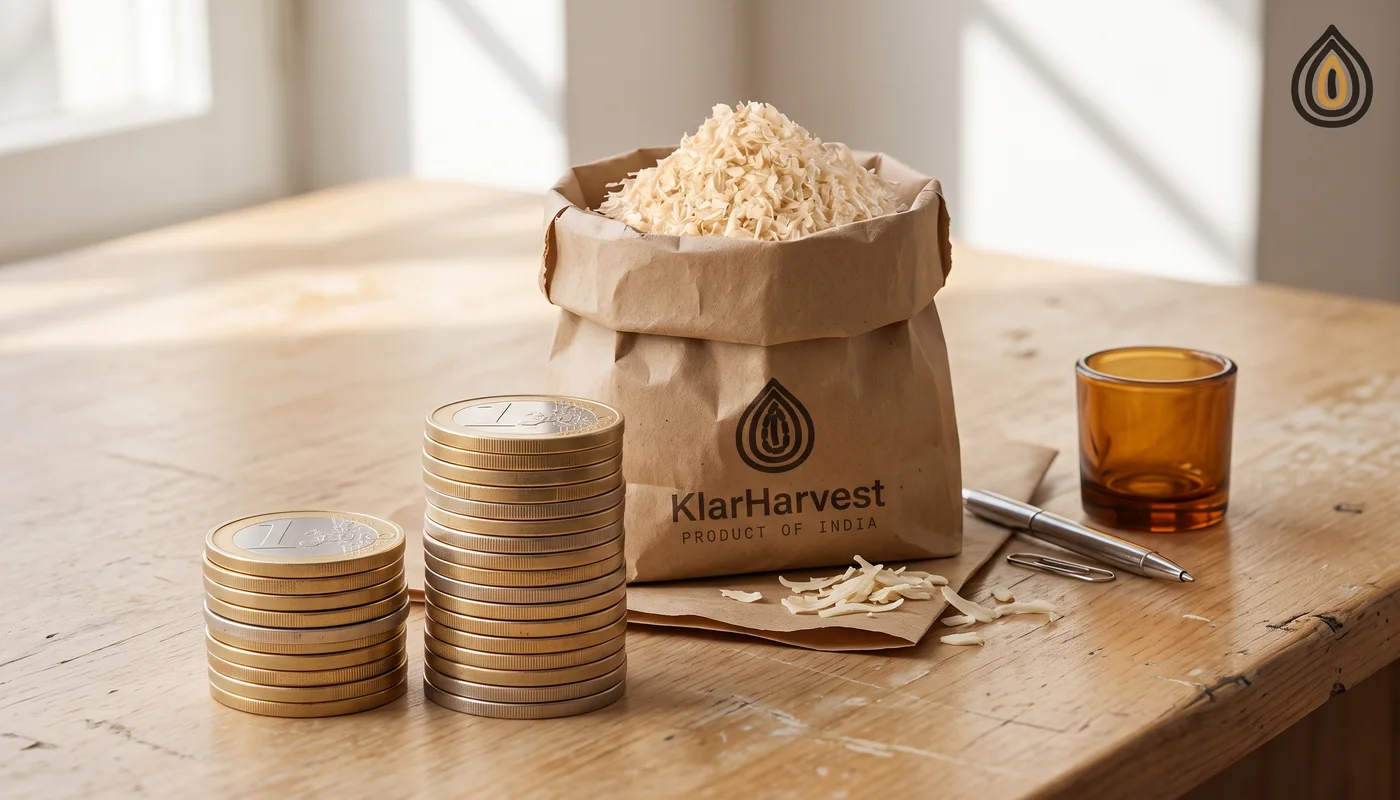
A trader's delivered price for white flakes in Germany in mid-2026 runs 2.30 to 3.50 euros per kilogram, against a direct landed cost of about 1.90 by full container; the gap of 0.40 to 1.50 is the trader's gross margin, and it buys the buyer six things.
| What the trader provides | What it is worth to a buyer | Who values it most |
|---|---|---|
| Stock in Europe: a pallet in two days, a truck in a week | Safety stock the buyer need not hold; no eight-week pipeline | Small and irregular buyers; anyone without warehouse space |
| An EU invoice in euros, VAT handled, no import paperwork | No EORI, broker, customs, duty or VAT process | Buyers with no import function |
| Credit: net 30 to 60 days | Working capital the buyer does not tie up | Buyers with tight cash flow |
| Quality risk carried: a failed lot is replaced from stock | No claim process against an Indian seller; no retained-sample dispute | Buyers without a quality function |
| Aggregation: one pallet of each of five cuts | Range without five containers | Blenders and packers with many items |
| Market knowledge and price smoothing | A price that moves less than India's yard | Buyers who cannot follow the Indian season |
Priced honestly, the six together are worth 10 to 25 cents per kilogram to a buyer at container volume with an import function, and 50 cents to a euro to a buyer at pallet volume without one; the difference between that and the actual gap is the trader's margin proper, which is what a buyer going direct captures.
What going direct saves
At a direct landed cost of 1.90 euros per kilogram and a trader's price of 2.60 for the same white flakes, the saving is 0.70 per kilogram, and on 100 tonnes a year, 70,000 euros; at a trader's price of 3.20, which is where the small-lot prices sit, the saving is 1.30 per kilogram. The saving is larger on the premium products, where the trader's margin is applied to a higher base, so low bacterial, red and custom bands show a bigger gap; and it is larger in a rising Indian market, when the trader's stock bought at the harvest low is resold at the current price, than in a falling one, when the trader's old stock is dearer than the plant's new price. Beyond price, direct buying gives a buyer the plant's identity and the lot record, which the trader's invoice does not carry, and a specification agreed with the maker rather than with a reseller.
What going direct costs the buyer
Direct import has costs that the trader's price absorbs, and a buyer counts them before comparing.
| Cost | Typical figure | Notes |
|---|---|---|
| Customs broker, per container | €80-150 | Or a forwarder's all-in service |
| Verification testing, per lot | €150-700 | Full set on first lots, routine thereafter |
| Working capital: advance and balance paid 4-8 weeks before delivery | €150-400 per container at a business's cost of money | Against the trader's credit |
| Safety stock: 6-8 weeks held against the pipeline | Warehouse space and capital | The trader held it before |
| Supplier approval: file, questionnaire, audit or video, annual review | 2-5 days of a quality manager's time a year | One-off, then maintenance |
| Purchasing time: quotes, contracts, documents, tracking | 1-2 days a month for a regular importer | |
| Quality risk: claims against the seller, a referee laboratory, occasional rejection | Rare, but real; a failed container is a month's disruption | Insured only in part |
| Currency exposure between order and payment | 1-2 % of a container's value in a normal period | Fixed by a euro invoice |
For a buyer at 100 tonnes a year the sum is 10,000 to 20,000 euros and a few weeks of staff time, against a saving of 40,000 to 130,000; for a buyer at 10 tonnes it is 4,000 to 8,000 against a saving of 4,000 to 13,000, which is the break-even zone.
The break-even volume
| Annual volume | Trader's price, €/kg (typical for the lot size) | Direct landed, €/kg incl. LCL or container | Direct fixed costs, €/yr | Net saving, €/yr | Verdict |
|---|---|---|---|---|---|
| 5 t (pallets) | 3.00-3.50 | 2.60-3.00 (LCL) | 4,000-6,000 | negative to 1,000 | Trader |
| 12 t (one container) | 2.60-3.00 | 1.95-2.10 | 5,000-8,000 | 0-6,000 | Either; direct if plant identity matters |
| 30 t | 2.50-2.80 | 1.90-2.05 | 7,000-11,000 | 9,000-18,000 | Direct, or hybrid |
| 100 t | 2.30-2.60 | 1.88-1.95 | 10,000-20,000 | 30,000-60,000 | Direct |
| 300 t | 2.20-2.50 | 1.85-1.92 | 15,000-30,000 | 90,000-170,000 | Direct, with annual contracts |
The break-even sits around one to two containers a year for a buyer that already has an import function, and around three for one that must build it. Below that, the trader wins on convenience; above it, direct wins on money and, increasingly, on knowledge of the product.
When a trader is right even at volume
Four situations keep container-volume buyers with a trader, and they are legitimate. A buyer with many items, ten cuts and colours of onion plus garlic, carrot and other dried vegetables, each in small quantities, for whom the trader's aggregation is the only way to hold the range without a warehouse full of slow-moving stock; the mixed-container alternative is in Mixed Containers: Combining Onion Cuts, Garlic and Vegetables. A buyer whose quality system cannot approve a non-EU supplier, whether by policy or by capacity, and for whom the trader's IFS certificate covers the chain; the approval process is in IFS and BRC Supplier Approval. A buyer whose demand is so irregular that a pipeline of eight weeks and a safety stock are unmanageable. And a buyer for whom the onion is a tiny share of cost and the purchasing time is worth more than the saving. None of these is a reason to pay the whole margin without knowing it; all are reasons to pay it knowingly.
When direct is right even at small volume
The reverse cases exist too. A buyer whose customers audit the chain to the plant, a baby-food maker or a retailer's own-label supplier, needs the plant's identity and certificates in the file, which the trader's invoice does not give; the trader may name the plant on request or may not. A buyer with a specification the trader's standard stock does not meet, a custom mesh band, a particular tier with spore limits, a colour grade, gets it made to order only from the plant. A buyer that wants price transparency, to see the yard price and the ratio behind a quote, gets it from a plant or an exporter and not from a reseller. And a buyer building a brand on provenance, "sourced from a named farm group in Gujarat", cannot say it about product bought from a Rotterdam warehouse. For these the direct route pays at a pallet, through an exporter that serves small orders.
The hybrid: an exporter with European service
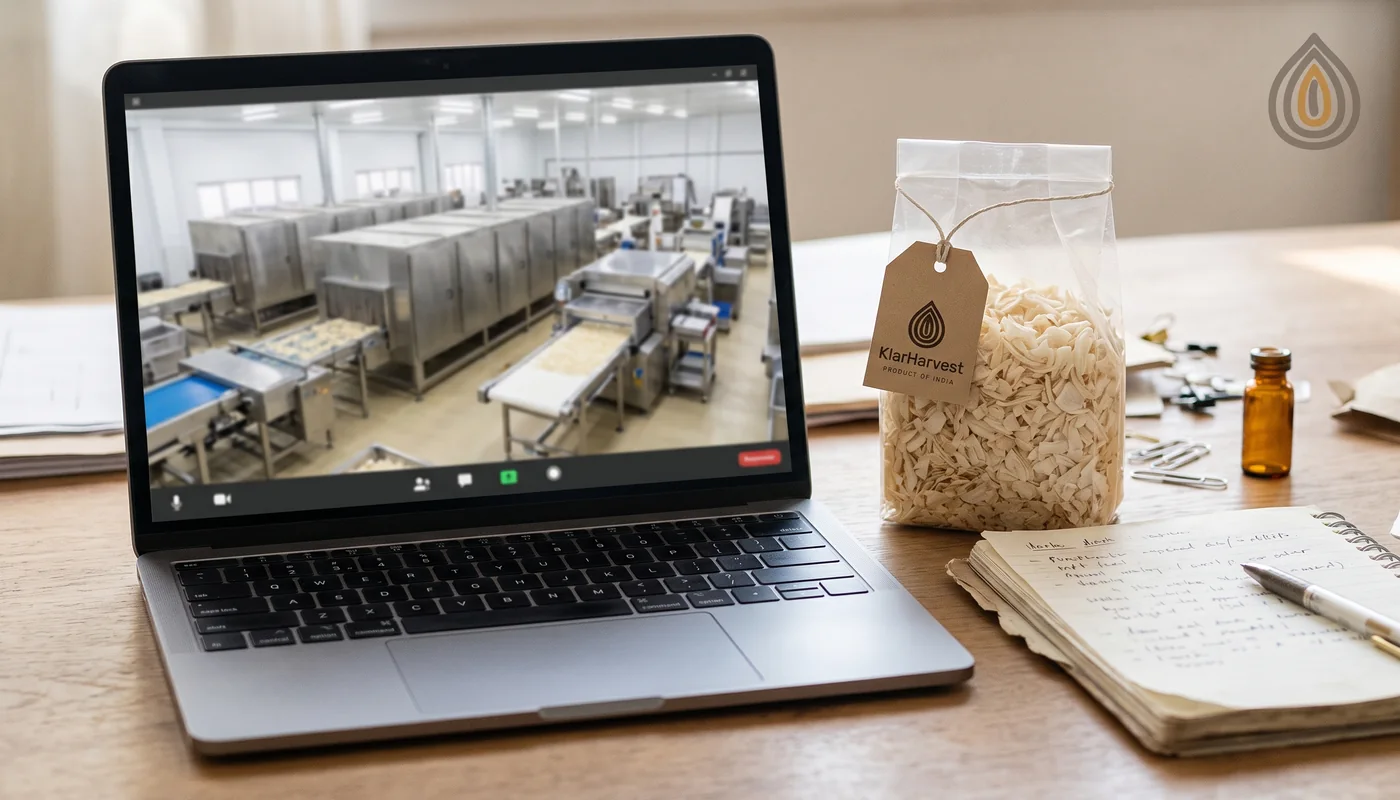
Between the plant and the trader sits a third model, and it is the one KlarHarvest is built on: an Indian exporter that sources from named certified plants and offers the parts of the trader's service that a buyer at modest volume actually needs, without the trader's margin. The parts: a response within business hours rather than business days; a quote with FOB, CIF and a landed estimate side by side; DAP delivery to the door for buyers who do not want to clear a container; pallet and LCL orders through a weekly consolidation; a lot record per shipment that names the plant and carries the certificate and the loading video; German-language data sheets and declarations; and a claims procedure with a referee laboratory named. What it does not offer is stock in Europe and credit from day one, which are the two things a small buyer most misses; a buyer at three pallets a quarter therefore plans its stock and pays 30/70, and in exchange lands the product at 2.10 to 2.30 euros per kilogram instead of 3.00 and knows which plant dried it. The service model is described on the our process page, and the small-order options in Buying Dehydrated Onion as a Small Food Business.
Quality and traceability on each route
The product is the same product; the knowledge of it differs. On the trading route the buyer's specification is with the trader, the certificate is the trader's or the plant's as the trader chooses to pass it on, the plant's identity is usually withheld, and a claim is settled from the trader's stock with no reference to the plant; the buyer's supplier approval covers the trader, whose IFS or BRCGS certificate for storage and distribution covers the handling but not the drying. On the direct route the buyer's specification is with the maker, the certificate names the plant and the lot, the plant's BRCGS certificate and audit are in the buyer's file, a claim goes back to the plant's retained sample and records, and a mock recall runs to the field block. For a buyer whose own customers ask where the onion came from, the second is the only route that answers; the traceability system is in Lot Codes and Traceability in Dehydrated Onion.
Risk on each route
The trading route moves most risks to the trader and charges for it: a wet container, a failed count, a short shipment, an Indian supplier that disappears, are the trader's problems and the buyer receives replacement stock. The direct route leaves them with the buyer and gives it the tools to manage them: cargo insurance under Clauses (A), a contract with a claims clause and a referee laboratory, a retained sample, a vetted supplier, a pre-shipment inspection for a first container, and the supplier's own replacement obligation. The residual risk on the direct route, after those tools, is a month's disruption if a container fails, which a safety stock covers; the risk that the tools cannot remove is a fraudulent or incompetent supplier, which vetting removes. The vetting is in 25-Point Checklist Before You Choose a Dehydrated Onion Supplier and the frauds in 12 Red Flags When Dealing with a Dehydrated Onion Exporter.
Price transparency and negotiation
A trader's price is a number; a plant's or an exporter's price is a build, yard price times ratio plus conversion plus origin plus margin, and a buyer who knows the build negotiates differently. It can check a quote against the current yard price, as 8 to 1: The Fresh-to-Dry Yield Ratio shows; it can contract at the April low with scheduled shipments and fix most of the year's price; it can trade a cut change or a container size for a saving that a trader's list does not offer; and it can see the premium for a tier or a colour as a line rather than as a different list price. A trader smooths the Indian market's swings for its customers and charges for the smoothing; a direct buyer rides the swings and, if it contracts at harvest, rides them downhill. The season's price pattern is in What Does Dehydrated Onion Cost per Kilogram?
A decision method for your own business
- Annual volume of dried onion, all cuts, in tonnes; and the number of distinct items.
- Current delivered price per kilogram from the trader, by item.
- Direct landed cost per kilogram for the same items, from an exporter's quote with the landed estimate, or from the calculator in the landed-cost guide.
- Gross saving = (2 minus 3) times 1.
- Direct fixed costs: broker, testing, purchasing and quality time, working capital, safety stock; from the table above or your own figures.
- Net saving = 4 minus 5.
- Non-price factors: does any customer audit to the plant; does any product need a specification the trader's stock does not meet; does the brand claim provenance; can the quality system approve a non-EU supplier; can the business hold six to eight weeks of stock.
- Decision: a positive net saving with no blocking non-price factor is direct; a negative one with no forcing factor is the trader; a small or negative saving with a forcing factor, plant identity or a custom specification, is the hybrid, direct through an exporter that serves small orders.
Making the switch from trader to direct
A buyer moving from a trader to a direct supplier does it in a season, not a week, and keeps the trader for the transition. Vet and approve the direct supplier while the trader still supplies; run the first container as a trial alongside trader stock; hold the trader as a second source for the first year, buying a pallet a quarter to keep the account open, since a direct supply chain with one supplier and no fallback is exposed; and switch the annual contract at the next April harvest, when the direct price is at its low and a scheduled shipment plan can be set. The first-container sequence is in From Sample to First Container; the contracting mechanics in Payment Terms for Dehydrated Onion Imports.
Three buyers, three answers
A soup manufacturer in Lower Saxony, 180 tonnes a year of minced and powder in two items, paying a trader 2.45 euros per kilogram: direct landed at 1.90, a gross saving of 99,000 euros, direct fixed costs of about 15,000, and an existing import function for other ingredients. Direct, on an annual contract at the April harvest, with the trader kept for a pallet a quarter. A seasoning blender near Stuttgart, 14 tonnes a year across nine cuts and colours plus garlic, paying 2.90 average: the aggregation is worth most of the gap, the blender has no import function, and the volumes per item are a pallet or two. Trader, with a review if any single item reaches a container; or the hybrid for the two largest items. An organic baby-food brand in Bavaria, 6 tonnes a year of one item, whose retailer audits to the plant: the trader cannot give the plant's identity or the organic chain in the form the auditor wants. Direct through an exporter, at a pallet a month by LCL, at a landed cost above the trader's price and worth it for the file.
Why the traders exist: a short history of the Rotterdam route
The route is older than the Indian industry it now serves. Dutch and Belgian merchants imported dried vegetables from the colonies and from Egypt and the United States from the early twentieth century, and when the Mahuva plants began exporting in the 1970s and 1980s the trading houses were the only European buyers with the knowledge, the finance and the warehouses to take Indian product, and the plants, which had no export departments and no English-language customer service, were glad of them. For thirty years the arrangement suited both: the plants sold containers to a handful of houses at the harvest, the houses carried the stock, the credit and the customer relationships, and the manufacturers in Germany, France and Scandinavia bought from a Dutch invoice as they bought their pepper and their nutmeg. What changed after 2010 was the plants' own capability, BRCGS certification, English-speaking quality managers, e-mail and video, and the manufacturers' own purchasing sophistication, which made direct buying possible for a container-volume buyer that wanted it; the houses adapted by moving down-market toward the small and irregular buyers and by adding value in blending, repacking and organic ranges. The route survives because it still solves a real problem for a real class of buyer, and the exporters that compete with it do so by solving the same problem more cheaply for the buyers who have grown out of it. The Mahuva side of the same history is in Mahuva, Gujarat: Inside India's Onion Dehydration Hub.
Questions to ask your trader, and what the answers tell you
A buyer that stays with a trader should still know what it is buying, and five questions settle it. Which plant dried this lot, and may I see its certificate: a trader that answers is selling transparency as part of its service and is worth its margin; one that will not is selling anonymity, which the buyer may not want. What is the drying date of the stock I am receiving: a trader's warehouse holds product for months, and a buyer whose specification has a colour or age clause should know whether it is getting spring product in October. What is your price basis and how does it move with the Indian season: a trader that explains the harvest cycle is one whose price a buyer can anticipate; one whose price is simply "the price" is smoothing the market for its own benefit as well as the buyer's. Can I see the lot certificate rather than your certificate of conformity: the laboratory's report for the lot is the evidence, and a trader that reissues its own summary is asking to be trusted. And what happens on a claim: replacement from stock is the trader's main advantage and it should be in writing. The answers tell a buyer whether its trader is a service partner or a price layer, and the same questions asked of an exporter are in 25-Point Checklist Before You Choose a Dehydrated Onion Supplier.
Working capital on each route, worked
The credit a trader gives is real money, and a buyer comparing routes should price it. On the trading route a buyer takes a pallet on Monday, is invoiced at 2.60 euros per kilogram, and pays in 45 days; on 100 tonnes a year in monthly pallets, the buyer's average outstanding to the trader is about 30,000 euros, which the trader is financing. On the direct route the same buyer pays 30 percent of a container at order and 70 percent at shipment, six to eight weeks before delivery, and then holds the container's stock for the months it takes to use it; on two containers a year the buyer's cash is out by 20,000 euros for two months per container and its stock investment averages 15,000 to 20,000 euros. The difference in financing, at a business's cost of money of 5 to 8 percent, is 2,000 to 4,000 euros a year, which is 2 to 4 cents per kilogram on 100 tonnes, a fraction of the 40 to 70 cents saved; for a buyer whose cost of money is 15 percent, an overdraft rather than a facility, it is 5 to 8 cents and still a fraction. The working-capital argument for the trader is strongest for a buyer that cannot raise the container's advance at all, which is a real constraint for some small businesses and no constraint for a manufacturer; the timing of the payments, and the instruments that shift it, are in Payment Terms for Dehydrated Onion Imports.
How KlarHarvest positions itself
KlarHarvest is the hybrid: an Indian exporter sourcing from named BRCGS-certified plants in Mahuva, selling direct to European buyers at container, pallet and LCL volumes, with the service a trader gives and the price and the plant identity a trader does not. Quotes carry the landed estimate for the buyer's country so that the comparison with a trader's delivered price is made on the same line; the lot record names the plant; the response commitment is one business day; and the German market is served in German. The comparison a buyer should run is the method above, on its own numbers, and a quote to run it with comes from the contact page.
Frequently asked questions
Why is dehydrated onion from a Dutch trader more expensive than direct from India?
The trader's price includes stock in Europe, an EU invoice, credit, quality risk and aggregation, plus its margin. The gap is 0.40 to 1.50 euros per kilogram; the service part of it is worth 10 to 25 cents to a container-volume buyer and more to a small one.
At what volume does buying direct pay?
Around one to two containers a year, 12 to 25 tonnes, for a buyer with an import function; about three for one that must build it. Below that the trader's convenience usually wins on money.
Can a small buyer go direct?
Yes, through an exporter that serves pallet and LCL orders with DAP delivery. The landed cost is above a container's but below most traders' small-lot prices, and the buyer knows the plant.
Does the trader tell me which plant made the onion?
Usually not; the trader's invoice and specification name the trader. A buyer whose customers audit to the plant needs the direct route for that reason alone.
Is the quality different?
The product is the same Mahuva onion. What differs is the knowledge: direct buying gives the plant's certificate, the lot record and a claim path to the maker; the trader gives replacement from stock.
What are the risks of buying direct?
A wet or failed container, a short shipment, a bad supplier. Insurance, a claims clause, a retained sample, pre-shipment inspection and supplier vetting manage them; a safety stock covers the disruption.
How do I switch without a supply gap?
Approve the direct supplier while the trader still supplies, run a trial container alongside trader stock, keep the trader as a second source for a year, and move the annual contract at the next April harvest.
Next step
Request a quote with your items and annual volume and it comes with the landed estimate for your country, so that the comparison with your trader's delivered price is on one line; or request a sample and start the approval while the trader still supplies.