- The whole sequence at a glance
- Step 1: Inquiry and supplier screening
- Step 2: Samples and certificates
- Step 3: Trials on your line
- Step 4: Specification and supplier approval
- Step 5: Quote, terms and contract
- Step 6: Order, advance and the price lock
- Step 7: Production and testing
- Step 8: Booking, stuffing and shipping
- Step 9: Documents and the balance
- Step 10: Arrival, clearance and release
- What runs in parallel
- Where weeks are lost
- A June order planned backward from September
- The second container: ten weeks
- The pallet route: a faster first order for small buyers
- Off-season and holiday timing: what changes
- Cash flow along the timeline
- The buyer's internal checklist for a first order
- How KlarHarvest runs the sequence
- Frequently asked questions
Judge the product, not the words
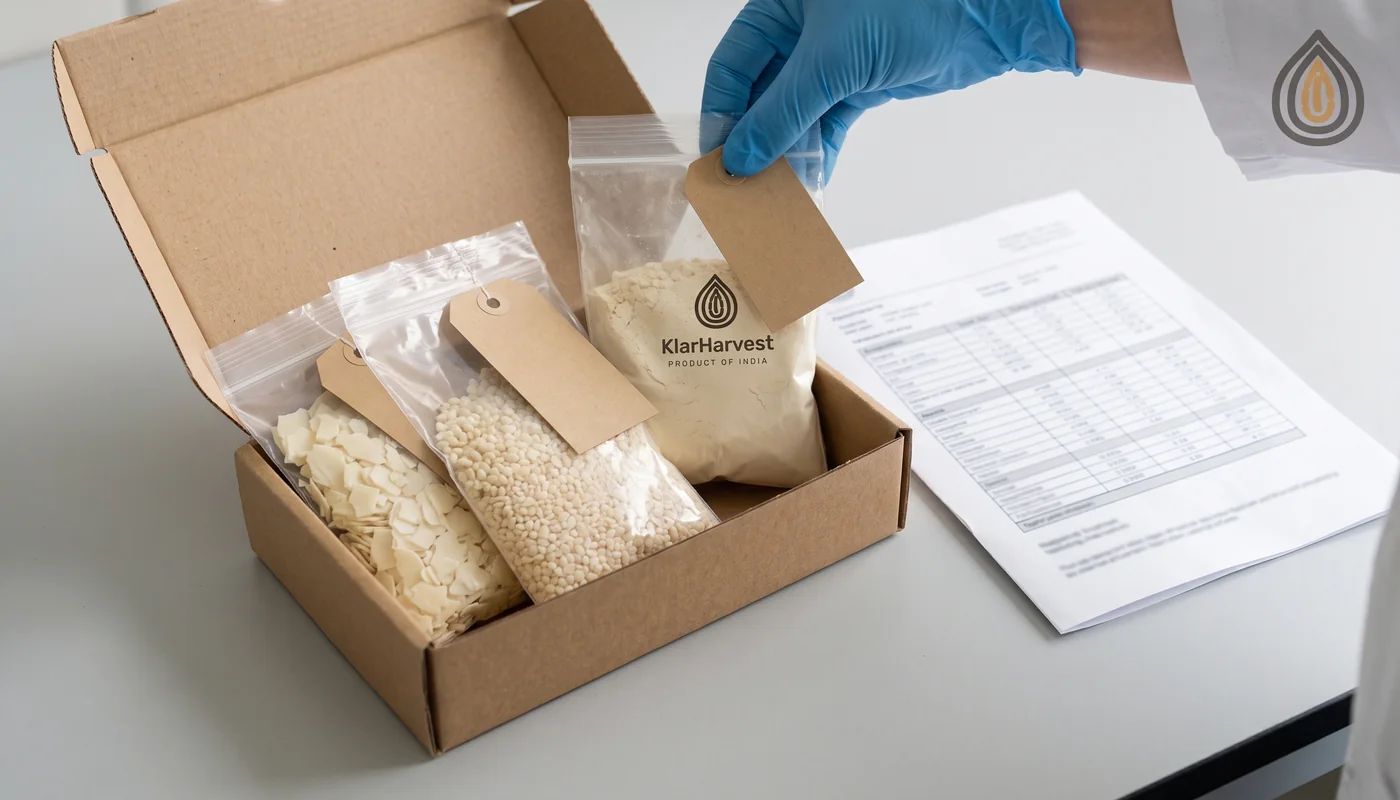
200-500 g from a current lot, dispatched by courier with the lot lab report.
Request a sampleThe dehydrated onion sample to order journey has a shape that first-time importers rarely expect: the ship, which everyone worries about, is four to six weeks of a twelve to eighteen week whole, and the rest is decisions, documents, samples and production slots that run at the pace of the two companies involved. Some of it can be compressed, some of it runs in parallel, and some of it cannot be hurried at all, and knowing which is which is what separates a first container that arrives when it was planned from one that arrives a season late. This guide lays the sequence out step by step with the durations, shows what gates each step and what runs alongside it, lists the places where weeks are lost, plans a June order backward from a September delivery, and explains why the second container takes ten weeks instead of sixteen.
It is written for a European buyer importing directly from an Indian exporter or plant; durations are for a normal season in March 2026 and stretch in the off-season and around Indian and European holidays.
What this guide covers
- The whole sequence at a glance
- Step 1: Inquiry and supplier screening
- Step 2: Samples and certificates
- Step 3: Trials on your line
- Step 4: Specification and supplier approval
- Step 5: Quote, terms and contract
- Step 6: Order, advance and the price lock
- Step 7: Production and testing
- Step 8: Booking, stuffing and shipping
- Step 9: Documents and the balance
- Step 10: Arrival, clearance and release
- What runs in parallel
- Where weeks are lost
- A June order planned backward from September
- The second container: ten weeks
- The pallet route: a faster first order for small buyers
- Off-season and holiday timing: what changes
- Cash flow along the timeline
- The buyer's internal checklist for a first order
- How KlarHarvest runs the sequence
- Frequently asked questions
The whole sequence at a glance
| Step | What happens | Typical duration | Cumulative, first order |
|---|---|---|---|
| 1 | Inquiry, supplier screening at the desk | 1-2 weeks | Week 2 |
| 2 | Samples requested, couriered, received with certificates | 1-2 weeks | Week 4 |
| 3 | Kitchen and line trials | 1-3 weeks | Week 6 |
| 4 | Specification agreed; supplier approval file completed | 1-2 weeks (parallel with 3) | Week 6 |
| 5 | Quote, terms, contract | 1 week | Week 7 |
| 6 | Order confirmed, advance paid, price locked, slot booked | 1 week | Week 8 |
| 7 | Production, testing, certificate | 1-3 weeks | Week 10 |
| 8 | Booking, stuffing, gate-in, sailing | 1 week | Week 11 |
| 9 | Documents, balance, originals or telex release | 1 week (during the voyage) | |
| 10 | Voyage, arrival, clearance, delivery | 4-7 weeks | Week 15-18 |
Twelve weeks is a fast first order with a decisive buyer in season; eighteen is a normal one with a trial that took a month and a Cape routing; more than twenty means something in the list below went wrong. The steps map onto the import process as a whole, which is described in How to Import Dehydrated Onion from India.
Step 1: Inquiry and supplier screening
The buyer sends an inquiry, ideally with the cut, the colour, the tier, the annual volume, the destination and the packaging, so that the reply can be specific; the supplier replies with a specification, a typical analysis, its certificates and an indicative price. The buyer screens: registrations verified online, the certificate checked in the BRCGS directory, the plant identified, references asked for. A good supplier replies within a business day and a good buyer screens in an afternoon, so the step takes a week for the correspondence and a second week if the buyer is screening several suppliers at once, which it should be. The screening list is 25-Point Checklist Before You Choose a Dehydrated Onion Supplier.
Step 2: Samples and certificates
The buyer requests samples of the cuts it will trial, 250 to 500 grams each, from a named current lot with that lot's certificate of analysis; the supplier packs them in the export liner and couriers them, which from Gujarat to Europe takes four to seven days by DHL or FedEx, plus a day or two at the supplier's end to draw and pack. Customs at the European end occasionally holds a food sample for a day. Two weeks is the safe allowance; one week happens when the supplier is prompt and the courier is not delayed. The buyer should ask at the same time for the supplier's declarations, the plant's certificate and audit summary, and a specimen certificate, so that step 4 can start while the samples are in the air. What to look for when the samples arrive is in How to Read a Dehydrated Onion Lab Report.
Step 3: Trials on your line
The buyer's kitchen compares the samples with its current product, then runs a line trial if the kitchen passes, which needs a trial quantity, 10 to 25 kilograms, couriered or air-freighted in a further week. The duration is the buyer's: a product developer with time runs the kitchen comparison in a day and the line trial in a week; a busy one takes a month to find a slot, and a retailer's or a customer's approval of the trial product adds more. This is the step where the calendar is most often lost, and the fix is to book the trial slot when the samples are requested, not when they arrive. The comparison method is in Sensory Evaluation of Dehydrated Onion, and the application guides for soups, meat and blends say what to look for on the line.
Step 4: Specification and supplier approval
While the trials run, the buyer's quality team turns the supplier's specification into the buyer's, with the numbers that matter for the use, and completes the supplier approval file: certificates, declarations, the plant's identity and audit summary, the residue and contaminant history, a video walk-through or a visit, and the buyer's own questionnaire. A German or British manufacturer's approval process can take two to six weeks of internal review if it is started late and one to two if the file is complete on arrival; the exporter's job is to make it complete. The specification content is in How to Read a Dehydrated Onion Specification Sheet, and the approval process from the buyer's side in IFS and BRC Supplier Approval.
Step 5: Quote, terms and contract
With the specification agreed, the buyer requests a firm quote for the volume and the shipment month, FOB and CIF side by side, with the tier, the packaging and the validity stated; the supplier quotes within a day or two and the quote holds for 7 to 10 days. Terms are agreed, 30 percent advance and 70 percent against documents for a first container being the norm, and the contract or the proforma invoice with its annexed specification is signed. A week is the allowance; the step stretches when the buyer's purchasing and legal review takes longer than the quote's validity, which forces a requote. The terms and their reasoning are in Payment Terms for Dehydrated Onion Imports, the Incoterms in FOB, CIF or DAP?, and the contract points in B2B Contract Terms for Dehydrated Onion.
Step 6: Order, advance and the price lock
The order is confirmed, the advance is transferred, and on its receipt, three to five banking days after it is sent, the exporter locks the plant's price and books the production slot and the vessel. Nothing at the plant happens before the advance arrives, because the plant buys raw onion for cash against a confirmed order and the price lock is what the advance buys; a buyer who confirms an order and pays the advance two weeks later has two weeks of exposure to the raw market and a slot that has moved. The logic is in Why Dehydrated Onion Quotes Are Valid for 7 Days.
Step 7: Production and testing
The plant dries the lot in its slot, which in season is within a week or two of the advance and in the off-season may be three or four, since off-season runs are scheduled around stored-onion purchases and maintenance; the run itself takes one to three days for a container's worth of a single cut, longer for a steam-treated tier or a custom band. The lot is packed and sampled, and the laboratory certificate takes three to seven days, ten for a full residue screen; a buyer who wants third-party pre-shipment sampling adds a few days for the inspector's visit. Two weeks is typical in season, three to four off-season. The production steps are in How Dehydrated Onion Is Made, and the seasonal availability of the plants' slots in The Indian Onion Harvest Calendar.
Step 8: Booking, stuffing and shipping
The forwarder's booking, made at step 6 for a vessel two to four weeks out, is confirmed with the routing and the scheduled arrival; the empty container is collected and inspected, the shipping bill is filed, the container is stuffed at the plant or the exporter's godown with the loading filmed, and it is gated in at Pipavav before the cut-off, two to three days before the vessel. Gate-in to sailing is three to five days. A week covers the step in a normal week; a missed cut-off rolls the container to the next sailing, which is the most common single week lost in the whole sequence. The loading practice is in How a Dehydrated Onion Container Is Loaded, and the lane in Pipavav to Hamburg.
Step 9: Documents and the balance
The shipped-on-board bill of lading issues two to four days after sailing; the exporter e-mails the copy documents, invoice, packing list, bill of lading, certificate of origin, certificates of analysis and, under CIF, the insurance certificate, and the buyer pays the balance within the agreed days; the originals are couriered or a telex release is issued on cleared funds. The buyer's broker pre-lodges the import declaration from the copies. The step runs during the voyage and costs no calendar time if the documents were drafted and checked before sailing; it costs a week at the destination if they were not. The document set is in Export Documents for Dehydrated Onion from India.
Step 10: Arrival, clearance and release
The voyage is 22 to 28 days port to port via Suez on a direct service, 32 to 40 via the Cape, a week more with transhipment; at arrival, discharge, customs release and a truck slot take three to five days with pre-checked documents and up to ten without. The container is delivered, unloaded, the empty returned within the free days; the buyer draws its retained sample, runs its verification test, and releases the lot to stock. Four to seven weeks from sailing to a released lot in the warehouse. The clearance mechanics are in Customs Clearance for Dehydrated Onion in the EU.
What runs in parallel
- Supplier approval (step 4) runs alongside the trials (step 3) and should start the day the samples are requested, using the documents that arrive with them.
- The forwarder's booking (step 8) is made at order confirmation (step 6), so that the vessel is fixed while the plant produces.
- Document drafting (step 9) happens during production (step 7): the exporter drafts the invoice and packing list from the order and the buyer's broker checks them before the lot exists.
- The buyer's EORI, broker appointment and VAT arrangement, if it has none, are done during steps 1 to 5 and must be ready before step 10.
- The importer's verification testing plan and the retained-sample procedure are written during step 4, not on arrival.
- For a buyer needing product before the first container, an air-freighted pallet ordered at step 6 arrives in a week, as described in Air or Sea Freight for Dehydrated Onion.
Where weeks are lost
- A trial slot not booked until the samples arrive: two to four weeks.
- Supplier approval started after the trial rather than alongside it: two to six weeks at a large manufacturer.
- A quote allowed to expire during the buyer's internal review, forcing a requote at a new raw price: one to two weeks and sometimes a higher price.
- The advance sent late after order confirmation: the slot moves and the lock lapses; one to three weeks.
- An off-season order placed in July or August, when the plants schedule around stored onion and maintenance: two to three weeks longer production.
- A missed gate cut-off at Pipavav: one week, occasionally two.
- A routing change from Suez to the Cape after booking: ten to fourteen days on the water.
- Document errors found at destination, a weight mismatch or a missing certificate of origin: three to seven days at the port and demurrage.
- Holidays: Diwali in October or November, Holi in March, the German summer break in August, the Christmas fortnight; each can add a week if the sequence lands on it.
- Payment fraud or a bank query on the first transfer, which is caught by confirming bank details by phone at step 5 and delays nothing if it is; the defences are in Payment Terms for Dehydrated Onion Imports.
A June order planned backward from September
A German manufacturer needs 10 tonnes of low bacterial white minced in its warehouse by 15 September for a Q4 production run.
| Date | Milestone |
|---|---|
| 15 September | Lot released to stock after verification test |
| 8-12 September | Container arrives Hamburg; clearance and delivery |
| 1-5 August | Sailing from Pipavav on a direct service, Cape routing assumed at 35 days plus a week of contingency |
| 28-30 July | Gate-in; documents checked by the broker before sailing |
| 14-25 July | Production and steam treatment; certificate issued; third-party sampling if wanted |
| 8 July | Advance received; price locked; slot and vessel booked |
| 1 July | Order confirmed; advance sent |
| 24-30 June | Quote issued and accepted within its validity; contract signed |
| 10-23 June | Line trial and approval sign-off; specification finalised |
| 27 May-9 June | Samples received; kitchen comparison; supplier approval file in progress |
| 20 May | Samples requested; trial slot booked for the week of 10 June; approval file opened |
| 13-19 May | Inquiry; supplier screened |
Sixteen weeks from inquiry to release, with two weeks of contingency inside it, ordering in July for a September need, which is the off-season and therefore the longer production allowance. A buyer starting in mid-May for mid-September is on time; one starting in mid-June is relying on everything going right.
The second container: ten weeks
The second order skips steps 1 to 4 entirely, since the supplier is approved and the specification is signed, and step 5 is a call-off against the contract or a one-line quote request; the sequence becomes order and advance, production, shipping and voyage, nine to eleven weeks in season and eleven to thirteen off-season. Buyers who contract annual volume at the April harvest with scheduled shipments skip step 5 and 6 too, and each container is simply produced and shipped to the schedule; the container that sails in June was locked in April. The steady state, for a buyer using a container every two months, is a rolling order placed when the previous container sails, a safety stock of four to six weeks against the lane's variability, and a supplier re-check each season, as described in The Indian Onion Harvest Calendar and the supplier checklist.
The second order is also where the relationship's terms move: an exporter that shipped a first container on 30 percent advance will usually offer 20 percent or documents against payment on the second, the buyer's forwarder may take over the booking under FOB, and the specification is confirmed rather than negotiated. A buyer should use the second order to fix two things that the first order revealed: the arrival contingency that the first shipment actually needed, and the safety stock that covers it. Two containers in, the sequence is routine, and the effort moves from the calendar to the supplier file, where each lot's certificate, verification result and delivery date accumulate into the record that the buyer's own auditors will read.
The pallet route: a faster first order for small buyers
A buyer who needs one to three pallets rather than a container runs the same first six steps and a shorter tail. Production is from the plant's or the exporter's stock rather than a dedicated run, so step 7 is a week of picking, labelling and testing rather than two of drying; the goods go to a consolidator's warehouse in Mumbai or Ahmedabad for a weekly LCL sailing, and the LCL voyage is a week longer than a full container's because of the consolidation and deconsolidation at each end; and destination charges and the customs process are the same as for a container but handled by the consolidator's agent. Ten to fourteen weeks from inquiry to warehouse is realistic for a pallet order, and the trial can be run on the pallet itself if the buyer is willing to buy a small quantity untested, which some do for a product as standardised as white onion flakes. A pallet by air is the fastest first order of all: order to warehouse in two to three weeks, at an air rate that adds 2 to 4 euros per kilogram, which for a first trial batch of 200 kilograms is a few hundred euros and often worth it. The small-order options and their costs are in Minimum Order Quantity for Dehydrated Onion and LCL or Full Container?
Off-season and holiday timing: what changes
The timeline above is for a normal season; two things stretch it. From July to February the plants dry from stored onion in shorter runs scheduled around raw-material purchases and, in June and late May, around maintenance stops, and a production slot is two to four weeks out rather than one to two; a buyer ordering in August should add two weeks to step 7 and ask the exporter for the slot date at quotation. Holidays fall on both sides: Diwali in October or November closes Indian offices, plants and customs for a week and slows everything for a fortnight around it; Holi in March is two or three days; the Indian financial year end at 31 March brings a rush of shipments that fills the vessels in the last week of March; the German summer break from mid-July to the end of August thins the buyer's own staff; and the Christmas fortnight stops European clearance and trucking. A first order that lands on any of these adds a week. The seasonal pattern of the plants and the raw market, which decides when the plants have slots and stock, is in The Indian Onion Harvest Calendar, and the Q4 case, where the holidays and the demand peak coincide, in Q4 Demand Planning.
Cash flow along the timeline
The money moves at four points, and a buyer planning a first order should map them against the calendar. Samples: the courier, 40 to 100 euros, in week two or three. Advance: 30 percent of the invoice, about 5,000 euros on a container of flakes, at order confirmation in week seven or eight. Balance: 70 percent, about 11,500 euros, against copy documents in week eleven or twelve, three to four weeks before the goods arrive. Duty, VAT and destination charges: about 1,100 euros of duty, 1,200 of import VAT recovered in the next return, and 600 to 900 of terminal, broker and trucking, at arrival in week fifteen to eighteen. The buyer's cash is fully out about four weeks before the lot is released to stock and six to eight weeks before the first product made from it is sold, and that gap, rather than the invoice, is the working capital a first import ties up; a second container ordered when the first sails overlaps the two and doubles the peak. The instruments that shift the timing, letters of credit and later open account, are in Payment Terms for Dehydrated Onion Imports, and the landed-cost figures behind the numbers in Landed Cost of Dehydrated Onion in Europe.
The buyer's internal checklist for a first order
- Week 1: inquiry sent with cut, colour, tier, volume, destination and packaging; three to five suppliers screened at the desk; EORI applied for if none; customs broker identified.
- Week 2: samples requested from a named lot with certificates and the supplier-approval pack; trial slot booked for the week the samples are due; approval file opened.
- Week 3 to 4: samples received; kitchen comparison run; questionnaire sent to the supplier; bank details received on letterhead and confirmed by phone.
- Week 5 to 6: line trial run; specification drafted with the buyer's numbers; approval file completed and signed off internally; forwarder chosen if buying FOB.
- Week 7: firm quote requested and accepted within its validity; contract or proforma signed with the specification annexed; insurance cover confirmed.
- Week 8: order confirmed and advance sent the same day; booking confirmation with vessel and routing received and filed.
- Week 9 to 10: production; document drafts received and passed to the broker for checking; verification testing plan written; warehouse space and unloading slot planned.
- Week 11: sailing confirmed; tracking alerts set; balance paid against copy documents; import declaration pre-lodged.
- Arrival week: container cleared and delivered; retained sample drawn; verification test sent; lot released on result; supplier file updated with the first-lot record; second order timed.
The import process behind each line is in How to Import Dehydrated Onion from India, and the mistakes the checklist is designed to prevent in 10 Mistakes First-Time Dehydrated Onion Importers Make.
How KlarHarvest runs the sequence
KlarHarvest's process is built to take the slack out of steps 1 to 6: a reply to any inquiry within one business day with the specification, the certificates and an indicative price; samples from a named lot with the certificate and the full supplier-approval pack in one courier, so that approval starts on day one; quotes with FOB and CIF side by side and the validity stated; a contract template with the specification annexed; and the vessel, the routing and the scheduled arrival on the booking confirmation the day the advance lands. Document drafts go to the buyer's broker before sailing, the container is tracked, and the lot record with the plant, the drying date, the certificate and the loading video is in the portal before the vessel leaves. The sequence is described on the our process page, and a first inquiry goes through the contact page.
Frequently asked questions
How long does it take to get a first container of dehydrated onion from India?
Twelve to eighteen weeks from the first inquiry to a released lot in a European warehouse: about six weeks of samples, trials and approval, two of quoting and ordering, two of production, and four to seven of shipping and clearance.
How long do samples take to arrive?
One to two weeks: a day or two to draw and pack at the supplier, four to seven days by courier from Gujarat, and occasionally a day at European customs.
What is the slowest step?
Usually the buyer's own trial and approval, which can take a month or more if the trial slot and the approval file are not started when the samples are requested. The voyage is the longest fixed step at four to six weeks.
When does production start?
When the advance arrives, three to five banking days after it is sent. The plant buys raw onion against the confirmed order and locks the price on receipt of the advance, not before.
How long is the voyage from India to Germany?
22 to 28 days port to port via Suez on a direct service, 32 to 40 via the Cape, a week more with transhipment, plus three to five days at the destination for clearance and delivery.
How much faster is the second order?
Nine to eleven weeks in season, since approval and specification are done and the order is a call-off; buyers who contract annual volume at harvest simply take scheduled shipments with no ordering step at all.
What can I do to shorten the first order?
Book the trial slot when requesting samples, start the approval file the same day, accept the quote within its validity, send the advance the day the order is confirmed, and have your broker check the documents before the vessel sails.
Next step
Request a sample and the supplier-approval pack comes with it, so that the trial and the approval run together from day one; or request a quote with the delivery date you need, and the plan comes back with the order date that meets it.