- Which cut for which product
- How each cut takes up water: ratios, times, temperatures
- Dosing: rates and fresh-onion equivalents
- Behaviour under dry blend, hot fill, retort and aseptic
- Salt, acid, fat and starch: the interactions
- White or red in soups and sauces
- Microbiology tier by process
- Common problems and fixes
- Cost per portion
- The specification lines that matter for this use
- A worked formulation: dry onion soup mix
- Gravies, stocks and bouillon: the powder use in detail
- Chilled and fresh soups: the short-process case
- Comparing two lots in the kitchen
- Handling opened bags in a soup or sauce plant
- Running a line trial
- What KlarHarvest supplies for soups and sauces
- Frequently asked questions
Judge the product, not the words
200-500 g from a current lot, dispatched by courier with the lot lab report.
Request a sampleBuying dehydrated onion for soups, sauces and gravies is the most common use of the product in Europe and the one where the choice of cut, the rehydration behaviour and the dosing arithmetic decide whether it works in the pot or only on paper. A dry soup mix wants a granule that rehydrates in the consumer's five minutes without going to mush; a retorted sauce wants a flake that survives sterilisation and still looks like onion; an instant gravy wants a powder that disperses without lumps and carries the flavour at half a percent. This guide is the practical manual for all three, written for product developers, buyers and quality staff at the manufacturers who make them.
It covers which cut suits which product and why, how each cut takes up water and how much, dosing rates with the fresh-onion equivalents, flavour and colour behaviour under the four ways soups and sauces are processed, dry blending, hot fill, retort and aseptic, the interaction with salt, acid, fat and starch, white against red in these products, the microbiology tier each process needs, common formulation problems and their fixes, cost per portion, the specification lines that matter for this use, and a worked formulation.
Figures are trade-typical values for Mahuva product as of March 2026; a plant trial on your own line settles the final numbers.
What this guide covers
- Which cut for which product
- How each cut takes up water: ratios, times, temperatures
- Dosing: rates and fresh-onion equivalents
- Behaviour under dry blend, hot fill, retort and aseptic
- Salt, acid, fat and starch: the interactions
- White or red in soups and sauces
- Microbiology tier by process
- Common problems and fixes
- Cost per portion
- The specification lines that matter for this use
- A worked formulation: dry onion soup mix
- Gravies, stocks and bouillon: the powder use in detail
- Chilled and fresh soups: the short-process case
- Comparing two lots in the kitchen
- Handling opened bags in a soup or sauce plant
- Running a line trial
- What KlarHarvest supplies for soups and sauces
- Frequently asked questions
Which cut for which product
| Product | Preferred cut | Why | Second choice |
|---|---|---|---|
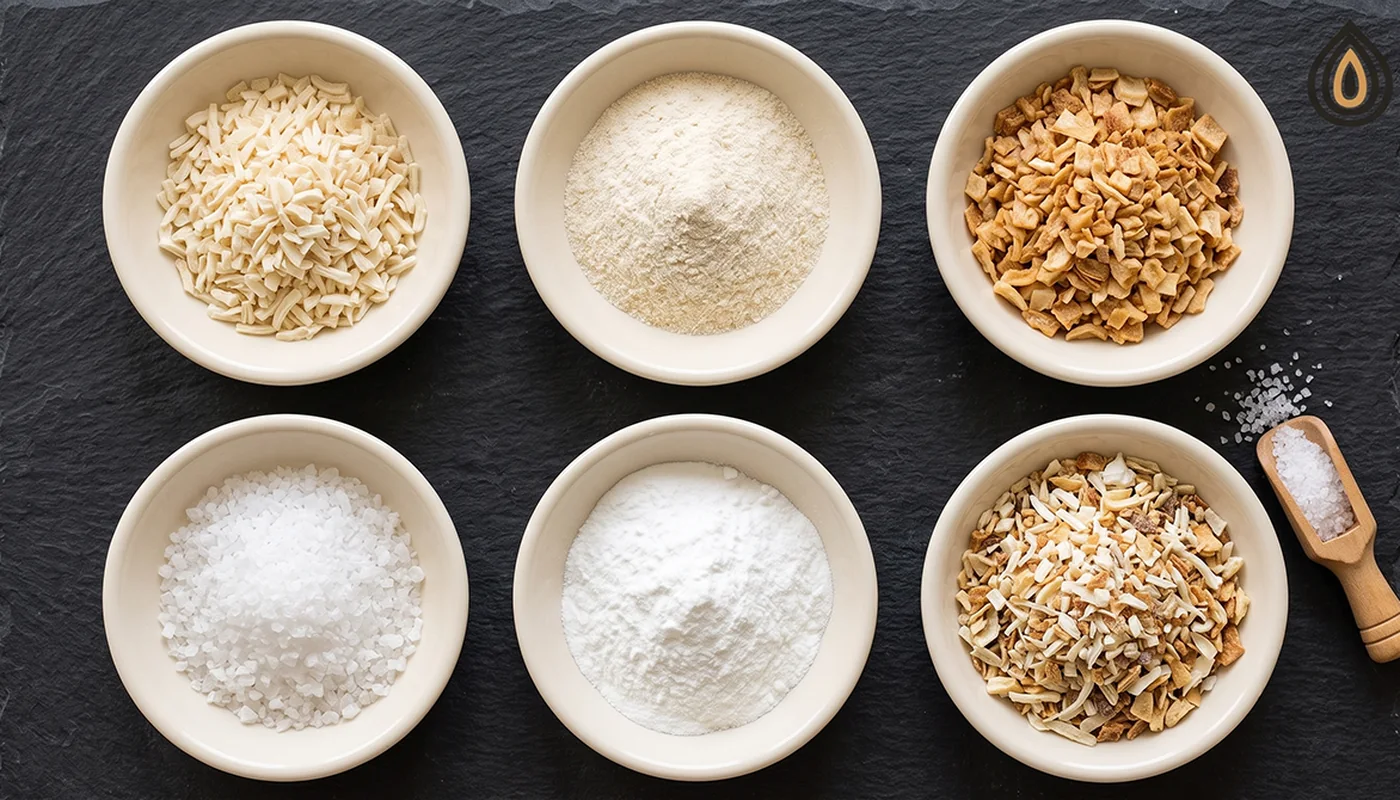
| Dry soup mix, consumer-cooked 5-10 min | Minced 1-3 mm or granules 16-40 mesh | Rehydrates within the cooking time; visible pieces | Chopped 3-5 mm for "chunky" styles, needs 10+ min |
| Instant soup, cup, 3 min in boiling water | Granules 26-40 or 40-60 mesh plus powder for flavour | Only fine cuts rehydrate in 3 minutes | Powder only, no visible onion |
| Wet soup, retorted (canned, pouched) | Chopped 3-5 mm or flakes 8-20 mm | Coarse cuts keep identity through sterilisation | Minced, softens more |
| Chilled fresh soup, hot fill | Chopped or minced, pre-hydrated | Short heat process; pre-hydration gives even texture | Fresh onion; dried used for consistency and cost |
| Cooking sauces, jarred (pasta, curry) | Chopped 3-5 mm | Visible in the jar, survives pasteurisation and retort | Flakes for rustic styles |
| Dry sauce and gravy mixes, instant | Powder 80 mesh | Disperses; onion flavour without pieces | Granules 40-60 for a little body |
| Gravy granules and stock products | Powder 80-100 mesh | Even distribution in a fat-bound granule | - |
| Dips, dressings, cold sauces | Minced or granules, pre-hydrated 30 min | No cooking; must hydrate cold | Powder for flavour only |
| Ready-meal sauce components | Chopped or minced by texture target | Rehydrates in process water | - |
The rule behind the table: the coarser the cut, the more it looks like onion and the longer it takes to rehydrate; the finer, the faster and the less visible. A product's cooking time and process decide the cut before flavour does. The five cuts as products are described in Flakes, Chopped, Minced, Granules or Powder.
How each cut takes up water: ratios, times, temperatures
| Cut | Water uptake (g water per g dry) | Time in water at 20 °C | Time in water at 90-100 °C | Rehydrated texture |
|---|---|---|---|---|
| Flakes 8-20 mm | 3.5-4.5 | 25-40 min | 8-12 min | Soft, slightly translucent, holds shape |
| Chopped 3-5 mm | 3.5-4.5 | 20-30 min | 5-8 min | Soft pieces, some shape |
| Minced 1-3 mm | 3-4 | 10-20 min | 3-5 min | Fine soft pieces |
| Granules 16-40 mesh | 2.5-3.5 | 5-10 min | 2-3 min | Small soft particles, near-invisible |
| Powder 80 mesh | 2-3 (disperses) | Immediate dispersion | Immediate | None; thickens slightly |
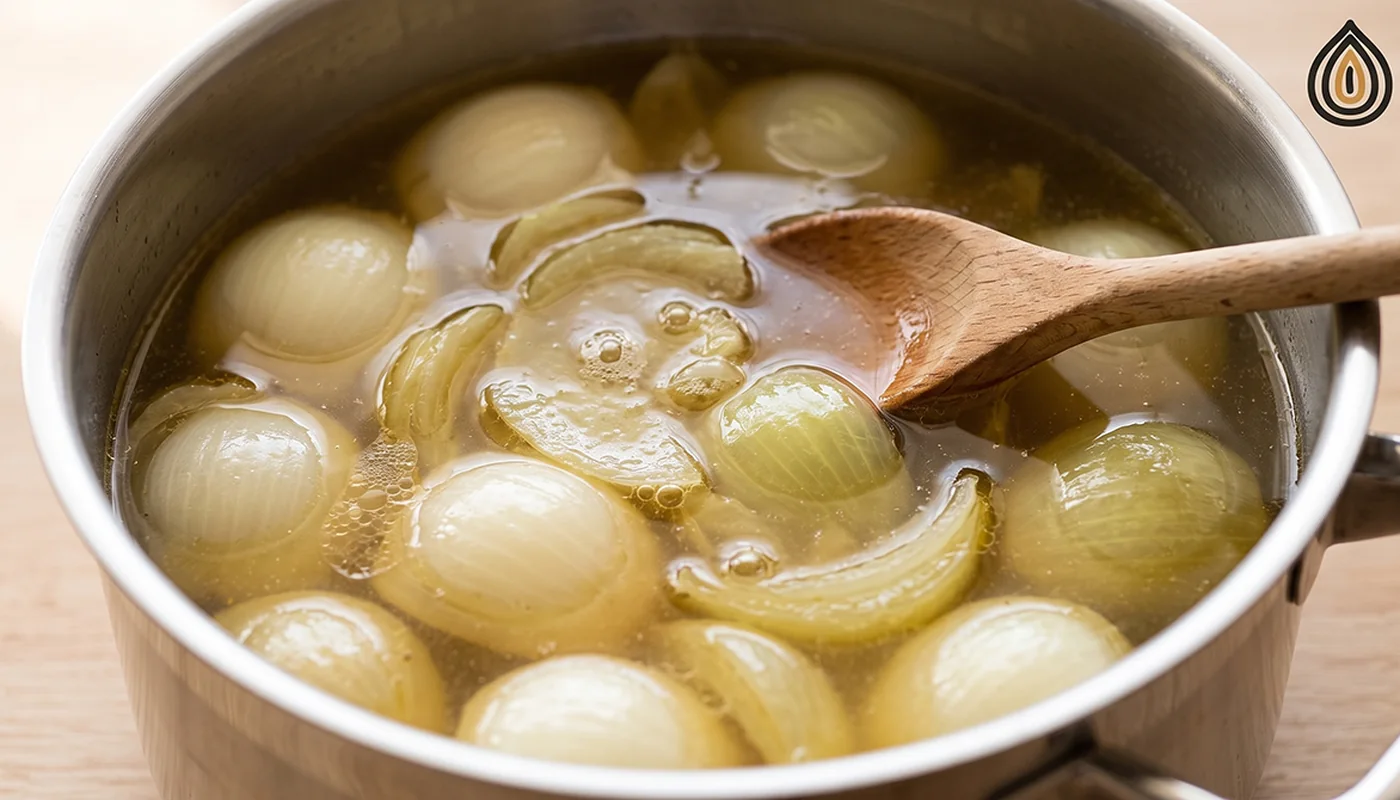
Water uptake is a property of the drying, not the cut: a well-dried flake at 5 percent moisture takes up around four times its weight, and the same tissue minced takes up slightly less because more of its cell walls are broken. Salt in the water slows rehydration and reduces uptake by roughly a fifth at 2 percent salt, which is why a soup mix formulated to rehydrate in five minutes in plain water may take seven in the finished, salted product; sugar and acid have smaller effects. Rehydration is faster and more complete in hot water, and the texture after full rehydration is close to cooked fresh onion, without the sharpness, since the volatile sulphur compounds that give raw onion its bite are largely lost in drying and the flavour that remains is the sweet, cooked note. A fuller treatment, with the method for measuring uptake, is in Rehydrating Dehydrated Onion.
Dosing: rates and fresh-onion equivalents
One kilogram of dehydrated onion replaces 8 to 9 kilograms of fresh onion in flavour and about 4 to 5 in rehydrated weight, since the dried product does not take back all the water it lost. Dosing rates in the finished product, by weight of dry onion:
| Product | Dry onion in finished product | Fresh-onion equivalent | Notes |
|---|---|---|---|
| Dry soup mix (as sold) | 8-20 % | - | Onion soup 15-25 %; vegetable soup 5-10 % |
| Prepared soup, as eaten | 0.6-1.5 % | 5-12 % | Onion-forward soups at the top |
| Cooking sauce, jarred | 1-3 % | 8-25 % | Visible pieces at 2 %+ |
| Gravy, as eaten | 0.3-0.8 % (powder) | 2.5-7 % | Above 1 % the flavour dominates |
| Dry gravy or sauce mix | 3-8 % (powder) | - | Diluted 1:8 to 1:10 in use |
| Dip or dressing | 1-2.5 % | 8-20 % | Pre-hydrate; raw-onion bite is absent |
Developers replacing fresh onion should start at a ninth of the fresh weight and adjust by taste, expecting to add back a little acid or a touch of raw-onion flavour where the fresh sharpness mattered, and expecting a sweeter, rounder note where it did not. The cost comparison, once labour, waste and storage of fresh onion are counted, is in Dehydrated vs Fresh Onion: The Real Cost per Kilo.
Behaviour under dry blend, hot fill, retort and aseptic
Dry blending is the gentlest use: the onion is mixed with salt, starch, dried vegetables and flavourings, packed, and cooked by the consumer. The concerns are particle size and flow, so that the blend does not segregate in the mixer or the sachet; moisture, since a dry onion at 6 percent in a blend with salt at 0.2 percent water activity will equilibrate and can cake; and the microbiology tier, since the consumer's cooking is the only kill step. Granules and minced hold their place in a blend; flakes ride to the top and powder sinks, which is why soup mixes rarely use either alone.
Hot fill, at 85 to 95 degrees for chilled or short-life ambient products, is a mild process in which pre-hydrated onion pieces keep their texture well; the risk is under-hydration, where pieces added dry go on absorbing water from the sauce after filling and the product thickens in the pack. Pre-hydrate for 20 to 30 minutes in warm water, or add early enough in the cook.
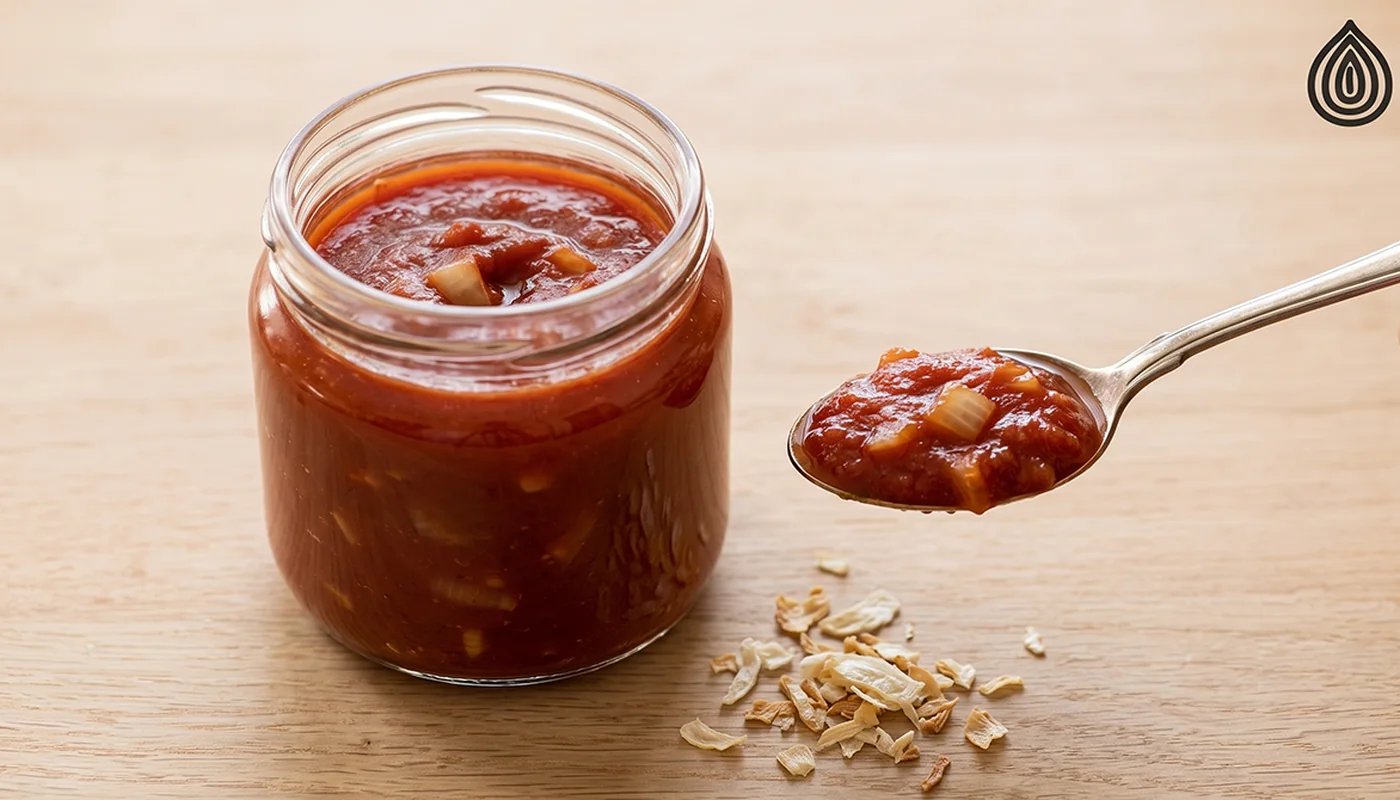
Retort sterilisation, at 121 degrees for 20 to 60 minutes in cans and pouches, is the hardest process on onion texture and colour. Chopped and flakes survive with recognisable shape; minced softens to near-dissolution; all cuts brown a little through the Maillard reaction with sugars, and white onion darkens to a light tan, which is acceptable in most sauces and not in pale cream soups, where a lower dose of powder for flavour and a few chopped pieces for appearance is the usual compromise. Flavour becomes rounder and sweeter still; a small addition of powder late in filling, or a more assertive dose, keeps the onion recognisable after retort.
Aseptic processing, with the sauce heated in a scraped-surface or tubular exchanger and filled cold into sterile packs, is quick and high-temperature, and particle integrity depends on the exchanger: chopped onion survives tubular systems well and scraped-surface systems less well. Pre-hydration is essential, since the residence time is too short for dry pieces to take up water before filling.
Salt, acid, fat and starch: the interactions
Salt slows rehydration and firms texture, so a highly salted product needs more time or a finer cut. Acid, in tomato-based sauces and vinegar dressings, slows rehydration slightly, preserves colour by inhibiting browning, and sharpens the onion flavour a little, which is why dried onion works well in tomato sauces at modest doses. Fat coats particles and slows water uptake markedly; onion added to a roux or a fat-bound gravy granule should be powder or pre-hydrated pieces, since dry granules in fat stay hard. Starch competes for water: in a starch-thickened soup the onion should be hydrated before the starch is gelatinised, or the starch takes the water first and the onion stays firm; a common fix in dry mixes is to specify a finer onion cut than the appearance target, knowing that the starch delays hydration. Sugar, in sweet sauces and chutneys, promotes browning of the onion in heat and gives a caramelised note that some products want and others do not. The general rule is that onion should meet water before it meets fat, starch or high salt.
White or red in soups and sauces
White onion is the default for soups, sauces and gravies: it is milder, sweeter, paler and cheaper, and it disappears into a pale soup or a cream sauce. Red is chosen for appearance in products where the pieces should be seen and coloured, in some curry sauces, salsas, relishes and Mediterranean-style sauces, and for its slightly sharper flavour; its colour leaches into the sauce as a pink-brown tint under heat, which rules it out of pale products and is a feature in dark ones. Red costs 10 to 25 percent more and is less available off-season. Pink onion sits between and is occasionally used for its colour in chutneys. The full comparison is in White vs Red Dehydrated Onion.
Microbiology tier by process
| Product / process | Kill step for the onion? | Tier usually specified | Total plate count |
|---|---|---|---|
| Retorted soups and sauces | Yes, full sterilisation | Standard | ≤500,000/g |
| Hot-fill cooking sauces, pasteurised | Yes, pasteurisation | Standard or low bacterial by risk assessment | ≤500,000 or ≤50,000/g |
| Dry soup and gravy mixes, consumer-cooked | Only the consumer's cooking | Low bacterial | ≤50,000/g |
| Instant products, boiling water only | Partial | Low or extra low bacterial | ≤50,000 or ≤10,000/g |
| Dips, dressings, cold sauces | None | Extra low bacterial | ≤10,000/g |
The tiers are delivered by steam treatment at the plant, at a premium of roughly 5 to 15 percent for low bacterial and 15 to 30 for extra low; the counts, methods and what they mean are in Microbiology in Dehydrated Onion, and the treatment itself in Low Bacterial and Extra Low Bacterial Dehydrated Onion. Salmonella absent in 25 grams and E. coli absent in one gram apply at every tier.
Common problems and fixes
| Problem | Usual cause | Fix |
|---|---|---|
| Onion pieces still firm after cooking | Salt, starch or fat reached the onion before water; cut too coarse for the cooking time | Hydrate first; finer cut; longer cook |
| Sauce thickens in the jar after filling | Dry onion added late, still absorbing water | Pre-hydrate or add earlier; allow for uptake in water content |
| Soup mix cakes in the sachet | Onion moisture too high, or salt drawing moisture | Specify ≤5 % moisture; check pack water activity; anti-caking in powder fractions |
| Onion flavour too weak after retort | Heat flattens the flavour | Raise dose 20-30 %; add part as powder late |
| Product too sweet or lacks bite | Drying removes raw-onion sharpness | Small acid adjustment; a little raw-onion flavouring; do not chase with more dried onion |
| Brown specks in a pale soup | Retort browning of pieces; or a lot with browned edges | Powder for flavour, minimal pieces; specify colour grade; check lot before use |
| Black or dark specks | Scorched particles from the dryer, or foreign matter | Specify defect limits; reject the lot if outside them |
| Pink tint in a white sauce | Red onion used, or a white lot with pink-skin admixture | Specify white, colour grade, and skin admixture limit |
| Segregation in the dry blend | Cut sizes too different from the rest of the mix | Match particle sizes; use granules rather than flakes |
| Batch-to-batch flavour variation | Different plants, seasons or drying temperatures | Single-source lots; retained reference sample; sensory check per lot |
The defects that arrive with a lot, rather than being made in the kitchen, are catalogued in Common Quality Defects in Dehydrated Onion.
Cost per portion
At a landed cost of 2.10 to 2.60 euros per kilogram for white flakes or granules delivered to a European manufacturer in March 2026, the onion in a 250 millilitre portion of prepared soup at 1 percent dry onion costs half a cent; in a 400 gram jar of cooking sauce at 2 percent, two cents; in a portion of gravy at 0.5 percent powder, a fraction of a cent. Low bacterial adds 5 to 15 percent to those figures and extra low 15 to 30; red adds 10 to 25. Against fresh onion at a European wholesale price of 0.40 to 0.80 euros per kilogram, plus peeling and chopping labour, waste of 10 to 15 percent, cold storage and price volatility, the dried product is at or below parity in most soups and sauces and well below in dry mixes, where fresh onion cannot be used at all. The landed-cost build is in Landed Cost of Dehydrated Onion in Europe.
The specification lines that matter for this use
- Cut and band matched to the process, with the share inside the band and a fines maximum, since fines cloud a clear soup.
- Moisture maximum 6 percent, 5 for dry mixes.
- Colour grade, especially for pale products; a white lot at the top grade, and a limit on browned and pink-skinned particles.
- Rehydration ratio, minimum 3.5 to 1 for flakes and chopped by the buyer's own method, if texture matters.
- Microbiology tier per the process table above.
- Flavour: a sensory clause against a retained reference sample, since a scorched or stale lot passes every chemical test and fails in the pot.
- Sulphite-free, declared, unless the product is formulated with sulphite and labelled for it.
- Allergen statement covering cross-contact at the plant, because a soup label carries every allergen the ingredients bring.
How each line is written and tested is in How to Read a Dehydrated Onion Specification Sheet.
A worked formulation: dry onion soup mix
A classic dry onion soup mix, 40 gram sachet making one litre, consumer-cooked for 8 minutes:
| Ingredient | Share of mix | Per 40 g sachet | Role |
|---|---|---|---|
| Dehydrated white onion, minced 1-3 mm, low bacterial | 22 % | 8.8 g | Visible onion; rehydrates in 8 min |
| Dehydrated white onion, powder 80 mesh, low bacterial | 8 % | 3.2 g | Flavour body; disperses |
| Toasted onion, minced | 5 % | 2.0 g | Roasted note and colour |
| Salt | 24 % | 9.6 g | ~1 % in the prepared soup |
| Maltodextrin and modified starch | 25 % | 10 g | Body and thickening |
| Yeast extract, sugar, spices, oil powder | 16 % | 6.4 g | Savoury base, balance |
The onion pieces at 22 percent, with a water uptake of 3.5, take up about 30 grams of the litre and give the visible onion; the powder carries the flavour that the pieces alone would not deliver in eight minutes; the toasted fraction, described in Toasted Onion vs Natural Dehydrated Onion, supplies the roasted colour. Onion is 35 percent of the mix by weight and, at 2.40 euros per kilogram, about 3.4 cents of the sachet's ingredient cost. Low bacterial is specified because the consumer's eight-minute simmer is the only kill step and the manufacturer's hazard analysis treats the mix as a product that may be under-cooked. The minced cut, rather than chopped, is chosen because chopped would still be firm at eight minutes in salted water.
Gravies, stocks and bouillon: the powder use in detail
Gravy granules, stock cubes, bouillon powders and instant sauce bases use onion almost entirely as powder, and the demands on the powder are different from those on a piece cut. The powder must disperse without lumps in the few seconds the consumer gives it, which favours 80 to 100 mesh and a low fines share below 200 mesh, since ultra-fine dust wets slowly and floats; it must flow in the manufacturer's blender and depositor, which argues against moisture above 5 percent and for a stated bulk density; and it must carry flavour at a low dose, typically 3 to 8 percent of the dry mix and 0.3 to 0.8 percent of the prepared gravy, without the scorched note that a badly milled powder brings. In a fat-bound gravy granule, where the powder is agglomerated with fat, salt and starch, the onion is coated and its flavour releases in the hot liquid; a coarser 60 to 80 mesh powder gives a little more body to the granule. Stock cubes press the powder with fat and salt under pressure, and here the powder's oil absorption matters, since a powder that takes up too much fat makes a crumbly cube; a plant's powder from a single lot, rather than a blend of lots, is more consistent in this respect. Toasted onion powder, made from kibble roasted before milling, adds a roasted colour and flavour that gravies and brown sauces want and pale sauces do not. The flow and density side is in Bulk Density and Flowability of Onion Powder and Granules.
Chilled and fresh soups: the short-process case
Chilled soups sold with a two to four week life are cooked, hot-filled or filled and pasteurised in the pot, and cooled, and they are a growing use of dried onion at manufacturers who want a consistent onion note without the labour and waste of fresh. The process is short and mild, so the onion's texture is preserved and its flavour is closer to the fresh-cooked note than in a retorted product, and the main formulation rule is to hydrate the onion early, in the water or stock before the starch and the fat go in, and to allow for its water uptake in the recipe so that the viscosity in the pot is the viscosity in the tub. Chopped and minced both work; flakes are too coarse for the spoon. The microbiology tier is decided by the manufacturer's hazard analysis, and most specify low bacterial for a product held chilled for weeks, even though it is cooked, because a low initial load is a wider margin on a product without a sterilisation step. Some chilled-soup makers use a blend of fresh and dried onion, fresh for the top note and dried for the base and for consistency across the year; the cost argument for the dried share is in Dehydrated vs Fresh Onion: The Real Cost per Kilo.
Comparing two lots in the kitchen
Chemical and microbiological tests do not catch a stale, scorched or flat lot, and the kitchen does. A repeatable comparison takes twenty minutes. Rehydrate 10 grams of each lot in 100 millilitres of water at 90 degrees for the time in the rehydration table, drain, and compare the drained weight, which should be within 10 percent between lots; the texture, by pressing a piece between the fingers; the colour of the pieces and of the water, since a browned lot tints the water; and the aroma, first of the dry product, which should be clean, sweet and sharp, and then of the hot rehydrated product, which should smell of cooked onion with no scorched, hay-like or musty note. Then taste both in a plain salted broth at 1 percent dry onion, blind, and score for onion intensity, sweetness, any off-note and overall. Keep the reference lot's dry sample sealed in the freezer and run the comparison on every new lot and on the reference at the same time, because the reference itself drifts over a year. A lot that passes every number on the certificate and fails this comparison should be raised with the supplier with the drained weights and the scores; the structured version of the method is in Sensory Evaluation of Dehydrated Onion.
Handling opened bags in a soup or sauce plant
Dried onion arrives at 5 percent moisture in a lined 20 kilogram bag, and it starts taking up moisture the moment the liner is opened. In a soup kitchen or a sauce plant at 60 to 70 percent relative humidity, an open bag of granules reaches 8 percent moisture in a few days and cakes; powder does so faster; flakes slower. The handling rules that prevent it are simple: open a bag only when it will be used within the shift, re-seal the liner with a clip or tape between uses, keep opened bags off the floor and away from the cooking area's steam, store at or below 25 degrees, and use lots in the order of their drying dates. Weigh out from the bag into a covered container for the day rather than leaving the bag open by the kettle. A caked bag is not spoiled, and can be broken up and used if the aroma is clean and the moisture is below 8 percent, but it does not weigh the same per scoop and should be dosed by weight. For dry-mix plants, the onion is often decanted into the blending room's day bins, which should be lidded and emptied and cleaned between lots so that fines from one lot do not build up under the next. The storage science is in Dehydrated Onion Shelf Life.
Running a line trial
A line trial on a new cut or a new supplier's lot answers the questions the kitchen cannot: how the onion behaves in the plant's own kettle, exchanger, filler or blender at full scale. Order 25 to 50 kilograms of the trial lot, with its certificate, and reserve a retained sample. Run the standard recipe with the current onion first as the control, then the trial lot, on the same day with the same operator, and record the rehydration behaviour in the process, the viscosity at filling, the appearance in the pack, the yield and any handling problems. Hold packs from both runs through the product's shelf life, and taste at the start, the middle and the end, because the differences between onion lots show most in a retorted or a chilled product after storage. A trial that passes at day one and fails at week six is telling you about the onion's own age or drying, and the supplier should be told the drying date of the lot that failed. Trials are also the moment to test a cheaper cut against the current one: a soup that carries chopped onion may be just as good with minced, which rehydrates faster and costs no more, and a sauce that uses granules for flavour may be better with powder. Suppliers expect trial orders and price them at product cost plus courier; the sample and trial sequence is in From Sample to First Container.
What KlarHarvest supplies for soups and sauces
All five white cuts and the red cuts, at the standard, low bacterial and extra low bacterial tiers, from BRCGS-certified plants in Mahuva, with the sieve band, moisture, colour grade and tier on each certificate, and a rehydration ratio on request. Samples of two adjacent cuts from the same lot are sent for a kitchen trial, and the lot record for every shipment shows the plant and the drying date so that a sensory difference between lots can be traced. Product pages for minced, chopped and powder carry the specifications; the application overview is on the products page.
Frequently asked questions
Which dehydrated onion cut is best for soup?
Minced or granules for dry soup mixes and instant soups, since they rehydrate within the consumer's cooking time; chopped or flakes for retorted wet soups, where the coarser cut keeps its identity through sterilisation.
How much dehydrated onion replaces fresh onion in a sauce?
About one part dried to eight or nine parts fresh by weight for flavour. Start there and adjust; expect a sweeter, rounder note and add a little acid where the raw sharpness mattered.
Do I need to rehydrate dehydrated onion before adding it to a sauce?
For hot-fill, aseptic and fat- or starch-rich products, yes, 20 to 30 minutes in warm water, or add it early in the cook. In retorted products and long simmers it can go in dry, with the water allowed for in the recipe.
Why does onion flavour fade after retorting?
Heat flattens and sweetens the flavour. Raise the dose by 20 to 30 percent or add part of the onion as powder late in the process.
Which microbiology tier does a dry soup mix need?
Usually low bacterial, total plate count at or below 50,000 per gram, because the consumer's cooking is the only kill step. Cold dips and dressings need extra low bacterial.
Can dehydrated onion cause a soup mix to cake?
Yes if its moisture is above about 5 percent or the mix's water activity lets moisture migrate. Specify 5 percent maximum for dry mixes and check the pack's water activity.
White or red onion for a tomato sauce?
White for flavour at lowest cost; red where visible coloured pieces are wanted and the sauce is dark enough to hide the pink tint that leaches out under heat.
Next step
Request a sample of two cuts from one lot, with the tier your process needs, and run them in your own kitchen; then request a quote with the annual volume and the tier, and it is priced within one business day.