- The role of onion in a blend
- Blend families and the cut that fits each
- Particle size: matching the blend to prevent segregation
- Bulk density and the volumetric filler
- Moisture, water activity and caking
- Dosing and the flavour contribution
- Toasted and roasted onion in blends
- Colour: keeping a pale blend pale
- Microbiology tier for blends that are not cooked
- Allergens, additives and the label
- Blend order, mixing and packing
- Common faults and fixes
- Specification lines for blending
- A worked blend: onion salt seasoning
- Onion in curry powders and Indian masalas
- Shelf life of a blend and the onion's share of it
- Sampling and approving an onion lot for blending
- What KlarHarvest supplies to blenders
- Frequently asked questions
Judge the product, not the words
200-500 g from a current lot, dispatched by courier with the lot lab report.
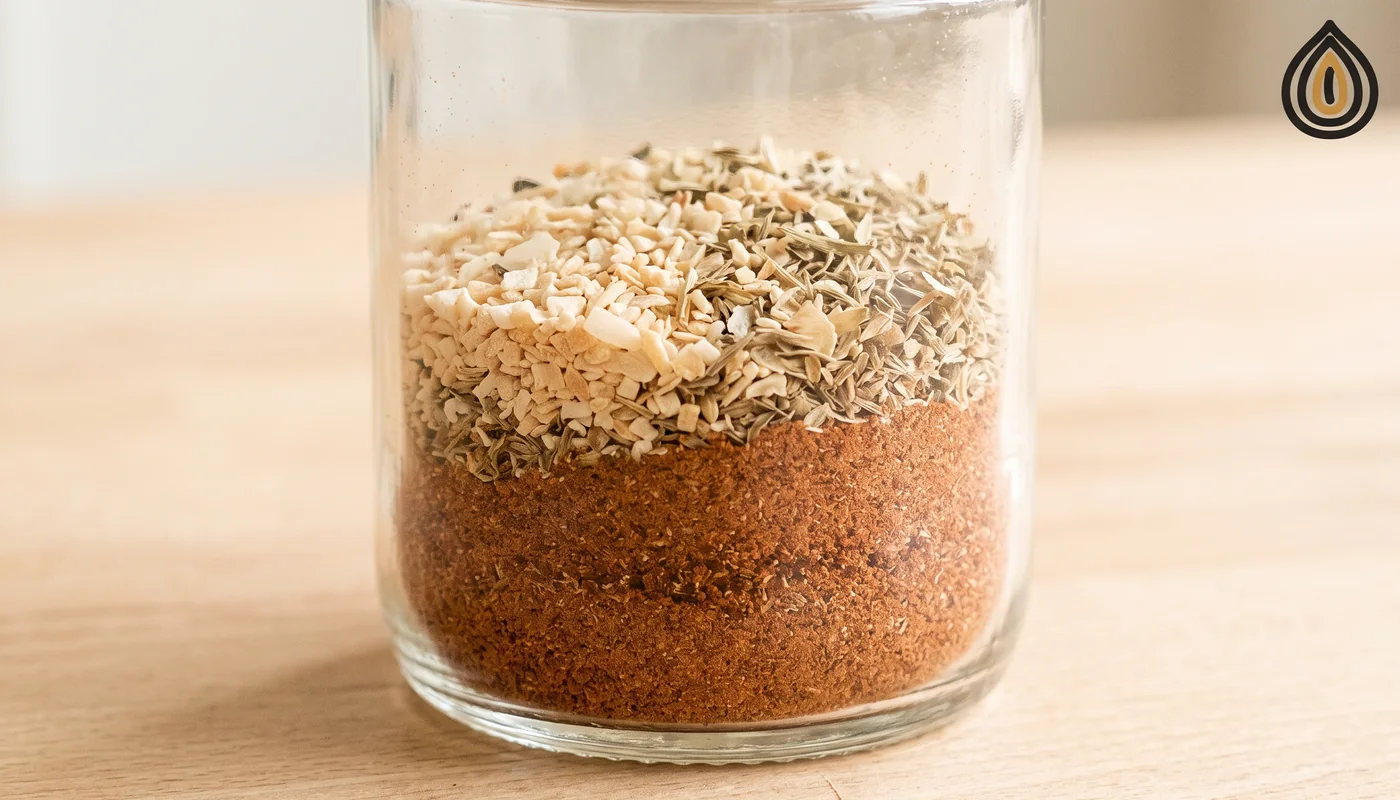
Request a sampleDehydrated onion spice blends are the largest single use of onion powder and granules after soups, and the one where the ingredient's physical properties matter more than its flavour. A blend is a mixture of particles that must stay mixed from the blender through the packing line, the shelf and the customer's shaker, and onion, which is hygroscopic, variable in bulk density, and available in five sizes, is the component that most often breaks that requirement: it segregates when its size does not match the rest, it cakes when its moisture rises, and it carries flavour at a dose that makes any variation visible. This guide is written for the seasoning and spice manufacturers, the blenders and the private-label packers who use onion in curry powders, barbecue rubs, salt blends, soup bases, snack seasonings and retail shakers, and for the buyers who specify it for them.
It covers the role onion plays in the main blend families, which cut and mesh fit which, matching particle size and density to prevent segregation, moisture, water activity and caking, dosing and the flavour contribution, toasted and roasted onion, the microbiology tier for blends that are not cooked, allergen and additive labelling, blend order and packing, common faults, specification lines and a worked blend. Values are trade-typical for Mahuva product in March 2026.
What this guide covers
- The role of onion in a blend
- Blend families and the cut that fits each
- Particle size: matching the blend to prevent segregation
- Bulk density and the volumetric filler
- Moisture, water activity and caking
- Dosing and the flavour contribution
- Toasted and roasted onion in blends
- Colour: keeping a pale blend pale
- Microbiology tier for blends that are not cooked
- Allergens, additives and the label
- Blend order, mixing and packing
- Common faults and fixes
- Specification lines for blending
- A worked blend: onion salt seasoning
- Onion in curry powders and Indian masalas
- Shelf life of a blend and the onion's share of it
- Sampling and approving an onion lot for blending
- What KlarHarvest supplies to blenders
- Frequently asked questions
The role of onion in a blend
Onion does three jobs in a seasoning. It is a flavour base, sweet and savoury, that supports the meaty, roasted and umami notes of a blend and rounds salt; almost every savoury seasoning carries it at 5 to 25 percent for that reason. It is a bulk carrier, since a blend needs body between its potent components, and onion at a moderate cost carries flavour of its own where maltodextrin or salt carry none. And in coarse blends it is a visible component, the pale flecks in a rub or a bread topping that signal "onion" to the eye. The three jobs pull toward different cuts: the base wants powder, the carrier wants granules or powder, and the visible component wants granules or minced, so most blends carry onion in two forms. The cuts as products are in Flakes, Chopped, Minced, Granules or Powder.
Blend families and the cut that fits each
| Blend family | Onion share | Cut and mesh | Notes |
|---|---|---|---|
| Curry powders and garam masala | 3-10 % | Powder 80-100 mesh | Matches the fine grind of the spices; roasted onion in some Indian styles |
| Barbecue and grill rubs | 10-25 % | Granules 26-40 or 40-60 plus powder | Coarse blend; granules visible and adherent; toasted onion for colour |
| Onion salt, garlic-onion salt | 20-40 % | Powder 80 mesh, or granules 40-60 matched to the salt grain | Hygroscopic pairing; anti-caking usual |
| Soup bases and bouillon powders | 5-15 % | Powder 80 mesh | Disperses in hot water |
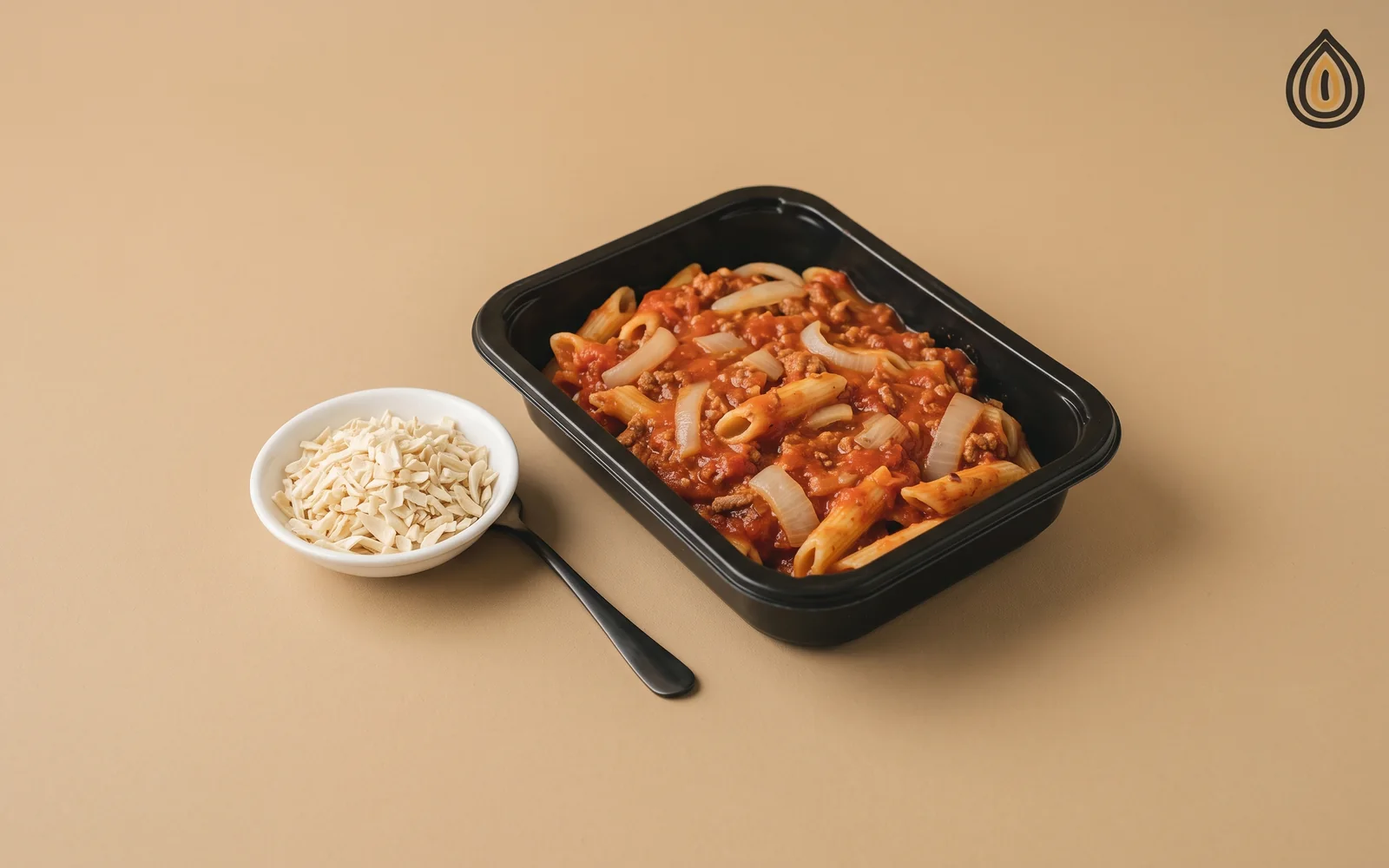
| Snack seasonings (tumble-applied) | 5-20 % | Granules 40-60 and powder | Adhesion and flow; see the snack guide |
| Salad and dip seasonings (rehydrated in sour cream, mayonnaise) | 15-35 % | Minced 1-3 mm and granules 16-40 | Visible pieces after rehydration; extra low bacterial |
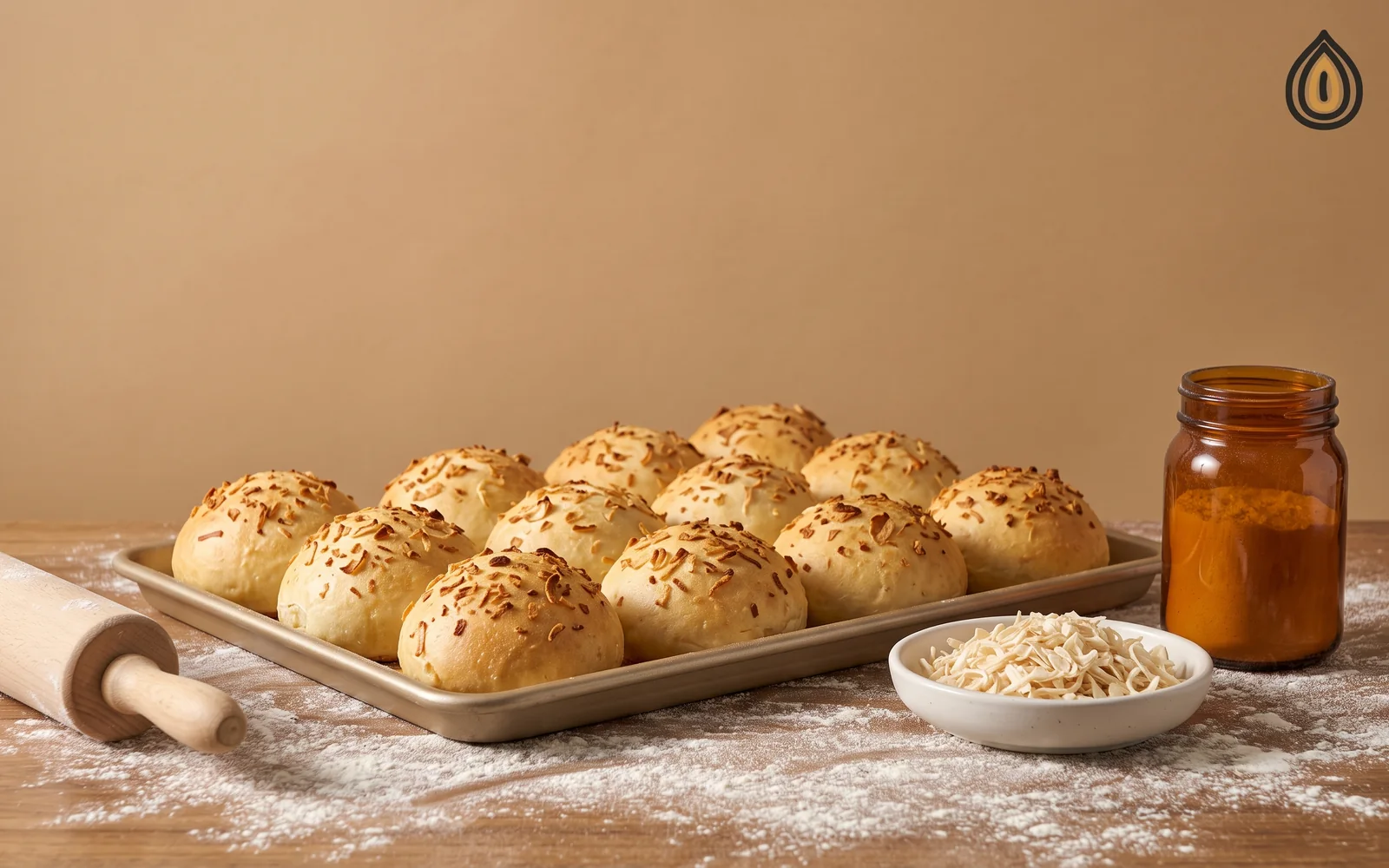
| Bread and bagel toppings | 30-60 % | Minced, chopped, flakes | Visible; toasted in the oven |
| Marinade and sauce mixes | 5-15 % | Powder | Dispersion |
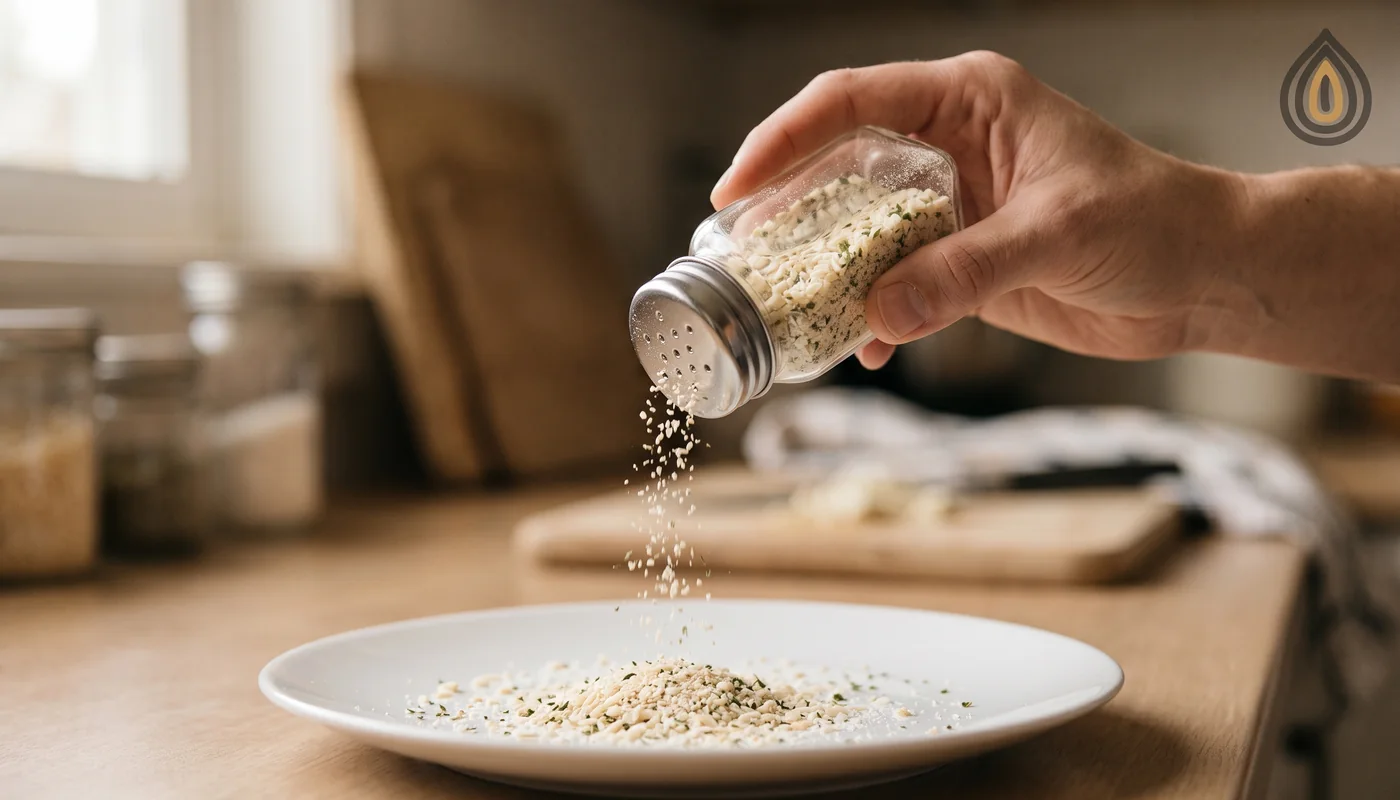
| Retail all-purpose seasonings and shakers | 5-20 % | Powder or granules matched to the grind | Must flow from a shaker after weeks on a shelf |
| Pet-free, allergen-free and clean-label blends | Various | Any | Onion is allergen-free; note the pet-food exclusion |
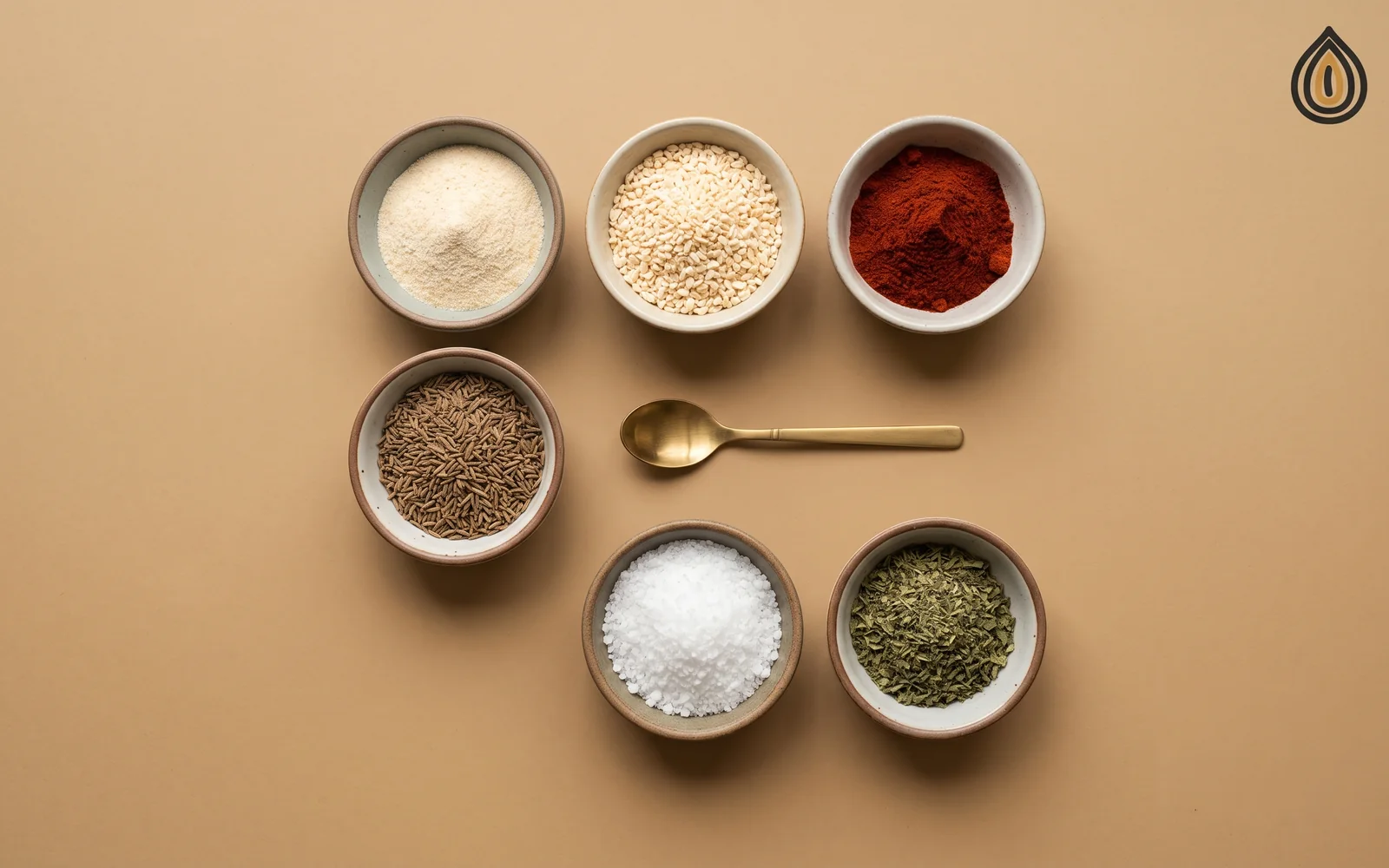
Curry powders are the largest single family by volume in Europe and Asia, and their onion is powder, milled to the same fineness as the coriander, cumin and turmeric it sits with; the specific case of onion in Indian blends, where roasted onion powder is traditional, is worth its own discussion below. The snack seasoning family has its own guide, Dehydrated Onion in Snack Seasoning.
Particle size: matching the blend to prevent segregation
A blend of particles of different sizes and densities separates when it is vibrated, poured or conveyed: fine particles sift down through the gaps between coarse ones, and coarse, light particles rise. The mechanism needs only a size ratio of two or three to one to start, and a blend with 80 mesh spices and 16-40 mesh onion granules, a ratio of six to one, will show visible separation in a jar after a day on a vibrating packing line. The rule is to match the onion's particle size to the blend's: powder at 80 to 100 mesh in a fine blend, granules at 40-60 in a medium one, 26-40 or 16-40 in a coarse rub where the other components are similarly coarse, cracked pepper and coarse salt, and minced or chopped only in toppings and dip mixes where everything is coarse. Where a blend must carry both a fine base and visible onion pieces, the fine fraction is made first and the coarse fraction added last with minimal further mixing, and the pack is filled straight away; some blenders agglomerate the fine fraction to the size of the coarse pieces to stop the sifting. The mesh bands and their millimetre equivalents are in Mesh Size in Dehydrated Onion.
Bulk density and the volumetric filler
Blends are filled by weight or by volume, and a volumetric filler, an auger or a cup, dispenses a fixed volume whose weight depends on the blend's bulk density. Onion powder at 500 to 650 grams per litre, granules at 450 to 550 and flakes at 180 to 230 change a blend's density in proportion to their share, and a lot of onion at the fine end of its band is denser than one at the coarse end; a blend whose onion lot changes can go out of weight tolerance on a volumetric line without any change to the recipe. Blenders on volumetric lines specify the onion's bulk density with a range, check it on arrival and adjust the filler; blenders on gravimetric lines need only the size band. Density also drives the segregation above: a light coarse particle in a dense fine matrix floats. The density figures and their causes are in Bulk Density and Flowability of Onion Powder and Granules.
Moisture, water activity and caking
Onion at 5 percent moisture has a water activity of about 0.30 to 0.35; salt has a water activity near zero until it deliquesces; sugar, maltodextrin and most ground spices sit at 0.3 to 0.5. In a sealed blend the components exchange moisture until they reach a common water activity, and onion, the most hygroscopic dry vegetable in the blend, takes up moisture from anything wetter than itself and gives it to anything drier; a blend with onion at 6 percent and dried herbs at 9 percent ends with the onion at 7 or 8 and caking. Salt blends are the hardest case: onion salt at 25 percent onion cakes within weeks if the onion is above 5 percent moisture or the salt is fine and slightly damp, because the onion's sugars and the salt's brine bridge the particles. The controls are the onion's moisture, specified at 5 percent maximum for blending rather than 6, a water-activity check on the finished blend, a target below 0.4, a barrier pack, and an anti-caking agent, silicon dioxide at 0.5 to 1 percent or calcium silicate, which is permitted in seasonings in the EU and declared as E551 or E552; clean-label blends use rice flour or rice concentrate at 2 to 4 percent instead, at some cost to flavour. Powder cakes faster than granules, which is a reason to use granules where the blend allows. The onion's own moisture and water activity are in Dehydrated Onion Moisture Content and Water Activity in Dehydrated Onion.
Dosing and the flavour contribution
Onion's flavour in a blend is the cooked-onion note, sweet and savoury, and it is potent: at 5 percent of a blend applied at 2 percent to a snack, onion is 0.1 percent of the finished food and clearly present; at 20 percent of a rub applied at 3 percent to a steak, 0.6 percent and dominant. The dosing table in the blend-family section gives the shares; the flavour contribution per unit is highest for powder, since fine particles release flavour fastest, and lowest for flakes, which release slowly and contribute mostly appearance. Onion also carries 30 to 40 percent sugars on the dry weight, which sweeten a blend and brown under a grill, and a blend formulator counts them. Red onion powder gives a slightly sharper note and a pink-brown colour and is used in a few coloured blends; white is the default. Where a sharper, rawer onion note is wanted, some blenders add a small share of onion extract or oleoresin, which is compared with the dried product in Dehydrated Onion vs Onion Oil and Oleoresin.
Toasted and roasted onion in blends
Toasted onion, kibble roasted to a golden or deep brown before milling, is a different flavour, caramel and roasted with the sweetness developed, and a different colour, and it is used in barbecue rubs, brown gravies, meat seasonings and the roasted-onion masalas of Indian cooking, where onion fried to brown before grinding is traditional and the dried toasted product replaces it. It is made by a few of the larger Mahuva plants on a separate roasting line and priced 20 to 40 percent over natural onion. In a blend it behaves like natural onion for size and moisture, cakes slightly less because roasting has converted some sugars, and colours the blend brown at any share above a few percent, so it is used deliberately. Its production, grades and uses are in Toasted Onion vs Natural Dehydrated Onion.
Colour: keeping a pale blend pale
A pale blend, an onion salt, a white barbecue rub, a cream sauce mix, shows the onion's colour, and a cream-grade or old lot turns the blend tan; a pale blend therefore specifies the top colour grade, a recent drying date and the age at which the grade applies. Milling darkens: a powder milled fine from good kibble is a shade darker than the granules from the same kibble, and a blender that mills its own onion in-house should mill cool. Scorched pieces show as black specks in a pale blend and are counted, not measured; the defect count matters more than the L* value. The grades, the browning causes and the specification wording are in Dehydrated Onion Colour.
Microbiology tier for blends that are not cooked
Many seasonings are applied to foods that are not cooked afterward, snack seasonings on a finished chip, dip mixes stirred into sour cream, table shakers, salad seasonings, and the blend's microbiology is the product's. For those, the extra low bacterial tier, total plate count at or below 10,000 per gram with the spore-formers controlled, is the usual specification, delivered by steam treatment at the plant; blends for products cooked after seasoning, rubs for grilling and soup bases, take low bacterial or standard under the blender's hazard analysis. Salmonella absent in 25 grams and E. coli absent in 1 gram apply at every tier, and the blender's own testing plan covers the finished blend. Spices and herbs from other origins are often the higher risk in a blend than the onion, which comes from a certified plant with a certificate per lot; the tiers and their meaning are in Microbiology in Dehydrated Onion and the treatment in Low Bacterial and Extra Low Bacterial Dehydrated Onion.
Allergens, additives and the label
Onion is not one of the fourteen EU allergens and pure dried onion carries no declarable allergen; sulphite, if present above 10 milligrams per kilogram in the finished blend, does, which is why blenders specify sulphite-free onion and test for it. A blend's allergen declaration comes from its other components, celery, mustard, sesame and gluten-containing ingredients being the usual ones, and from cross-contact in the blending plant; the onion supplier's declaration covers the plant it came from. The onion appears in the ingredient list as "onion" or "dried onion" or "onion powder", with the share where the quantitative ingredient declaration rules require it, which for a blend named "onion salt" they do. Anti-caking agents are declared by name or E number. A blend sold as an ingredient to another manufacturer travels with a specification and an allergen statement rather than a retail label. The allergen picture for onion itself is in Allergens, Gluten and Dehydrated Onion, and the retail label rules in Labelling Dehydrated Onion for the EU.
Blend order, mixing and packing
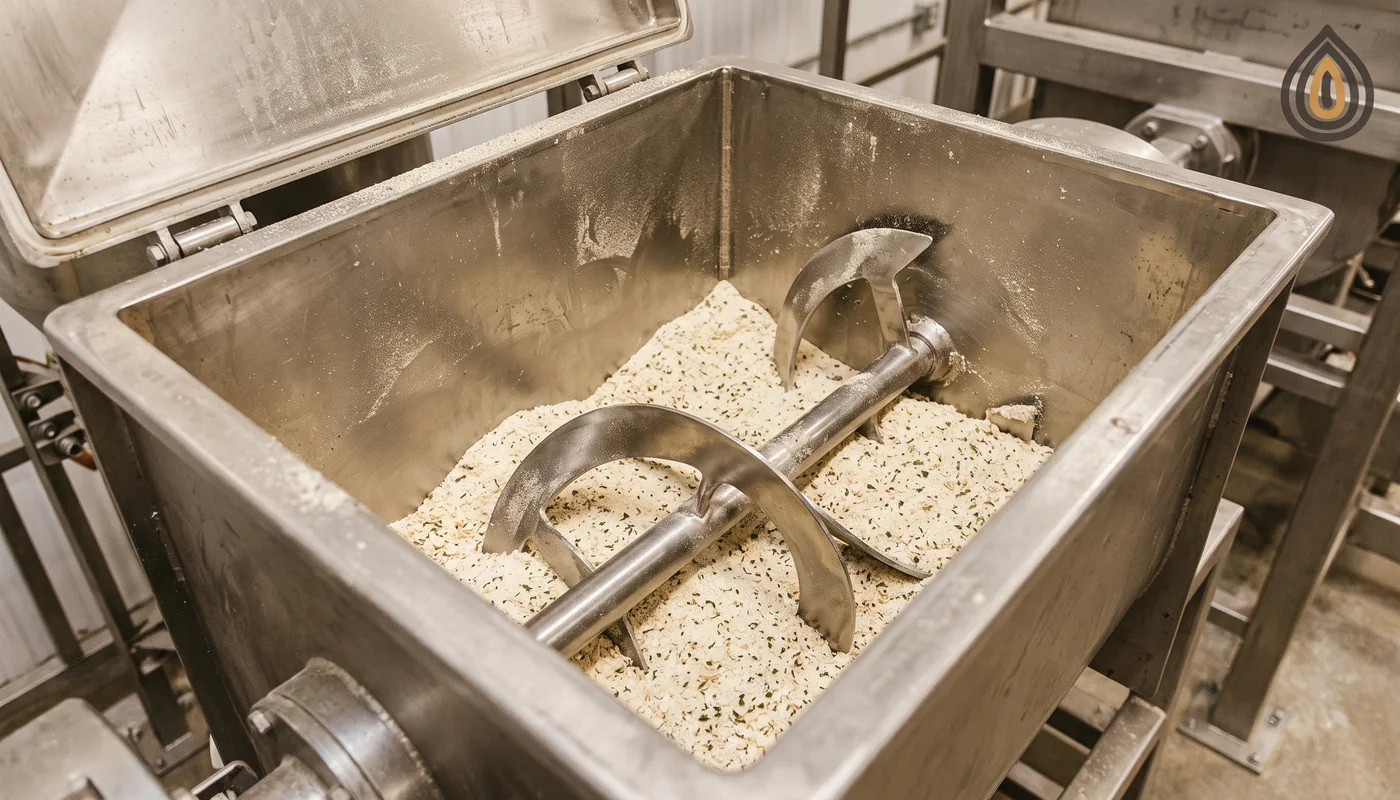
The order of addition in a ribbon or paddle blender matters for onion. Salt and any coarse crystalline components go in first and are broken up; the powders, spices and onion powder next, mixed to uniformity, typically 5 to 10 minutes in a ribbon blender; liquid or oil components, if any, sprayed in and mixed briefly; anti-caking agent with the powders or at the end; and any coarse visible component, granules, minced, dried herbs, last with the shortest mix that disperses them, since long mixing breaks them down and starts segregation. The blend is discharged straight to the packing line, not held in a hopper, because a blend at rest in a hopper separates and the first packs off the hopper differ from the last. Onion bags are opened at the blender and the liner re-sealed if any is left; the day's requirement is weighed out in a dry room. Blending validation, the check that the blend is uniform, is done by sampling the discharge at the start, middle and end and assaying a marker, salt being the usual one. The handling of opened onion bags and the storage of the blend follow the rules in Dehydrated Onion Shelf Life.
Common faults and fixes
| Fault | Cause | Fix |
|---|---|---|
| Blend separates in the jar | Onion particle size or density far from the rest | Match mesh to the blend; add coarse fraction last; pack immediately |
| Blend cakes on the shelf | Onion moisture above 5 %, or water activity mismatch with herbs or salt | Specify 5 % max; check blend water activity; anti-caking; barrier pack |
| Shaker will not dispense after a month | Caking as above, or fines bridging the holes | Granules instead of powder; anti-caking; larger holes |
| Pale blend turns tan | Cream-grade or old onion; hot milling | Top colour grade; recent drying date; mill cool |
| Black specks | Scorched onion pieces | Tighter defect count in the specification |
| Weight drift on the volumetric filler | Onion bulk density changed between lots | Specify density range; check on arrival; adjust filler |
| Onion flavour varies between batches | Different plants, seasons or drying | Single-source lots; retained reference; sensory check |
| Sulphite declared on a blend that should be free | Sulphited onion or cross-contact at the plant | Sulphite-free specification with a test; ask the plant about its lines |
| High counts on an uncooked blend | Standard-tier onion, or the other spices | Extra low bacterial onion; treated spices; blend testing |
| Dust in the blending room | Fines in the onion lot | Fines maximum in the specification; dust extraction |
Specification lines for blending
- Cut and mesh matched to the blend, with the share inside the band and a fines maximum: "granules 40-60 mesh, minimum 90 percent between 40 and 60 mesh, maximum 5 percent passing 60".
- Bulk density, loose, with a range, where the filler is volumetric.
- Moisture maximum 5 percent for blending; water activity maximum 0.40.
- Colour grade and defect count for pale blends; drying-date window.
- Microbiology tier per the blend's use; Salmonella and E. coli absence always.
- Sulphite-free, with a result by a specific method.
- Allergen statement covering the plant's cross-contact.
- Anti-caking: none in the onion as supplied, unless specified for powder.
- Packaging in lined bags or cartons that a blender can re-seal, or in the day's-use size.
- Sensory clause against a retained reference.
The whole specification is in How to Read a Dehydrated Onion Specification Sheet.
A worked blend: onion salt seasoning
A retail onion salt in a 70 gram shaker, 20 grams of onion per 100 grams of blend, for table and cooking use.
| Ingredient | Share | Role | Notes |
|---|---|---|---|
| Sea salt, fine, 0.3-0.6 mm | 65 % | Base | Free-flowing grade, dry |
| Dehydrated white onion, granules 40-60 mesh, extra low bacterial | 14 % | Visible onion, flavour | Matched to the salt grain; top colour grade |
| Dehydrated white onion, powder 80 mesh, extra low bacterial | 6 % | Flavour base | Fine fraction |
| Toasted onion, powder | 2 % | Depth, colour | Optional; gives a warm tone |
| Dried parsley, 1-2 mm | 1 % | Colour contrast | |
| Sugar, fine | 5 % | Balance | |
| Black pepper, ground | 1 % | ||
| Rice flour | 3 % | Anti-caking, clean label | Or silicon dioxide at 1 % |
| Onion extract | 0.2 % | Raw top note | Optional |
| Garlic powder | 2.8 % |
Method: salt first, broken up for two minutes; sugar, onion powder, toasted onion, garlic, pepper and rice flour added and mixed five minutes; granules and parsley last, mixed two minutes; discharged to the filler and packed in a shaker with a foil seal and a desiccant-free pack. Water activity target below 0.35. The extra low bacterial tier is specified because the shaker is used on finished food. Onion is 22 percent of the blend and, at 2.60 euros per kilogram for the treated product, about 4 cents of a 70 gram shaker's ingredient cost. The matched 40-60 granule and the fine salt grain are what keep the blend from separating in the shaker.
Onion in curry powders and Indian masalas
Curry powders made for the European and export markets carry onion at 3 to 10 percent as a background sweetness, milled to the blend's fineness and added as plain white powder; the onion is not traditional in most regional Indian masalas, where fresh onion is fried as the base of the dish, but it is standard in the composite "curry powder" of the export trade and in ready-made gravy and sauce bases. Where onion is traditional is in the fried-onion masalas, the bhuna and the biryani mixes, where onion fried slowly to brown is ground with the spices; the dried equivalent is toasted onion powder, and the larger Indian blenders and the diaspora brands in Britain and the Gulf use it at 5 to 15 percent. Two practical points for a blender: the dark toasted powder colours the masala, which is expected in a brown masala and not in a pale one; and the fried-onion flavour is sweet and caramelised, so a blend converted from fresh fried onion to toasted powder needs less added sugar. Indian blends are also where red onion powder appears, for the pink-brown tint some regional styles show. The blends themselves are usually low bacterial or extra low, since many are used as table condiments or added at the end of cooking. Toasted onion's grades and uses are in Toasted Onion vs Natural Dehydrated Onion, and the red and pink options in White vs Red Dehydrated Onion.
Shelf life of a blend and the onion's share of it
A seasoning blend carries a best-before of twelve to twenty-four months, and the onion in it is rarely the limiting component if it went in dry and the pack is a barrier: onion's own life is eighteen to twenty-four months, its flavour fades slowly rather than turning, and its colour shift toward cream is hidden in a coloured blend. The onion becomes the limiting component in three cases. In a pale blend where its colour shows, it sets the visual life at about twelve months. In a blend where it went in at 6 percent moisture rather than 5, it raises the blend's water activity and shortens the life of everything, since caking and the loss of volatile spice notes both accelerate with water activity. And in a blend with fat or oil, an oil-sprayed snack seasoning or a rub with a fat carrier, the onion's surface and its sugars can take part in the oxidation and browning of the fat, and a blend that goes rancid at nine months is sometimes blamed on the onion when the cause is the fat's exposure. A blender setting a shelf life runs the blend through an accelerated test, 35 to 40 degrees for three months as a proxy for a year, and a real-time test in parallel, and reads the onion's contribution from the colour and the water activity; the onion's own storage behaviour is in Dehydrated Onion Shelf Life.
Sampling and approving an onion lot for blending
A blender's approval of an onion lot is shorter than a soup maker's and focused on the physical properties, and a repeatable routine takes an hour. From the sample or the first bag: a sieve check on two kitchen sieves at the band's limits, for the share inside and the fines; a loose bulk density in a measuring cylinder, tapped and untapped; a moisture reading by halogen analyser, against the 5 percent limit; a colour comparison against the retained reference under daylight, and a count of dark specks in 100 grams; a smell of the dry product for staleness or scorch; and a small trial blend, 500 grams to a kilogram, with the blend's real components in the real proportions, shaken in a jar for a minute and left to stand for an hour, to see whether the onion separates or clumps. The trial blend catches nine tenths of the problems that appear on the line later. For a new supplier, the lot certificate is checked for the tier and the sulphite result, and the supplier's declaration for the additives and carriers, since a powder with an undeclared anti-caking agent changes the blend's label. The results go into the supplier file against the lot number, and a lot that drifts across deliveries is the early sign to raise with the supplier; the wider certificate reading is in How to Read a Dehydrated Onion Lab Report.
What KlarHarvest supplies to blenders
White onion powder at 80 and 100 mesh, granules at 16-40, 26-40 and 40-60 mesh, minced and flakes, at the standard, low bacterial and extra low bacterial tiers, with bulk density, sieve analysis, moisture, colour grade and defect count on every certificate and water activity on request; toasted onion powder and granules and red onion powder on request. Custom mesh bands are milled to a blender's band with the fines maximum stated. Samples come as two bands from one lot so that a blend trial compares size alone. The products are on the powder and granules pages, and custom bands are quoted through the contact page.
Frequently asked questions
Which onion cut should go in a spice blend?
The one that matches the blend's particle size: powder at 80 to 100 mesh in fine blends such as curry powders, granules at 40-60 in medium blends and onion salts, coarser granules or minced in rubs and toppings. A mismatch of more than two or three to one in size causes segregation.
Why does my onion salt cake?
Onion above 5 percent moisture, or a water-activity mismatch between the onion, the salt and any herbs. Specify 5 percent maximum, check the blend's water activity, use granules rather than powder where possible, and add an anti-caking agent or rice flour.
How much onion goes into a seasoning blend?
Typically 5 to 25 percent, higher in onion salts and dip mixes at 20 to 40 percent and in bread toppings at 30 to 60 percent. Onion is potent at low doses because its cooked-onion note is strong and its sugars sweeten.
What microbiology tier does a seasoning need?
Extra low bacterial for blends applied to foods not cooked afterward, snack seasonings, dips and shakers; low bacterial or standard for rubs and soup bases cooked after seasoning, under the blender's hazard analysis.
Is onion an allergen in a blend?
No; onion is not among the EU's fourteen allergens. Sulphite above 10 mg/kg in the finished blend would be, so specify sulphite-free onion and test for it.
What is toasted onion used for in blends?
Barbecue rubs, brown gravies, meat seasonings and roasted-onion masalas, where its caramel, roasted note and brown colour are wanted. It costs 20 to 40 percent more than natural onion.
Should I specify bulk density?
Yes, with a range, if you fill by volume; a change in the onion lot's density moves the fill weight. On gravimetric lines the size band is enough.
Next step
Request a sample of two mesh bands from one lot at the tier your blend needs, and run them in your blender against your current onion; then request a quote with the bands, the tier and the annual volume, and custom bands are priced with their lead time within one business day.