- What onion does in a snack seasoning
- Granules, powder or minced: choosing the cut for the application
- Application rates by profile, with worked examples
- Particle size, adhesion and dusting on the line
- Flow and caking in salt-based blends
- Flavour intensity: natural, toasted, white, red
- In-dough and extruded snacks
- The microbiology question topical seasoning raises
- Two profiles worked in detail
- Onion in clean-label and reduced-salt seasonings
- Labelling the onion in a seasoning
- What onion costs per tonne of finished snack
- A trial protocol that finds the problems before the line does
- Specification lines for a seasoning buyer
- How KlarHarvest supplies seasoning manufacturers
- Frequently asked questions
Judge the product, not the words
200-500 g from a current lot, dispatched by courier with the lot lab report.
Request a sampleOnion is in more snack seasonings than any flavour except salt, and dehydrated onion snack seasoning work is mostly about three decisions: which cut carries the onion, how much of it goes into the blend, and whether the blend flows through the seasoning drum at the end of the line without caking or dusting. Cheese and onion, sour cream and onion, barbecue, onion ring, sweet chilli, salt and vinegar, nearly every savoury profile on a crisp, a corn snack or a cracker has dried onion in the base, at rates from 3 to 20 percent of the seasoning, and the difference between a blend that works on the line and one that does not is usually particle size and moisture rather than flavour.
This guide is for seasoning formulators and snack manufacturers. It covers the role onion plays in the main profiles, the choice between granules, powder and minced for topical and in-dough applications, application rates with worked examples, how particle size affects adhesion and dusting on oil-sprayed and electrostatic lines, flow and caking in salt-based blends, flavour intensity and the toasted, red and white options, the microbiology question that topical seasoning raises and most formulators miss, labelling, costing per tonne of finished snack, and a trial protocol. It ends with the specification lines a seasoning buyer should write.
Figures are for white and red onion from Mahuva, Gujarat, as of February 2026; application rates are starting points for trials, not recipes.
What this guide covers
- What onion does in a snack seasoning
- Granules, powder or minced: choosing the cut for the application
- Application rates by profile, with worked examples
- Particle size, adhesion and dusting on the line
- Flow and caking in salt-based blends
- Flavour intensity: natural, toasted, white, red
- In-dough and extruded snacks
- The microbiology question topical seasoning raises
- Two profiles worked in detail
- Onion in clean-label and reduced-salt seasonings
- Labelling the onion in a seasoning
- What onion costs per tonne of finished snack
- A trial protocol that finds the problems before the line does
- Specification lines for a seasoning buyer
- How KlarHarvest supplies seasoning manufacturers
- Frequently asked questions
What onion does in a snack seasoning
Onion in a seasoning does three jobs. It is the savoury base that makes a cheese profile taste like cheese and onion rather than cheese alone, the roasted-sweet note under barbecue and smoky profiles, and the recognisable flavour in the profiles named after it. It carries umami and a mild sweetness that round out salt and acid, which is why a blend with 5 percent onion powder tastes fuller than one without even when nobody identifies onion in it. And in visible form, as granules or minced on a cracker or a pretzel, it is a texture and an appearance, the specks that tell a consumer the snack is seasoned. Dried onion suits the job because it is dry, shelf-stable, dispersible and cheap per unit of flavour: a kilogram of onion powder at 5 percent moisture carries the flavour of eight to nine kilograms of fresh onion at a fraction of the handling.
Granules, powder or minced: choosing the cut for the application
Three cuts do the work in seasonings, and the choice follows the application method.
| Cut | Size | Where it is used | Why | Watch for |
|---|---|---|---|---|
| Powder | 80-100 mesh (below 0.18 mm) | Fine topical seasonings for crisps; slurry and oil-based coatings; in-dough for extruded snacks and crackers | Disperses evenly, blends with salt and dairy powders, highest flavour per gram | Dusting, caking with salt, darker colour in pale blends |
| Granules 26-40 or 40-60 mesh | 0.25-0.6 mm | Topical seasonings on corn snacks, pellets and crackers; blends dosed by volume | Flows well, resists caking, adheres to oil-sprayed surfaces without dusting | Uneven flavour if the blend segregates; slightly lower flavour per gram |
| Granules 16-40 mesh | 0.4-1 mm | Visible seasoning on pretzels, bagel chips, thick-cut crisps | Visible specks, toasts in the oven | Falls off smooth surfaces; needs oil or a binder |
| Minced 1-3 mm | 1-3 mm | Topping on crackers and breads, bar mixes | Clearly visible, browns attractively | Too coarse for drums and slurries |
Most crisp seasonings use powder, because the seasoning is fine, applied through a drum onto an oiled surface and blended with fine salt and cheese powder; most corn-snack and pellet seasonings use a mix of powder and 40-60 mesh granules to balance adhesion and flow; visible-seasoning products use coarser granules or minced. Where a formulator can choose, granules are the safer cut on the line and powder the stronger cut on the palate, and blends often use both. The cuts and their behaviour in general are in Flakes, Chopped, Minced, Granules or Powder.
Application rates by profile, with worked examples
Seasoning is applied to a snack at 5 to 12 percent of the finished weight, most often 7 to 9; onion sits in the seasoning at rates that depend on the profile. The table gives typical starting points for the onion share of the seasoning and the resulting onion in the finished snack.
| Profile | Onion in the seasoning | Cut | Seasoning on snack | Onion in finished snack |
|---|---|---|---|---|
| Cheese and onion (crisps) | 8-14 % | Powder | 8 % | 0.6-1.1 % |
| Sour cream and onion | 10-18 % | Powder plus 40-60 mesh granules | 8-9 % | 0.8-1.6 % |
| Barbecue | 3-6 % | Powder, part toasted | 8 % | 0.25-0.5 % |
| Onion ring snack | 15-25 % | Powder, part toasted; granules for surface | 7-10 % | 1.0-2.5 % |
| Salt and vinegar | 0-2 % | Powder | 8 % | 0-0.15 % |
| Sweet chilli | 3-5 % | Powder | 8 % | 0.25-0.4 % |
| Savoury cracker topping | 20-40 % of topping | 16-40 mesh granules or minced | 3-5 % | 0.6-2 % |
| Pretzel and bagel chip (everything style) | 25-35 % of topping | Minced and 16-40 mesh granules | 4-6 % | 1-2 % |
A worked example for a cheese and onion crisp. The seasoning is applied at 8 percent, so a tonne of crisps takes 80 kilograms of seasoning. Onion powder at 12 percent of the seasoning is 9.6 kilograms per tonne of crisps. At 1.75 euros per kilogram landed, the onion costs 16.80 euros per tonne of finished crisps, against 80 kilograms of seasoning at perhaps 4 to 6 euros per kilogram all-in, so the onion is 5 to 8 percent of the seasoning cost and well under 1 percent of the snack's cost. The lesson is that onion is not where a snack seasoning saves money; it is where a cheap ingredient does most of the flavour work, and a formulator should choose the grade for performance and treat the price as secondary.
Particle size, adhesion and dusting on the line
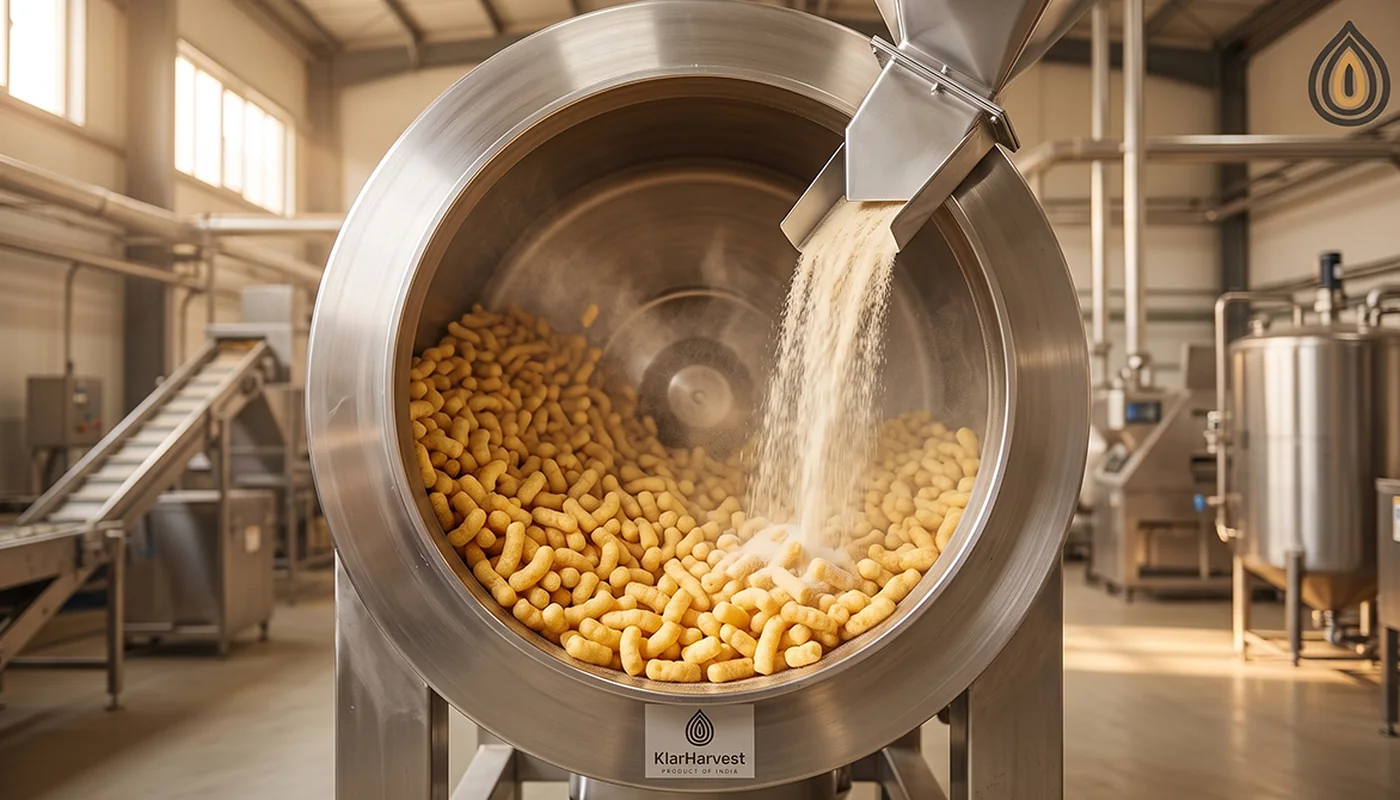
Topical seasoning is applied in a rotating drum, onto snacks that have been oil-sprayed or that carry their own frying oil, sometimes with electrostatic assistance, and the physics is simple: fine particles stick to oil, coarse particles bounce off, and very fine particles float. Onion powder at 100 mesh adheres well to an oiled crisp and disperses evenly, but its fines below 200 mesh become airborne in the drum, coat the equipment, and reach the consumer as a flavour on the fingers rather than on the snack; 5 to 10 percent of a fine seasoning can be lost this way. Granules at 40-60 mesh sit at the sweet spot for oil-sprayed corn snacks and pellets, heavy enough not to float and small enough to stick. Coarser granules and minced adhere only where there is a binder, a starch slurry, a sugar glaze or an egg wash on a cracker, or where they are pressed into a dough before baking. Electrostatic seasoning systems, which charge the particles and attract them to the snack, reduce dusting and favour a narrow particle size distribution, which is a reason to specify a sieve analysis on the onion rather than a cut name.
The onion also has to survive the drum. Flakes and large granules break in a tumbling drum into fines that dust; the coarser the visible onion wanted, the shorter and gentler the drum time should be, and the more the topping should be applied by a sprinkler onto a wet surface rather than tumbled. The flow and density figures behind these choices are in Bulk Density and Flowability of Onion Powder and Granules.
Flow and caking in salt-based blends
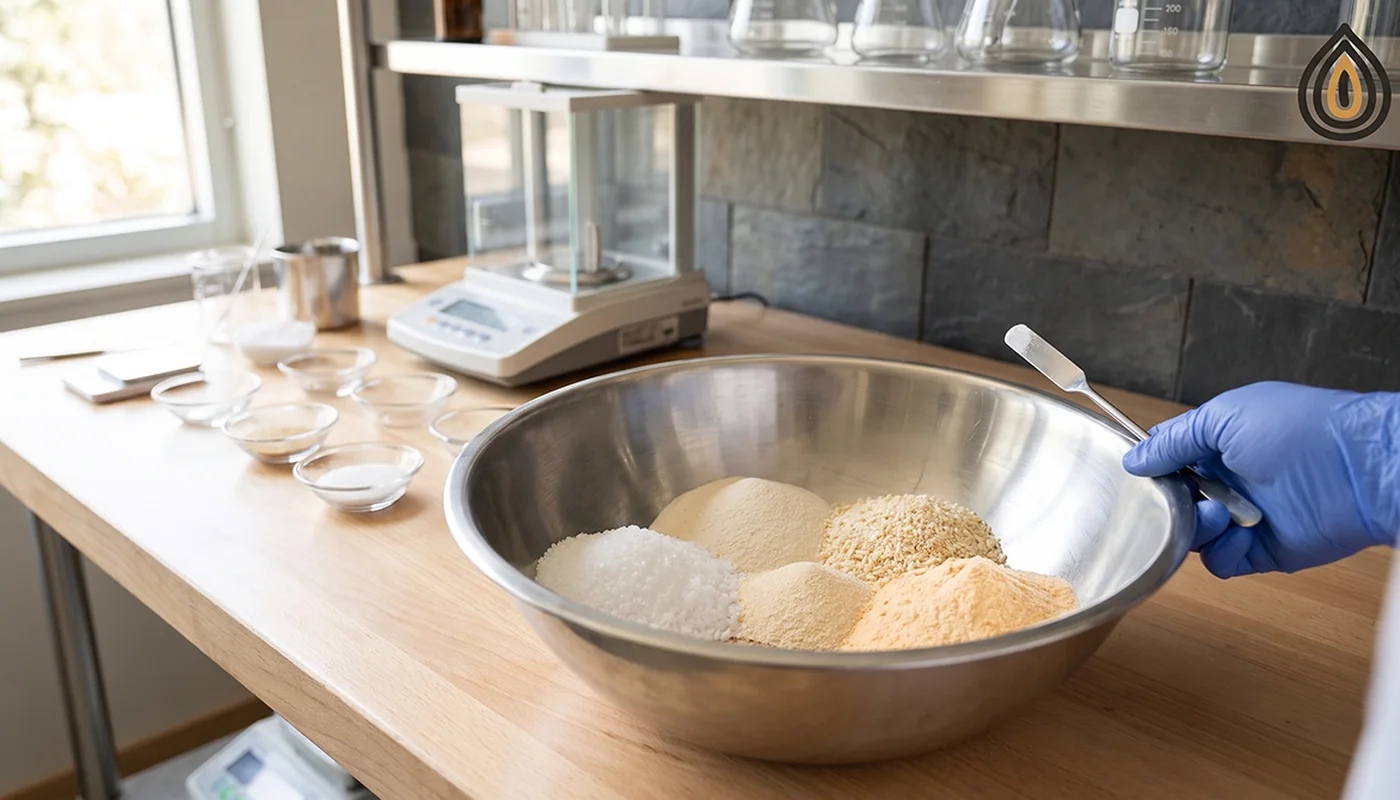
A snack seasoning is typically 30 to 50 percent salt, plus sugar, dairy or cheese powders, acids such as citric or lactic, yeast extract, spices and onion, and the blend is more hygroscopic than any ingredient alone because salt and acid powders draw water and the dairy and onion powders hold it. Onion powder in such a blend cakes sooner than it would on its own: a cheese and onion seasoning at 60 percent relative humidity begins to lump within days of the bag being opened. Three controls handle it. An anti-caking agent, silicon dioxide at 0.5 to 1.5 percent of the blend, keeps it free-flowing and is standard in the industry; where a clean label is required, calcium carbonate or rice flour are the usual alternatives, less effective. Blending order matters: adding the onion and dairy powders to the salt last, after the anti-caking agent has been dispersed through the salt, coats the hygroscopic particles. And moisture control at the onion end: powder at 5 percent moisture rather than 6, packed in a heat-sealed liner and opened only into a closed hopper, makes a visible difference to a blend's life. Granules cake less than powder, which is a further reason to carry part of the onion as 40-60 mesh granules in a blend that will stand in a hopper for a shift. The moisture behaviour is explained in Dehydrated Onion Moisture Content.
Flavour intensity: natural, toasted, white, red
Four onion ingredients give a formulator four different notes at four different doses. Natural white onion powder is the rounded, mild, savoury base and the default; it needs 8 to 14 percent of a cheese and onion blend to be recognised as onion. Toasted onion powder, white onion dried further until it browns, gives a roasted, sweeter, slightly caramel note at half the dose and a darker colour, and it is the onion in most barbecue and onion-ring profiles; blends often use natural and toasted together, two parts natural to one toasted, for a fuller onion. Red onion powder is sharper and fruitier and carries a pinkish tint, useful in profiles that name it, sour cream and red onion, or where a brighter onion is wanted at a lower dose; its premium is 10 to 25 percent over white. Onion oleoresin and onion flavour, liquid extracts dosed at grams per hundred kilograms, give intensity without bulk or visible specks and are used alongside powder in high-impact profiles rather than instead of it, since they lack the body and the appearance of the dried vegetable. The comparison of the extracts with the dried product is in Dehydrated Onion vs Onion Oil and Oleoresin, and toasted onion in Toasted Onion vs Natural Dehydrated Onion.
In-dough and extruded snacks
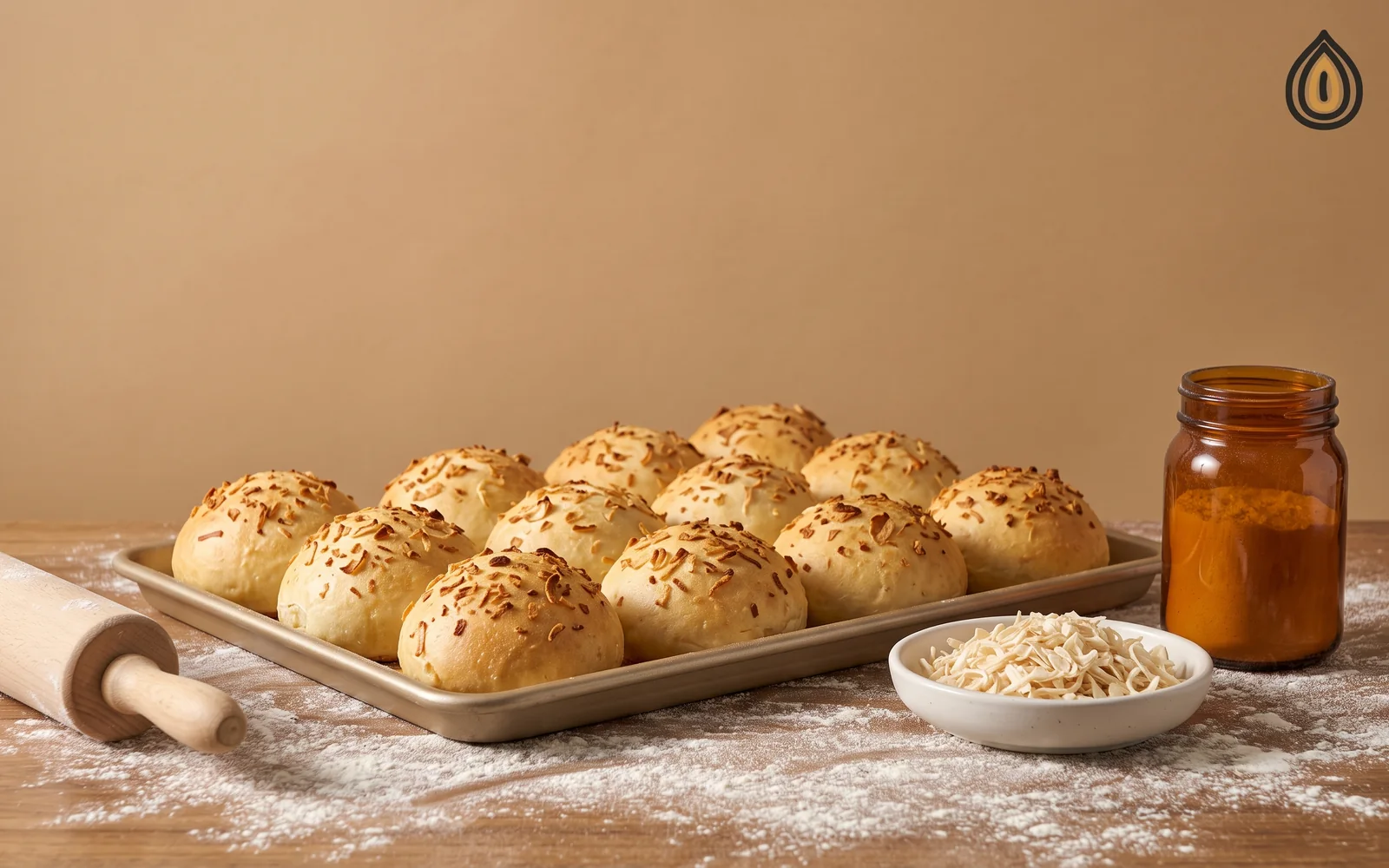
Onion also goes into the snack itself: into cracker doughs, into extruded corn and potato snacks through the dry mix or the slurry, into pellet doughs before drying and into bread-based snacks. Here the cut is nearly always powder, dosed at 0.5 to 2 percent of the dry mix, because it must disperse evenly through a dough or an extruder feed without leaving specks that burn. Two things change relative to topical use. The onion goes through a cook, an oven, a fryer or an extruder barrel at 120 to 180 °C, which is a kill step, so standard microbiology grade is right and the treated tiers add nothing. And the onion's sugars take part in browning during baking or extrusion, which deepens colour and flavour; a dough with 1.5 percent onion powder browns faster than one without, and ovens and fryers may need a small adjustment. Where visible onion in a cracker is wanted, minced or 16-40 mesh granules are pressed into the surface or sprinkled onto a glazed dough before baking rather than mixed in. In-dough use is where onion is cheapest per flavour delivered, because nothing is lost to dusting.
The microbiology question topical seasoning raises
Most snack manufacturers assume their product has a kill step, and for the snack it does: the crisp is fried, the corn snack is extruded, the cracker is baked. But topical seasoning is applied after the kill step, onto a finished snack that will not be heated again, and every organism in the seasoning is eaten as it is. For salt, sugar and most spices that has always been so; for onion it means that the seasoning's total plate count is largely the onion's, since onion is one of the highest-count ingredients in a typical blend. A cheese and onion seasoning made with standard-grade onion powder at 12 percent inherits 20,000 to 60,000 cfu/g from it before anything else is counted. That is safe in a dry, low water activity snack, where nothing grows, and it has been the industry's practice for decades; it becomes a specification problem when a customer's finished-product limit is tighter than the arithmetic allows, and it becomes a food-safety question only for pathogens, which must be absent in every grade. The practical position: standard grade is acceptable for most topical seasonings, low bacterial grade is the specification where the finished-snack limit is below 50,000 cfu/g or a retailer's code demands it, and Salmonella absent in 25 grams on every lot is non-negotiable because the snack will not be cooked again. The tiers and the question that decides them are in Microbiology in Dehydrated Onion.
Two profiles worked in detail
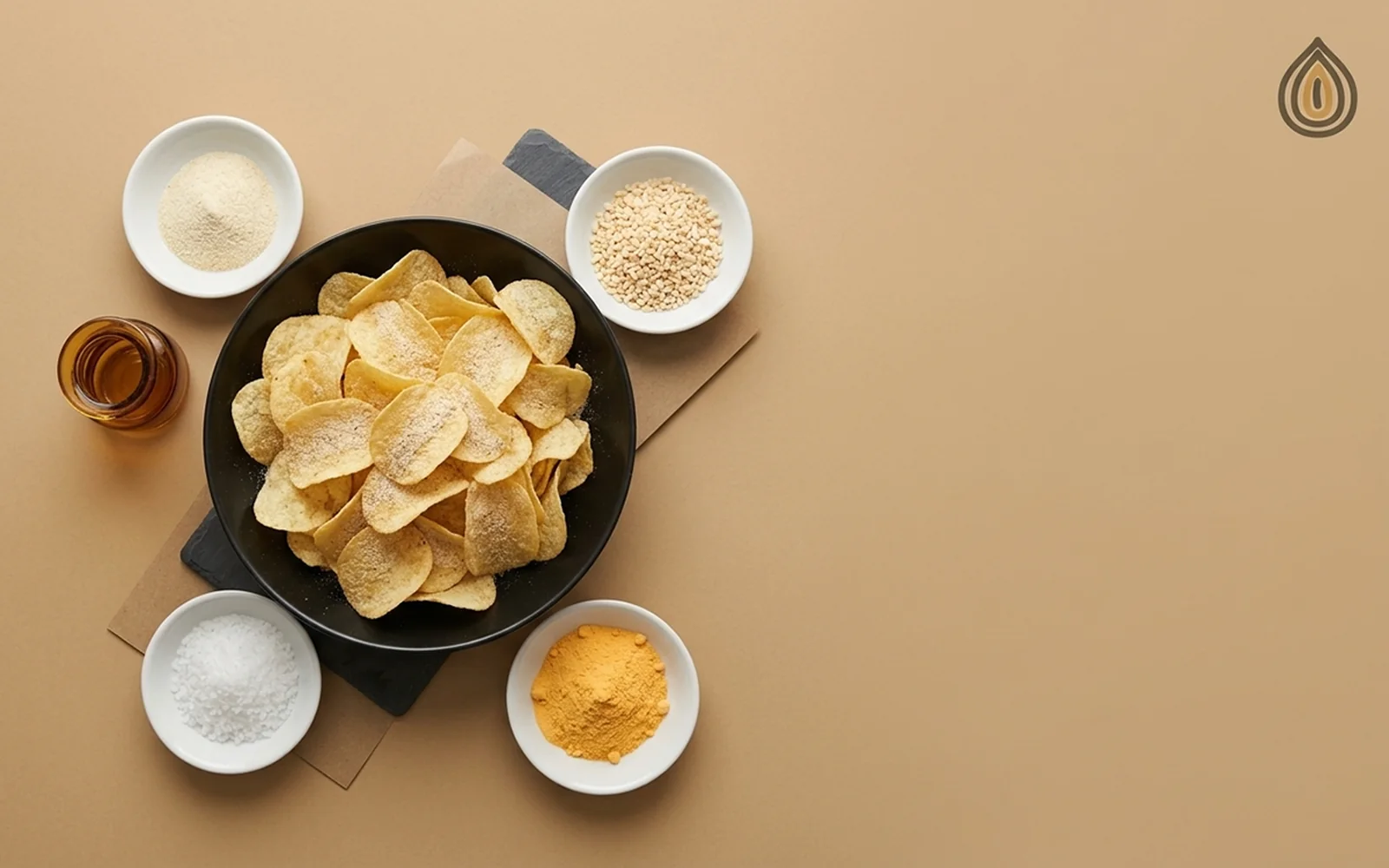
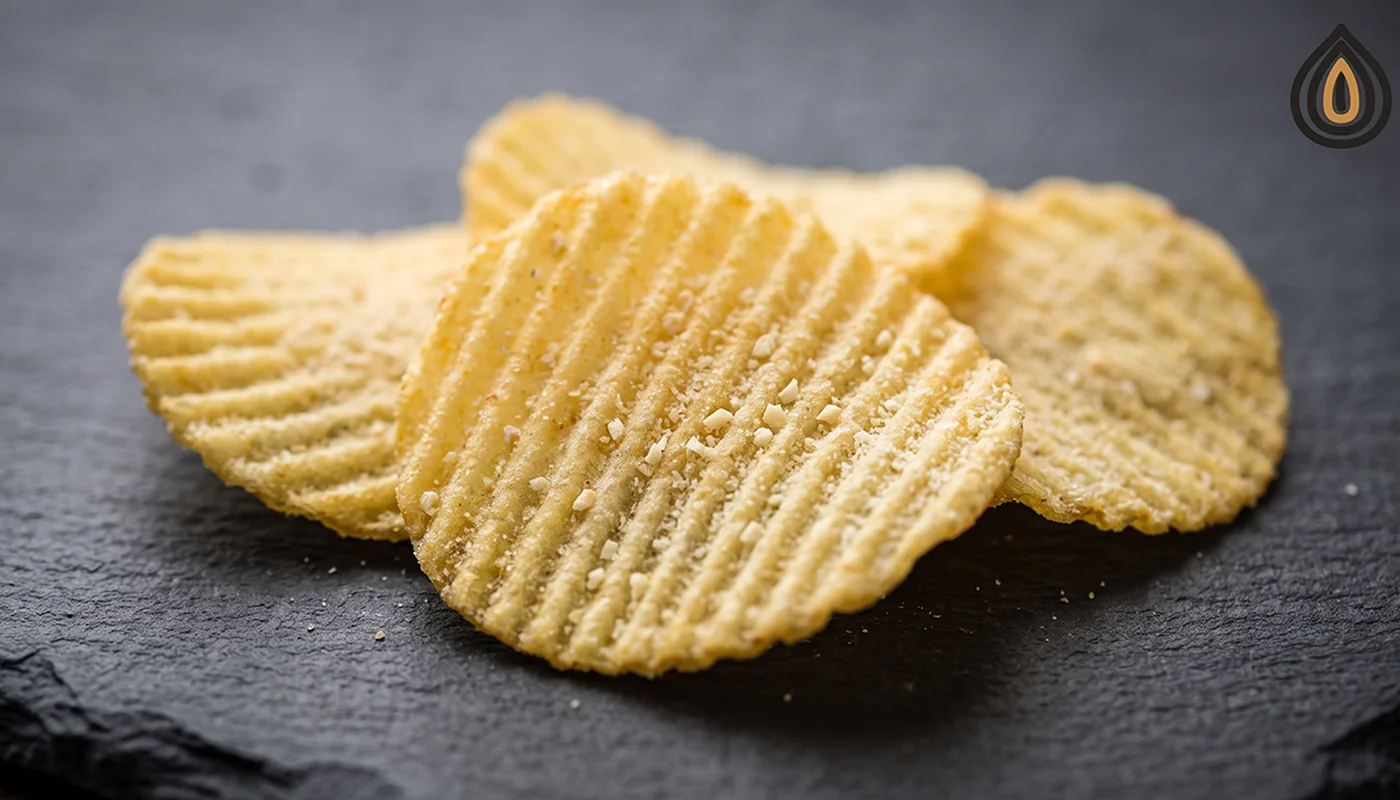
Cheese and onion, crisp, 8 percent seasoning. A representative blend: cheese powder 30 percent, salt 22, whey or milk powder 15, onion powder 12, sugar 6, yeast extract 4, lactic and citric acid 3, silicon dioxide 1, colour and flavour to 100. The onion is white, natural, 100 mesh, sulphite-free, at 5 to 5.5 percent moisture, standard microbiology tier where the finished-snack limit allows. The 12 percent onion is what gives the "and onion"; formulators who drop it to 8 percent for cost get complaints that the profile has gone flat, and those who raise it to 16 get an onion crisp with cheese. Dusting loss on an oil-sprayed crisp with a fine blend is 5 to 8 percent; a 26-40 mesh granule at a quarter of the onion share reduces it and adds visible flecks, which the market reads as premium.
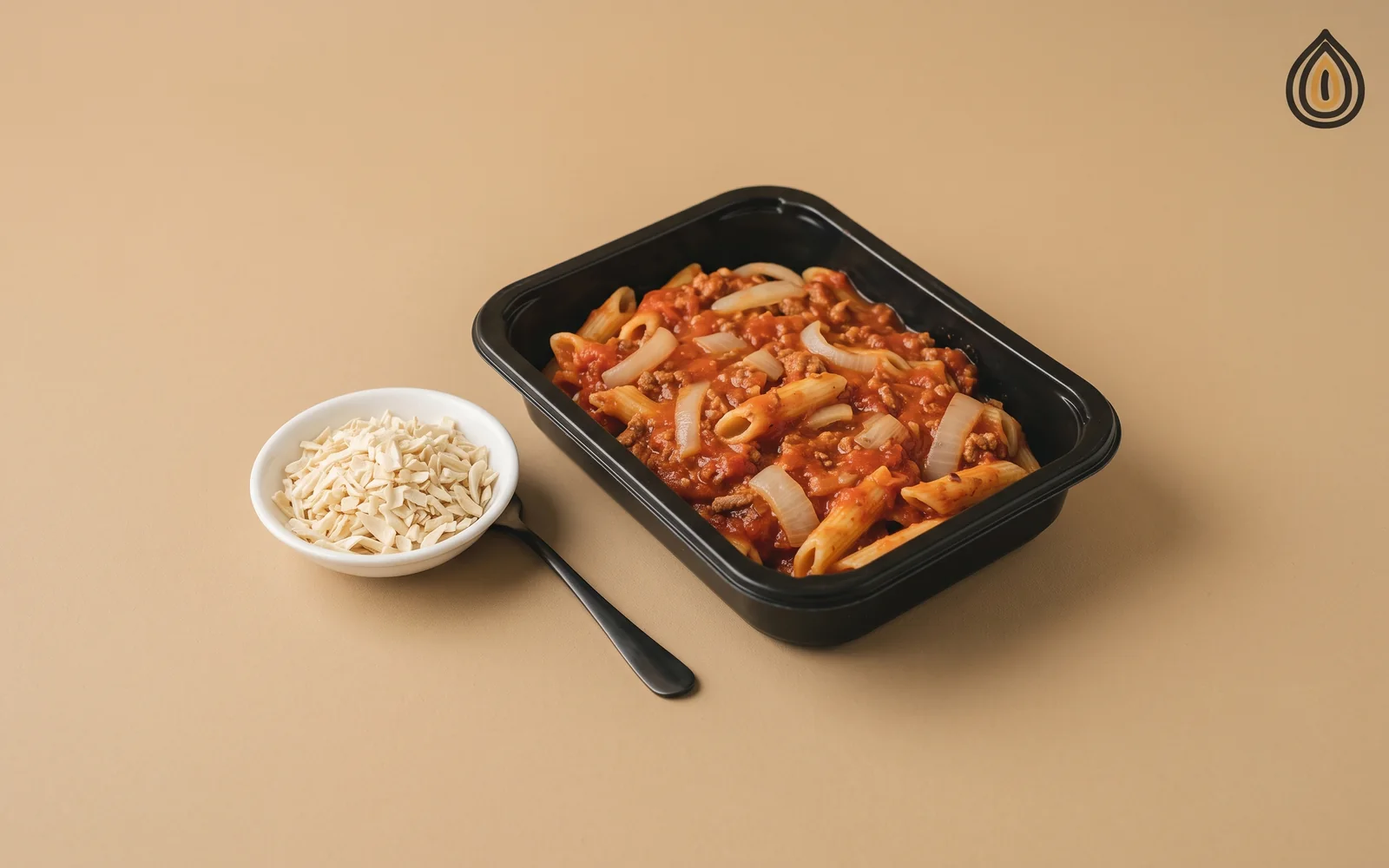
Sour cream and onion, corn snack, 9 percent seasoning. Sour cream powder 25 percent, salt 20, onion 15 (10 powder, 5 granules 40-60 mesh), buttermilk powder 12, sugar 6, yeast extract 4, citric acid 3, green herb flecks 2, silicon dioxide 1.5, flavour to 100. The onion share is higher because sour cream is a quiet base and the profile is defined by the onion; the granule fraction gives the flecks that distinguish the product on the shelf and helps the blend flow in a drum that runs a full shift. Because the seasoning is topical and the corn snack is extruded before it, this is the profile where a retailer's finished-product count most often forces the low bacterial tier: with standard onion at 15 percent the seasoning starts at 30,000 to 75,000 cfu/g, with low bacterial onion at under 8,000.
Onion in clean-label and reduced-salt seasonings
Two trends in snack development lean on onion harder. Clean-label seasonings that drop yeast extract, flavour enhancers and added flavours need their savoury depth from somewhere, and dried onion, toasted onion, dried garlic and tomato powder are the ingredients that supply it; onion shares in such blends rise to 15 to 20 percent, and toasted onion does much of the work that a flavour did. Reduced-salt seasonings, driven by targets in the UK, the Netherlands and Germany, use onion in the same way: onion's umami and sweetness let a blend lose 20 to 30 percent of its salt without tasting empty, and onion powder is one of the few ingredients that can replace salt's volume in the blend as well as some of its taste. Both trends push formulators toward higher-quality onion, since at 20 percent of a blend the difference between a pale, clean powder and a beige one with a cooked note shows in the finished snack, and both make the sulphite question sharper, because a clean-label product cannot carry a sulphite declaration.
Labelling the onion in a seasoning
On the snack's ingredient list, onion appears inside the seasoning's compound ingredient or, if the manufacturer lists the seasoning components directly, as "onion powder" or "dried onion" in descending order of weight. Onion is not an allergen in the EU, the UK or the USA. Sulphite-treated onion must be declared as sulphites above 10 milligrams per kilogram in the finished food, and since a snack contains at most 2 percent onion, a sulphited onion powder at 500 milligrams per kilogram contributes 10 milligrams per kilogram to the snack, right at the threshold; snack manufacturers therefore specify sulphite-free onion to keep the allergen line clean. Anti-caking agents added to the onion at the plant must be declared by the manufacturer, and a formulator who adds its own silicon dioxide to the blend should know whether the onion already carries some. Toasted onion is still "onion" or "toasted onion"; red onion may be labelled "red onion" and should be if the pack names it. The EU labelling rules for the ingredient are in Labelling Dehydrated Onion for the EU.
What onion costs per tonne of finished snack
| Profile | Onion per tonne of snack | Onion grade and landed price (Feb 2026) | Onion cost per tonne of snack |
|---|---|---|---|
| Cheese and onion crisp | 9.6 kg powder | Standard white powder, 1.75 EUR/kg | 16.80 EUR |
| Sour cream and onion corn snack | 12 kg (8 powder, 4 granules 40-60) | Low bacterial white, 1.95 EUR/kg | 23.40 EUR |
| Barbecue crisp | 4 kg (2.5 natural, 1.5 toasted) | Natural 1.75, toasted 2.10 EUR/kg | 7.50 EUR |
| Onion ring snack | 18 kg (12 natural, 6 toasted) | As above | 33.60 EUR |
| Everything-style pretzel chip | 15 kg (10 minced, 5 granules) | Standard white, 1.70 EUR/kg | 25.50 EUR |
At snack prices of 3,000 to 6,000 euros per tonne ex-factory, onion is 0.2 to 1 percent of the product's cost in every profile. Upgrading from standard to low bacterial grade on the sour cream and onion line above costs 2.40 euros per tonne of snack; switching from white to red adds 3 to 5 euros. These are decisions to make on performance and specification, not on price, and a seasoning buyer who negotiates onion hard is negotiating the wrong line. Where the price does matter is in volume: a seasoning house blending for several snack manufacturers buys onion by the container, and the landed cost arithmetic in Dehydrated Onion Price per kg applies.
A trial protocol that finds the problems before the line does
- Bench blend. Make 2 kilograms of the seasoning with the candidate onion at the target rate, and a second batch with the alternative cut or grade. Record moisture of the onion and of the blend.
- Flow and caking. Store 500 grams of each blend open in a jar at the production room's conditions for one week; check flow by pouring through a funnel and look for lumps daily.
- Adhesion. Apply the seasoning to 5 kilograms of base snack in a lab drum at the target rate; weigh the seasoning that reaches the product against what was dosed; the loss is dusting.
- Sensory. Taste the seasoned snack against the current product, plain and after two weeks in the finished pack; check colour on the pale snacks.
- Line trial. Run one production batch with the chosen onion; check dusting on the equipment, flow in the hopper across the shift, and the finished product's microbiology if the specification requires it.
- Retain. Keep a sealed sample of the approved onion lot as the reference for deliveries.
Most problems appear at step 2 or 3: a blend that cakes in a week or a seasoning that loses 10 percent to dust is a particle-size or moisture problem to solve with the supplier before the line trial. The sensory step is where toasted versus natural and white versus red are decided; the scoring method is in Sensory Evaluation of Dehydrated Onion.
Specification lines for a seasoning buyer
Beyond the standard sheet, a seasoning buyer should write five lines. Particle size as a sieve analysis, "minimum 95 percent passing 80 mesh, maximum 10 percent passing 200 mesh" for a powder that must not dust, or "minimum 90 percent between 40 and 60 mesh" for granules. Moisture at maximum 5.5 percent. Sulphite-free. Bulk density with a range, because dosing by volume in a blender depends on it. And the microbiology tier decided by the finished-snack limit, with Salmonella absent in 25 grams per lot in every case. Colour against a retained sample for pale profiles, and an anti-caking statement, with or without silicon dioxide and at what level, complete it. The general sheet is described in How to Read a Dehydrated Onion Specification Sheet.
How KlarHarvest supplies seasoning manufacturers
KlarHarvest supplies onion powder, 40-60 and 26-40 mesh granules and minced onion in white, toasted and red, in standard and treated microbiology tiers, from BRCGS-certified plants in Mahuva, with a sieve analysis and the tier on every certificate of analysis. Powder for seasoning use is specified at 5.5 percent moisture and packed in heat-sealed liners; product with silicon dioxide is available where a buyer wants the anti-caking agent carried by the onion rather than added to the blend. Sample sets for trials, a powder and a granule of the same lot, or natural and toasted, are sent from current lots so that the bench blend and the line trial use the same material as the first delivery. The products are on the onion powder and granules pages.
Frequently asked questions
How much onion powder goes into a snack seasoning?
Typically 8 to 14 percent of a cheese and onion seasoning, 10 to 18 percent of sour cream and onion, 3 to 6 percent of barbecue, and 15 to 25 percent of an onion ring profile. Applied at 8 percent of the snack, that is 0.3 to 2 percent onion in the finished product.
Should I use onion powder or granules in a seasoning?
Powder for fine crisp seasonings, slurries and in-dough use; 40-60 mesh granules for oil-sprayed corn snacks and pellets where dusting and caking matter; coarser granules or minced where visible onion is wanted. Many blends use powder and granules together.
Why does my seasoning cake, and is the onion the cause?
Salt-based blends are hygroscopic and onion and dairy powders hold the water they draw. Onion at 5 percent moisture rather than 6, granules instead of part of the powder, silicon dioxide at 0.5 to 1.5 percent of the blend, and closed hoppers are the usual fixes.
Do I need low bacterial onion for a topical seasoning?
Topical seasoning is applied after the snack's kill step, so the onion's count reaches the consumer. Standard grade is acceptable for most products and has been industry practice; low bacterial grade is the specification where the finished-snack limit is tight or a retailer requires it. Salmonella absent in 25 grams applies to every lot.
What is toasted onion powder used for?
Roasted, sweeter onion notes at half the dose of natural, with a darker colour, in barbecue, onion ring and roasted profiles; often blended with natural onion two to one.
Does dried onion contain allergens for snack labelling?
No. Onion is not an allergen. Sulphite-treated onion contributes sulphites that must be declared above 10 milligrams per kilogram in the snack, which is why snack manufacturers specify sulphite-free onion.
How much does the onion add to the cost of a tonne of crisps?
Roughly 7 to 35 euros per tonne of finished snack depending on the profile, at February 2026 prices, which is 0.2 to 1 percent of the snack's ex-factory cost. Grade and cut should be chosen on performance.
Next step
For a trial, request a sample of powder and 40-60 mesh granules from the same lot, or of natural and toasted, and name the profile; both arrive with sieve analysis and certificate of analysis within days. For a seasoning house buying by the container, request a quote with the sieve specification and tier and it is priced FOB with freight shown separately within one business day.