- The four meal types and their processes
- Which cut for which component
- Hydration inside a sauce, a starch or a filling
- Cook-chill: the short-life meal
- Cook-freeze: what freezing and thawing do to onion
- Retort and pouch: the ambient meal
- Microwave reheating and the consumer's cook
- Dosing against fresh onion
- Interactions: starch, fat, acid, salt and protein
- Microbiology tiers for each line
- Rice, pasta and grain components
- Pies, fillings and pastry products
- Plant-based and vegetable meals
- Common faults and fixes
- Cost per portion
- Specification lines for ready-meal use
- A worked formulation: lasagne meat sauce
- What KlarHarvest supplies to ready-meal makers
- Frequently asked questions
Judge the product, not the words
200-500 g from a current lot, dispatched by courier with the lot lab report.
Request a sampleDehydrated onion ready meals are the application where the ingredient is asked to do the most: it is cooked in the plant, chilled or frozen, held for days or months, and cooked again by the consumer, and it must look and taste like onion at the end of all that. The ready-meal and convenience-food sector, chilled meals for the supermarket, frozen meals and meal components, retorted and pouched meals, microwave rice and pasta pots, pies and fillings, is the third largest user of dried onion in Europe after soups and meat, and it uses every cut, because a lasagne sauce, a pilau rice, a pie filling and a stir-fry mix each want something different. This guide is written for the product developers, process technologists and buyers on those lines.
It covers the four meal types and their processes, which cut fits which component, how onion hydrates inside a sauce, a starch or a filling rather than in free water, what cook-chill, cook-freeze, retort and microwave reheating each do to it, dosing against fresh onion, the microbiology tiers for each line, the interaction with the other ingredients, common faults and their fixes, cost per portion, specification lines, and a worked lasagne sauce. Values are for Mahuva product in 2026.
What this guide covers
- The four meal types and their processes
- Which cut for which component
- Hydration inside a sauce, a starch or a filling
- Cook-chill: the short-life meal
- Cook-freeze: what freezing and thawing do to onion
- Retort and pouch: the ambient meal
- Microwave reheating and the consumer's cook
- Dosing against fresh onion
- Interactions: starch, fat, acid, salt and protein
- Microbiology tiers for each line
- Rice, pasta and grain components
- Pies, fillings and pastry products
- Plant-based and vegetable meals
- Common faults and fixes
- Cost per portion
- Specification lines for ready-meal use
- A worked formulation: lasagne meat sauce
- What KlarHarvest supplies to ready-meal makers
- Frequently asked questions
The four meal types and their processes
| Meal type | Process | Shelf life | Onion's journey | Main risk to the onion |
|---|---|---|---|---|
| Chilled ready meal (cook-chill) | Components cooked, assembled hot or cold, sealed, blast-chilled to below 5 °C | 5-14 days | One plant cook, chill, consumer reheat | Under-hydration; texture on reheat |
| Frozen ready meal (cook-freeze) | Components cooked, assembled, sealed, blast- or spiral-frozen to -18 °C | 6-18 months | One plant cook, freeze, consumer cook from frozen | Dry onion frozen unhydrated; freezer burn on exposed pieces |
| Retorted or pouched meal | Filled raw or par-cooked, sealed, sterilised at 121 °C | 12-36 months ambient | Sterilisation cook, ambient hold, consumer reheat | Softening and browning in the retort |
| Microwave pot, instant meal | Dry or part-dry components, consumer adds water and microwaves | 6-12 months ambient | No plant cook; consumer's 3-5 minutes | Rehydration time too short for coarse cuts |
The four are different problems for the onion, and the most common mistake in the sector is to move a recipe from one to another without re-thinking the cut and the hydration; a chopped onion that is perfect in a chilled lasagne is hard in a microwave pot and mush in a retorted stew.
Which cut for which component
| Component | Preferred cut | Why | Notes |
|---|---|---|---|
| Tomato, meat and cream sauces (chilled, frozen) | Chopped 3-5 mm or minced 1-3 mm | Visible pieces; hydrates in the sauce cook | Chopped for rustic styles, minced for smooth |
| Sauces for retort | Chopped 3-5 mm | Keeps identity through sterilisation | Minced softens to nothing |
| Curries and stews | Chopped, or flakes for visible pieces | Long cook; coarse cuts hold | Powder for the base note in some styles |
| Rice and pilau components | Minced or granules 16-40 | Hydrates in the rice's cooking water | Toasted onion for biryani styles |
| Pasta and noodle pots | Granules 26-40 or 40-60 plus powder | Only fine cuts rehydrate in 3-5 minutes | |
| Pie and pastry fillings | Chopped or minced, pre-hydrated | Fillings are low in free water | |
| Stuffings, meatballs, patties in meals | Minced or granules | See the meat guide | |
| Stir-fry vegetable mixes (frozen) | Flakes or chopped, pre-hydrated and frozen with the vegetables | Visible; frozen hydrated | Rarely used; fresh onion common here |
| Mashed potato and gratins | Powder | Smooth texture | |
| Vegetable and plant-based components | By texture target | See the plant-based guide |
The cuts as products are in Flakes, Chopped, Minced, Granules or Powder; the soup and sauce cases that overlap with this guide are in Dehydrated Onion in Soups, Sauces and Gravies.
Hydration inside a sauce, a starch or a filling
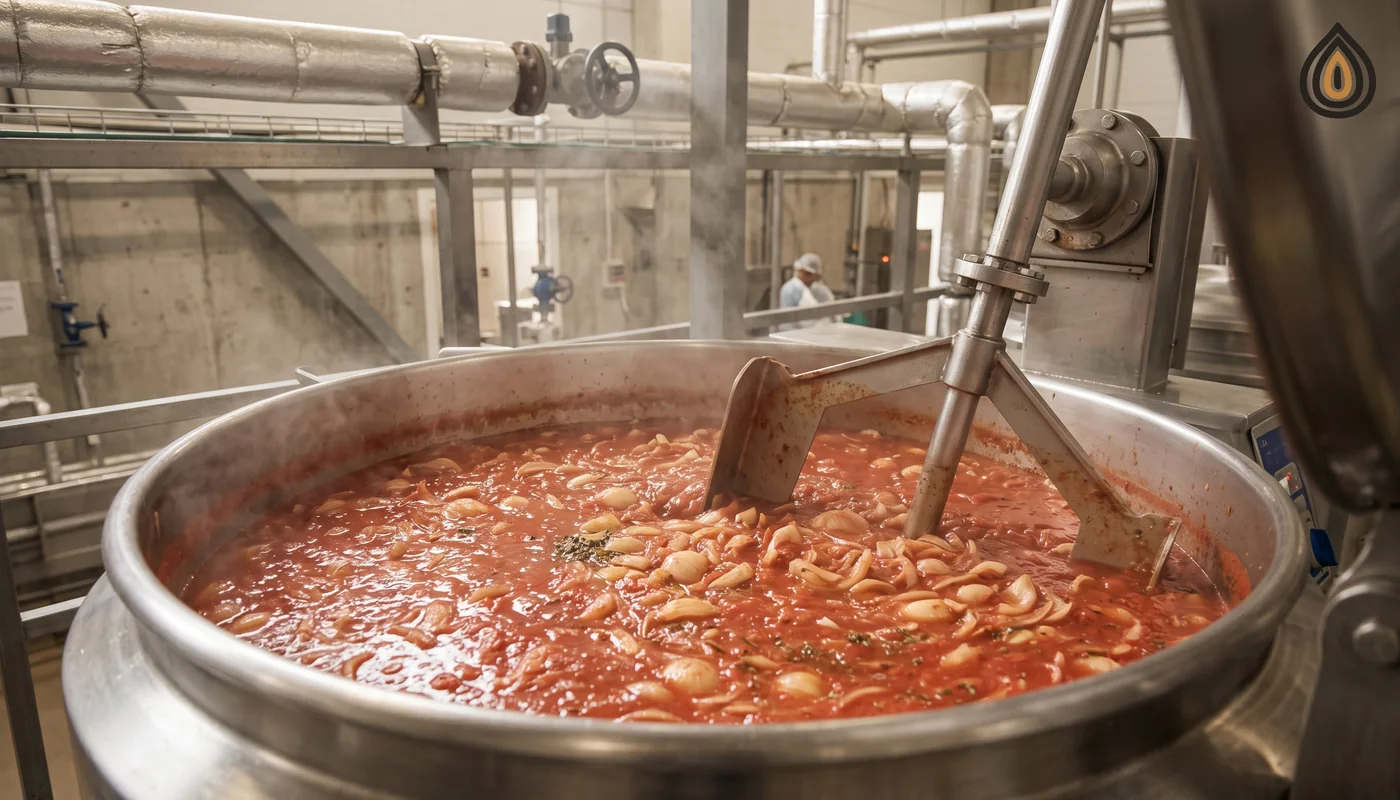
In a soup the onion hydrates in a surplus of water; in a ready-meal component there is rarely a surplus, and the onion takes its water from a sauce that the starch is also thickening, a rice that is absorbing it, or a filling that has little to give. The rule is that onion should meet free water before anything else claims it. In a kettle-cooked sauce, the onion goes in with the water or the stock at the start, hydrates for ten to fifteen minutes while the base heats, and the tomato, the thickener and the fat follow; a sauce made the other way, onion added to a finished thickened sauce, leaves the onion firm and the sauce thin as the onion draws water for the next hour. In a rice component, the onion goes in with the cooking water and hydrates as the rice does; in a filling, the onion is pre-hydrated in cold water, one part onion to three of water for twenty to thirty minutes, and the slurry is added, water and all. The water each cut takes, 3.5 to 4.5 times its weight for chopped and flakes, 3 to 4 for minced, 2.5 to 3.5 for granules, is a recipe input and is written into the water line; a developer who forgets it makes a sauce that is 4 percent thicker than intended. The rehydration data by cut and temperature are in Rehydrating Dehydrated Onion.
Cook-chill: the short-life meal
The chilled meal's process is gentle: components are cooked in kettles or ovens, deposited hot or cold into trays, sealed, blast-chilled and held at 0 to 5 degrees for a week or two, then microwaved or oven-heated by the consumer. Onion that was fully hydrated in the plant cook comes through it well, with a texture close to sautéed fresh onion and a flavour that has rounded during the chill; the risk is the reheat, where a sauce that was slightly under-hydrated at depositing sees its onion finish hydrating in the consumer's microwave and firm pieces result. The developer's check is a sample held for the full shelf life and reheated as the consumer would, at the end as well as the start. Chilled meals are also where fresh onion is still used most, for the top note, and where the mixed approach, dried for the base and a little fresh for the sharpness, is common; the cost side of that split is in Dehydrated vs Fresh Onion: The Real Cost per Kilo.
Cook-freeze: what freezing and thawing do to onion
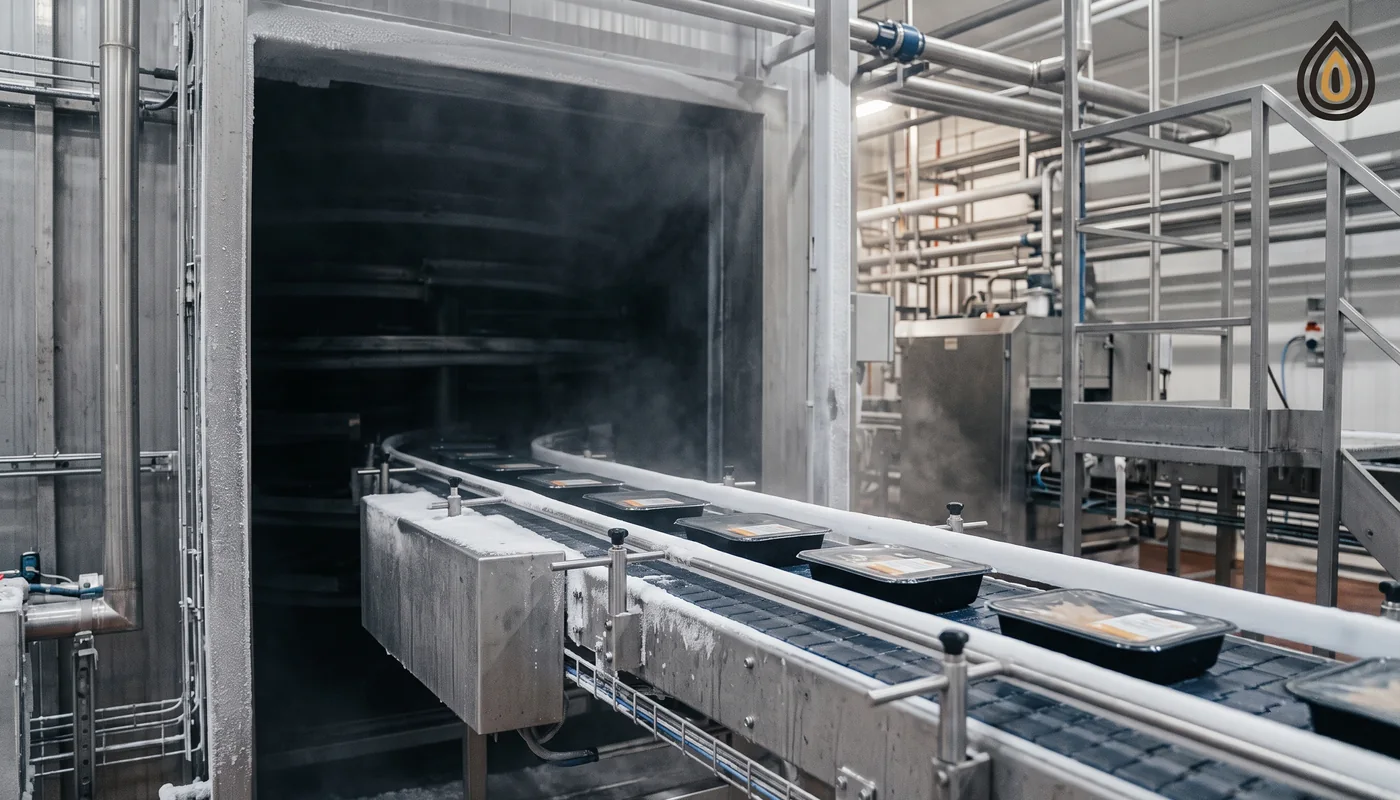
Freezing is where dried onion earns its place, and where the most mistakes are made. Fully hydrated onion pieces freeze as a cooked vegetable does: ice crystals form in the tissue, the structure softens a little on thawing, and the piece is a touch softer than before freezing but otherwise intact, with the flavour held; a blast or spiral freezer that takes the meal through the critical zone quickly makes smaller crystals and softer damage. Onion that was not fully hydrated at freezing is the problem: the dry core does not freeze, since it has no water, and when the consumer cooks the meal from frozen the core hydrates in the few minutes available and unevenly, so the meal carries hard pieces that the plant never saw. Exposed onion pieces on the surface of a frozen meal, a topping or a piece at the edge of a tray, lose water to the freezer over months and go tough and brown, which is freezer burn; a sauce that covers the onion protects it. Frozen meals are held for six to eighteen months, and the onion's flavour holds through that better than most vegetables', but a meal tested at week one and not at month twelve has not been tested. The freeze-thaw case for meat components, patties and meatballs in meals, is in Dehydrated Onion in Meat Products.
Retort and pouch: the ambient meal
Retorted meals, in cans, trays and pouches, are sterilised at 121 degrees for 20 to 60 minutes after sealing, and the process is the hardest on onion texture and colour of any in the sector. Chopped onion at 3 to 5 millimetres comes through with recognisable pieces, softened; flakes hold their shape better still; minced dissolves into the sauce and contributes flavour and body without pieces; granules and powder are flavour only. All cuts brown a shade through the Maillard reaction with the meal's sugars, from pale to light tan, which is invisible in a curry or a bolognese and visible in a pale cream sauce, where the usual answer is powder for the flavour and a few chopped pieces for appearance. Flavour flattens and sweetens in the retort, and the dose is raised 20 to 30 percent over a chilled recipe to compensate, with part of it as powder added late in filling so that a fresher note survives. Pouches with a shorter, higher-temperature process are kinder to the onion than cans with a long one. The onion goes in dry to a retort meal in most recipes, since the sterilisation is a long wet cook, with the water allowed for; pre-hydration is used where the fill is a thick filling with little free water.
Microwave reheating and the consumer's cook
Two things happen to onion in a microwave that do not happen in an oven or a pan. Heating is fast and uneven, so pieces at the tray's edge overheat while the centre is cold, and an onion piece at the edge that is not covered by sauce dries and toughens in two minutes; the plant's fix is to keep the onion in the sauce and the sauce over the onion. And where the consumer adds water to a dry pot and microwaves for three to five minutes, that is the whole rehydration budget, and only granules at 26-40 or 40-60 mesh and powder hydrate in it; a pot with chopped onion has firm pieces at the end, whatever the pack says. Instant pots therefore carry their onion as fine granules for a little visible texture and powder for the flavour, and a developer who wants a bigger piece agglomerates or pre-cooks it. Oven reheating is gentler and forgives coarser cuts; air-fryer reheating, now common, is like a microwave for drying and like an oven for evenness, and exposed pieces brown fast.
Dosing against fresh onion
| Component | Dry onion, % of component | Fresh equivalent, % | Notes |
|---|---|---|---|
| Tomato or meat sauce for pasta meals | 1.5-3 | 12-25 | Visible pieces above 2 % |
| Curry sauce | 2-4 | 16-32 | Powder for the base plus chopped |
| Cream and cheese sauces | 0.5-1.5 (powder or minced) | 4-12 | Pale; watch colour |
| Stew and casserole | 1.5-3 (chopped or flakes) | 12-25 | Long cook |
| Pilau and flavoured rice, as cooked | 0.5-1.5 | 4-12 | Toasted for biryani |
| Pie and pastry filling | 1.5-3 | 12-25 | Pre-hydrate |
| Instant noodle or pasta pot, dry | 2-5 (granules and powder) | Diluted by the water | |
| Stuffing and breadcrumb-based components | 3-6 | See the bakery guide |
The conversion is one part dried for eight to nine parts fresh by flavour, with water added back at three to four parts per part of dried for the bulk; a recipe converted from fresh loses the raw sharpness, which most cooked meals do not miss and which a trace of onion powder added late restores where it matters. The yield arithmetic behind the ratio is in 8 to 1: The Fresh-to-Dry Yield Ratio.
Interactions: starch, fat, acid, salt and protein
Starch is the onion's competitor for water in every sauce and every filling, and the sequence rule above, onion before thickener, is the whole answer; a sauce thickened with modified starch that has already gelatinised gives the onion nothing. Fat coats the pieces and slows hydration, so a sauce started with a roux or with sautéed fat should have the onion hydrated in water first. Acid, in tomato sauces, preserves the onion's colour and slows browning in the retort, and slightly slows hydration. Salt at meal levels, 0.8 to 1.2 percent, slows hydration a little and firms the pieces, which is why pre-hydration in plain water gives a softer result than hydration in a salted sauce. Protein, in a meat sauce or a cheese sauce, binds water in competition with the onion during the cook and releases some of it on reheating; a meat sauce is a wet environment and the onion hydrates well, a cheese sauce is a dense one and takes powder or pre-hydrated minced. Sugar in the meal browns the onion in the retort and under a grill, and a sweet sauce is a dark one. The soup and sauce guide linked above treats the same interactions for the simpler case.
Microbiology tiers for each line
| Line | Kill step for the onion? | Usual tier | Notes |
|---|---|---|---|
| Cook-chill, onion cooked in the component | Yes, the plant cook to 75 °C | Standard or low bacterial by risk assessment | Many retailers' codes ask for low bacterial on chilled meals |
| Cook-chill, onion added after cooking (garnish, cold component) | None | Extra low bacterial | |
| Cook-freeze, onion cooked | Yes | Standard or low bacterial | Spores survive freezing; low bacterial where the consumer cook may be short |
| Retort | Yes, sterilisation | Standard | |
| Microwave pot, no plant cook | Only the consumer's microwave | Low or extra low bacterial | The consumer's 3 minutes is not a reliable kill step |
| Pie and filling, baked | Yes | Standard or low |
Salmonella absent in 25 grams and E. coli absent in 1 gram apply at every tier. Chilled meals are the sector with the most retailer scrutiny of ingredient microbiology, and low bacterial has become the default specification for onion in them even where the plant cook is a kill step; the tiers and their meaning are in Microbiology in Dehydrated Onion, and the treatment in Low Bacterial and Extra Low Bacterial Dehydrated Onion.
Rice, pasta and grain components
Flavoured rice, pilau, biryani and risotto components in chilled and frozen meals carry onion at 0.5 to 1.5 percent of the cooked rice, added as minced or 16-40 granules to the cooking water so that it hydrates with the grain, and in biryani styles as toasted onion for the fried-onion note and the brown flecks that the dish expects; toasted onion is the ingredient that makes a biryani component read as authentic, at 1 to 2 percent, and it is discussed in Toasted Onion vs Natural Dehydrated Onion. Pasta components take their onion in the sauce rather than the pasta. Couscous, bulgur and grain salads, chilled, take fine granules hydrated with the grain. Instant rice and noodle pots, as above, take fine granules and powder for the consumer's three minutes. In every grain component the onion competes with the grain for water and the water line is adjusted for it.
Pies, fillings and pastry products
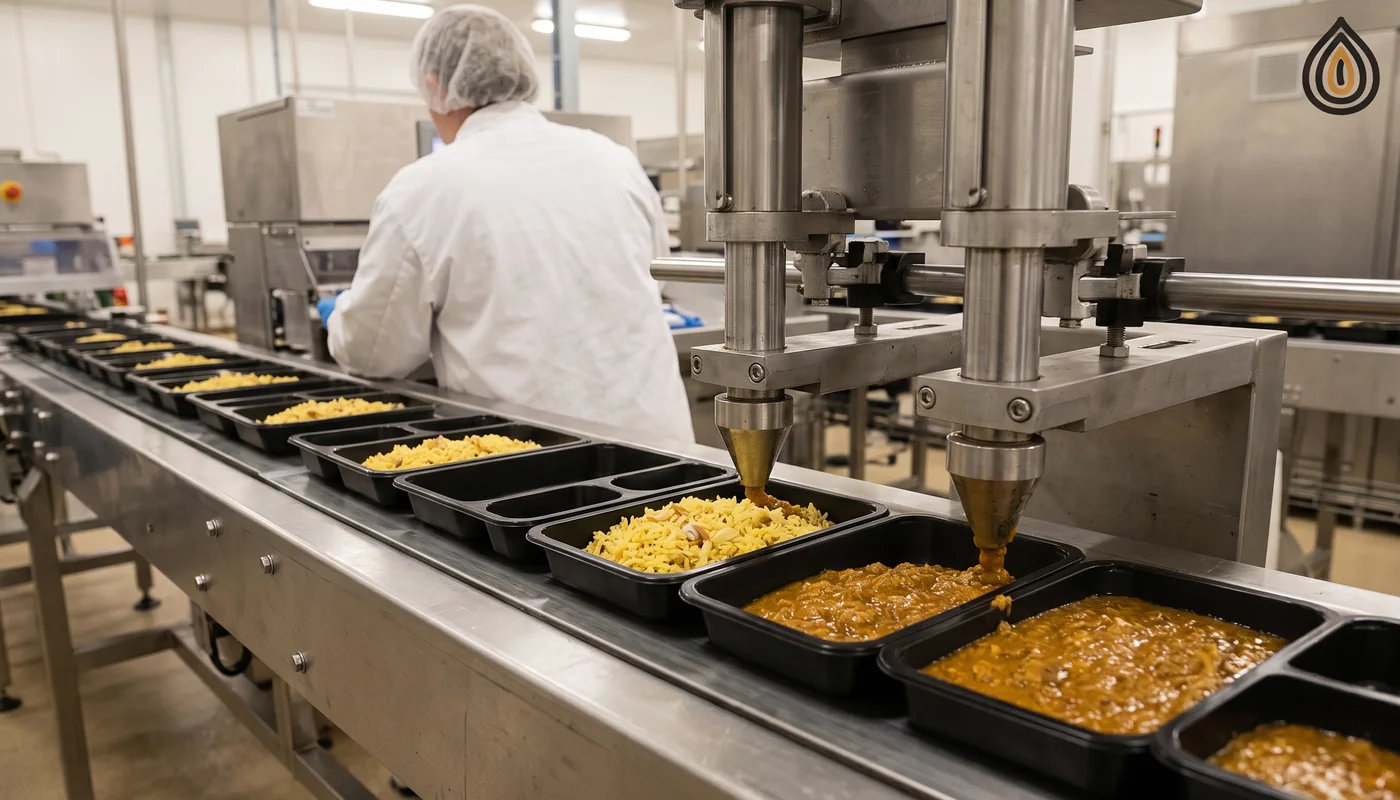
Pie fillings, pasties, sausage rolls, quiches and filled pastries are low in free water and are sealed in pastry that must not go soggy, which makes them the pre-hydration case: the onion is hydrated in cold water, drained or undrained according to the filling's water budget, and mixed in, at 1.5 to 3 percent dry onion of the filling weight, usually chopped or minced. A filling made with dry onion draws water from the meat or the sauce and leaves firm pieces in the baked pie; a filling made with over-wet hydrated onion soaks the pastry. The bakery's oven is a kill step for the filling in a baked product, and a raw-filled frozen pie's kill step is the consumer's oven, for which the low bacterial tier is the safe specification. Quiches and egg-based fillings take minced or powder, since a chopped piece in a set custard reads as a foreign body. The bakery products where onion is a topping or a dough inclusion are in Dehydrated Onion in Bakery.
Plant-based and vegetable meals
Vegetable curries, bean stews, lentil dishes and the growing range of plant-based ready meals use onion at the top of the dosing table, 2 to 4 percent, because onion is the base of the flavour where meat is absent, and they use it in two forms: powder for the depth and chopped for the pieces. Plant-based meat analogues in meals, burgers, mince and sausages made from pea or soy protein, take onion as the meat versions do, minced or granules hydrated in the mix, and the onion's water uptake matters more in a textured-protein matrix that is itself hydrating; the specific case is in Dehydrated Onion in Plant-Based and Vegan Products. Onion is vegan, allergen-free and, from a certified plant, gluten-free by composition, which makes it an easy ingredient for the label claims these meals carry; the claims are in Allergens, Gluten and Dehydrated Onion.
Common faults and fixes
| Fault | Cause | Fix |
|---|---|---|
| Hard onion pieces in the reheated meal | Onion added after the starch or the fat; not hydrated before freezing | Onion in with the water first; verify hydration before depositing and freezing |
| Sauce thickens in the tray after depositing | Onion still absorbing water | Allow the uptake in the water line; hydrate longer before depositing |
| Sauce thin at depositing | Too much water added for the onion, or onion pre-hydrated undrained into a recipe that already allowed for it | Count the water once |
| Onion pieces tough and brown on the meal's surface | Freezer burn or microwave edge drying | Keep onion under the sauce; cover the tray |
| Pale sauce turns tan in the retort | Maillard browning of the onion | Powder for the flavour, few pieces; shorter process; acid |
| Onion flavour flat after retort or after months frozen | Heat and time | Raise dose 20-30 %; part as powder added late |
| Pink flecks in a pale meal | Pink admixture in the white onion | Specify admixture limit; see the defects guide |
| Black specks in a cream sauce | Scorched pieces in the lot | Tighter defect count |
| Instant pot has firm onion at 3 minutes | Cut too coarse | Granules 40-60 and powder only |
| Batch-to-batch variation in onion note | Different lots or plants; different hydration times | Single-source lots; fixed sequence; sensory check per lot |
| High counts on a chilled meal traced to the onion | Standard tier where the retailer's code wanted lower | Low bacterial tier; plant cook validated |
The lot defects that arrive rather than being made on the line are catalogued in Common Quality Defects in Dehydrated Onion.
Cost per portion
At a landed cost of 2.10 to 2.60 euros per kilogram for white chopped or minced at the standard tier and 2.40 to 3.00 for low bacterial in 2026, the onion in a 400 gram chilled pasta meal with 150 grams of sauce at 2 percent dry onion is 3 grams, under a cent; in a 350 gram curry meal at 3 percent of a 200 gram sauce, 6 grams, about 1.5 cents; in a pie filling at 2 percent of 180 grams, 3.6 grams, a cent. Fresh onion at the same flavour would cost the same or more on the invoice once the equivalence is applied, and several cents more in labour and waste per portion, as the cost guide shows; in a sector where a meal's ingredient cost is fought over in tenths of a cent, dried onion is one of the few ingredients that is both cheaper and simpler than its fresh alternative. The landed-cost build is in Landed Cost of Dehydrated Onion in Europe.
Specification lines for ready-meal use
- Cut and band by component, with the fines maximum.
- Moisture maximum 6 percent, 5 for dry pot components.
- Colour grade and defect counts, tight for pale sauces and instant pots.
- Microbiology tier per line, with the retailer's code where one applies; Bacillus cereus and Clostridium perfringens limits for chilled and rice meals.
- Rehydration ratio minimum, 3.5:1 for chopped in boiling water in 8 minutes, by the buyer's method, since the water line depends on it.
- Flavour clause against a retained reference, evaluated after the meal's process and at the end of its shelf life.
- Sulphite-free, declared; allergen statement for the plant.
- Packaging in bag sizes the line uses within a shift.
The specification sheet as a whole is in How to Read a Dehydrated Onion Specification Sheet.
A worked formulation: lasagne meat sauce
A chilled beef lasagne, 400 gram tray, 45 percent meat sauce; the sauce recipe per 100 kilograms.
| Ingredient | kg | Role | Notes |
|---|---|---|---|
| Water | 22.0 | Includes 8.0 kg for the onion at 4:1 | Counted once |
| Dehydrated white onion, chopped 3-5 mm, low bacterial | 2.0 | Visible pieces, flavour base | In with the water at the start |
| Minced beef | 30.0 | ||
| Tomato passata | 30.0 | ||
| Tomato paste | 4.0 | ||
| Sunflower oil | 2.5 | After the onion has hydrated | |
| Modified starch | 1.8 | Thickener | After the onion, in the last ten minutes |
| Salt, sugar, herbs, garlic powder, pepper | 2.7 | Onion powder 0.3 kg in this line for the base note | |
| Red wine reduction, stock | 5.0 |
Method: water and onion into the kettle, heated to 60 degrees and held ten minutes; beef browned separately in the oil and added; passata, paste, stock and seasonings added and simmered twenty minutes; starch slurry in the last ten; deposited hot at 80 degrees over the pasta, assembled, sealed and blast-chilled. The onion at 2 percent replaces about 17 percent fresh by flavour and, hydrated, is about 9 percent of the sauce by weight, which is the visible flecking; the 8 kilograms of water on the onion line is the water the fresh onion would have brought. Low bacterial is specified because the retailer's chilled-meal code asks for it. Cost of the onion per tray: about 1 cent. A sample held ten days and microwaved from chilled is the release test, with the onion pieces checked for softness at the tray's edge.
What KlarHarvest supplies to ready-meal makers
White chopped, minced, granules and powder at the standard, low bacterial and extra low bacterial tiers from BRCGS-certified plants in Mahuva, with the rehydration ratio by a stated method, the defect counts, the moisture and the tier on every certificate, and Bacillus cereus and Clostridium perfringens on request; toasted onion for rice components and red onion for coloured meals. Samples come as two cuts from one lot so that a kettle trial compares cut alone, and the lot record for every shipment carries the plant, the drying date and the treatment record. The products are on the chopped and minced pages, and a trial quantity is requested through the contact page.
Frequently asked questions
Which dehydrated onion cut is best for ready meals?
Chopped 3-5 mm for visible pieces in chilled, frozen and retorted sauces; minced for smoother sauces and fillings; granules and powder for instant pots and rice, where the consumer's microwave is the only cook.
Why are there hard onion pieces in my frozen meal?
The onion was not fully hydrated before freezing, so its dry core hydrated unevenly in the consumer's microwave. Add the onion with the water at the start of the cook, before the starch and the fat, and verify hydration before depositing.
Does dried onion survive freezing?
Fully hydrated, yes: it freezes and thaws like a cooked vegetable, a little softer afterward, with the flavour held for months. Keep it under the sauce to avoid freezer burn on exposed pieces.
How much dried onion replaces fresh in a sauce?
One part dried for eight to nine parts fresh by flavour, with three to four parts water added back for the bulk. Two percent dried chopped onion in a sauce replaces about 17 percent fresh.
What tier of onion does a chilled meal need?
Most retailers' chilled-meal codes ask for low bacterial even where the plant cook is a kill step; onion added after cooking needs extra low. Microwave pots with no plant cook take low or extra low.
Why does onion brown in retorted meals?
Maillard browning between the onion's sugars and the meal's amino acids at 121 degrees. In pale sauces use powder for the flavour and few pieces; a shorter pouch process and acidity help.
Can chopped onion go in an instant noodle pot?
No; three minutes in the consumer's microwave hydrates only granules at 40-60 mesh and powder. Coarser cuts stay firm.
Next step
Request a sample of chopped and minced from one lot at the low bacterial tier and run them through your kettle, chill and reheat; then request a quote with the annual volume, the tier and the components, and it is priced within one business day.