- The onions behind the colours
- Flavour: pungency, sweetness and what survives drying
- Colour in the dried product and in the finished food
- Colour by cut: where red shows and where it disappears
- Applications: where white is the default and where red earns its premium
- Price and availability through the year
- What changes on the specification sheet
- Pink onion: the third option
- Blending colours and other ways to get the effect for less
- Colour stability in storage: which colour ages better
- Processing and microbiology: the same, with one difference
- Labelling: what "onion" covers and when to name the colour
- How to compare white and red samples in your own product
- How KlarHarvest supplies both colours
- Frequently asked questions
Judge the product, not the words
200-500 g from a current lot, dispatched by courier with the lot lab report.
Request a sampleThe choice between white vs red dehydrated onion is decided by three things: how the product should look, how strong the onion should taste, and what a kilogram is allowed to cost. White onion is the standard export product from India and the one most European specifications mean by "onion" without saying so. Red onion is chosen on purpose, for its colour and its sharper, slightly sweet character, and it costs more in most seasons. Pink onion, a regional variety, sits between them and is dried to order.
This guide is for developers and buyers who have to write "white" or "red" on a specification and want to know what follows from it. It covers the varieties behind each colour, the flavour chemistry in plain terms, how the colour behaves in each cut and in the finished product, where each colour is the usual choice, the price and availability differences across the year, and the specification lines that differ between the two. It ends with the mixed-colour options that solve some problems more cheaply than either colour alone.
The figures are for Mahuva-processed onion at below 6 percent moisture, as of January 2026. Where a number depends on the crop, it is given as a range with the season stated.
What this guide covers
- The onions behind the colours
- Flavour: pungency, sweetness and what survives drying
- Colour in the dried product and in the finished food
- Colour by cut: where red shows and where it disappears
- Applications: where white is the default and where red earns its premium
- Price and availability through the year
- What changes on the specification sheet
- Pink onion: the third option
- Blending colours and other ways to get the effect for less
- Colour stability in storage: which colour ages better
- Processing and microbiology: the same, with one difference
- Labelling: what "onion" covers and when to name the colour
- How to compare white and red samples in your own product
- How KlarHarvest supplies both colours
- Frequently asked questions
The onions behind the colours
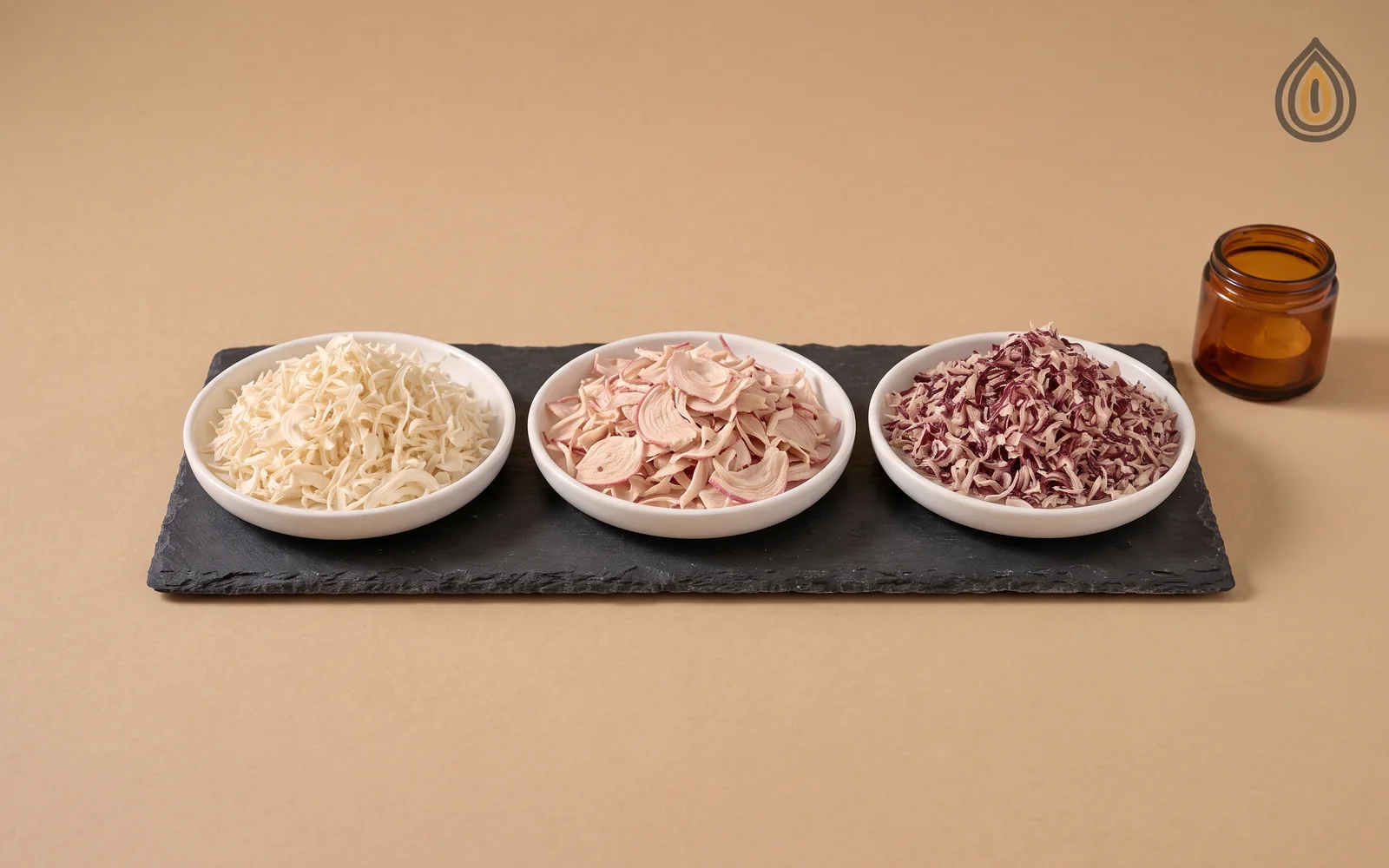
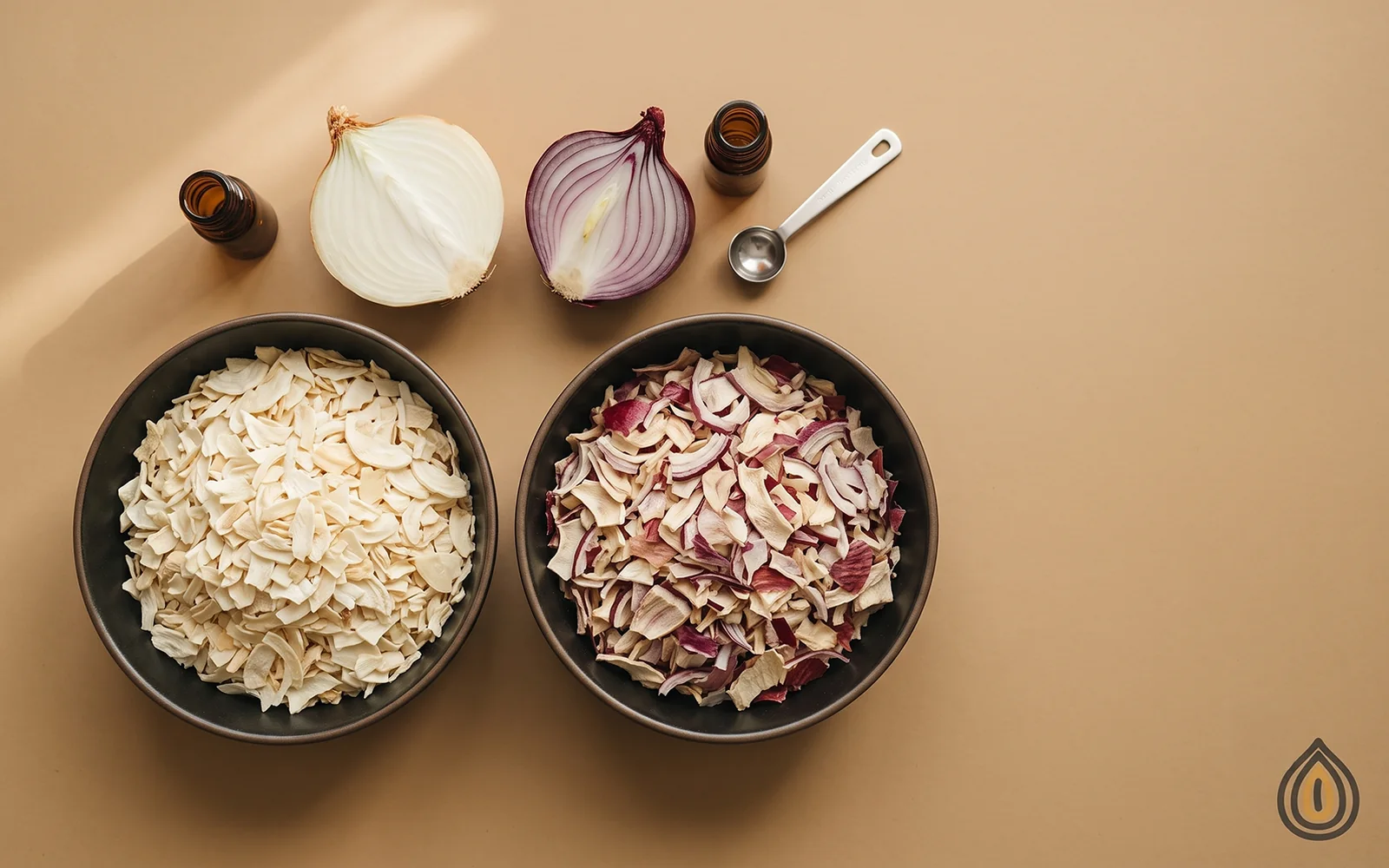
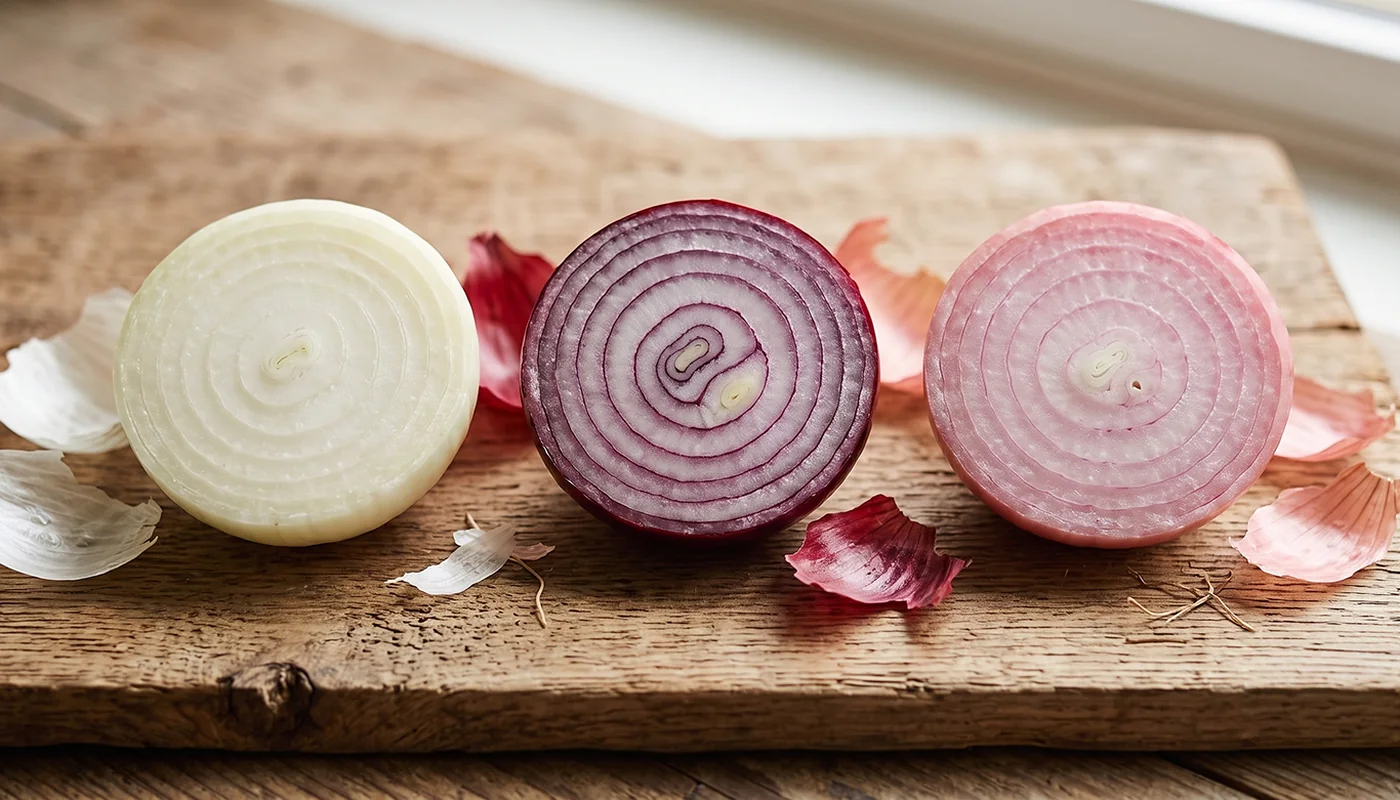
Indian dehydration plants work with three raw materials, and each is a different variety grown for a different reason. The white onion used for dehydration around Mahuva and in the Bhavnagar district is a local selection that farmers and plants have refined over decades for the traits drying rewards: high dry matter, around 14 to 16 percent against 10 to 12 for a table onion, a low sugar content that does not brown in the dryer, a firm bulb that slices cleanly, and a mild, clean flavour. It is grown almost entirely for the plants; very little of it is eaten fresh. The rabi crop, harvested from late February to May, supplies nearly all of it.
The red onion that goes into dehydration is closer to the table onion India eats every day, grown in Gujarat, Maharashtra and Madhya Pradesh: a purple-red skin, white to pale pink flesh with red rings, more pungent, a little sweeter, and with a lower dry matter that gives a slightly worse yield in the dryer. Plants choose the firmer, higher dry-matter red varieties for dehydration, but the raw material competes with the fresh market, and that competition is the root of the price difference.
Pink onion is a regional variety, lighter in colour than red, with a milder flavour than red and stronger than white. It is grown in smaller volumes and is dried on request rather than held in stock. Its place is discussed in its own section below and on the pink onion page.
Flavour: pungency, sweetness and what survives drying
Onion flavour comes from sulphur compounds that form when the cells are cut and an enzyme meets its substrate. The pungency a taster perceives is roughly proportional to the amount of pyruvate that reaction produces, and red onion varieties produce more of it than the mild white dehydration onion: in laboratory terms, red onion typically measures in the range of 8 to 12 micromoles of pyruvate per gram against 4 to 7 for the Mahuva white. That difference is the sharper bite a developer notices in a red sample. Red onion also carries more sugar, which reads as a sweeter finish and, in the dryer, as a greater tendency to brown.
Drying changes flavour in the same direction for both colours. The heat drives off some of the most volatile compounds and cooks others, so a dehydrated onion tastes less raw and more like a lightly cooked onion than the fresh bulb. The mild white onion becomes a rounded, savoury, almost neutral base note, which is why it disappears so well into soups, sauces and blends: it adds onion without announcing itself. Red onion keeps a recognisable sharpness and a fruity note after drying, and a seasoning made with red onion powder tastes noticeably more of onion at the same dose. In blending terms, a red onion dose can be 10 to 20 percent lower than white for the same onion impact, which recovers part of its price premium.
The flavour difference is smallest in powder, where the surface area and the milling expose everything at once, and largest in flakes, where the rehydrated piece is tasted as onion. A developer choosing between the colours for flavour alone should taste rehydrated chopped onion of both, plain and in the recipe, rather than comparing powders.
Colour in the dried product and in the finished food
White onion dries to a colour between ivory and pale cream. Plants grade it against a reference and the export grades allow a slight yellow cast but not beige or brown; the darker shades mean over-drying, old stock or, occasionally, a sulphite-free process in a plant that normally uses sulphite. Some plants treat white onion with a sulphite solution before drying to keep it white; the treatment is permitted in the EU within a limit and must be declared as an allergen above 10 milligrams per kilogram, so a specification should say whether sulphite is acceptable. Sulphite-free white onion is available and is the norm for German retail-facing products. The rules are in Sulphites in Dehydrated Onion.
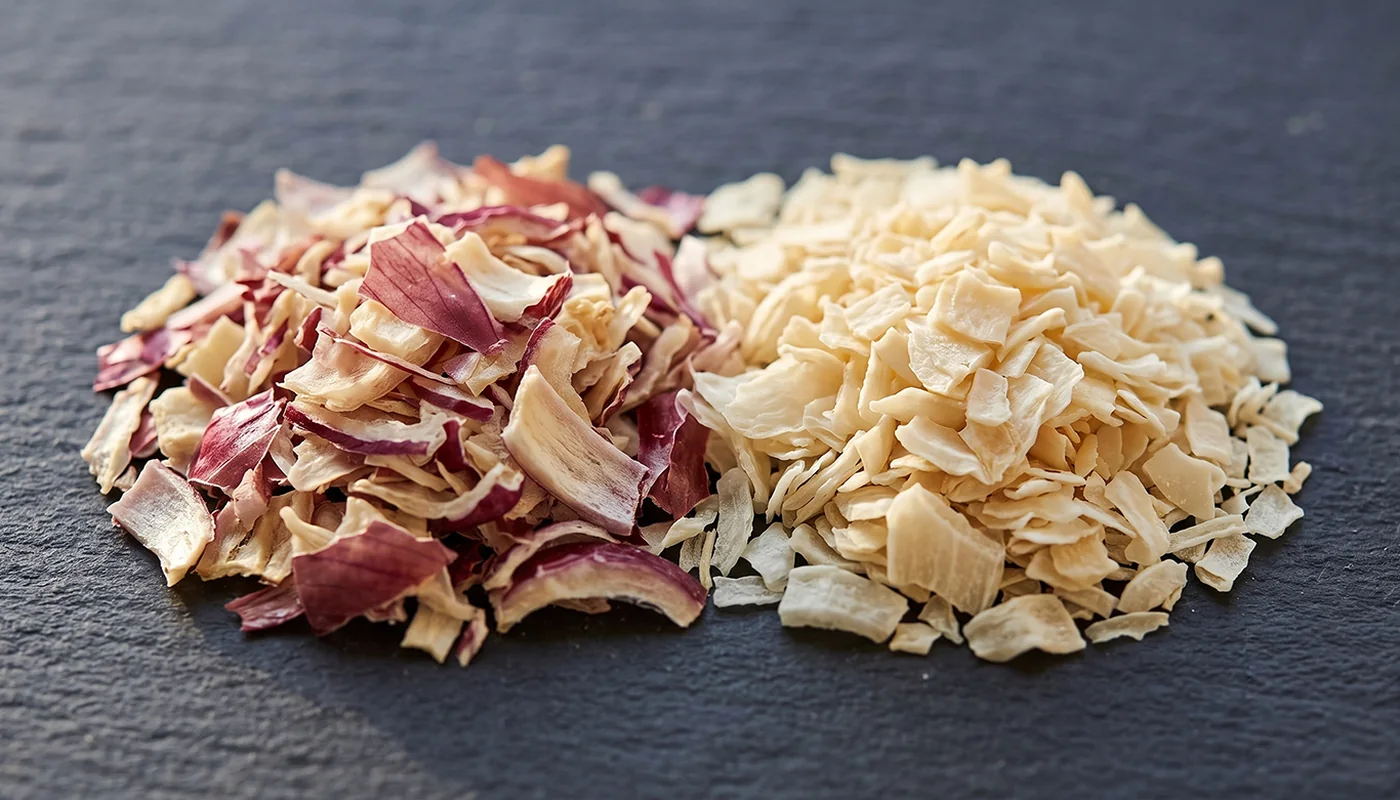
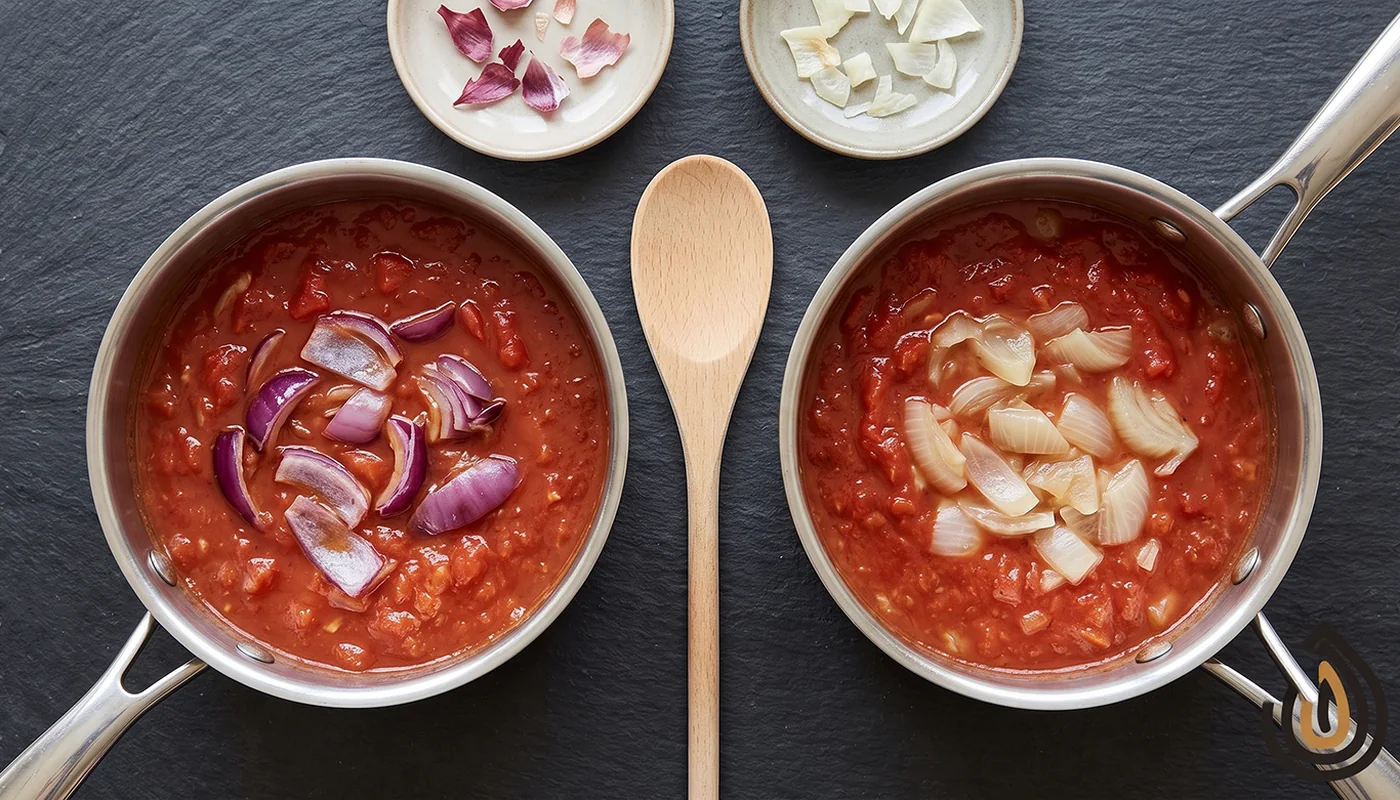
Red onion's colour lives in the outer layers of each ring, in pigments called anthocyanins, and it survives drying reasonably well: a dried red onion flake shows reddish-purple skin fragments against cream flesh, and a handful of red flakes is unmistakably red. Two things degrade it. Heat and time in the dryer turn the purple towards brown, so red onion is dried at slightly lower temperatures for longer, which is one reason it costs more. And the pigments are sensitive to pH: in an acidic product such as a tomato sauce or a pickle the red stays red or brightens, in a neutral or alkaline product such as a bread dough or a cheese sauce it drifts towards blue-grey. Developers who want visible red onion in a neutral product should test the colour after processing, not in the bag.
In the finished food, white onion is invisible unless the cut is large enough to be seen as pieces, and even then the pieces are pale and read as "onion" rather than as colour. Red onion is a visible ingredient in flakes, chopped and minced, and a colour contribution, pinkish to beige, in granules and powder. A product photographed for a label with "red onion" in its name needs the coarser cuts.
Colour by cut: where red shows and where it disappears
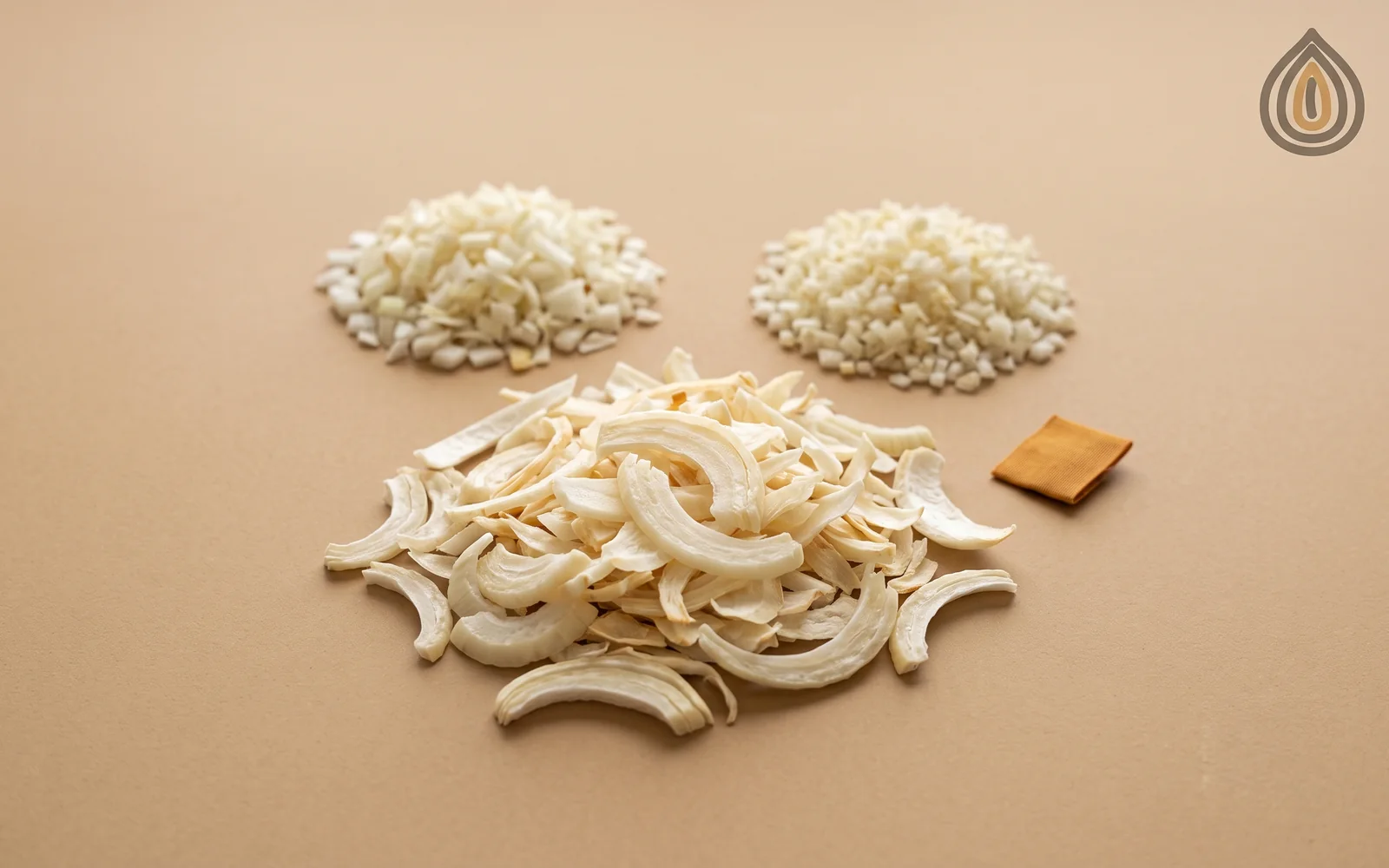
Both colours are cut into the same five bands, flakes 8-20 mm, chopped 3-5 mm, minced 1-3 mm, granules 0.5-1 mm and powder 80-100 mesh, and they rehydrate at the same rates. What differs is how much of the red is visible at each size.
| Cut | White onion appearance | Red onion appearance | Red colour visible after cooking? |
|---|---|---|---|
| Flakes 8-20 mm | Ivory to cream pieces, translucent when rehydrated | Cream pieces with clear reddish-purple skin fragments | Yes, clearly, in acidic and neutral products |
| Chopped 3-5 mm | Pale pieces | Mixed cream and red pieces, red clearly visible | Yes |
| Minced 1-3 mm | Pale specks | Pink-red specks | Yes as specks; fades in dark sauces |
| Granules 0.5-1 mm | Cream | Pinkish beige overall | Slight tint only |
| Powder 80-100 mesh | Off-white to cream | Pinkish beige to light brown | No, only a tint in pale products |
A common mistake is to buy red onion powder for a product that is supposed to look like it contains red onion. The flavour is there; the colour is not. If the label says red onion and the customer expects to see it, the cut has to be minced or coarser. The full cut comparison, with rehydration and price by cut, is in Flakes, Chopped, Minced, Granules or Powder.
Applications: where white is the default and where red earns its premium
White onion is the default for any product in which onion is a background ingredient: soups, sauces, gravies, stocks, ready meals, seasonings for snacks and meat, coatings, bakery toppings, and any blend where a neutral onion note is wanted at the lowest cost. It is also the default wherever the finished product should stay pale: cream soups, white sauces, cheese products, dips, mayonnaise-based dressings and bread doughs, where red onion's pigment would grey the product.
Red onion earns its premium in four kinds of product. Ethnic and regional ranges, where the recipe traditionally uses red onion and the flavour is expected: South Asian, Middle Eastern, Mexican and Mediterranean lines. Products that show onion and name it: red onion relish, pickled red onion, salad toppers, burger toppings, pizza. Marinades, chutneys and snack seasonings that want a sharper, fruitier onion note than white gives. And products positioned on appearance, where pink-red specks on a cracker or in a rice mix are part of the design. In each case the buyer is paying for a characteristic that white onion cannot provide, and the premium is justified if the characteristic reaches the consumer.
| Product type | Usual colour | Why |
|---|---|---|
| Cream soups, white sauces, cheese products, dips | White | Colour must stay pale; mild note wanted |
| Snack seasonings, coatings, rubs | White (granules/powder) | Cost, flow, neutral base; red where a sharper note is designed in |
| Meat products: sausages, burgers, kebabs | White minced; red for ethnic lines | Red gives the traditional flavour in kebab and kofta seasonings |
| Tomato sauces, salsas, chutneys, marinades | Either; red common | Acidic product keeps the red colour and suits the sharper flavour |
| Pickles, relishes, salad toppers | Red flakes or chopped | Visible red onion is the point |
| Bread, crackers, pizza toppings | White minced, or red for appearance | Red specks brown attractively; watch greying in dough |
| Instant noodles, soup sachets | White minced or granules | Cost and fast rehydration |
| Ready meals, rice and pasta mixes | White chopped; red in ethnic lines | Visible pieces; colour per recipe |
Price and availability through the year
Red onion costs more than white in nearly every month, and the premium moves with the season. Three causes stack up. The raw material is dearer: red onion competes with the fresh market, where India's own consumers and fresh-onion exporters bid for the same bulbs, and in the dehydration months the plant-gate price of red is typically 1 to 3 rupees per kilogram above white, which through the 8 to 9 yield ratio is 10 to 25 rupees on the dry product. The yield is slightly worse, because red varieties have lower dry matter. And the runs are smaller and slower, with lower drying temperatures to protect the colour.
| Period | White onion flakes, FOB (INR/kg, indicative) | Red onion flakes, FOB (INR/kg, indicative) | Red premium |
|---|---|---|---|
| January 2026 (now) | 150-175 | 175-210 | 15-25 % |
| March-May (season, typical year) | 140-165 | 160-195 | 10-20 % |
| July-November (off-season, typical year) | 140-155 | 165-185 | 15-25 % |
| Short-crop year, any month | +30-60 % | +30-70 % | Widens |
Availability follows the same logic. White onion in the standard cuts is in stock at most Mahuva plants all year. Red onion is made in season and stocked in smaller quantities, so a specific red cut in the off-season may need a production run from stored red kibble or, from November onward, may be short until the new crop; lead times for red can be one to two weeks longer than for white between July and February. Buyers who need red onion for a year-round product should fix volume in the season, when the plants are running red, and hold stock or have the exporter hold it. The price mechanics are in Dehydrated Onion Price per kg.
What changes on the specification sheet
Most of a dehydrated onion specification is identical for the two colours: moisture below 6 percent, ash, particle size band, foreign matter, microbiology tier, pathogens absent. Five lines differ.
- Colour description and reference. White: "ivory to pale cream, free of brown". Red: "cream flesh with reddish-purple skin fragments, minimum share of red-skinned pieces" for flakes and chopped; for red powder, a colour reference against a retained sample, because "pinkish beige" is not a testable phrase. Some buyers add an instrumental colour value for white powder.
- Sulphite. White onion may be sulphite-treated for colour and the specification must say whether that is permitted and at what limit; red onion is not sulphite-treated, because the treatment would bleach the colour, so a red specification normally states "no sulphite".
- Pungency. Rarely specified, but a buyer who has chosen red for its bite can ask for a pyruvate value; plants with a laboratory can measure it, and a minimum of 8 micromoles per gram is a reasonable line for red.
- Yield-related lines. Red onion's slightly lower dry matter shows as a slightly higher water activity at the same moisture; the 6 percent limit is still the working limit.
- Origin and variety. Where a label or a customer requires it, name the variety group and region; white from Bhavnagar district, red from Gujarat or Maharashtra as the case may be.
How to write the sheet, line by line, is in How to Read a Dehydrated Onion Specification Sheet.
Pink onion: the third option
Pink onion is a regional Indian variety with a light pink to rose skin and pale flesh. Dried, it looks like a lighter red onion, with pink rather than purple skin fragments, and it tastes between white and red: more character than the mild dehydration white, less bite than red. It is grown in far smaller volumes than either, so plants dry it to order, usually in a minimum run of a few hundred kilograms per cut, and its price is at or above red's. Its uses are where a developer wants a recognisable onion flavour and a pink rather than purple colour: salad toppers, pale pickles, premium snack seasonings that show the onion, and some export recipes for specific markets that call for it by name. It is not a substitute for white in cost-driven products, and it is not a substitute for red where deep colour is wanted. The specification and the availability calendar are on the pink onion page, and the dried product is described in Pink Onion, Dehydrated.
Blending colours and other ways to get the effect for less
Several products that seem to need red onion can be made more cheaply with a blend. A snack seasoning that wants a sharper onion note but no visible colour can use 80 percent white granules and 20 percent red granules and taste closer to the red version at a fraction of the premium. A pickle that wants visible red onion can use white chopped as the bulk and red flakes at 20 to 30 percent as the visible fraction. A ready meal can use white chopped for the body and a small dose of red minced for the specks on top. Plants and exporters supply the two colours as separate lots, and the blend is made at the buyer's plant, so the buyer controls the ratio and the declaration ("onion" covers both).
Two effects cannot be blended into existence. A product that must be visibly red throughout needs red flakes or chopped as the main ingredient, and a product that must stay pale must avoid red altogether, because even a small share of red pigment greys a white sauce. Toasted onion, which is white onion browned further in the dryer, is a different lever: it gives a darker colour and a roasted flavour without any red pigment, and is discussed in Toasted Onion vs Natural Dehydrated Onion.
Colour stability in storage: which colour ages better
Both colours are declared at 18 to 24 months in sealed bags, but they age differently. White onion's failure mode is browning: a slow non-enzymatic darkening that turns ivory to beige over a year or two, faster in a warm warehouse and faster in powder than in flakes. It does not affect safety and barely affects flavour, but a white sauce made with two-year-old powder is a shade darker than one made with fresh stock, and retail buyers notice. Red onion's failure mode is pigment loss: the purple skin fragments fade towards brown, and after a year in a warm store a red flake looks like a lightly toasted white flake with darker edges. The flavour keeps better than the colour.
The practical rules follow. Store both colours below 25 °C, below 60 percent relative humidity and out of light, on pallets and in the original sealed liners. Rotate red onion faster than white: a red lot bought in the season should be used within nine to twelve months for full colour, even though the bag says longer. Buy red in the cut you will use rather than milling it yourself later, since milling exposes more surface and speeds the fade. And keep a retained sample of each lot in a sealed jar in the dark; it is the only reliable way to tell whether a colour complaint is about the lot or about the customer's storage. The storage conditions in detail are in Dehydrated Onion Shelf Life.
Processing and microbiology: the same, with one difference
The two colours go through the same line: washing, peeling, slicing, belt drying, sieving and milling, metal detection, packing. The microbiology tiers, standard, low bacterial and extra low bacterial, apply to both, with the same limits, and the pathogen requirements are identical. The one process difference is the dryer setting: red onion is dried at a lower air temperature for longer to protect the pigment, which is part of its cost and which slightly changes the microbiological outcome, since a longer, cooler drying cycle reduces the load a little less than a hot one. In practice the standard-grade counts for red and white from the same plant are similar, and the treated grades meet the same limits because the steam step does the work. Sulphite is the other difference: it may be used on white for colour and is not used on red. A buyer specifying low bacterial red onion for a product without a kill step should expect the same tier premium as for white, plus the red premium, and should check the certificate of analysis for the actual count, as with any treated grade. The tiers are explained in Microbiology in Dehydrated Onion.
Labelling: what "onion" covers and when to name the colour
In the EU ingredient list, "onion" or "dried onion" covers white, red and pink alike; the colour is not a mandatory part of the name, and a product that switches from white to red onion for flavour does not need a new label on that account. Two situations change this. If the product name or a claim on the pack refers to red onion, "red onion relish", "with red onion", the ingredient list should say "red onion" and the product should visibly contain it, which brings the cut question back: red onion powder alone in a product called red onion relish invites a complaint. And if the white onion is sulphite-treated, the sulphite must be declared above 10 milligrams per kilogram, in the allergen emphasis the regulation requires, whatever the colour of the final product. Origin labelling is not required for a dried onion ingredient in a processed food, but a buyer's own customer may ask for it, and the lot record answers the question. The rules are gathered in Labelling Dehydrated Onion for the EU.
How to compare white and red samples in your own product
Ask the supplier for the same cut in both colours, from current lots, with their certificates of analysis. Rehydrate 20 grams of each in 60 grams of water for the time the cut needs, and taste plain: this is where the pungency and sweetness difference is clearest. Then make the recipe twice, once with each, at the same dose, and once more with the red at 85 percent of the white dose, since red usually needs less. Judge colour after the full process, including any heating, and again after a week of storage if the product is chilled, because the red pigment's drift is slow. Record moisture and colour of the dry samples on the day they arrive; they are the reference for the first delivery. Sensory scoring for onion, with a simple sheet, is in Sensory Evaluation of Dehydrated Onion.
How KlarHarvest supplies both colours
KlarHarvest supplies white and red onion in all five cuts from BRC-certified plants in Mahuva, and pink onion to order. White onion is available from stock throughout the year; red onion is produced in season and held for regular buyers, and for a year-round red product we recommend fixing the season's volume in April or May. Both colours ship with a lot code, a certificate of analysis from an NABL-accredited laboratory and a retained sample, and mixed pallets with both colours are packed at our godown from sealed plant bags. Sample sets with white and red of the same cut are the usual first step. The products are on the white onion and red onion pages.
Frequently asked questions
Is red dehydrated onion stronger than white?
Yes. Red onion varieties produce more of the sulphur compounds that give onion its bite, and the difference survives drying. In blends, a red onion dose can usually be 10 to 20 percent lower than white for the same onion impact.
Why is red dehydrated onion more expensive?
The raw material is dearer because red onion competes with the fresh market, its yield in the dryer is slightly lower, and it is dried in smaller, slower runs to protect the colour. The premium over white is typically 10 to 25 percent and widens in a short-crop year.
Does red onion powder colour a product red?
Only slightly. The red pigment is concentrated in the skin fragments, which are visible in flakes, chopped and minced but blend into a pinkish beige in granules and powder. For visible red onion, use a cut of 1 millimetre or larger.
Which colour is right for a soup or a white sauce?
White. It gives a mild, rounded onion note and keeps the product pale. Red onion's pigment drifts towards grey in neutral or alkaline products such as cheese sauces and doughs.
Is white dehydrated onion treated with sulphites?
Some plants treat white onion with sulphite before drying to keep the colour bright; it must be declared as an allergen above 10 milligrams per kilogram in the EU. Sulphite-free white onion is available and should be specified explicitly. Red onion is not sulphite-treated.
Can I get red onion all year?
Usually, but with longer lead times between July and February, when it comes from stored kibble or waits for the new crop. Buyers with a year-round red product fix their volume in the March to May season.
What is pink onion used for?
Products that want a recognisable onion flavour with a pink rather than purple colour: salad toppers, pale pickles, premium snack seasonings and some regional recipes. It is dried to order in small runs and priced at or above red.
Next step
If you are choosing between the colours, the fastest answer is a pair of samples of the same cut. Request a sample of white and red, tell us the product in one line, and both arrive from current lots with their lab reports. For a product already specified in one colour, request a quote and the priced specification is back within one business day.