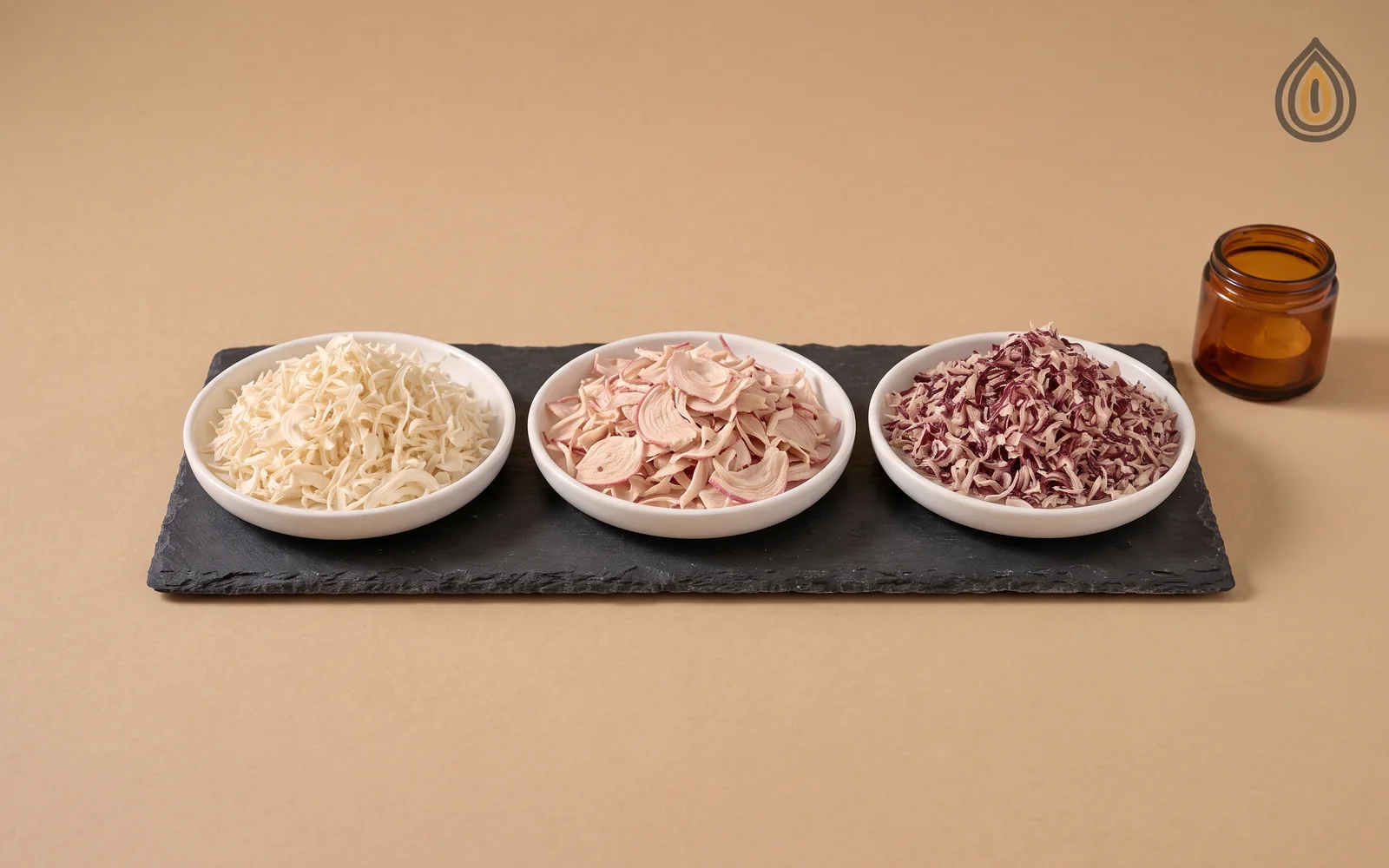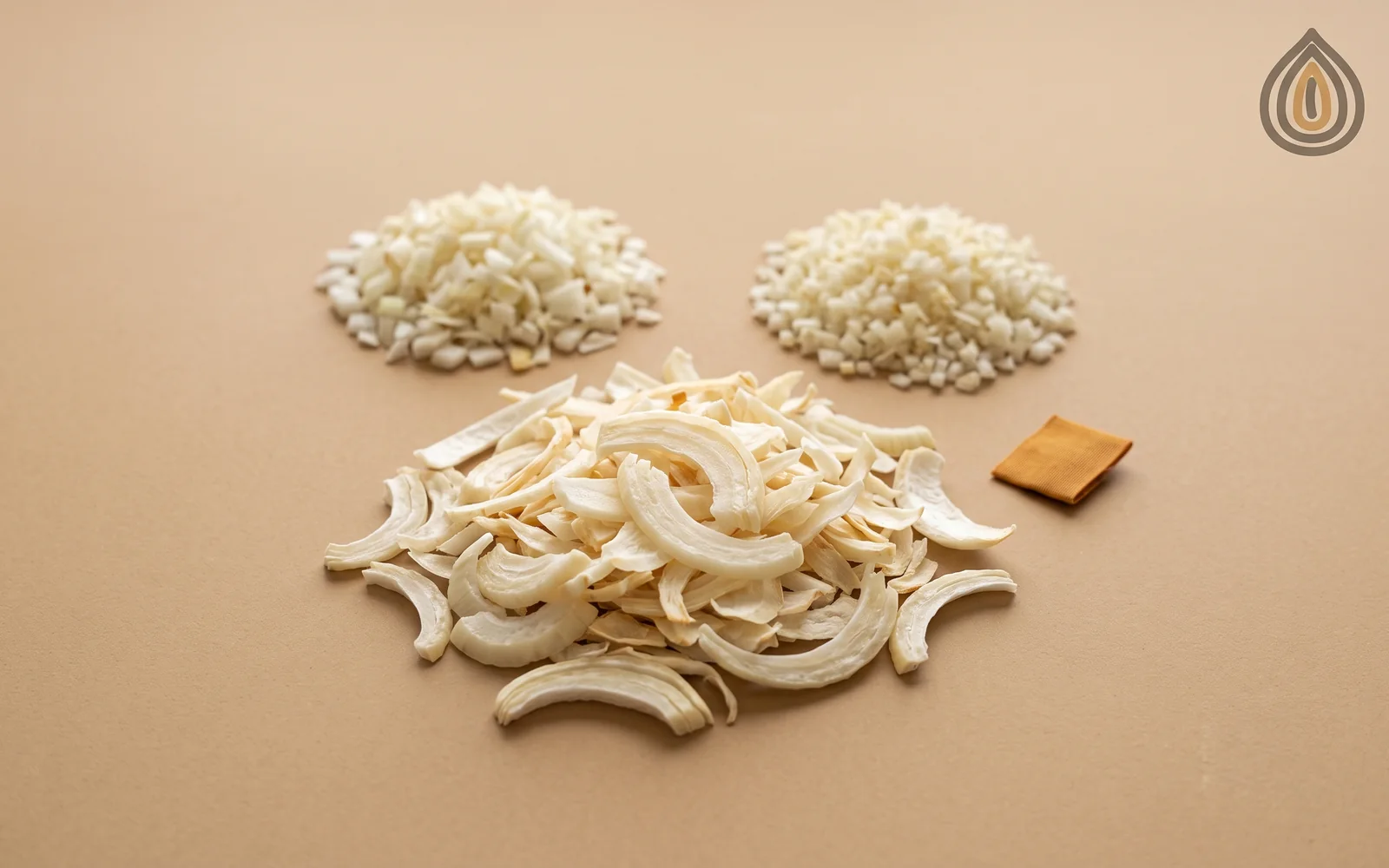
- What a mesh number is, and the two sieve series
- Mesh to millimetres and microns: the numbers that matter for onion
- The standard bands for each cut, in mesh and millimetres
- How a plant sieves and mills to a band
- Reading the sieve analysis on a certificate
- Custom bands: 26-40, 40-60, 60-80 and finer
- Powder fineness: what 60, 80, 100 and 120 mesh change
- Particle size, bulk density and dosing
- How particle size is measured: sieves, lasers and why they differ
- Particle size after transit: breakage and segregation
- Particle shape: why the same mesh looks different
- Red onion and particle size
- Mixed bands and private-label blends
- A five-minute incoming check without a laboratory
- Five particle-size mistakes seen in inquiries
- The specification wording
- Conversion table to print
- How KlarHarvest specifies and reports particle size
- Frequently asked questions
Judge the product, not the words
200-500 g from a current lot, dispatched by courier with the lot lab report.
Request a sampleDehydrated onion mesh size is the number that turns a cut name into a specification. "Granules" means nothing until it says 16-40 mesh; "powder" means nothing until it says 80 or 100 mesh; and a supplier who reads "flakes" without a band can ship a bag with a quarter of its weight in dust and still be within the words of the order. Mesh is an old system, openings per inch of a woven sieve, and it sits alongside millimetres and microns on the same specification sheets, which confuses buyers who have not had the conversion table in front of them. This guide puts it there.
It explains what mesh numbers mean and how they convert to millimetres and microns, the standard bands for each cut of dehydrated onion in both units, how a plant sieves and mills to a band and why no bag is 100 percent inside it, how to read the sieve analysis on a certificate of analysis, the custom bands that snack, meat and blend manufacturers ask for, what fineness does to a powder's dispersion, colour and flow, how particle size is measured and why sieve and laser results differ, and the specification wording that removes the argument. It ends with a conversion table you can print.
Bands and values are those used by Mahuva plants and European buyers as of March 2026.
What this guide covers
- What a mesh number is, and the two sieve series
- Mesh to millimetres and microns: the numbers that matter for onion
- The standard bands for each cut, in mesh and millimetres
- How a plant sieves and mills to a band
- Reading the sieve analysis on a certificate
- Custom bands: 26-40, 40-60, 60-80 and finer
- Powder fineness: what 60, 80, 100 and 120 mesh change
- Particle size, bulk density and dosing
- How particle size is measured: sieves, lasers and why they differ
- Particle size after transit: breakage and segregation
- Particle shape: why the same mesh looks different
- Red onion and particle size
- Mixed bands and private-label blends
- A five-minute incoming check without a laboratory
- Five particle-size mistakes seen in inquiries
- The specification wording
- Conversion table to print
- How KlarHarvest specifies and reports particle size
- Frequently asked questions
What a mesh number is, and the two sieve series
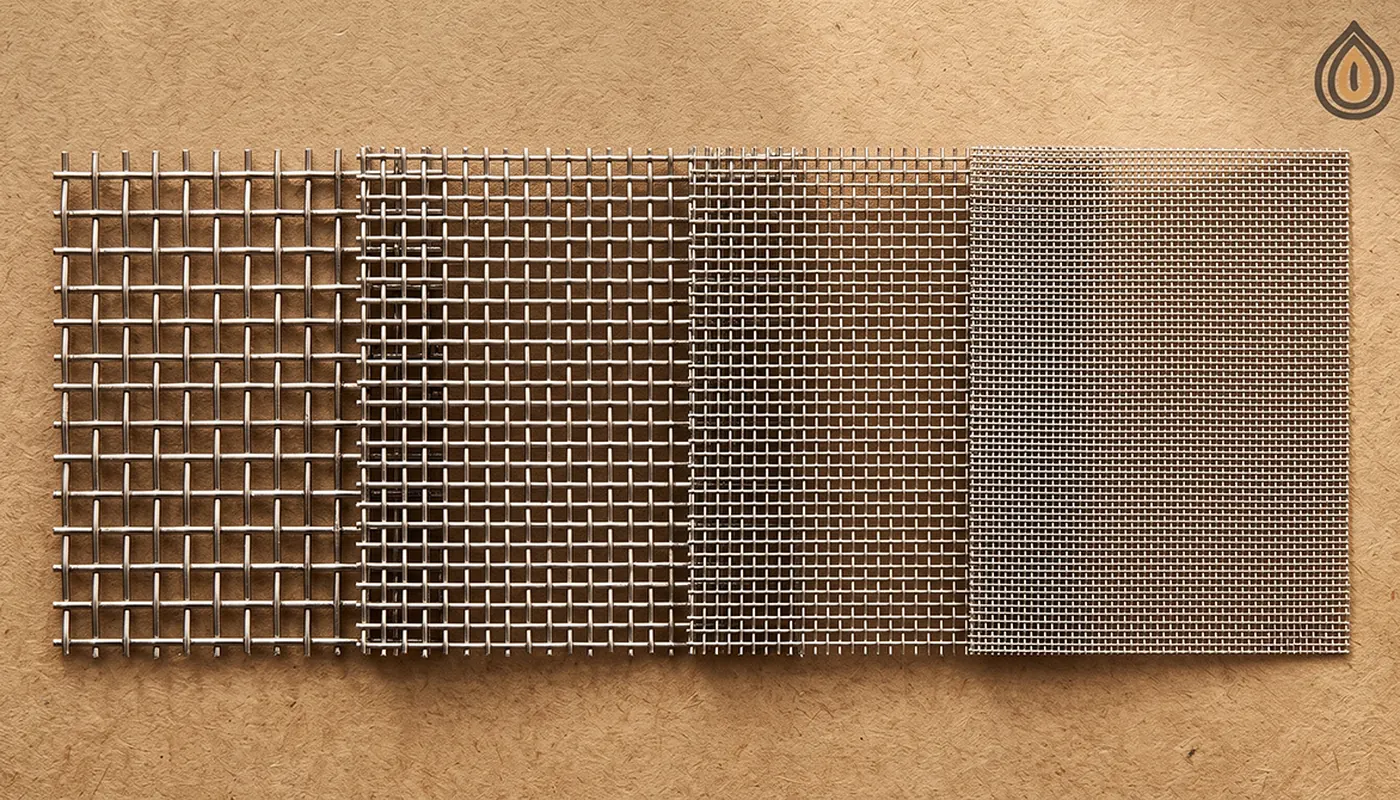
A mesh number is the count of openings across one linear inch of a woven wire sieve: a 40 mesh sieve has 40 openings per inch, each opening about 0.42 millimetres wide once the wire's own thickness is subtracted. Higher numbers mean finer sieves. The system dates from the days when sieves were woven by hand, and it survives because the food and spice trades in India, Britain and America have always used it. Two series are in use: the US standard series, defined in ASTM E11 and matching ISO 3310-1 in its opening sizes, and the older Tyler series, which uses slightly different numbers for some sizes. In dehydrated onion the two series agree closely at the sizes that matter, 16, 40, 60, 80 and 100 mesh, and specifications rarely state which series is meant; where a buyer's own sieves are Tyler, the millimetre figure on the specification settles it.
A specification in mesh therefore always needs the millimetre or micron equivalent beside it, and a specification in millimetres needs the mesh beside it for the plant's operators, who set their sieve stacks by mesh number. Both units on the sheet, and both on the certificate, is the practice that avoids a conversion argument.
Mesh to millimetres and microns: the numbers that matter for onion
| US mesh (ASTM E11) | Opening (mm) | Opening (microns) | Used in onion for |
|---|---|---|---|
| 4 | 4.75 | 4,750 | Upper limit of chopped |
| 6 | 3.35 | 3,350 | Lower limit of chopped, upper of minced |
| 8 | 2.36 | 2,360 | Within minced |
| 10 | 2.00 | 2,000 | Within minced |
| 16 | 1.18 | 1,180 | Upper limit of standard granules |
| 20 | 0.85 | 850 | Within granules |
| 26 (Tyler 28) | 0.60 | 600 | Upper limit of 26-40 granules |
| 40 | 0.425 | 425 | Lower limit of standard granules; upper of 40-60 |
| 60 | 0.25 | 250 | Lower limit of 40-60 granules; coarse powder |
| 80 | 0.18 | 180 | Standard onion powder passes 80 |
| 100 | 0.15 | 150 | Fine powder |
| 120 | 0.125 | 125 | Extra-fine powder, rare |
| 200 | 0.075 | 75 | Dust fraction; specified as a maximum |
Two habits of the trade to note. Flakes, chopped and minced are specified in millimetres, because they are large enough to measure that way and because their bands come from slicing and breaking rather than from sieves; granules and powder are specified in mesh, because they are made on sieve stacks. And "passing" and "retained" carry the meaning: "95 percent passing 80 mesh" means 95 percent of the weight goes through the 80 mesh sieve; "90 percent retained between 16 and 40 mesh" means 90 percent goes through 16 and stays on 40.
The standard bands for each cut, in mesh and millimetres
| Cut | Band in millimetres | Band in mesh | Usual specification |
|---|---|---|---|
| Flakes (kibbled) | 8-20 mm | - | Min 90 % between 8 and 20 mm; fines below 3 mm max 5 % |
| Chopped | 3-5 mm | 4-6 | Min 90 % between 3 and 5 mm |
| Minced | 1-3 mm | 6-16 | Min 90 % between 1 and 3 mm |
| Granules, standard | 0.42-1.18 mm | 16-40 | Min 90 % between 16 and 40 mesh; max 5 % passing 40 |
| Granules, medium | 0.42-0.60 mm | 26-40 | Min 90 % between 26 and 40 mesh |
| Granules, fine | 0.25-0.42 mm | 40-60 | Min 90 % between 40 and 60 mesh |
| Powder, standard | below 0.18 mm | 80 | Min 95 % passing 80 mesh |
| Powder, fine | below 0.15 mm | 100 | Min 95 % passing 100 mesh |
The five cuts and their uses are described in Flakes, Chopped, Minced, Granules or Powder; this guide is about the numbers that define them.
How a plant sieves and mills to a band
Dried kibble from the dryer is a mix of sizes, from whole dried rings to dust, and the plant separates it on vibrating screens: a stack of two or three sieves, coarse on top, fine below, shaken so that each fraction ends up on the sieve that stops it. The fraction retained on the 8 millimetre screen and passing 20 is flakes; what passes 8 and stays on 3 is chopped; what passes 3 and stays on 1 is minced; what passes 1 goes to the mills, together with whatever share of the coarser fractions the season's orders for granules and powder require. Milling is done in hammer mills or pin mills, which break the kibble by impact, and the milled product is sieved again to the ordered band: for 16-40 granules, retained on 40 and passing 16, with the oversize returned to the mill and the undersize sent to the powder line; for powder, passing 80 or 100, with the oversize re-milled.
No sieve is perfect and no band is 100 percent full. Particles near the cut size pass or stay depending on their shape and orientation; long flat flakes slip through openings that would stop a cube of the same weight; and vibration breaks a few percent of everything. A well-run plant achieves 90 to 95 percent inside the band for granules and 95 percent or more passing for powder, and that is why specifications ask for a minimum share rather than "all". Screens wear and stretch, so certified plants check sieve openings against certified test sieves and replace screens on a schedule; a plant whose sieve analyses drift over a season has screens that have stretched. The eight-step process, with sieving and milling as step six, is in How Dehydrated Onion Is Made.
Reading the sieve analysis on a certificate
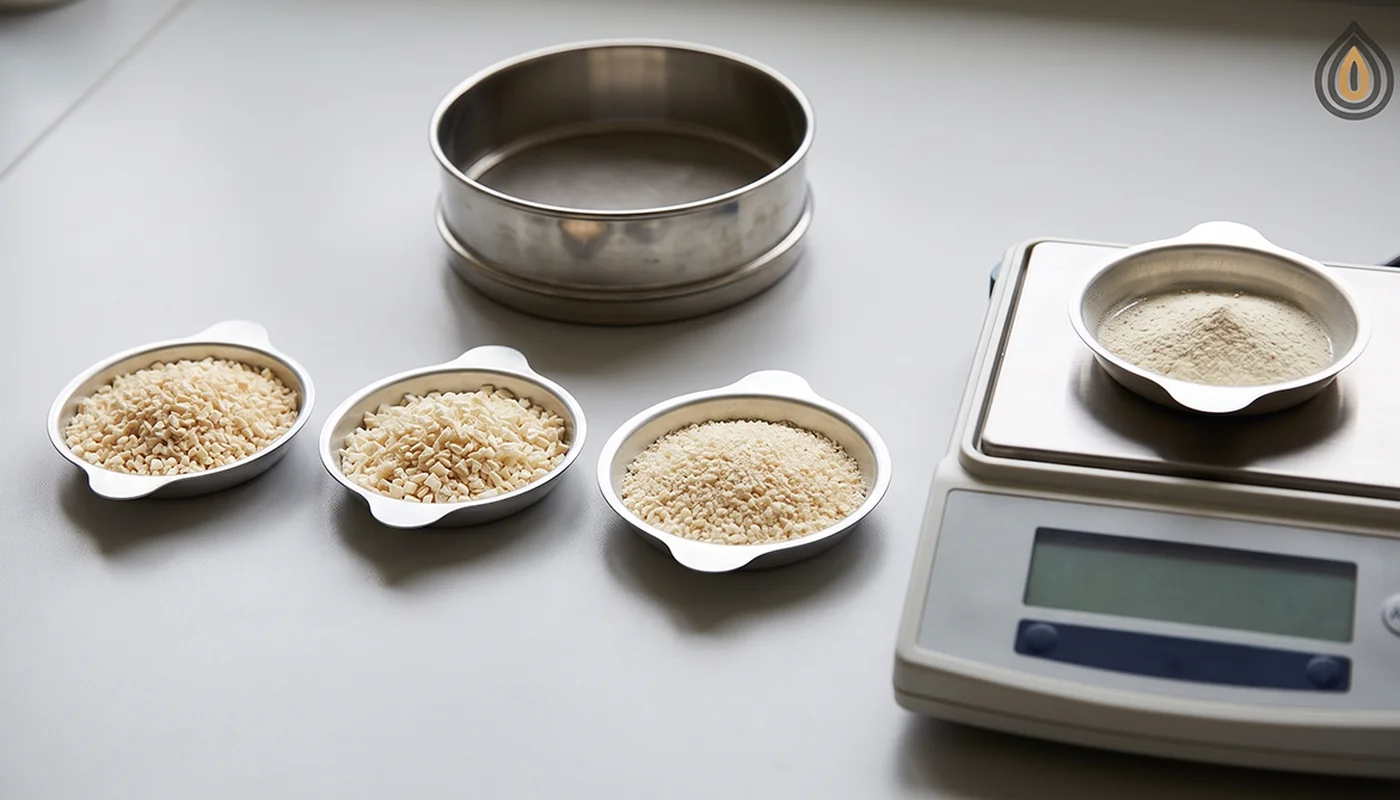
A sieve analysis lists the share of a sample's weight retained on each sieve of a stack and passing the finest one. For a lot of 16-40 mesh granules, a good certificate reads something like this:
| Fraction | Share by weight | Meaning |
|---|---|---|
| Retained on 16 mesh (above 1.18 mm) | 2.1 % | Oversize; slipped the top screen |
| Passing 16, retained on 40 (0.425-1.18 mm) | 93.4 % | Inside the band; the specification asks for 90 minimum |
| Passing 40, retained on 60 (0.25-0.425 mm) | 3.6 % | Fines, coarse |
| Passing 60 (below 0.25 mm) | 0.9 % | Dust |
Three things to check. The fractions must add to 100. The inside-the-band share must meet the minimum. And the fines share must meet the maximum, because it is the fines that dust in a drum and cake in a hopper; a lot with 91 percent inside the band and 8 percent dust is within one line and outside the other. A certificate that gives only "conforms" or a single percentage without the stack is not a sieve analysis, and a buyer should ask for the stack. The whole certificate is read in How to Read a Dehydrated Onion Lab Report.
Custom bands: 26-40, 40-60, 60-80 and finer
The standard bands cover most uses, and four custom bands cover most of the rest. 26-40 mesh granules, 0.42 to 0.60 millimetres, are the choice for visible-but-fine seasoning on corn snacks and for blends dosed by volume, because the narrower band flows more predictably than 16-40. 40-60 mesh, 0.25 to 0.42 millimetres, is the fine granule for oil-sprayed snack seasonings, where it adheres without dusting, and for dry blends where powder cakes. 60-80 mesh is a coarse powder used where a smooth product must still have a little body, in some coatings and dry marinades. Below 100 mesh, 120 and finer, is extra-fine powder for instant dispersion in liquids and for dusting applications; it is rarely ordered from India because it costs more to mill, darkens in milling and dusts badly in handling. A custom band costs a small premium, 2 to 5 percent, because the sieve stack is changed and the out-of-band fractions have to be sold as something else, and it adds days to the lead time; it is worth specifying when a line has been tuned to a size, not because a competitor's datasheet mentions it. The snack applications that drive most custom-band requests are in Dehydrated Onion in Snack Seasoning.
Powder fineness: what 60, 80, 100 and 120 mesh change
Going finer in a powder changes four things, and only one of them is an improvement. Dispersion improves: a 100 mesh powder disperses in a sauce faster and with fewer specks than an 80 mesh one, and a 120 mesh powder disperses almost instantly. Colour darkens: finer milling exposes more of the browned edges and generates more heat, so a 120 mesh powder from the same kibble is a shade darker than an 80 mesh one, which matters in pale products. Flow worsens: finer powders have more surface area, take up moisture faster and cake sooner, so a 120 mesh powder needs an anti-caking agent where an 80 mesh one may not. And dusting increases: the fraction below 200 mesh, which floats in a drum and coats equipment, rises with fineness. The trade's standard of 80 mesh, with 95 percent passing, is where dispersion is good enough for nearly every liquid application and the other three penalties are still small; 100 mesh is the usual upgrade for instant sauces and coatings; finer than that should be a deliberate choice with a reason. The flow and density side is in Bulk Density and Flowability of Onion Powder and Granules.
Particle size, bulk density and dosing
Particle size sets bulk density, and bulk density decides what a line dosing by volume actually delivers. Flakes at 180 to 230 grams per litre, granules at 450 to 550, powder at 500 to 650: a volumetric feeder set for one band delivers a different weight from another, and a lot at the fine end of a band delivers more than one at the coarse end. Buyers dosing by volume should specify bulk density with a range alongside the sieve band and check both on arrival; buyers dosing by weight need only the band. Two related effects: a mixture of sizes segregates in a hopper, fines sinking and coarse rising, so a blend of granules and powder delivers differently at the top and bottom of a batch, which is a reason to keep the band narrow for volumetric lines; and tapped density, after vibration, runs 10 to 20 percent above loose density, so a specification should say which is meant.
How particle size is measured: sieves, lasers and why they differ
The sieve analysis is the reference method in this trade: a weighed sample of 50 to 100 grams on a stack of certified test sieves, shaken mechanically for a fixed time, typically 5 to 10 minutes, each fraction weighed. It measures what a particle does on a sieve, which is what it does on the plant's screens and in the buyer's own sieves, and it is cheap; every plant and most buyers have a stack. Laser diffraction, used in some large buyers' laboratories, measures the size distribution of particles suspended in air or liquid and reports a median diameter, D50, and the spread; it is fast and repeatable but reads a flat flake or an elongated granule differently from a sieve, usually as smaller, so a laser D50 and a sieve band are not directly comparable. Where a buyer's specification is written in laser terms, D50 and D90, the plant should be asked to correlate its sieve results with a laser measurement on the same lots once, and the specification should carry both. Sample preparation matters for either method: a sample of powder that has caked in the bag gives a coarse result until it is gently broken up, and a sample taken from the top of a bag reads coarser than the bag as a whole because fines settle. The reference standard for test sieves is ISO 3310-1 (ASTM E11), and the analysis method most laboratories follow is ISO 2591-1.
Particle size after transit: breakage and segregation
The sieve analysis on the certificate describes the lot as packed, and two things change it before use. Breakage in transit adds fines, most of all to flakes, which are brittle at 5 percent moisture and fracture when bags are dropped, stacked six high or forklifted repeatedly; a flake lot leaving the plant with 3 percent fines can arrive with 6 after an LCL journey with several handling steps. Segregation inside a bag moves fines to the bottom, so the first scoop from a bag reads coarser than the last. Neither is a plant defect, and a buyer's specification should allow for transit: a fines maximum of 5 percent at packing and 8 on arrival is a fair pair of numbers for flakes, and sampling for an arrival sieve analysis should take from the middle of several bags. Palletised, stretch-wrapped, top-sheeted cargo and a container rather than LCL reduce breakage; the handling differences between the modes are in LCL or Full Container?
Particle shape: why the same mesh looks different
Two lots can share a sieve analysis and look nothing alike, because a sieve sorts by the smallest dimension a particle can present to an opening, not by its volume. Dehydrated onion is sliced tissue, so its particles are plates rather than cubes: a flake is a curved sheet perhaps 0.5 millimetres thick and 15 across; a granule from a hammer mill is a chip, longer than it is thick; powder from a pin mill is closer to equant. A long chip passes a sieve end-on that it would not pass lying flat, so a 16-40 band from a hammer mill contains longer, thinner particles than the same band from a pin mill, and it looks coarser in the hand, packs to a lower bulk density and rehydrates a little slower, because water reaches the centre of a thick chip more slowly than the centre of a thin one. Buyers who change plant and find the "same" granule behaving differently on the line are usually seeing a change in mill type, not in sieving. The cure is to keep a retained reference sample of the approved lot, compare each new lot against it by eye and by bulk density, and to name the mill type in the specification once a line has been tuned to it: "granules from hammer mill, chip form" or "from pin mill, near-equant". Colour interacts with shape too: thin chips show more browned edge per gram and read darker than thick ones from the same kibble.
Red onion and particle size
Red onion is dried and milled on the same equipment to the same bands, and three things differ. Red kibble is softer and slightly more hygroscopic than white at the same moisture, so it breaks less in transit but cakes more as a powder, and red powder is more often ordered at 60-80 mesh than at 100 for that reason. The red pigment is in the outer layers of each ring, so fine milling distributes it through the powder and gives an even pink-brown, while a coarse granule shows a mottle of red-edged and pale particles; a buyer who wants an even colour in a coarse product is asking for something the material cannot do. And the sieve analysis of red lots drifts more from packing to arrival, because the softer particles rub to dust; the fines allowance on arrival should be a point or two wider for red. Where a blend uses both colours, specifying the same band for both makes the blend segregate less. The colour and flavour differences are in White or Red Dehydrated Onion?
Mixed bands and private-label blends
Some retail and foodservice products are deliberate mixtures: a "minced onion" jar that is really minced with a share of granules for body, or a seasoning that combines flakes for appearance with powder for flavour. A mixture is a legitimate product but it needs its own specification, because a sieve analysis of a mixture describes the recipe rather than a band, and because mixtures segregate. The clean way is to specify the components separately, "70 percent minced 1-3 mm plus 30 percent granules 16-40 mesh by weight, blended at the plant", and to ask for the sieve analysis of each component before blending as well as the blend. Plants blend in ribbon blenders in batches of 250 to 500 kilograms, and the blend should be packed straight after blending, because a blended product left in a hopper separates within minutes. A buyer who blends in their own plant should order the components in separate bags and do the same. For a retail jar, the target is appearance at the top of the jar, which is the coarse fraction after segregation in transit, so the recipe is usually set a little finer than the look the buyer wants on the shelf. Private-label packing and blending options are on the products overview.
A five-minute incoming check without a laboratory
A goods-in team without a sieve stack can still catch the two failures that matter, oversize and excess fines, with two kitchen sieves and a kitchen scale. Buy two stainless steel sieves whose mesh openings have been checked once against a certified test sieve, or against the plant's, at the upper and lower limits of the band, 16 and 40 mesh for standard granules, 8 and 3 millimetres for flakes. Weigh 100 grams from the middle of a bag, shake it through the coarse sieve for a minute and weigh what stays on top; shake what passed through the fine sieve for two minutes and weigh what passes. Oversize should be under 3 to 5 percent and fines under 5 to 8 depending on the cut; anything well outside those figures is worth a formal sieve analysis before the lot is released. Do the check on three bags from different pallets, not one, and record the figures against the lot number, because a drift across deliveries is the early sign of a plant's screens stretching. The same session is the moment for the moisture check and the visual check against the retained sample; the arrival routine as a whole is in Common Quality Defects in Dehydrated Onion.
Five particle-size mistakes seen in inquiries
- A cut name and no band. "Onion granules" without "16-40 mesh" lets the plant ship whichever band it has; and a plant that ships 26-40 or 40-60 because it had them is not in breach of anything.
- A band with no tolerance. "100 percent between 16 and 40 mesh" cannot be met by any screen; a plant will either refuse the specification or sign it and hope. Ask for 90 percent and a fines maximum.
- Mesh without millimetres. A buyer's Tyler sieves and a plant's ASTM sieves differ by a few percent at some sizes; the millimetre figure decides the dispute.
- A powder specified only by "passing". "95 percent passing 80 mesh" is met by a powder that is 90 percent dust below 200 mesh, which cakes and floats. Add a dust maximum where handling matters.
- Bulk density copied from a datasheet. Density follows shape and mill type as much as band; a figure copied from another supplier's sheet becomes a rejection ground on arrival. Ask for the plant's own loose and tapped figures and set a range around them.
The specification wording
The lines that remove the argument, one per cut:
- Flakes: "Dehydrated white onion flakes 8-20 mm: minimum 90 percent retained between 8 mm and 20 mm test sieves; fines passing 3 mm maximum 5 percent at packing, 8 percent on arrival. Sieve analysis (above 20 / 8-20 / 3-8 / below 3) on each certificate."
- Granules: "Dehydrated white onion granules 16-40 mesh (0.425-1.18 mm, ASTM E11): minimum 90 percent retained between 16 and 40 mesh; maximum 5 percent passing 40 mesh; maximum 3 percent retained on 16 mesh. Sieve analysis with those three fractions on each certificate. Bulk density, loose, 450-550 g/l."
- Powder: "Dehydrated white onion powder 80 mesh: minimum 95 percent passing 80 mesh (0.18 mm); maximum 10 percent passing 200 mesh (0.075 mm) where dusting must be limited. Bulk density, loose, 500-650 g/l."
Add the method, "sieve analysis per ISO 2591-1 on ISO 3310-1 test sieves, 100 g sample, 10 minutes mechanical shaking", and the argument about whose sieves are right goes away. The whole sheet is in How to Read a Dehydrated Onion Specification Sheet.
Conversion table to print
| Cut / band | Mesh | Millimetres | Microns | Typical loose bulk density (g/l) |
|---|---|---|---|---|
| Flakes | - | 8-20 | 8,000-20,000 | 180-230 |
| Chopped | 4-6 | 3-5 | 3,000-5,000 | 280-350 |
| Minced | 6-16 | 1-3 | 1,000-3,000 | 350-450 |
| Granules standard | 16-40 | 0.425-1.18 | 425-1,180 | 450-550 |
| Granules medium | 26-40 | 0.425-0.60 | 425-600 | 480-560 |
| Granules fine | 40-60 | 0.25-0.425 | 250-425 | 500-580 |
| Powder coarse | 60-80 | 0.18-0.25 | 180-250 | 500-600 |
| Powder standard | passing 80 | below 0.18 | below 180 | 500-650 |
| Powder fine | passing 100 | below 0.15 | below 150 | 520-660 |
| Dust fraction | passing 200 | below 0.075 | below 75 | - |
How KlarHarvest specifies and reports particle size
Every KlarHarvest product page states its band in both mesh and millimetres, and every certificate of analysis carries a sieve analysis with the fractions named in the specification, run on ISO 3310-1 test sieves. Custom bands, 26-40, 40-60, 60-80 and 100 mesh powder, are quoted with their lead time and premium. Buyers who dose by volume get bulk density, loose and tapped, on the certificate on request. Samples of two adjacent bands, 16-40 and 26-40 granules, or 80 and 100 mesh powder, are sent from the same lot so that a line trial compares size and nothing else. The cuts are on the granules and powder pages.
Frequently asked questions
What does mesh size mean for onion powder?
The number of openings per inch of the sieve the powder passes through. Standard onion powder is 80 mesh, meaning 95 percent passes a sieve with openings of 0.18 millimetres; 100 mesh is finer, at 0.15 millimetres. Higher mesh means finer powder.
What is 16-40 mesh onion granules in millimetres?
Particles between 0.425 and 1.18 millimetres: they pass a 16 mesh sieve and are retained on a 40 mesh sieve. The specification usually asks for 90 percent of the weight inside that band.
Why are flakes specified in millimetres but granules in mesh?
Flakes are large and are sized by breaking and coarse screens, so millimetres are natural; granules and powder are made on fine sieve stacks that operators set by mesh number. A specification should carry both units.
What is a sieve analysis?
The share of a sample's weight retained on each sieve of a stack and passing the finest one, reported on the certificate of analysis. It shows the share inside the band and the share of fines, which a single percentage does not.
Is finer onion powder better?
Only for dispersion. Finer powder darkens in milling, cakes sooner and dusts more. 80 mesh is the standard for a reason; 100 mesh is the usual upgrade for instant sauces; finer should have a specific reason.
Why does my arrival sieve analysis show more fines than the certificate?
Breakage in transit, especially for flakes, and fines settling to the bottom of bags. Allow for it in the specification, for example 5 percent fines at packing and 8 on arrival, and sample from the middle of several bags.
Can I specify particle size by laser diffraction?
Yes, but correlate it once with sieve results on the same lots, because lasers read flat and elongated particles as smaller than sieves do. The sieve analysis remains the reference the plant works to.
Next step
If a band is in question, request a sample of the two nearest bands from one lot and run them on your own sieves and your own line. For a custom band, request a quote with the mesh and millimetre limits and the fines maximum, and it is priced with its lead time within one business day.