- The mass balance: 100 kilograms of fresh onion to 11 of dry
- Step 1: Harvest, curing and receiving at the plant
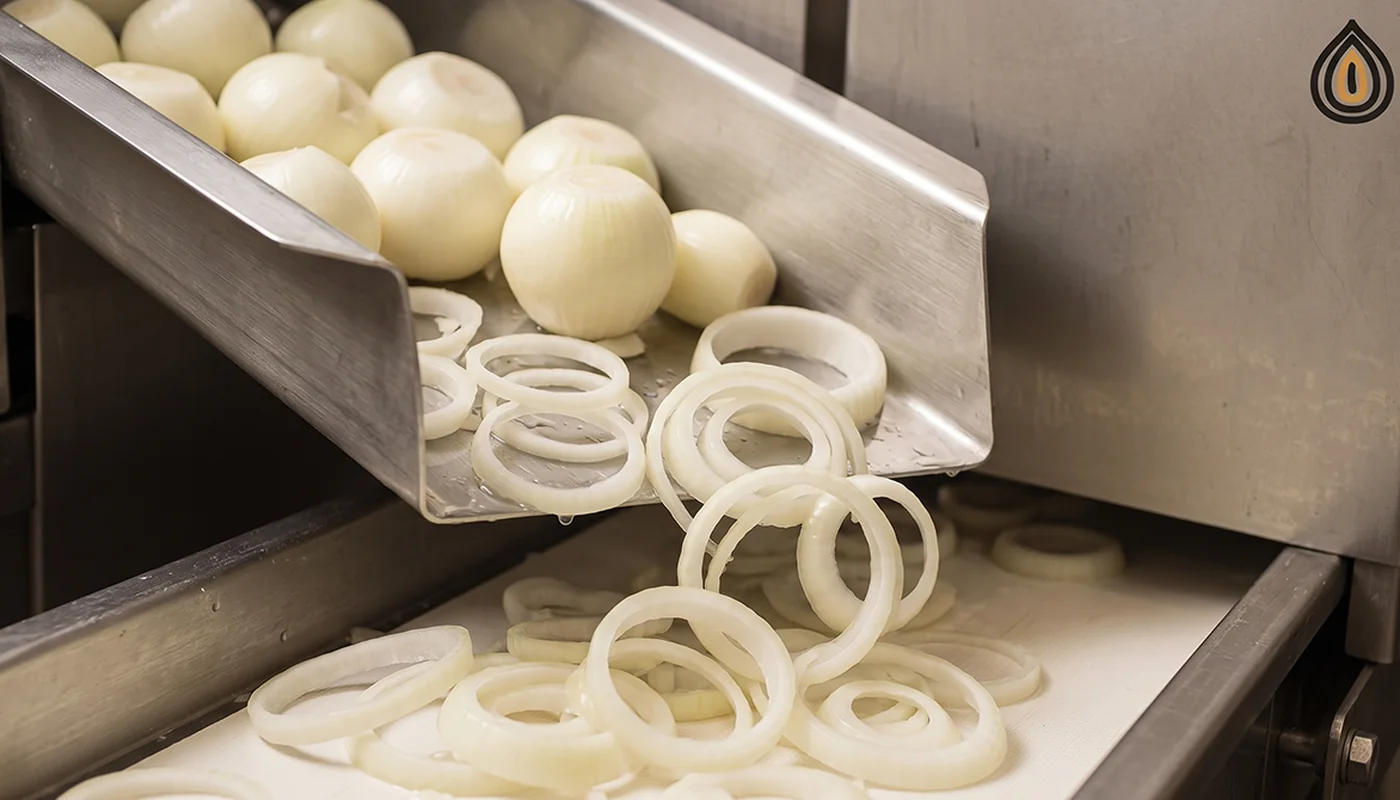
- Step 2: Topping, tailing and peeling
- Step 3: Washing and inspection
- Step 4: Slicing, and the optional sulphite dip
- Step 5: Drying: the belt dryer, temperatures, times and energy
- Step 6: Cooling, sieving, milling and sorting into cuts
- Step 7: Steam treatment for the low-bacterial grades
- Step 8: Metal detection, packing, lot coding and release
- Red and pink onion: where the process differs
- Plant capacity and what a production run means for your order
- Water and sanitiser: the numbers a food-safety team asks for
- The timeline from field to sealed bag
- By-products, water and waste
- Which defects come from which step
- The questions to ask a plant at each step
- How KlarHarvest works with the process
- Frequently asked questions
Judge the product, not the words
200-500 g from a current lot, dispatched by courier with the lot lab report.
Request a sampleBuyers who know how dehydrated onion is made read certificates differently, ask plants better questions and recognise a quality problem by the step that caused it. The process is not complicated: an onion is harvested, cured, peeled, washed, sliced, dried in hot air for several hours, cooled, sieved or milled into a cut, sorted, detected for metal and packed. But each of those steps has a variable that shows up later in the bag, as moisture, colour, grit, fines, a count or an off-note, and a plant's answers to a buyer's questions about them are the difference between a supplier and a certified supplier.
This guide walks through the eight steps as they run in a certified plant in Mahuva, Gujarat, from the field to the sealed bag, with the numbers at each stage: the mass balance from 100 kilograms of fresh onion to 11 or 12 kilograms of dry product, the temperatures and times in the dryer, the energy that drying takes, the checks that a good plant makes and a buyer can ask about, the by-products, and the timeline from harvest to a lot code. It ends with the questions to ask at each step and a summary of which defects come from where.
The description is of continuous belt-dryer plants, which make nearly all export-grade product; the older tray and tunnel dryers and sun-drying yards that still exist in the district make product for other markets and are mentioned where they differ. Figures are as of February 2026.
What this guide covers
- The mass balance: 100 kilograms of fresh onion to 11 of dry
- Step 1: Harvest, curing and receiving at the plant
- Step 2: Topping, tailing and peeling
- Step 3: Washing and inspection
- Step 4: Slicing, and the optional sulphite dip
- Step 5: Drying: the belt dryer, temperatures, times and energy
- Step 6: Cooling, sieving, milling and sorting into cuts
- Step 7: Steam treatment for the low-bacterial grades
- Step 8: Metal detection, packing, lot coding and release
- Red and pink onion: where the process differs
- Plant capacity and what a production run means for your order
- Water and sanitiser: the numbers a food-safety team asks for
- The timeline from field to sealed bag
- By-products, water and waste
- Which defects come from which step
- The questions to ask a plant at each step
- How KlarHarvest works with the process
- Frequently asked questions
The mass balance: 100 kilograms of fresh onion to 11 of dry
Every step removes something. The table follows 100 kilograms of white onion from the plant gate to the finished cuts in a typical certified plant; a poor crop, a wetter variety or a less careful line moves each line a few percent.
| Stage | Weight remaining (kg) | What leaves |
|---|---|---|
| Fresh onion received, 86-88 % water | 100 | - |
| After topping, tailing, peeling | 82-86 | Skins, root plates, tops: 14-18 kg |
| After washing, inspection, trimming | 80-84 | Rejected bulbs, damaged parts: 2 kg |
| Sliced, onto the dryer | 80-84 | - |
| Dried to 5 % moisture | 10.5-12 | Water: about 70 kg |
| Sieved and sorted into cuts | 10-11.5 | Fines below the smallest cut, dark pieces: 0.3-0.5 kg (sold as feed or lower grade) |
The whole trade's arithmetic sits in this table. Roughly 8.5 to 9.5 kilograms of onion at the gate become one kilogram of export-grade product, which is why the field price times eight or nine is the largest line in every quote, described in Dehydrated Onion Price per kg. The 70 kilograms of water that leave in the dryer are the energy cost. And the 15 to 18 kilograms of peel and trim are the by-product stream discussed at the end.
Step 1: Harvest, curing and receiving at the plant
White onion for dehydration is lifted from late February to May, left in the field for a few days to cure so that the outer skins dry and the neck closes, then topped, bagged and moved by tractor trailer to the plant, usually within 50 kilometres. Curing matters: a well-cured bulb has a dry, tight skin that peels cleanly and a lower surface count; an uncured bulb brought in wet after unseasonal rain peels badly, carries soil into the plant and starts to sprout or rot in the yard. At the gate the plant weighs the load, samples it for size, dry matter and defects, records the farmer or broker and the field, and assigns the raw-material batch number that the lot code will later trace back to. Bulbs are held in shaded, ventilated yards for a day or two at most; the certified plants run the yard on first in, first out and refuse loads with more than a few percent of damaged bulbs. In the season a mid-size plant receives 100 to 200 tonnes a day. The crop and the calendar are described in The Indian Onion Harvest Calendar.
Step 2: Topping, tailing and peeling
The bulbs are cut at the top and the root plate, by hand on a table or by a machine that positions each bulb and slices both ends, and the outer papery skins and the first fleshy layer are removed. Peeling is done by abrasion in a rotating drum with rough walls and water spray, by compressed-air peelers that blow the skins off after a cut, or by hand in the small units. The trade-off is yield against cleanliness: abrasion peeling is fast and cheap and takes a little more flesh; air peeling is gentler; hand peeling is the most thorough and the most expensive. The root plate must go entirely, because it carries the most soil and the highest count, and the small dark fragments that show up as defects in flakes are very often root-plate pieces that got through. Peeled bulbs go straight to washing; a peeled onion left standing browns and dries at the surface.
Step 3: Washing and inspection
Peeled bulbs are washed in flumes or spray washers with potable water, and in certified plants with chlorinated water at 50 to 100 parts per million free chlorine, or with an alternative sanitiser, which reduces the surface count before drying. Washing also removes the sand that would otherwise show up as acid-insoluble ash in the finished product; the plants that recycle their washing water do it through settling and filtration and monitor the water. After washing the bulbs pass along an inspection belt where workers remove damaged, discoloured or sprouting bulbs and cut out bad parts; some plants add a camera sorter here. The inspection belt is the last point at which a whole bulb can be judged, and in the monsoon months, when bulbs come from storage rather than from the field, it is where the reject rate rises.
Step 4: Slicing, and the optional sulphite dip
Washed bulbs are fed through slicers that cut them into rings or half-rings of 3 to 5 millimetres. Slice thickness is a decision: thinner slices dry faster and cheaper and give more fines, thicker slices dry slower and give larger, more robust flakes; plants set the slicer for the cuts the season's orders demand. Some plants dip or spray the slices with a sodium metabisulphite solution before drying, which keeps the product whiter through drying and storage by suppressing browning, and leaves a sulphite residue that must be within the EU limit for dried vegetables and declared above 10 milligrams per kilogram. Sulphite-free product, which most European buyers now specify, skips the dip and relies on fast drying and good raw material for colour. The choice is made per lot, recorded, and stated on the certificate; a buyer should ask which, because a plant that runs both has a cross-contamination point here. The rules and the trade-off are in Sulphites in Dehydrated Onion.
Step 5: Drying: the belt dryer, temperatures, times and energy
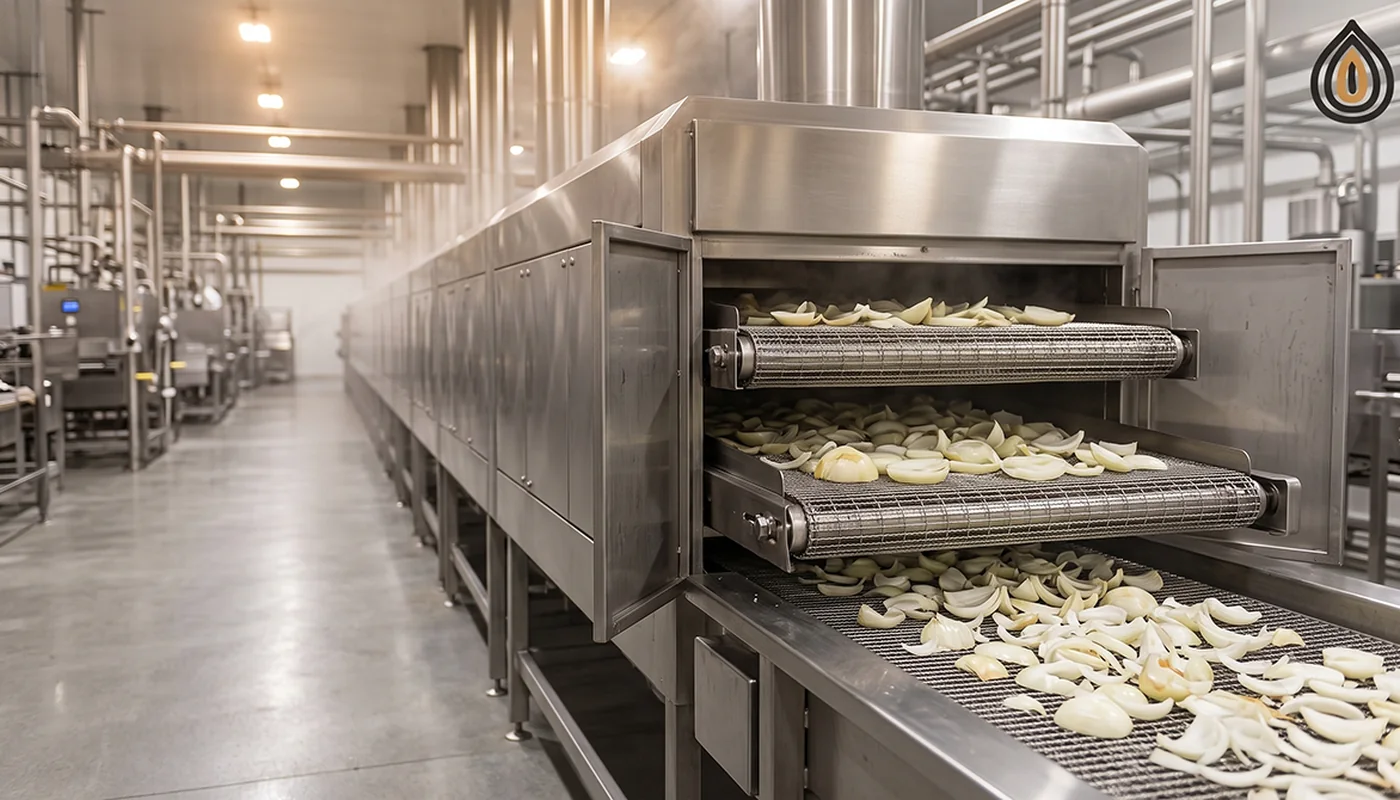
The slices are spread in an even layer, 5 to 10 centimetres deep, onto the first belt of a multi-stage belt dryer: a stainless steel tunnel 30 to 50 metres long in which two to five perforated belts run one above the other, the product dropping from belt to belt, while heated air is blown through it. The air is hottest at the entry, where the slices are wet and evaporation cools them, and cooler at the exit, where over-heating would brown the product. Typical settings for white onion: 75 to 85 °C on the first belt, falling through 65 to 70 °C to 55 to 60 °C on the last, for a total of four to eight hours, until the product leaves at 4.5 to 5.5 percent moisture. Red onion is run cooler and longer to protect its colour. The dryer's operator checks exit moisture hourly with a halogen analyser and adjusts belt speed and air temperature; the plant's laboratory confirms by oven on every lot.
Older technology dries differently. Tray and tunnel dryers, batch processes in which slices on trays are wheeled through a heated tunnel, give less uniform moisture and are still used by smaller units. Sun-drying on yards, the original method, gives a brown product with high counts and is not used for export grades. Heat comes from natural gas burners, biomass briquette furnaces with heat exchangers, or, in old plants, diesel; the choice is the plant's largest operating cost after onion.
| Dryer parameter | Typical value, white onion, certified plant | Effect on the product |
|---|---|---|
| Inlet air temperature | 75-85 °C | Higher: faster, more browning risk at the end |
| Exit air temperature | 55-60 °C | Sets final colour and residual moisture |
| Residence time | 4-8 hours | Longer at lower temperature protects colour and volatiles |
| Bed depth | 5-10 cm on the first belt | Deeper beds dry unevenly |
| Exit moisture | 4.5-5.5 % | Margin for uptake before packing |
| Water removed | About 7 kg per kg of product | - |
| Thermal energy | 6-9 kWh per kg of product | Efficiency of the dryer and heat recovery decide the range |
The energy line explains why drying is nearly as large a cost as the onion: evaporating seven kilograms of water needs about 4.5 kilowatt-hours of heat in theory and 6 to 9 in a real dryer, and at Indian gas or biomass prices that is 20 to 35 rupees per kilogram of product. Efficient plants recover heat from the exhaust and run the dryer continuously in season; the difference between an efficient and an inefficient dryer is several rupees per kilogram and shows in the plant's price.
Step 6: Cooling, sieving, milling and sorting into cuts
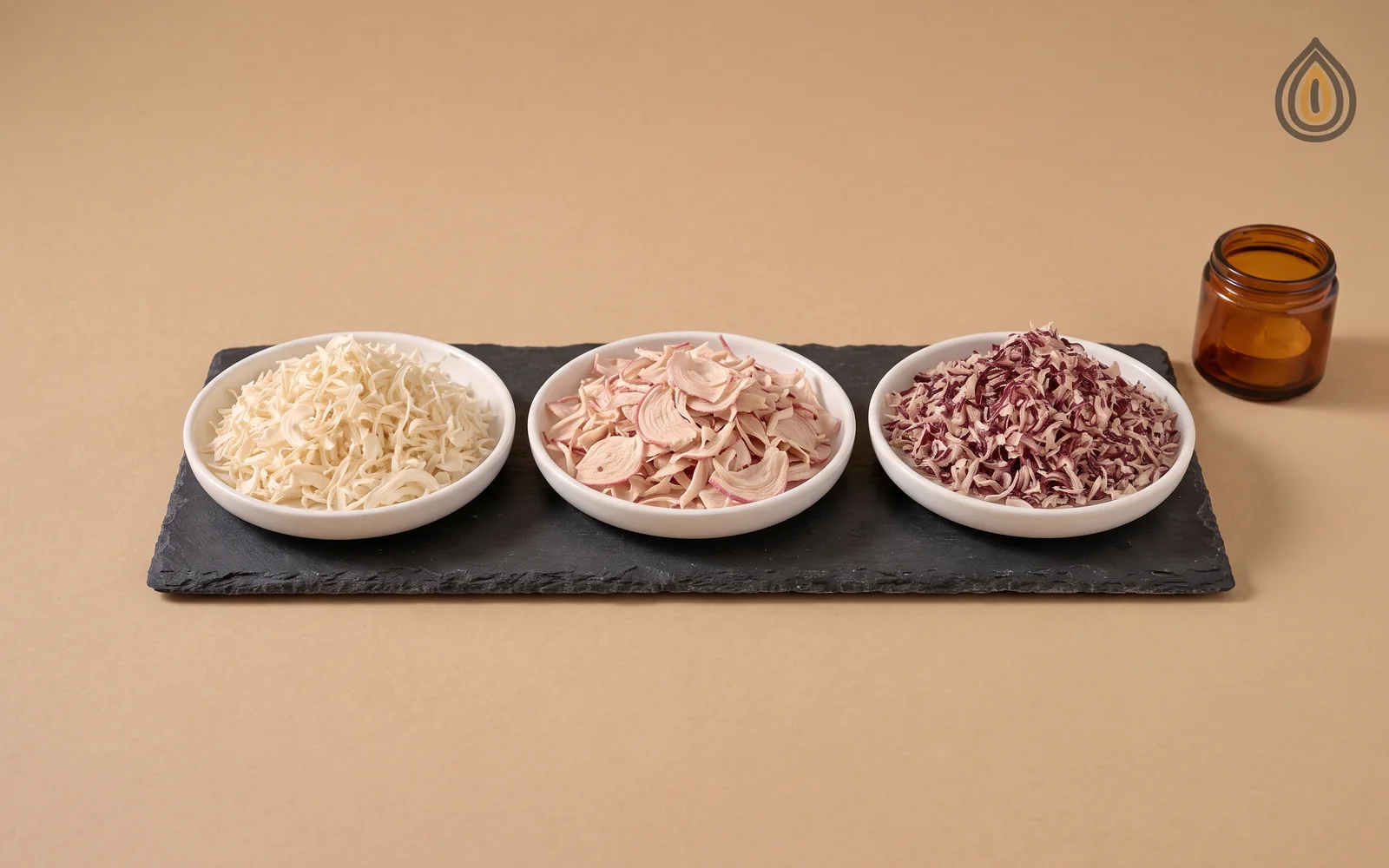
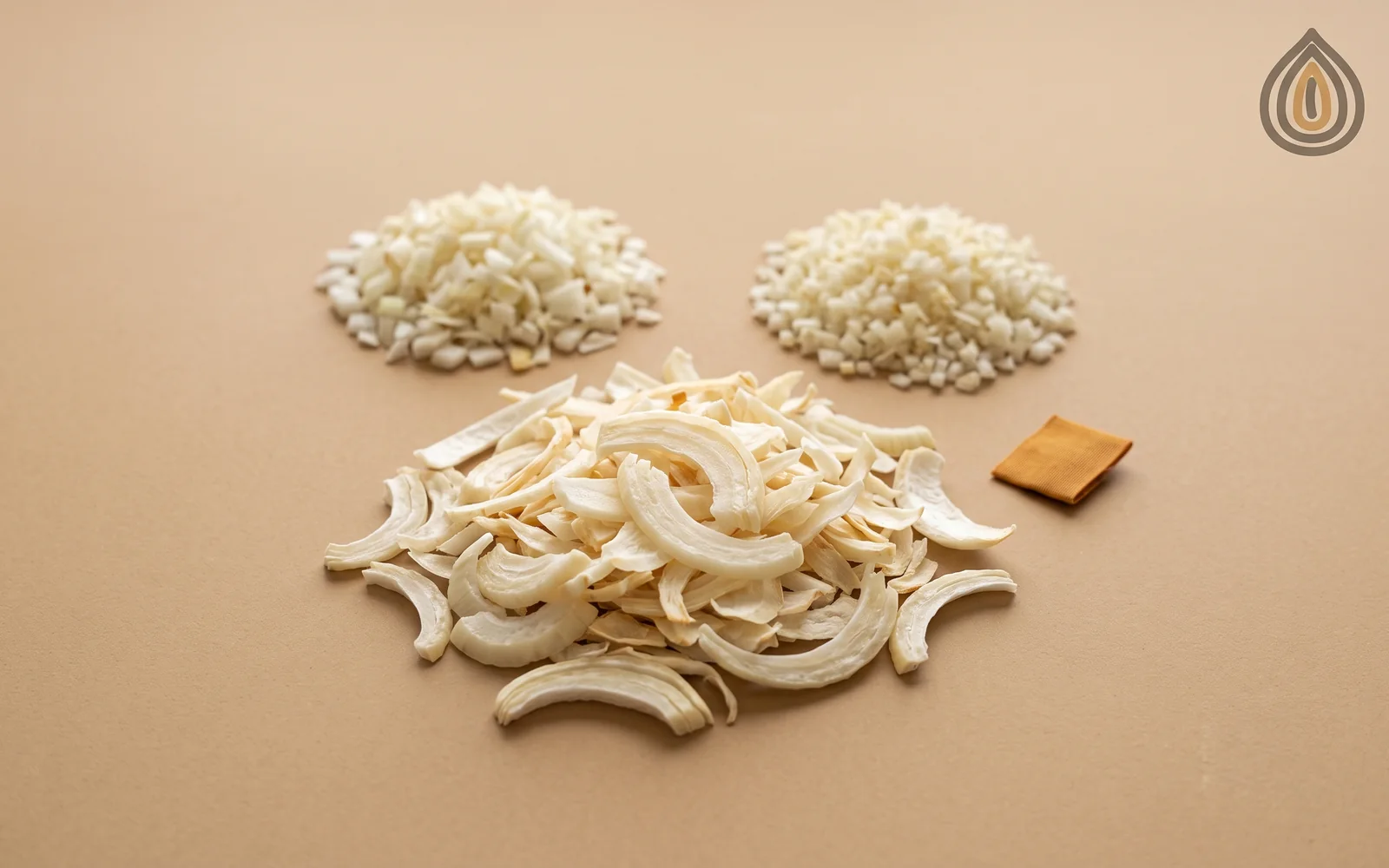
Dried kibble leaves the dryer warm and brittle and is cooled on a belt or in a cooling section, because warm product packed into a liner sweats. It then goes through vibrating sieves that separate it by size: the largest pieces become flakes, the fractions below become chopped and minced, and the fines go to the mills. Granules and powder are made by milling kibble, and part of the flake fraction, in hammer or pin mills and sieving the output to the mesh band ordered; the mills are the step that sets the particle size distribution a buyer sees on the certificate's sieve analysis, and a plant that runs its sieves and mills well produces cuts with 90 to 95 percent inside the band. Between sieving and packing, certified plants run the product past optical sorters, which eject dark or discoloured pieces with air jets, and over hand-picking belts where workers remove what the sorter missed; this is the step that sets the defect count, and it is where the small units without sorters fall short. Magnets along the line pull out ferrous fragments. The cuts and their bands are in Flakes, Chopped, Minced, Granules or Powder.
Step 7: Steam treatment for the low-bacterial grades
Product ordered as low bacterial or extra low bacterial takes one more step. The dried cut passes through a steam tunnel or a batch vessel where saturated steam at 100 to 110 °C contacts it for one to a few minutes, killing vegetative bacteria and a large share of the spores that survived drying, and then it is re-dried to below 6 percent moisture and cooled. In a certified plant the step is a validated critical control point with recorded temperature and time, and the treated product is segregated from untreated stock afterwards. The treatment darkens the product slightly and reduces the sharpest volatile notes a little, which is why it is not applied to everything; it is applied where the buyer's product has no cooking step of its own. The step and the counts it achieves are in Low Bacterial and Extra Low Bacterial Dehydrated Onion.
Step 8: Metal detection, packing, lot coding and release
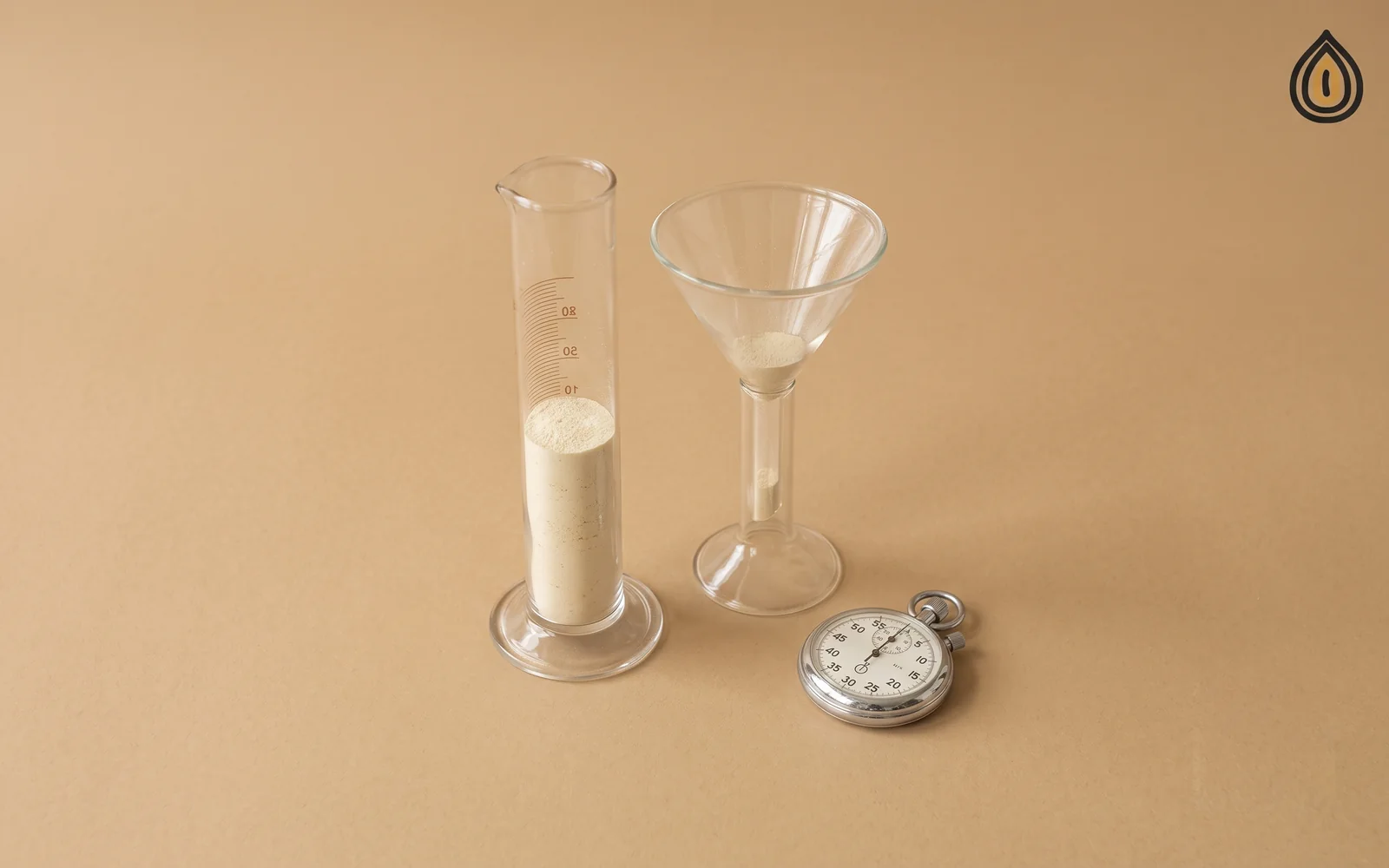
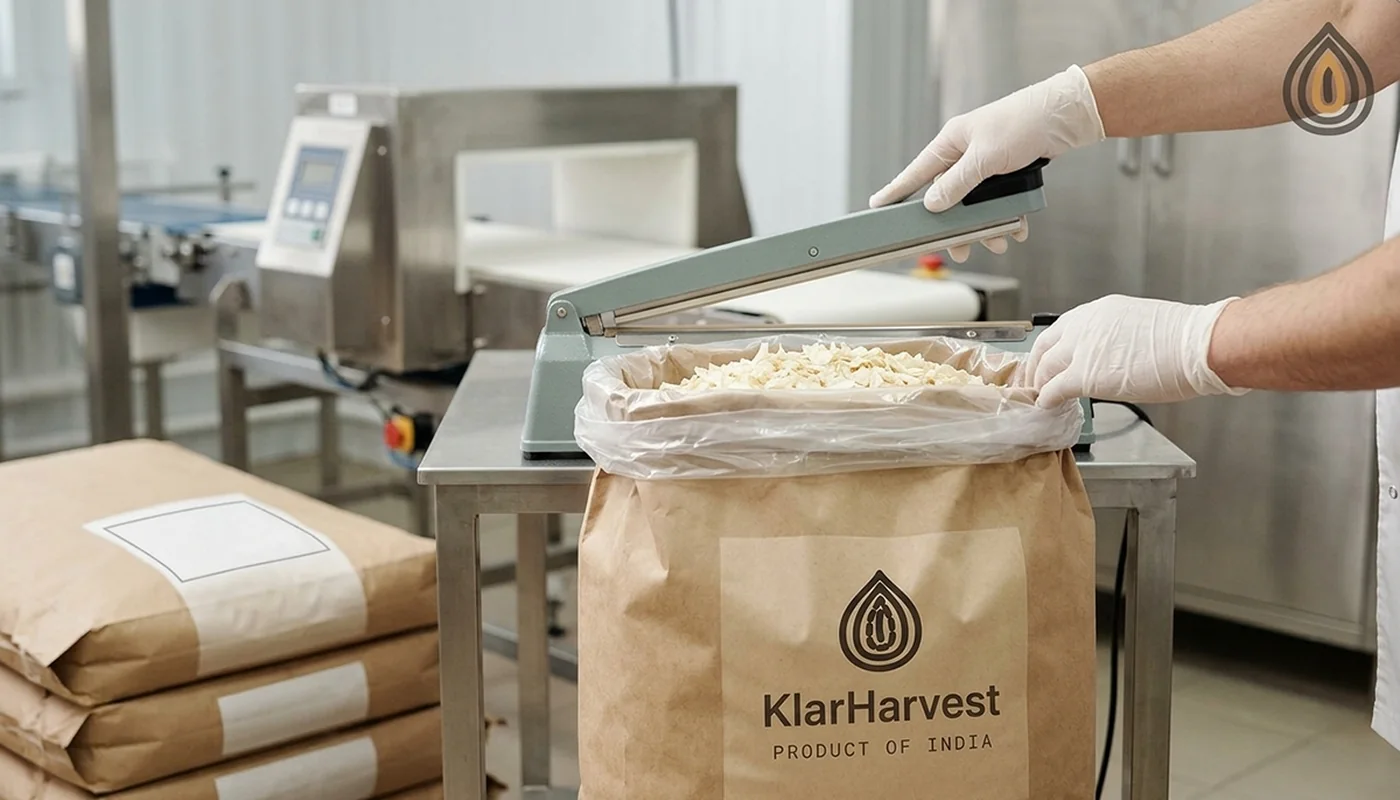
The finished cut passes through a metal detector, set and checked hourly with test pieces at the sensitivities the plant's food safety plan specifies, and any rejected portion is investigated. It is then weighed into polyethylene liners, 20 kilograms net as the export standard, the liners heat-sealed with the air pressed out, and the liners placed in kraft paper or woven bags that are stitched or sealed and printed or labelled with the product, cut, net weight, lot code, production date and best-before date. Certified plants condition the air in the packing room during humid months. The lot code links the bag to the raw-material batches, the drying run and the packing date. Samples from the lot go to the plant's laboratory for moisture and sieve analysis and to an accredited laboratory for the microbiology and, on schedule, residues and metals; the lot is held in the finished-goods store until the results are in and released against the specification. A retained sample is kept for the shelf life. The certificate that results is read line by line in How to Read a Dehydrated Onion Lab Report.
Red and pink onion: where the process differs
Red and pink onion go through the same eight steps with three adjustments. The raw material is bought differently, in competition with the fresh market and often from further away, so the yard holding time is shorter and the reject rate at inspection higher, because red varieties bruise and sprout faster than the dehydration white. The dryer is run cooler and longer, typically 5 to 10 °C lower on each belt and an hour or two more, because the anthocyanin pigment that gives red onion its colour browns faster than the white flesh; a red lot run on white settings comes out brown-edged and dull. And the sulphite dip is never used, because sulphite bleaches the pigment. Red kibble is sieved and milled on the same equipment after a clean-down, and the plants that run both colours schedule red runs at the end of a day or a week to avoid the pink flecks that a red run leaves in the next white lot; a buyer who finds pink pieces in white flakes has found a plant that does not. Pink onion is processed like red, in small runs to order. The colour differences in the product are in White vs Red Dehydrated Onion.
Plant capacity and what a production run means for your order
A single belt dryer line in a mid-size Mahuva plant takes 8 to 15 tonnes of fresh onion a day and produces 1 to 2 tonnes of dry product; a large plant runs three to five lines and produces 5 to 10 tonnes a day in season, 24 hours a day from March to June. A production run, from the buyer's point of view, is the smallest batch a plant will set up for a specific cut, colour or grade: the slicer, the dryer settings, the sieve stack and the mill are configured, the run goes through, and the equipment is cleaned and changed. For the standard white cuts a plant runs continuously and draws orders from the flow; for a custom band, a red colour or a treated tier, it schedules a run of at least a few hundred kilograms to a tonne, and the lead time for that order is the wait for the slot plus a day or two of processing plus the laboratory release. This is why a pallet of standard white flakes ships within a week from stock and a pallet of 40-60 mesh red granules takes two to three weeks in the off-season. Buyers who need a custom product regularly get it faster by agreeing a season volume so that the plant schedules it into the run plan. The order-size and lead-time arithmetic is in Minimum Order Quantity for Dehydrated Onion.
Water and sanitiser: the numbers a food-safety team asks for
The washing step is where a European buyer's food-safety questionnaire goes deepest, and the certified plants have the numbers. Water source: bore well, municipal supply or both, with a potability test at least annually against the Indian drinking-water standard and a microbiological test more often. Sanitiser: chlorine dosed to 50 to 100 parts per million free chlorine in the wash, measured with test strips or a meter each shift and logged, or peracetic acid at its label rate; the residual is checked so that the last rinse carries little chlorine onto the slices. Water use: 3 to 6 litres per kilogram of onion washed, with recycling through settling tanks and sand filters in the larger plants and a fresh-water final rinse. Effluent: treated in the plant's own effluent treatment unit before discharge, with the plant's consent from the state pollution board on file. A plant that cannot give these four sets of numbers is not running a controlled wash, and the acid-insoluble ash and the Enterobacteriaceae count on its certificates will say so. The questionnaire items and the documents behind them are in IFS and BRC Supplier Approval.
The timeline from field to sealed bag
| Stage | Duration | Cumulative |
|---|---|---|
| Field curing after lifting | 2-5 days | - |
| Transport and yard holding at the plant | 0.5-2 days | Day 0 |
| Peeling, washing, inspection, slicing | 1-2 hours per batch | Day 0 |
| Drying | 4-8 hours | Day 0-1 |
| Cooling, sieving, milling, sorting | 2-6 hours | Day 1 |
| Steam treatment and re-drying (treated grades) | 4-8 hours | Day 1-2 |
| Packing and lot coding | Same day | Day 1-2 |
| Laboratory results and release | 3-7 days (Salmonella enrichment sets the pace) | Day 5-9 |
In season, a bulb lifted on a Monday can be a sealed, coded bag by Wednesday and a released lot the following week. Off-season, product comes from stored kibble that is sieved, milled and packed to order, and the "production date" on the bag is the packing date, while the drying date sits in the lot record; a buyer who cares about crop age should ask for both.
By-products, water and waste
Nothing in the process is hazardous and little is wasted. Skins, tops and root plates, 15 to 18 percent of the incoming weight, go to cattle feed or compost; fines below the smallest cut and dark pieces from the sorters, another few percent, are sold as lower-grade powder for domestic seasoning use or as feed. Washing water, several litres per kilogram of onion, is settled, filtered and partly recycled in the larger plants and treated before discharge; the dryer exhaust is warm, moist air, in the best plants passed through heat recovery. The plant's own environmental record, water source, fuel, effluent treatment, is a normal part of a European customer's supplier questionnaire, and the certified plants have it ready. The cluster's resource picture is described in Mahuva, Gujarat: Inside India's Onion Dehydration Hub.
Which defects come from which step
| Defect seen by the buyer | Step it comes from | What went wrong |
|---|---|---|
| Grit, high acid-insoluble ash | Washing (3) | Poor washing, dirty recycled water |
| Dark or black specks | Peeling (2), sorting (6) | Root plate fragments got through; no optical sorter |
| Brown, uniform beige colour | Drying (5) | Exit temperature too high, dryer overloaded, or old stock |
| High moisture on arrival | Packing (8) or transit | Humid packing room, unsealed liner, container sweat |
| Excess fines in flakes | Slicing (4), sieving (6), transit | Thin slices, rough handling, broken in transit |
| High yeast and mould | Receiving (1), packing (8), storage | Wet raw material, humid packing, uptake in storage |
| Sulphite where none was specified | Slicing (4) | Dip line shared, or wrong lot shipped |
| Cooked, flat aroma | Drying (5), steam (7) | Over-drying, treatment too long |
| Metal | Detection (8) | Detector not run or not sensitive enough |
The full list of defects, their causes and the accept-or-reject decision is in Common Quality Defects in Dehydrated Onion.
The questions to ask a plant at each step
- Receiving: Do you record the farmer and field for each raw-material batch, and can a lot code be traced to them?
- Peeling: How is the root plate removed, and what is your reject rate at inspection in season and off-season?
- Washing: Is the water potable, is it sanitised, is it recycled, and how often is it tested?
- Slicing: Do you run a sulphite dip, on which lots, and how is the sulphite-free product segregated?
- Drying: Belt or tray dryer, what are the exit temperature and moisture targets, how often is moisture checked and against what reference?
- Sorting: Do you have an optical sorter and a hand-picking line, and what defect rate do you achieve on the certificate?
- Steam treatment: Is it a validated critical control point with records, and is treated product segregated?
- Packing: Is the packing room conditioned in the monsoon, are liners heat-sealed, what are the metal detector sensitivities, and what is tested before release?
A certified plant answers all eight without looking anything up, because the audit asked the same questions. The wider supplier checklist is in 25-Point Checklist Before You Choose a Dehydrated Onion Supplier.
How KlarHarvest works with the process
KlarHarvest sources from BRCGS-certified belt-dryer plants in Mahuva and specifies the process, not just the product: sulphite-free by default, exit moisture at 5 percent or below, optical sorting and hand-picking on every export lot, heat-sealed liners, and steam treatment as a validated step for the treated tiers. Product is packed and sealed at the plant and is not opened again; our own godown in Bhavnagar labels and stuffs sealed bags. The lot code on each bag traces to the raw-material batch and the drying run, and buyers who want the drying date as well as the packing date get both on request. Every lot ships with a certificate of analysis from an NABL-accredited laboratory. The chain is described on the our process page.
Frequently asked questions
How is dehydrated onion made?
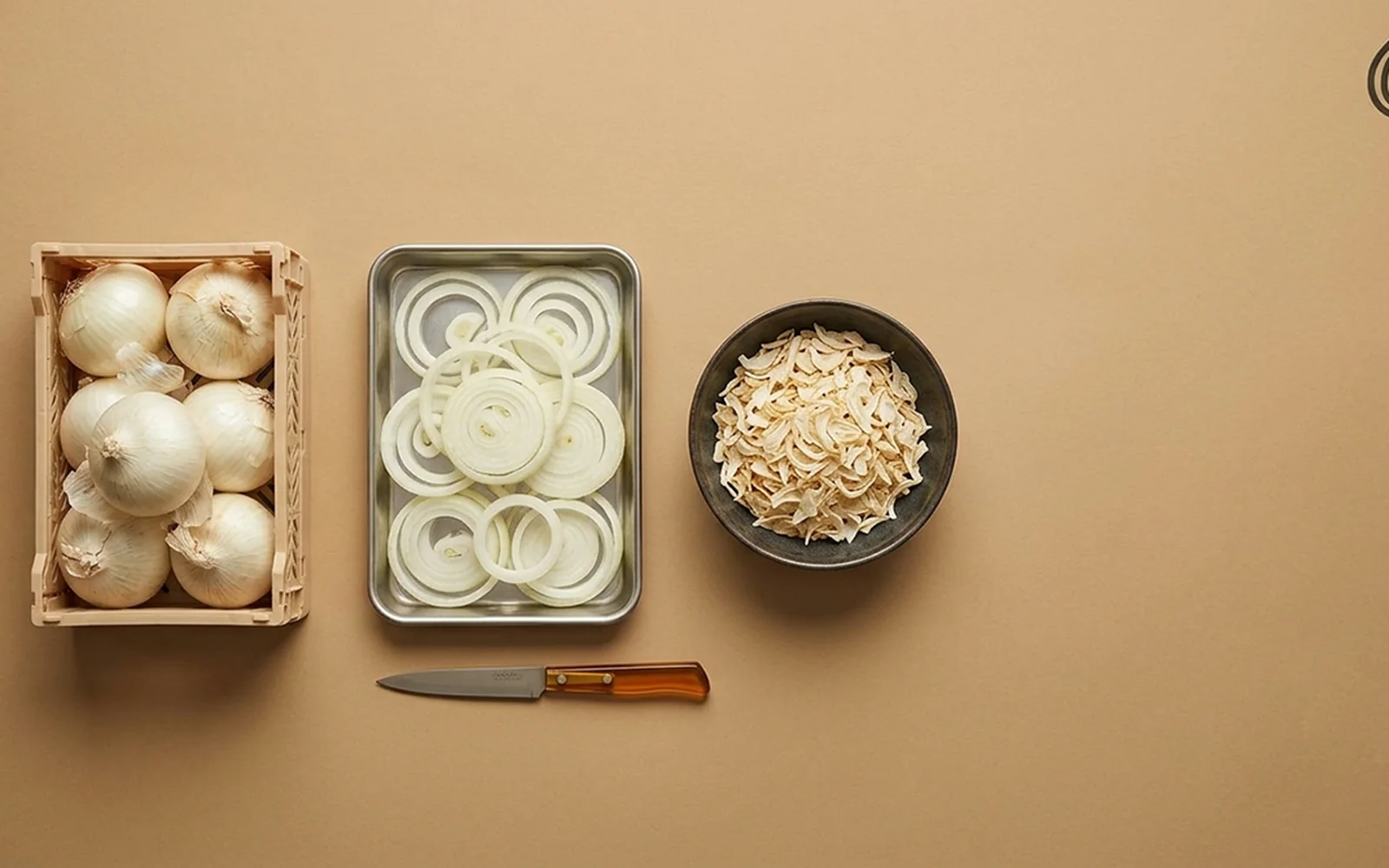
Fresh onion is cured, topped and peeled, washed, sliced into 3 to 5 millimetre rings, dried in a hot-air belt dryer for four to eight hours to below 6 percent moisture, cooled, sieved and milled into flakes, chopped, minced, granules or powder, sorted, metal-detected and packed in sealed liners with a lot code. Low-bacterial grades get a steam treatment before packing.
How many kilograms of fresh onion make one kilogram of dehydrated onion?
About 8.5 to 9.5 kilograms at the plant gate. Peeling and trimming remove 15 to 18 percent, drying removes about 70 kilograms of water from every 100, and sieving takes out a little more.
What temperature is dehydrated onion dried at?
Belt dryers run at 75 to 85 °C on the first belt, falling to 55 to 60 °C at the exit, for four to eight hours. Red onion is dried cooler and longer to protect its colour.
Is anything added during processing?
In the standard product, no. Some plants dip the slices in a sulphite solution before drying to keep the colour white; sulphite-free product skips it. Anti-caking agents are added to powder only on request.
How long does it take from harvest to a finished lot?
In season, two days from the plant gate to a sealed, coded bag, and five to nine days to a released lot once laboratory results are in. Off-season product is packed to order from stored kibble.
What is the difference between a belt dryer and a tray dryer?
A belt dryer is a continuous tunnel with stacked moving belts and staged temperatures, giving uniform moisture and colour; a tray dryer is a batch process with slices on trays in a heated tunnel, less uniform and used by smaller units. Export grades come from belt dryers.
What happens to the onion skins and waste?
Skins, tops and root plates go to cattle feed or compost; fines and dark pieces from sorting become lower-grade powder or feed; washing water is settled, filtered and partly recycled in the larger plants.
Next step
If you would like to see the process before you see the product, tell us your dates through the contact page; we visit the plants weekly and arrange visits in season. Otherwise request a sample of any cut and it arrives with the certificate of analysis and, on request, the drying and packing dates of the lot.