- Where Mahuva is and why geography made it the hub
- How a coastal farming town became the world's dehydration centre
- The cluster today: plants, capacity and certification
- The farm side: the white onion belt and its calendar
- Inside a plant: from truck to sealed bag
- Who is who: plants, exporters, brokers, laboratories, packers
- A year in Mahuva: what happens month by month
- Pipavav and the road to Europe
- Where the product goes
- The risks that shape the cluster's prices
- Labour: who works in the plants
- Water, energy and waste in a dry district
- What a buyer should know about dealing with the cluster
- Where KlarHarvest sits in the cluster
- Frequently asked questions
Judge the product, not the words
200-500 g from a current lot, dispatched by courier with the lot lab report.
Request a sampleMost of the dehydrated onion the world imports comes from one small town on the coast of Gujarat. Mahuva dehydrated onion is not a brand or a grade; it is a place, a cluster of around 120 dehydration plants within a 30 kilometre radius of a town of about 100,000 people in Bhavnagar district, and the white onion belt that feeds them. If you buy onion flakes, granules or powder from India, the odds are high that the bag was filled within sight of the same low hills, whatever the exporter's letterhead says.
This guide is for buyers who want to understand the place they are buying from: how Mahuva became the hub, how the cluster is organised, who the plants, exporters, brokers and laboratories are and how they relate, what the season looks like on the ground, how the product gets from a field to Pipavav and onto a ship, and what all of that means for a buyer sitting in Hamburg or Rotterdam. It is written from Bhavnagar, an hour up the road, by people who drive to the plants.
The figures are as of January 2026 and are approximate where the cluster keeps no single register, which is most of the time.
What this guide covers
- Where Mahuva is and why geography made it the hub
- How a coastal farming town became the world's dehydration centre
- The cluster today: plants, capacity and certification
- The farm side: the white onion belt and its calendar
- Inside a plant: from truck to sealed bag
- Who is who: plants, exporters, brokers, laboratories, packers
- A year in Mahuva: what happens month by month
- Pipavav and the road to Europe
- Where the product goes
- The risks that shape the cluster's prices
- Labour: who works in the plants
- Water, energy and waste in a dry district
- What a buyer should know about dealing with the cluster
- Where KlarHarvest sits in the cluster
- Frequently asked questions
Where Mahuva is and why geography made it the hub
Mahuva sits on the southern coast of the Saurashtra peninsula in Gujarat, western India, about 100 kilometres south-west of the district town of Bhavnagar and 60 to 70 kilometres by road from the port of Pipavav. The land around it is flat, the soil is a light loam over limestone that drains well, and the climate is dry for eight months of the year with a monsoon from June to September. Winters are mild, with clear skies and low humidity from November to March, which is exactly the weather an onion needs to bulb and cure and a dryer needs to run efficiently.
Three things about the geography matter to a buyer. The onion is grown next to the plants: most raw material travels less than 50 kilometres from field to slicer, which keeps it fresh and cheap. The port is close: a container stuffed in Mahuva in the morning is at Pipavav's gate by afternoon, and Pipavav has direct services to north Europe. And the dry season coincides with the harvest, so the plants run at full capacity in exactly the months when the air is driest and the onions are best, from March to June.
How a coastal farming town became the world's dehydration centre
Farmers around Mahuva grew white onion for the fresh market long before anyone dried it; the variety suited the soil and stored well. Dehydration arrived in the 1970s and 1980s with a handful of small units using sun drying and then simple hot-air cabinets, selling powder into the domestic spice trade. The step change came in the 1990s, when export demand from the Middle East, and then from Europe, met a generation of local entrepreneurs who built belt dryers and learned the export trade. Each successful plant trained managers who left to start their own; each exporter who found a European customer brought back a specification that the next plant learned to meet. By the 2010s the town had over 100 plants, and India had become the largest exporter of dehydrated onion in the world, with Mahuva supplying most of it.
The cluster grew the way clusters do: on shared knowledge, shared suppliers and shared labour. A plant in Mahuva can hire a dryer operator who has run three other dryers, buy liners and kraft bags from a local supplier who stocks the export sizes, call a broker who knows which farmer's field is ready, and send a sample to a laboratory in Bhavnagar that tests onion every day. A plant built anywhere else in India has to create all of that, which is why attempts to replicate the cluster in Maharashtra and Madhya Pradesh have produced individual plants rather than a second Mahuva.
The cluster today: plants, capacity and certification
Nobody keeps a single register, but the plant count that the trade uses is around 120 in the Mahuva area, with a few dozen more scattered across Bhavnagar and Amreli districts. They range from family units with one dryer and a seasonal workforce of twenty, producing a few hundred tonnes a year for the domestic market and for traders, to industrial plants with several continuous belt dryers, their own laboratories and cold storage for raw onion, producing 5,000 to 15,000 tonnes a year for export under their own or their customers' brands. Total capacity in the cluster is well above what the export market takes; in a good crop year the constraint is demand, in a poor crop year it is raw material.
| Plant type | Approximate number | Annual output (dry product) | Certification | Typical customer |
|---|---|---|---|---|
| Small family units | 50-60 | 200-1,000 t | FSSAI licence; some ISO 22000 | Domestic spice trade, traders, small exporters |
| Mid-size export plants | 40-50 | 1,000-5,000 t | FSSAI, ISO 22000 or FSSC 22000, some BRCGS | Exporters, direct export to Middle East and Asia |
| Large certified exporters | 15-20 | 5,000-15,000 t | BRCGS (usually grade A or AA), FSSC 22000, organic, halal, kosher | European importers, multinational food manufacturers |
The certification line is the one a European buyer cares about. BRCGS certification, the standard most European retailers and manufacturers require of their suppliers' plants, is held by perhaps 15 to 25 plants in the cluster, and those plants produce a large share of what goes to Europe. The rest of the cluster supplies markets with lower documentation demands, and supplies the certified plants themselves in years when they need more kibble than they can dry. What certification means in practice, and how to verify it, is in What BRC Certification Means for a Dehydrated Onion Supplier.
The farm side: the white onion belt and its calendar
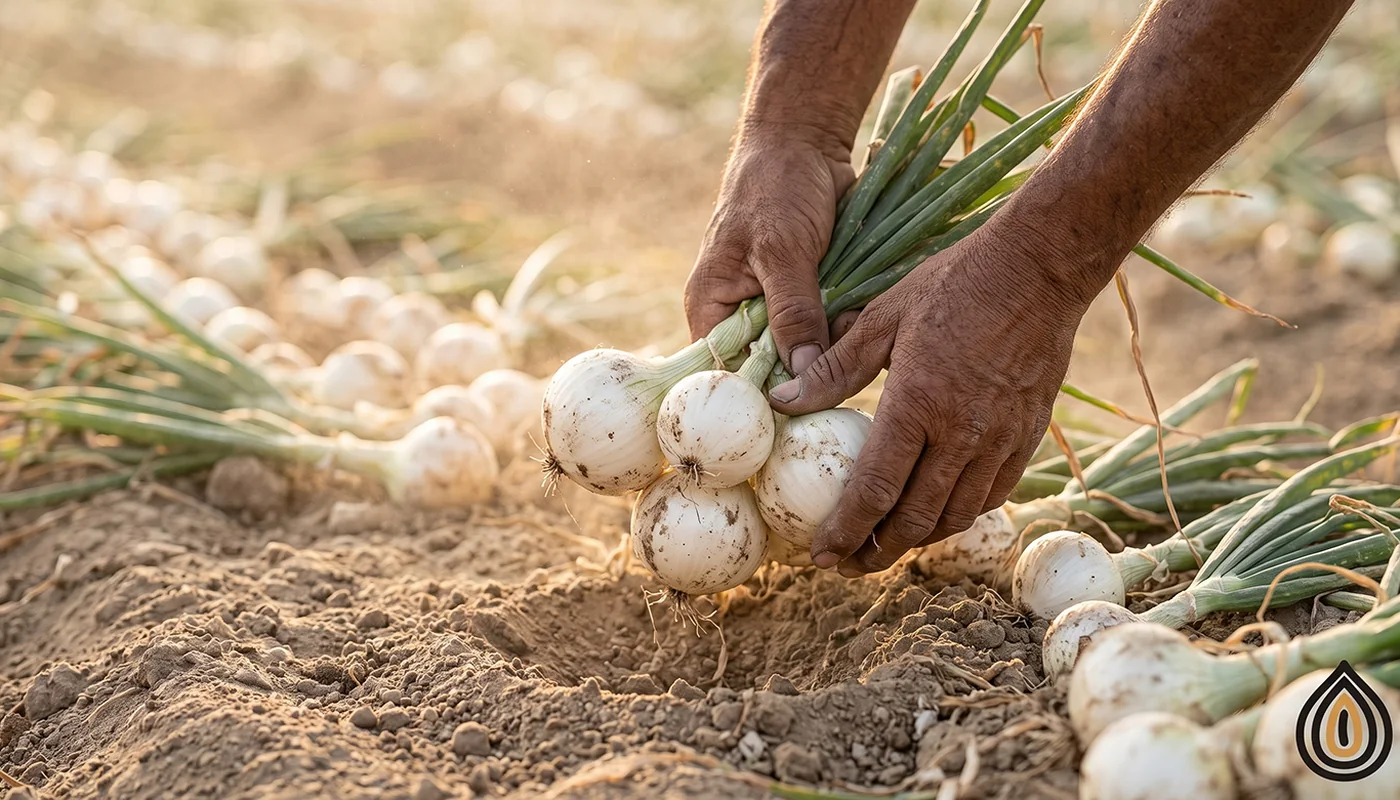
The white onion that feeds the cluster is grown on tens of thousands of hectares in the coastal talukas of Bhavnagar and Amreli districts, mostly on farms of one to five hectares, often by families who have grown it for two or three generations. It is a rabi crop: seedlings are transplanted from nurseries in October and November after the monsoon, the bulbs form through the cool dry winter, and harvest runs from late February to May, with the peak in March and April. The farmers grow it for the plants and know it; the variety has been selected over decades for dry matter, for a flat bulb that slices well, and for a low sugar content that does not brown in the dryer, and it yields 25 to 35 tonnes per hectare in a good year.
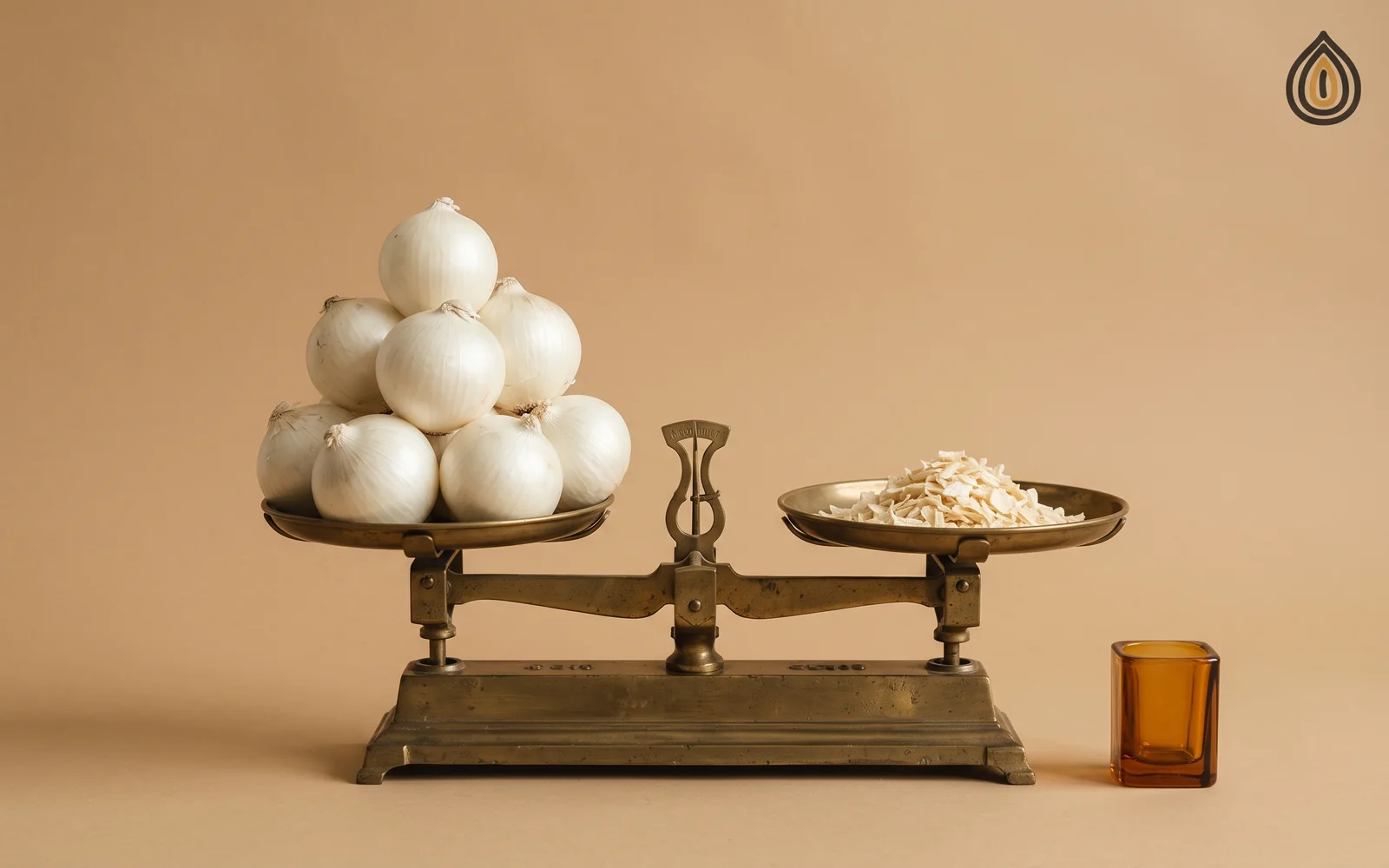
Raw material reaches the plants by three routes. Contract farming, where a plant advances seed and inputs and buys the crop at an agreed price; open-market purchase through brokers who buy from farmers at the field and deliver by tractor trailer, priced by the day; and the plants' own farms, a small share. In a normal year the plant-gate price during the season is 4 to 7 rupees per kilogram; in a short year it can double, and because 8 to 9 kilograms go into every kilogram of dry product, that doubling reaches the buyer as a 40 to 60 percent rise in the dry price. The calendar and its effect on buyers are in The Indian Onion Harvest Calendar.
Red onion is different. It is grown for the fresh market across Gujarat, Maharashtra and Madhya Pradesh, and the plants buy it in competition with fresh-onion traders, which is why red onion products cost more and why their availability follows the fresh market's mood.
Inside a plant: from truck to sealed bag
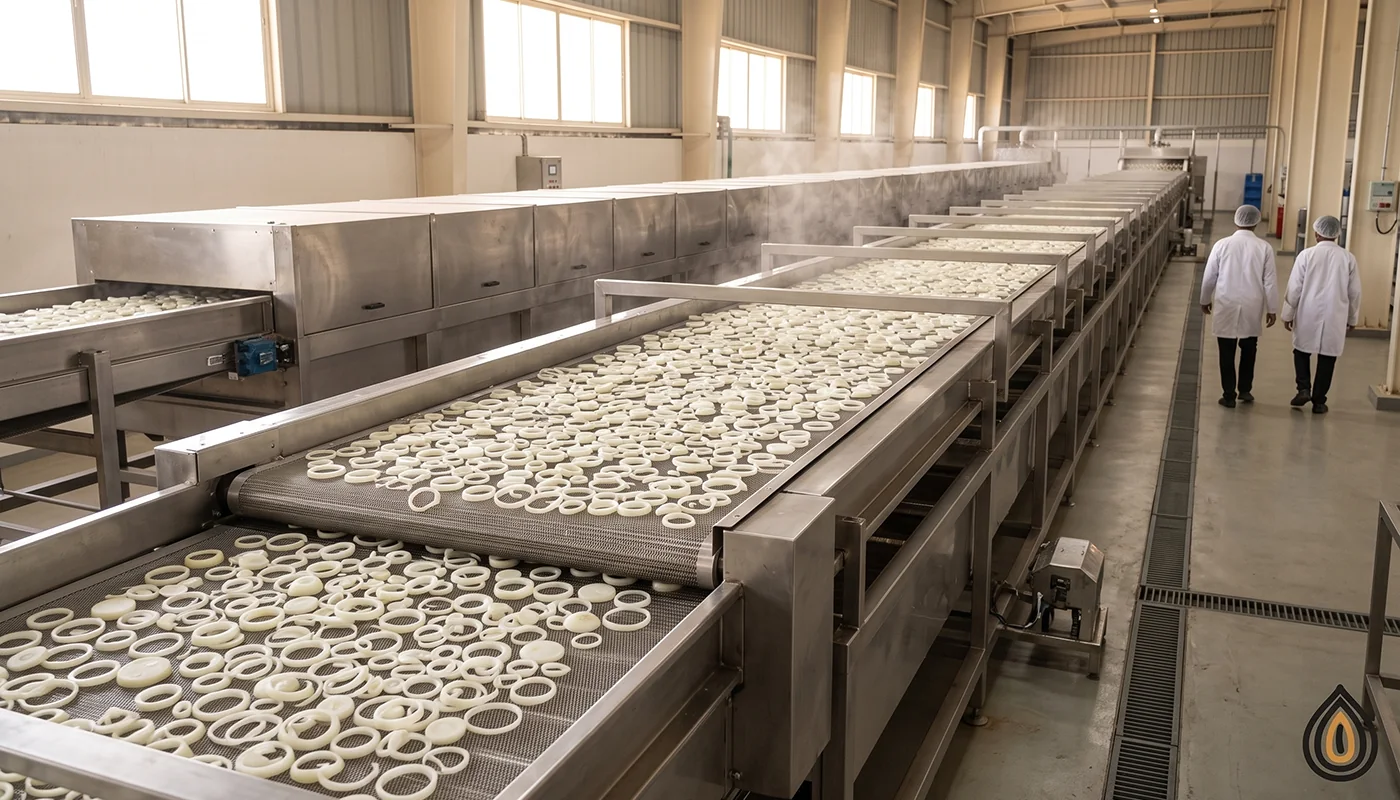
A certified plant in Mahuva runs a line that would be recognisable to any European vegetable processor. Trailers of onion are weighed and tipped into a receiving hopper; the bulbs are topped and tailed, peeled by abrasion or by hand, washed in chlorinated water, inspected on a belt and sliced into 3 to 5 millimetre rings. The slices are spread on a stainless steel belt dryer, a tunnel 30 to 50 metres long with several belts stacked one above the other, and dried with hot air at temperatures that start around 70 °C and fall along the tunnel, for four to eight hours, until the moisture is below 6 percent. The dried kibble is cooled, sieved into flakes and the smaller fractions, and milled where granules and powder are wanted. Optical sorters and hand-picking remove dark pieces; magnets and metal detectors take out metal; the product is filled into liner bags, weighed, sealed and coded with the lot number. Treated grades go through a steam chamber before final drying. The line's own laboratory tests moisture and sieve analysis on every lot and sends samples to an accredited laboratory for the rest.
The energy source is the plant's biggest operating decision after raw material. Natural gas from the Gujarat pipeline grid, biomass briquettes made from agricultural waste, and in older plants diesel, each with a different cost per kilogram of water evaporated; the certified plants have mostly moved to gas or efficient biomass and heat recovery. Water is the other constraint in a dry district, and the larger plants recycle their washing water. The eight steps in more detail, with what to ask at each one, are in How Dehydrated Onion Is Made.
Who is who: plants, exporters, brokers, laboratories, packers
The cluster is a market with several kinds of participants, and knowing which kind you are talking to decides what you can expect.
- Plants own dryers and sell what they make, to exporters, to traders and, the large ones, directly to foreign buyers. A plant's strength is consistency within its own production; its limit is that it sells its own output and its own cuts, and in a short year prioritises its regular customers.
- Merchant exporters do not dry onion; they buy from plants, often from several, and sell abroad under their own name, adding sourcing, quality control, documents and, in the better cases, their own handling. Their strength is flexibility across plants, cuts and colours and a willingness to serve smaller buyers; their weakness, in the worse cases, is that "which plant" has no fixed answer.
- Traders and brokers connect plants with domestic buyers and with exporters, and connect farmers with plants. They are the cluster's nervous system and rarely deal with foreign buyers directly, though foreign buyers sometimes discover that the "manufacturer" they found online is one.
- Laboratories accredited by NABL under ISO/IEC 17025 sit in Bhavnagar, Rajkot and Ahmedabad and test the cluster's product for pathogens, residues, metals and ethylene oxide. Their reports are the documents a European buyer should ask for.
- Packaging suppliers, transporters, customs house agents and forwarders in Mahuva, Bhavnagar and Pipavav complete the chain; the transport from plant to port is a two-hour truck run that the whole cluster prices the same way.
The practical question for a buyer is which of these is on the other end of the email, and the way to find out is to ask which plant will process the order and to ask for that plant's certificate. The differences between the three kinds of seller, and which suits which buyer, are in Exporter, Trader or Manufacturer: Who Should You Buy Dehydrated Onion From?
A year in Mahuva: what happens month by month
| Months | On the farms | In the plants | In the market |
|---|---|---|---|
| October-November | Nursery sowing, transplanting after the monsoon | Off-season; maintenance; stock sales | Prices firming; next-crop acreage estimated |
| December-February | Bulbs form in the cool dry winter | Last old-crop stock; some early red onion | Prices at or near the year's high in February |
| March-April | Main harvest; fields cleared in weeks | Full capacity, 24 hours a day; most of the year's output made | New-crop prices set; season contracts signed |
| May-June | Late harvest; farmers' stored onion sold | Capacity still high; stock building; red onion runs | Prices firm on raw-material cost, then ease |
| July-September | Monsoon; fields under other crops or fallow | Reduced runs; humidity control; stock shipped | Softest prices of the year |
The season explains why the cluster's best product and best prices do not coincide. Product made in March and April, from fresh onion in dry air, is the year's best; the price of that product is set while the plants are paying for raw material and is firm. Product bought in September is the same lot, six months older, at a softer price. Buyers who visit in March and April see the cluster at its most impressive and its most expensive, and the ground reports on this blog follow the same calendar, starting with March 2026.
Pipavav and the road to Europe
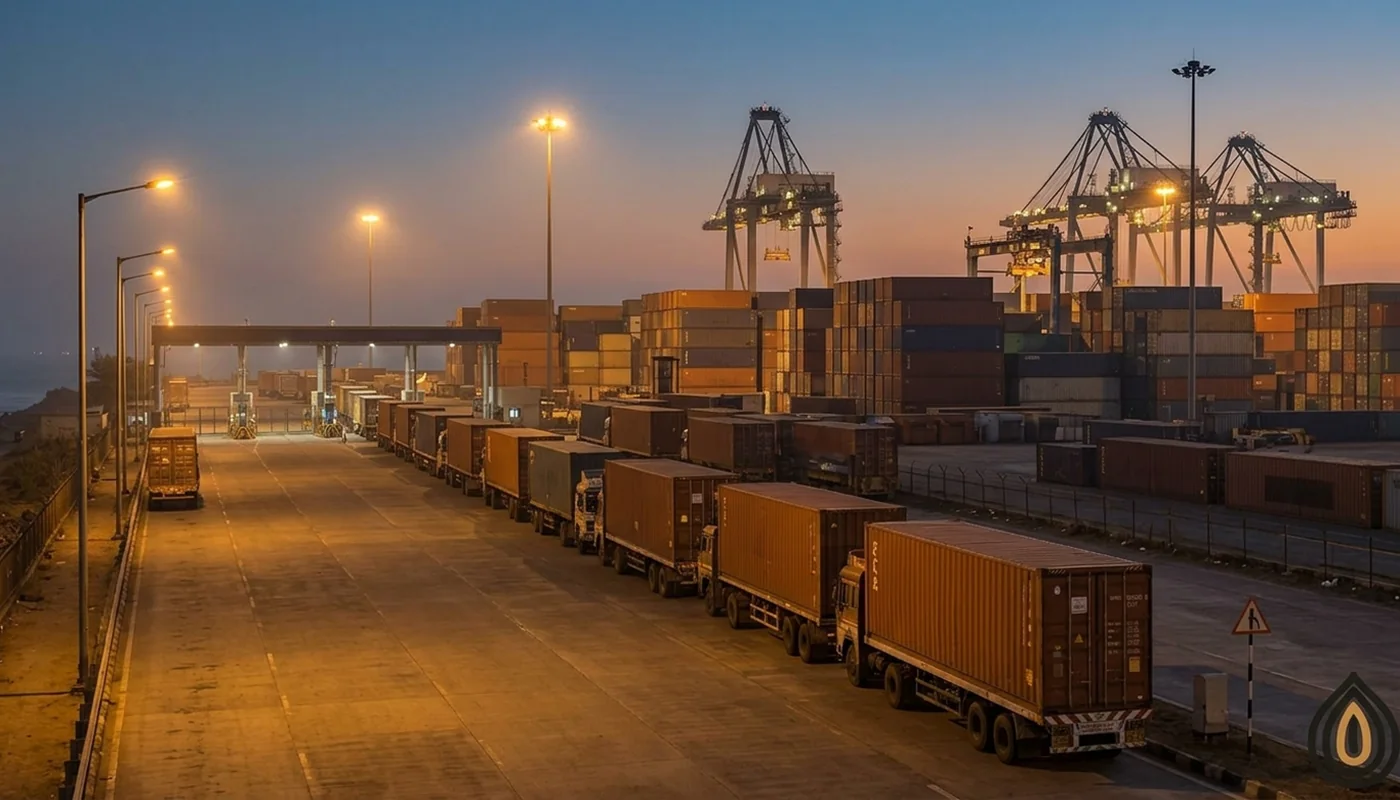
The port of Pipavav, operated by APM Terminals, is the cluster's main gateway and in recent years has handled close to half of India's dried onion exports by weight, with Mundra and Nhava Sheva taking most of the rest. The road from Mahuva is a two-hour truck journey. Containers are stuffed at the plant or the exporter's godown under the customs self-sealing system, sealed with an electronic seal, and driven to the port gate the same day; LCL cargo is delivered to consolidators' warehouses in Pipavav or Mundra. Transit to Hamburg, Rotterdam or Antwerp is 25 to 30 days on the direct services and 30 to 35 with a transshipment, and there are weekly sailings. The route, the transit times and the costs are in Pipavav to Hamburg.
For a buyer the logistics are the least variable part of the trade: every serious exporter in the cluster uses the same three ports, the same forwarders and the same document set, and the differences between them are in what happens before the container is sealed, not after.
Where the product goes
India exports roughly 130,000 tonnes of dried onion a year, and Mahuva supplies most of it. Germany is the largest single destination at around 13,000 tonnes, followed by the Netherlands and Belgium, whose traders re-export within Europe, the United Kingdom, the United States, and a long list of Middle Eastern, African and Asian markets that take standard grades in bulk. Europe buys the certified plants' product, in the finer specifications and the treated grades; the Middle East and Asia buy the bulk of the standard flakes and powder. The average export value across all grades and markets in recent years has been in the region of 160 to 170 rupees per kilogram FOB, with European destinations above the average and bulk markets below it.
Within Europe, the Netherlands is the entry point for a large share of what Germany consumes: Dutch traders import at Indian prices, hold stock in Rotterdam and sell to German manufacturers at two to three times the FOB price, a premium for convenience and trust that is the gap a direct relationship closes. The trade flows and who buys what are the subject of Importing Dehydrated Onion into Germany and Buying via Dutch Traders or Direct from India.
The risks that shape the cluster's prices
Four risks explain the price history of Mahuva onion, and a buyer who understands them buys at better times.
- The crop. Unseasonal rain in February or March damages bulbs in the field and cuts yields; a poor previous monsoon reduces the water available for the winter crop. The 2023 and 2024 seasons showed both. A short crop raises the plant-gate price within weeks and the dry price by 30 to 60 percent.
- Onion politics. Fresh onion is a staple whose price moves Indian elections, and the government intervenes in the fresh market with export bans, minimum export prices and stock limits. Those measures do not apply to dehydrated onion but move the raw-material price the plants pay: an export ban traps fresh onion in India and lowers it, a free export market raises it.
- Energy. Drying is the second-largest cost line, and gas and biomass prices feed through within a season.
- Labour. The plants run on seasonal labour, much of it migrant, and a season when other work competes for the same hands raises processing costs and slows the run.
The compounding effect is the 8 to 9 yield ratio, described in Dehydrated Onion Price per kg: small moves in the field are large moves in the bag, and the cluster's quotes are valid for a week because of it.
Labour: who works in the plants
A dehydration plant is a seasonal employer. A mid-size unit that runs with 40 people in the off-season runs with 150 to 250 from March to June: peelers, sorters, dryer operators, packers, loaders, most of them on the plants' rolls for the season and many of them migrant workers from other districts of Gujarat and from neighbouring states, housed near the plant. The certified plants run the social-compliance side that European customers audit, written contracts, wage records, safety training, welfare facilities, and several hold SMETA or similar social audits alongside their food-safety certificates; the small units run on the informal arrangements that Indian agriculture has always run on. For a buyer whose own customers ask about labour conditions, the plant's audit report is the document to ask for, and its existence is one more line that separates the certified plants from the rest. The peak-season workforce is also why lead times stretch in the off-season: a plant that has released its seasonal staff runs a small line for stock cuts and needs notice for anything else.
Water, energy and waste in a dry district
Dehydration uses water to wash onions and energy to remove water from them, in a district where both are scarce. A plant washes each kilogram of onion in several litres of water; the large units recycle washing water through settling and filtration and draw the rest from bore wells and the municipal supply, and water availability in a dry year is a real constraint on how many hours a plant can run. Energy is the larger issue: evaporating the seven kilograms of water in eight kilograms of fresh onion takes several kilowatt-hours of heat per kilogram of dry product, and the cluster's fuel has moved from diesel to natural gas and to biomass briquettes pressed from crop residues, which are cheaper, locally available and count as renewable in the sustainability questionnaires European customers send. Waste is small and useful: peel and trimmings go to cattle feed and composting, and the effluent from washing is treated in the certified plants' own treatment units. A buyer filling in a supplier sustainability questionnaire can ask a plant for its energy source, its water source and recycling, and its effluent treatment, and the certified plants have the answers in the format the questionnaires expect. Dehydrated onion's own environmental case is simple: it needs no cold chain from field to factory, and one container of flakes replaces eight to nine containers of fresh onion on the water. That argument is made in Why Dehydrated Onion Needs No Cold Chain.
What a buyer should know about dealing with the cluster
Five practical points from the ground. First, the cluster is not one quality: the spread between a BRCGS-certified plant with optical sorting and a small unit with a hand-picking table is wider than the spread between India and any other origin, so the plant matters more than the country. Second, the same plant's product is sold under many names; two quotes from two exporters may be for the same kibble, and the difference is in the handling, documents and honesty of the exporter. Third, the cluster talks in rupees per kilogram FOB and in crop months; a buyer who follows the raw onion price and the harvest calendar negotiates on the cluster's own terms. Fourth, visiting is easy and worth it: Bhavnagar has a regional airport with flights from Mumbai, Rajkot's airport is three hours by road, the plants receive visitors in season, and a day in March or April at three plants teaches more than a year of emails. Fifth, the trade runs on relationships and on the season: an order placed in April with a supplier who knows you will be filled from the best of the crop, and one placed in December by a stranger will be filled from what is left.
The supplier questions that sort the cluster are in 25-Point Checklist Before You Choose a Dehydrated Onion Supplier, and how to audit a plant without flying is in How to Audit a Dehydrated Onion Supplier Remotely.
Where KlarHarvest sits in the cluster
KlarHarvest is a merchant exporter based in Bhavnagar, the district town, with its own godown in the GIDC industrial estate. Product is dried and sealed in bags at BRCGS-certified plants in Mahuva, collected in sealed form, labelled with the lot code and stuffed into containers at our premises under customs self-sealing, and shipped from Pipavav. That structure is deliberate: the plant never opens a bag outside its certified line, the buyer's identity and specification stay with us, and several plants' product can go into one container for a buyer who wants mixed cuts or colours. Every lot ships with a certificate of analysis from an NABL-accredited laboratory and a loading video, and small orders are welcome. The process is on our process page and the company on the about page.
Frequently asked questions
Where is Mahuva and why is it known for dehydrated onion?
Mahuva is a coastal town in Bhavnagar district, Gujarat, western India, about 65 kilometres from the port of Pipavav. It sits in a white onion growing belt with a dry harvest season, and around 120 dehydration plants have grown up there since the 1980s, making it the source of most of the dehydrated onion India exports.
How many dehydration plants are there in Mahuva?
Around 120 in the Mahuva area, from small family units to large certified exporters, with a few dozen more across Bhavnagar and Amreli districts. Perhaps 15 to 25 hold BRCGS certification and supply most of what goes to Europe.
When is the dehydration season in Mahuva?
The white onion harvest runs from late February to May and the plants run at full capacity from March to June. Most of the year's output is made in those months and sold from stock through the rest of the year.
Is all Indian dehydrated onion from Mahuva?
Most of it. Plants exist in other parts of Gujarat and in Maharashtra and Madhya Pradesh, but the Mahuva cluster produces the large majority of exports and sets the prices the trade quotes.
Which port does Mahuva ship from?
Pipavav, 60 to 70 kilometres away, handles close to half of India's dried onion exports; Mundra and Nhava Sheva take most of the rest. Transit to north Europe is 25 to 30 days on direct services.
Can I visit the plants?
Yes. Bhavnagar has an airport with flights from Mumbai, and certified plants receive buyers in season. March and April, during the harvest, show the cluster at work; the off-season shows the stock and the storage.
What is the difference between a Mahuva plant and a Mahuva exporter?
A plant dries onion and sells its own output; an exporter buys from one or more plants and sells abroad, adding sourcing, quality control, handling and documents. Ask any supplier which plant processes your product and for that plant's certificate.
Next step
If you would like to see the product before the place, request a sample of any cut and it comes from a current Mahuva lot with its lab report. If you plan to visit, tell us the dates through the contact page; we drive to the plants every week and can arrange a day at two or three of them in season.