- The monsoon in Saurashtra: what actually happens
- Why dried onion and 85 percent humidity do not mix
- At the plant: drying, packing and storing in the wet
- The stored raw onion: losses and the off-season price
- Dry stock in the godown: the dehumidifier rule
- Powder, granules, flakes: which cakes first
- Microbiology in the monsoon
- Containers and the shipping lane in the rains
- Prices and availability from July to October
- The kharif crop and the monsoon's second effect
- Buying timing: before, during and after
- Specifying for monsoon shipments
- Receiving a monsoon shipment in Europe
- A bad monsoon year and a good one
- How KlarHarvest manages the monsoon
- Frequently asked questions
Judge the product, not the words
200-500 g from a current lot, dispatched by courier with the lot lab report.
Request a sampleThe monsoon dehydrated onion question comes up every year from July, when a buyer's August delivery arrives caked, a count comes back high, or a quote for product dried from stored onion comes in above the price of the spring stock, and the answer to all three is the same three months of weather. From the third week of June to the end of September the southwest monsoon sits over Saurashtra, relative humidity runs at 80 to 90 percent day and night, and a product dried to 5 percent moisture is trying to reach 12: every opened bag, every tied liner, every unsealed store and every damp container is a route to caking, mould and counts. The monsoon also decides the off-season price, because it is the season in which the stored rabi onion that feeds the plants until the next harvest either keeps or rots. This guide sets out what the monsoon does to each link of the chain, how the good plants and exporters manage it, what it does to prices and availability from July to October, and how a buyer should time, specify and receive purchases around it.
It is written for buyers planning the second half of the year, with the 2026 season's figures and the general pattern; the monthly ground reports carry the specifics of each year.
What this guide covers
- The monsoon in Saurashtra: what actually happens
- Why dried onion and 85 percent humidity do not mix
- At the plant: drying, packing and storing in the wet
- The stored raw onion: losses and the off-season price
- Dry stock in the godown: the dehumidifier rule
- Powder, granules, flakes: which cakes first
- Microbiology in the monsoon
- Containers and the shipping lane in the rains
- Prices and availability from July to October
- The kharif crop and the monsoon's second effect
- Buying timing: before, during and after
- Specifying for monsoon shipments
- Receiving a monsoon shipment in Europe
- A bad monsoon year and a good one
- How KlarHarvest manages the monsoon
- Frequently asked questions
The monsoon in Saurashtra: what actually happens
The southwest monsoon reaches the Gujarat coast around the third week of June and withdraws in the last week of September in a normal year, and for those three months the Mahuva and Bhavnagar belt has a climate unlike the other nine: daytime temperatures fall from the 40s of May to 28 to 32 degrees, relative humidity rises from 30 to 40 percent to 80 to 90 and stays there through the night, and rain comes in spells of a few days at a time between hot, steamy breaks; the region's annual rainfall of 500 to 700 millimetres falls almost entirely in this window, with July and August the wettest months. Some years bring a weak monsoon with long dry breaks and drought worries; some bring a heavy one with flooding in the low-lying fields and the coastal road cut for a day or two; most bring something in between. The monsoon is also the kharif planting season, when the farmers who grew the rabi onion in winter plant cotton, groundnut and, in Maharashtra and Karnataka, the kharif onion that will feed the fresh market from October. Humidity is the number that matters for dried onion, and it is the number a plant's hygrometer shows from the day the rains arrive; the seasonal calendar this sits in is in The Indian Onion Harvest Calendar.
Why dried onion and 85 percent humidity do not mix
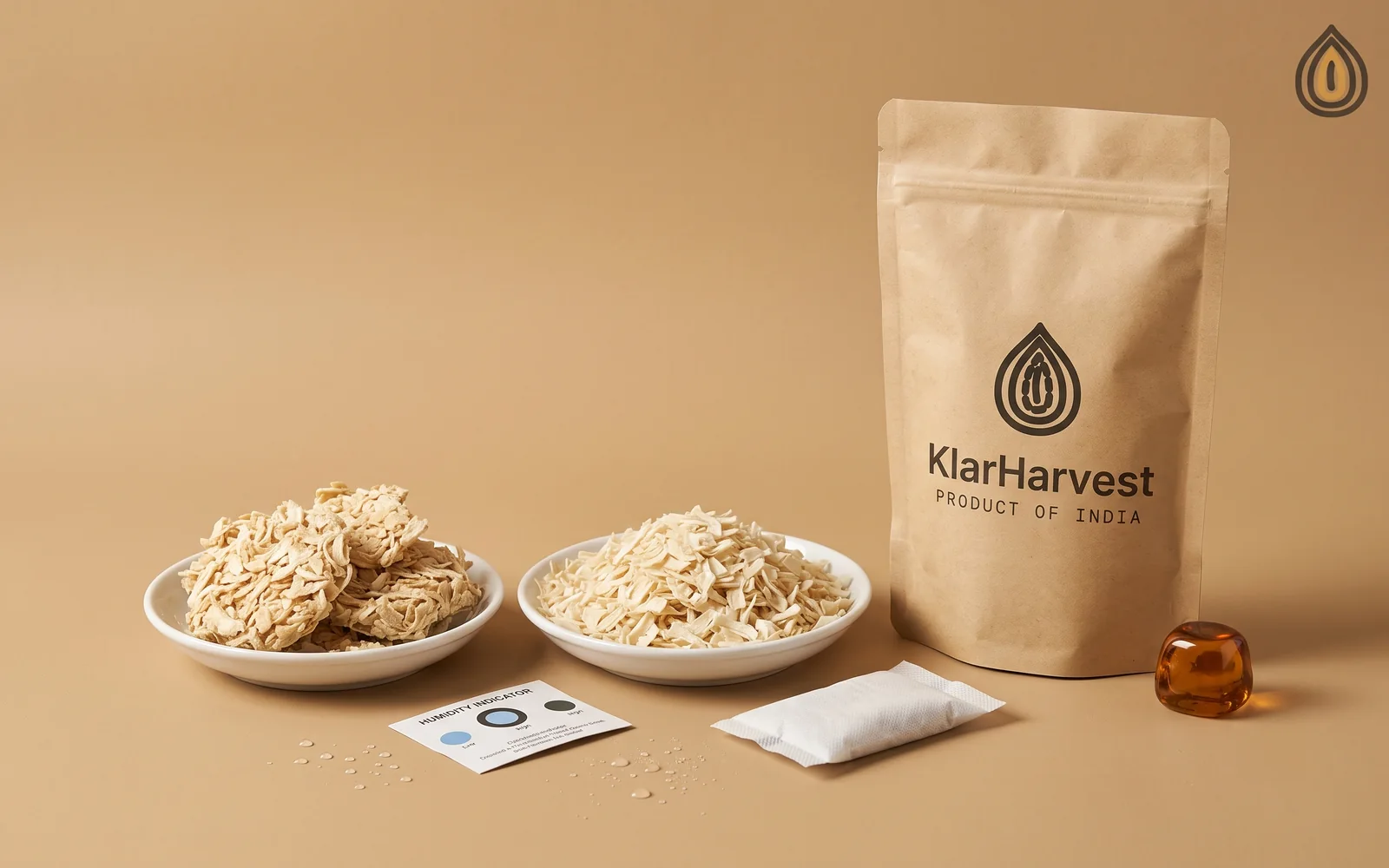
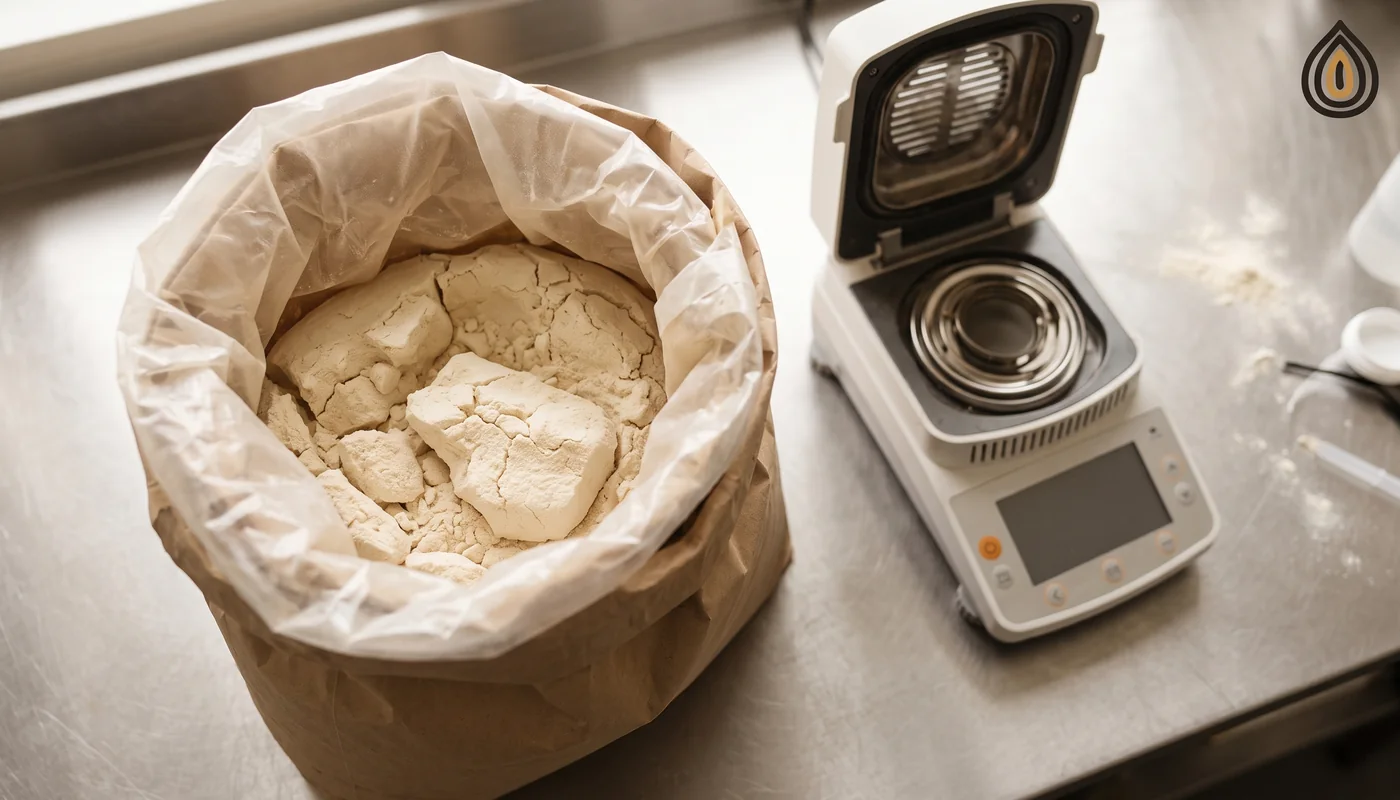
Dried onion is hygroscopic: at any humidity it moves toward an equilibrium moisture, and at 85 percent relative humidity and 30 degrees that equilibrium is 12 to 14 percent, more than double the 5 percent it was dried to. The rate depends on the surface exposed: powder in an open bin reaches 9 percent in a fortnight and cakes solid, granules in a week or two more, flakes over a month or two, and all of them go soft, then sticky, then mouldy as the water activity climbs past 0.6. A sealed 100 micron liner slows the transfer by two orders of magnitude and holds the product at 5 percent through the season; a tied liner leaks at the neck and lets the top of the bag reach 7 or 8; a punctured liner is an open bag. The monsoon is therefore not a threat to product that is packed and sealed properly and stored dry, and it is a threat to everything else: opened bags, the plant's kibble bins between the dryer and the mill, product cooling on the packing floor, samples on a laboratory bench, and a container stuffed on a wet day. The moisture science is in Dehydrated Onion Moisture Content and the water-activity thresholds in Water Activity in Dehydrated Onion.
At the plant: drying, packing and storing in the wet
Plants that run through the monsoon, drying stored rabi onion in one or two shifts, change their practice in four ways, and a buyer taking July to September product should ask whether its plant does. The dryer's inlet air is humid, which lengthens the drying cycle by 10 to 20 percent and raises fuel cost, and the finishing zone must run a little longer to reach 5 percent, which is a colour risk if the temperature is raised instead; the good plants accept the longer cycle. Product leaving the dryer at 60 degrees and 5 percent moisture must be cooled and packed at once, since kibble left in an open bin overnight in monsoon air is at 7 percent by morning; the good plants run a cooling conveyor straight into the packing room and keep the packing room closed and dehumidified. Milling and sieving of stored kibble is done from sealed bins in a dry room, since powder made from kibble that has crept to 6.5 percent is powder that will cake. And packed bags go straight into a sealed store rather than onto an open floor. The plants that stop for the monsoon, which is many of the smaller ones, hold their spring stock through it, and the quality of that stock in October depends entirely on where it was held. The production steps are in How Dehydrated Onion Is Made.
The stored raw onion: losses and the off-season price
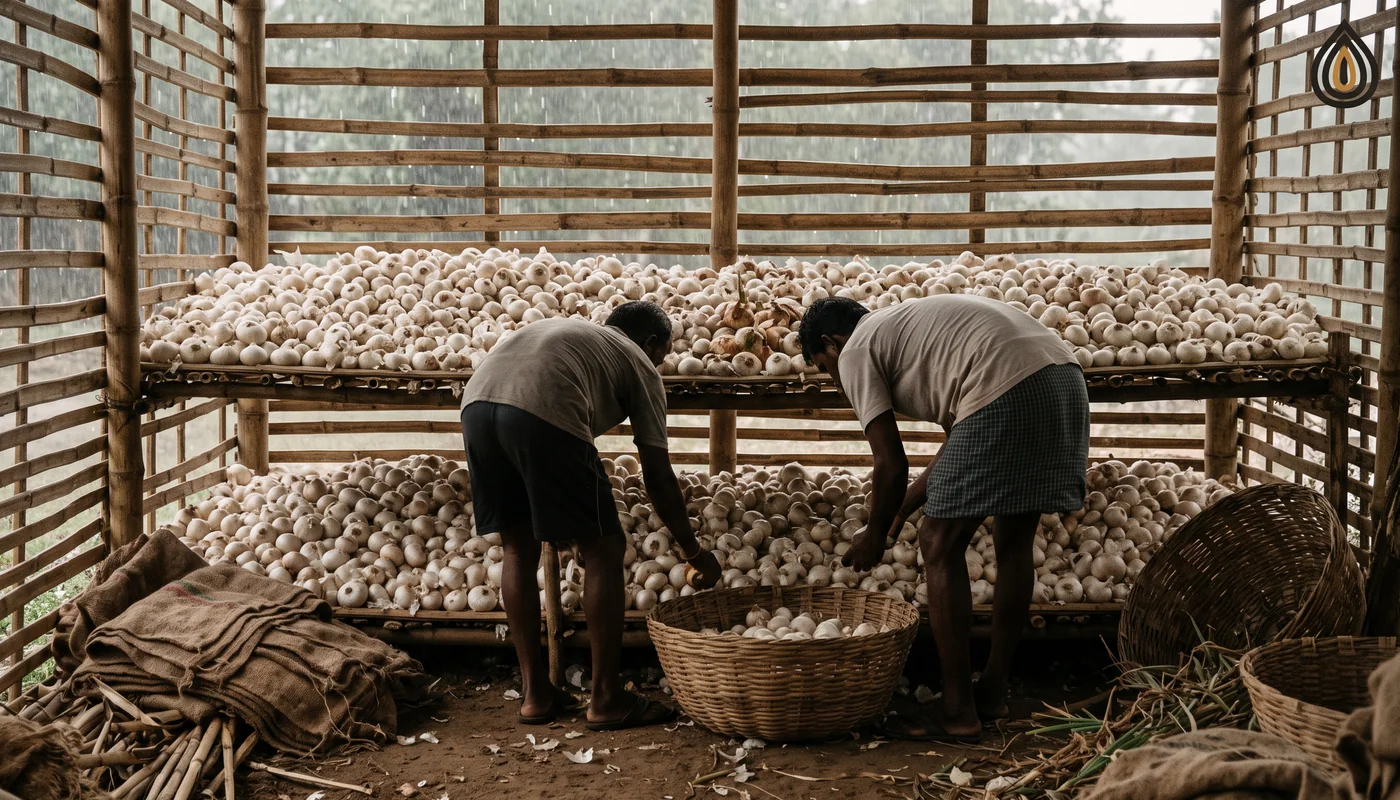
The rabi white onion that the plants dry from July to February was lifted in March to May and sits in the traditional ventilated sheds of Saurashtra, on bamboo racks under tin roofs with open slatted sides, and the monsoon is the season in which it sprouts, rots and shrinks. In a normal year the stored crop loses 25 to 40 percent of its weight by December, to water loss, sprouting and the removal of rotten bulbs, and the losses run fastest in July and August when the humidity is highest and the sheds' ventilation cannot dry the bulbs' surfaces; a wet, warm monsoon with few dry breaks pushes the losses toward 50 percent, a dry, breezy one holds them nearer 25. What survives is also poorer for drying: softer, lower in dry matter as sprouting consumes the bulb's sugars, and higher in rejects at the plant's intake, so the yield ratio worsens by half a point to a point over the monsoon as well as the price rising. The losses are the whole story of the off-season price: the tonnage that comes out of the sheds in October is the supply until March, and a monsoon that took half of it is a tight autumn. The May ground report's storage read, about 30 percent of the crop stored in 2026, is the starting point, and the August report's loss estimate is the update; the arithmetic that turns a raw price into a product price is in 8 to 1: The Fresh-to-Dry Yield Ratio.
Dry stock in the godown: the dehumidifier rule
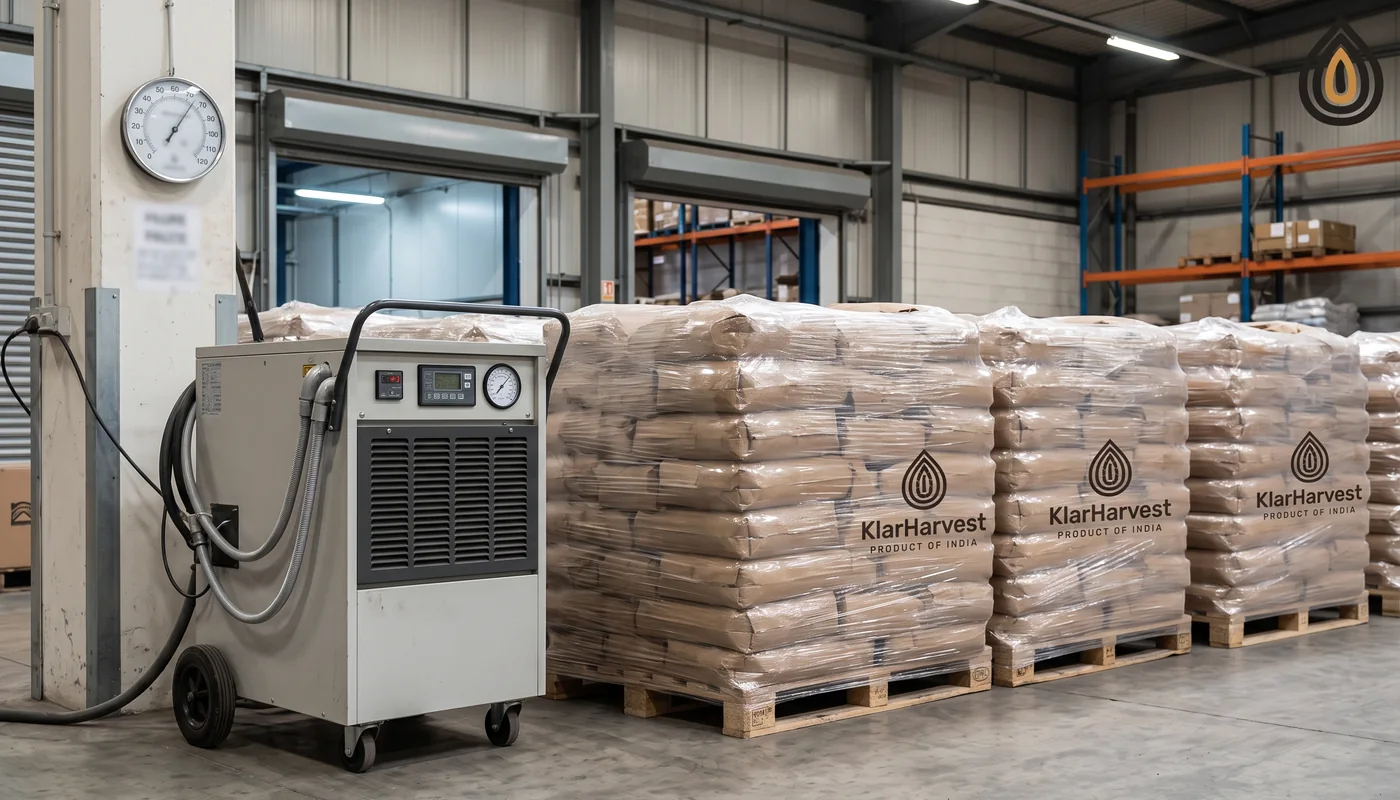
Plants and exporters finish May with the year's largest stock of dry product, most of it contracted for shipment through September, and the monsoon is where that stock is kept or lost. The rule the good ones follow is simple: sealed bags on pallets in a closed store with a dehumidifier holding 50 to 55 percent relative humidity and a hygrometer on the wall to prove it, pallets off the floor and away from the outer walls, no opened bags, and a daily check for roof leaks and for the wet corners that a monsoon finds in any building. A dehumidified godown costs a plant or an exporter a few lakh rupees a season in equipment and power and it is the cheapest insurance in the trade. The bad practice is the open shed with the roller door up for air, where the product sits in the same 85 percent as the street, and where the liner is the only defence; a good liner holds, a tied or punctured one does not, and the buyer who receives that stock in October finds out which. A buyer contracting July to September shipment from stock should ask where the stock is held and at what humidity, and should ask for the moisture on the certificate to be taken at shipment rather than at packing in April. Storage rules for the product are in Dehydrated Onion Shelf Life.
Powder, granules, flakes: which cakes first
| Cut | Surface exposed | Time to reach 8 % moisture in an open bag at 85 % RH, 30 °C | Symptom | Monsoon handling |
|---|---|---|---|---|
| Powder 80-100 mesh | Highest | 7-14 days | Solid caking, mould risk | Sealed liner essential; cartons or drums preferred; anti-caking for buyers who open bags often |
| Granules 40-60 mesh | High | 2-3 weeks | Lumps, then caking | Sealed liner; day-use quantities |
| Granules 16-40 mesh | Moderate | 3-4 weeks | Soft lumps | Sealed liner |
| Minced 1-3 mm | Moderate | 4-6 weeks | Softening, sticking | Sealed liner |
| Chopped 3-5 mm | Lower | 6-8 weeks | Softening | Sealed liner |
| Flakes 8-20 mm | Lowest per gram, but large pieces | 8-12 weeks | Rubbery flakes, no caking | Sealed liner; flakes forgive the most |
The table is why the caking complaints of August are nearly all powder and fine granules, and why a buyer using powder through the monsoon months should take cartons or drums with a sealed liner rather than bags, and should specify 4.5 to 5 percent moisture at shipment. The flow and caking physics are in Bulk Density and Flowability of Onion Powder and Granules.
Microbiology in the monsoon
Counts climb in the monsoon by two routes. The stored raw onion carries a higher load, from rot and from the wet, and a plant's intake sorting and washing must work harder; a plant that dries rotten-adjacent bulbs makes product with high yeast and mould and a sour note, and the good plants reject more at the gate in August than in April. And dry product that has crept above 7 percent moisture supports mould growth at the surface, slowly at first and then visibly, so a lot that was at 400 yeast and mould in May and has sat in a humid shed reads 5,000 in September. Steam-treated lots for the lower tiers are at more risk than standard ones, not less, because the treatment leaves the product briefly wetter and the re-drying must be complete before packing, and a plant that treats in the monsoon must control the re-dry. Salmonella and E. coli are not monsoon problems; yeast, mould and total count are. A buyer taking monsoon-period product should specify the microbiological set on a certificate dated at shipment, and should run its own verification on arrival; the tiers and their meaning are in Microbiology in Dehydrated Onion.
Containers and the shipping lane in the rains
The container is the monsoon's last chance at the product, and it takes it in two ways. A container stuffed in the rain, or on a wet floor, or with pallets that stood in a humid yard, carries water into the box; on the voyage the box passes through the Arabian Sea's warmth into cooler air and the water condenses on the roof and walls and drips onto the pallets, which is container rain, and the top layer of the pallets nearest the walls arrives caked. The defences are stuffing under cover on a dry floor, dry pallets, a moisture-absorbing desiccant bag hung in the box, kraft or corrugated top sheets over every pallet, dunnage against the walls, and a container inspected at the depot for a sound roof and door seals; the good exporters do all of it as routine and film it. The lane itself is affected less than a buyer might expect: Pipavav operates through the monsoon, vessels sail with a day or two of weather delay at worst, and the Arabian Sea's swell delays feeder connections occasionally; the tighter space and the peak surcharges of August to October are the carriers' peak season rather than the weather. The loading practice is in How a Dehydrated Onion Container Is Loaded and the lane in Pipavav to Hamburg.
Prices and availability from July to October
| Month | Raw onion source | Yard price tendency | Export price, customs average 2025 | Availability |
|---|---|---|---|---|
| July | Early stored rabi | Firm, +5-10 % on May | ₹147.4/kg (May ₹169.5) | Plants' free stock thinning; contracts shipping |
| August | Stored rabi, losses building | Rising, +10-20 % on May | ₹145.0/kg | Stock-only for red and pink; white from one- or two-shift runs |
| September | Stored rabi, late | High, +15-30 % on May | ₹147.7/kg | Tightest month for spot product |
| October | Late stored rabi; kharif fresh arriving in Maharashtra | Peak, then easing as kharif eases the fresh market | ₹145.0/kg | Plants restart fuller runs as raw supply steadies |
The yard pattern is a normal year's; a wet monsoon with high storage losses steepens it, as 2024 did, and a dry one flattens it. The export price has not followed the yard in recent years: the DGCIS customs average for dried onion fell from ₹169.5/kg in May 2025 to ₹142.7-147.7 from July to November 2025, as the plants' stock and the mix of grades shipped outweighed the stored-onion cost, and it was firmest around February and May. Expect stock product near or below the May level and product dried from stored onion quoted firmer. The month-by-month picture is in What Does Dehydrated Onion Cost per Kilogram? and the history of the swings in Dehydrated Onion Price History 2020-2026.
The kharif crop and the monsoon's second effect
The monsoon has a second effect on the onion market a season later: it is the growing season for the kharif onion crop of Maharashtra and Karnataka, planted in June and July and harvested from October, which supplies India's fresh market through the autumn and early winter and takes the pressure off the stored rabi onion that the plants and the fresh trade are competing for. A good monsoon makes a good kharif crop, which eases the fresh-market price in October and November and with it the yard price the plants pay; a failed or excessive monsoon makes a short kharif, and the whole country's fresh demand falls on the stored rabi, which is when the yard price spikes and the government's export controls on fresh onion sometimes follow. The kharif onion is red and low in dry matter and is not itself dried in volume, but its size sets the autumn price of the onion that is; the outlook for it, watched from August, is in Kharif Onion Crop 2026.
Buying timing: before, during and after
Before, April to June: the season's lowest raw-onion price, the freshest product, the plants' free stock, and shipments that arrive in Europe before the origin's humidity is a factor; the best buying window for a buyer with warehouse space, and the window in which most annual contracts are placed. During, July to September: product from the plants' dehumidified stock or from one-shift runs on stored onion, stock offered near or below the spring price and fresh runs on stored onion quoted firmer, with the quality depending on where the stock was held and how the container was stuffed; a buyer who must buy in these months specifies for it and picks the supplier for its storage. After, October to February: stored-onion product with the ratio worse and the colour a shade lower; the customs average stayed near ₹143-145/kg in October and November 2025 and climbed to ₹171.5 by February 2026; the months to cover from spring stock or contracts rather than to buy spot. The practical rule is to contract 40 to 60 percent of the year's need in April and May with shipments scheduled through September, to hold six to eight weeks of safety stock over the monsoon, and to buy the second half's balance in October or later when the kharif has shown its size. The contracting mechanics are in Payment Terms for Dehydrated Onion Imports and the demand-planning side in Q4 Demand Planning.
Specifying for monsoon shipments
- Moisture at shipment: "Maximum 5.0 percent, measured on a sample drawn within 7 days of stuffing and stated on the certificate with the sampling date" rather than the packing-date figure.
- Storage: "Product held in a closed, dehumidified store at not more than 55 percent relative humidity from packing to stuffing; hygrometer log available on request."
- Liner: "100 micron polyethylene, heat-sealed; no tied liners."
- Powder and fine granules: cartons or drums with sealed liners; 4.5 percent moisture maximum.
- Container: "Stuffed under cover on a dry floor with dry pallets; desiccant bags, top sheets and wall dunnage; container inspected and photographed at the depot; loading filmed."
- Microbiology: the tier's counts on a certificate dated at shipment; yeast and mould stated.
- Colour: grade and age clause allowing for stored-onion product where the drying date is after June.
- Drying date: stated on the bag and the certificate, so that a buyer knows whether it is spring stock or a monsoon run.
- Arrival allowance: a moisture allowance on arrival of 0.5 points over the shipment figure, since transit adds a little, with anything beyond it a claim.
The specification sheet these join is in How to Read a Dehydrated Onion Specification Sheet, and the packaging detail in Dehydrated Onion Packaging.
Receiving a monsoon shipment in Europe
A container that left Pipavav in August arrives in Hamburg in September or October, and the arrival inspection should assume the monsoon tried its luck. Open the doors and look at the top sheets and the pallets nearest the walls for water marks, and at the desiccant bags for saturation. Weigh bags from the top and the bottom of the pallets nearest the walls against the net, since a caked bag is a heavier bag. Open three bags from different positions, check the liners for seals and holes, and read the moisture on each; a spread between bags is the sign of a container problem, a uniform rise the sign of a storage one. Smell each for mustiness. Draw the retained samples and send the verification test with yeast and mould included. A lot that reads 5.5 percent with clean aroma is fine; one at 7 with a musty note is a claim, and the loading video, the container photographs and the shipment-date certificate decide whether it is the supplier's, the carrier's or the insurer's. The inspection routine is in Common Quality Defects in Dehydrated Onion, and the claims route in Marine Insurance and Claims for Dehydrated Onion Shipments.
A bad monsoon year and a good one
| Heavy, wet monsoon (2024 pattern) | Normal monsoon (2025) | Forecast for 2026 | |
|---|---|---|---|
| Rainfall, Saurashtra | Well above normal, floods in low fields | Near normal | Normal to slightly above |
| Storage losses by December | 45-50 % | 30-35 % | Expected 30-35 % |
| Yard price, September vs May | +40 % and more | +15-20 % | Expected +15-25 % |
| Export price (customs average), September vs May | Not in this report's customs series | -13 % (₹169.5 to ₹147.7/kg) | Stock near or below May |
| Kharif crop | Damaged by excess rain; short | Good | Expected good |
| Autumn fresh-onion price and export controls | Spike; controls imposed | Steady | Watch from October |
| Quality complaints on monsoon shipments | High: caking, counts | Low from good stores | Depends on the store |
The 2024 column is the case a buyer plans against: a wet monsoon, high storage losses, a short kharif, a spike, and a run of caked and high-count shipments from suppliers whose stores were not dehumidified; 2026's forecast is for something near normal, and the May storage read of 30 percent is a comfortable start. The August ground report will carry the loss estimate and the kharif's progress.
Two signals tell a buyer in Europe which kind of year it is without waiting for the reports. The India Meteorological Department publishes weekly rainfall against normal by district through the season, and Saurashtra's July figure, well above normal or well below, is the first hint of the storage losses to come. And the Mahuva yard price in the second half of August, which the plants and the exporters quote freely, shows whether the sheds are emptying fast: a price 10 to 15 percent over May is a normal year, 25 percent and more is a wet one with the autumn spike ahead. A buyer with a second-half requirement and no contract cover who sees the second signal in August should buy in August rather than in October.
How KlarHarvest manages the monsoon
KlarHarvest holds all dry stock through the monsoon in a closed, dehumidified godown in Bhavnagar at 50 to 55 percent relative humidity with the hygrometer log in the lot record, in heat-sealed 100 micron liners, and takes a moisture reading within seven days of stuffing that goes on the certificate with its date; powder and fine granules are shipped in cartons or drums from July to September as standard. Containers are inspected and photographed at the depot, stuffed under cover with desiccant, top sheets and dunnage, and filmed; the drying date is on every bag so that a buyer knows spring stock from a monsoon run. Buyers who contract in April get scheduled shipments through September from that stock, and the monthly ground reports carry the storage-loss and kharif estimates that set the autumn price; the process is on the our process page and a monsoon-period quote comes from the contact page.
Frequently asked questions
Does the monsoon affect dehydrated onion quality?
Only where the product is exposed: opened bags, tied or punctured liners, unsealed stores and wet containers let a product dried to 5 percent moisture climb toward 12 in 85 percent humidity, which cakes powder and raises yeast and mould. Sealed liners in a dehumidified store hold it at 5.
Why does onion powder cake in August?
Powder has the most surface and takes up moisture fastest: an open or badly sealed bag in a monsoon warehouse reaches 8 percent in a fortnight and cakes. Specify sealed liners, cartons or drums, 4.5 to 5 percent moisture at shipment and dehumidified storage.
Do dehydrated onion prices rise from July to October?
The raw price does: the plants dry stored rabi onion whose losses build through the monsoon, so the yard price rises 15 to 30 percent from May to September in a normal year, more in a wet one. The export price has not followed it: the customs average fell from ₹169.5/kg in May 2025 to ₹142.7-147.7 from July to November 2025. Stock product is offered near or below May; product dried from stored onion is quoted firmer.
When is the best time to buy dehydrated onion?
April to June, when raw onion is at its lowest and the product freshest, with shipments scheduled through September; cover the second half from spring stock or contracts and buy the balance in October or later once the kharif crop's size is known.
Are containers a problem in the monsoon?
A container stuffed on a wet day or with damp pallets carries water that condenses on the voyage and cakes the pallets nearest the walls. Covered stuffing, dry pallets, desiccant, top sheets and dunnage prevent it; the lane itself runs normally.
What is the kharif crop and why does it matter?
The red onion crop of Maharashtra and Karnataka grown through the monsoon and harvested from October. It feeds the fresh market and eases the pressure on stored rabi onion; a short kharif makes a tight autumn and a spike in the yard price the plants pay.
What should I check on a monsoon shipment?
Water marks on top sheets and wall-side pallets, bag weights, liner seals, moisture on three bags from different positions, aroma, and yeast and mould on the verification test. A uniform rise points to storage, a spread between bags to the container.
Next step
Request a quote for July to September shipment and it comes with the storage conditions, the shipment-date moisture and the container practice stated; or request a sample from the current stock and its hygrometer log and moisture reading come with the certificate.