- The harvest closes
- The last fresh-crop lots: quality at the tail
- How much onion went into storage
- Market yard prices, week by week
- Plant operations: the step down
- The season's dry-product output
- FOB indications by cut
- Red and pink at their peak
- Contract shipments and the stock position
- Logistics in May
- Weather and the monsoon ahead
- May 2026 against the two previous seasons
- Buyer questions answered this month
- Field notes: three plants in the third week of May
- What to expect from June to August
- How this report is compiled
- What KlarHarvest is doing this month
- Frequently asked questions
Judge the product, not the words
200-500 g from a current lot, dispatched by courier with the lot lab report.
Request a sampleThe dehydrated onion May 2026 picture from Mahuva is a season closing on schedule with the numbers a buyer wants to see: a full harvest lifted without a weather loss, the plants' largest dry-product stock of the year in the bag, the raw price off its April low by a rupee but nowhere near stress, and a storage share a little above normal that promises an orderly summer. The month has a different rhythm from March and April: the yard is quieter, the plants are stepping down, the red and pink runs are at their peak, and the trade's attention has moved from the harvest to the stock, which is what decides prices from July until the next crop. This report covers the close of the harvest, the last fresh-crop lots, the storage read, the yard week by week, plant operations and the step-down, the season's output, FOB indications by cut, red and pink, contract shipments and the stock at plants and exporters, logistics, the weather, and the summer outlook.
It is written from the fields, the yard and the plants of Bhavnagar district in the first three weeks of May 2026. The April report, which covered the peak, is at Mahuva Ground Report, April 2026; the season's calendar is in The Indian Onion Harvest Calendar.
What this report covers
- The harvest closes
- The last fresh-crop lots: quality at the tail
- How much onion went into storage
- Market yard prices, week by week
- Plant operations: the step down
- The season's dry-product output
- FOB indications by cut
- Red and pink at their peak
- Contract shipments and the stock position
- Logistics in May
- Weather and the monsoon ahead
- May 2026 against the two previous seasons
- Buyer questions answered this month
- Field notes: three plants in the third week of May
- What to expect from June to August
- How this report is compiled
- What KlarHarvest is doing this month
- Frequently asked questions
The harvest closes
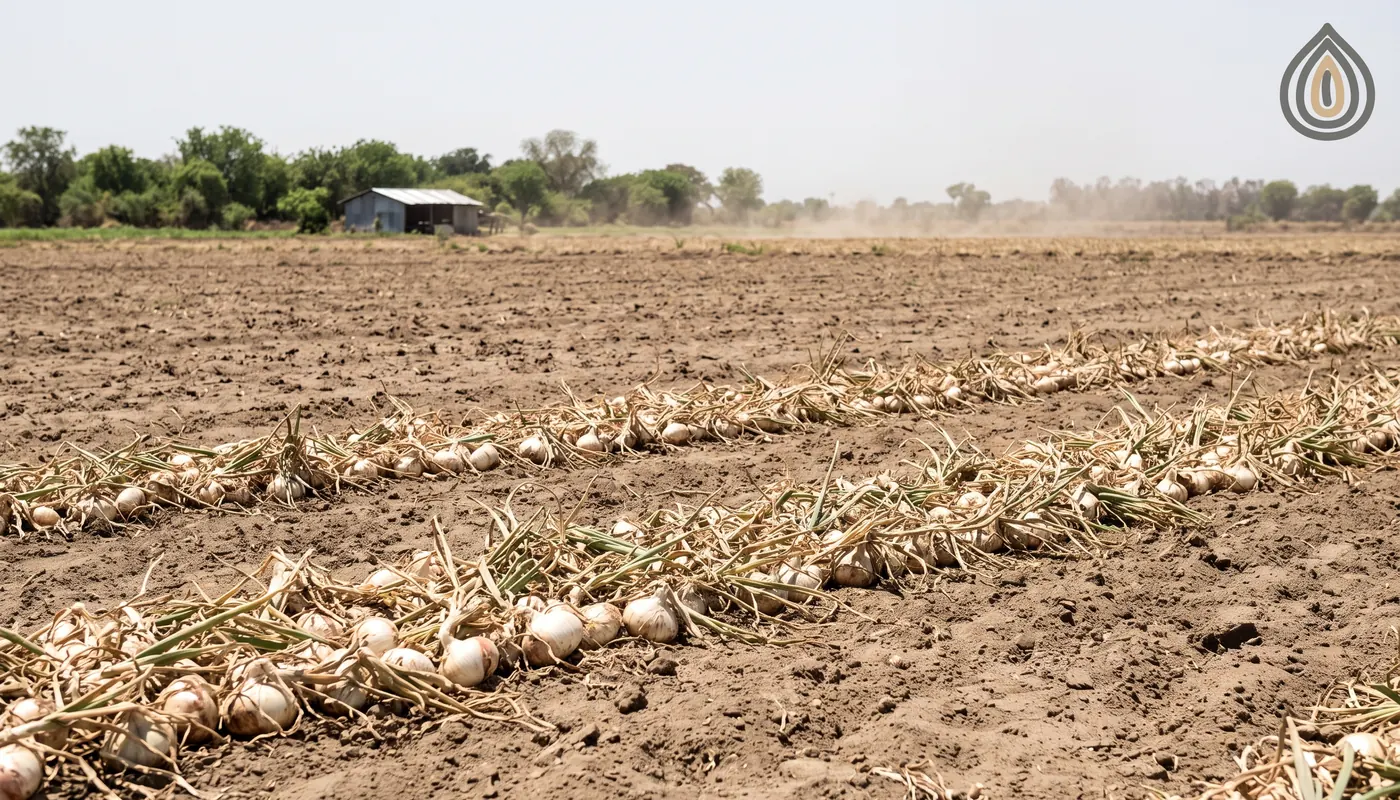
The rabi white onion harvest in the Mahuva, Talaja, Palitana and Amreli belts finished in the second week of May, three or four days ahead of a normal year, with the last fields on the heavier soils toward Talaja and the late second plantings lifted by the 12th. The yard's arrival boards, which showed 8,000 to 9,000 tonnes on the heaviest April days, were at 3,000 to 4,000 tonnes in the first week of May and under 2,000 by the third, and the trailer queues at the plant gates have gone. The crop as a whole came in at or a little above the trade's pre-season estimate, on higher-than-average dry matter, and without a weather loss: the pre-monsoon showers that were the April report's watch item did not arrive, and the tail of the harvest was lifted dry. The red harvest, three to four weeks behind the white, is in its last fortnight and will finish by the end of the month. For the plants, the end of the harvest is not the end of the fresh season, since farmers' own field stores and the market's stocks carry fresh onion into June, but it is the end of the cheapest raw material, and the yard price has begun to reflect that.
The last fresh-crop lots: quality at the tail
The tail of a harvest is where quality slips, and this year's tail is better than most. The late-lifted onion from the heavier soils is larger and a little lower in dry matter than the April mainstream, 17.5 to 19 percent at intake against 18 to 20.5, which costs the plants half a point of yield and a little colour, and some of it has been directed to the granule and powder lines. Skins are looser on the late bulbs and the peeling lines are taking a slightly higher peel loss. Defects remain low, with no rot to speak of because the crop stayed dry; sprouting, which appears in stored onion from July, is not an issue in May. Plants that dried to the top colour grade through April are still doing so in May, with L* readings a point lower on average; buyers who specified April drying dates got the year's whitest product and buyers with May dates have product that conforms comfortably. The laboratories report counts on standard product in the low hundreds of thousands, the same as April, and pesticide screens clean at 0.01 milligrams per kilogram. The last fresh-crop lots, dried in the second half of May, are the ones to ask for by drying date for a buyer who wants fresh-crop product with the longest remaining shelf life; the colour and age relationship is in Dehydrated Onion Colour.
How much onion went into storage
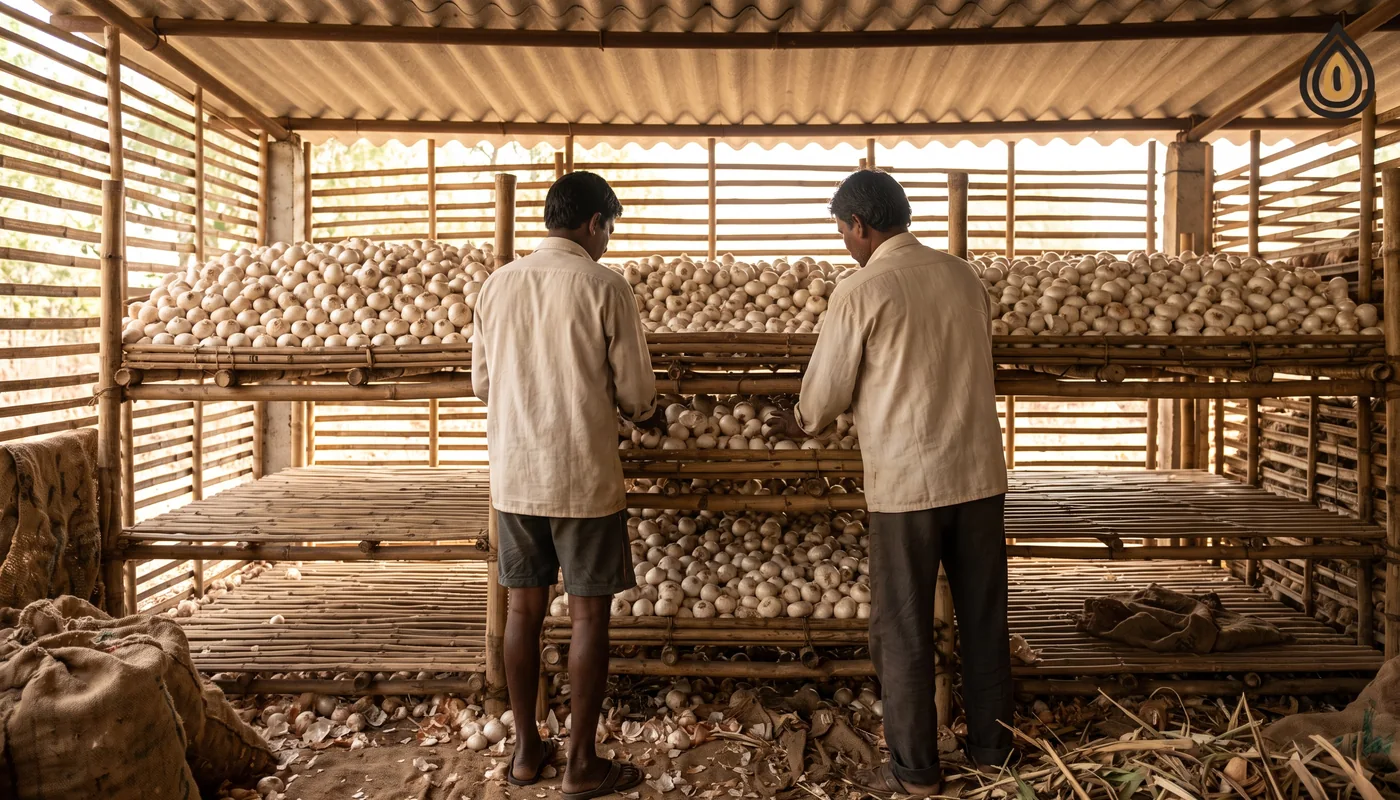
The number that sets the off-season is the share of the crop that farmers and traders have put into storage rather than sold at harvest, and the first read in the third week of May is that it is about 30 percent, against a normal 25 to 30 and a range in recent years of 20 to 35. The reasoning behind it is visible at the yard: the April price around 5 rupees was low enough that farmers with sheds chose to hold rather than sell, and the trade's expectation of a firmer summer, on a smaller kharif acreage in Maharashtra and steady export demand, encouraged it. Stored rabi onion in the traditional ventilated sheds of Saurashtra loses 25 to 40 percent of its weight and a share of its quality to sprouting, rot and shrinkage by December, faster in a wet monsoon, and the losses are what lift the off-season price; a storage share of 30 percent means about 30 percent of the crop's tonnage is available to the plants and the fresh trade from July at a rising cost, which is a comfortable position rather than a tight one. The plants themselves have stored little raw onion, since it does not pay to hold fresh onion against drying it, and their stock is in dry product. The storage economics, and why they matter more than the harvest size for a buyer contracting in the second half, are in The Indian Onion Harvest Calendar.
Market yard prices, week by week
| Week | Dehydration-grade white, ₹/kg at the yard | Table-grade white, ₹/kg | Red, ₹/kg | Arrivals | Note |
|---|---|---|---|---|---|
| 27 Apr - 2 May | 4.8-5.6 | 6.0-7.2 | 5.5-7.0 | Heavy, thinning | Off the April low by a fraction |
| 4 - 9 May | 5.0-5.9 | 6.2-7.5 | 5.8-7.2 | Moderate | Storage buying visible |
| 11 - 16 May | 5.3-6.2 | 6.5-7.8 | 6.0-7.5 | Light; harvest closing | Firming; plants buying for the last fresh runs |
| 18 - 21 May (to date) | 5.5-6.4 | 6.8-8.0 | 6.2-7.8 | Light | Stable at the higher level |
The yard has firmed by about a rupee from the April floor, which is the normal end-of-harvest pattern as arrivals thin and storage buyers compete with the plants for the last sound lots; it puts the raw-material share of a kilogram of flakes at 47 to 54 rupees, up from 40 to 45 at the April low. Table grade has held its premium and red its premium over white. The move is orderly and expected, and it is not the beginning of a tight summer: at 5.5 to 6.5 rupees the industry is well inside its comfortable range, and the stress level of 7 rupees and above, which pushes FOB toward 180 and above, is not in sight on the current storage read. The arithmetic from the yard to the FOB price is in 8 to 1: The Fresh-to-Dry Yield Ratio.
Plant operations: the step down
The plants ran three shifts through the first fortnight of May and began the step down to two in the third week as the fresh supply thinned, a week or so earlier than last year because the harvest closed early. Maintenance stops, deferred since March, begin at the end of the month: belt replacements, burner servicing, mill overhauls and the annual deep clean that the certification audits look for, each plant taking a week to ten days offline in turn through June. Labour is being released, with the seasonal crews going back to their villages before the monsoon planting, and the wage premium of April has gone. Heat is the operating constraint, with afternoons at 42 to 44 degrees; packing has shifted to nights and early mornings, and the plants with cooling tunnels are running them hard. Two plants reported dryer belt failures in the second week, of the kind that appear at the end of a peak, with a shift lost each and no quality effect on packed product. Power cuts on the GIDC estates have lengthened in the afternoons and the diesel sets are running two to three hours on the worst days, which adds a rupee to conversion cost. The operations behind these notes are in How Dehydrated Onion Is Made.
The season's dry-product output
With the fresh season nearly over, the plants can count what they have dried, and the official customs figures give the shipping side of it: India exported 11,700 tonnes of dried onion in April 2026 and 12,599 tonnes in May, 16 and 11 percent less than in the same months of 2025, at firmer average values of ₹159.6 and ₹169.8 per kilogram. The mix has shifted a little toward granules and powder, on the demand from Europe and North America for the finer cuts and on the late-season onion's suitability for milling, and toward the low bacterial tier, which the plants ran in longer blocks this year because buyers contracted it early. India's export volume for the fiscal year to March 2026 was 131,328 tonnes at an average of ₹155.2 per kilogram; the customs data that will confirm it are described in Dehydrated Onion Price History 2020-2026.
FOB indications by cut
| Product, white, standard tier | FOB Pipavav, ₹/kg | FOB, €/kg (at ₹100 = €1.00) | Change vs April |
|---|---|---|---|
| Flakes 8-20 mm | 155-170 | 1.55-1.70 | +5 to +6 % |
| Chopped 3-5 mm | 155-170 | 1.55-1.70 | +5 to +6 % |
| Minced 1-3 mm | 157-172 | 1.57-1.72 | +5 to +6 % |
| Granules 16-40 mesh | 160-175 | 1.60-1.75 | +5 to +6 % |
| Powder 80 mesh | 162-178 | 1.62-1.78 | +5 to +6 % |
| Low bacterial, any cut | +8 to +15 | +0.08 to +0.15 | Unchanged premium |
| Extra low bacterial, any cut | +20 to +35 | +0.20 to +0.35 | Unchanged premium |
| Red, any cut | +15 to +30 over white | +0.15 to +0.30 | Unchanged; peak availability |
| Pink, any cut | +8 to +15 over white | +0.08 to +0.15 | Small quantities |
Indications have firmed 5 to 6 percent from April, in step with the official customs figures: the average value of India's dried-onion exports rose from ₹159.6/kg in April 2026 to ₹169.8/kg in May, back at the February level of ₹171.5; the plants are quoting a little more firmly for shipments from July onward, which will be dried from stored onion, and a little more softly for shipments from stock dried in April and May, of which they have plenty. Quote validities are back to 7 days. The customs unit-value pattern of previous years, with May among the firmer months on the year's mixed shipments and the second half softer, is in What Does Dehydrated Onion Cost per Kilogram?; the freight and landed-cost layers in Landed Cost of Dehydrated Onion in Europe.
Red and pink at their peak
May is the red month. The red harvest has been at its peak through the first three weeks and every plant that runs red has had it on the line in blocks, mostly for flakes and granules and increasingly for powder, where the demand from seasoning makers has grown. The red crop is somewhat smaller than last year, as the April report expected, and red raw material has held a premium of about 1.5 rupees over white at the yard; the red premium at FOB is unchanged at 15 to 30 rupees. Buyers who need red for the year should have contracted it by the end of May, because the red offer from August onward is the April-to-June product in stock and no more; the plants do not dry red from stored onion in any volume. Pink onion, which two plants offered in April, is being dried by three in May and is finding buyers among seasoning and snack makers who want a hint of colour at a smaller premium; its window is the same as red's. The colour and flavour differences are in White vs Red Dehydrated Onion, and the pink type in Pink Onion, Dehydrated.
Contract shipments and the stock position
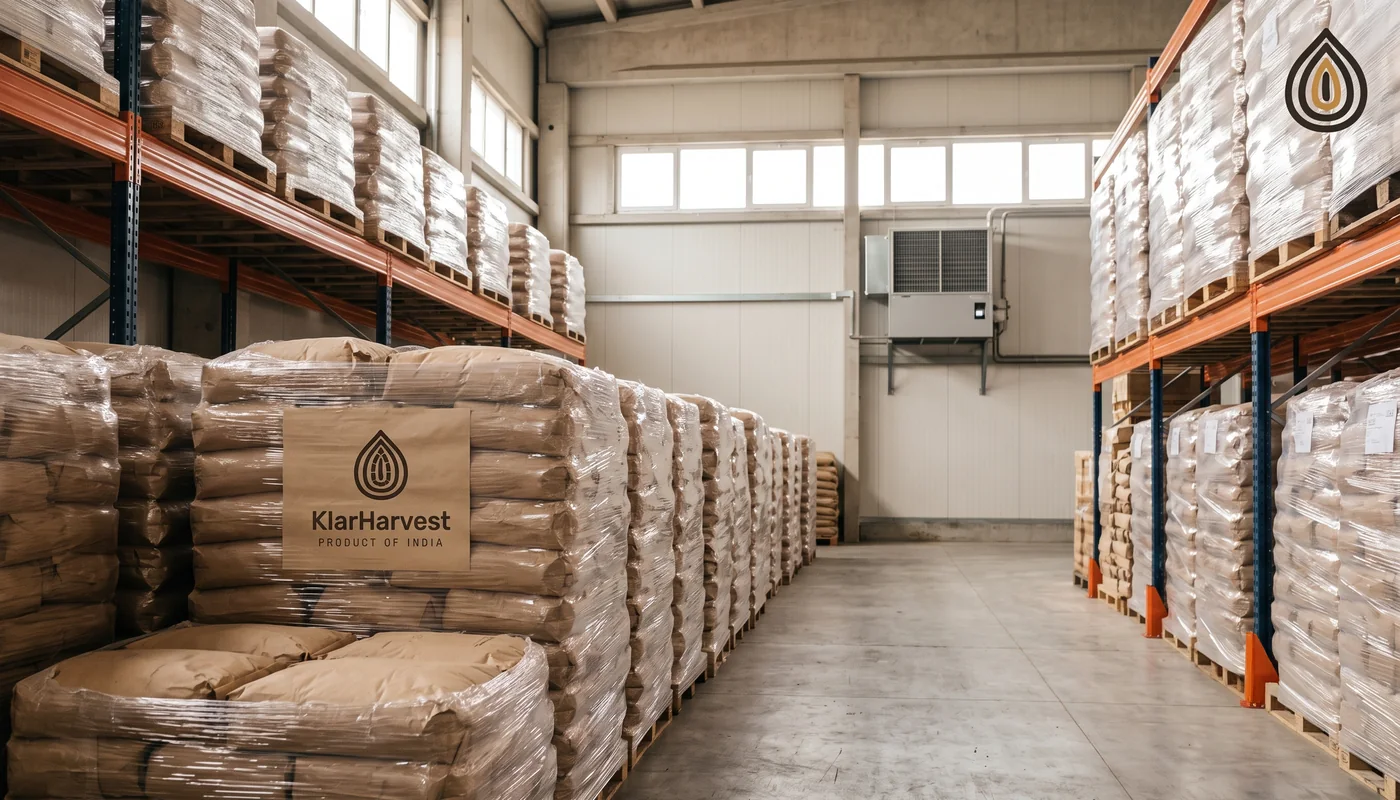
Season contracts placed in April began shipping in May, and India's dried-onion exports in the month, 12,599 tonnes, were the highest monthly figure since August 2025. Plants and exporters finish May with their largest dry stock of the year, mostly committed against contracts with shipment dates through September, and with a free stock of standard white product that the plants are keen to move before the monsoon, since holding dry product through the humid months costs them dehumidified storage and the risk of caking in bags with imperfect liners. That free stock is where a buyer who did not contract in April can still buy at close to the season's low: April and May drying dates, standard and low bacterial tiers, ready for a June or July sailing. The traders in the Netherlands and Belgium took their expected large positions and are shipping them now; European manufacturers who contracted 40 to 60 percent of their year are taking their first calls. Payment terms on the contracts are running normally, with advances in and balances against documents; the exporters report no difficulty on letters of credit this season. The stock picture matters for the second half: with the plants' free stock cleared by July, the second-half price is the stored-onion price, and the contract route to it is in Payment Terms for Dehydrated Onion Imports and Why Dehydrated Onion Quotes Are Valid for 7 Days.
Logistics in May
Pipavav handled the peak without congestion: gate-in to sailing three to five days, direct services to northern Europe available weekly, and rates steady from April with the routing on most services still around the Cape and a few back on Suez; transit to Hamburg at 32 to 40 days on the Cape services. Container availability tightened for a fortnight in the middle of the month as the season's peak volume moved, and two exporters reported rolled bookings, a week each, on the busiest sailings; forwarders with contract allocations were not affected. Trucking from Mahuva is back to normal as the plant loading bays clear. LCL consolidations are running weekly again from Bhavnagar and Ahmedabad after the tighter April schedules, and pallet buyers are seeing normal lead times. The lane's detail is in Pipavav to Hamburg, and the container practice at the plants in How a Dehydrated Onion Container Is Loaded.
Weather and the monsoon ahead
The harvest was lifted dry and the weather risk to the crop has closed. The watch item now is the monsoon, which reaches Saurashtra in the third week of June in a normal year: for the plants it means humidity of 80 to 90 percent for three months, which is a storage question, dehumidified godowns for dry product and the liner discipline on every bag, rather than a production one; for the stored fresh onion it means storage losses, higher in a wet, warm monsoon and lower in a dry one, which feed straight into the off-season raw price. The seasonal forecast for 2026 is for a normal to slightly above-normal monsoon, which is good for the kharif onion crop in Maharashtra and Karnataka that supplies the fresh market from October and neutral for storage losses. A buyer planning the second half should watch the monsoon's progress in July for the first hint of the autumn price; the storage and humidity side is in Monsoon and Dehydrated Onion.
May 2026 against the two previous seasons
| Indicator, third week of May | 2024 | 2025 | 2026 |
|---|---|---|---|
| Harvest finished | ~20 May | ~15 May | ~12 May |
| Weather loss to the crop | None | Minor, showers | None |
| Dehydration-grade white at the yard, ₹/kg | 8.5-10.0 (tight year) | 5.5-6.5 | 5.5-6.4 |
| Storage share of the crop, first read | ~20 % | ~27 % | ~30 % |
| White flakes FOB indication, ₹/kg | 195-215 | 158-172 | 155-170 |
| Plants' free stock end of May | Low | Normal | Above normal |
| Red availability | Short | Normal | Slightly short |
The comparison with 2024, when a short crop and a low storage share took FOB past 200 by autumn, is the reason the storage read matters: 2026's 30 percent is the opposite starting point, and the summer should be orderly. The cycles behind the numbers are in Dehydrated Onion Price History 2020-2026.
Buyer questions answered this month
I missed the April contracting; is it too late? No. The plants' free stock of April and May product is available at about 5 percent over April for June and July sailings; contract it now rather than in July, when it will be gone. Will prices rise over the summer? The raw price will, by a rupee or two at the yard through August. The export price has not followed it in recent years: the customs average fell from ₹169.5/kg in May 2025 to ₹142.7-147.7 from July to November 2025, as stock and the mix of grades shipped outweighed the stored-onion cost. Expect stock product near or below the May level and product dried from stored onion quoted firmer. Is May product as good as April? It conforms comfortably; April was the whitest. For a product where dry colour shows, ask for April dates; otherwise May is fine and has a month more shelf life ahead of it. Should I take stock before the monsoon? If you have dry warehouse space, product shipped in June arrives before the humidity is a factor at the origin and is the year's low; if not, the plants' dehumidified godowns hold it well and the risk is small. Is red still available? Yes, at peak, for contracts placed by the end of May; after that the offer is the stock dried this spring.
Field notes: three plants in the third week of May
At a large certified plant on the Mahuva road, the last white run of the fresh season was on the line on the 19th, from a farmer group's field store rather than the yard, at a dry matter the intake laboratory was pleased with; the plant had already moved its night shift to the granule and powder mills to work down the kibble stock, and its quality manager was pleased with the season's colour, which he put down to the January cold. Its maintenance stop is booked for the first week of June, and its free stock of April flakes is on offer for June sailings. At a mid-sized plant in the Bhavnagar GIDC belt, red was on the line in the second of three planned blocks, with raw red holding its premium over white at the yard; the owner's concern was the afternoon power cuts, which had cost him two hours of diesel a day for a fortnight. At a smaller plant near Talaja that serves the domestic market and a few exporters, the season was over on the 16th, the crew had gone, and the owner was deciding whether to run the monsoon at all on stored onion or to stop until August, a decision the yard price over the next month will make for him. Three plants, three versions of the same month: the season's tonnage in the bag, the last fresh onion going through, and the summer about to become a question of storage.
What to expect from June to August
June is the last month of fresh-onion drying, from farmers' field stores and the market's last sound lots, at yard prices a fraction above May, with the plants down to two shifts and taking their maintenance stops in turn; product dried in June is the last of the fresh crop. The monsoon arrives in the third week and the plants move to storage mode for dry product. July and August are the off-season: the plants dry from stored onion at rising raw prices, run one or two shifts, and fill contracts from stock; the customs average has eased from its May level into July to November in recent years (₹143-148/kg in 2025, against ₹169.5 in May), so stock product is likely to be offered at or below May levels while product dried from stored onion is quoted firmer, and quote validities stay at 7 days. Red and pink are stock-only from August. The next report, for August, will cover the off-season stock position, storage losses through the monsoon, the kharif crop's progress in Maharashtra and its meaning for the autumn price, and the first thoughts on the 2027 rabi acreage, which the farmers decide on the prices they see this summer.
How this report is compiled
From visits to the Mahuva market yard and to plants in the Mahuva, Talaja and Bhavnagar GIDC belts during the first three weeks of the month; conversations with plant owners, quality managers, commission agents, storage-shed operators and farmers; the plants' own intake and laboratory figures where they were shared; the yard's daily arrival and price boards; and the public customs and market data where they are current. Prices are ranges observed in the period, not offers, and FOB indications are for container quantities of standard product from certified plants; a quotation for a specific lot and date can differ. Figures in this series are indicative and should be confirmed against a written quote before any commercial decision.
What KlarHarvest is doing this month
Shipping the first calls on April contracts, with April and May drying dates and certificates in the lot records; offering free stock of April and May white product, standard and low bacterial, for June and July sailings to buyers who did not contract in April; closing red and pink contracts for the year from the peak runs; and moving all dry stock into dehumidified storage at the Bhavnagar godown ahead of the monsoon, where it is held sealed until it is labelled and loaded. The lot records, with plant, drying date and laboratory report, are visible to each buyer through the portal described on the our process page.
Frequently asked questions
What is the dehydrated onion price in May 2026?
FOB Pipavav indications for white flakes from certified plants are 148 to 165 rupees per kilogram, about 1.48 to 1.65 euros, up 2 to 3 percent from the April low; granules and powder a few rupees higher, low bacterial plus 8 to 15, red plus 15 to 30.
When did the 2026 onion harvest finish in Mahuva?
Around 12 May, three or four days ahead of a normal year, lifted dry without a weather loss; the red harvest finishes at the end of May.
How much onion went into storage in 2026?
About 30 percent of the rabi crop on the first read, a little above the normal 25 to 30, which points to an orderly off-season rather than a tight one.
Can I still buy at near the season's low in May?
Yes, from the plants' free stock of April and May product for June and July sailings, at 2 to 3 percent over the April low. That stock is usually gone by July.
Will dehydrated onion prices rise over the summer of 2026?
Modestly on the current storage read: 5 to 10 percent at FOB by August, more only if a wet monsoon raises storage losses. The 2024 pattern of a 30 percent rise came from a short crop and a low storage share, neither of which applies this year.
Is red dehydrated onion still available?
Yes, at peak production through May for contracts placed by the end of the month. From August the red offer is the stock dried in April to June.
What happens to the plants in June?
Two shifts, the last fresh-onion drying from field stores, and maintenance stops in turn; from the monsoon's arrival in the third week the plants hold dry stock in dehumidified storage and dry from stored onion.
Next step
Request a sample of the cut you use from a May lot, with its certificate and drying date; to take free stock before the monsoon or contract red for the year, request a quote with the tonnage and the sailing month and it comes back within one business day.