- The standard: 20 kg kraft bag with a polyethylene liner
- Why the liner matters more than the bag
- Bag sizes and weights by cut
- Powder: cartons, drums and the caking question
- Big bags and bulk formats
- Retail and foodservice formats
- Nitrogen flushing, vacuum and desiccants
- Pallets: patterns, weights and what fits a container
- Bag marking: what every bag must carry
- Private label: what it involves and what it costs
- Packaging materials and food-contact compliance
- Handling at the receiving end
- Packaging costs in the price
- Packaging lines for the specification
- Testing a package: the checks a buyer can run
- Packaging faults seen on arrival, and their causes
- Sustainability: paper, plastic and the recycling question
- How KlarHarvest packs
- Frequently asked questions
Judge the product, not the words
200-500 g from a current lot, dispatched by courier with the lot lab report.
Request a sampleDehydrated onion packaging is where a two-year shelf life is won or lost. The product leaves the dryer at 5 percent moisture and would climb to 8 or 10 within weeks in the open air of a Gujarat summer or a Hamburg warehouse in July; the package is what stops that, and the package is not the kraft bag that everyone sees but the polyethylene liner inside it that nobody thinks about. This guide covers the packaging as it is actually done in Mahuva and as European buyers actually receive it: the standard bag and its liner, the alternatives for powder and for foodservice, the pallet and the container arithmetic, the marking every bag has to carry, the private-label options and their costs, and the packaging lines that belong in a specification.
It is written for buyers, quality staff and warehouse managers, and it uses the figures current in March 2026. Packaging is one of the few cost items a buyer can change by specification, so the costs are given with the options.
What this guide covers
- The standard: 20 kg kraft bag with a polyethylene liner
- Why the liner matters more than the bag
- Bag sizes and weights by cut
- Powder: cartons, drums and the caking question
- Big bags and bulk formats
- Retail and foodservice formats
- Nitrogen flushing, vacuum and desiccants
- Pallets: patterns, weights and what fits a container
- Bag marking: what every bag must carry
- Private label: what it involves and what it costs
- Packaging materials and food-contact compliance
- Handling at the receiving end
- Packaging costs in the price
- Packaging lines for the specification
- Testing a package: the checks a buyer can run
- Packaging faults seen on arrival, and their causes
- Sustainability: paper, plastic and the recycling question
- How KlarHarvest packs
- Frequently asked questions
The standard: 20 kg kraft bag with a polyethylene liner
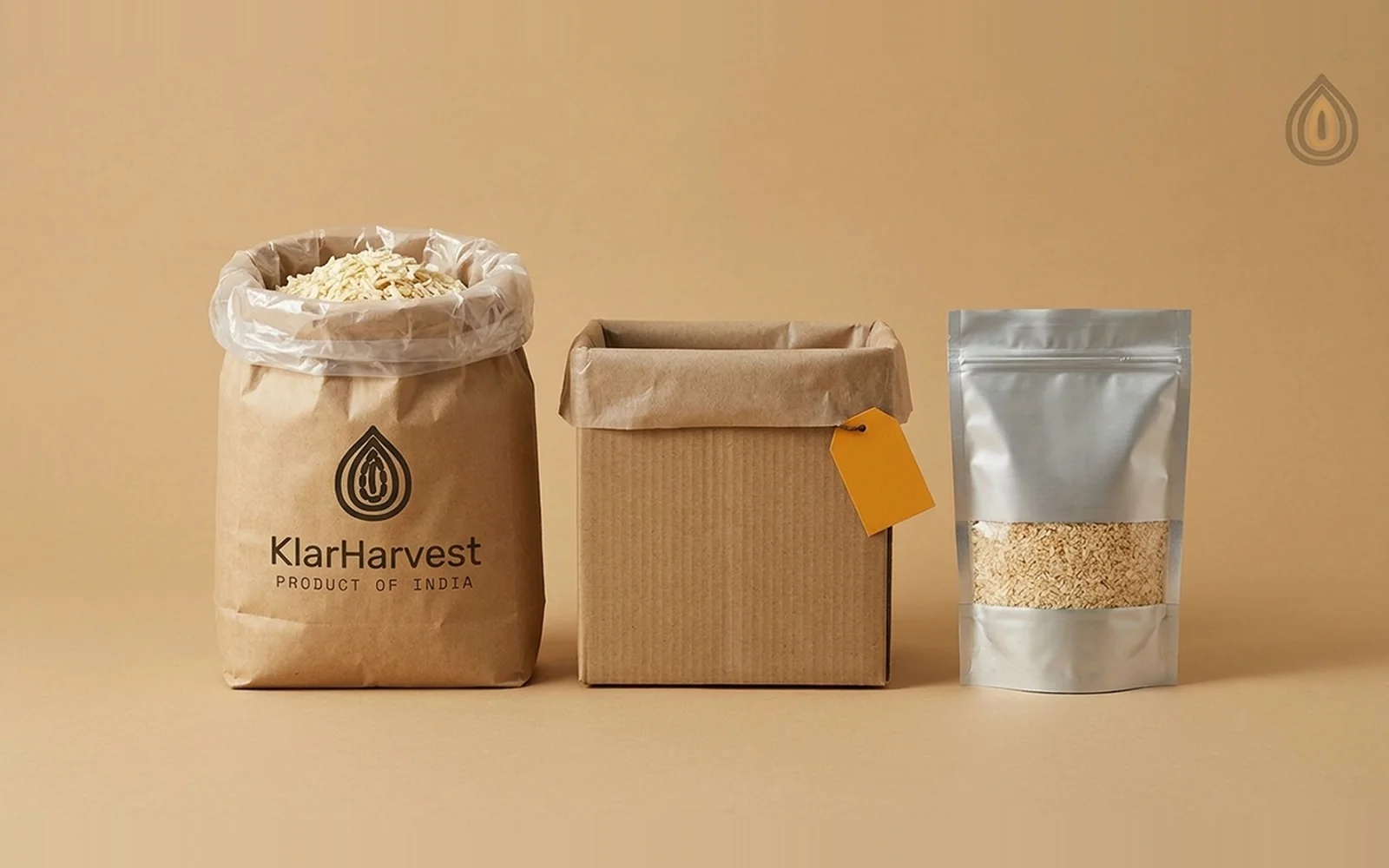
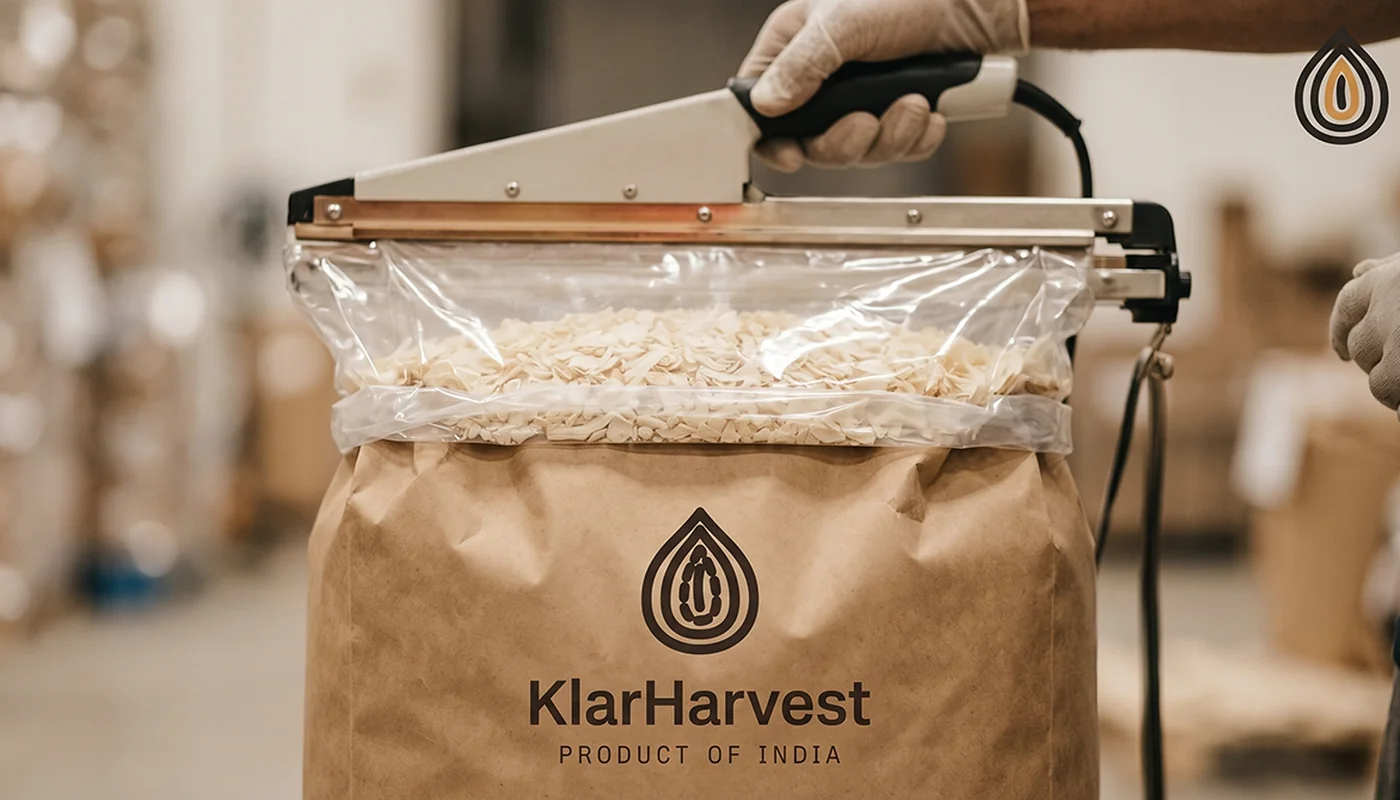
The unit of the export trade is a multi-wall paper sack, two or three plies of kraft paper, holding a polyethylene liner, filled with 20 kilograms net of product, the liner heat-sealed or tied and the paper sack stitched or pasted closed. Some buyers take 25 kilograms, some 10 or 12.5 for handling reasons, and the American trade uses 50 pound bags, but 20 kilograms is the European default and the size the plants' filling lines are set to. The bag is 50 to 60 centimetres wide and 80 to 90 long when filled with flakes and shorter for the denser cuts; the paper is 70 to 90 grams per square metre per ply, natural brown or bleached white; and the liner is low-density polyethylene of 75 to 100 microns. Filled bags are palletised, wrapped and loaded, and the kraft sack does two jobs: it protects the liner from puncture in handling, and it carries the printing. The liner does the third job, which is the one that matters.
Why the liner matters more than the bag
Dried onion is hygroscopic and sits far below the equilibrium moisture it would reach in any warehouse: at 60 percent relative humidity and 20 degrees, onion flakes equilibrate at around 9 to 10 percent moisture, and at 80 percent humidity in a monsoon or a summer port they climb past 12, where they cake, brown and support mould. Kraft paper is porous to water vapour; a paper sack alone would let the product reach that equilibrium within a few weeks. The liner is the barrier, and its performance depends on three things: thickness, since water vapour transmission through polyethylene falls roughly in proportion to it, and 75 microns is the practical minimum for a two-year life, with 100 preferred for humid destinations; the closure, since a tied liner leaks at the neck and a heat seal does not, and the better plants heat-seal every liner; and integrity, since a pinhole from a rough pallet or a stitching needle that catches the liner turns a sealed bag into an open one. Buyers who receive caked product in a bag that looks fine from outside will usually find a needle hole in the liner where the sack was stitched, which is why the plants that use pasted rather than stitched closures, or that fold the liner away from the stitch line, have fewer complaints. A metallised or aluminium-laminated liner cuts vapour transmission by a further order of magnitude and is used for long-life retail packs and for extra-sensitive powder; for a 20 kilogram bag turned over within a year, plain polyethylene at 100 microns is enough. The moisture science behind all this is in Dehydrated Onion Shelf Life and Water Activity in Dehydrated Onion.
Bag sizes and weights by cut
| Cut | Bulk density (g/l) | Volume of 20 kg (litres) | Bag fill | Bags per Europallet | Pallet net weight |
|---|---|---|---|---|---|
| Flakes 8-20 mm | 180-230 | 90-110 | Loose; bag is large and light | 30-35 | 600-700 kg |
| Chopped 3-5 mm | 280-350 | 60-70 | Moderate | 40 | 800 kg |
| Minced 1-3 mm | 350-450 | 45-55 | Firm | 40-45 | 800-900 kg |
| Granules 16-40 mesh | 450-550 | 36-45 | Firm | 45-50 | 900-1,000 kg |
| Powder 80 mesh | 500-650 | 30-40 | Dense; cartons or drums preferred | 45-50, or 40 cartons | 900-1,000 kg |
Flakes are the awkward cut: a 20 kilogram bag of flakes is bulky, light and easily crushed, and flakes break to fines when bags are stacked high or dropped, which is why the flake pallet is lower, why some buyers take flakes in 10 or 12.5 kilogram bags or in cartons, and why a container of flakes carries only about ten tonnes. The other cuts fill a bag firmly and stack well. The densities and what they mean for dosing are in Bulk Density and Flowability of Onion Powder and Granules.
Powder: cartons, drums and the caking question
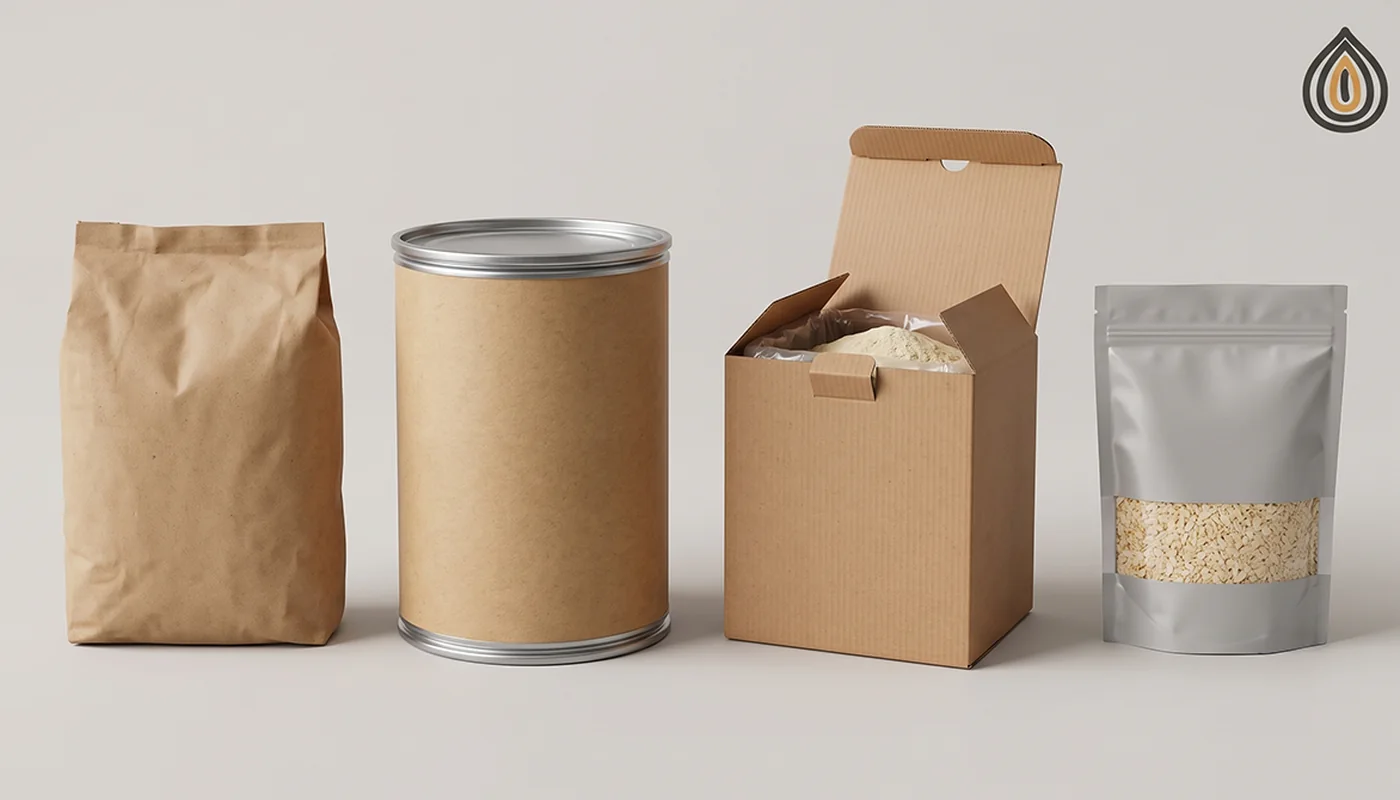
Onion powder is packed in the same 20 kilogram lined bag by many plants, and it is the format most likely to arrive caked, because powder has the most surface area, takes up moisture fastest, and compacts under the weight of a pallet stack into a block that needs breaking before use. The alternatives, in ascending order of cost, are: the lined bag with a thicker or metallised liner and a lower pallet stack; the lined corrugated carton, 10 to 20 kilograms, which holds its shape under stacking so the powder is not compressed and which stacks on a pallet without the slumping of bags, at roughly double the packaging cost of a bag; and the fibre drum with a liner, 20 to 25 kilograms, which is rigid, re-closable and the format of choice for flavour houses and pharmaceutical-grade buyers, at four to five times the cost of a bag. A buyer who uses powder through a season from opened packs should take cartons or drums; a buyer who uses a bag at a time can stay with bags. Anti-caking agent, silicon dioxide at 0.5 to 1 percent, is the other tool, permitted in the EU and declared as an ingredient, and it is a formulation choice rather than a packaging one; it is discussed with the flow question in the bulk-density guide linked above.
Big bags and bulk formats
Flexible intermediate bulk containers, big bags, of 500 to 1,000 kilograms with a polyethylene liner are used for granules and powder by large manufacturers with bulk handling, and by a few traders who repack in Europe; they cut packaging and handling cost per kilogram and are the worst format for moisture, since a big bag is opened once and then sits, and the product in it is exposed for as long as it takes to use a tonne. A big bag needs a lined inner with a spout, a discharge system at the buyer's end, and a plan to use its contents within days of opening. Flakes are not packed in big bags, since their weight crushes the bottom layer to fines. Bulk formats are not offered for LCL shipments, where the consolidator's handling would damage them.
Retail and foodservice formats
Retail packs, the 50 to 500 gram jars, tubs, pouches and shakers, are almost always filled in Europe by packers who buy the 20 kilogram bag, because the retail label, the language, the packer's address and the retailer's specification all sit on the European side, and because a retail-ready pack from India would carry sea freight on air and packaging. A few Mahuva plants have retail lines and fill stand-up pouches and jars for private-label customers in the Gulf and for Indian retail, and can do so for Europe at a cost that only makes sense for a full container of one item; the labelling burden then falls on the plant, which needs the European buyer's artwork and regulatory sign-off. Foodservice formats, 1 to 5 kilogram pouches, tubs and shakers for kitchens, sit between: they are filled in India for some buyers, in re-closable laminated pouches with a zip, since a kitchen opens a pouch and uses it over weeks, and the pouch needs a barrier that a 20 kilogram liner does not. The foodservice case, with portion economics, is in Dehydrated Onion for Foodservice and HoReCa; the retail label rules in Labelling Dehydrated Onion for the EU.
Nitrogen flushing, vacuum and desiccants
Nitrogen flushing, replacing the air in the pack with nitrogen before sealing, slows oxidation of the flavour compounds and the browning that oxygen contributes to, and it is standard for retail jars of onion powder with a two-year label life and for premium foodservice pouches; it is not used on 20 kilogram bags, where the liner is not gas-tight and the product is used within months. Vacuum packing compacts the product into a block, which is harmless for powder and destroys flakes, and is used only for some retail bricks. Desiccant sachets are not used in bulk bags, because a sachet in a bag of loose product is a foreign body waiting to happen; where extra moisture protection is wanted the answer is a better liner. A buyer who wants nitrogen or vacuum should say so and expect a per-bag premium and a longer lead time, since the plants run those operations on separate equipment.
Pallets: patterns, weights and what fits a container
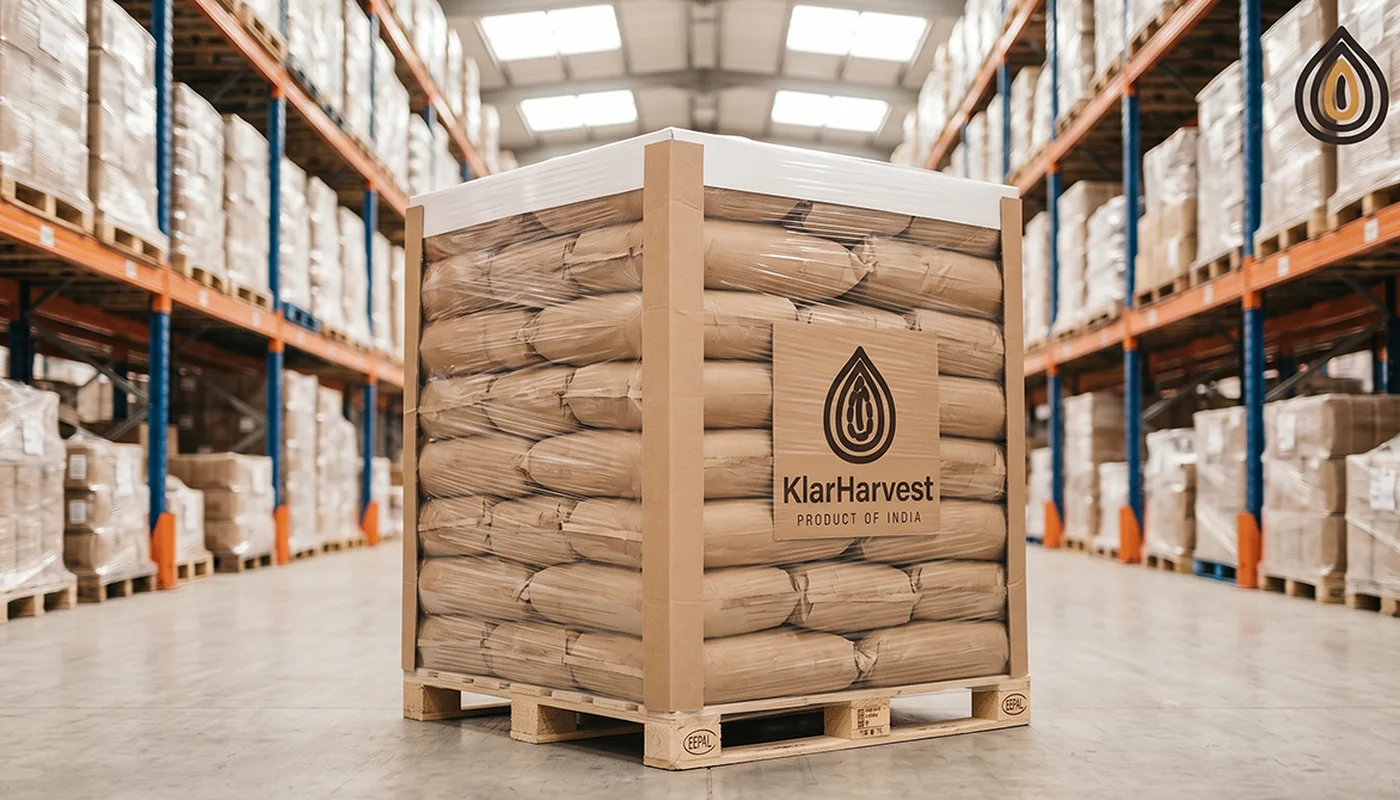
European buyers want Europallets, 800 by 1,200 millimetres, and the plants have them or use the 1,000 by 1,200 industrial pallet on request; American buyers want 1,016 by 1,219. Bags are laid in interlocking patterns, five bags per layer on a Europallet for the standard 20 kilogram sack, eight layers for granules and powder, six or seven for chopped and minced, five or six for flakes, with a top sheet, corner boards on the better-packed pallets, and stretch wrap of five or six turns; the pallet is then 1.6 to 2.0 metres high and 600 to 1,000 kilograms. A 20-foot container takes 10 Europallets on the floor, or 11 with a tight pattern, and a 40-foot takes 23 to 25; since dried onion is light, the volume runs out before the weight does, and the container arithmetic is by cut: about 10 tonnes of flakes, 12 to 13 of chopped, 14 to 15 of minced, 16 to 18 of granules and 18 to 20 of powder in a 20-foot box, doubled and a little more in a 40-foot. Wooden pallets must be ISPM 15 heat-treated and stamped for the EU, and the plants use treated pallets as routine; plastic pallets are available at a premium for buyers whose warehouses require them. Floor-loaded containers, bags stacked loose without pallets, carry 15 to 20 percent more weight and are used for some destinations, but European warehouses will not take them and the bags arrive damaged; they are not recommended for Europe. The loading practice and the weights per cut are in How a Dehydrated Onion Container Is Loaded, and the pallet configurations in detail in Pallet Configurations for Dehydrated Onion.
Bag marking: what every bag must carry
| Element | Required by | Notes |
|---|---|---|
| Product name and cut | Buyer's specification; EU B2B food information rules | "Dehydrated white onion flakes 8-20 mm" |
| Net weight | Weights and measures rules at destination | "20 kg net"; gross weight optional |
| Lot number | EU lot marking directive; every certification scheme | Must resolve to the plant, date and line |
| Production (drying) date and best-before date | EU food information rules for B2B | Month and year at minimum; day preferred |
| Country of origin | Customs; EU food information | "Product of India" |
| Packer or exporter name and address | EU food information rules | The FSSAI licensee's name; exporter's name for branded bags |
| Storage instructions | Good practice; some buyers' specifications | "Store cool and dry, below 25 °C, away from light" |
| Allergen and additive statement | Good practice | "Sulphite-free; no added ingredients" |
| Buyer's item code and barcode | Buyer's specification | GS1-128 with lot and date is the useful form |
| FSSAI licence number | Indian rules for the domestic market; carried on export bags as routine | |
| Halal, kosher or organic marks | Only where certified |
The marking is printed on the kraft sack in one or two colours from a plate the plant keeps, or applied as a printed label, and the variable data, lot, dates and weight, is inkjet-printed or stamped at filling. A buyer's marking requirements should be sent as artwork with the first order, and the plant's proof approved before printing; a bag reprinted because a buyer's item code was wrong costs a week. The lot code's structure and what it should resolve to is in Lot Codes and Traceability in Dehydrated Onion.
Private label: what it involves and what it costs
Private label at the bulk level means the 20 kilogram bag carries the buyer's or the exporter's brand rather than the plant's. Plants supply plain bags, printed with the mandatory marking and no brand, as standard; a buyer's brand is printed from a plate the buyer pays for once, 5,000 to 15,000 rupees per design, with a minimum print run of a few thousand bags, and adds 2 to 4 rupees per kilogram to the price for the printing and the handling of a dedicated bag stock. The buyer supplies the artwork, the plant checks it against the mandatory marking, and the exporter keeps the bag stock at the plant or at its own godown. For an exporter that sources from several plants, the practical arrangement is plain sealed bags from the plant and the brand applied as a label at the exporter's premises, which keeps the plant's certification chain intact, since the sealed bag is never opened, and lets one bag stock serve every plant. Retail private label is a different business, filled and labelled in Europe or by a plant with a retail line, as above. The private-label models and their trade-offs are in Private Label Dehydrated Onion.
Packaging materials and food-contact compliance
The liner touches the food and must comply with the food-contact rules of the destination: in the EU, the framework regulation on food contact materials and the plastics regulation, which the liner supplier evidences with a declaration of compliance covering the polyethylene grade and its migration testing; in the US, the relevant FDA food-contact regulations; in India, the FSSAI packaging regulations. A buyer's supplier approval file should hold the liner supplier's declaration of compliance, which the plant obtains from its film supplier and passes on. Kraft paper does not touch the food and is not a food-contact material in the regulatory sense, but it should be food-grade and free of recycled content that could migrate through the liner; inks are printed on the outer ply. Pallets are ISPM 15; stretch film and strapping are not food-contact. Packaging waste rules in the EU, extended producer responsibility for the paper and plastic placed on the market, fall on the importer as the party placing the packaging on the market, and importers registered under their country's scheme count the sack and liner weights per shipment, which the packing list should make easy by stating packaging weights.
Handling at the receiving end
The best packaging fails if the receiving warehouse treats it badly, and the failures are the same everywhere: bags stacked directly on the floor in a damp corner, pallets stacked three high so the bottom bags split, forklift tines through a bag, opened bags left open. The rules are a dry warehouse at or below 25 degrees and 65 percent humidity, pallets on racking or two high at most, no direct sunlight, opened liners re-sealed with a clip within the shift, and first-in first-out by drying date rather than by arrival. A bag with a punctured liner should be used first or re-bagged; a bag with visible caking should be checked for moisture before use. The warehouse side is in Storing Dehydrated Onion in a European Warehouse.
Packaging costs in the price
| Format | Packaging cost per kg of product, ₹ | Against the standard bag |
|---|---|---|
| Standard 20 kg 2-ply kraft with 75 µm PE liner, plain print | 2.5-3.5 | Baseline |
| Same with 100 µm liner, heat-sealed | 3-4 | +0.5 |
| 3-ply kraft, 100 µm liner, private-label print | 4.5-6.5 | +2 to +3 |
| Metallised liner | +2 to +3 | |
| 10 kg or 12.5 kg bags | +1 to +1.5 | More bags per tonne |
| Lined corrugated carton, 10-20 kg | 6-9 | About double |
| Fibre drum with liner, 20-25 kg | 12-18 | Four to five times |
| Big bag with liner, 500-1,000 kg | 1.5-2.5 | Cheaper per kg; handling at destination |
| Foodservice laminated zip pouch, 1-5 kg | 15-30 | Retail-type cost |
| Palletising, wrap, corner boards, ISPM 15 pallet | 2-3 per kg of a Europallet load | Included in most FOB quotes |
Packaging is 2 to 5 percent of the FOB price for the standard bag and up to 10 percent for drums, which is why a buyer's format choice belongs in the specification rather than in an afterthought; the whole cost build is in What Does Dehydrated Onion Cost per Kilogram?
Packaging lines for the specification
- "Packed in 20 kg net multi-wall kraft paper sacks, minimum 2 ply, with a food-grade low-density polyethylene liner of minimum 100 microns, heat-sealed; sack closure stitched or pasted so as not to puncture the liner."
- "Powder in lined corrugated cartons of 20 kg net" or "in lined fibre drums of 20 kg net", if that is the choice.
- "Bags marked with product name and cut, net weight, lot number, production and best-before dates, country of origin, packer's name and address, storage instructions and the buyer's item code as per approved artwork."
- "Palletised on ISPM 15 heat-treated Europallets 800 x 1,200 mm, maximum 8 layers, maximum pallet height 2.0 m, with top sheet, corner boards and stretch wrap of minimum 5 turns; pallets not to be double-stacked in the container."
- "Liner supplier's declaration of compliance with EU food-contact regulations to be provided at supplier approval."
- "Packaging weights per bag and per pallet stated on the packing list."
Testing a package: the checks a buyer can run
A buyer does not need a packaging laboratory to know whether a supplier's bag will hold. Four checks on the first sample bags, and again on the first delivery, cover it. Measure the liner: a micrometer on a cut piece reads the thickness, and a liner sold as 100 microns that reads 60 is the most common substitution in the trade, since film is bought by weight and a thinner film saves the plant a rupee a bag. Inspect the seal: a heat seal should be a continuous band 5 to 10 millimetres wide with no channels, and a strip cut across it should not peel apart by hand; a tied or taped liner is not a seal. Look for punctures at the stitch line: open a bag from the bottom and hold the liner to the light where the sack was stitched, since a needle that catches the liner leaves a row of holes. And weigh the product's moisture on arrival against the certificate: a rise of more than 0.5 points over a normal transit says the liner failed somewhere. For a buyer with a laboratory, the water vapour transmission rate of the film, tested to the standard method, is the number that predicts shelf life, and a liner supplier's data sheet states it; 100 micron low-density polyethylene runs around 1 to 2 grams per square metre per day at tropical conditions, and a metallised laminate an order of magnitude lower. The moisture check itself is in Dehydrated Onion Moisture Content.
Packaging faults seen on arrival, and their causes
| Fault on arrival | Usual cause | Prevention |
|---|---|---|
| Product caked in a bag that looks intact | Liner punctured at the stitch line, or tied rather than sealed | Pasted closure or liner folded away from the stitch; heat seal specified |
| Whole pallet caked on one side | Condensation from the container roof or wall | Top sheets and wall dunnage; desiccant in the box; pallets away from the walls |
| Bags split at the bottom of the stack | Pallet too high, or pallets double-stacked in the container | Maximum layers in the specification; no double stacking |
| Flakes broken to fines | Rough handling; heavy bags; high pallets | 10 or 12.5 kg bags for flakes; lower stacks; palletised full containers rather than LCL |
| Bags torn by forklift tines | Handling at the origin depot or the destination | Corner boards; pallets not overhanging; loading video to locate the damage |
| Smell of a previous cargo in the product | Container not inspected; contaminated depot | Food-grade container inspection at the depot, written into the contract |
| Wet pallets, mould on the wood | Container floor damage; rain at stuffing | Depot inspection; stuffing under cover; ISPM 15 pallets stored dry |
| Bag marking illegible or wrong lot | Inkjet failure; wrong plate; bags from an old stock | Proof approval; marking check on the loading video and the packing list |
| Liner thinner than specified | Substitution at the plant to save cost | Micrometer check on samples and first delivery; thickness on the certificate |
| Product dusty and bags leaking fines | Powder in a sack without a proper liner, or a liner that split | Cartons or drums for powder; liner check |
Most of these are visible on the loading video and the packing list before the container sails, which is one of the reasons the video exists; the arrival inspection and the claims procedure that follows a packaging failure are in Marine Insurance and Claims for Dehydrated Onion Shipments.
Sustainability: paper, plastic and the recycling question
The standard bag is a paper sack, recyclable in the paper stream once the liner is removed, and a polyethylene liner, recyclable in the film stream where one exists, and European importers under the packaging waste rules count and pay for both. The options to reduce the plastic are limited by the product's need for a moisture barrier: a paper sack with a barrier coating instead of a loose liner exists and performs less well in tropical transit; a compostable liner from bio-based film is available at three to four times the cost and with a shorter barrier life, and is used for some organic and retail programmes; a thinner liner saves plastic and loses shelf life. Big bags cut packaging per kilogram by four fifths for buyers who can handle them, and returnable plastic pallets replace treated wood for buyers with a closed loop. The honest position for a bulk dried vegetable is that the 20 kilogram paper sack with a polyethylene liner is already a low-packaging format, about 1.5 percent of the product's weight, and that the largest packaging saving available to most buyers is to stop losing product to moisture, since a caked bag thrown away wastes the onion, the water and the fuel that dried it as well as the bag. Importers reporting under their national schemes need the sack and liner weights per unit, which a supplier's packing list should carry and which KlarHarvest's does.
How KlarHarvest packs
KlarHarvest ships in 20 kilogram two-ply or three-ply kraft sacks with a 100 micron heat-sealed liner as standard, filled and sealed at the BRCGS-certified plant; bags are never opened after sealing, and the KlarHarvest label with the lot QR code is applied to the sealed bag at the exporter's godown. Cartons and drums are available for powder, 10 and 12.5 kilogram bags for flakes, and buyer-branded printing on the standard bag from a one-off plate. Pallets are ISPM 15 Europallets, cornered, wrapped and top-sheeted, never double-stacked, and the loading is filmed; the loading video and the packing list with packaging weights are in the lot record described on the our process page. The liner supplier's declaration of compliance is in the supplier approval pack sent with the first sample.
Frequently asked questions
What is the standard packaging for dehydrated onion?
A 20 kilogram net multi-wall kraft paper sack with a polyethylene liner inside, the liner heat-sealed, palletised on Europallets and stretch-wrapped. Powder is often packed in lined cartons or drums instead.
Why does the liner thickness matter?
The liner is the moisture barrier; kraft paper is porous. At 75 to 100 microns, heat-sealed, it holds 5 percent moisture for two years; a thin, tied or punctured liner lets the product climb to 8 or 10 percent within weeks and cake.
How many bags fit on a pallet and in a container?
Forty 20 kilogram bags on a Europallet for granules and minced, fewer for flakes; 10 to 11 Europallets in a 20-foot container, so roughly 10 tonnes of flakes, 13 of chopped, 15 of minced, 17 of granules and 18 to 20 of powder.
Can I have my own brand on the bags?
Yes. Supply artwork, pay once for a printing plate, and the bag costs 2 to 4 rupees per kilogram more. Exporters sourcing from several plants apply a brand label to the sealed plain bag instead.
Should onion powder be in bags or drums?
Bags are fine if a bag is used at a time. Cartons or drums are better where powder is used gradually from opened packs, since they hold their shape, do not compress the powder and re-close.
What must be printed on every bag?
Product name and cut, net weight, lot number, production and best-before dates, country of origin, the packer's name and address, and storage instructions; plus the buyer's item code and barcode where specified.
Are the pallets treated for the EU?
Yes, ISPM 15 heat-treated and stamped, as routine at export plants. Plastic pallets are available at a premium.
Next step
Request a sample and it comes in the export liner so the pack can be assessed with the product; to price a specific packaging, pallet or private-label arrangement, request a quote with the format and the volume.