- What is the same
- Where Indian garlic grows, and the calendar
- Dry matter and the yield ratio
- Cuts and bands: garlic's sizes
- Colour and browning in garlic
- Flavour: allicin and what drying does to it
- Drying garlic: what the plant does differently
- Residues and contaminants in garlic
- Microbiology and the tiers for garlic
- Price: garlic's own cycle
- Chinese garlic and the origin question
- Storage and shelf life differences
- Specifying garlic beside onion
- Mixed containers of the two
- Blends of onion and garlic
- Approving a supplier for both
- Where garlic is used, and the cut for each
- The two markets side by side in 2026
- Quality defects particular to garlic
- How KlarHarvest supplies garlic
- Frequently asked questions
Judge the product, not the words
200-500 g from a current lot, dispatched by courier with the lot lab report.
Request a sampleBuying dehydrated garlic and onion together is the natural thing to do, since the same certified plants around Mahuva dry both, the same exporters sell both, the same bags, containers and documents carry both, and a seasoning maker or a soup manufacturer uses both; a buyer who has done the work of approving an onion supplier can add garlic from it in a week. But garlic is not onion with a stronger smell. It grows in a different part of Gujarat and in other states, on a calendar a month behind, at two to three times the dry matter, so that its yield ratio and its price behave differently; its flavour chemistry, allicin rather than the onion sulphur compounds, sets different limits on drying and storage; its colour runs cream to yellow and browns differently; its residue profile is its own; and its market is separate from onion's, with a supply cycle that can be tight when onion is loose. This guide sets out what stays the same when a buyer adds garlic to an onion supply and what changes, so that the second product is bought as well as the first.
It is written for buyers already sourcing onion who want garlic from the same chain, with figures for the 2026 season. The onion side of every comparison is in the onion guides linked throughout; this guide is the garlic side and the joint purchase.
What this guide covers
- What is the same
- Where Indian garlic grows, and the calendar
- Dry matter and the yield ratio
- Cuts and bands: garlic's sizes
- Colour and browning in garlic
- Flavour: allicin and what drying does to it
- Drying garlic: what the plant does differently
- Residues and contaminants in garlic
- Microbiology and the tiers for garlic
- Price: garlic's own cycle
- Chinese garlic and the origin question
- Storage and shelf life differences
- Specifying garlic beside onion
- Mixed containers of the two
- Blends of onion and garlic
- Approving a supplier for both
- Where garlic is used, and the cut for each
- The two markets side by side in 2026
- Quality defects particular to garlic
- How KlarHarvest supplies garlic
- Frequently asked questions
What is the same
The chain is the same chain. The plants that dry export onion in Mahuva and the Bhavnagar belt dry garlic on the same belt dryers in a second season, under the same BRCGS certification, with the same laboratories, the same 20 kilogram lined kraft bags, the same pallets and containers and the same document set; the registrations behind the export, IEC, APEDA and FSSAI, cover both products; the customs classification is a neighbour, 0712 90 for dried garlic against 0712 20 for onion, with the same 6.4 percent EU duty; the Incoterms, the payment terms, the quote structure and the claims procedure are identical; and the supplier a buyer has vetted for onion needs no new vetting for garlic beyond the product-specific points below. A buyer's onion specification is the template for its garlic specification, its onion supplier file is the file the garlic goes into, and the onion lot record's structure carries the garlic lot. The chain is described in How to Import Dehydrated Onion from India and the supplier vetting in 25-Point Checklist Before You Choose a Dehydrated Onion Supplier; both apply to garlic without change.
Where Indian garlic grows, and the calendar
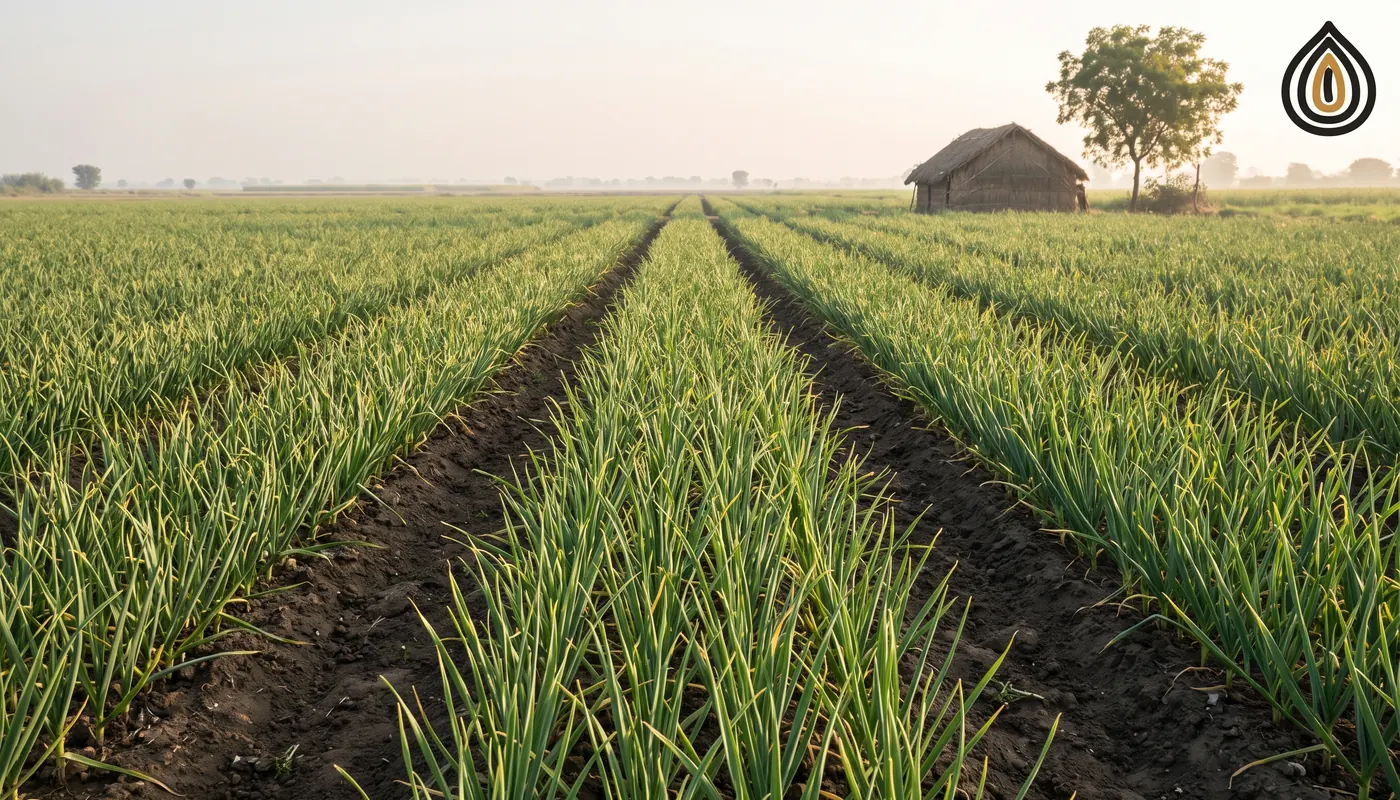
India is the world's second garlic producer after China, and its crop is grown as a rabi crop in Madhya Pradesh, which is the largest state, Rajasthan, Gujarat and Uttar Pradesh, planted in October and November and lifted from February to April; the Gujarat garlic belt is in the central and northern districts rather than the coastal Saurashtra belt where the dehydrator onion grows, and the plants around Mahuva buy their garlic from that belt and from Madhya Pradesh, trucked a day or two. The plants therefore run garlic as a second season after the white onion peak, from late April into June and again from stored garlic through the year, since garlic stores better than onion; a plant's garlic runs interleave with its onion runs, and a buyer ordering both in April is buying onion from the peak and garlic from the first new-crop lots. The onion calendar that garlic follows a month behind is in The Indian Onion Harvest Calendar.
| Onion (white dehydrator) | Garlic | |
|---|---|---|
| Main growing belt for the plants | Coastal Saurashtra: Mahuva, Talaja, Amreli | Central and north Gujarat; Madhya Pradesh; Rajasthan |
| Planting | November-December | October-November |
| Harvest | Late February-May | February-April |
| Plants' drying season | March-June, then stored onion | Late April-June, then stored garlic |
| Storage life of the raw crop | 4-8 months, losses 25-40 % | 6-10 months, losses 15-30 % |
| Dry matter at intake | 17-20 % | 35-40 % |
| Yield ratio, flakes | 8-9 to 1 | 3-3.5 to 1 |
Dry matter and the yield ratio
Garlic cloves are 35 to 40 percent dry matter against onion's 17 to 20, so a kilogram of dried garlic takes 3 to 3.5 kilograms of fresh cloves where a kilogram of dried onion takes 8.5 of fresh bulb; the peeling loss on garlic is higher, since the cloves must be separated from the bulb and skinned, 15 to 20 percent of the fresh weight, and the drying is slower per kilogram of water removed because the clove is dense, but the ratio is still a third of onion's. That changes the price arithmetic: garlic's raw material is a smaller multiple of the yard price, so a rupee at the garlic yard is 3 to 3.5 rupees on the product rather than 8.5, and garlic's price is driven more by the raw price level, which is several times onion's per kilogram, than by the ratio's amplification. The onion arithmetic, and the multiplier that garlic lacks, is in 8 to 1: The Fresh-to-Dry Yield Ratio.
Cuts and bands: garlic's sizes
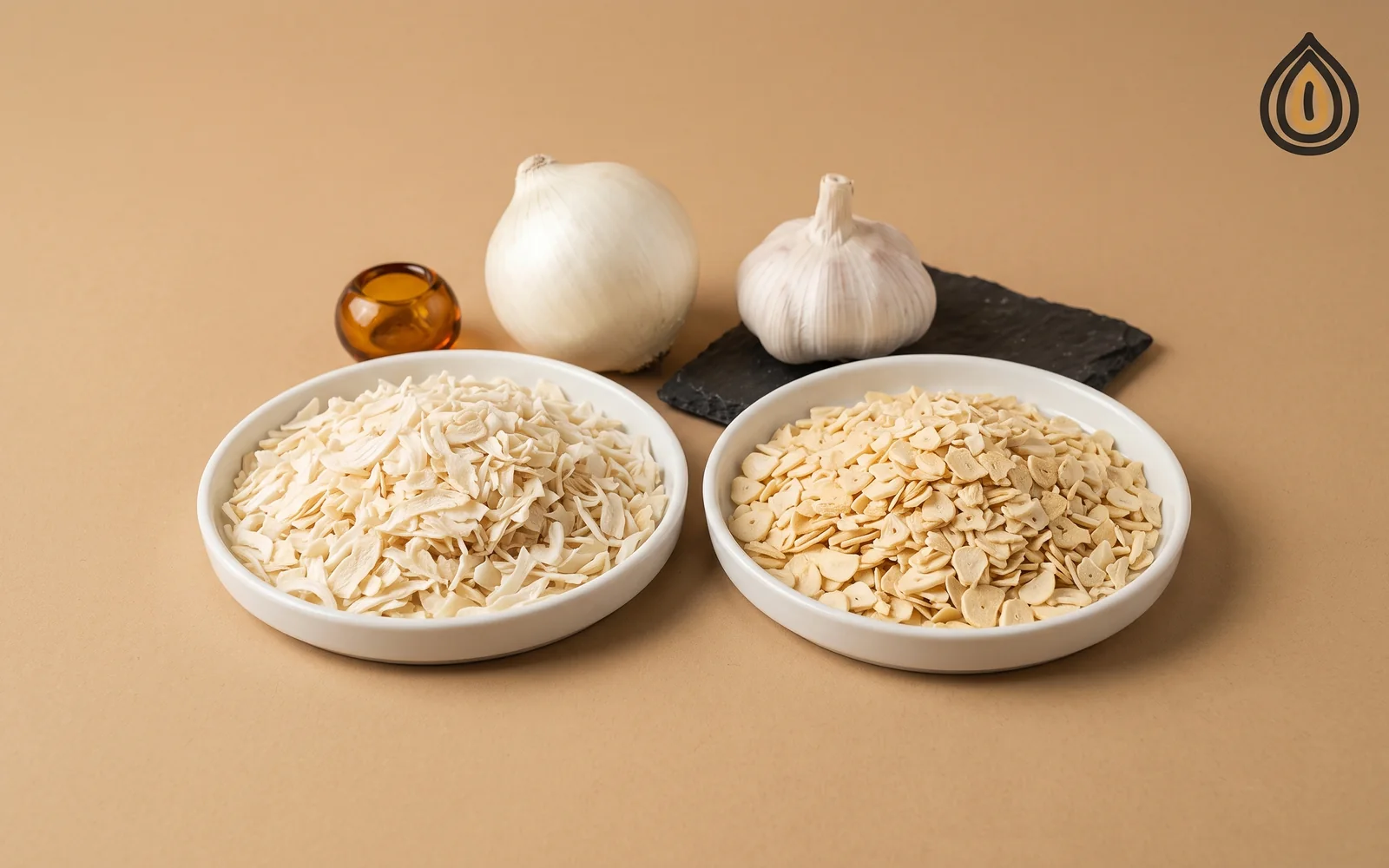
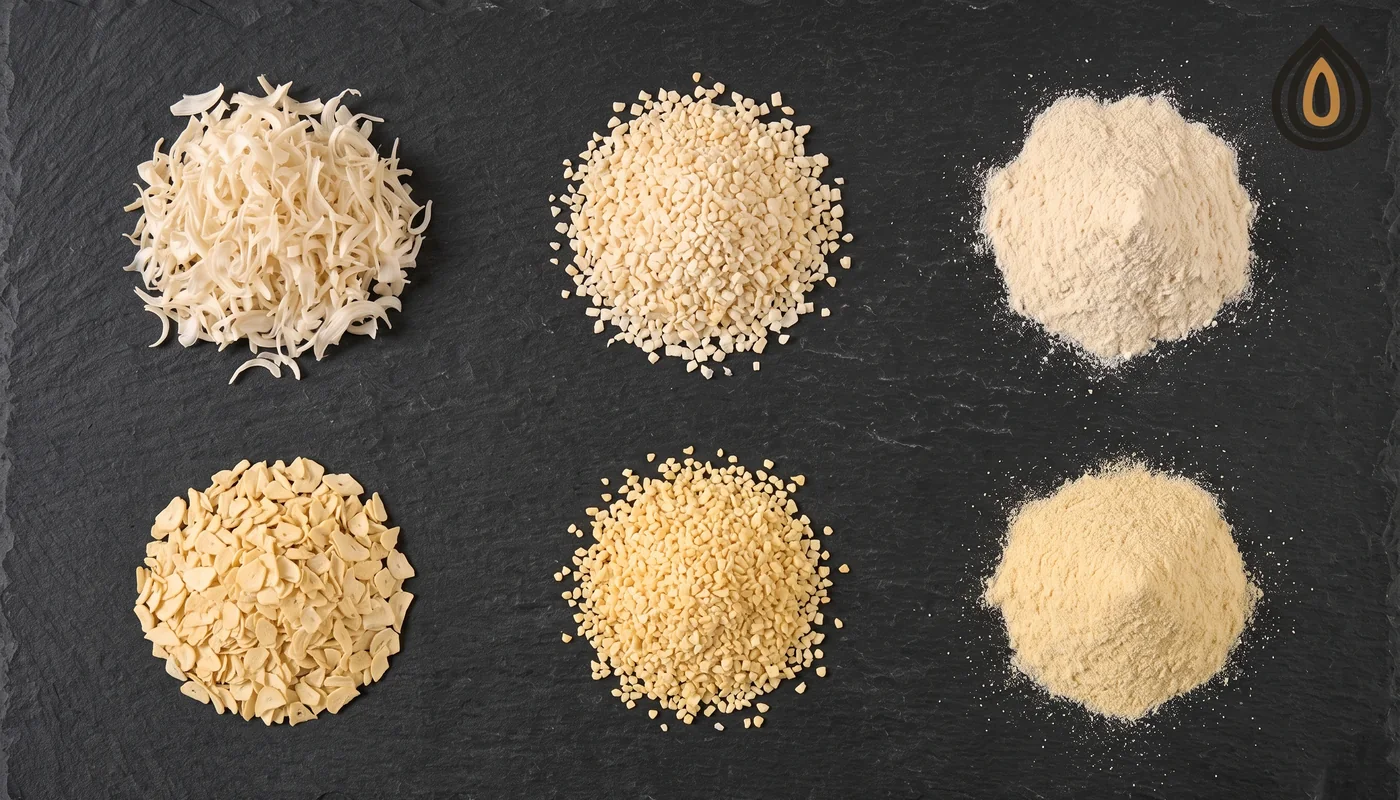
Garlic is dried as sliced cloves rather than rings, and its cuts run a size smaller than onion's at every step: garlic flakes are 3 to 8 millimetres, the size of onion chopped; garlic chopped is 1.5 to 3; garlic minced 0.5 to 1.5; and garlic granules and powder share onion's mesh bands, 16-40, 26-40, 40-60 and 80 or 100 mesh. A buyer ordering "flakes" of both should expect two different piece sizes, and a specification written in millimetres and mesh avoids the confusion, as Mesh Size in Dehydrated Onion explains for onion. Garlic's bulk densities are higher than onion's cut for cut, flakes at 300 to 380 grams per litre against onion's 180 to 230, so a container of garlic flakes carries 14 to 16 tonnes where onion flakes carry ten, and garlic powder at 550 to 700 approaches the box's weight limit in a 40-foot.
| Cut | Onion size | Garlic size | Garlic bulk density | Garlic tonnes per 20 ft |
|---|---|---|---|---|
| Flakes | 8-20 mm | 3-8 mm | 300-380 g/l | 14-16 |
| Chopped | 3-5 mm | 1.5-3 mm | 380-450 | 16-18 |
| Minced | 1-3 mm | 0.5-1.5 mm | 450-520 | 18-20 |
| Granules 16-40 mesh | same band | same band | 500-600 | 19-21 |
| Powder 80-100 mesh | same band | same band | 550-700 | 20-22 |
Colour and browning in garlic
Fresh garlic cloves are white to ivory and dried garlic runs cream to pale yellow, with the yellow deepening as the product ages or is over-dried; the trade grades it as white, creamy white and yellow, and a buyer's colour clause for garlic uses a b* value on the yellow axis rather than the L* that onion's clause leans on. Garlic browns in the dryer as onion does, through the Maillard reaction of its sugars, but it also greens: cloves that have been stored cold or bruised develop blue-green pigments when cut and heated, a harmless reaction of the clove's sulphur compounds, and a green-tinged garlic lot is a raw-material fault rather than a plant one. Garlic does not carry the pink admixture problem, and its scorched-piece defect reads as dark brown against the yellow. The colour grading method for onion, with the instrumental values, is in Dehydrated Onion Colour, and it adapts to garlic with the yellow axis added.
Flavour: allicin and what drying does to it
Onion's pungency comes from sulphur compounds released when the cell is cut, and drying loses most of them, leaving the sweet cooked note; garlic's comes from allicin, formed when the enzyme alliinase meets its substrate alliin at cutting, and drying handles it differently. Dried garlic keeps its alliinase active if it is dried gently, below 60 degrees at the finish, and the powder or flake regenerates allicin and its pungency on rehydration, which is why dried garlic tastes sharply of garlic in a way that dried onion does not taste sharply of onion; a garlic lot dried hot has its enzyme denatured and tastes flat and cooked. The trade therefore specifies garlic's pungency, as allicin potential or as a sensory grade, and a buyer of garlic for a raw application, a dressing or a dip, wants the gently dried product while a buyer for a cooked sauce is less concerned. The sensory comparison method in Sensory Evaluation of Dehydrated Onion applies to garlic with a pungency line added.
Drying garlic: what the plant does differently
The line is the same line with four changes. Cloves are separated from the bulb by a cracker and peeled by air or by hand, which is slower and lossier than onion peeling and is the bottleneck of a garlic run; the peeled cloves are sliced thin, 2 to 3 millimetres, since a whole clove would take a day to dry; the dryer runs cooler at the finish to protect the enzyme, 55 to 60 degrees, and longer per kilogram of product because the slice is dense; and the plant cleans down between garlic and onion runs, since each carries its flavour into the other's product, a garlic-tainted onion lot being a rejection in any pale application. Garlic dust in a plant is an irritant and the milling room is ventilated for it. A plant that runs both products well schedules them in blocks with a full clean between, and a buyer of both should ask how the changeover is done; the eight-step process that garlic shares is in How Dehydrated Onion Is Made.
Residues and contaminants in garlic
Garlic's pest and disease pressures differ from onion's and so does its residue profile: the fungicides carbendazim, mancozeb and the triazoles are used against rots and blights, the insecticides against thrips overlap with onion's, and the storage of garlic in warehouses brings phosphine fumigation into the picture, since garlic is fumigated against storage pests where onion rarely is; a garlic residue screen should include phosphine and the storage fumigants. The EU's MRLs for garlic are set on the fresh clove and the processing factor is about 3 rather than 8, which makes the concentration argument less severe than for onion. Heavy metals follow the growing region's soils; the Madhya Pradesh belt has a different profile from Saurashtra's. The residue system and the reading of a screen are in Pesticide Residues in Dehydrated Onion, with the substances swapped for garlic's.
Microbiology and the tiers for garlic
Garlic carries a higher natural load than onion, from the soil that clings to the clove skins and the bulb's structure, and standard-tier dried garlic runs to the same 500,000 per gram limit with results nearer the top of the range than onion's; steam treatment to the low and extra low tiers works as it does for onion and at the same premiums, with the caveat that steam denatures the alliinase and a treated garlic is a less pungent garlic, which a buyer of treated garlic for a raw application should taste before contracting. The tiers and the treatment are in Low Bacterial and Extra Low Bacterial Dehydrated Onion; the trade-off between pungency and count is garlic's own.
Price: garlic's own cycle
Dried garlic from India sold in the 2026 season at 230 to 320 rupees per kilogram FOB for flakes and 250 to 350 for powder, one and a half to two times onion, and its price is set by the fresh garlic market, which has its own cycle: Indian garlic prices spiked in 2023 and 2024 on short crops and export demand, tripling at the yard, and eased through 2025 and 2026 on larger plantings, and the dried price followed. Garlic's cycle is not onion's, so a buyer of both faces two independent price risks, and a year of cheap onion can be a year of dear garlic; contracting both at their respective harvests, onion in April and garlic in May or June, is the way to fix both. Garlic's price history, and the export controls the Indian government has occasionally placed on fresh garlic in short years, are part of the picture in Dehydrated Onion Price History 2020-2026, which tracks the two side by side.
Chinese garlic and the origin question
China grows most of the world's garlic and dries most of the world's dried garlic, at prices that Indian product cannot always match, and the origin question is a real one for a European buyer: Chinese dried garlic has been the subject of EU anti-dumping and anti-circumvention measures on the fresh product, of residue and contaminant findings, and of country-of-origin fraud where Chinese garlic was relabelled as Indian or other origin to avoid duty; a buyer of dried garlic should require the origin on the certificate of origin and the bag, should ask the plant for its raw-material sourcing, and should know that Indian garlic's flavour profile, variety and residue pattern differ from Chinese and can be distinguished by a laboratory. A supplier that offers Indian garlic at a Chinese price should be asked where the cloves came from. The origin and registration questions for an Indian exporter are in FSSAI, APEDA and IEC: The Indian Registrations Behind a Legitimate Exporter.
Storage and shelf life differences
Dried garlic at 5 to 6 percent moisture stores as onion does, sealed and cool, for 18 to 24 months, and it shares onion's caking and moisture-uptake behaviour with a lower sugar content that makes it cake a little less readily; its particular risks are flavour loss, since the allicin potential falls with time and with heat, so a garlic lot for a raw application should be fresh-crop, and yellowing, which is the visible sign of age. Garlic and onion should be stored apart, since each taints the other through the bag over months, and a warehouse that keeps them on the same pallet has both products smelling of garlic by the spring. The storage rules are in Dehydrated Onion Shelf Life, and the water-activity thresholds that garlic shares in Water Activity in Dehydrated Onion.
Specifying garlic beside onion
- Cut in millimetres and mesh, since "flakes" means a different size for garlic.
- Colour: white to creamy white, with a b* maximum on the ground product, and a green-tinge exclusion.
- Pungency: allicin potential or a sensory grade against a retained reference, for raw applications.
- Drying: "dried at a finishing temperature not exceeding 60 °C to preserve alliinase" where pungency matters.
- Moisture and aw as for onion: 6 percent and 0.40, 5 percent and 0.35 for powder.
- Microbiology tier with the note that treated garlic is milder.
- Residues: the garlic list including phosphine and the storage fumigants; processing factor stated.
- Origin: "Indian garlic, cloves sourced from [state]", on the certificate of origin and the bag.
- Changeover: "produced in a garlic block following a full clean-down from onion" and the reverse for onion lots.
- Allergen and additive statements as for onion; garlic is likewise on no mandatory allergen list.
The onion specification these lines sit beside is in How to Read a Dehydrated Onion Specification Sheet.
Mixed containers of the two
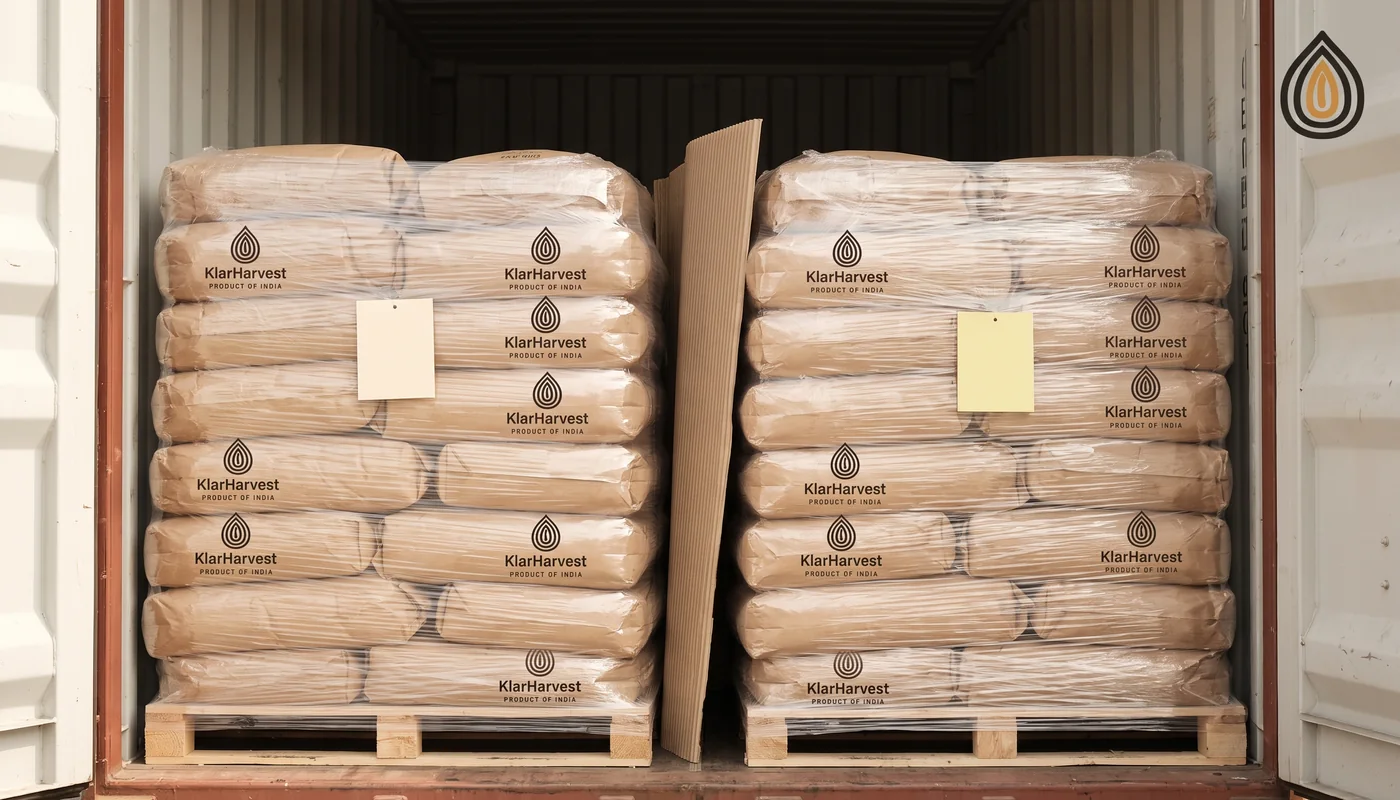
A buyer of both products fills a container with pallets of each, and the loading follows the mixed-load rules: one lot per pallet, the denser garlic pallets low and central for weight distribution, the onion flakes never under anything, the lots listed per pallet on the packing list, and the two products separated in the box by a pallet's width or a sheet where either is a flake, since the flavours transfer through kraft over a month at sea; a container of garlic powder and onion flakes together arrives with garlic-scented flakes unless the onion is in a lined carton or the two are dunnaged apart. The customs entry lists both tariff lines, and the certificate of origin and the phytosanitary certificate, where requested, name both products. The load planning is in How a Dehydrated Onion Container Is Loaded and the wider mixed-load case in Mixed Containers: Combining Onion Cuts, Garlic and Vegetables.
Blends of onion and garlic
Onion and garlic go together in seasonings at ratios from ten to one to one to one, and the blender's concerns are the ones the spice-blend guide sets out, with two garlic specifics: garlic powder is denser than onion powder and the two segregate less than either does with a coarse component, so a garlic-and-onion powder base blends well; and garlic's stronger flavour at a given dose means a blend's onion is the bulk and the garlic the accent, typically 3 to 8 percent garlic against 10 to 25 percent onion in a savoury base. Garlic salt and onion salt are made the same way, with the same caking controls. A plant that supplies both can pre-blend to a buyer's ratio in its own blender, which saves the buyer a blending step and is a legitimate operation under the plant's certification; the blending detail is in Dehydrated Onion in Spice Blends and Seasonings.
Approving a supplier for both
Adding garlic to an approved onion supplier is a short exercise: the plant's certificate scope is checked to include garlic, which for the Mahuva plants it does; the garlic specification is written from the onion template with the lines above; samples of the garlic cuts come from a named lot with the certificate, including the pungency line and the residue screen with the garlic substances; the changeover procedure is asked for; and the supplier declaration is extended to garlic. A first garlic order can go in the same container as the next onion order, which is the usual way the second product starts. The whole sequence is the one in From Sample to First Container, shortened by the approval already held.
Where garlic is used, and the cut for each
Garlic goes into most of the products onion goes into, at a fraction of the dose, and a few of its own.
| Product | Garlic cut | Typical dose | Onion in the same product |
|---|---|---|---|
| Seasoning blends, rubs, marinades | Powder 80-100 mesh; granules 40-60 | 2-8 % of the blend | 10-25 % onion |
| Garlic salt, garlic bread seasoning | Powder or granules 26-40 | 15-30 % | Often none |
| Soups, sauces, gravies | Powder; minced for visible pieces | 0.2-0.8 % of the finished product | 1-3 % onion |
| Sausages, burgers, kebab meat | Powder; granules 40-60 | 0.2-0.5 % of the meat block | 1-2.5 % onion |
| Bread toppings, focaccia, garlic bread | Flakes 3-8 mm, oiled or in butter | 1-3 % of the dough weight on top | Onion flakes on onion rolls |
| Pickles, chutneys, relishes | Flakes or chopped | 1-3 % | 2-5 % onion |
| Dips, dressings, hummus | Powder; ELB tier | 0.3-1 % | 1-2.5 % onion |
| Snack seasonings | Powder; granules 40-60 | 2-6 % of the seasoning | 5-20 % onion |
| Ready meals, curry sauces | Powder; chopped | 0.3-1 % | 1-4 % onion |
Garlic's pungency after gentle drying means a raw application, a dressing or a dip, tastes strongly of it at doses that would be mild for onion; the application guides for soups and sauces, meat, bakery and blends give the onion side of each row.
The two markets side by side in 2026
| Dehydrated onion, white | Dehydrated garlic | |
|---|---|---|
| Indian export volume, approx. | 130,000 t/yr | 25,000-35,000 t/yr |
| Largest competitor origin | Egypt, China, USA (small) | China (dominant) |
| FOB flakes, ₹/kg, mid-2026 | 148-165 | 230-320 |
| FOB powder, ₹/kg | 155-172 | 250-350 |
| Price driver | Rabi onion yard price × 8.5 | Fresh garlic market × 3.3; export-control risk |
| Season low | April-May | May-June |
| Second-half tendency | +8-15 % on stored onion | Flatter; garlic stores better |
| Yield ratio | 8-9 to 1 | 3-3.5 to 1 |
| Container load, flakes, 20 ft | ~10 t | ~15 t |
| EU tariff line | 0712 20 00 | 0712 90 90 |
| EU duty | 6.4 % | 6.4 % |
| Anti-dumping measures in EU | None | On fresh Chinese garlic; none on Indian dried |
| Plant certification | Shared | Shared |
Two things stand out. Garlic's price is set by a market in which China's crop, not India's, is the swing factor, and a buyer of Indian garlic watches the Chinese harvest as well as the Indian one; and garlic's smaller export volume means fewer plants run it in export quantity, so a buyer of both should confirm that its onion plant runs garlic at the tonnage it needs rather than assuming it.
Quality defects particular to garlic
Garlic shares onion's defect list, browning, scorched pieces, fines, caking, off-odour, high counts, and adds four of its own. Green or blue-green tinged pieces, from cold-stored or bruised cloves, harmless but a rejection in a pale product. Skin and root fragments at a higher rate than onion, since clove peeling is harder, and specified with a tighter count for that reason. A flat, cooked flavour with no bite, from a hot dryer finish that denatured the enzyme, which the pungency line in the specification catches and which no chemical test does. And a musty or sour note from cloves that sat wet before processing, which garlic's denser tissue holds more than onion's. Insect damage in stored garlic is also more common than in onion, and a garlic lot from late-season stored cloves is inspected for it. The inspection routine and the general catalogue are in Common Quality Defects in Dehydrated Onion, and a garlic lot is inspected the same way with the green-tinge and pungency checks added.
How KlarHarvest supplies garlic
KlarHarvest supplies dehydrated garlic from the same BRCGS-certified Mahuva plants that dry its onion, in flakes, chopped, minced, granules and powder at the standard and treated tiers, with the cut in millimetres and mesh, the colour on the yellow axis, a pungency grade for raw-application lots, the residue screen with the garlic substances and phosphine, and the origin of the cloves on the certificate; garlic blocks are run after a documented clean-down from onion and the changeover record is in the lot record. Mixed containers of onion and garlic are loaded with the products dunnaged apart and listed per pallet, and a buyer's onion approval is extended to garlic in a week. Garlic is quoted beside onion on the products page, and a first garlic sample goes with the next onion order through the contact page.
Frequently asked questions
Do the same Indian plants dry onion and garlic?
Yes; the certified plants around Mahuva run garlic as a second season after the onion peak, on the same dryers under the same certification, with a clean-down between the two products.
How does dehydrated garlic differ from dehydrated onion in sourcing?
Garlic grows in central Gujarat and Madhya Pradesh rather than coastal Saurashtra, is lifted a month later, has twice the dry matter and a third of the yield ratio, its own residue profile including storage fumigants, and its own price cycle that is independent of onion's.
Are garlic flakes the same size as onion flakes?
No; garlic flakes are 3 to 8 millimetres, the size of onion chopped, and every garlic cut runs a size smaller. Granules and powder share the same mesh bands. Specify in millimetres and mesh.
Why does dried garlic taste sharper than dried onion?
Garlic's pungency enzyme survives gentle drying and regenerates allicin on rehydration; onion's sulphur compounds are largely lost in the dryer. Garlic dried hot or steam-treated is milder.
Can onion and garlic ship in the same container?
Yes, one lot per pallet, garlic low and central for weight, the two dunnaged apart or the flakes in lined cartons so that the flavours do not transfer at sea.
What does dried garlic cost compared with onion?
About one and a half to two times onion: 230 to 320 rupees per kilogram FOB for flakes in 2026. The price follows the fresh garlic market, which has its own cycle.
Should I worry about the origin of dried garlic?
Yes; Chinese garlic is cheaper, has been relabelled as other origins to avoid duty, and has its own residue history. Require the origin on the certificate and the bag and ask the plant where its cloves come from.
Next step
Request a sample of garlic flakes and powder from a named lot beside your onion samples, with the pungency grade and the garlic residue screen on the certificate; to add garlic to an onion contract or to a mixed container, request a quote with both products and the pallet split.