- What is sprayed on Indian onion, and why
- The substances that matter for export
- The EU MRL system in one page
- The processing factor: MRLs on a dried product
- The multi-residue screen: method, scope, LOQ
- Reading a residue report
- How plants control residues at source
- Sampling for residues
- Other markets: UK, US, Japan, Gulf
- What to do with a marginal result
- Specification and testing plan
- Ethylene oxide and the fumigants
- The processing factor, worked on three substances
- Residue trends on Indian onion, 2020 to 2026
- Questions to ask a supplier about residues
- How KlarHarvest handles residues
- Frequently asked questions
Judge the product, not the words
200-500 g from a current lot, dispatched by courier with the lot lab report.
Request a samplePesticide residues dehydrated onion buyers ask about are the parameter most likely to fail an otherwise conforming lot, and the one where the failure is as often a matter of arithmetic as of chemistry. The maximum residue levels are set on fresh onion; the dried product is eight to nine times more concentrated; and whether a laboratory divides the dried result by that factor before comparing it with the fresh limit, or compares it directly, turns the same lot into a pass or a fail. Add a short list of substances that Indian onion growers used for decades and the EU has since withdrawn, and residues become the test that a European importer's quality manager reads first. This guide sets out what is actually found on Indian onion, how the EU limits work for a dried product, how the test is run and reported, how the certified plants control residues before the onion reaches the dryer, and how a buyer should specify, read and act on a residue result.
Figures and regulations are as of March 2026. The EU MRL database is amended continually; the values named here should be checked in it before use.

What this guide covers
- What is sprayed on Indian onion, and why
- The substances that matter for export
- The EU MRL system in one page
- The processing factor: MRLs on a dried product
- The multi-residue screen: method, scope, LOQ
- Reading a residue report
- How plants control residues at source
- Sampling for residues
- Other markets: UK, US, Japan, Gulf
- What to do with a marginal result
- Specification and testing plan
- Ethylene oxide and the fumigants
- The processing factor, worked on three substances
- Residue trends on Indian onion, 2020 to 2026
- Questions to ask a supplier about residues
- How KlarHarvest handles residues
- Frequently asked questions
What is sprayed on Indian onion, and why
Onion in Saurashtra is a winter crop transplanted in November and December and harvested from late February, and it faces three groups of pests. Fungal diseases, purple blotch, Stemphylium blight and downy mildew in humid spells, are treated with fungicides, historically mancozeb and copper, now increasingly azoxystrobin, tebuconazole, difenoconazole and propiconazole. Thrips, the main insect pest, are treated with insecticides, historically chlorpyrifos, profenofos and the organophosphates, now lambda-cyhalothrin, fipronil, imidacloprid, thiamethoxam and spinosad. Weeds in the young crop are treated with pre-emergence herbicides, oxyfluorfen and pendimethalin. Most sprays fall in the first two months after transplanting, when the crop is vulnerable, and a well-managed field has a pre-harvest interval of several weeks in which no spray is applied and the residues decline. Onion is a bulb grown underground with a thin skin removed at peeling, and residues on the marketable bulb are low relative to leafy crops; the concern is not high loads but a few persistent substances whose EU limits are at the detection limit.
The substances that matter for export
| Substance | Use on onion | EU status and MRL on onion (as of March 2026) | Note for dried product |
|---|---|---|---|
| Chlorpyrifos, chlorpyrifos-methyl | Insecticide, thrips; formerly widespread | Approval withdrawn 2020; MRL 0.01 mg/kg (default) | The most common failure; still used by some growers; detectable for months |
| Mancozeb (as dithiocarbamates, CS2) | Fungicide, blight | Approval withdrawn 2021; MRLs lowered | Dithiocarbamate test reads onion's natural sulphur compounds: false positives, see below |
| Carbendazim, thiophanate-methyl | Fungicide | Not approved; low MRLs | Occasionally found |
| Profenofos | Insecticide | Not approved; MRL 0.01 | Occasionally found |
| Lambda-cyhalothrin | Insecticide | Approved; MRL set for onion | Usually well within |
| Imidacloprid, thiamethoxam | Insecticide | Restricted outdoor use in EU; MRLs set | Systemic; can persist in bulb |
| Fipronil | Insecticide | Not approved; very low MRL | Persistent; occasionally found |
| Tricyclazole | Fungicide (rice) | Not approved | Found through spray-drift or shared equipment |
| Azoxystrobin, tebuconazole, difenoconazole | Fungicides | Approved; MRLs set | Usually within |
| Oxyfluorfen, pendimethalin | Herbicides | Approved or low MRL | Rarely detected in bulb |
| Ethylene oxide, 2-chloroethanol | Fumigant, not a crop pesticide | MRL at LOQ | See the fumigants section |
Two of these deserve a note. Chlorpyrifos is the substance that fails Indian dried onion lots in Europe more than all the others together, because it was the standard thrips control for a generation, it persists in soil and bulb, and its limit fell to the default 0.01 milligrams per kilogram in 2020; a dried-onion result of 0.05, which is 0.006 on the fresh basis, is a pass under one convention and a fail under another, which is the processing-factor problem. Dithiocarbamates, the group that includes mancozeb, are measured by a method that decomposes the residue to carbon disulphide and measures that, and onion's own sulphur compounds also yield carbon disulphide under the method, so a sulphur-rich crop like onion or garlic gives false positives that can read at several times the MRL with no mancozeb present; the EU's own guidance acknowledges the interference for alliums, and a positive dithiocarbamate result on onion should be confirmed by a specific method for the parent compound before it is treated as a fail.
The EU MRL system in one page
Regulation (EC) 396/2005 sets a maximum residue level for every combination of an active substance and a food commodity in its annexes, and where no specific level is set a default of 0.01 milligrams per kilogram applies. MRLs are set on the raw agricultural commodity, for onion the fresh bulb, and they are derived from the residue that good agricultural practice leaves when a substance is used as approved, not from a toxicological threshold, so a level of 0.01 means "not to be used" rather than "dangerous above". Substances lose their EU approval when a review finds risks or gaps, and their MRLs are then lowered to the default, usually with a transition period; that is what happened to chlorpyrifos and mancozeb. The system applies to imported food as to EU-grown, and an importer placing a lot on the market with a residue above the MRL has placed a non-compliant food on the market, whatever the toxicology. The database, searchable by substance and commodity, is public, and a buyer's laboratory should be reporting against it. The wider set of EU rules that a dried-onion consignment meets is in EU Import Requirements for Dehydrated Onion.
The processing factor: MRLs on a dried product
Article 20 of the regulation provides that where an MRL is not set for a processed product, the MRL of the raw commodity applies, taking into account changes in residue levels caused by processing, that is, the concentration or dilution. Drying concentrates: 8 to 9 kilograms of fresh onion make one kilogram of dry product, so a residue that survives drying unchanged is 8 to 9 times more concentrated in the dry product than in the fresh bulb, and a residue that degrades in drying, as some do, is concentrated less. The Commission and the member states maintain a compilation of processing factors, and where a factor exists for a substance on dried onion it is applied: the dried-product MRL is the fresh MRL multiplied by the factor. Where none exists, and for most of the substances above none does, the practice varies. Most member-state and commercial laboratories apply a default concentration factor based on the dry-matter ratio, dividing the dried result by 8 or so before comparison, or equivalently comparing the dried result with 8 times the fresh MRL; some compare the dried result directly with the fresh MRL, which is the conservative reading and the one an importer facing a border check should assume the authorities might take. The practical consequence is that a specification must say which convention it applies, the certificate must state which it used, and a lot that passes only with the factor applied should be treated as a lot to discuss rather than a clear pass. Where the default 0.01 applies, as for chlorpyrifos, the factored limit on dry product is about 0.08, and a lot at 0.03 dry is a pass by the factor and a fail without it.
The multi-residue screen: method, scope, LOQ
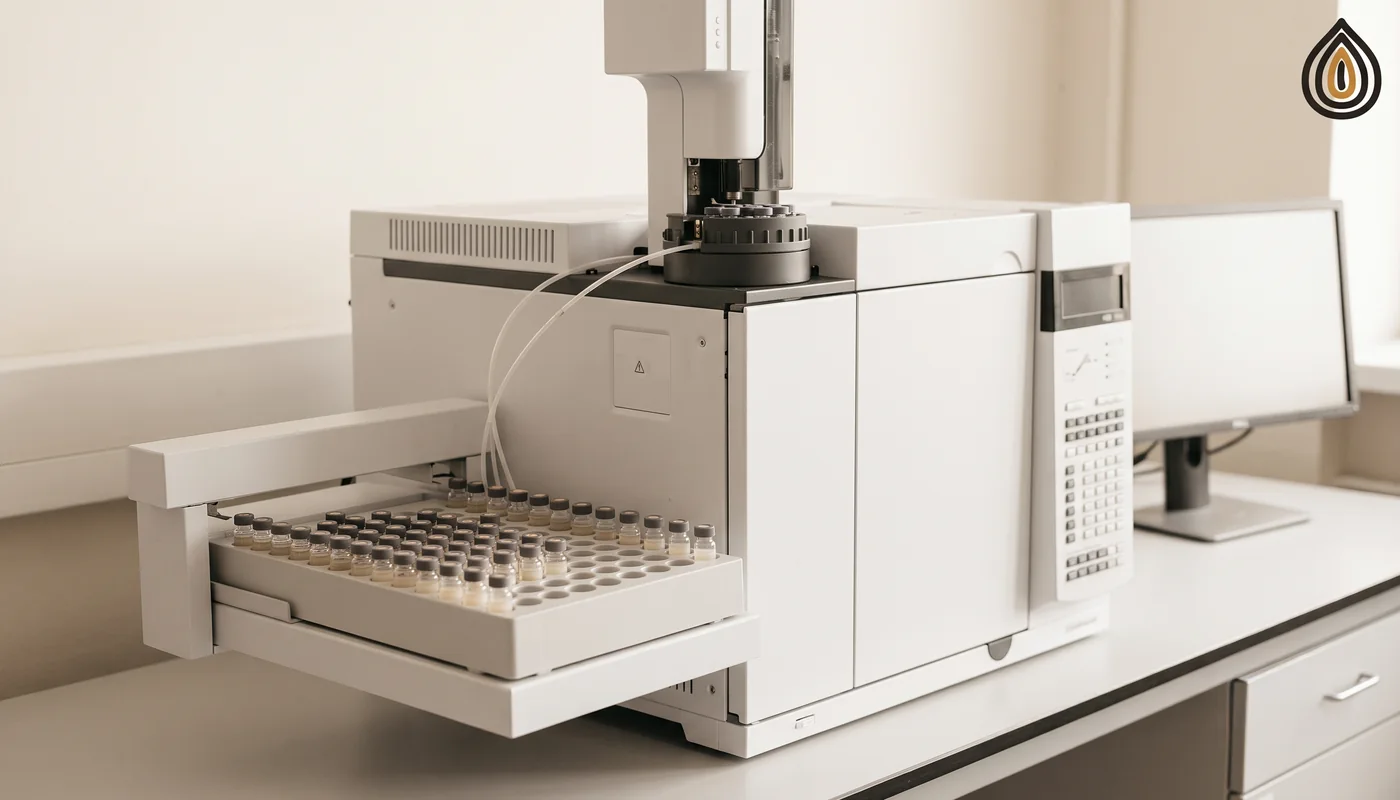
The test is a multi-residue screen: the sample is extracted, usually by the QuEChERS method, and analysed by gas chromatography with tandem mass spectrometry for the volatile substances and liquid chromatography with tandem mass spectrometry for the rest, against a library of several hundred active substances. Three things define its worth. Scope: the number of actives screened, from 200 at a basic laboratory to 600 or more at the large groups; the list should include every substance in the table above, and a buyer should ask to see it, since a screen that omits chlorpyrifos or fipronil tells nothing about them. Limit of quantification: the lowest concentration reported as a number, 0.01 milligrams per kilogram for most actives at a competent laboratory on dried onion, higher for a few difficult substances; a screen at 0.05 misses the range where the default MRLs sit. Matrix: dried onion is a difficult matrix, with sulphur compounds and sugars that interfere, and a laboratory should have validated its method on dried alliums, which the large groups have and some small laboratories have not. Single-residue methods are used for the substances the multi-residue screen cannot see: dithiocarbamates by the carbon disulphide method with its interference problem, glyphosate and other polar herbicides by a dedicated method, and ethylene oxide by its own. A full screen costs 150 to 300 euros at a European laboratory and 8,000 to 15,000 rupees in India, takes five to ten days, and needs 200 to 500 grams of sample. The certificate on which it appears is read as a whole in How to Read a Dehydrated Onion Lab Report.
Reading a residue report
A residue report lists either every active screened with its result and LOQ, which runs to many pages, or the actives detected with their results and a statement that the remainder were below LOQ, with the list of actives and the LOQs attached or available. The lines to read: the sample description and whether it is the dried product as tested; the number of actives and the LOQ; each detected substance with its result in milligrams per kilogram, the MRL used, the basis of that MRL, fresh or factored, and the conformity assessment; the method, QuEChERS with GC-MS/MS and LC-MS/MS, and the laboratory's accreditation for it; and the measurement uncertainty, which the EU sets at a default 50 percent for enforcement, meaning that a result must exceed the MRL by more than the uncertainty before an authority treats it as a definite exceedance. A report that says "none detected" with no LOQ, no list and no method is a statement rather than a result. A report with a detection at a fraction of the factored MRL is a normal report; onion from any origin carries traces of approved substances, and a screen that never detects anything is more suspicious than one that does.
How plants control residues at source
A dryer does not remove residues, so a certified plant controls them before the onion arrives. The control has four parts, and a buyer auditing a supplier should ask about each. Sourcing by field block: the better plants contract with farmer groups, know which fields their onion comes from, issue a spray programme of approved substances with pre-harvest intervals, and refuse onion from unknown fields in the export season; the traceability that makes this possible is in Lot Codes and Traceability in Dehydrated Onion. Grower training and the banned list: chlorpyrifos and mancozeb are cheap, familiar and still sold in India, and a plant's field staff spend the winter telling contracted growers not to use them; the plants that do this well have the cleanest screens. Intake testing: a rapid screen on incoming raw onion, by a strip test for organophosphates and a laboratory screen on a sampling plan, with lots that fail rejected before they enter the plant; one plant in the district rejected a farmer's lot for a mancozeb trace this April. Lot testing on the dry product: the full screen on each export lot, or on a plan agreed with the buyer, at an accredited laboratory. Peeling and washing remove some surface residue, and drying degrades the heat-labile substances, but neither is a control a plant should rely on. The plants' certification, BRCGS or equivalent, requires a raw-material risk assessment that covers residues, and the audit report shows how it is done; what the certificate does and does not guarantee is in What BRC Certification Means for a Dehydrated Onion Supplier.
Sampling for residues
Residues are not evenly distributed: one farmer's field in a lot of forty can carry the chlorpyrifos that fails the lot, and a sample from one bag can miss it or find it. The EU's sampling directive for residue control specifies, for a lot of packaged dried vegetables, a number of increments proportional to the lot size, combined into a bulk sample from which the laboratory sample is taken, and a supplier's certificate should say how the sample was drawn. A lot dried from a single field block or a single day's intake is more uniform than one blended across a week, and a buyer who specifies single-source lots gets more meaningful residue results. For the importer's own verification, a sample drawn across ten or more bags from different pallets, composited and split, with a retained portion sealed, is the practice; the sampling line's importance on any certificate is explained in the laboratory report guide linked above.
Other markets: UK, US, Japan, Gulf
The UK retained the EU MRL system at Brexit and has since diverged in a few cases, mostly by keeping older, higher limits where the EU lowered them; the substances in the table are limited similarly. The United States sets tolerances under the EPA, which differ from EU MRLs and are often higher for the older substances, and dried onion is tested against them by the FDA on a sampling basis; chlorpyrifos tolerances were revoked in the US in 2022, reinstated by court action and revised again, and a US buyer's own compliance adviser should confirm the current position. Japan operates a positive list with a default of 0.01 and tests imports intensively; Japanese buyers specify the full screen and are strict on the same substances as the EU. The Gulf states follow Codex MRLs, which are generally higher, and test less. An exporter serving all of these works to the EU list, which is the strictest in practice, and a lot that passes the EU screen on the conservative convention passes everywhere else. The US route is in Importing Dehydrated Onion into the USA, and the UK's in Importing Dehydrated Onion into the UK.
What to do with a marginal result
A result near the limit on either convention calls for four steps before any decision. Confirm the substance and the value by re-analysis of the retained sample, ideally at a second laboratory, since a single result at the LOQ carries a 50 percent uncertainty. Check the convention: a dried result of 0.03 against a fresh MRL of 0.01 is 0.004 on the fresh basis with the factor, well inside; it is a fail only on the direct comparison. Check the dithiocarbamate case specifically, which is a false positive on onion until a parent-compound method says otherwise. And check the lot's sourcing: a plant with field-block records can identify the field, test it and exclude the grower, and can tell the buyer whether the rest of the lot came from elsewhere. Then decide, with the buyer's own regulatory adviser, whether the lot is compliant for the intended market and use; a marginal result on a substance with a default MRL is usually the point at which a buyer declines the lot and the exporter sells it to a market with a higher limit. The contractual side, notice, referee laboratory and remedies, is in B2B Contract Terms for Dehydrated Onion.
Specification and testing plan
- Limit: "Pesticide residues to comply with Regulation (EC) 396/2005 as amended, applied to the dried product with a processing factor of [8] for concentration where no specific factor is published" or, conservatively, "applied to the dried product without a processing factor"; the buyer chooses and states it.
- Scope: "Multi-residue screen of not fewer than 400 active substances by QuEChERS extraction with GC-MS/MS and LC-MS/MS, including as a minimum chlorpyrifos, chlorpyrifos-methyl, profenofos, carbendazim, fipronil, imidacloprid, thiamethoxam, lambda-cyhalothrin, tricyclazole and the azole fungicides; dithiocarbamates by a method appropriate to alliums with positive results confirmed for the parent compound."
- LOQ: "0.01 mg/kg on the dried product for the substances named, except where the laboratory's validated LOQ is higher and stated."
- Frequency: "On each lot" for the first three lots and for high-inclusion uses; thereafter "on a sampling plan of one lot in [four], rising to every lot on any detection above 50 percent of the limit."
- Laboratory: "ISO/IEC 17025 accredited for the method on dried vegetables; report to state the LOQ per substance, the MRL and its basis, and the sampling method."
- Sourcing: "Lots to be traceable to field blocks under the supplier's spray programme; supplier to provide the programme and the list of prohibited substances communicated to growers."
- Marginal results: "Any detection above 50 percent of the applicable limit to be notified to the buyer before shipment with the retained-sample confirmation."
The specification sheet as a whole is in How to Read a Dehydrated Onion Specification Sheet, and the importer's own verification plan in the laboratory report guide.
Ethylene oxide and the fumigants
Ethylene oxide is not a crop pesticide but a fumigant and sterilant, and it appears on the same residue reports because it is regulated under the same MRL system, at a level equal to the LOQ for onion, expressed as the sum of ethylene oxide and its reaction product 2-chloroethanol. It is not used on Indian dried onion by the certified plants, which reduce counts by steam, and it should be tested for on the first lots and on a plan, since its presence anywhere in a consignment is a rejection and a RASFF notification. Phosphine, used to fumigate stored grain and sometimes warehouses, has an MRL for dried vegetables and can be found where onion has been stored near fumigated grain; methyl bromide is prohibited. A supplier's declaration should cover all three, and the ethylene oxide story, which reshaped the trade's testing habits, is in Ethylene Oxide and Dehydrated Onion.
The processing factor, worked on three substances
The arithmetic is easier to see on real numbers than in the regulation's language. Take three results on a dried white onion lot and read them under the two conventions, with a concentration factor of 8.
| Substance | Result on dried product (mg/kg) | Fresh-onion MRL (mg/kg) | Factored limit for dried (MRL × 8) | Direct comparison, no factor | Factored comparison | Verdict |
|---|---|---|---|---|---|---|
| Chlorpyrifos | 0.03 | 0.01 (default) | 0.08 | Exceeds by 3× | 38 % of the limit | Fail direct, pass factored: discuss; most buyers decline |
| Lambda-cyhalothrin | 0.12 | 0.2 (set for onion) | 1.6 | 60 % of the limit | 8 % of the limit | Pass under both |
| Tebuconazole | 0.9 | 0.15 (set for onion) | 1.2 | Exceeds by 6× | 75 % of the limit | Fail direct, pass factored: the convention decides |
The lambda-cyhalothrin line is the ordinary case, a trace of an approved insecticide well inside either reading. The tebuconazole line is the case that produces disputes: a fungicide used as approved, at a level that would be a comfortable pass on fresh onion, concentrated by drying to a figure that a laboratory comparing directly reports as a six-fold exceedance; a plant seeing that report has done nothing wrong and a buyer's authority might still hold the lot. The chlorpyrifos line is the case where most buyers decline whatever the convention, because the substance is withdrawn, the default MRL signals "not to be used", and a factored pass at 38 percent of the limit still tells the buyer that a grower in the lot sprayed it. Where the Commission's processing factor database carries a factor for a substance on dried onion, it replaces the default 8 and can be lower, since some substances degrade in drying; where it carries none, the specification's convention governs, and the measurement uncertainty of 50 percent is applied by an enforcement authority before an exceedance is treated as definite. Buyers should ask their laboratory to print both readings on the report so that the conversation with the supplier starts from the same page.
Residue trends on Indian onion, 2020 to 2026
The picture has improved, and the improvement follows the export plants' sourcing discipline rather than any change in the regulation. Around 2020, when the EU lowered the chlorpyrifos MRL to the default, a meaningful share of Indian dried-onion lots screened in Europe showed chlorpyrifos above 0.01 on the dried product, and the trade's laboratories in Gujarat reported it on a third or more of raw-onion intake samples in the worst districts. By 2023 the certified plants' contracted growers had largely stopped using it under the plants' spray programmes, and detections on export lots from those plants had fallen to a few percent, mostly at trace levels from soil carry-over; the uncertified plants and the open-market onion remained the source of the lots that still failed. Mancozeb followed the same path after its 2021 withdrawal, complicated by the dithiocarbamate false-positive problem that made the true rate hard to read. Fipronil detections, from its use against thrips and from residues in soil, have been the newer concern since 2022 and are the substance the careful plants now test intake for alongside the organophosphates. The residue rate on lots from a plant with field-block sourcing is now close to that of European-grown onion; the rate on open-market Indian onion is not, which is the whole argument for buying from a plant that knows its fields. The RASFF notifications for dried onion from India, which are public, show the same curve: a cluster in 2020 to 2022, a handful since. The wider quality history of the trade is in Dehydrated Onion Price History 2020-2026.
Questions to ask a supplier about residues
Six questions, in an e-mail or on a call, separate a plant that controls residues from one that hopes. Where does the onion for my lot come from, and can you name the field blocks or the farmer groups? What spray programme do you issue to growers, and which substances does it prohibit; can I see it? Do you test raw onion at intake, by what method and on what sampling plan, and what did you reject last season? Which laboratory screens your export lots, for how many actives, at what LOQ, and can I see the last twelve reports? Which processing-factor convention does your certificate apply, and will you state it on mine? And what happens when a result is above half the limit: do you notify the buyer before shipment? A plant that answers the first and third from documents rather than from memory is one whose residue results a buyer can rely on; the remote audit method that puts these questions in context is in How to Audit a Dehydrated Onion Supplier Remotely.
How KlarHarvest handles residues
KlarHarvest sources from certified plants that contract growers by field block under a spray programme, communicate the EU-withdrawn substances as prohibited, and test raw onion at intake; every export lot carries a multi-residue screen of 500 or more actives at an LOQ of 0.01 milligrams per kilogram from a NABL-accredited laboratory, with the processing-factor convention stated on the certificate, dithiocarbamate positives confirmed by a parent-compound method, and ethylene oxide tested on request. Any detection above half the applicable limit is notified to the buyer before shipment with the retained-sample confirmation, and the lot's field-block record is available through the lot record described on the our process page. The registrations and the laboratory are named on the quality page.
Frequently asked questions
Which pesticides are found in dehydrated onion from India?
Traces of approved fungicides and insecticides, usually well within limits, and occasionally chlorpyrifos, mancozeb, carbendazim, profenofos or fipronil, which the EU has withdrawn and limits at or near the detection limit. Chlorpyrifos is the most common cause of a failed lot.
How do EU MRLs apply to a dried product?
The MRL is set on fresh onion. For dried onion the residue is adjusted for the drying concentration, roughly a factor of 8, where a published processing factor exists; where none does, laboratories differ, and the specification and certificate must state which convention applies.
What test should a supplier run?
A multi-residue screen of 400 or more actives by GC-MS/MS and LC-MS/MS at an LOQ of 0.01 mg/kg on the dried product, from an accredited laboratory, with dithiocarbamates by a method suited to onion and positives confirmed.
Why did my onion test positive for dithiocarbamates?
Probably because the standard method measures carbon disulphide, which onion's own sulphur compounds also produce. Confirm with a parent-compound method before treating it as mancozeb.
How do plants keep residues out?
By contracting growers by field block under a spray programme that excludes withdrawn substances, testing raw onion at intake and rejecting failures, and screening each dry lot. Drying itself removes little.
How often should I test?
Every lot for the first three from a new supplier and for high-inclusion uses; then a sampling plan of one lot in four, rising to every lot on any detection above half the limit. Keep a retained sample from every lot.
Is ethylene oxide a pesticide residue?
It is regulated under the same MRL system, at the detection limit for onion, though it is a fumigant rather than a crop pesticide. Certified plants do not use it; test the first lots and keep it on the plan.
Next step
Request a sample and it comes with the lot's residue screen, the list of actives and the LOQs, so your regulatory adviser can read it before any order; to specify the convention and the testing frequency for a contract, request a quote and say so, and the testing is priced in.