- Water activity and moisture: two different numbers
- The sorption isotherm for dehydrated onion
- The thresholds: what starts at which aw
- Why onion sits where it does on the scale
- Humidity, equilibrium and the warehouse
- Water activity by cut and after treatment
- Water activity in a blend: the migration problem
- Browning, flavour and aw
- How water activity is measured
- What the certificate should say
- Specification wording
- Practical rules for buyers, blenders and warehouses
- Water activity and the microbiological tiers
- A case: two lots, one moisture, two outcomes
- Temperature: what heat does to the same number
- Measuring at the buyer's end: a routine and a budget
- Water activity in the finished food: what the onion contributes
- How KlarHarvest reports water activity
- Frequently asked questions
Judge the product, not the words
200-500 g from a current lot, dispatched by courier with the lot lab report.
Request a sampleWater activity dehydrated onion buyers should know about is the number that moisture content stands in for and never quite replaces: moisture says how much water a product contains, water activity says how much of that water is free to do harm, and for a dried vegetable it is the free water that decides whether the product cakes, browns, goes mouldy or stays as it was packed for two years. Two lots at the same 6 percent moisture can sit at different water activities and behave differently; a lot at 5 percent is at about 0.30, safe from everything, and a lot at 8 percent is at about 0.55, on the edge of caking and a step from mould. The better specifications carry both numbers, and a buyer who understands the second reads a certificate, a warehouse and a blend more accurately. This guide explains water activity from the physics to the specification.
It covers what water activity is and how it relates to moisture, the sorption isotherm that links them for onion, the thresholds at which each kind of deterioration starts, how humidity in a warehouse moves a product's aw, what steam treatment, milling and blending do to it, how aw is measured and what a meter costs, the specification wording, and the practical rules that follow for buyers, blenders and warehouses. Figures are for Mahuva product in 2026; the moisture measurement itself is in Dehydrated Onion Moisture Content.
What this guide covers
- Water activity and moisture: two different numbers
- The sorption isotherm for dehydrated onion
- The thresholds: what starts at which aw
- Why onion sits where it does on the scale
- Humidity, equilibrium and the warehouse
- Water activity by cut and after treatment
- Water activity in a blend: the migration problem
- Browning, flavour and aw
- How water activity is measured
- What the certificate should say
- Specification wording
- Practical rules for buyers, blenders and warehouses
- Water activity and the microbiological tiers
- A case: two lots, one moisture, two outcomes
- Temperature: what heat does to the same number
- Measuring at the buyer's end: a routine and a budget
- Water activity in the finished food: what the onion contributes
- How KlarHarvest reports water activity
- Frequently asked questions
Water activity and moisture: two different numbers
Moisture content is the mass of water in a product as a share of its total mass, measured by drying a sample and weighing the loss, and it tells a buyer how much water it is paying for and how far the product is from the plant's target. Water activity, written aw, is the ratio of the water vapour pressure above the product to the vapour pressure of pure water at the same temperature, a number from 0 to 1, and it tells a buyer how strongly the product holds its water: at aw 1.0 the water is as free as in a glass, at 0.3 it is bound to the product's sugars, fibres and proteins so tightly that a microbe cannot use it and a surface cannot dissolve in it. Pure water is 1.0; fresh onion is about 0.98; honey is 0.6; dried onion at 5 percent moisture is about 0.30; a dry cracker is 0.2. The two numbers are related for a given product through its sorption isotherm, but they are not proportional and they are not interchangeable across products: 6 percent moisture is 0.35 in onion and 0.6 in a starch, because the two hold water differently. Microbes, enzymes and the chemistry of caking and browning respond to water activity, not to moisture, which is why food science uses aw and why the thresholds below are stated in it.
The sorption isotherm for dehydrated onion
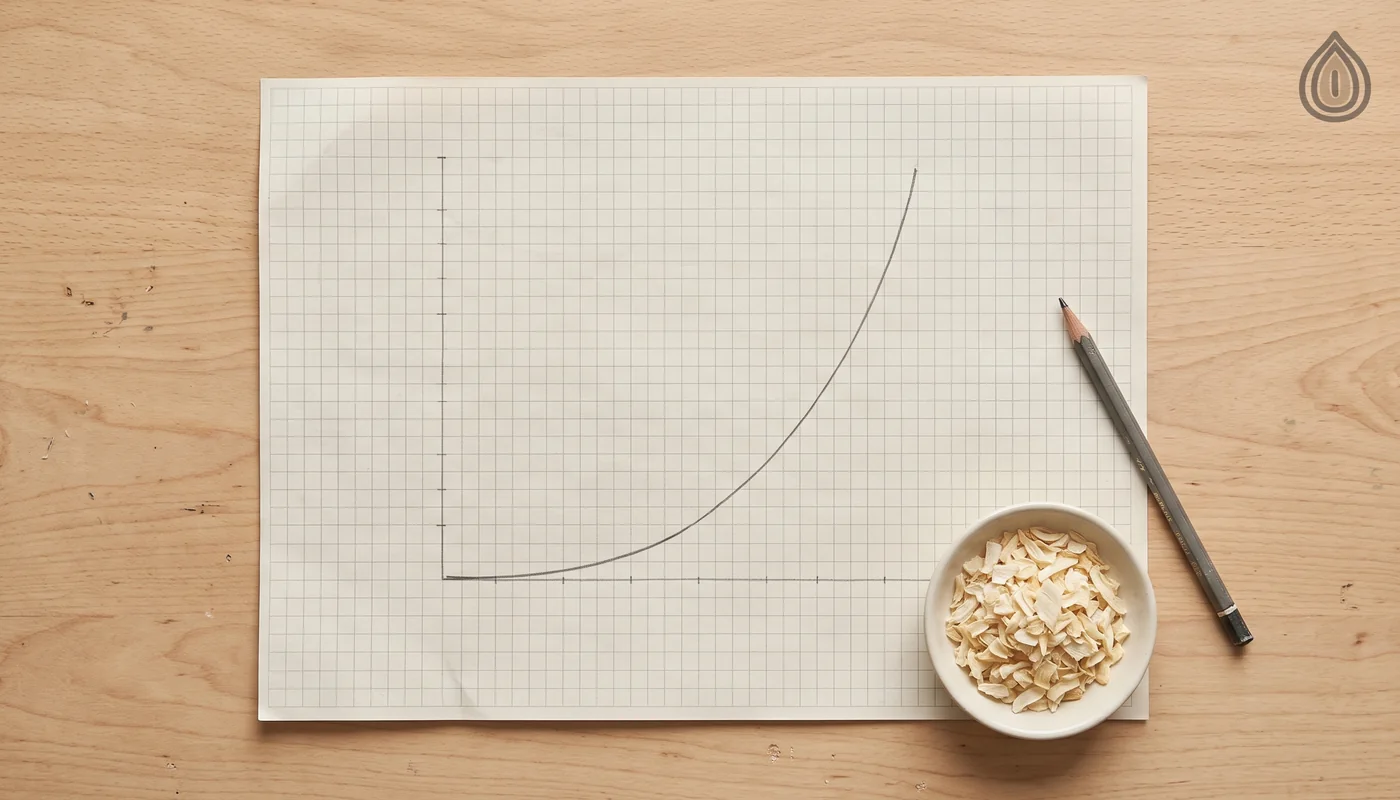
The isotherm is the curve of moisture content against water activity at a fixed temperature, measured by holding samples over salt solutions of known humidity until they equilibrate and weighing them; for dehydrated onion at 25 degrees it has the sigmoid shape of most sugar-rich dried foods.
| Water activity | Moisture content, white onion flakes (approx., 25 °C) | State |
|---|---|---|
| 0.10 | 2.5 % | Bone dry; brittle, dusty, over-dried |
| 0.20 | 3.5 % | Very dry; long life; flavour slightly flat |
| 0.30 | 4.5-5.0 % | The export target; stable in every respect |
| 0.40 | 6.0 % | Specification limit; stable if kept there |
| 0.50 | 7.5 % | Soft; powder begins to lump; browning accelerates |
| 0.60 | 9.5 % | Caking; browning fast; some xerophilic moulds can begin |
| 0.70 | 12-13 % | Mould growth; sticky; flavour deteriorating |
| 0.80 | 16-18 % | Yeasts and many bacteria grow; product spoiling |
| 0.90 | 25 %+ | Most bacteria grow; the product is a wet vegetable |
Two features of the curve matter for practice. It is flat at the dry end, so between 3 and 6 percent moisture the aw moves from 0.2 to 0.4, a wide safe band; and it is steep above 0.5, so between 7.5 and 12 percent moisture the aw moves from 0.5 to 0.7, from soft to mouldy in four points of moisture. That is why a lot at 6 percent is fine and a lot at 9 is not, and why the specification limit of 6 percent has a margin behind it that 8 does not. Onion's high sugar content, 30 to 40 percent of the dry weight, is what shapes the curve: sugars bind water strongly at low aw and dissolve into a syrup above about 0.5, which is the caking mechanism described in Bulk Density and Flowability of Onion Powder and Granules.
The thresholds: what starts at which aw
| Deterioration | Starts at about | Fast at | Notes for onion |
|---|---|---|---|
| Caking of powder | 0.40-0.45 | 0.55+ | Sugar surfaces dissolve and bridge; worse under load and at 30 °C |
| Non-enzymatic browning (Maillard) | Slow at any aw; peaks at 0.6-0.7 | 0.6 | Fastest in the intermediate range, slower again when wet |
| Lipid oxidation | Fastest at very low aw, minimum near 0.3 | below 0.2 | A reason not to over-dry: flavour flattens |
| Loss of volatile flavour | Higher at higher aw | 0.5+ | Volatiles mobile in a softer matrix |
| Xerophilic moulds | 0.60-0.65 | 0.70+ | The first organisms to grow on damp dried onion |
| Ordinary moulds | 0.70-0.80 | 0.80+ | |
| Yeasts | 0.80-0.88 | 0.88+ | |
| Most spoilage bacteria | 0.90+ | 0.95+ | |
| Salmonella growth | 0.94+ | Survives but does not grow in dried onion | |
| Staphylococcus aureus growth | 0.86+ |
The table is the reason the trade's target is 0.30 and its limit about 0.40: below 0.4 nothing in the list happens at a rate that matters over two years, and the only deterioration in play is the slow oxidative flattening of flavour that is, if anything, slightly faster when a product is over-dried. Between 0.4 and 0.6 the product is safe from microbes and losing its physical and sensory quality; above 0.6 it is on the way to spoilage.
Why onion sits where it does on the scale
Dehydrated onion at its export moisture is a low-moisture food in the food scientist's sense, with an aw below 0.6, and it shares the class with crackers, dried pasta, milk powder and spices; it is safe from microbial growth by its dryness alone and needs no other preservative, which is why it carries no additives and no cold chain, as Why Dehydrated Onion Needs No Cold Chain explains. It sits nearer the danger zone than a cracker because of its sugars and its hygroscopicity: it wants to take water from the air, and it reaches 0.6 at a moisture content, about 9.5 percent, that a cracker would not reach until 12. That is why the liner, the store and the opened-bag discipline matter more for onion than for most dry ingredients, and why the monsoon months in India are the season of caking complaints; the seasonal side is in Monsoon and Dehydrated Onion.
Humidity, equilibrium and the warehouse
A product in air moves toward the aw that equals the air's relative humidity divided by 100: onion at 0.30 in a room at 60 percent humidity takes up water until it reaches 0.60, which on the isotherm is 9.5 percent moisture and caking, and the only question is how fast, which the surface area and the liner decide. Powder in an open bin reaches equilibrium in days, granules in a week or two, flakes in a month or two, and product in a sealed 100 micron liner in years. The rule for a warehouse follows directly: keep the relative humidity below the product's target aw times 100, which is 40 percent for a target of 0.4, and since few warehouses are that dry, keep the bags sealed; a dehumidified store at 50 to 55 percent humidity holds sealed product indefinitely and opened bags for a few weeks. Temperature shifts the isotherm a little, and a warm warehouse at the same humidity gives a slightly lower moisture at the same aw, but the practical effect of heat is to speed every reaction in the table; the storage rules are in Dehydrated Onion Shelf Life and Storing Dehydrated Onion in a European Warehouse.
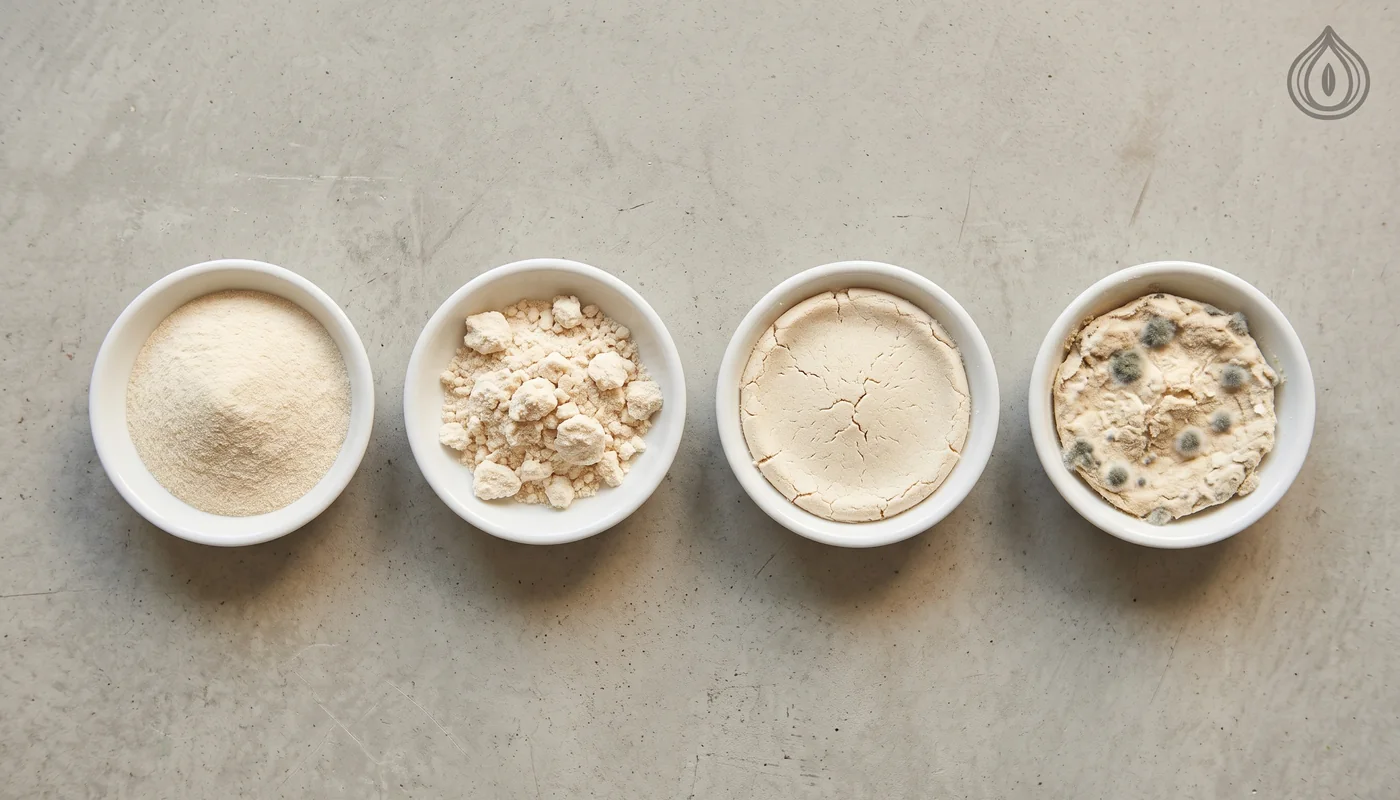
Water activity by cut and after treatment
| Product, at 5 % moisture | Typical aw | Note |
|---|---|---|
| Flakes 8-20 mm | 0.30-0.33 | Least surface; slowest to change |
| Chopped, minced | 0.30-0.34 | |
| Granules 16-40 mesh | 0.31-0.35 | |
| Powder 80 mesh | 0.32-0.36 | Milling exposes sugars; slightly higher at the same moisture |
| Steam-treated, re-dried to 5 % | 0.33-0.38 | Surface sugars mobilised; cakes a little sooner |
| Toasted onion | 0.28-0.32 | Roasting converts sugars; slightly lower |
| Powder with 1 % silicon dioxide | 0.31-0.34 | The silica takes surface water; flow improves more than aw changes |
The differences are small at the target moisture and grow as moisture rises: a treated powder at 6.5 percent is at 0.45 and beginning to lump while flakes at the same moisture are at 0.40 and fine. A buyer of treated powder specifies 5 percent moisture or 0.35 aw rather than the 6 percent that serves flakes; the treatment's effects are in Low Bacterial and Extra Low Bacterial Dehydrated Onion.
Water activity in a blend: the migration problem
In a sealed blend the components do not keep their own water activities; they exchange water until they reach a common aw, and the moisture of each moves to where its isotherm puts it at that aw. Onion at 0.32 blended with dried herbs at 0.55 and salt at 0.2 ends somewhere near 0.4 to 0.45, the onion having taken water from the herbs and given some to the salt; the onion's moisture rises to 6 or 7 percent and, in a powder, it cakes, while the herbs dry out and lose colour. The blender's controls are to specify every component's aw, to target a blend aw below 0.4, to use an anti-caking agent or rice concentrate where the target cannot be met, and to pack in a barrier; the calculation for a blend's final aw is done from the components' isotherms and is offered by some ingredient suppliers, or approximated by mixing a small trial batch and reading it after a week. The blending detail is in Dehydrated Onion in Spice Blends and Seasonings.
Browning, flavour and aw
The Maillard browning that turns stored onion from white toward cream runs slowly at 0.3, faster at 0.4, and fastest in the intermediate range around 0.6 to 0.7, where the reactants are mobile in a partly dissolved matrix but not yet diluted by free water; a lot that creeps from 0.3 to 0.5 in a poor liner browns several times faster than one that stays at 0.3, which is why colour complaints and moisture complaints arrive together. Flavour volatiles leave a product faster at higher aw as the matrix softens, so a damp lot is a flat lot as well as a caked one. At the other end, over-drying to 0.15 or 0.2 accelerates lipid oxidation of the small fat fraction and gives the flat, hay-like note of an over-dried lot; the target of 0.3 is where both processes are slowest, which is not a coincidence but the reason the target was chosen. The colour side is in Dehydrated Onion Colour.
How water activity is measured
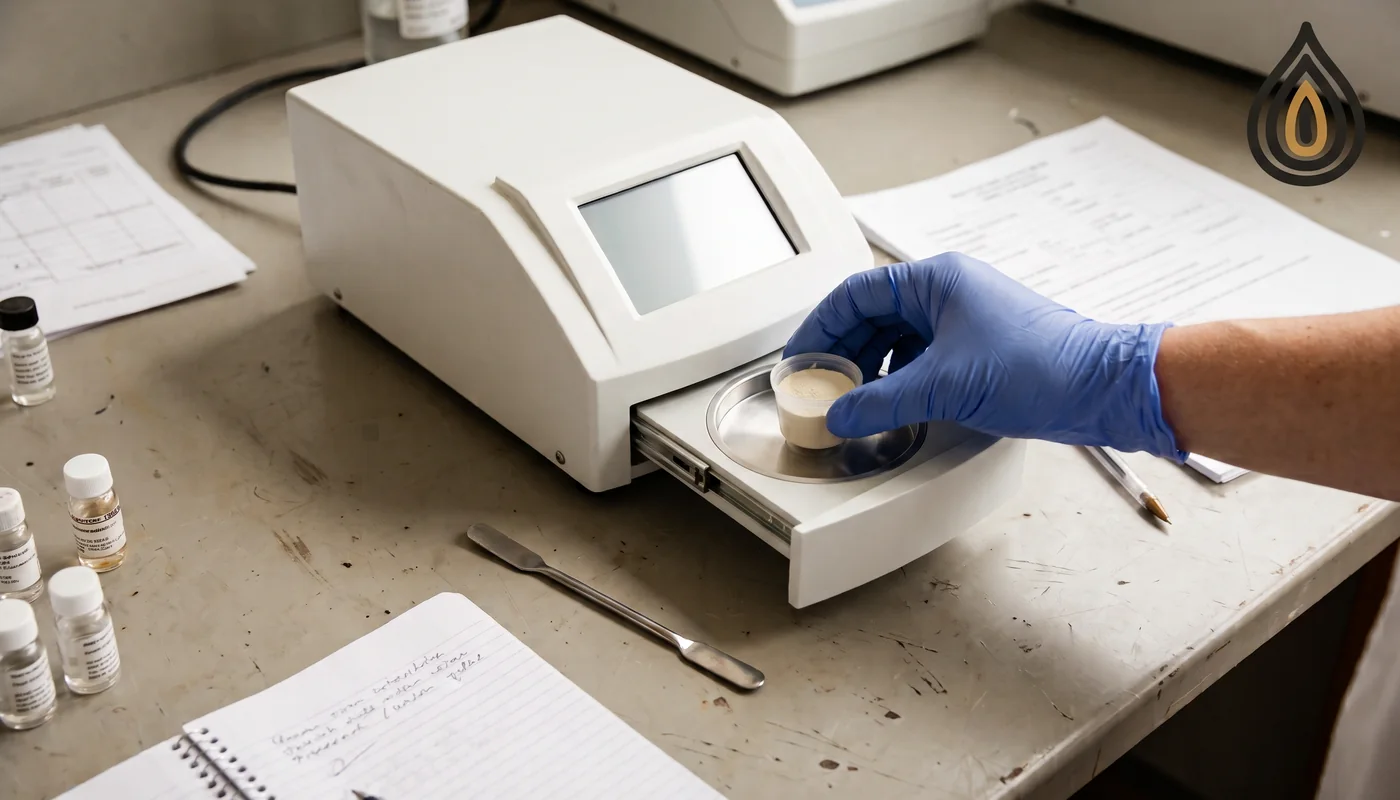
The standard instrument is a chilled-mirror dew-point meter: a sample is sealed in a small cup in a chamber, the headspace air equilibrates with it, and a mirror is cooled until dew forms, at which point the dew-point temperature and the sample temperature give the aw directly; the reading takes five minutes, is accurate to about 0.003, and the instruments cost 4,000 to 10,000 euros. Capacitance sensors are cheaper, slower to stabilise and accurate to about 0.015, which is enough for a specification at 0.40. Either instrument is calibrated against saturated salt standards of known aw, and the measurement needs the sample at the instrument's temperature, since a warm sample reads high, and a sample that fills the cup evenly, ground for flakes so that the headspace equilibrates in a reasonable time. A laboratory reports aw with the temperature, since it shifts a little with it; 25 degrees is the convention. A plant's quality laboratory reads aw on each lot alongside moisture at the larger plants and on request at the smaller; a buyer's own meter pays for itself in the first caking dispute it settles.
What the certificate should say
A certificate line for water activity reads "Water activity: 0.32 at 25 °C, chilled-mirror dew point", with the limit beside it, and it sits next to the moisture line; the two together tell a buyer more than either alone, since a lot at 5.5 percent and 0.38 is drier in moisture and wetter in effect than a lot at 5.8 and 0.33, and the difference is the lot's history, a treatment, a milling, an age. A certificate that carries moisture only is the norm and is adequate for flakes; a buyer of powder, of treated product or of product for a blend should ask for aw, and the reading of the certificate as a whole is in How to Read a Dehydrated Onion Lab Report.
Specification wording
- Moisture and aw together: "Moisture maximum 6.0 percent by oven at 103 °C; water activity maximum 0.40 at 25 °C by dew-point method" for flakes, chopped and minced.
- Powder, granules and treated product: "Moisture maximum 5.0 percent; water activity maximum 0.35 at 25 °C."
- For blending: "Water activity maximum 0.35 at 25 °C, reported on each lot."
- At shipment for monsoon-period product: "Water activity measured within 7 days of stuffing and stated with its date."
- Arrival allowance: "Water activity on arrival not to exceed the shipment figure by more than 0.05."
- Method: "Chilled-mirror dew-point instrument calibrated against saturated salt standards; sample ground and equilibrated at 25 °C."
The specification sheet as a whole is in How to Read a Dehydrated Onion Specification Sheet.
Practical rules for buyers, blenders and warehouses
- Buy at 5 percent moisture and 0.30 to 0.35 aw; accept 6 percent and 0.40 for flakes and coarse cuts, not for powder or blends.
- Keep bags sealed; an opened bag in a room above 45 percent humidity is a product moving toward 0.5.
- Store below 25 degrees and, where possible, in a dehumidified room at 50 to 55 percent humidity.
- Read aw on arrival for powder and treated product, and again after a month in your own store, to see what your warehouse is doing to it.
- In a blend, target 0.40 or below across the blend, specify every component's aw, and test the blend after a week.
- Never rely on a desiccant sachet inside a product bag; rely on the liner and the room.
- Treat a rise of 0.05 in aw as the early warning it is; the product is still fine and the cause is not.
- Over-dried product at 0.2 is not better; it is flatter in flavour and more brittle, and it takes up water faster to reach the same 0.3 as everything else.
Water activity and the microbiological tiers
The tiers, standard, low bacterial and extra low, are counts of the organisms present, and water activity is what keeps them from becoming organisms growing: at 0.3 the count on a lot is the count it will have in two years, at 0.7 it is a starting point. A treated ELB lot that is allowed to reach 0.65 in a damp store grows mould and loses its tier, and a standard lot kept at 0.3 keeps its count; the tier is a property of the lot at packing and the aw is what preserves it. The interaction with the dormant load, and the reason a treated product needs the same storage discipline as any other, is in Microbiology in Dehydrated Onion.
A case: two lots, one moisture, two outcomes
A German blender received two lots of 80 mesh onion powder from two plants in the same month, both certified at 5.8 percent moisture, both within the 6 percent specification. Lot A caked in its bags within six weeks in the blender's store; lot B was free-flowing at three months. The blender's aw meter, bought after the complaint, read the retained samples at 0.44 for lot A and 0.34 for lot B: lot A had been steam-treated and milled fine, both of which raise aw at a given moisture, and its plant had re-dried it only to the moisture limit rather than below it; lot B was untreated and coarser. The moisture specification had been met by both, and the aw told the difference. The blender's specification now carries 0.35 aw for powder, and the plant supplying lot A re-dries treated powder to 4.8 percent, which puts it at 0.36. The defect itself, and the inspection that would have flagged the first lot, are in Common Quality Defects in Dehydrated Onion.
Temperature: what heat does to the same number
Water activity is defined at a temperature, and a product's aw rises a little as it warms: dried onion at 0.32 at 25 degrees reads about 0.34 at 35 and 0.30 at 15, because the water bound to the sugars is held less tightly when the matrix is warmer. The shift is small and it matters in two places. In a sealed bag that moves from a 15-degree European warehouse into a 35-degree lorry in summer, the aw in the headspace rises, water moves from the product to the air inside the liner, and when the bag cools again the water condenses on the liner and the top of the product, which is the mechanism of the soft cake that forms under the liner of a bag that has been through a hot loading dock; a bag kept at one temperature does not do it. And in a monsoon godown at 32 degrees, the product's aw is a step higher than the same moisture would give in Hamburg, which is one reason the shipment-date reading matters more than the packing-date one for product that has sat through an Indian summer. The instrument reports aw at the temperature of its chamber, and a sample read at 30 degrees against a specification at 25 reads high by about 0.02; a laboratory states the temperature for that reason. The storage side of the same physics is in Storing Dehydrated Onion in a European Warehouse.
Measuring at the buyer's end: a routine and a budget
A buyer who uses powder, granules or treated product, or who blends, should own a meter, and the routine is short. On arrival: one reading per lot from a composite of three bags, from the middle of the bags rather than the top, ground if the cut is coarse, sealed in the cup and left ten minutes to reach the chamber's temperature before the reading; the result goes in the lot record beside the certificate's figure, and a difference of more than 0.05 is a question for the supplier or the container. In the store: a reading on one open lot each month, to see what the room is doing; a rise of 0.03 a month is a room that needs a dehumidifier. In a blend: a reading on the blend a week after mixing, against the target. Calibration: the two salt standards, at about 0.33 and 0.75, run monthly. A capacitance meter at 1,500 to 3,000 euros serves a blender whose specification is 0.35 or 0.40; a dew-point meter at 4,000 to 10,000 euros serves a laboratory that must resolve a dispute at 0.01. Either is cheaper than one caked container. The arrival inspection the reading joins is in Common Quality Defects in Dehydrated Onion.
Water activity in the finished food: what the onion contributes
A product developer building a low-moisture food, a cracker, a dry mix, a snack seasoning, a bar, sets a target aw for the whole product and needs each ingredient's contribution, and dried onion's is simple: at 0.32 it is drier than most of what it joins and it pulls the blend's aw down a little while taking up water from the wetter components. In a soup mix at 20 percent onion with salt, starch and dried vegetables, the blend settles near 0.35 to 0.40 and the onion is not the constraint; in a cracker at 2 percent onion powder the onion is invisible to the product's aw; in a snack seasoning with an oil carrier the onion is the component most likely to take up moisture through the pack over months and should be the one the developer watches. Where a product's aw is above 0.6, a sauce, a dip, a filling, the onion rehydrates fully and its own aw is irrelevant; the microbiology of the product is then the product's, with the onion's dormant load woken, which is the reason for the tiers in Low Bacterial and Extra Low Bacterial Dehydrated Onion. The intermediate products, aw 0.4 to 0.6, are where a developer should read the isotherm carefully, since a small moisture change moves aw fastest there; the blend mechanics are in Dehydrated Onion in Spice Blends and Seasonings.
How KlarHarvest reports water activity
KlarHarvest reports water activity by the dew-point method at 25 degrees beside the moisture on every certificate for powder, granules and treated product, and on request for the coarse cuts, with the shipment-date reading for monsoon-period lots; powder for blending is supplied at 5 percent moisture and 0.35 aw maximum, and treated powder is re-dried below the moisture limit rather than to it. The hygrometer log of the Bhavnagar godown, which holds sealed stock at 50 to 55 percent humidity, is in the lot record described on the our process page, and the specifications per cut are on the powder and granules pages.
Frequently asked questions
What is the water activity of dehydrated onion?
About 0.30 to 0.35 at the export moisture of 5 percent, rising to 0.40 at 6 percent and 0.60 at about 9.5 percent, where caking is established and mould can begin. Powder and steam-treated product read slightly higher at the same moisture.
What is the difference between moisture and water activity?
Moisture is how much water the product contains; water activity is how much of it is free to support microbes, caking and browning. They are linked by the product's sorption isotherm and are not proportional; aw is the better predictor of shelf life.
At what water activity does onion powder cake?
Soft lumps from about 0.40 to 0.45, caking from 0.55, worse under a pallet's weight and at 30 degrees. That is 6 to 8 percent moisture for onion, which is why powder is specified at 5 percent.
At what water activity does mould grow on dried onion?
Xerophilic moulds from about 0.60 to 0.65, ordinary moulds from 0.70; yeasts from about 0.85 and most bacteria above 0.90. At the export target of 0.3, nothing grows.
How is water activity measured?
With a chilled-mirror dew-point meter on a sealed sample at 25 degrees, in about five minutes, accurate to a few thousandths; capacitance meters are cheaper and adequate for a 0.40 specification.
Should I specify water activity as well as moisture?
For powder, granules, steam-treated product and anything going into a blend, yes: 0.35 maximum at 25 degrees. For flakes and coarse cuts, moisture at 6 percent with an optional aw at 0.40 is enough.
What happens to water activity in a blend?
Components exchange water until they share one aw, so onion at 0.32 blended with damp herbs rises and cakes while the herbs dry out. Specify every component's aw and target 0.40 or below across the blend.
Next step
Request a sample of powder or granules with the water activity on its certificate beside the moisture, and read it again after a month in your own store; to specify aw for a contract, request a quote with the limit and the plant confirms its re-drying target before the first lot.