- The set at a glance
- The exporter's registrations behind every document
- Commercial invoice
- Packing list
- Shipping bill and the let-export order
- Bill of lading, seaway bill and telex release
- Certificate of origin
- Phytosanitary certificate
- Certificate of analysis and the laboratory report
- Health certificate: when it is and is not needed
- Fumigation certificate and ISPM 15
- Insurance certificate
- Supplier declarations
- Documents for letters of credit
- Common errors and what they cost
- Checking the drafts before sailing
- Timeline: when each document is ready
- How KlarHarvest handles the set
- Frequently asked questions
Judge the product, not the words
200-500 g from a current lot, dispatched by courier with the lot lab report.
Request a sampleThe dehydrated onion export documents that travel with a container from Pipavav are the reason a shipment clears in a day or sits for a week, and they are mostly the exporter's job to produce and the buyer's job to check. There are about a dozen: three that the exporter writes, the invoice, the packing list and the shipping instructions; three that Indian authorities or chambers issue, the shipping bill, the certificate of origin and the phytosanitary certificate; two that carriers and insurers issue, the bill of lading and the insurance certificate; the laboratory's certificate of analysis; and the exporter's declarations, on allergens, treatments and origin, that a European quality system files. A few are legally required at the destination, several are required by the buyer's bank or quality system rather than by law, and all of them must agree with each other on weights, lot numbers and descriptions. This guide explains each one: who issues it, what it says, what it is for, and where it goes wrong.
It is written for the buyer who receives the set and for the exporter who assembles it, with the practice of March 2026. The regulatory position at the EU end is in EU Import Requirements for Dehydrated Onion; this guide is the Indian end and the document set itself.

What this guide covers
- The set at a glance
- The exporter's registrations behind every document
- Commercial invoice
- Packing list
- Shipping bill and the let-export order
- Bill of lading, seaway bill and telex release
- Certificate of origin
- Phytosanitary certificate
- Certificate of analysis and the laboratory report
- Health certificate: when it is and is not needed
- Fumigation certificate and ISPM 15
- Insurance certificate
- Supplier declarations
- Documents for letters of credit
- Common errors and what they cost
- Checking the drafts before sailing
- Timeline: when each document is ready
- How KlarHarvest handles the set
- Frequently asked questions
The set at a glance
| Document | Issued by | Required by | Purpose at destination |
|---|---|---|---|
| Commercial invoice | Exporter | Customs at both ends; bank; buyer | Customs value, duty, payment |
| Packing list | Exporter | Customs; warehouse; buyer | Bags, pallets, weights, lots |
| Shipping bill (India) | Customs broker, filed in ICEGATE | Indian customs | Export clearance; incentives |
| Bill of lading or seaway bill | Carrier or forwarder | Buyer; bank | Title and release of the goods |
| Certificate of origin | Chamber of commerce | Most importers; some banks; some customs | Origin declaration |
| Phytosanitary certificate | Plant Quarantine, India | Not required for dried onion in the EU; requested by many importers | File completeness; some markets require it |
| Certificate of analysis | Accredited laboratory | Buyer's quality system | Conformity to specification |
| Health certificate | Export Inspection Council or APEDA-recognised agency | Only where the destination requires it | Some markets; EU only if listed |
| Fumigation certificate | Licensed fumigator | Some importers; wooden packaging | Pallets; some markets |
| Insurance certificate | Insurer | CIF and CIP shipments | Claims |
| Supplier declarations | Exporter | Buyer's quality system | Allergens, treatments, GMO, irradiation, sulphite |
| APEDA registration and IEC | Exporter's own | Indian export system | Behind every shipment, not shipped with it |
The exporter's registrations behind every document
Three registrations sit behind the set and appear on it. The Importer-Exporter Code, IEC, from the Directorate General of Foreign Trade, is the exporter's identity in the customs system and appears on the shipping bill and the invoice; no export leaves India without one. The APEDA registration, from the Agricultural and Processed Food Products Export Development Authority, is required for the export of scheduled products, dehydrated onion among them, and its number appears on the shipping bill and is checked by customs; it is also what qualifies the exporter for APEDA's schemes. The FSSAI licence covers the food business, the plant's manufacturing licence and the exporter's storage or trading licence, and its number is on the bag and often on the invoice. A GST registration is on the invoice for tax purposes. A buyer verifying an exporter checks these before the first order, and the process is in FSSAI, APEDA and IEC: The Indian Registrations Behind a Legitimate Exporter.
Commercial invoice
The invoice is the document customs on both sides value the goods from and the bank pays against, and it must carry: the exporter's and buyer's names and addresses with the exporter's IEC and GST numbers and the buyer's EORI or equivalent; the invoice number and date; the Incoterm with its edition and named place; the description of the goods, "dehydrated white onion flakes 8-20 mm, sulphite-free", with the HS code 071220 and the country of origin, India; the quantity in kilograms net and the number of bags; the unit price and the total in the invoice currency; the lot numbers; the payment terms; the vessel and port details once known; and, for a CIF invoice, the freight and insurance shown separately or included as stated. The packaging weights, gross per bag and per pallet, are usually on the packing list but customs value declarations at the destination need gross and net totals, and an invoice that carries them saves a query. Indian customs require the invoice to match the shipping bill exactly; EU customs require it to match the bill of lading and the packing list. The invoice is also the basis of the export incentive claims, so an exporter files it carefully.
Packing list
The packing list says what is in the container, bag by bag and pallet by pallet: the number of pallets, the bags per pallet, the net and gross weight per bag, the total net and gross, the lot number per pallet, the pallet dimensions and the container and seal numbers. It is the document the destination warehouse checks the delivery against and the one customs uses for a physical examination, and it must agree with the invoice on quantities and with the bill of lading on gross weight and package count. A packing list that gives packaging weights per unit, the sack and the liner, helps the importer's packaging-waste reporting; one that gives the lot numbers per pallet lets the buyer's warehouse book the goods in by lot. It is written by the exporter from the loading record, and the loading video, where the exporter makes one, is its evidence. The loading practice is in How a Dehydrated Onion Container Is Loaded.
Shipping bill and the let-export order
The shipping bill is India's export declaration, filed electronically in the customs system, ICEGATE, by the exporter's customs house agent, the CHA, against the invoice and the packing list, with the exporter's IEC and APEDA numbers, the HS code, the value, the destination and the incentive scheme claimed. Customs assess it, may examine the goods, and issue the let-export order, after which the container may be loaded; under the self-sealing procedure that certified exporters use, the container is sealed at the exporter's premises with an electronic seal and gated in without a further examination in most cases. The shipping bill is not sent to the buyer, but its number appears on the bill of lading and the buyer's broker may ask for a copy; its export date is the date the export incentives and the foreign-exchange realisation clock run from. Delays here come from a mismatch between the invoice and the shipping bill, a lapsed APEDA registration or a customs query on the value, and they are the exporter's to fix; a good CHA files a day ahead of the gate cut-off. The Pipavav process around it is in Pipavav to Hamburg.
Bill of lading, seaway bill and telex release
The bill of lading is the carrier's receipt for the goods, the evidence of the contract of carriage and, in its negotiable form, the document of title: whoever holds the original can claim the goods at the destination. It is issued by the carrier or by the forwarder as a house bill, two to four days after the vessel sails, marked "shipped on board" with the date, and it carries the shipper, the consignee, the notify party, the vessel and voyage, the ports, the container and seal numbers, the package count, the gross weight, the description and the freight terms. Three forms are used. Original bills, usually three, are couriered to the buyer against payment and one is surrendered to the carrier's agent at the destination for release; this is the form a letter of credit requires. A telex release, the shipper surrendering the originals at origin and the carrier instructing its destination agent to release without them, is the common practice in the onion trade once the balance is paid, and it saves the courier and the risk of lost originals. A seaway bill, non-negotiable, names the consignee and releases to it without any surrender, and is used between parties that trust each other and where no bank is involved. The bill's gross weight and package count must match the packing list, and the consignee and notify party must be right, since the arrival notice goes to the notify party and a wrong one means the buyer's broker hears nothing. The payment mechanics that turn on the bill of lading are in Payment Terms for Dehydrated Onion Imports.
Certificate of origin
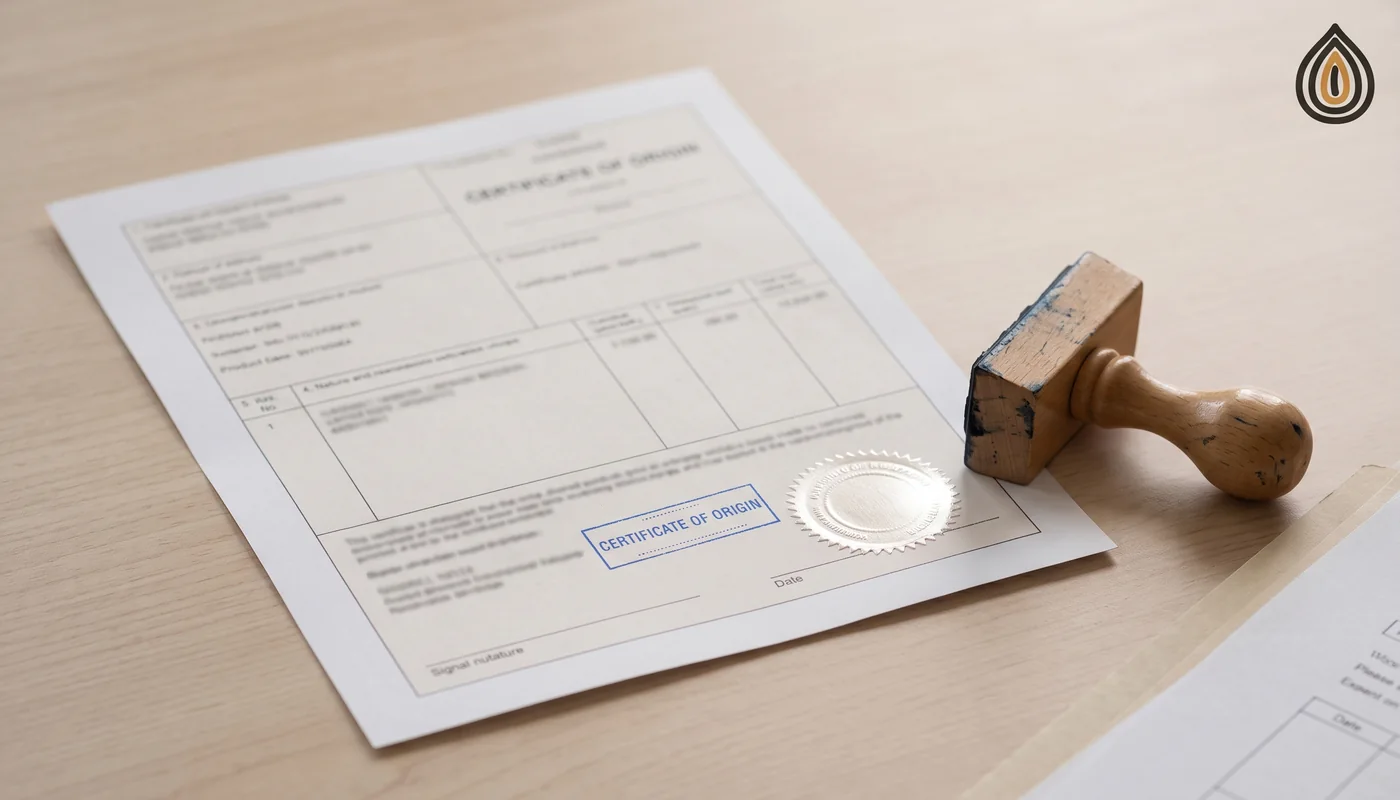
The certificate of origin for dried onion to the EU is non-preferential: it declares that the goods originated in India and gives no duty benefit, since India has no preferential rate on this line. It is issued by a chamber of commerce, the Federation of Indian Export Organisations, the local chamber in Bhavnagar or Rajkot, or a trade association authorised for the purpose, on the exporter's application with the invoice and a declaration, usually within a day or two, on a form that carries the exporter, the consignee, the goods, the marks and the chamber's stamp and signature. Most European importers ask for it as a matter of file completeness and some banks require it under letters of credit; German importers ask for it almost without exception. Some other destinations, the Gulf states and some African and Asian markets, require it for customs, sometimes legalised by the destination's consulate, which adds a week. For preferential trade, where a free-trade agreement exists, the certificate of origin takes a different form, and if the EU-India agreement under negotiation in 2026 comes into force with a preference on this line, the preferential certificate or an origin declaration on the invoice will replace it. The HS classification the certificate refers to is in HS Code 071220 for Dried Onion.
Phytosanitary certificate
The phytosanitary certificate is issued by India's Plant Quarantine organisation after an inspection of the consignment, and it declares that the goods are free of quarantine pests. The EU does not require it for dried onion, which is a processed product outside the plant health regime, and neither does the UK or the US; many importers request it anyway, because their document checklist was written for the whole range of plant products, because some banks' letters of credit list it, and because it costs the exporter only a few thousand rupees and a day. Some markets do require it for dried vegetables, and an exporter shipping to several destinations obtains it as routine. It should describe the goods as "dehydrated onion", give the quantity and the packing, and be dated within the window the destination accepts, usually 14 days before shipment. An importer that does not need it can leave it off its checklist; one whose bank or system asks for it should ask for it at the order rather than at the arrival.
Certificate of analysis and the laboratory report
The certificate of analysis is the laboratory's report on the lot, and it belongs to the quality file rather than to customs, but it travels with the set and a European importer's release of the goods depends on it. It comes from an accredited laboratory, in three to ten days after sampling, and covers the parameters the specification names: moisture, sieve analysis, colour, defects, the microbiological set, residues, metals, sulphite and whatever else was ordered. It must carry the lot number that appears on the bags, the packing list and the invoice, and its sampling line should say who drew the sample; a certificate for one lot number shipped under another is the most common quality-document error. The reading of the certificate, line by line, is in How to Read a Dehydrated Onion Lab Report, and the residue and microbiology parameters in their own guides.
Health certificate: when it is and is not needed
A health certificate is an official statement by the exporting country's competent authority that the food is fit for human consumption, and it is issued in India by the Export Inspection Council, the Export Inspection Agencies, or APEDA-recognised bodies, after inspection and testing. The EU requires it for dried onion from India only if the product is listed for increased official controls under Regulation 2019/1793, which it was not in March 2026; a listing would add an official certificate and a laboratory result to every consignment. Other markets differ: the Gulf states, Saudi Arabia in particular, require a health certificate for most foods; Russia and some Central Asian markets require one; the US does not; the UK follows the EU pattern. An exporter serving those markets obtains it as routine through the Export Inspection Agency, which takes a week and involves an inspection and sampling; an exporter serving the EU alone does not need it and a buyer should not be alarmed by its absence. A buyer should check the current list before each shipment, as the EU guide linked above explains.
Fumigation certificate and ISPM 15
Wooden pallets and dunnage entering the EU, the UK, the US and most other markets must be treated under the international standard ISPM 15, heat-treated or fumigated, and marked with the wheat-ear stamp of a registered treatment provider; the stamp on the pallet is the evidence and no certificate is required for it. A fumigation certificate, from a licensed fumigator, covers the fumigation of the goods or the container with an approved fumigant, and it is a separate matter: dried onion is not fumigated by the certified plants, and a fumigation certificate for the product is neither required by the EU nor desirable, since the fumigants it would name, methyl bromide or phosphine, are the ones a residue test looks for. Some importers' checklists ask for a "fumigation certificate" meaning the pallet treatment, and the answer is the ISPM 15 stamp and, if the importer insists, a certificate from the pallet supplier. Plastic pallets need nothing. The pallet question is in Pallet Configurations for Dehydrated Onion.
Insurance certificate
Under CIF and CIP the exporter must insure the cargo in the buyer's favour and provide the certificate or the policy, showing the insured value, 110 percent of the CIF value by convention, the voyage, the cover, Institute Cargo Clauses (A) for a moisture-sensitive cargo, and the claims-payable location, the buyer's country in its currency. The certificate is issued by the exporter's insurer against its open cover, per shipment, on the day of sailing, and goes with the documents; under FOB the buyer insures and no certificate comes from the exporter. A certificate that names Clauses (C) rather than (A) is the thing to check, since (C) does not cover wetting or theft. Claims, and the documents they need, are in Marine Insurance and Claims for Dehydrated Onion Shipments.
Supplier declarations
The declarations are not customs documents but a European buyer's quality system will not release the goods without them on file: the allergen statement in matrix form; the declaration that no ethylene oxide, irradiation or chemical sterilant was used; the non-GMO statement; the sulphite statement with the test method; the origin and variety statement; the packaging's food-contact declaration of compliance from the liner supplier; and, where the buyer asks, statements on nanomaterials, animal-derived processing aids, and the plant's ethical and environmental position. They are issued at supplier approval and renewed annually rather than per shipment, but the first shipment should carry them, and a change in any of them should be notified before the shipment it affects. Their content is set out in Allergens, Gluten and Dehydrated Onion and GMO and Irradiation Status of Indian Dehydrated Onion.
Documents for letters of credit
Under a letter of credit the documents are not just shipped but presented to a bank, which checks them against the credit's terms to the letter, and a discrepancy, a misspelt name, a date outside the presentation period, a document the credit lists that is missing, lets the bank refuse payment until the buyer waives it. The usual documents a credit lists for dried onion: the commercial invoice, signed, in the number of copies stated; the packing list; a full set of clean on-board bills of lading consigned to order of the issuing bank, marked freight prepaid or collect as the term requires; the certificate of origin; the certificate of analysis; the insurance certificate under CIF; sometimes the phytosanitary certificate and a beneficiary's certificate that copies were sent to the buyer. The credit should be drafted with the exporter's documents in mind and the exporter should read it before shipment and ask for amendments to anything it cannot meet; a presentation period of 21 days is standard. The rules are UCP 600, and the trade-off between a credit and a transfer is in Payment Terms for Dehydrated Onion Imports.

Common errors and what they cost
| Error | Where it is caught | Cost |
|---|---|---|
| Gross weight on the bill of lading differs from the packing list | Destination customs | Query, 1-3 days; possible examination |
| Lot number on the certificate of analysis not on the bags or the packing list | Buyer's quality release | Hold until the right certificate arrives, 3-7 days |
| Consignee or notify party wrong on the bill of lading | Arrival notice goes astray | Demurrage until someone notices, days |
| Certificate of origin missing where the importer's bank or system requires it | Buyer's broker or bank | Courier from India, 3-5 days |
| Incoterm or edition missing on the invoice | Destination customs value query | 1-2 days |
| HS code wrong (0712 90 or 2005 instead of 0712 20) | Destination customs | Reclassification, possible duty difference, days |
| Description on the invoice differs from the bag marking | Physical examination | Days; possible relabelling |
| Phytosanitary certificate dated outside the destination's window | Where required | Consignment held; new certificate impossible after departure |
| Insurance certificate under Clauses (C) | Only when a claim arises | Uncovered loss |
| Original bills of lading lost in courier | Destination release | Bank guarantee for release, weeks; use telex release instead |
| Documents in three instalments with a certificate expiring between them | Buyer's approval | Supplier marked down; delay |
Every error in the table is prevented by one habit: the exporter sends drafts of the invoice, the packing list and the bill of lading instructions to the buyer's broker before the vessel sails, and the broker checks them against each other and against the order. The destination end of the same errors is in Customs Clearance for Dehydrated Onion in the EU.
Checking the drafts before sailing
A buyer's broker checks five things on the drafts, and it takes twenty minutes. That the invoice, the packing list and the bill of lading instructions agree on the package count, the net and gross weights, the description and the container number. That the invoice carries the Incoterm and edition, the HS code, the origin, the lot numbers and the packaging weights. That the consignee and the notify party on the bill of lading are the buyer and its broker, exactly as registered. That the certificate of analysis's lot numbers match the packing list's. And that the certificate of origin's description matches the invoice's. Then the broker pre-lodges the import declaration from the drafts, so that release follows discharge; the pre-lodging is what turns a five-day clearance into a one-day one. An exporter that will not send drafts, or sends them after sailing, is telling the buyer something about its process.
Two habits on the buyer's side help as much. Keep a one-page document checklist per supplier and per destination, ticked per shipment, so that the phytosanitary certificate a bank requires is asked for at the order and not at the arrival; and file the set per lot number rather than per shipment, since a container carries several lots and a later claim, a recall exercise or an auditor will ask for the documents of one lot, not of one container. The lot record that holds all of it is described in Lot Codes and Traceability in Dehydrated Onion.
Timeline: when each document is ready
| Days before or after sailing | Document |
|---|---|
| -15 to -10 | Certificate of analysis (lot tested after packing) |
| -7 | Draft invoice and packing list from the loading plan |
| -5 to -3 | Phytosanitary inspection and certificate, if required |
| -4 to -2 | Shipping bill filed; let-export order |
| -3 to -2 | Container stuffed and sealed; final packing list; loading video |
| -2 | Certificate of origin applied for |
| -2 to 0 | Gate-in; bill of lading instructions confirmed with the forwarder |
| 0 | Sailing; insurance certificate issued |
| +2 to +4 | Shipped-on-board bill of lading issued; copy documents e-mailed |
| +3 to +7 | Balance paid; telex release or originals couriered |
| +5 | Broker pre-lodges the import declaration |
| Arrival | Release against the telex or the original; delivery |
The sequence from order to arrival, in which these documents are one thread, is in From Sample to First Container.
How KlarHarvest handles the set
KlarHarvest sends the invoice, the packing list and the bill of lading instructions as drafts to the buyer's broker before the container gates in, with the certificate of analysis for each lot and the loading video, and issues the final set by e-mail within a day of the shipped-on-board date; the certificate of origin, the phytosanitary certificate and the insurance certificate under CIF are obtained as routine, and a health certificate where a destination requires it. Supplier declarations go with the first shipment and are renewed annually. Telex release is the default once the balance is paid, originals on request or under a letter of credit. Every document carries the lot numbers that are on the bags and in the lot record described on the our process page, and the registrations behind the set are listed on the quality page.
Frequently asked questions
What documents are needed to export dehydrated onion from India to the EU?
Commercial invoice, packing list, bill of lading, certificate of origin and certificate of analysis as the core; a shipping bill filed in India; an insurance certificate under CIF; supplier declarations for the buyer's file. A phytosanitary certificate is requested by many importers though not required by EU law, and a health certificate only if the product is listed for increased controls.
Is a phytosanitary certificate required for dried onion?
Not by the EU, UK or US, since dried onion is a processed product outside the plant health regime. Many importers ask for it anyway and it is cheap to obtain; some other markets do require it.
What is the certificate of origin for?
It declares Indian origin, issued by a chamber of commerce. For the EU it is non-preferential and gives no duty benefit, but most importers and some banks require it; some other markets require it for customs, sometimes legalised.
What is a telex release?
The shipper surrenders the original bills of lading at origin and the carrier releases the goods at destination without them. It is the usual practice in the onion trade once the balance is paid and avoids couriering originals.
Which errors delay clearance most?
Weights that differ between the packing list and the bill of lading, a certificate of analysis for the wrong lot, a wrong notify party, and a missing certificate of origin where the buyer's system requires it. Draft checks before sailing prevent them.
Does dried onion need a fumigation certificate?
No, and it should not be fumigated. Wooden pallets need the ISPM 15 stamp, which is the evidence of treatment; no separate certificate is required for it.
When are the documents ready?
The certificate of analysis a week or more before sailing, drafts of the commercial documents a week before, the bill of lading two to four days after, and the full set by e-mail within a day of that.
Next step
Request a quote and the document set for your destination is listed on it, with which items are legally required and which are for your file; or request a sample and a specimen set from a recent shipment comes with it for your broker to review.