- Harvest progress: how much is lifted and where
- Crop condition: bulb size, dry matter, defects
- Early yields against a normal year
- Market yard prices for white onion, week by week
- Plant status: runs, shifts, labour, fuel
- First new-crop product: what the early lots look like
- New-crop price indications, FOB
- Red and pink onion: when the runs start
- Contract activity and what buyers are asking
- Logistics: Pipavav, trucking, freight
- Field notes: three plants in the third week of March
- March 2026 against the two previous seasons
- Buyer questions answered this month
- Terms used in this report
- Drying costs this month: fuel, labour, power
- What to expect in April
- How this report is compiled
- What KlarHarvest is doing this month
- Frequently asked questions
Judge the product, not the words
200-500 g from a current lot, dispatched by courier with the lot lab report.
Request a sampleThis is the first Mahuva ground report of the 2026 season: what we saw in the fields, the market yard and the plants of Bhavnagar district in the first three weeks of March, written for buyers who want the picture from the ground rather than from a price list. The new crop is in, the plants are running, and the numbers that matter for the year, arrivals, bulb quality, yard prices, plant capacity and the first new-crop quotes, are forming week by week. Everything below is what we observed in the period stated, rounded to ranges; it is an indication for planning and not a quote, and it will be updated in the April report.
The short version: the harvest started on schedule in the last week of February, the winter was dry and cool enough for good bulbing, early yields are around the normal range, yard prices opened firm on the first lots and are easing as arrivals build, the certified plants moved to round-the-clock running around the middle of the month, and the first new-crop white flakes are being quoted below February's old-crop level. Red onion runs begin later in the month. Buyers who want new-crop samples should ask now; buyers who want season contracts should expect quotes from the first week of April, once the plants have covered their raw material.
What this report covers
- Harvest progress: how much is lifted and where
- Crop condition: bulb size, dry matter, defects
- Early yields against a normal year
- Market yard prices for white onion, week by week
- Plant status: runs, shifts, labour, fuel
- First new-crop product: what the early lots look like
- New-crop price indications, FOB
- Red and pink onion: when the runs start
- Contract activity and what buyers are asking
- Logistics: Pipavav, trucking, freight
- Field notes: three plants in the third week of March
- March 2026 against the two previous seasons
- Buyer questions answered this month
- Terms used in this report
- Drying costs this month: fuel, labour, power
- What to expect in April
- How this report is compiled
- What KlarHarvest is doing this month
- Frequently asked questions
Harvest progress: how much is lifted and where
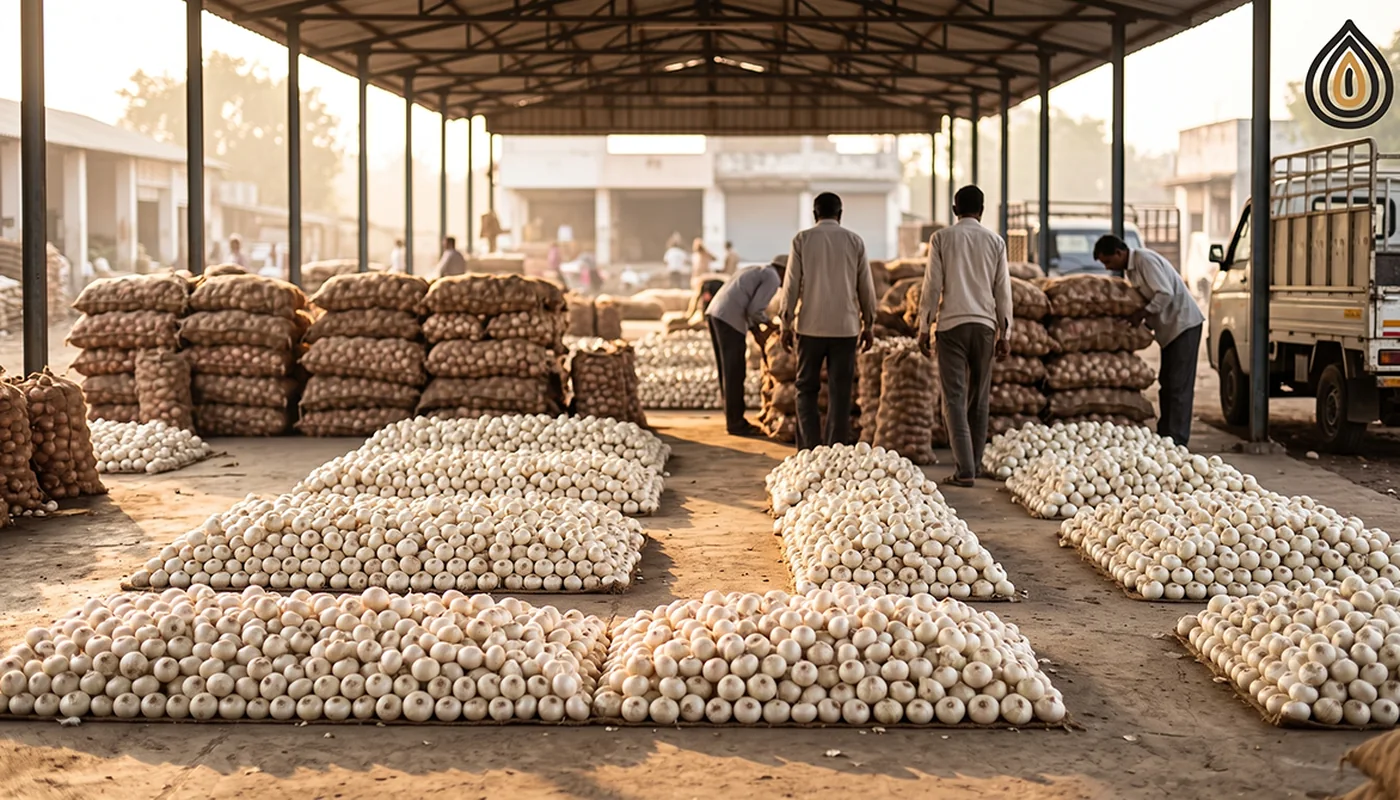
Lifting began in the earliest fields around Talaja and the coastal strip south of Mahuva in the last week of February, a few days ahead of the usual date, and spread inland through the first two weeks of March. By the third week of the month, by our own count along the main roads and from the plants' field staff, roughly a third of the white onion area in the Mahuva, Talaja and Rajula talukas had been lifted, with the peak of lifting expected from the last week of March through the second week of April. Fields transplanted late in December, after the cold spell, are running a week or two behind and will lift into late April. Curing conditions have been good: dry days, low humidity, no rain, so the bulbs are coming to the plants with tight skins and dry necks, which peel cleanly and carry less soil than a damp crop.
Crop condition: bulb size, dry matter, defects
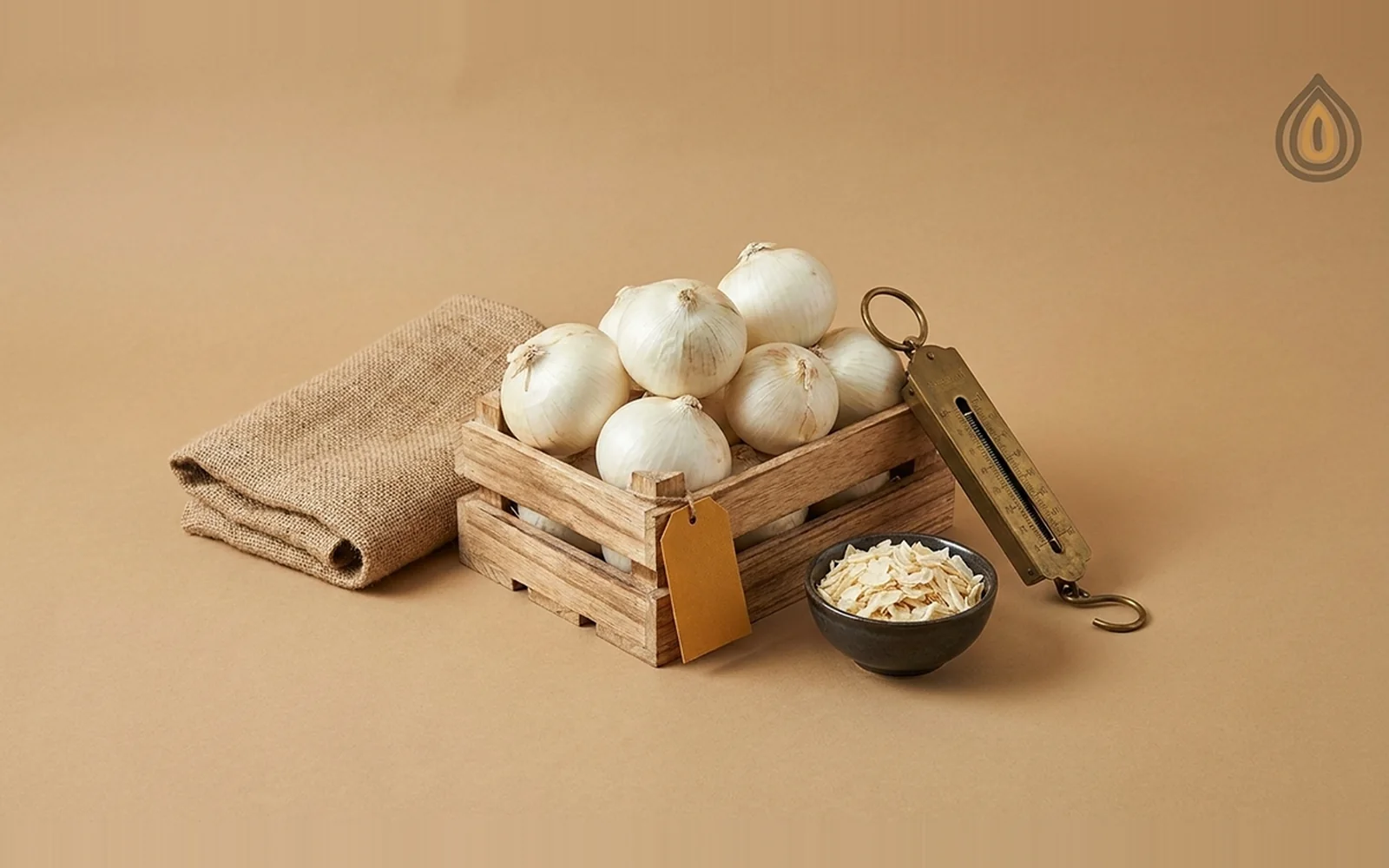
The winter was cool and dry in Saurashtra, with no significant unseasonal rain through February, and the crop shows it. Bulb size in the early fields is medium to large, with the flat shape the plants want and few doubles or bolters. Dry matter on the first lots sampled at the plants is in the normal range for the Mahuva white, around 14 to 15 percent, which keeps the yield ratio near 8.5 kilograms of fresh onion per kilogram of dry product. Reject rates at the plants' inspection belts on the early lots are low, in the range of 2 to 4 percent, mostly for mechanical damage and the occasional sprouted bulb from fields that were lifted late last year and replanted. There are no reports so far of the fungal problems that a wet February brings, and no reports of the thrips damage that a warm dry winter sometimes brings; the crop is, on the early evidence, a clean one.
Early yields against a normal year
| Indicator, white onion for dehydration | Normal year | Early March 2026 observation |
|---|---|---|
| Yield per hectare, early fields | 25-35 t | 28-32 t reported by plants' field staff |
| Dry matter | 14-16 % | 14-15 % on first lots |
| Reject rate at plant inspection | 2-5 % | 2-4 % |
| Share of area lifted by 20 March | 25-40 % | About a third |
| Acreage versus last year | - | Similar to slightly higher, on the plants' estimates |
Two cautions. Early fields are usually the best-managed ones, and the whole-season yield settles lower than the first reports; and the plants' acreage estimates are informed guesses until the state's figures are published. The picture is of a normal to slightly above-normal crop, which is the picture that matters for price. The seasons and their meaning are set out in The Indian Onion Harvest Calendar.
Market yard prices for white onion, week by week
White onion for dehydration is priced at the plant gate and at the Mahuva market yard, in rupees per kilogram, and the first three weeks of the season followed the usual shape: firm on the first, scarce lots, then easing as arrivals built.
| Week | Arrivals | Yard price range, white onion, dehydration grade (INR/kg) | Comment |
|---|---|---|---|
| Last week of February | First lots, small | 6.5-7.5 | Old-crop scarcity still in the price |
| 1-7 March | Building | 6.0-7.0 | Plants starting first runs; brokers active |
| 8-14 March | Rising quickly | 5.5-6.5 | Most certified plants on two shifts |
| 15-21 March | Heavy | 5.0-6.0 | Round-the-clock running; contract deliveries starting |
At 8.5 kilograms per kilogram of product, the mid-March range puts the raw material in a kilogram of flakes at 43 to 51 rupees, against 55 to 64 in the first week; that difference, 10 to 15 rupees, is what separates the old-crop quote from the new-crop quote. Whether the yard price falls further into April depends on the peak arrivals in the next three weeks and on how much of the crop the plants have already contracted; in a normal year the season low comes in April. How the yard price becomes an FOB price is in Dehydrated Onion Price per kg.
Plant status: runs, shifts, labour, fuel
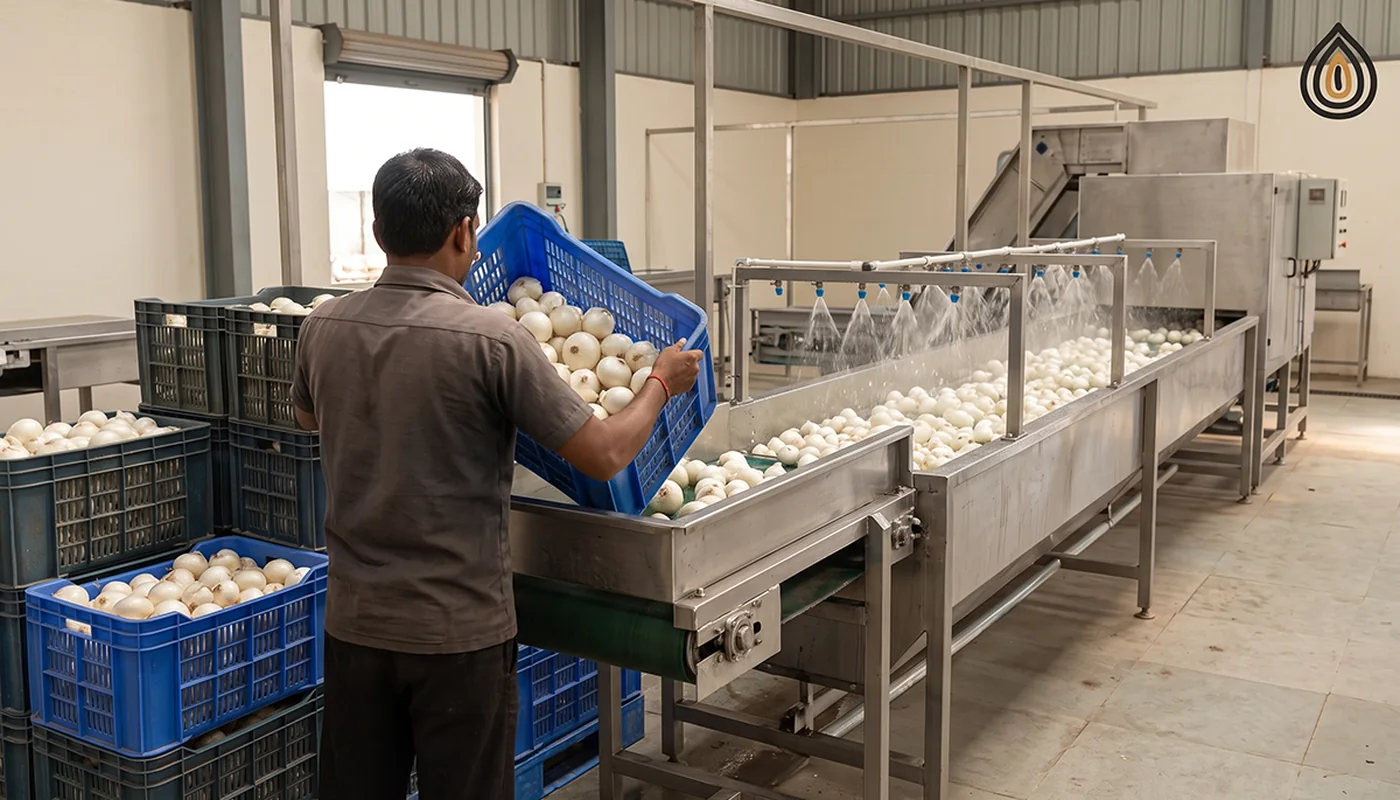
The certified plants made their first new-crop runs between 25 February and 5 March, cleaning and restarting lines that had run at low rates or stood idle since December. By the second week of March most were on two shifts and by the third week the larger plants were running 24 hours, which is the season's normal state from mid-March to June. Seasonal labour arrived on time; the plants report their peeling and sorting lines fully staffed, with the usual training week for new workers at the start of the month. Fuel has not been a story this season: natural gas prices on the Gujarat grid are steady, and the plants running biomass briquettes have stock from the winter. Dryer capacity in the district is, as always, well above what the export market will take, and the constraint in the coming weeks is raw material flow and trucking rather than drying. Two plants we visited have added optical sorting capacity since last season, and one has extended its steam-treatment line, which will show in treated-grade availability later in the year. The plants and the cluster are described in Mahuva, Gujarat: Inside India's Onion Dehydration Hub.
First new-crop product: what the early lots look like
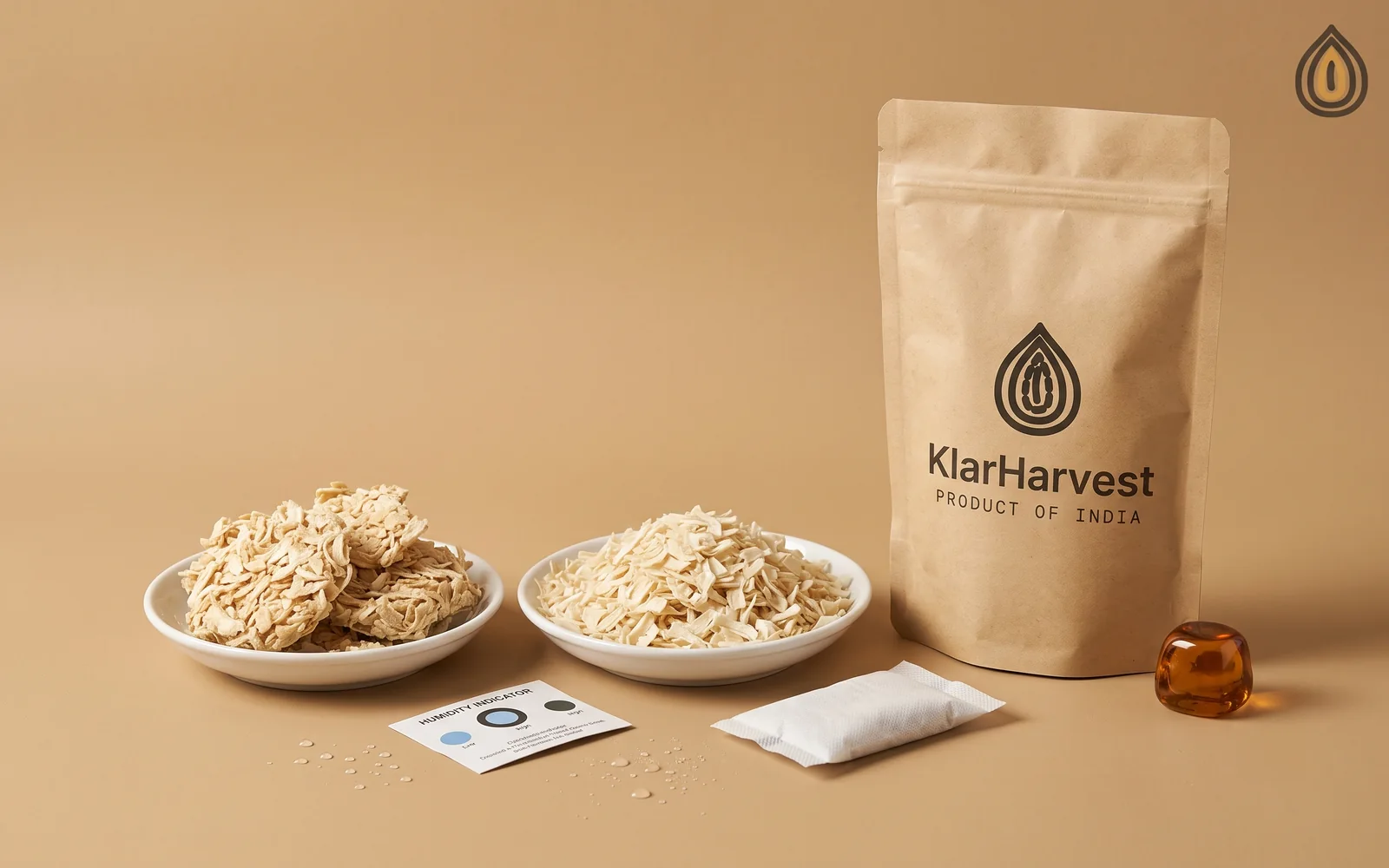
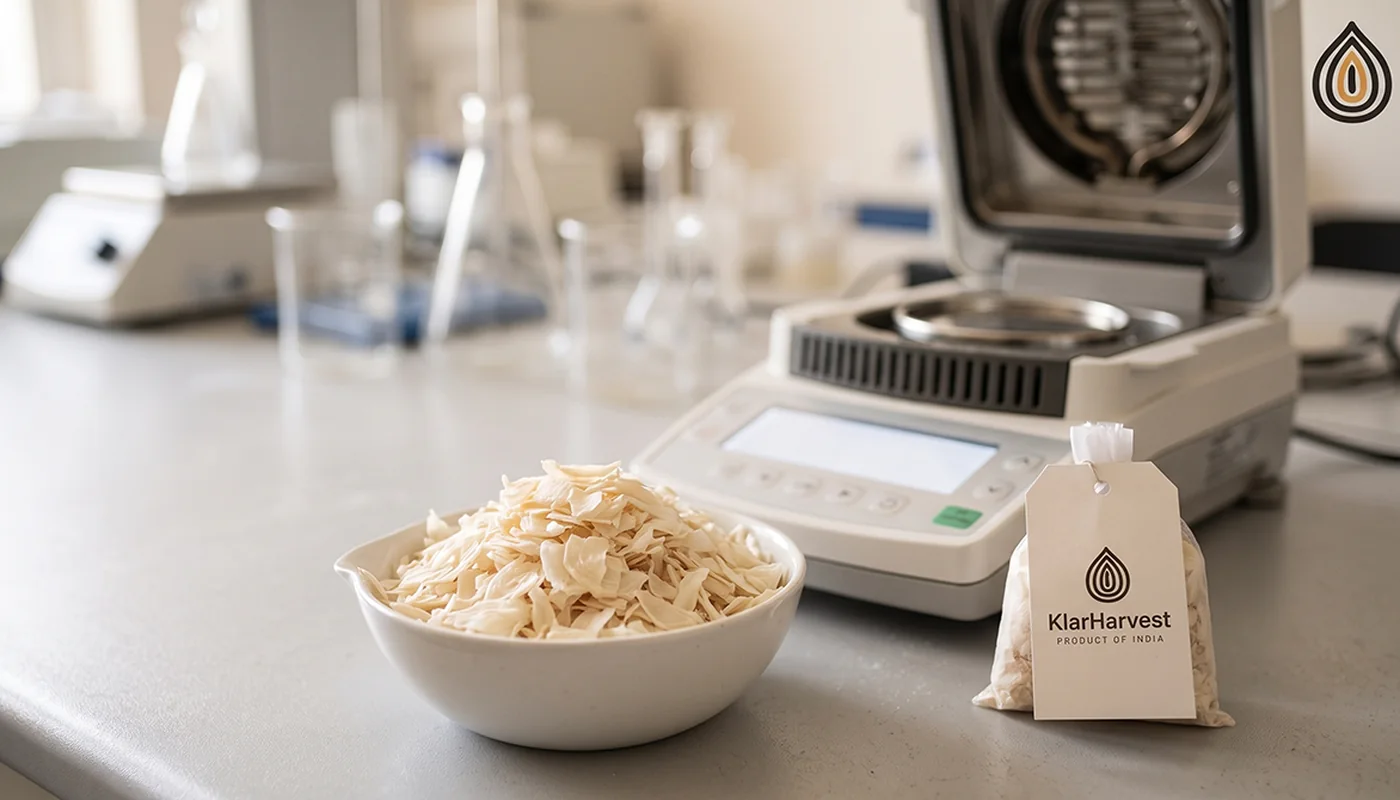
The first lots of new-crop white flakes and kibble we have handled and sent for testing look the way a good early season should. Colour is ivory, uniform, with the slight translucency of well-dried flakes and none of the beige cast of old stock. Moisture on the plants' packed figures is 4.8 to 5.5 percent, with the accredited laboratory's oven results on the first two lots we tested at 5.1 and 5.3. Total plate counts on those lots are at the low end of the standard range, in the tens of thousands rather than the hundreds of thousands, which is typical of dry-air drying from field-fresh bulbs. Fines in flakes are low, sieve analysis showing 92 to 95 percent inside the 8-20 millimetre band. Aroma is full and sharp. This is the product that buyers of pale or sensitive applications should be sampling now, because it is the year's best and the price on it is being set this month. The parameters and how to read them are in How to Read a Dehydrated Onion Specification Sheet.
New-crop price indications, FOB
Quotes in the district moved in the third week of March from old-crop to new-crop levels. The ranges below are indications from plants and exporters for standard-grade white onion in 20 kilogram bags, FOB Pipavav or Mundra, for shipment in April and May; they are not KlarHarvest quotes, which are issued per order with a seven-day validity.
| Product | February 2026, old crop (INR/kg FOB) | Third week of March 2026, new crop (INR/kg FOB) | In EUR/kg at 90 |
|---|---|---|---|
| White flakes 8-20 mm | 165-178 | 150-165 | 1.67-1.83 |
| White chopped 3-5 mm | 165-178 | 150-166 | 1.67-1.84 |
| White minced 1-3 mm | 167-180 | 152-168 | 1.69-1.87 |
| White granules 16-40 mesh | 170-183 | 155-170 | 1.72-1.89 |
| White powder 80-100 mesh | 172-185 | 156-172 | 1.73-1.91 |
| Low bacterial, any cut | +5-10 % | +5-10 % | - |
| Red flakes 8-20 mm | 195-215 | Runs starting; first indications 180-200 | 2.00-2.22 |
The new-crop level is about 8 to 10 percent below February's, in line with the fall in the yard price; the exporters' margins have not widened, and freight is unchanged, so the difference is raw material. Whether April brings a further step down depends on the peak arrivals; in a normal year the new-crop price holds through April while the plants cover their purchases and eases from June. The quote validity and price-lock practice that goes with this volatility is explained in Why Dehydrated Onion Quotes Are Valid for 7 Days.
Red and pink onion: when the runs start
Red onion for dehydration comes mostly from the Maharashtra and Gujarat rabi red crop, which is a week or two behind the white, and the plants schedule red runs once the white production has settled. The first red runs in the district are expected in the last week of March, with volume from April and the largest runs in April and May. Early indications for red flakes are 180 to 200 rupees per kilogram FOB, the premium over white in the normal 15 to 25 percent band; red raw material at the yard is trading a rupee or two above white, as usual in the season. Pink onion is grown in small pockets and dried to order; buyers who need it in 2026 should place the order in April, when the bulbs are available and the plants can fit a run. The two colours and their seasons are compared in White vs Red Dehydrated Onion.
Contract activity and what buyers are asking
March is the sampling month, and the plants and exporters are sending new-crop samples to Europe by courier every day; the questions that come with the sample requests are about the drying date, the moisture, and whether the lot is sulphite-free, in that order. Season contracts are being discussed but not yet signed: the plants want to see the peak arrivals and cover their raw material before they fix a price for a year, and most expect to quote fixed-price and indexed contracts in the first half of April. European buyers who negotiated in Q4 on an indexed basis are now seeing the index move in their favour. The most common request this month from first-time buyers is for a landed cost comparison between one pallet by LCL and a container; the arithmetic is in Minimum Order Quantity for Dehydrated Onion, and the way to place a first order in How to Import Dehydrated Onion from India.
Logistics: Pipavav, trucking, freight
The direct services from Pipavav and Mundra to north Europe are running to schedule, with transit of 26 to 30 days to Rotterdam and Hamburg; routing is via Suez on the services we use, and the forwarders are not reporting Cape diversions this month. Container availability at the two ports is normal for the season and rates for a 20 foot box to north Europe are in the range the trade has seen since the turn of the year. Trucking from Mahuva to Pipavav, a two-hour run, tightens in the second half of the season when the plants ship at full rate; bookings for April stuffing are being placed now. LCL consolidators in Mundra are receiving food cargo weekly. The route and the schedules are in Pipavav to Hamburg.
Field notes: three plants in the third week of March
A large certified exporter south of Mahuva. Four belt-dryer lines running 24 hours since 14 March; receiving 150 to 180 tonnes of fresh onion a day from contract growers and the yard; peeling on air peelers, two optical sorters on the flake line; packing room conditioned to about 45 percent relative humidity. New-crop flakes from the week's runs at 5.0 to 5.3 percent moisture on the plant's analyser, ivory, fines under 5 percent. The plant is quoting April shipment on new-crop prices and has told regular buyers that season contracts will be offered in the second week of April; it has covered about 40 percent of its expected season raw material on contract at prices agreed in December, which is why its quotes have moved less than the yard.
A mid-size certified plant near Talaja. Two lines, running two shifts and moving to three at the end of the month; receiving mainly spot-bought onion from the yard; hand-picking lines rather than optical sorters, with a defect count on the first lots we sampled of 0.3 percent black specks, within the export specification. Powder and granule milling had not yet started for the season, so its first new-crop cuts are flakes, chopped and minced; powder from new-crop kibble is expected from the last week of March. The plant is short of one thing, trucking slots to Pipavav in April, and is booking now.
A small plant east of Mahuva, uncertified. One tray dryer, sun-drying yard for a domestic-grade product, no laboratory. Its product goes to the domestic spice trade and to traders; it is included here as the reference point for what "Mahuva dehydrated onion" also means, and for why the plant, not the town, is the specification. The difference between the first and third of these plants in colour, fines and counts is larger than the difference between India and any other origin, as set out in What BRC Certification Means for a Dehydrated Onion Supplier.
March 2026 against the two previous seasons
| Indicator, third week of March | 2024 (short crop) | 2025 (normal) | 2026 (early view) |
|---|---|---|---|
| Weather through the harvest start | Unseasonal rain in early March; damaged bulbs | Dry | Dry, cool winter |
| Yard price, white onion (INR/kg) | 8-10 | 5.5-6.5 | 5.0-6.0 |
| Reject rate at plants | 6-10 % | 3-5 % | 2-4 % |
| New-crop white flakes, FOB (INR/kg) | 195-215 | 155-170 | 150-165 |
| Plants at full capacity by | Late March, interrupted | Mid-March | Mid-March |
| Fresh-onion export policy at the time | Export ban in force (lifted May 2024) | Duty, then free | Free |
The comparison is the point of a ground report: 2026 is opening like 2025, a normal year, and unlike 2024, when early rain and a short crop put the new-crop price 25 to 30 percent higher and kept it there. Buyers who remember 2024 and expect a similar March are paying an old-crop price for a new-crop year. The three years are set in the longer sequence in Dehydrated Onion Price History 2020-2026.
Buyer questions answered this month
"Should we wait for April to buy?" If you need product in May or June, no: the new-crop price is in the quotes now and April's further easing, if it comes, is a few rupees; if you need product in the autumn, buy in June to September when stock prices soften. "Can we get the drying date on the certificate?" Yes, from us; the certificate carries the lot code, and the lot record carries the drying and packing dates, which we print on the certificate on request. "Is sulphite-free available from the first lots?" Yes; the certified plants run sulphite-free as standard for European orders, and the lots we sampled test below 10 milligrams per kilogram. "Are treated grades available already?" Low bacterial from the plants with steam lines from the last week of March; extra low bacterial from April. "What happens if it rains?" Prices rise within days and the lots dried before the rain become the year's best stock; a sample and an order in hand before the weather turns is the only protection. The mechanics behind that last answer are in Why Dehydrated Onion Quotes Are Valid for 7 Days.
Terms used in this report
- Yard price: the price at the Mahuva agricultural market yard for a lot of fresh white onion, in rupees per kilogram, set by open auction; the plants' spot raw-material price.
- Plant-gate price: the yard price plus transport and broker commission, what a plant pays delivered; usually half a rupee to a rupee above the yard.
- Dehydration grade: white onion of the local high-dry-matter variety, cured, medium to large; distinct from table onion.
- Dry matter: the share of the fresh bulb that is not water; 14 to 16 percent for the Mahuva white; sets the yield ratio.
- Yield ratio: kilograms of fresh onion at the gate per kilogram of dry product; about 8.5 this season.
- New crop / old crop: product dried from the current harvest against stock dried from the previous one; the price step between them is the March story every year.
- Season contract: a fixed-price or indexed agreement for volume shipped over 6 to 12 months, quoted by plants once raw material is covered, typically in April.
- FOB indication: a price range seen in the district for standard grade in 20 kilogram bags loaded on the ship at Pipavav or Mundra; not a quote.
Drying costs this month: fuel, labour, power
Raw onion is the largest cost of a kilogram of flakes but not the only one that moves, and March is when the other three settle for the season. Fuel first: most Mahuva dryers burn a mix of biomass briquettes, groundnut shell and, at the larger plants, natural gas or diesel-fired hot air. Briquette prices in the first three weeks of March held around 8 to 9 rupees per kilogram delivered, near last year's level, and groundnut shell was plentiful after the winter crushing season; with 3 to 3.5 kilograms of briquette burned per kilogram of dry product, fuel sits at roughly 25 to 30 rupees per kilogram of flakes, unchanged on the year. Labour second: the plants run on seasonal workers, many from Saurashtra villages and from Madhya Pradesh, at daily rates that rose by about 5 to 8 percent this season, and the round-the-clock shifts of mid-March mean the labour line, some 10 to 14 rupees per kilogram of product, is a little higher than the same weeks last year. Power third: state grid supply to the GIDC estates was steady through the month with only short cuts, so diesel generator hours, which cost three times grid power, were few; power runs at about 5 to 7 rupees per kilogram of product. Put together, the non-onion conversion cost of a kilogram of white flakes in March 2026 is in the region of 45 to 55 rupees, before packing and margin, against roughly 90 to 105 rupees of raw onion at the yard prices of the third week. That split explains why the yard price dominates every quotation and why a plant's FOB offer moves by 8 to 9 rupees per kilogram of product for every rupee on the yard, and hardly at all for anything else. Buyers reading FOB indications should treat the conversion cost as flat for the season and watch the yard; the cost build is worked through in What Does Dehydrated Onion Cost per Kilogram? Two cost signals worth following into April: a rise in briquette prices, which usually follows a poor cotton-stalk and groundnut-shell supply, and any return of grid load-shedding as summer demand climbs, both of which push conversion cost up by a rupee or two rather than by the tens that the yard can move.
What to expect in April
Peak arrivals from the last week of March through mid-April, with the yard price finding the season's low if the weather holds; plants at full capacity all month, and the largest share of the year's production made; season contract quotes from the first half of April; red onion runs at volume; and the first new-crop containers sailing for Europe in the second half of the month. The risk in the outlook is weather: a western disturbance bringing rain to Saurashtra in late March or April would damage curing bulbs in the field and lift prices within days, and the crop's clean condition so far is a reason to sample and contract rather than to wait. The April report will carry the peak figures, the settled new-crop price range and the contract terms the plants are offering.
How this report is compiled
The observations come from our own visits to plants and to the Mahuva market yard during the period, from the field staff of the plants we work with, from the lots we handled and sent to an accredited laboratory, and from the quotes we received and gave. Prices are rounded to ranges and stated as indications; yard prices are for dehydration-grade white onion and vary with lot quality; FOB indications are for standard grade in 20 kilogram bags. Nothing in the report is a quote or a forecast, and the numbers will be revised in the next report as the season settles. Readers who want the underlying trade data can follow the sources listed in The Indian Onion Harvest Calendar.
What KlarHarvest is doing this month
We are sending new-crop samples of white flakes, chopped, minced, granules and powder from the first March lots, each with the lot's drying date and its certificate of analysis, and taking bookings for April and May shipment at new-crop prices with the usual seven-day validity and price lock at confirmation. Season plans for buyers who have told us their annual volume will be quoted in the first half of April, once the plants have covered raw material. Red onion samples follow at the end of the month. The sample and quote forms reach us within the hour, and the next report will be published in April.
Frequently asked questions
Has the 2026 onion harvest started in Mahuva?
Yes. Lifting began in the last week of February, about a third of the white onion area was lifted by 20 March, and the peak runs from the last week of March through mid-April.
How is the 2026 crop looking?
Clean and normal to slightly above normal on early evidence: a cool dry winter, medium to large bulbs, dry matter of 14 to 15 percent, reject rates of 2 to 4 percent and early yields of 28 to 32 tonnes per hectare.
What is the price of white onion at the Mahuva yard in March 2026?
In the third week of March, 5.0 to 6.0 rupees per kilogram for dehydration-grade white onion, down from 6.5 to 7.5 on the first lots at the end of February.
What are new-crop dehydrated onion prices in March 2026?
Indications for standard white flakes are 150 to 165 rupees per kilogram FOB, about 1.67 to 1.83 euros, some 8 to 10 percent below February's old-crop level; powder and granules a few rupees higher; red flakes 180 to 200.
When can I get new-crop samples?
Now. The first March lots are available and ship by courier within days with the lot's drying date and certificate of analysis.
When will season contracts be quoted?
In the first half of April, once the plants have seen the peak arrivals and covered their raw material for the year.
Are there any shipping problems this month?
No. Direct services from Pipavav and Mundra are on schedule via Suez with 26 to 30 days to north Europe, and container availability is normal for the season.
Next step
Request a sample of the cut you use and it comes from a March new-crop lot with its drying date and lab report. If you plan volume for the year, request a quote with the quantity and the months and you will have a season plan in the first half of April.