- What dehydrated onion is, and what it is not
- The five cuts and how to choose one
- White, red and pink: choosing the onion behind the cut
- The specification: eight numbers that define a lot
- Microbiology tiers and when you need steam treatment
- Where it comes from: Mahuva and the Indian season
- Price: what a kilo costs and why it moves
- Packaging, shelf life and storage
- Order size, containers and lead times
- Documents and compliance for an EU or UK buyer
- How to evaluate a supplier in one call and one sample
- How KlarHarvest handles a first order
- Frequently asked questions
Judge the product, not the words
200-500 g from a current lot, dispatched by courier with the lot lab report.
Request a sampleA dehydrated onion buyer's guide has one job: to get a food manufacturer, importer or distributor from "we need onion in this product" to a specification, a price and a supplier they can defend to their own quality team. This guide is written from the sourcing side in Mahuva, Gujarat, the town that processes most of the dehydrated onion India exports, and it stays on the facts a buyer can check: cut sizes in millimetres, moisture in percent, microbiology in colony-forming units, prices in ranges with dates attached.
It is for three readers. The product developer who has been asked to replace fresh onion or an expensive flavour system with a dry ingredient. The purchasing manager who has a specification already and needs to compare quotes that look alike but are not. And the importer or trader who is weighing a direct Indian supplier against a European stockist. If you are one of them, by the end you should be able to write a one-page specification, read a quote line by line, and know which questions separate a plant-backed exporter from a middleman with a website.
Everything below is current as of January 2026 and marked where it depends on the season. Prices move with the raw onion crop, so treat every number as a range with a date, not a list price.
What this guide covers
- What dehydrated onion is, and what it is not
- The five cuts and how to choose one
- White, red and pink: choosing the onion behind the cut
- The specification: eight numbers that define a lot
- Microbiology tiers and when you need steam treatment
- Where it comes from: Mahuva and the Indian season
- Price: what a kilo costs and why it moves
- Packaging, shelf life and storage
- Order size, containers and lead times
- Documents and compliance for an EU or UK buyer
- How to evaluate a supplier in one call and one sample
- How KlarHarvest handles a first order
- Frequently asked questions
What dehydrated onion is, and what it is not
Dehydrated onion is fresh onion that has been washed, peeled, sliced and dried with hot air until its moisture falls from about 88 percent to below 6 percent. Nothing is added in the standard product: no salt, no oil, no carrier, no preservative. The result keeps roughly 12 percent of the original weight and most of the flavour compounds, which is why 8 to 9 kilograms of fresh onion become one kilogram of dry product. That ratio is the single most useful number in this trade, because it links every price you will see to the price of raw onion in the field.
It is not the same as fried onion (cooked in oil, a different ingredient with a different shelf life), not the same as onion oleoresin or onion oil (solvent or steam extracts used at grams per tonne), and not the same as freeze-dried onion, which is a low-volume premium product with a different texture and a price several times higher. When a specification simply says "onion powder", it almost always means air-dried onion milled to a powder, and that is what this guide is about.
The product is shelf-stable at ambient temperature, needs no cold chain, and rehydrates in water. Those three properties are the reason it exists: a soup manufacturer in Hamburg cannot run a line on fresh onion that arrives at 88 percent water, varies by season and rots in three weeks. A 20 kilogram bag of flakes gives the same onion, every batch, for 18 to 24 months.
The five cuts and how to choose one
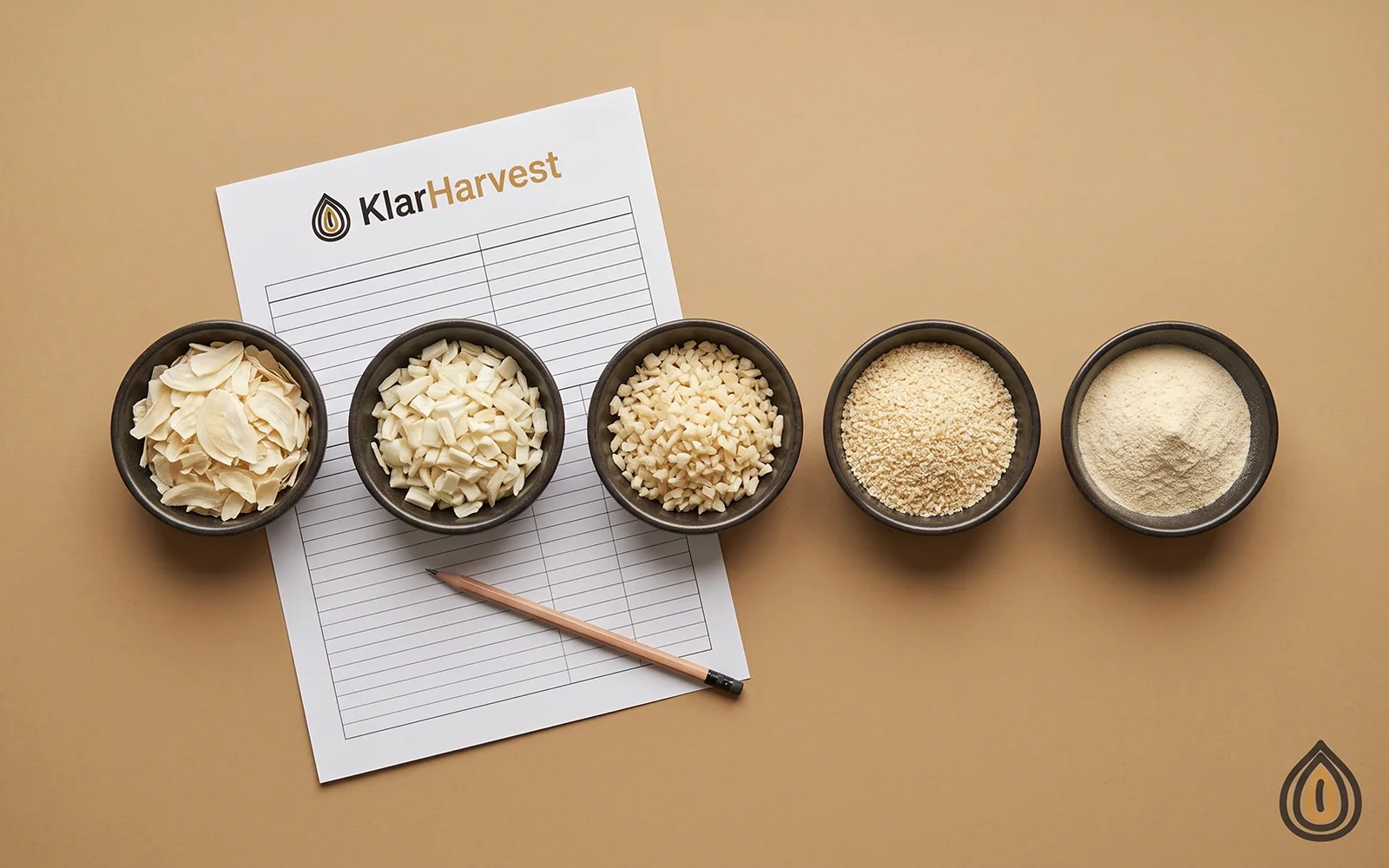
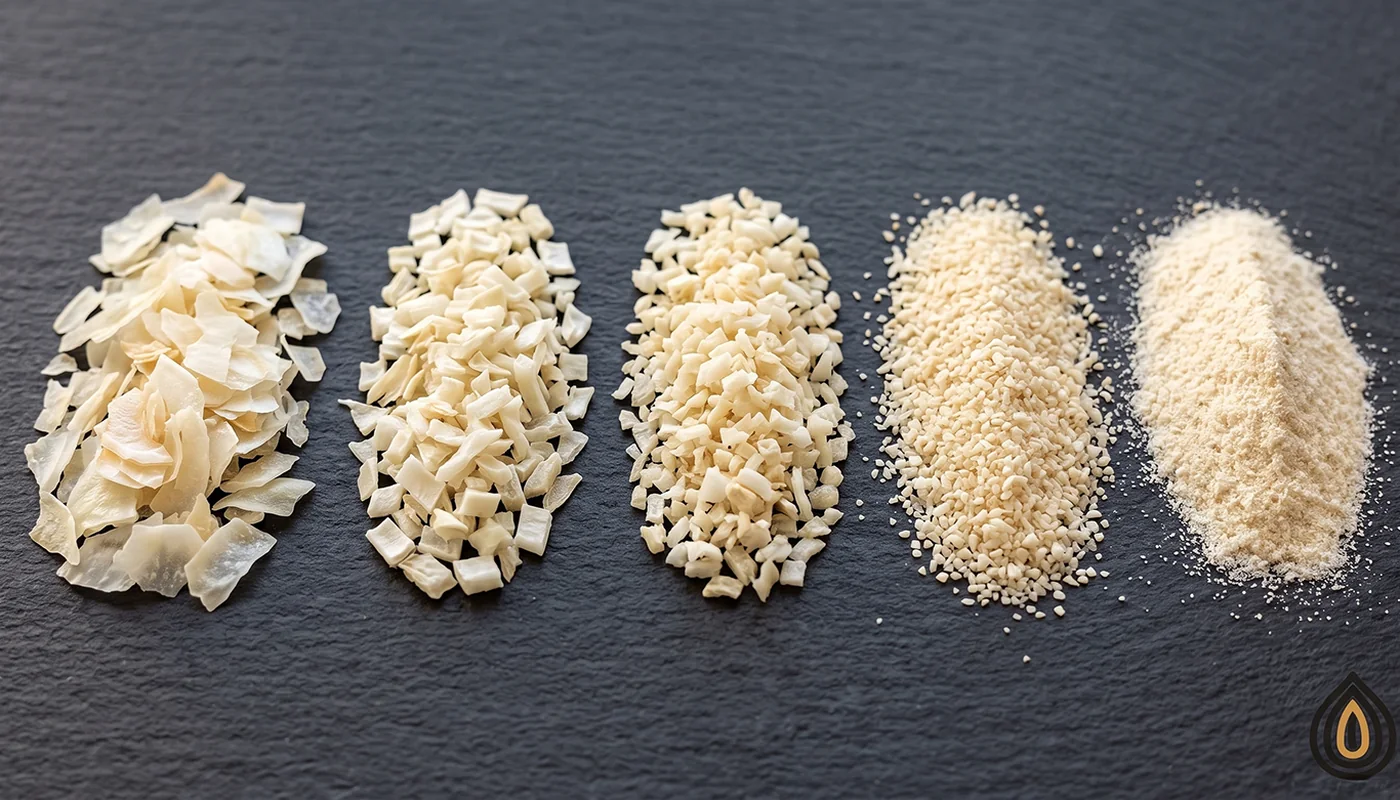
Every plant in Mahuva produces the same five cuts from the same dried slices. The cut is decided after drying, by sieving and milling, so the cut is a processing choice, not a different raw material. What changes is particle size, and particle size decides rehydration time, visibility in the finished food, dispersion in a dry blend and, to a smaller degree, price.
| Cut | Typical size | Rehydration | Where it is used | What to watch |
|---|---|---|---|---|
| Flakes (kibbled) | 8-20 mm | 15-20 min in water | Soups, pizza and bread toppings, pickles, retail packs | Broken pieces and fines below 8 mm, colour uniformity |
| Chopped | 3-5 mm | 10-15 min | Sauces, gravies, stuffings, ready meals | Share of pieces above and below the band |
| Minced | 1-3 mm | 5-10 min | Meat products, marinades, dips, seasonings with texture | Dust content, caking in humid storage |
| Granules | 0.5-1 mm (16-40 mesh) | 3-5 min, or used dry | Snack seasonings, spice blends, rubs, instant noodles | Flowability, bulk density, fines |
| Powder | 80-100 mesh | Used dry, disperses instantly | Powder blends, sauces, coatings, extruded snacks | Caking, colour, particle size distribution |
A practical way to choose: decide first whether onion must be visible in the finished product. If yes, choose flakes or chopped and accept a rehydration step. If no, choose granules for dry blends where flow matters and powder where instant dispersion matters. Minced sits in the middle and is the usual choice for meat processing, because it rehydrates during mixing and stays as small visible pieces in a sausage or patty.
Price differences between cuts are small compared with the difference between colours and grades. Powder and granules usually cost a few rupees per kilogram more than flakes because of the extra milling and sieving, and because losses in milling are higher. A buyer who is cost-driven should not choose a cut on price; choose the cut the process needs and negotiate the grade instead. The full comparison is in Flakes, Chopped, Minced, Granules or Powder, and each cut has its own specification on the white onion and red onion pages.
White, red and pink: choosing the onion behind the cut
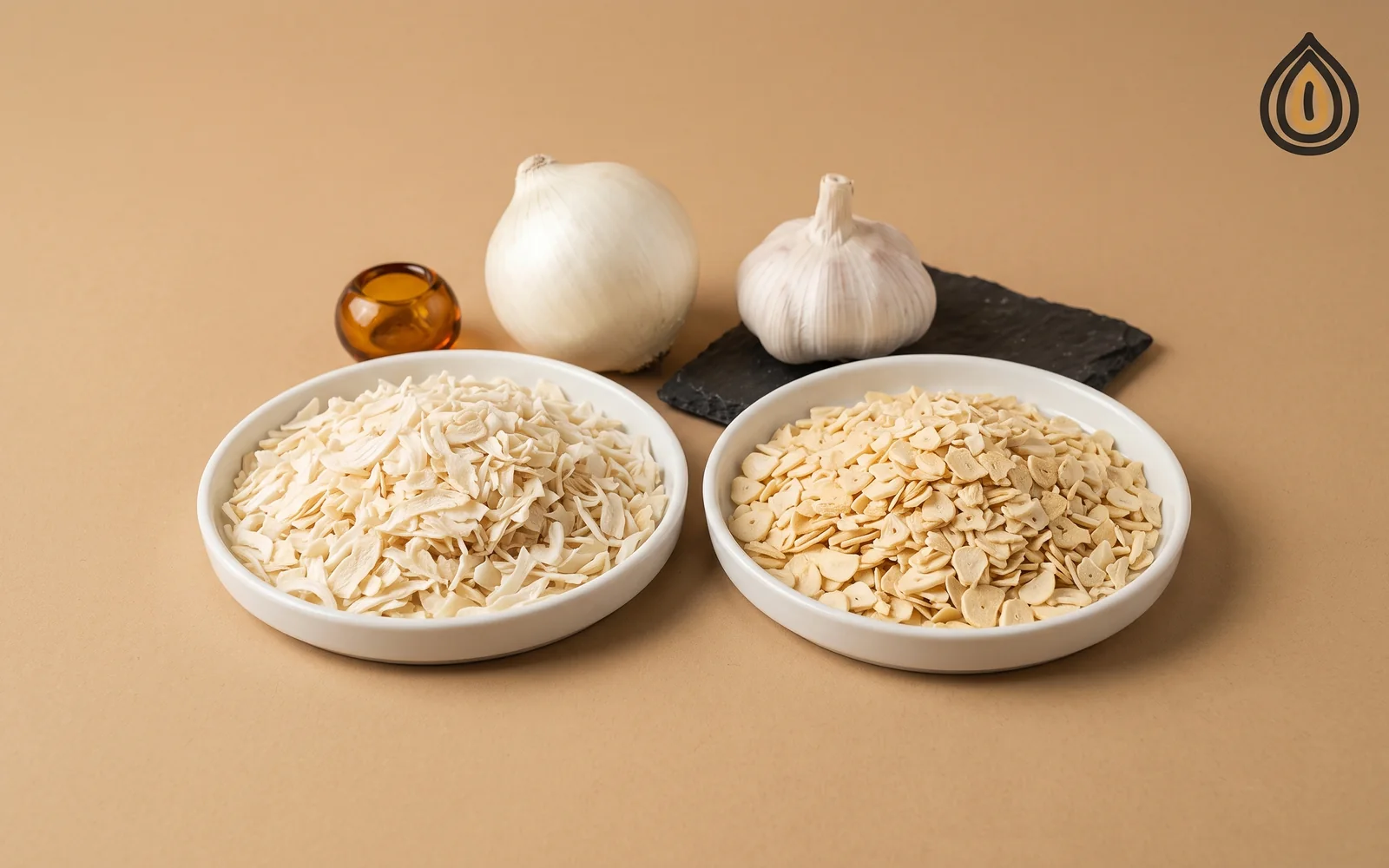
Three raw materials go into Indian dehydrated onion. White onion is the standard export product and by far the largest volume. It is the mildest of the three, dries to an ivory to pale cream colour, and is what most European specifications mean by "onion". Red onion is more pungent and slightly sweet, keeps its reddish-purple skin in the dried product, and is chosen where the colour and character of the onion should show: ethnic ranges, marinades, chutneys, snack toppings. Pink onion is a regional variety that sits between the two in pungency and is dried on request rather than held in stock.
Two rules follow. First, always specify the colour explicitly, because a plant can supply either and "onion flakes" alone will be read as white. Second, expect red onion to cost more per kilogram in most seasons, partly because raw red onion is more expensive in the dehydration months and partly because it is processed in smaller runs. The colour question is covered in White vs Red Dehydrated Onion.
If you buy fresh onion as well as dried, note that the export grades and seasons are different: fresh onion is a living cargo with its own arrival-condition risks, described on the fresh onion pages. This guide is about the dried product.
The specification: eight numbers that define a lot
A dehydrated onion specification fits on one page. The numbers below are the ones that appear on a certificate of analysis and that a lab can verify. If a supplier's specification sheet does not carry them, ask why.
| Parameter | Typical value, white onion, Grade A | Method | Why it matters |
|---|---|---|---|
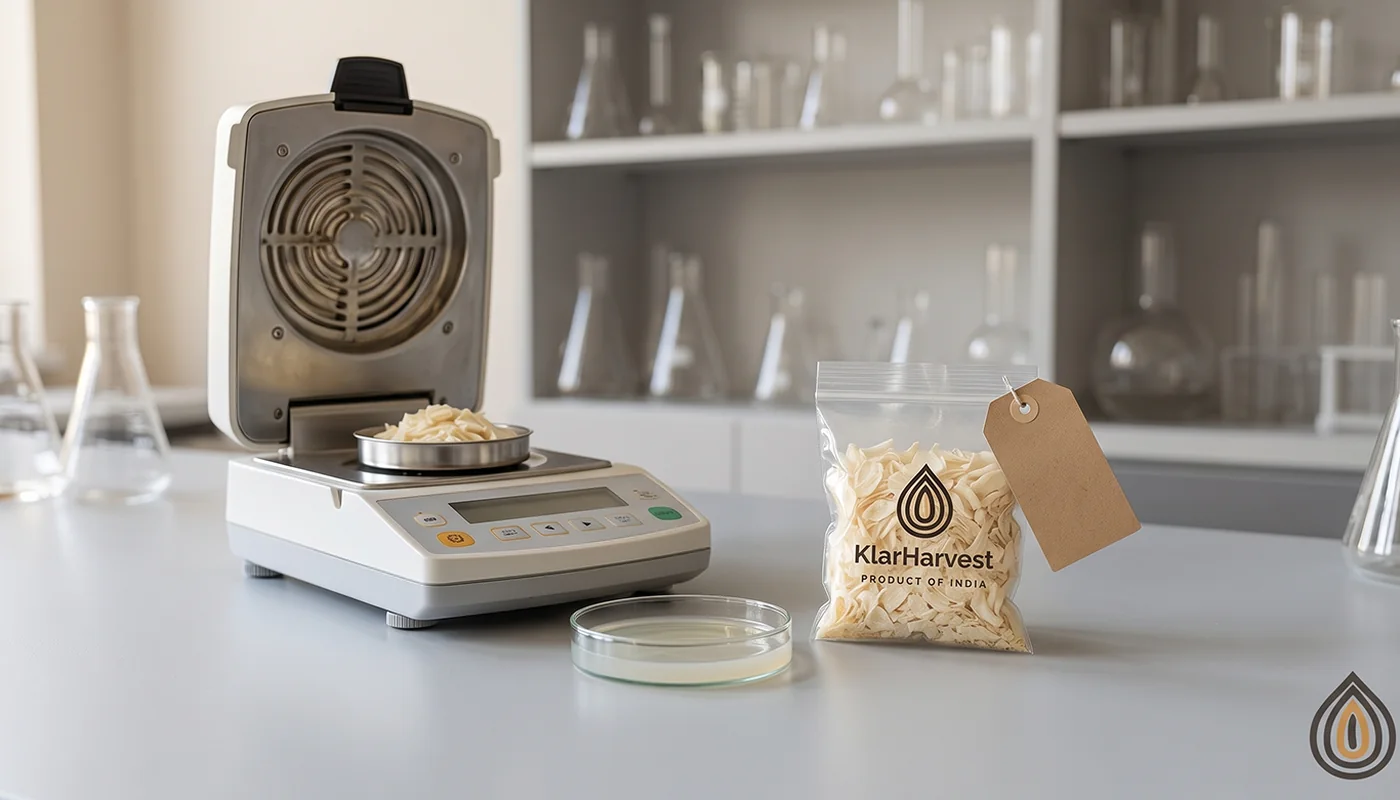
| Moisture | Max 6 %, usually 4.5-5.5 % | Oven drying, 105 °C | Shelf life, caking, microbial safety; every 1 % is 1 % of the weight you pay for |
| Total ash | Max 5 % | Gravimetric | Mineral content; high ash suggests soil or contamination |
| Acid-insoluble ash | Max 0.5 % | Gravimetric | Sand and grit |
| Colour | Ivory to pale cream (white); reddish-purple with cream flesh (red) | Visual against a retained sample, optional Hunter Lab | Browning means over-drying or old stock |
| Particle size | By cut, percent within band, e.g. min 90 % in 8-20 mm | Sieve analysis | Rehydration and appearance |
| Foreign matter and defects | Max 0.5 % black or brown specks; no stones, no metal | Visual, magnet, sieves | Rejection risk on your line |
| Total plate count | Tiered: see microbiology section | ISO 4833 | Your product's process and shelf life |
| Pathogens | Salmonella absent in 25 g; E. coli absent in 1 g | ISO 6579, ISO 16649 | Non-negotiable in every tier |
Two of these numbers deserve a longer look. Moisture is a quality number and a commercial number at the same time. A lot at 7 percent moisture instead of 5 percent contains two percent more water that you have paid for at the dry price, and it will cake sooner in a warm warehouse. The industry limit of 6 percent is not arbitrary: below it, the water activity is low enough that moulds and bacteria cannot grow. How the number is measured, and why a hand-held meter and a laboratory oven disagree, is explained in Dehydrated Onion Moisture Content.
Particle size is the number most often left vague. "Flakes" without a band lets a supplier ship a product with 25 percent fines and still call it flakes. Write the band and the minimum share inside it, and ask for a sieve analysis on the certificate of analysis. Reading a full specification line by line is the subject of How to Read a Dehydrated Onion Specification Sheet.
Microbiology tiers and when you need steam treatment
Air drying reduces microbial load but does not sterilise. A standard dehydrated onion carries a total plate count in the range of a few hundred thousand colony-forming units per gram, which is acceptable in a product that will be cooked, but not in a product that is eaten without a kill step, such as a dip, a dressing or a topping added after baking. For those uses the industry offers treated grades.
| Tier | Total plate count | Yeast and mould | Treatment | Typical use |
|---|---|---|---|---|
| Standard | Max 500,000 cfu/g (often 100,000-300,000 in practice) | Max 5,000 cfu/g | None | Products with a cooking step: soups, sauces, gravies, meat products |
| Low bacterial | Max 50,000 cfu/g | Max 1,000 cfu/g | Steam treatment of the dried product | Dry blends and seasonings, mild-heat processes |
| Extra low bacterial | Max 10,000 cfu/g | Max 500 cfu/g | Steam treatment, controlled | Ready-to-eat products, dips, dairy, no kill step |
Steam treatment costs money and slightly darkens the product, so do not specify a lower tier than your process needs. Ask your own quality team one question: is there a validated kill step after the onion is added? If yes, standard grade is normal. If no, low bacterial or extra low bacterial is the correct specification and should be written into the purchase order. Pathogen limits do not change between tiers: Salmonella absent in 25 grams and E. coli absent in 1 gram apply to every lot.
Where it comes from: Mahuva and the Indian season
India is the world's largest exporter of dehydrated onion, and most of it is processed in one district. Mahuva, in Bhavnagar district of Gujarat, has around 120 dehydration plants within a 30 kilometre radius, from small family units to BRC-certified exporters with continuous belt dryers. The white onion grown around the town was selected for dehydration over decades: high dry matter, low sugar, a clean flavour. The port of Pipavav is 60 to 70 kilometres away and handles close to half of India's dried onion exports; Mundra and Nhava Sheva take most of the rest.
The season sets the calendar for the whole trade. Onion is harvested from late February to May, plants run at full capacity from March to June, and most of the year's production is made in those months. After the monsoon starts in June, drying slows and stock is sold from warehouses until the next crop. For a buyer this means three things: prices are usually lowest in the months after the season when stock is plentiful, product made in April is fresher than product bought in April of the following year, and a plant's answer to "which crop is this lot from" is a fair question. Indian customs data put the country's dried onion exports at roughly 130,000 tonnes a year, with Germany the largest single destination at around 13,000 tonnes and the Netherlands close behind, much of it re-exported within Europe. More on the town in Mahuva, Gujarat: Inside India's Onion Dehydration Hub.
Price: what a kilo costs and why it moves
The price of dehydrated onion is the price of raw onion multiplied by the yield ratio, plus energy, labour, packing and margin. Because 8 to 9 kilograms of fresh onion go into every kilogram of dry product, a change of 3 to 4 rupees per kilogram in the field price moves the dry price by 25 to 30 rupees per kilogram. This is the reason quotes are valid for 7 to 10 days and not for a quarter, and it is the reason a supplier who offers a fixed price for a year is either taking a large risk or planning to renegotiate.
In January 2026 export prices for standard white onion flakes are in the range of 150 to 175 rupees per kilogram FOB Indian port, which is 1.50 to 1.75 euros per kilogram at the exchange rate of the time. Powder and granules sit at the upper end of that range or slightly above. Red onion products carry a premium of roughly 10 to 25 percent depending on the season. Sea freight to a north European port adds about 10 to 15 rupees per kilogram on a full container and more on a small LCL shipment, which is why a CIF price should always be read as FOB plus a freight line that you can compare with your own forwarder's quote.
The same product bought from a European stockist typically costs two to three times the FOB price, and a part of that is real service: stock in Rotterdam, delivery in days, one invoice in euros. The other part is margin for taking price risk off the Indian side. Whether that trade-off makes sense for you depends on volume and planning horizon; the arithmetic is in Dehydrated Onion Price per kg. What a quote should contain, line by line, is in the section on supplier evaluation below.
Packaging, shelf life and storage
The standard export pack is a 20 kilogram polyethylene liner inside a multi-wall kraft paper bag or a woven polypropylene bag, heat-sealed at the plant. Cartons of 10 or 12.5 kilograms are used for retail-oriented buyers and for air freight. Bulk bags of 500 to 1,000 kilograms are possible for large powder users. Private label printing on the outer bag is common and costs 2 to 4 rupees per kilogram extra at container volumes.
Shelf life is 18 months as a routine declaration and 24 months where storage is controlled, provided the bag stays sealed, moisture stays under 6 percent and the product is kept below 25 °C and away from direct light. The product does not spoil in the sense that fresh food does; it slowly browns, loses aroma and, if humidity gets in, cakes. Powder is the most sensitive because of its surface area, flakes the least. A European warehouse without climate control is fine in most of the year; what damages product is a hot summer in a metal container or a bag left open on a production floor. Details and the storage checklist are in Dehydrated Onion Shelf Life.
Order size, containers and lead times
Dehydrated onion is light for its volume, so containers cube out before they weigh out. A 20 foot container takes about 10 tonnes of flakes on pallets, 12 to 13 tonnes of chopped or minced, and 18 to 20 tonnes of powder. A 40 foot high-cube roughly doubles the flakes figure. This matters for pricing: freight per kilogram of flakes is nearly twice the freight per kilogram of powder in the same box.
| Order size | Mode | Typical lead time from order to European port | Notes |
|---|---|---|---|
| 1-5 pallets (500-2,500 kg) | LCL sea freight | 6-8 weeks | Consolidation adds a week; freight per kg is higher; ideal for first orders and trials |
| 6-10 pallets | LCL or shared container | 6-8 weeks | Mixed cuts and colours in one shipment are normal |
| 20 ft FCL (~10 t flakes) | FCL sea freight | 5-7 weeks | Best freight per kg; stuffing at origin with loading video |
| Urgent samples or 50-200 kg | Air freight or courier | 4-8 days | Costly per kg; used for line trials and gap-filling |
Lead time breaks down into roughly one to two weeks for production and packing (longer in the off-season if the cut is not in stock), a few days for documents and customs at origin, 25 to 30 days on the water from Pipavav to Hamburg or Rotterdam, and a few days for clearance and delivery. Minimum order quantities vary by supplier; plants prefer full containers, exporters who serve smaller buyers accept single pallets. The trade-offs are in Minimum Order Quantity for Dehydrated Onion.
Documents and compliance for an EU or UK buyer
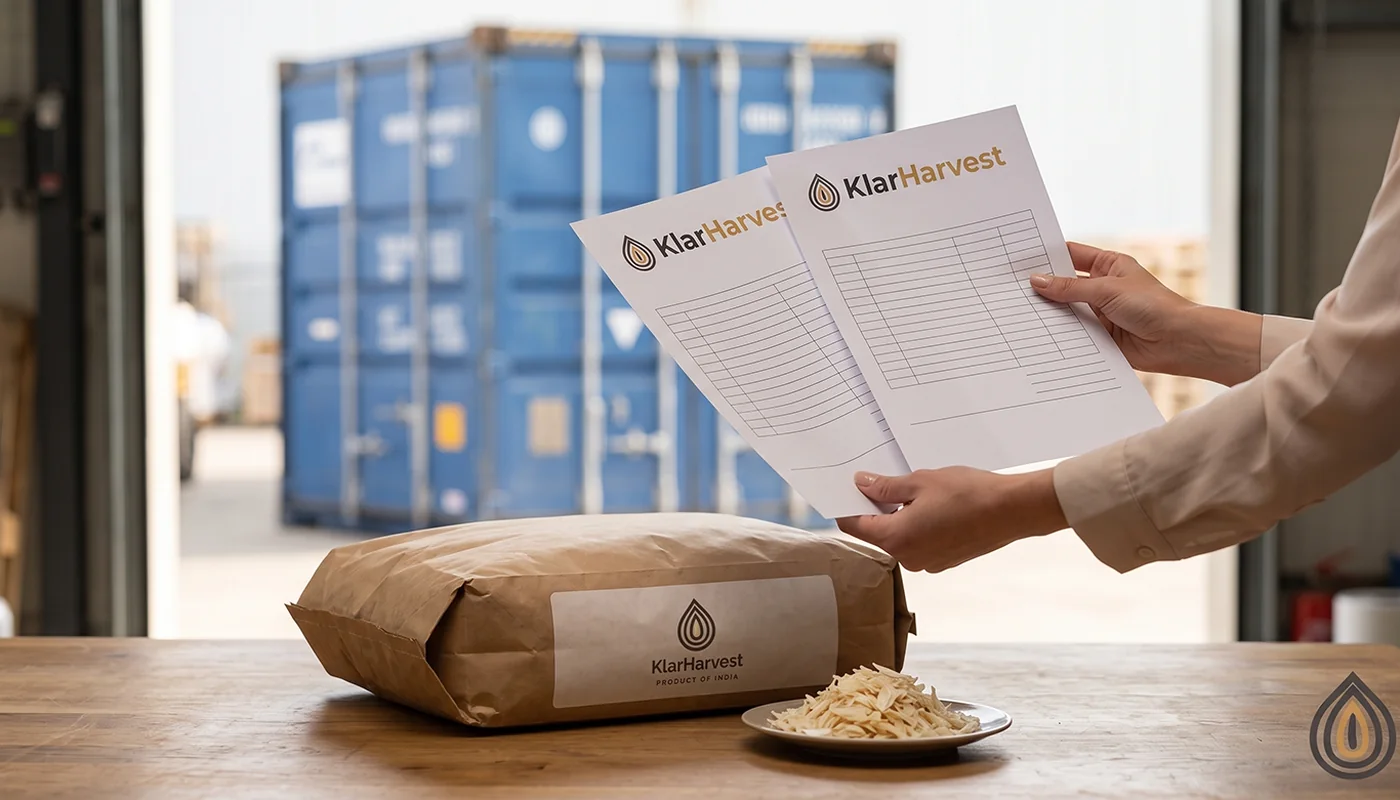
Dried onion is classified under HS code 0712.20 (dried onions, whole, cut, sliced, broken or in powder, but not further prepared). Import into the European Union carries no special licence requirement, but the shipment must arrive with the standard document set and the product must comply with EU food law on residues and contaminants. The documents an importer needs are:
- Commercial invoice and packing list with HS code, net and gross weights, lot numbers and Incoterm.
- Bill of lading from the shipping line, or the forwarder's house bill for LCL.
- Certificate of origin, issued by a chamber of commerce in India, needed for customs and sometimes for the buyer's own traceability system.
- Phytosanitary certificate from the Indian plant quarantine authority, confirming the consignment is free of regulated pests. Dried onion is a processed product, and whether a phytosanitary certificate is demanded at EU entry depends on the member state and the customs office; experienced exporters issue it as a matter of course because refusal at the border costs far more than the certificate.
- Health certificate where the buyer or destination requires it.
- Certificate of analysis for the lot, from an accredited laboratory, covering the parameters in your specification.
On compliance, the questions that come up most are pesticide residues (EU maximum residue levels apply to the dried product with a processing factor), sulphites (permitted in dried onion within a limit and must be declared as an allergen above 10 milligrams per kilogram), heavy metals, and, since 2020, ethylene oxide, which is not permitted for treatment of food in the EU. A supplier who sources from BRC-certified plants and tests each lot at an accredited laboratory will have these numbers on file. The full regulatory picture is in EU Import Requirements for Dehydrated Onion and the document set in Export Documents for Dehydrated Onion from India.
How to evaluate a supplier in one call and one sample
Most of the risk in this trade is not in the product but in the counterparty. Mahuva has around 120 plants and several hundred exporters and traders who sell their output; websites do not distinguish between them. A few questions do.
- Which plant processes your product, and can you name it? An exporter who owns or contracts a specific BRC-certified unit will say so and can show the certificate. Evasive answers mean the exporter buys wherever the price is lowest that week, and your lot-to-lot consistency depends on luck.
- Can you send a certificate of analysis for a recent lot of this cut? A real one carries a laboratory name, an accreditation number, a lot code and a date. A specification sheet with "conforms" in every row is not a certificate of analysis.
- What is the quote valid for, and what happens if raw onion moves? The right answer is a short validity, a price lock at order confirmation and no renegotiation afterwards. A long validity with a "subject to market" clause is worse than a short one.
- What are the terms and the minimum? Typical is a 30 percent advance with the balance against a copy of the bill of lading, or a letter of credit at sight for larger buyers. A demand for 100 percent in advance from a new supplier is a warning sign; so is a supplier who refuses a small first order outright.
- What will I receive with the shipment? Loading photos or video, the certificate of analysis, and the document set above should be standard, not a favour.
Then order a sample of the exact cut and grade, and test it in your own process, not just in the laboratory. Rehydrate flakes in your soup base at your temperature; run the powder through your blender and check for caking after a week in your warehouse. A 500 gram sample and two weeks of testing are cheap compared with a container that does not perform. A checklist with all 25 points is in 25-Point Checklist Before You Choose a Dehydrated Onion Supplier, and the warning signs in 12 Red Flags When Dealing with a Dehydrated Onion Exporter.
How KlarHarvest handles a first order
KlarHarvest is a merchant exporter based in Bhavnagar, 60 kilometres from the Mahuva plants. Product is processed and sealed in bags at BRC-certified units, moved to our own godown for labelling and container stuffing, and shipped from Pipavav. Every lot gets a lot code, a certificate of analysis from an NABL-accredited laboratory and a loading video; the buyer receives them in the order file, not on request. Quotes go out within one business day with the specification attached, are valid for seven days and are locked at order confirmation. Small orders are welcome: one pallet by LCL is a normal first order, and mixed shipments of several cuts and colours are packed together. The cuts and their specifications are on the products page; the process from inquiry to delivery is on our process.
Frequently asked questions
How much fresh onion is in one kilogram of dehydrated onion?
Between 8 and 9 kilograms, depending on the dry matter of the variety and the final moisture. The white onion grown around Mahuva has high dry matter, which is one reason it is used for dehydration. This ratio is why dry onion prices follow raw onion prices with a multiplier.
What is the difference between onion flakes and kibbled onion?
None in practice. Kibbled onion is the British trade name for flakes in the 8 to 20 millimetre range. Some suppliers use "kibbled" for a slightly smaller cut; ask for the size band in millimetres to be sure.
What is the minimum order for dehydrated onion from India?
It depends on the supplier. Plants prefer full containers of about 10 tonnes of flakes. Exporters who serve smaller buyers accept one pallet of 500 to 800 kilograms by LCL sea freight. Sample quantities of 500 grams to a few kilograms are sent by courier.
How long does dehydrated onion keep?
18 to 24 months in the sealed export bag, stored dry and below 25 °C. It does not become unsafe after that date but it browns, loses aroma and, if moisture gets in, cakes. Powder is the most sensitive cut.
Does dehydrated onion contain sulphites?
Some plants use sulphite treatment to keep the colour white; the EU permits it within a limit and it must be declared as an allergen above 10 milligrams per kilogram. Sulphite-free product is available and should be specified explicitly if your label needs it.
Is dehydrated onion from India cheaper than from Egypt or China?
Usually, and it is also the largest supply. In most seasons Indian white onion flakes are the lowest-cost origin at comparable quality, which is why India supplies the majority of Europe's imports. Prices converge in years when the Indian crop is short.
Can I get a sample before ordering?
Yes, and you should. Ask for a sample from a current lot of the exact cut and colour, with its certificate of analysis, and test it in your own process. A serious supplier sends it within days by courier.
Next step
If you have a product in mind, the fastest way forward is a sample of the cut you think you need and the one next to it: flakes and chopped, or granules and powder. Request a sample with a few lines about the application and we send both with their lab reports. If you already have a specification, request a quote and you will have a priced offer with the specification attached within one business day.